The first officer reached for Mara Ellison’s wrist before he ever asked who she was. That was the moment Friday night stopped being ordinary. Less than two hours earlier, Mara had been standing beneath the lights outside the federal courthouse in downtown Atlanta, announcing indictments against a trafficking network that stretched across four states. Now she was barefoot on her own porch, wearing loose linen pants and an old Howard University T-shirt, staring at two uniformed officers who seemed determined to put her in handcuffs. She had spent the week helping federal agents put dangerous men into custody, and she had spent the last six years living in the same red-brick house on Hawthorne Ridge without once imagining that returning home would require proving she belonged there. When Officer Daniel Mercer reached toward her again, Mara stepped back just enough to prevent his fingers from closing around her wrist and said, in a voice suddenly stripped of all warmth, “Officer, I strongly suggest you remove your hand.”
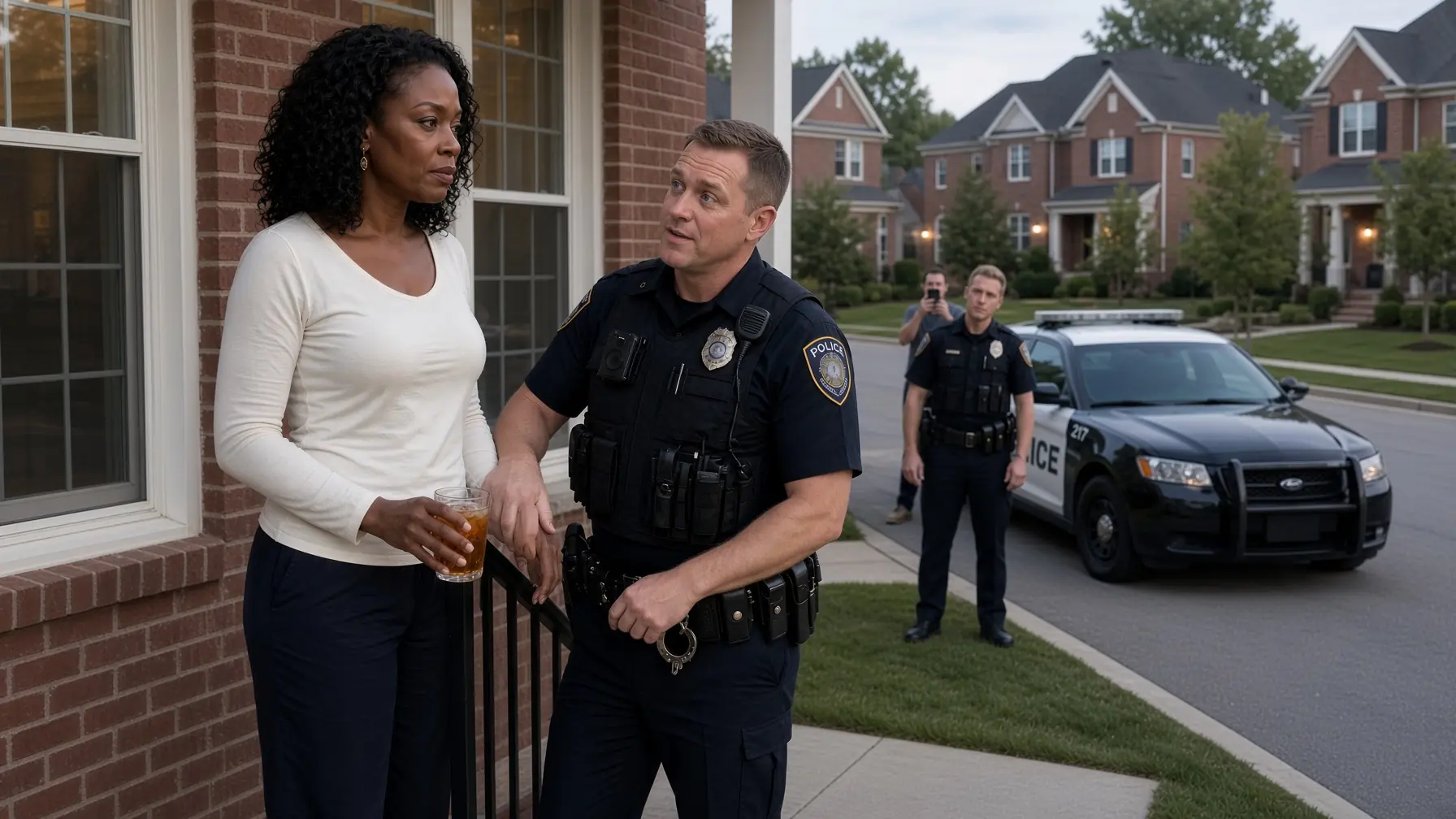
The younger officer, Kyle Bennett, looked toward the street before Mercer could respond. A black Chevrolet Suburban with government plates had turned onto Hawthorne Ridge and slowed abruptly at Mara’s driveway. Two people in business clothes stepped out almost before the vehicle stopped. Special Agent Leah Grant was first, still wearing the dark pantsuit she had worn at the courthouse. Behind her came Deputy U.S. Marshal Anthony Reed, broad-shouldered and visibly exhausted after a sixteen-hour day. Grant saw Mercer reaching toward Mara and shouted from the curb, “Get your hands off the United States Attorney!” The words carried across three lawns. Mercer froze. His face lost color so quickly that Mara almost felt embarrassed for him, although nothing about the previous four minutes had given her reason to be charitable. Bennett stared from Grant to Mara, then down at the handcuffs Mercer had already unclipped from his belt.
Mara closed her eyes for half a second. Of all the ways she had imagined the evening ending, this was the one she would have preferred to avoid. Grant and Reed had not come racing to rescue her. Earlier that afternoon, one defendant’s associates had made a vague threat after the trafficking indictments were unsealed, and the Marshals Service had arranged a temporary security check while investigators assessed whether the threat had any substance. Mara had argued that it was unnecessary. Reed had told her he would stop by anyway to verify an alarm-contact number and drop off a secure phone she had left at the courthouse. The timing was coincidence. Unfortunately for Mercer, coincidence had just arrived in a black government SUV and announced Mara’s title to half the neighborhood.
Mercer’s entire posture changed. “Ma’am,” he said, stepping backward, “if I had known—” Mara cut him off before he could finish. “No.” Her voice was quieter now, and that made Grant stop where she was. “Do not complete that sentence.” Mercer swallowed. “I was just going to say if I had known you were the United States Attorney, this could have been handled differently.” Mara looked at him for several seconds. “That is precisely why you should not say it.” Across the street, a neighbor was still holding up a phone. Another resident stood half-hidden behind a hedge. Mara gestured toward the porch beneath her bare feet. “My job did not make this house mine. It was mine when you pulled up.”
Mercer glanced toward Bennett as if hoping his partner might help explain. Bennett did not. Mara could see the younger officer replaying the encounter in his head. The call had come in as suspicious activity at a residence. An unfamiliar Black woman had been seen entering through the front door of a large house. The caller said she did not recognize Mara as the homeowner and had watched her “messing with the lock” for several seconds. What the caller did not know was that the August humidity had swollen Mara’s old wooden doorframe, and the deadbolt sometimes required her to pull the door toward herself before the key turned. The dispatcher had asked whether the caller saw a broken window, forced entry, stolen property, a weapon, or anyone in distress. The answers were all no. The call had been coded as suspicious person, not burglary in progress.
Mercer had arrived first and made the problem larger. He walked directly to the porch and asked Mara whether she lived there. She said yes. He asked for identification. Mara asked what crime had been reported. Instead of answering, Mercer told her that someone matching her description had been seen trying to enter the property. Mara said, “I entered through my own front door.” Mercer replied, “Then ID shouldn’t be an issue.” She offered to retrieve her wallet from the kitchen if he would stay at the threshold. Mercer immediately told her she could not go inside. She offered to give him her full name and date of birth so dispatch could check the address. He said they would get to that. Then she asked whether she was detained. His answer had been, “Right now, you need to cooperate.”
Leah Grant reached the porch and looked first at Mara’s hands, then at Mercer’s cuffs, then at Bennett. “What is the basis for detention?” she asked. Mercer stiffened. “Possible burglary.” Mara looked at Bennett. The younger officer’s face tightened. Grant noticed. “What burglary indicators?” Mercer said the homeowner status had not been verified. Mara spoke before Grant could. “That is not what she asked.” Mercer looked toward her. “Ma’am, I understand you’re upset.” Mara gave him a small, humorless smile. “You do not understand me well enough to tell me what I am.”
Reed came up the walkway more slowly and stopped beside Grant. Unlike her, he did not look angry. He looked procedural. “Officer, do you have a complainant who identifies someone else as the homeowner?” Mercer answered, “Neighbor says she doesn’t recognize her.” Reed nodded. “That isn’t what I asked.” Mercer’s jaw tightened again. Bennett finally spoke. “Dispatch said caller knew the previous owners socially. She wasn’t sure who owned it now.” Mara turned toward him. That was new information. “Previous owners?” Bennett nodded. “Caller said she remembered an older couple living here.” Mara almost laughed. The Wilsons had sold the property to Mara six years ago. The caller apparently had not updated her mental picture of the neighborhood in half a decade.
Grant said, “Run the address.” Mercer looked at her. “I can handle my scene.” Mara lifted one hand. “Agent Grant, stop.” Grant turned. Mara’s expression was firm. “He does not have to follow your instruction. This is not a federal operation.” Grant’s mouth closed. Mara looked back at Mercer. “But Officer Bennett suggested running the address before you tried to cuff me, didn’t he?” Bennett’s eyes flicked toward his partner. Mercer said nothing. Mara repeated, “Didn’t he?” Bennett answered quietly, “Yes.”
That mattered more than her title. Mara could already see how the later report might try to simplify the incident into a misunderstanding resolved when federal agents identified her. She did not want that version. It would allow Mercer to argue that the problem was merely not knowing an unusual fact. The real issue was that ordinary facts had been available and ignored. A woman said she lived at an address. The address could be checked. The property record could be checked. The caller had not reported a crime. The front door showed no damage. Mara had offered identification inside. None of those things had satisfied Mercer because each answer threatened the assumption he had already chosen.
“Officer Bennett,” Mara said, “please ask dispatch to run Mara Elise Ellison at this address.” Mercer opened his mouth. Mara looked at him. “Unless you have a lawful reason to prevent your partner from checking readily available information.” Bennett keyed his shoulder radio. The response took less than forty seconds. Mara’s Georgia driver’s license listed 117 Hawthorne Ridge. Vehicle registration matched. No warrants. No alerts. Bennett looked at Mercer. “Address matches.” Mara waited.
Mercer did not end the detention.
Instead he said, “A license address does not necessarily prove current residence.” Grant looked at him in disbelief. Mara did not. She had seen this logic too many times in court filings. One fact disappeared, so the suspicion changed shape. “Then check property ownership,” Mara said. Mercer’s eyes narrowed. “You don’t tell me how to conduct an investigation.” She nodded. “Correct. I am explaining what information exists.” He looked toward Reed and Grant as if their presence itself were now interference. “This is exactly what I mean. Everybody here wants to take control before we even verify what happened.”
Mara’s face became still. “What have I done to interfere?” Mercer answered, “You’ve been argumentative since contact.” Bennett looked down. Mara asked, “Did I refuse to identify myself?” “You questioned why.” “Did I attempt to leave?” “No.” “Did I threaten you?” “No.” “Did I enter the house after you told me not to?” Mercer paused. “No.” Mara nodded. “Then what act are you calling argumentative?” Mercer’s voice sharpened. “This. Right now. Constantly challenging.” Mara almost smiled. “Questions are not evidence of burglary.”
The property check came back while they were speaking. Bennett’s radio crackled with the county parcel record. Mara Elise Ellison, sole owner of 117 Hawthorne Ridge. Purchase recorded six years earlier. Grant closed her eyes briefly. Reed looked toward the sky. Mara did not move. Mercer’s hand was no longer near his cuffs, but he still had not said she was free to go.
“Officer,” Mara said, “what fact currently supports the belief that I am unlawfully on this property?” Mercer replied that they had received a suspicious-person call. “That is why you came,” Mara said. “It is not an answer to why you remain.” His face reddened. “Because I have not completed the investigation.” “What remains?” “I need to determine why the caller thought you were breaking in.” Mara stared at him. “The caller’s mistaken belief does not become criminal evidence simply because you have not yet interviewed her twice.”
Mercer pointed toward Mara. “There. That tone.” Reed shifted. Grant began to speak, but Mara stopped her again with one glance. She wanted the officer to finish his thought. “My tone now creates suspicion?” Mercer answered, “Most innocent people are relieved when police show up.” Mara nodded slowly. “That is a remarkably dangerous sentence.” Mercer scoffed. “Here we go.” She continued. “You are saying my emotional reaction to your mistake can become the justification for continuing the mistake.” Bennett’s expression changed. It was the first moment he looked less embarrassed than alarmed.
A supervisor arrived seven minutes later because Bennett had quietly requested one before the government SUV appeared. Lieutenant Carla Nguyen parked behind the patrol cruiser, walked up the driveway, and stopped when she saw Grant and Reed. She recognized their agencies from credentials but did not let that reorder the scene. “Who called for a supervisor?” Bennett raised his hand slightly. Nguyen nodded. “Start from initial dispatch.” She listened to him first.
Bennett’s account was concise. Suspicious-person call. No forced entry reported. Caller uncertain about current homeowner. Mercer contacted Mara on porch. Mara said she owned residence. She offered ID from inside. Mercer prevented entry. Mara provided name. Bennett recommended address check. Before verification, Mercer ordered Mara to turn around and attempted to take her wrist after she asked whether she was detained. Government agents arrived. Address and property ownership were then confirmed. No crime observed.
Nguyen looked toward Mercer.
“Anything materially different?”
Mercer said, “She was evasive and increasingly confrontational.”
Nguyen asked, “What was she evasive about?”
“Providing ID.”
Mara said, “I offered my wallet from the kitchen and then my full name and date of birth.”
Nguyen looked at Bennett.
He nodded.
Mercer added, “She kept demanding legal explanations instead of following instructions.”
Nguyen asked, “Which instruction did she fail to follow?”
Silence.
“Officer Mercer?”
“She refused to turn around for detention.”
“What was the detention based on at that point?”
“Possible burglary.”
“What burglary fact had you personally observed?”
Mercer looked toward the house. “Caller reported possible break-in.”
Bennett interrupted softly. “Caller did not say break-in.”
Mercer turned.
Bennett met his eyes.
“She said unfamiliar woman at the door. No force observed.”
Nguyen’s expression changed.
Mara saw it.
The lieutenant looked toward her. “Ms. Ellison, are you injured?”
“No.”
“Did Officer Mercer make physical contact?”
“He reached twice. I stepped back before he closed his hand.”
Nguyen looked toward the body cameras on both officers’ chests. “Both activated?”
Bennett nodded. Mercer did too.
“Good.”
Then Nguyen asked Mara for her full name.
“Mara Elise Ellison.”
The lieutenant paused.
Her eyes moved toward Grant.
Then Reed.
Then back to Mara.
“The U.S. Attorney?”
Mara’s shoulders sank a fraction.
“Yes.”
Nguyen’s expression remained professional, but Mercer’s face changed again. The title was no longer something shouted by a stranger getting out of a government SUV. His own supervisor knew the name. Mara Ellison had been the United States Attorney for the Northern District of Georgia for almost four years. She had prosecuted public corruption, civil-rights cases, violent trafficking networks, and fraud schemes large enough to make national news. Earlier that evening, local television had aired footage of her announcing twenty-three federal indictments in a trafficking investigation called Operation Lantern.
Mercer stared at her.
“I saw you on the news.”
Mara looked at him.
“That changes nothing.”
“No, ma’am.”
“It should change nothing.”
He swallowed.
“Yes, ma’am.”
The sudden courtesy irritated her more than the earlier hostility.
Mara turned toward Nguyen. “Lieutenant, I want to be clear. My identity as a federal prosecutor is not the basis for ending this detention.” Nguyen nodded immediately. “Understood.” Mara continued, “If your officer had stopped an accountant, teacher, nurse, mechanic, or unemployed person standing on property verified to be theirs, the analysis would be the same.” Nguyen answered, “Agreed.”