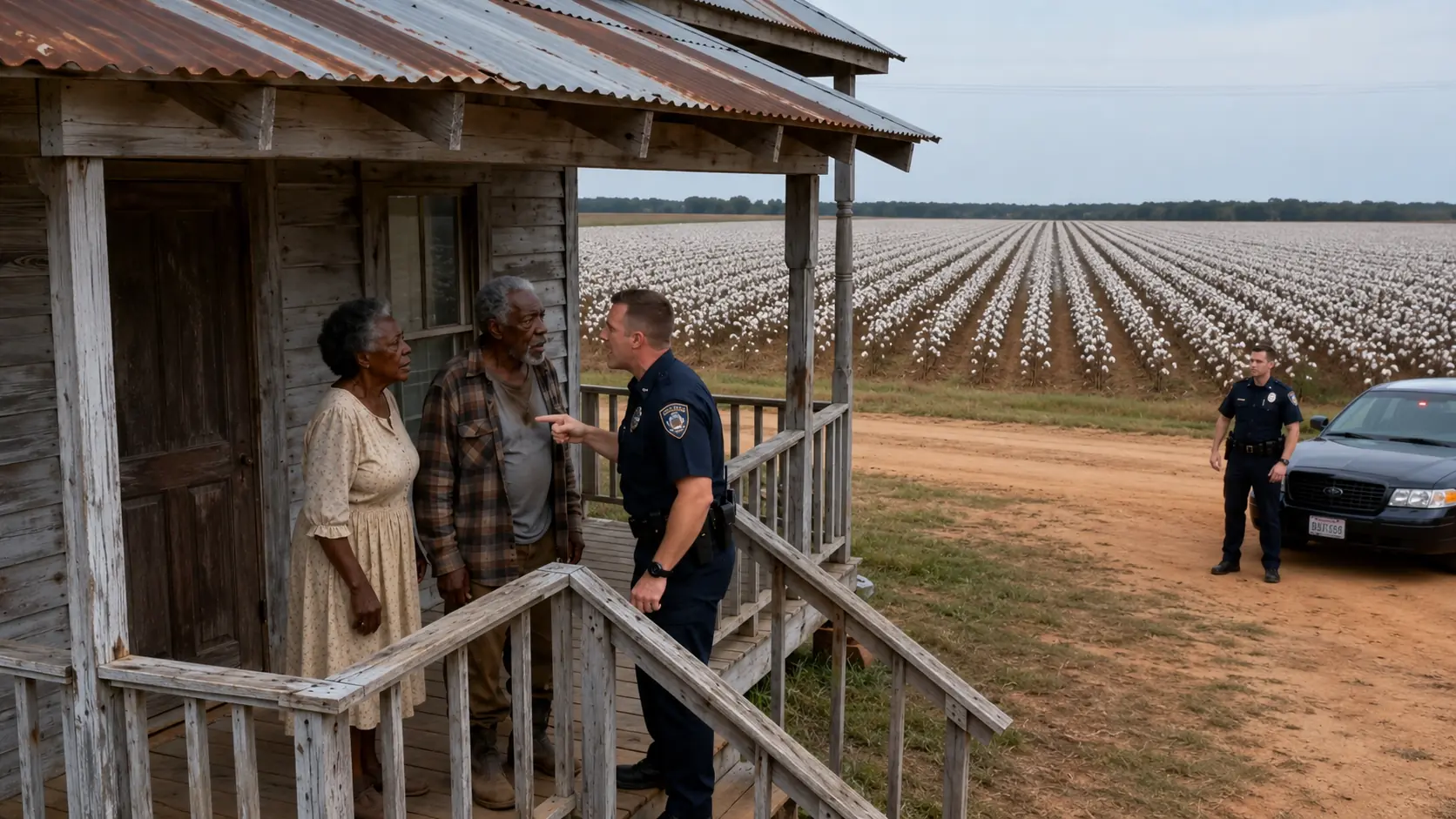
By the time the first sheriff’s cruiser rolled through the front gate, Nathaniel Reed had already spent forty-eight summers watching sunlight move across the same Alabama field. He knew where the soil turned red near the creek, where the cotton grew thickest after heavy rain, and which fence post his father had replaced the year Nathaniel turned twelve. The farm had survived droughts, storms, bad harvests, medical bills, and banks that once refused his father a loan without even looking at the numbers. Nathaniel never imagined the thing that might finally take it from his family would arrive wearing a county badge.
His wife, Lillian, was carrying a basket of tomatoes toward the porch when she heard tires grinding across the gravel. Three patrol vehicles stopped near the old pecan tree, throwing dust into air that had been still only seconds earlier. Four deputies climbed out, followed by a heavyset lieutenant named Curtis Hale, whose sunglasses stayed on even after he stepped into the shade. Nathaniel set down the irrigation hose and waited.
“Afternoon,” Hale called, walking toward the porch like he had been invited. “We’re responding to a complaint involving property boundaries and unlawful use of disputed acreage.” Nathaniel stared at him for a moment, then looked past him toward the fields his family had worked since his grandfather bought the first sixty acres in 1949. “There’s nothing disputed about this land,” he said.
Hale removed his sunglasses. “That’s not what the county has been told.” Lillian stepped beside her husband and asked who had filed the complaint. The lieutenant glanced toward the far western field, where a row of white survey stakes had appeared two weeks earlier without permission. “Southern Crest Development,” he said.
Nathaniel felt something cold move through his chest. Southern Crest had been buying farmland throughout the county for almost three years, turning fields into warehouses, distribution centers, and subdivisions with names like Willow Oaks despite there being neither willows nor oaks left after construction. The company had approached Nathaniel twice with offers so low he assumed they were jokes. Both times, he had told the representative the Reed farm was not for sale.
“We have deeds,” Nathaniel said. “Surveys too.” Hale shrugged as though paperwork were a minor inconvenience. “Then there shouldn’t be any problem cooperating while this gets sorted out.”
Lillian’s voice sharpened. “Cooperating with what?” Hale pointed toward the western acreage. “We need access to inspect the boundary and document possible encroachment.” Nathaniel answered immediately, “Not without proper authorization.”
The deputy closest to Hale shifted his stance. Nothing dramatic, but Lillian noticed the movement and so did Nathaniel. They had both lived long enough in rural Alabama to understand that conversations could change very quickly once a Black landowner stopped sounding grateful. Hale smiled without warmth and said, “Mr. Reed, nobody here wants trouble.”
Nathaniel looked directly at him. “Then don’t bring trouble onto my farm.” One of the younger deputies looked down, but Hale’s expression hardened. The lieutenant said they would return with whatever documentation the county considered necessary.
When the cruisers finally left, Lillian remained on the porch staring at the dust cloud. “That wasn’t about a boundary,” she said. Nathaniel did not answer immediately. He was looking at one of the white survey markers near the field.
His father had taught him something simple about land. People rarely started by trying to take the whole thing. They started by making you uncertain about a corner.
That evening, Nathaniel retrieved a metal document box from beneath the bed. Inside were deeds, tax receipts, agricultural assessments, old photographs, and survey maps collected across three generations. Lillian spread everything across the kitchen table while the ceiling fan clicked above them. By midnight, nothing in those records suggested Southern Crest owned a single foot of Reed land.
“What worries me is they already knew that,” Lillian said. Nathaniel leaned back and rubbed his eyes. “Then why send deputies?” She looked toward the dark window. “Because they thought badges might do what money didn’t.”
The next Sunday, their pastor asked Nathaniel to stay after service. Reverend Samuel Dixon had led New Covenant Baptist for twenty-six years and knew nearly every family within ten miles. He closed the fellowship-hall door after the last child left and placed three envelopes on a folding table. “You’re not the first,” he said.
One letter belonged to Earl Simmons, whose family farm sat near County Road 19. Another belonged to widow Florence McKay, seventy-two, who had been told part of her pasture violated a newly interpreted easement. The third came from James Carter, who sold forty acres after receiving repeated citations for drainage, access roads, and equipment storage that had never been problems before Southern Crest became interested. Nathaniel read all three twice.
“James sold?” he asked. Reverend Dixon nodded. “Told me he got tired.” Nathaniel looked toward him. “That’s what they’re counting on.”
Word spread quietly after that. Nobody called it a movement because people who worked farms did not have time to name every problem before solving it. They simply began meeting in kitchens, church basements, tractor sheds, and one back room at a feed store owned by a man who trusted no politician more than he trusted a weather forecast. Each family brought whatever paperwork they had.
The pattern became hard to ignore. Farmers received strange inspection notices, sudden questions about boundaries, unusually low appraisals, or warnings involving road access shortly after refusing offers from Southern Crest. Several families described deputies appearing during disputes that were civil matters and had never required law-enforcement presence before. Most of the affected owners were Black.
Lillian became the best organizer among them. She created a binder for every family and insisted people record dates, names, vehicle numbers, letters, photographs, and exact language used during each encounter. “Memory is useful,” she told them, “but paper survives arguments.” People started carrying notebooks in their trucks.
Nathaniel installed two simple security cameras, one covering the driveway and another facing the western fence line. They were not hiding anything and made no effort to monitor neighbors. Nathaniel wanted a record of who entered his land. Within five days, one camera captured a survey crew crossing the fence without permission.
The men stayed twelve minutes. They measured a section near the creek, hammered another stake into the ground, and left. A Southern Crest logo was visible on the side of their pickup. Nathaniel sent a copy of the footage to an attorney recommended by Reverend Dixon.
Her name was Eleanor Grant, and she practiced property law from an office in Montgomery. She watched the footage once, then asked Nathaniel for his full chain of title, tax history, and every communication from Southern Crest. After reviewing the documents, she said, “Your ownership looks solid.” Then she added, “Which means the question becomes why so many people are pretending it isn’t.”
Eleanor advised the families to stop arguing individually with officials. Every future communication would be written whenever possible, every notice appealed, and every property entry documented. She also requested public records involving rezoning, proposed development maps, road-expansion plans, and county communications with Southern Crest. Within weeks, the first documents arrived.
The maps changed the mood immediately. A proposed industrial corridor ran directly through multiple Black-owned farms, including nearly eighty acres belonging to Nathaniel and Lillian. Southern Crest had quietly presented plans to county officials before acquiring all the land needed to build them. The development company had apparently promised future jobs, increased tax revenue, and new road funding.
Nathaniel stared at the map in Eleanor’s office. “They planned the project before we agreed to sell.” Eleanor nodded. “That appears to be the case.” Lillian said quietly, “So they didn’t make offers because they hoped we would sell.”
“They made offers because they already decided we would,” Nathaniel finished. For the first time, anger showed plainly on his face. He had spent decades surviving people who assumed poor farmers did not understand contracts. Being old did not make him stupid.
Still, anger did not solve the immediate problem. Another police vehicle appeared two days later while Nathaniel repaired fencing, and Lieutenant Hale stepped out carrying a new notice. This one claimed county inspectors had reason to believe a drainage ditch crossed onto property controlled by Southern Crest. Nathaniel took the paper and said nothing.
Hale seemed disappointed by the lack of argument. “You understand this could get expensive if you keep resisting.” Nathaniel looked at him. “Resisting what?”
“Progress,” Hale answered. Nathaniel smiled slightly. “Funny how progress always needs my land.” Hale’s eyes narrowed.
Lillian recorded the entire exchange from the porch. When Hale noticed the phone, he changed tone immediately and began describing the visit as a routine service call. Nathaniel understood then that documentation was already working. Men behaved differently when they knew their version would not be the only one left afterward.
The person Nathaniel still had not called was his son. Marcus Reed had left Alabama nearly fifteen years earlier, first for service overseas and later for a security-management job in Atlanta. He loved his parents, visited when he could, and sent money whenever machinery broke, but Nathaniel had always refused to make the farm Marcus’s responsibility. “You build your life,” he told him.
Lillian disagreed this time. “He deserves to know what’s happening.” Nathaniel shook his head. “He has work.”
“He has parents too.” Nathaniel looked at her. Lillian raised an eyebrow that had ended more arguments than any judge.
Marcus arrived three days later.
His truck appeared just after sunrise while Nathaniel was feeding chickens. Marcus stepped out wearing jeans, work boots, and a charcoal jacket, looking older than the son who had left and younger than the man Nathaniel sometimes imagined over the phone. Lillian reached him first and wrapped both arms around him.
“You should have called sooner,” Marcus said into her shoulder. Lillian replied, “Tell your father.” Nathaniel looked toward the barn and pretended not to hear.
Marcus spent the morning listening. He did not interrupt while his parents explained the police visits, survey stakes, low offers, church meetings, and public-record discoveries. Then Lillian placed three binders on the kitchen table. Marcus opened the first and spent nearly an hour reading without speaking.
When he finally looked up, he asked, “Who organized these records?” Lillian said, “Mostly me.” Marcus smiled. “Then you’ve already done half the important work.”
Nathaniel expected his son to start talking about confronting the sheriff’s department. Marcus did the opposite. He said no one should patrol property lines carrying weapons, nobody should threaten survey crews, and no one should post accusations online that could not be supported. “If these people are coordinating,” he said, “the easiest gift we can give them is footage of angry farmers doing something reckless.”
Reverend Dixon invited Marcus to the next church meeting. More than sixty people attended, including farmers who had never spoken publicly about what they were experiencing. Marcus stood beside the fellowship-hall whiteboard and listened for nearly two hours before saying anything. When he finally spoke, the room quieted.
“This cannot become one family against one company,” Marcus said. “That is how they win.” He pointed toward Lillian’s binders. “You need one timeline, one legal team, one place for evidence, and people trained to document without escalating.”
Marcus’s years of military leadership had made him methodical, but he had no interest in turning rural Alabama into some kind of armed standoff. He created rotating observation teams whose only job was to note license plates, take photographs from lawful positions, and contact attorneys when officials appeared. Veterans in the community helped train volunteers in calm communication and incident reporting. Church leaders handled phone trees and transportation for elderly farmers.
Eleanor Grant expanded the legal team. A civil-rights attorney from Birmingham joined, followed by an agricultural-law professor who had spent years researching land loss among Black farmers in the South. They found discrepancies in multiple county appraisals. Properties owned by families refusing to sell were suddenly assessed differently from comparable neighboring land.
Then the financial records started arriving. Campaign donations from executives connected to Southern Crest had gone to two county commissioners, Sheriff Donald Pierce, and the district attorney’s reelection committee. Donations alone proved nothing, and Eleanor repeatedly reminded everyone of that. But money was now part of the picture.
The bigger discovery came from zoning emails. A county planning official had sent a message to a Southern Crest executive six months earlier asking when the “remaining holdouts” could be expected to clear the corridor. The executive responded that “enforcement pressure and code compliance” should help. Marcus read the sentence twice.
Nathaniel stood behind him. “They called us holdouts.” Marcus nodded.
“What are we holding out from?” Nathaniel asked. Marcus looked toward his father. “Apparently from a deal nobody remembers us agreeing to.”
A local reporter named Rebecca Sloan began investigating. She had covered agriculture and county government for years and initially expected a complicated zoning dispute. After seeing the emails and speaking with multiple families, she realized the story was larger. Her first article ran on a Sunday morning.
BLACK FARMERS QUESTION POLICE ROLE IN DEVELOPMENT LAND DISPUTES
The article did not accuse anyone of crimes. It simply compared dates, documents, statements, and property records. That restraint made it harder for county officials to dismiss.
Sheriff Pierce held a press conference the following afternoon. He said deputies had only responded to lawful requests for assistance and accused “outside agitators” of creating racial tension where none existed. Marcus watched the broadcast from his parents’ kitchen. Nathaniel laughed once.
“Outside agitator,” he said. “You were born twelve feet from where you’re sitting.” Marcus smiled. “Apparently Atlanta changed my citizenship.”
The media attention brought more families forward. A widow from the southern part of the county had been told officers might cite her sons for trespassing while they repaired a fence on land she owned. Another farmer produced audio of a deputy telling him selling was “probably easier than fighting the county forever.” A retired teacher described surveyors entering her property twice after she declined an offer.
Every account was reviewed before it was added to the coalition’s evidence. Marcus insisted on separating rumor from documentation. If someone remembered a threat but had no supporting record, it was labeled as testimony rather than proof. That discipline slowly built credibility.
Then somebody made a mistake.
A Southern Crest project manager emailed a spreadsheet to the wrong address. The intended recipient was a county planning consultant, but the address auto-filled to a community volunteer with a nearly identical name. The spreadsheet listed targeted parcels, purchase status, appraisal estimates, and a final column titled Pressure Status.
Nathaniel’s property was marked HIGH RESISTANCE — LAW ENFORCEMENT CONTACT ACTIVE. Florence McKay’s farm showed CODE ACTION PENDING. James Carter’s former parcel was marked ACQUIRED AFTER ENFORCEMENT.
Marcus immediately told everyone not to circulate the file publicly. Eleanor preserved the original email, metadata, and attachment before contacting state authorities. “If this is genuine,” she said, “we do not want social media destroying the evidence chain.”