Rain slammed against the cracked windows of the Carter apartment like handfuls of gravel. Sharp, angry, relentless. South Philadelphia storms were always loud. But tonight felt different. Wild, electric, dangerous. Thirteen-year-old Malik Carter zipped up his thin gray hoodie and tied the frayed laces of his sneakers already soaked from the leaks in their hallway ceiling. His grandmother, Miss Evelyn, watched him from their couch, her hands massaging her swollen knees. "Baby, you don't need to go to that corner store tonight," she said gently. "A storm like this? Streets ain't safe."
Malik forced a smile. "Grandma, I promised Mr. Kowalski I'd cover tonight. If I don't work, we don't eat." She sighed defeated. "Just walk fast and keep your hood up." He leaned down, kissed her forehead, and grabbed the umbrella missing two spokes. The moment he stepped outside, the wind slapped it sideways. Useless, he tossed it in the trash and lowered his head against the rain, trudging through ankle-deep water running along the gutters like a river.
The corner store's old neon open sign flickered weakly, buzzing in protest against the storm. Mr. Kowalski, the Polish shop owner with a belly like a medicine ball and a voice like crushed gravel, looked up the moment Malik entered. "You shouldn't be out here, kid," he scolded, wiping down the counter. "Storm's only getting worse." "You said you needed help tonight," Malik replied, heading straight to the stock room. "I'm here." Mr. Kowalski gazed at him for a long moment, eyes soft and sad, and simply said, "You're a good boy, Malik."
He worked the next four hours stocking shelves, cleaning spills, and bagging groceries for the few desperate customers braving the storm. At nine-thirty p.m., Mr. Kowalski locked the doors early. "Go home," he said, pressing a five-dollar bill into Malik's hand. "For your bus fare." "There is no bus tonight," Malik said quietly. "They shut the route down in this weather." Mr. Kowalski hesitated, then handed him a plastic poncho that smelled like old rubber. "Then wear this."
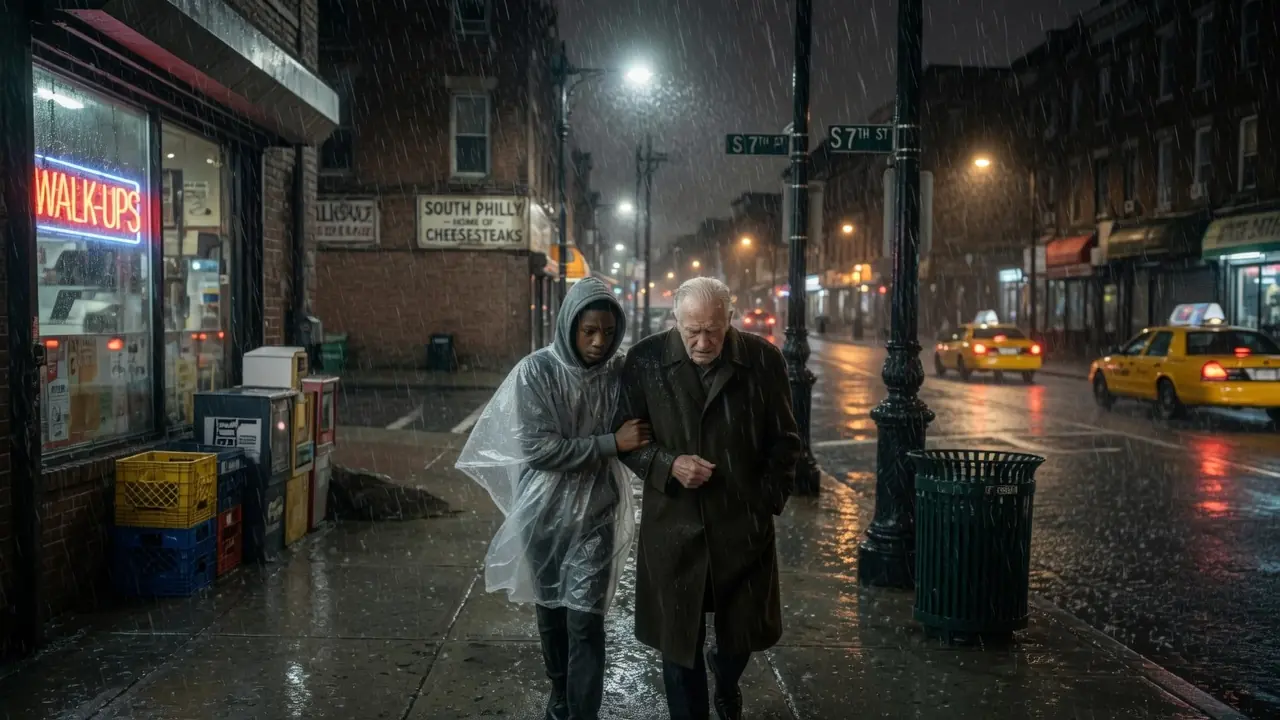
Malik stepped outside again, the poncho whipping around his skinny frame. He tightened the hood tighter and began the long walk home, his sneakers slipping on wet pavement. Lightning flashed bright and jagged, and thunder cracked, rolling through the city like a broken drum. Three blocks from home, he saw him. An older white man, maybe early seventies, clinging to a lamppost like the storm was trying to rip him off the earth. Expensive coat, expensive shoes, but soaked straight through. Water dripped from his silver hair. He looked lost or scared, or both.
A black sedan with tinted windows drove slowly beside him, hazard lights blinking. A younger man shouted from the passenger seat, "Mr. Holston, sir, please just get in the car. It's not safe." But the older man shook his head stubbornly. "Leave me alone. I'm walking." The sedan followed, creeping slowly, helplessly. Malik hesitated. Getting involved with rich white folks in Philly usually meant trouble. People like that didn't trust kids like him, not even in daylight. And at night, during a storm, he could walk past, pretend he didn't see anything, make it home alive.
But something in the old man's trembling legs, something in the way his hand pressed against his chest like he was fighting the wind with his heartbeat, reminded Malik of his own grandfather who had died of a heart attack two years earlier on a rainy night just like this. And suddenly Malik couldn't walk away. He approached slowly. "Sir, are you okay?" The old man looked up confused. "Do I know you?" "No, sir, but you look like you need help." "I don't need help," the man snapped, but it was weak, desperate.
The security guard tried again. "Sir, please, your doctor said—" "Enough," the old man barked. "Leave us." The sedan reluctantly drove off to a distance, watching but giving space. Malik offered the man his arm. The old man hesitated, then took it. They walked slowly, painfully through the storm. "Name?" the man asked, panting. "Malik Carter, sir." "I'm Henry. Henry Holston." The name hit Malik like a punch. Everybody in Philly knew that name. Billionaire real estate giant. Owned half the city's skyscrapers. Henry Holston. The man whose face was on billboards and magazines. The man rumored to fire employees for being five minutes late. The man no one approached. And here he was leaning on a poor black kid in the middle of a storm.
"You shouldn't be out here alone," Malik said softly. Henry laughed bitterly. "Kid, you have no idea." They reached a crosswalk when Henry suddenly swayed. Malik grabbed him. "Sir, you okay? Just tired? You want to call someone?" "No," Henry said firmly. "I don't want ambulances. I don't want cameras. I don't want attention." He gripped Malik's shoulder harder. "Help me home, son." That word hit Malik deep. He had not heard it spoken toward him in years.
They walked another block. Henry slipped twice. Malik held him up each time. At one point, the man's expensive watch, worth thousands, slid off his wrist as he steadied himself. Malik picked it up and handed it back. Henry stared at him, surprised. "You didn't pocket it." "No, sir." Henry looked away, ashamed. Finally, they reached a tall brownstone building. Beautiful marble steps, gold-trimmed doors. "Here," Henry whispered. "This is home." The sedan pulled up again, headlights bouncing off the rain. Two men rushed out. "Mr. Holston. Sir, are you—?" Henry raised his hand. "Silence." He turned to Malik. Rain poured off the brim of his bent poncho. "You walked me home," Henry said softly. "You could have stolen my watch. My wallet. You could have left me to die on the sidewalk. But you didn't." Malik shrugged. "You needed help."
Henry stared at him for a long time. "Where do you live, Malik?" "Just out on Twelfth and Jackson." "Dangerous walk back," Henry murmured. "Weather's getting worse." Then Henry reached into his inside coat pocket and pulled out a folded check. He pressed it into Malik's hand. "For you, for helping me." Malik felt the shape of it but did not open it yet. "Sir, I didn't do this for money." Henry smiled for the first time that night. "That's exactly why you deserve it." Before Malik could respond, the security guards ushered Henry inside. The door shut. The sedan drove off. The storm raged on.
Malik stood on the marble steps alone, soaked, shivering, clutching a check he hadn't asked for. When he finally unfolded it, the rain smeared the ink slightly, but the number was still clear. Two thousand dollars signed Henry T. Holston. Two thousand dollars. More money than he had ever seen in his life. He didn't know that tomorrow morning men in black suits would show up at his grandmother's doorstep asking only one question. "Where is Malik Carter?" And his life would change forever.
The night after Malik had walked the old man home, he barely slept. His clothes were still damp from the storm and his tiny bedroom still smelled like rain. The thin blanket did almost nothing against the cold breeze slipping through the cracked window. But Malik didn't care because for the first time in a long time, he felt something warm inside him, like he had done something right, something meaningful. He kept replaying the moment when the old man, Mr. Holston, smiled at him. Not many people smiled at Malik in this world. That small gesture felt bigger than a gift.
But morning came fast and life did what it always did, reminded him that kindness didn't pay bills. He had woken up before sunrise and quietly left the house so he wouldn't disturb his grandmother who had worked a double shift the night before. Today, like every day, he walked six blocks to the diner and stood outside the back door waiting. He wasn't employed. The diner didn't hire kids, but the owner, Ms. Jenkins, paid him a few dollars to help unload boxes or take out trash. Malik never complained. Even the smallest amount helped.
As he worked, he kept thinking about Mr. Holston. Was he okay? Had he gotten sick from the storm? Was he alone? Malik felt something he didn't expect. Worry. After the diner, he went straight to school, but his mind wasn't on math or history. It was back in that quiet house with the old paintings, the old clock, and the man with soft but lonely eyes. When school ended, Malik found himself walking toward Maple Street, toward that same home. He told himself he just wanted to check if the man was all right. But deep inside, he knew he was also searching for something, maybe belonging, maybe meaning, maybe both.
He walked up to the porch and hesitated. What if the man didn't remember him? What if he didn't want company? But before he could talk himself out of it, the door opened. Mr. Holston stood there leaning on a cane, wearing a sweater too big for him. And when he saw Malik, he broke into the warmest smile. Malik wasn't used to that kind of welcome. He swallowed hard. The man thanked him again for walking him home and invited him inside. Not out of charity, but with genuine delight, as if Malik's presence brought something alive inside the quiet house.
Malik stepped in carefully, almost awkwardly. The home smelled like old books and lemon polish. Everything was neat. Everything had a place. It didn't feel like Malik belonged here. Yet somehow, it felt like the only place he had been welcomed sincerely in years. The old man poured him a cup of warm tea. Malik wasn't used to tea, but he drank it politely. Mr. Holston asked about school, about his grandmother, about what he liked. Nobody ever asked Malik these things. Not with interest.
As he talked, he noticed something strange. Mr. Holston listened. Really listened. The world didn't listen to boys like him. He was used to being invisible. That afternoon changed something. Malik stayed for an hour, then two, helping the man move boxes, dust shelves, and fix a loose hinge on a cabinet. Mr. Holston wasn't demanding. He was grateful. He treated Malik not as a charity case, not as a servant, but as a companion. When Malik finally left for the day, he promised he'd return tomorrow. And he meant it.
Days passed into a week. The pattern grew natural. School, work, then stopping by the old man's house. He helped with chores, listened to stories about the past, and sometimes just sat quietly while the old man painted landscapes from memory. Malik liked those moments most. They felt peaceful, safe. The neighborhood didn't understand it. People saw a poor black boy spending time with an old white man in a big house and whispered. Some said Malik was taking advantage. Others said the old man was foolish. But neither of them cared because in that house, Malik felt like he mattered. And in return, he brought Mr. Holston something the man had been missing since his wife passed. Company.
One cold afternoon, as Malik placed firewood beside the fireplace, he noticed a framed photograph on the mantle. It showed a younger Mr. Holston standing proudly with two sons. They were tall, wealthy-looking, dressed in suits. But the picture was old, dusty, forgotten. Malik didn't ask, but the old man noticed his gaze lingering. "That was a long time ago," Mr. Holston said softly. "People change. Money changes them faster." Malik nodded. He didn't pry. He understood that some pains lived quietly inside people.
Over the next few weeks, Malik learned more about the man, not through direct questions, but through small moments. The old man had been a businessman, wealthy, but lonely. His children had grown successful, but distant. They rarely visited. Months would pass without a call. Malik felt a sting in his chest. He didn't know what it was like to have a father, but he knew what it felt like to be forgotten. One evening, after helping fix a leaky pipe under the sink, Malik turned to leave and the old man stopped him. He gave Malik a jacket, a thick, warm one that must have cost a lot. Malik refused at first. He didn't want to seem greedy, but the old man insisted. "I want you to have it," he said, placing a trembling hand on Malik's shoulder. "You've helped me more than you realize." Malik accepted it, and something inside him cracked open. Gratitude mixed with disbelief. No one ever gave him anything this valuable without expecting something in return.
Winter deepened. Snow fell hard. Money at home grew tighter. Some nights Malik didn't eat enough. But he never told the old man. He didn't want pity. He kept showing up. He kept helping. The old man grew weaker at times and Malik stayed longer. Sometimes helping him up the stairs or carrying groceries. Then one week everything changed. Malik arrived at the house one afternoon and found the door unlocked. He called out but heard no answer. His heart started pounding. He rushed inside and found the old man lying on the floor near the study, unconscious. For a second, his world froze. Then instinct kicked in. Malik called for help, his voice shaking but firm. The ambulance came fast. The neighbors gathered, some whispered, some judged. But Malik stayed beside the stretcher until they took the old man away.
At the hospital, the staff didn't let Malik enter the room because he wasn't family. He sat outside for hours, shivering in fear and worry. He didn't have anyone's number, not even the old man's children. He waited deep into the night until a nurse finally came out and told him the old man was stable. Exhausted, Malik walked home under the streetlights, wondering what would happen next. The next morning, he returned hoping for news. But something unexpected happened. When he reached the old man's house, two black luxury cars were parked outside. Tall men in suits stood on the porch. Malik froze. They didn't belong to this neighborhood. They looked like lawyers, businessmen, important people.
As soon as they saw Malik, one of them stepped forward and asked sharply, "Are you Malik Carter?" Malik's stomach dropped. He didn't know why men like them would be looking for a boy like him. But their eyes were serious, searching, almost urgent, and whatever they were here for, Malik knew his life was about to change in a way he never imagined. Malik stood still on the sidewalk, frozen by the sight of the luxury cars that did not belong in his neighborhood. Men in tailored suits, polished shoes, and heavy expressions waited on the porch like they were on official business. Their presence felt sharp, cold, and completely out of place among the cracked pavement and old wooden fences. Malik felt small, almost invisible, yet somehow the center of their attention.
When one of the men asked whether he was Malik, he hesitated. His throat tightened. Every instinct told him to run. Boys like him didn't get approached by men in suits unless something bad had happened. Trouble usually arrived wearing authority. And these men carried it like armor. But something about their tone was different. Not threatening, not angry. Controlled. Searching. Malik nodded slowly. The men exchanged looks. Then the one in front stepped closer, his voice steady but firm. He said they needed to talk to him about Mr. Holston. The moment the old man's name was spoken, the fear in Malik's chest loosened just a little. But a new kind of worry took its place. Did something bad happen? Was the old man worse? Did he ask for him? Or did something go wrong at the hospital?
The man introduced himself as Mr. Charles, the old man's attorney. The title alone made Malik tense. Attorneys were people who dealt with money, property, and problems. Malik had none of those except problems. Another man opened the front door and gestured for Malik to follow. Malik stepped in cautiously, removing his cold hands from his pockets. The house felt different today, still quiet, still filled with the scent of old wood and paint, but the atmosphere was heavier. The warmth that usually wrapped the house felt replaced by structure, like the air was standing straighter.
Malik was led into the living room where two more men sat at a large table filled with papers. Thick folders were stacked neatly. Pens lined up. Everything looked official. Too official for a boy like him. They asked him to sit. Malik sat on the edge of the chair as if touching too much of it would be disrespectful. He kept his jacket zipped, unsure what to do with his hands. The attorney cleared his throat and began by thanking Malik for helping Mr. Holston during the storm and visiting him regularly. The sincere tone threw Malik off. Adults didn't usually talk to him like he mattered.
Then the room shifted. The attorney said Mr. Holston had told them everything about Malik. Every visit, every chore he helped with, every act of kindness. He said the old man admired him deeply, trusted him, considered him the only person who had shown him genuine care in years. Malik stared at the table slowly blurring in front of him. He didn't know what to say. No one had ever spoken about him that way. He felt something rising in his chest, something warm but painful.
Then the attorney delivered news that made the world tilt slightly. The old man had asked for Malik the moment he woke up in the hospital. He had asked repeatedly. He wanted to speak to him more than anyone else. Malik absorbed that quietly, gripping his jacket tighter. It meant more than he could express, but he still didn't understand why lawyers were involved. The attorney paused, then gently placed a document on the table. He said this wasn't easy to explain, but Mr. Holston had made decisions earlier that morning, life decisions, ones that involved Malik.
Malik blinked, confused. The attorney continued, "Mr. Holston had rewritten his will. Not yesterday, not last week, but that very morning from the hospital bed. He had listed Malik by name." At first, the words didn't feel real. It felt like someone else's story, a movie someone forgot to finish. Malik asked why. The attorney said the old man believed that kindness from a stranger, especially a child, was more meaningful than inherited bloodlines that abandoned him. The old man didn't want his life's work, wealth, or home going to people who hadn't visited him for years, except when they wanted something. He wanted it to go to the person who showed up when nobody else did, a boy who walked him home in the storm.
But even with all that, Malik couldn't think about money or inheritance. All he cared about was whether the old man was all right. His voice shook when he asked. The attorney softened. He said the old man was stable but weak and asking to see Malik again. Before they left for the hospital, the attorney pulled out one more document. It wasn't a will. It was something Mr. Holston had asked them to give Malik personally. A sealed envelope with Malik's name written in shaky handwriting.
Malik stared at it like it wasn't meant for him, like the world had handed him something too fragile and too important to hold. The attorney didn't pressure him. He simply told him he could open it whenever he felt ready. On the ride to the hospital, Malik sat between two men in the back of the black car. He had never been in a vehicle this expensive. The seats felt too soft. The silence felt too heavy. His mind raced with a thousand thoughts. What if the old man didn't recover? What if this letter had something painful inside? What if the old man's children blamed him? He remembered the photograph. Two tall sons who looked like they belonged to a different world. A world of polished shoes, expensive houses, and cold smiles. A world that pushed boys like him to the edge.
When they arrived at the hospital, Malik's heart pounded in his chest. He walked through the automatic doors, guided by the men. Nurses recognized the attorney and let them pass without question. Malik stayed quiet, barely breathing. They stopped outside a room. The attorney placed a hand on Malik's shoulder and nodded for him to go in. Malik stepped inside slowly. The old man lay in the bed, pale, fragile, but awake. His eyes opened at the sound of footsteps, and the moment he saw Malik, something in them lit up. Soft. Relieved. Grateful.
Malik moved closer, feeling the sting of tears forming. The old man reached out a weak hand, and Malik took it gently. There were no words big enough to fill the space between them. The old man whispered something, too soft for the others to hear, but loud enough for Malik. He told Malik he was proud of him, that meeting him was the greatest blessing of his final years, that he had brought light into a lonely house. Malik squeezed his hand, desperate not to cry.
Then the old man whispered that he needed to tell Malik something important, something he had waited too long to say. The room went quiet. Even the machines seemed to slow down. The old man took a shaky breath and just then the door swung open. Two people stormed in. A tall man and a woman, both sharply dressed, both angry. Malik recognized them instantly. The sons from the photograph. Their eyes landed on Malik and rage filled the room like fire.
The story was no longer just emotional. It had turned dangerous. Malik froze in place as the two men entered the room, their sharp eyes scanning every inch of him like he was an intruder. The hospital lights glinted off their polished shoes and gold watch bands. The kind of accessories Malik had never seen outside of a magazine. He could feel the tension snap through the air, thick and heavy, as if it had mass and weight. The old man's frailty seemed more pronounced now, his hand gripping Malik's like an anchor to steady him in the storm of emotions building in the room.
The men spoke, voices low but cutting, each word carrying authority, anger, and disbelief. Malik felt his chest tighten. Their presence alone was a forceful reminder of a life he had never known. The wealth and privilege he had never touched. And yet they were looking at him, really looking at him as though he had upset the natural order of things simply by existing. He could feel the silent judgment of a lifetime of expectation pressing down, but he refused to flinch. He remembered the night in the storm, remembered the old man's gratitude, and something deep inside him steadied. This wasn't about money. This wasn't about fear. This was about right and wrong, about choices that mattered.
The attorney, standing quietly behind Malik, reminded him to breathe. Malik's hands tightened around the envelope he had been given. The sealed cream-colored folder seemed suddenly heavier than anything he had ever carried. Inside were the documents that could change everything. The old man's words, his intentions, and a future he had decided Malik deserved. But he hadn't opened it yet. Part of him feared what he might find. Part of him could hardly wait.
He looked at the old man again, who gave a faint nod of encouragement, as if to say, "You belong here. You're meant to see this." The sons were growing more impatient, their expressions shifting from anger to disbelief and finally to desperation. They spoke over each other, accusing, demanding, insisting that Malik had no right to be part of the old man's life, let alone the decisions being made about his wealth. But Malik didn't move. He didn't argue. He didn't flinch. He remembered his grandmother's teachings. Honor your word. Act with integrity. Give everything even when it costs you. This was the moment those lessons crystallized into reality. He would not retreat. He would not shrink.
And then, almost imperceptibly, the old man's lips curled into a faint smile. His frail hand tightened over Malik's, a quiet reassurance. "Do not fear," his eyes seemed to say. "This is the right thing. Always the right thing." Malik swallowed, felt a lump rise in his throat, and finally, with a deliberate motion, he broke the seal on the envelope. The paper inside smelled faintly of ink and old parchment, a tangible link to the man who had trusted him so completely. Malik's hands shook as he unfolded the documents. They were legal papers typed and stamped with authority. But the handwriting over them, the personal note, the letter from the old man, made it real. Human. It spoke of belief, of trust, of seeing a child for his courage, his integrity, his heart. Every word was deliberate, almost sacred.
Malik felt tears welling as he read the lines over and over. "You are exactly who I have waited for. You're the reason my work can continue. You are the hope I have placed in this world." And then the numbers hit him. Numbers that made his stomach turn. That made the world feel impossibly large and impossibly real at the same time. The scholarship, the full tuition, the stipend, the opportunities laid out in legal clarity. This was not charity. This was a chance. A lifeline. A bridge from everything he had known into everything he could now dare to dream.
He sat frozen, the envelope trembling in his hands, the weight of it sinking deep into his bones. The old man's sons looked on in shock, unable to argue with the legitimacy of what was happening. Their faces betrayed disbelief, anger, and slowly the faint beginnings of respect, or at least acknowledgement, that the choice had been made long before their voices entered the room. Malik realized something profound in that moment. Kindness, integrity, and courage were forces stronger than inheritance, stronger than anger, stronger than expectation. And he had wielded those forces unknowingly, but with precision, with instinct, with heart.
As the attorney guided the process, explaining how Malik would be enrolled in the scholarship program, the terms of the living stipend and the path laid before him, Malik began to understand the depth of what he had done, not just for himself, but for his grandmother, for the community that had raised him, for the legacy of a man he had never truly known until the storm night. Each word carried weight. Each detail solidified the promise of a future previously unimaginable. He thought about the nights he had gone to bed hungry, about the mornings when his grandmother woke him for school, about the small jobs he had taken to keep them afloat. And now all of that struggle, all of that perseverance, all of that relentless kindness was being recognized in the most profound way.
The old man had seen him, truly seen him, and had acted to ensure that his vision, his potential would no longer be limited by circumstance. Malik's tears fell freely now, hot and unrestrained. The old man, frail but alert, smiled through his own tears. It was a smile that carried years of sorrow, loss, hope, and trust. Malik realized in that instant that the bridge between their lives was not just metaphorical. Every act of kindness, every small gesture had constructed it. And now standing on the precipice of his new life, he understood that bridges were not merely steel or concrete. They were built from the human heart.
The sons had finally retreated, their anger unresolved, but muted by the clarity of their father's intentions. Malik felt a surge of relief and empowerment. He had not sought this. He had not demanded it. He had only done what was right. And the universe in its own way had honored him. And through it all, the old man had given him something far beyond money or opportunity. He had given him belief in himself. Belief that the choices of a single person, even a child, could ripple out to touch countless lives.
The day stretched onward. Malik and the old man spoke quietly. Plans laid, encouragement exchanged. The attorney left them for a moment alone. Malik finally dared to speak, his voice cracking with emotion. He asked questions, careful questions about the responsibilities, the expectations, the path ahead. And the old man answered patiently, lovingly, as if teaching him that the courage he had shown in the storm was only the beginning of a lifetime of choices that mattered.
Malik left the hospital that day changed. The rain had stopped, but the sky remained heavy with clouds as if reflecting the magnitude of what had happened. He walked slowly, thinking about the envelope, the scholarship, the bridge he had been invited to help design. His mind was alive with possibilities, buzzing with the realization that one act, one walk through a storm had transformed the trajectory of his life and the lives of everyone around him. At home, his grandmother waited anxiously. When she saw him, the tears she had been holding back finally spilled. Malik handed her the envelope. She read every page, her hands shaking, her breath catching. And when she looked up, her eyes met his with a mixture of disbelief, joy, and gratitude so profound that it left Malik breathless. For the first time in years, the weight of survival had lifted, replaced by hope, by promise, by possibility.
That night they ate together in silence at first. The papers spread out on the table like sacred text. Then they spoke, laughed, cried, and dreamed. The future, once so heavy, was now a canvas. And Malik finally felt like he had the brush in his hands. He could shape it, guide it, honor it. And somewhere deep inside, he understood that the storm, the walk, the choices he had made, and the courage he had summoned had not only changed his life, they had rekindled hope in someone else's world, someone who had been ready to give up. And that, he realized, was the true measure of what he had done.
The night was calm, a soft drizzle falling on the streets of Philadelphia, a gentle echo of the storm that had set everything in motion months before. Malik sat on the edge of his bed, the envelope still open on his lap. The weight of its contents had shifted from disbelief to resolve, from fear to determination. He ran his fingers over the papers, contracts, scholarship details, and a letter from Henry Holston. Each word carried the promise of a future he had never dared to imagine. The reality was almost surreal. Full scholarships, stipends, a career path laid before him, and security for his grandmother who had carried the brunt of the world for years. For a moment he allowed himself to simply breathe, to let the enormity of what had happened sink in. He could almost hear the echoes of that stormy night, the rain pelting his jacket, the cold biting at his skin, the shivering footsteps toward a stranger's home. That night had seemed ordinary, maybe even foolish. Yet, it had been the catalyst for everything that was now possible. One walk in the rain, one choice to act with integrity, and his life had been irrevocably transformed.
Grandma Evelyn's voice called from the kitchen, warm and familiar, pulling him back to the present. He handed her the documents. Her eyes widened as she read, tears spilling freely, her hands trembling as she touched each page. For the first time in decades, she did not have to worry about money, about survival, about the relentless strain of her jobs. Her future, too, had been rewritten. The joy on her face was almost painful in its intensity. The kind of happiness that only comes after years of struggle, after enduring hardships that would have broken most.
That evening, they shared a simple meal, pizza, something they hadn't been able to afford for months. They laughed, they cried, they marveled at the reality that had emerged from a single act of selflessness. And in those moments, Malik understood something profound. Change was not a distant dream, not an abstract idea. It was tangible, alive, and often sparked by the smallest gestures. The act of helping someone, of choosing to do right when it seemed easier to turn away, could ripple outward, reshaping lives in ways impossible to predict. As the weeks turned into months, Malik's transformation became visible to everyone around him. From a quiet, exhausted boy working multiple jobs just to keep his family afloat, he became a symbol of possibility, a beacon of hope in a neighborhood that had long been forgotten by opportunity.
His designs for the Storm Walker Bridge, inspired by the river and the dreams of Henry Holston, began to take shape under the guidance of engineers and architects. Each curve, each arch, each line in the sketches was a tangible expression of his creativity, his intelligence, and his determination to make a difference. The local news picked up the story. Headlines splashed across newspapers and television screens. "From storm to scholarship, teen's act of kindness sparks opportunity." "Philadelphia boy turns heroic gesture into life-changing scholarship." "Storm Walker Initiative launched after teen helps billionaire." Social media lit up with reactions. Some skeptical, some incredulous, some inspired. Malik read through the comments with a careful heart, ignoring those that doubted him or attributed his success to his race rather than his character.
Henry Holston called him one evening, reminding him that jealousy and cynicism were natural. But his achievements were earned, his choices mattered, and he had changed lives through courage and integrity. Meanwhile, Grandma Evelyn thrived in her new role as community outreach coordinator at the Holston Center. Her arthritis improved. Her work was meaningful. And for the first time in years, she was able to engage with people and projects without physical exhaustion. Her pride in Malik was palpable, radiating through every interaction, every conversation with neighbors, friends, and families who had watched the boy grow.
The center itself became a hub of hope and innovation, a place where education, opportunity, and community converged. Malik became a mentor to other students at Lincoln High and within the Holston Center, teaching them not just about engineering or bridge design, but about integrity, perseverance, and the power of kindness. His story became a lesson in action. That courage was not only measured by grand gestures, but by the choices made when no one is watching. He inspired a generation of students to see beyond their circumstances, to believe in their own potential and to act with heart even when life seemed to offer only obstacles.
The Storm Walker Bridge became more than a structure of steel and concrete. It was a symbol, a representation of connection, of opportunity, of the promise that no matter where you come from, you could reach beyond your circumstances. Groundbreaking ceremonies, community celebrations, and media coverage turned it into a landmark. But for Malik, it was personal. Every rivet, every beam, every design decision carried the memory of the storm, the walk, and the moment he had chosen to act when it mattered most.
By the time the center officially opened, Malik was no longer just a student. He was a leader, a collaborator, a symbol of hope for five hundred students who walked through the doors that first day. He spoke at the ribbon-cutting ceremony with confidence, articulating a vision for community empowerment and opportunity that had once seemed beyond reach. The mayor, local business leaders, educators, and families listened, some with tears in their eyes, all recognizing the significance of what had been accomplished. Graduation rates improved. Crime decreased. And a culture of ambition and empathy began to spread throughout the neighborhood. The ripple effects of that night continued to grow.
Other philanthropists took notice, inspired by the tangible impact of Henry Holston's actions and the integrity of the young boy who had sparked it all. Partnerships with technology companies, construction firms, and educational institutions created internships, scholarships, and resources for countless more students. Malik watched as the world he had once only glimpsed through a fog of struggle opened up, revealing the possibilities that come when courage and kindness intersect.
One rainy evening, much like the one that had changed everything, Malik found himself walking through Rittenhouse Square. He saw a young girl, no older than thirteen, struggling with her grandmother at a crosswalk. Traffic honked impatiently and the girl looked overwhelmed, embarrassed, and near tears. Instinctively, Malik approached, offering help. He guided the grandmother across the street, carried her bag, and walked them two blocks to their building. The girl looked up at him, suspicion fading into gratitude, and he handed her a card. The Holston Center for Youth Innovation. "It's okay to ask for help," he told her gently. "Someone once did the same for me."
As he walked away, the rain falling softly around him, he looked back at the Storm Walker Bridge. Its sleek curved arch glowed under the streetlights, a beacon of possibility and proof that one act of kindness could indeed change everything. The Holston Center shimmered with life, filled with students learning, growing, and building their own futures. And somewhere in a quiet corner of his heart, Malik knew that the lessons of that stormy night, the courage to act, the choice to help, the belief in the power of kindness would guide him forever.
A text from Henry Holston buzzed on his phone. "Dinner Thursday. Want to hear about your MIT application." Malik smiled, feeling the bridge between their lives, not just in steel and concrete, but in trust, hope, and shared vision. He texted back, "Yes, sir." He looked up at the rain, remembering that night, the storm, the fear, and the decision that had shaped everything. "I didn't turn down two thousand dollars," he whispered to himself. "I invested it. I invested it in believing that doing the right thing matters." And the universe paid him back a thousand times over.
The city hummed around him. But for Malik, the moment was quiet, sacred, and full of promise. He had walked a man home in a storm and in return received far more than he had ever imagined. Hope, opportunity, and a reminder that the smallest acts of courage and kindness can ripple outward to change the world. And somewhere he felt his grandfather smiling, proud of the boy he had raised with integrity. Somewhere, Henry Holston's dream of connecting people lived on in bridges of steel and in bridges of the heart.
Malik continued walking, the storm light now gentle, the city alive, carrying within him a message for anyone willing to listen. Help when you can. Act with courage and trust that your choices, even the smallest ones, can create ripples that change everything. Because sometimes one walk in the rain can change a life. And sometimes it can change the world.