"Please," the old woman whispered. "He needs to eat."
Her husband sat slumped on the park bench, his face the color of wet cement. His fingers trembled like dry leaves.
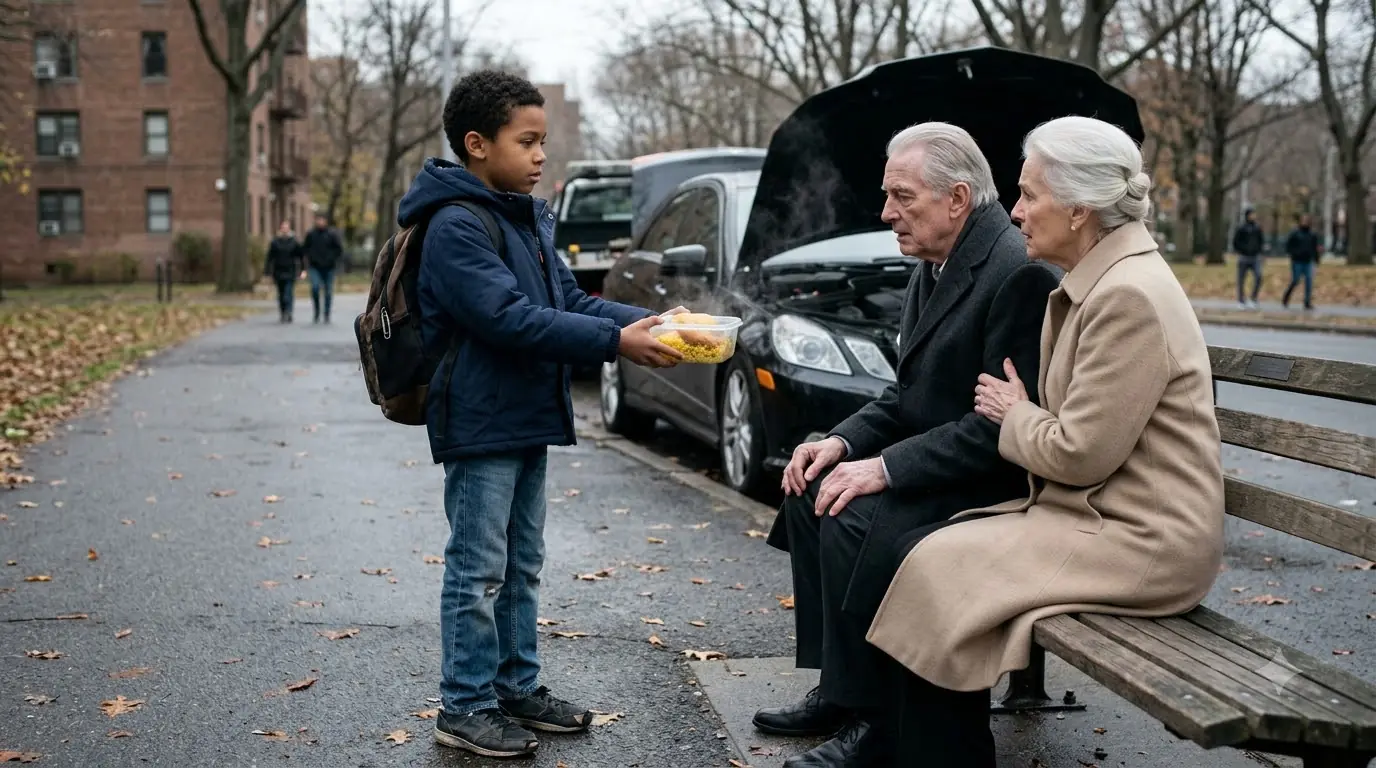
"Ma'am?" A small voice. A boy, nine years old, clutching a warm container against his chest.
"His sugar dropped. We've been here twenty minutes. No one stopped."
The boy looked down at the container. Steam curled through the lid. His stomach growled.
"Here." He held it out. All of it.
"Sweetheart, that's your dinner."
"He needs it more."
His fingers uncurled. The warmth left his hands. He didn't know that the man trembling on that bench had signed checks worth more than every building on that block combined. What knocked on his door the next morning stopped his mother cold.
Owen Taylor woke up every morning to the sound of pipes groaning behind the walls. The alarm clock on his nightstand had stopped working two years ago, but it didn't matter. His body knew. 5:45 every day.
The same creak of the mattress springs. The same cold floor under bare feet. He was nine years old, and he moved through the apartment like someone who had memorized every broken thing in it.
The third floorboard from the bathroom door, skip it or it screamed. The kitchen faucet, turn it left first, then right, or it sprayed sideways. The light above the stove, tap it twice. He didn't think about these things anymore. They were just part of breathing.
The apartment sat on the third floor of Building C, a five-story brick rectangle on Eastside's Linden Avenue. The hallway smelled like old carpet and fried onions. The elevator hadn't worked since before Owen was born. Three flights up every single day, and he never complained. Not once.
His mother, Diane Taylor, was already gone by the time he poured his cereal. She left at 4:30 for her first shift, pressing and folding at Park Lane Laundry on Fifth Street. By noon, she'd clock out, eat a granola bar in the parking lot, and drive eleven minutes to Rosetti's Italian Kitchen, where she prepped vegetables and washed dishes until 8:00. Sometimes 9:00. Sometimes 10:00 if the weekend crowd ran late.
Owen understood math, even if no one taught him. Two jobs meant the lights stayed on. Two jobs meant the rent check didn't bounce. Two jobs meant his mother's eyes carried shadows that never fully lifted, even when she smiled.
He made his own breakfast. Cereal if there was milk, toast with peanut butter if there wasn't. He packed his own lunch: half a sandwich, an apple if they had one, and a bottle of water filled from the tap. He locked the door behind him, checked it twice, and walked nine blocks to Jefferson Elementary.
At school, Owen sat in the third row, middle seat. He liked math. He liked reading. He didn't like recess much because recess was where the gaps showed.
His sneakers had a tear along the left toe that he'd glued shut with super glue three times. His backpack zipper was held together with a paperclip. His jacket, the only one he owned, was a size too small, and the sleeves stopped two inches above his wrists. Kids noticed. Kids always notice.
"Nice shoes, Owen. Did you fish those out of a dumpster?"
That was Kyle Whitfield. Blond hair, new Nikes every month, a father who drove a truck with chrome wheels. Kyle said things like that the way other people said good morning. Casual, automatic, thoughtless.
Owen didn't respond. He'd learned that silence was cheaper than a fight. Fights meant the principal's office. The principal's office meant a phone call.
A phone call meant his mother was leaving work early. Leaving work early meant less money. Less money meant a harder week.
So he said nothing. He smiled sometimes, not because it was funny, but because smiling cost nothing, and it confused people who expected tears.
After school, Owen walked home the long way, past the bakery where Mrs. Hendrix sometimes left day-old rolls by the back door, past the corner store where Mr. Gomez let him read comic books for free as long as he didn't bend the pages, and past Redmond Park, where the oak trees were tall enough to block out the apartment towers for a few seconds if you tilted your head right.
Home. Third floor. Keys out. Door open. Backpack on the chair.
He did his homework at the kitchen table, the same table where Diane paid bills on Sunday nights with a calculator and a face that looked like she was solving a problem that had no answer. Owen sometimes watched her from the hallway, the way her pen hovered over the checkbook, the way she'd close her eyes and breathe before writing a number.
He never asked for things. Not toys, not games, not the shoes Kyle Whitfield wore. He asked for one thing once, a book about space from the school book fair. Three dollars. Diane had given him the money without hesitation, but he'd seen her put back a box of cereal at the grocery store that same week. He never asked again.
Evenings were quiet. Diane came home tired, her hands smelling like lemon cleaner and garlic. She'd heat up whatever she'd managed to stretch: rice and beans, pasta with canned sauce, sometimes chicken thighs she got discounted from Rosetti's.
They ate together, always. That was the rule. No matter how late, no matter how tired. Owen set the table, Diane said grace, and for twenty minutes the apartment didn't feel small. It felt enough.
One night, Owen found his mother asleep on the couch, still in her work shoes, the TV murmuring the 10:00 news. He pulled the blanket from the back of the couch and draped it over her shoulders, tucked the edges around her feet, turned off the TV, and stood there for a moment in the dark, listening to her breathe.
He was nine. He carried things that most nine-year-olds never see.
That Thursday afternoon, Diane handed Owen a warm container and three dollar bills. "Mrs. Patterson's chicken and rice. Bring this home safe, baby." She kissed his forehead. He tucked the container under his arm and walked out into the gray afternoon.
He had no idea those words would mean more than either of them ever imagined.
The wind picked up around 4:30. Not the gentle kind that moves leaves, the kind that cuts through a jacket and finds your bones. Owen walked faster, the container warm against his ribs, the three dollar bills folded tight in his pocket.
He took his usual route through Redmond Park, past the rusted swings, past the basketball court with the bent rim, past the oak trees that blocked the apartment towers if you tilted your head just right.
That's when he saw the car. A black sedan parked crooked against the curb near the park entrance. Not the kind of car that showed up on Linden Avenue. This one was polished, long, with leather seats visible through tinted windows. The hood was propped open. A thin trail of steam curled upward and vanished into the gray sky.
Owen slowed. He didn't know anything about cars, but he knew that steam wasn't good. Then he heard the voice.
"Harold. Harold, stay with me."
An old woman sat on the park bench ten feet from the car. White hair pinned back, a wool coat buttoned to her chin. Her hands gripped the arm of the man beside her, an old man, tall even while sitting, but folded forward like a building losing its foundation.
His face was the color of candle wax. His lips moved, but no sound came out. His fingers shook against his thighs in a rhythm that had nothing to do with the cold.
Eleanor Bennett was seventy-two years old. Her husband, Harold, was seventy-five. Their driver, James, had gone to find a service station twelve minutes ago. Twelve minutes that felt like twelve hours.
Harold's blood sugar had been dropping since the car stalled. He'd felt it first in his hands, the tingling, then the trembling, then his vision blurred. Then his legs gave up their vote on standing.
Eleanor had tried to flag someone down. A woman in a jogging suit glanced over, then crossed the street. A young man with earbuds walked past without turning his head. A middle-aged man in a brown coat paused long enough to say, "Call 911," then kept walking as if the words themselves were the rescue.
No one stopped. Not in this neighborhood. Not for two old strangers sitting on a bench.
Owen stood twelve feet away, watching. The old man's hand slipped off his knee and hung limp at his side. The woman caught it, pressed it between both of hers, and whispered something Owen couldn't hear.
He looked down at the container under his arm. Mrs. Patterson's chicken and rice. The only dinner waiting for him tonight. His stomach had been talking to him since lunch. Half a peanut butter sandwich and a bottle of tap water.