The morning Darius Green first noticed Mr. Henry Lawson, Chicago was buried under a snowstorm that had made the whole neighborhood sound quieter than usual.
Cars sat along the curb like white lumps under thick blankets. The sidewalks had disappeared. The bare trees along 79th Street bent under ice, their branches shining in the pale morning light. Every few minutes, a snowplow growled past, pushing dirty snow toward the corners, leaving heavy ridges at the edge of driveways and crosswalks.
Darius was eleven years old, Black, skinny, and serious-eyed, with dark brown skin, close-cropped hair, and a blue winter coat that was too thin at the sleeves. His gloves did not match. One was black, one was gray, and both had small holes near the fingertips. His boots were worse. The right one had a split near the sole, and every time he stepped into deep snow, cold water crept inside.
Still, Darius was working.
He had borrowed a shovel from Mr. Perry on the first floor and was clearing sidewalks for neighbors who could pay a few dollars. His mother, Monica Green, worked nights at a hospital laundry department and mornings at a cafeteria. She had told him not to stay outside too long.
“Fifteen minutes at a time,” she said. “Then come back in and warm up.”
“Yes, ma’am.”
“And don’t be out there trying to be grown.”
“I’m just shoveling.”
“That is grown work when the snow is taller than your knees.”
But Darius wanted to earn money.
Not for candy.
Not for video games.
For boots.
There was a pair at the thrift store on Cottage Grove. Brown, sturdy, thick-soled, and almost new. They were twelve dollars, which felt both possible and far away. The woman at the store had said she could not hold them for long.
“Winter doesn’t wait, baby,” she told him.
Darius knew that already.
He had six dollars folded in a sandwich bag inside his coat pocket. By lunchtime, if enough neighbors needed help, maybe he could earn the rest.
He cleared Mrs. Alvarez’s front walk for two dollars.
He cleared the path to the basement laundry door for Mr. Perry for one dollar and a cup of hot tea.
He cleared half of Mrs. Jenkins’s steps before she opened the door and told him she could only pay him next week.
“That’s okay,” Darius said.
“It is not okay,” she replied, pressing a wrapped biscuit into his hand. “But it is what I have.”
He took the biscuit and thanked her.
By eleven o’clock, his socks were wet, his cheeks stung, and the sandwich bag in his pocket held nine dollars.
Three more.
He was dragging the shovel behind him, heading toward a row of small brick houses near the corner, when he saw the old man.
Mr. Henry Lawson lived in the narrow brick house with the black railing and the faded green mailbox. Darius had seen him before, but only from a distance. He was elderly, maybe late seventies or older, with deep brown skin, a white beard trimmed close to his jaw, and large glasses that made his eyes look thoughtful and sharp. He usually wore a dark wool cap and a long coat, even in weather that was not very cold.
Most people on the block knew his name but not much else.
Some said he had been a newspaper man.
Some said he had once traveled all over the country.
Some said he had boxes full of old photographs inside his house.
Darius had never spoken to him.
That morning, Mr. Lawson stood halfway out his front door, one hand gripping the doorframe and the other holding a cane. Snow covered his steps completely. A thick wall of plowed snow blocked the short path between his house and the sidewalk. His mailbox was nearly buried.
He looked down at the snow as if it were a locked gate.
Then he tried to step forward.
His cane sank.
Darius stopped moving.
The old man paused, breathing hard, then pulled the cane back. He looked toward the street. A few people passed on the opposite sidewalk, heads down, shoulders hunched against the cold. Nobody noticed him.
Or maybe they noticed and kept going.
Darius knew the difference did not matter much when you were the one standing stuck in your doorway.
He walked closer.
“Sir?” he called.
Mr. Lawson looked up.
“You all right?”
The old man gave a small smile.
“I am attempting to become all right.”
Darius stepped through the snow toward the gate.
“You need your steps cleared?”
“I need many things cleared,” Mr. Lawson said. “The steps would be a fine beginning.”
Darius looked at the house. The snow was deep and packed heavy near the walkway. It would take longer than the other jobs.
“Were you trying to go somewhere?” he asked.
“The pharmacy delivered yesterday, but the package is in the mailbox. I would prefer not to wait until spring to retrieve it.”
Darius glanced at the half-buried green mailbox.
“I can get it.”
Mr. Lawson looked at him carefully.
“You do not know me.”
“You live on the block.”
“That is not the same thing.”
“It’s close enough in snow.”
The old man’s smile widened slightly.
“That is a reasonable philosophy.”
Darius opened the gate and stepped inside. Snow slid over the tops of his boots immediately. Cold water touched his sock again, but he ignored it.
He cleared the first step, then the second, then the third. The snow was heavy, and his arms began to ache quickly. Mr. Lawson stood in the doorway watching him with the expression of someone who wanted to help but knew his body would not agree.
“You have a name, young man?” he asked.
“Darius Green.”
“Henry Lawson.”
“Yes, sir.”
“You say that like you already knew.”
“People talk.”
“That is unfortunate but useful.”
Darius smiled and kept shoveling.
By the time he cleared the steps, sweat had gathered under his hat despite the cold. He moved to the walkway, breaking the packed snow into chunks. His shovel scraped concrete. He liked that sound. It meant progress.
A man in a nice coat walked past and called, “You doing snow removal now, kid?”
Darius looked up.
“Trying.”
“I got ten dollars if you clear my driveway next.”
Darius froze.
Ten dollars.
Enough for the boots.
More than enough.
The man pointed toward a house two doors down. “But I need it now. I got to leave in thirty minutes.”
Darius looked at Mr. Lawson’s buried walkway.
Then at the man’s driveway.
Then at his own wet boots.
Mr. Lawson seemed to understand immediately.
“You may go,” he said. “I can manage from here.”
Darius looked at the mailbox still trapped behind a ridge of snow.
“No, you can’t.”
The man in the nice coat sighed.
“Kid, you want the job or not?”
Darius gripped the shovel.
He wanted the job.
He wanted dry feet.
He wanted those boots before someone else bought them.
But Mr. Lawson was still stuck inside his house, and the pharmacy package was still outside.
“I gotta finish this first,” Darius said.
The man shook his head.
“Suit yourself.”
He walked away.
Darius watched ten dollars disappear down the block.
Then he turned back to the snow.
Mr. Lawson said nothing for a while.
That somehow made it worse.
Darius shoveled harder.
By the time he reached the mailbox, his arms burned. He cleared around the post, opened the frozen metal door, and pulled out a small padded envelope. He carried it back to Mr. Lawson.
“Here.”
The old man took it with both hands.
“Thank you.”
“You should have somebody check on you in weather like this.”
“I had somebody,” Mr. Lawson said. “Time took most of them.”
Darius did not know what to say to that.
So he cleared the rest of the walkway.
When he finished, Mr. Lawson disappeared inside for a moment and returned with a five-dollar bill.
Darius shook his head.
“No, sir.”
“You worked.”
“I know.”
“Work should be paid.”
“You needed help.”
“That does not erase labor.”
Darius looked at the money.
Five dollars would help.
But he had seen the way Mr. Lawson held the pharmacy envelope. He had seen the old man’s thin hands and careful coat. He knew enough about grown-up life to understand that not every person with a house had money to spare.
“I got other jobs,” Darius said, though the best one had already walked away.
Mr. Lawson studied him.
“You are declining payment?”
“Yes, sir.”
“Because you think I cannot afford it?”
Darius’s face warmed despite the cold.
“I didn’t say that.”
“No. You were polite enough not to.”
“I just mean it’s okay.”
Mr. Lawson folded the bill slowly.
“Pride is a complicated thing, Darius Green.”
“Yes, sir.”
“I do not want yours injured, and you do not want mine injured.”
Darius shifted his weight.
The old man looked back inside his house, then returned with something else.
It was a photograph.
Black and white.
Small.
A picture of a street after snow, sunlight touching the tops of parked cars, a child’s footprints crossing the sidewalk, and an old woman in the distance sweeping her steps. It looked ordinary and beautiful at the same time.
Darius stared at it.
“You took this?”
“Many years ago.”
“It looks real.”
“That is usually the goal.”
“No, I mean…” Darius searched for the words. “It looks like the street is telling you something.”
Mr. Lawson’s face changed.
His eyes sharpened with interest.
“That,” he said softly, “is the first intelligent thing anyone has said about my photographs in a long while.”
Darius looked embarrassed.
“I didn’t mean anything fancy.”
“Fancy is often where truth goes to hide.”
Mr. Lawson handed him the photograph.
“Take this instead.”
“I can’t take your picture.”
“You can. It is a print, not the last memory on earth.”
Darius held it carefully.
“Why?”
“Because you noticed the old man in the doorway. Perhaps you will notice other things too.”
Darius looked down at the picture again.
“What am I supposed to do with it?”
“Look at it,” Mr. Lawson said. “Then look at the world. Compare the two.”
That was how their friendship began.
Darius did not get the boots that week.
When he finally reached the thrift store with enough money three days later, the brown boots were gone. The woman behind the counter looked sorry.
“I told you winter doesn’t wait.”
Darius nodded.
“I know.”
He walked home in his old boots with wet socks and the black-and-white photograph tucked safely inside his coat.
He should have felt foolish.
Instead, he kept thinking about the picture.
The street is telling you something.
A week later, he saw Mr. Lawson again. The old man was sitting on his front steps, wrapped in a heavy coat, watching the block. Darius was coming home from school with his backpack dragging one shoulder down.
Mr. Lawson lifted a hand.
“Darius Green.”
“Mr. Lawson.”
“Did you look at the photograph?”
“Yes, sir.”
“And?”
Darius hesitated.
“I saw more stuff the longer I looked.”
“Such as?”
“The old woman sweeping. The footprints. The way the cars look stuck but the footprints keep going.”
Mr. Lawson nodded slowly.
“Good.”
Darius shifted on the sidewalk.
“Were you really a photographer?”
“I was.”
“For a newspaper?”
“Among other things.”
“You took pictures of famous people?”
“A few.”
“Like who?”
Mr. Lawson smiled.
“The less interesting ones usually had the bigger entourages.”
Darius laughed.
Mr. Lawson looked toward the house.
“I have tea, if your mother permits you to drink tea in the presence of old men.”
“My mother permits tea. She does not permit foolishness.”
“A wise policy.”
Darius called his mother first from Mr. Lawson’s landline because Monica Green believed children should not simply disappear into old men’s houses, no matter how polite the old men seemed. She asked questions. Mr. Lawson answered them. He gave his full name, address, former employer, and the name of Mrs. Jenkins across the street as someone who could confirm he was not “some strange mess,” as Monica put it.
Only after that did she allow Darius to stay for twenty minutes.
Mr. Lawson’s house was warm and crowded with memories.
Not messy.
Crowded.
There were bookshelves, framed photographs, old cameras, newspaper clippings, and boxes labeled by year. A large wooden desk sat near the front window, facing the street. Beside it stood a black camera on a tripod, covered with a cloth.
Darius stopped in the doorway.
“You got a museum in here.”
Mr. Lawson chuckled.
“No. Museums have funding.”
On the walls were pictures of Chicago streets, church picnics, train stations, diners, barbershops, children jumping rope, women in Sunday hats, men holding protest signs, snow-covered porches, bus stops, firefighters, weddings, funerals, and faces that looked straight at the camera as if they trusted the man behind it.
Darius moved slowly from one photo to another.
“These people all famous?”
“Most of them were not.”
“Then why take their picture?”
Mr. Lawson set two mugs of tea on the table.
“Because being famous is not the same as being important.”
Darius turned toward him.
That sentence stayed with him.
He did not know it yet, but it would become one of the beams inside his life.
Over the next few years, Darius became a regular visitor at Mr. Lawson’s house.
At first, he went to help.
He shoveled snow.
Carried groceries.
Changed lightbulbs.
Picked up mail.
Took out trash.
Helped organize boxes that were too heavy for Mr. Lawson to lift.
But slowly, the visits became lessons.
Mr. Lawson taught Darius how to hold a camera.
Not just physically.
Morally.
“A camera is not a weapon,” he said one afternoon, placing an old film camera in Darius’s hands. “It should not be used to steal dignity from people.”
“How do you steal dignity with a camera?”
“By making people look smaller than they are. By catching only their worst moment and pretending it is their whole life. By taking without asking when asking is possible.”
Darius looked at the camera.
“So what should it do?”
“Pay attention honestly.”
Mr. Lawson taught him about light, distance, patience, framing, timing, and waiting until the person in front of the lens had room to be human.
He taught him to notice hands.
“Hands tell the truth when faces are busy performing.”
He taught him to look at backgrounds.
“A good photograph knows the subject is not floating in empty air. People belong to places.”
He taught him to write dates on the backs of prints.
“Memory is powerful, but it becomes stronger when it has evidence.”
Darius listened.
At thirteen, he took his first good photograph.
It was of his mother at the kitchen table, still wearing her cafeteria apron, laughing with one hand over her mouth while steam rose from a pot of rice behind her. He had not meant to take anything special. He had simply seen her laughing and pressed the button.
When he showed the print to Mr. Lawson, the old man held it under the lamp for a long time.
“This is love without decoration,” he said.
Darius felt proud for three days.
At fourteen, Darius began taking pictures for neighbors.
Birthday parties.
Church dinners.
Graduation cookouts.
A new baby coming home.
An old couple’s fiftieth anniversary.
He never charged much. Sometimes people paid him in cash. Sometimes food. Sometimes nothing but thanks. Mr. Lawson made him keep a notebook anyway.
“Every job deserves a record.”
“Even free ones?”
“Especially free ones. Free work can still be serious work.”
By fifteen, Darius had become the unofficial photographer of the block.
People called him when they wanted something remembered.
He liked that.
He liked being trusted with memory.
But he also learned that carrying a camera did not make people see him clearly.
At school, some teachers praised him. Others treated photography like a hobby he should not take too seriously. One counselor told him, “It is good to have creative interests, but you need practical options.”
Darius knew about practical options.
His mother was made of practical options.
But he also knew what happened when practical people had no one to tell their stories.
They became invisible.
Mr. Lawson understood.
“Do not let anyone convince you that noticing is not work,” he said.
At seventeen, Darius entered a citywide youth photography competition.
The prize was not just a trophy. It included a summer mentorship at a major newspaper, a scholarship fund, and a chance to have a photo essay displayed in a public gallery downtown.
Darius almost did not apply.
The entry fee was small but annoying.
The application required an artist statement, which sounded like something designed to embarrass him.
And the other students applying came from art schools, magnet programs, and neighborhoods where kids had expensive cameras and teachers who knew the names of famous photographers.
Darius had an old camera, a bus pass, and Mr. Lawson.
“Apply,” the old man said.
“You haven’t even seen the application.”
“I have seen you.”
Darius rolled his eyes.
“That sounds like something from a movie.”
“Many true things are ruined by bad movies. Apply anyway.”
So he did.
His photo essay was called The Block Holds.
It showed ordinary people holding ordinary life together: Mrs. Jenkins placing salt on icy steps, his mother packing lunch at dawn, Mr. Perry fixing a bicycle chain for a child, a young father braiding his daughter’s hair on the porch, teenagers carrying groceries for an elder, church ladies serving soup from big silver pots, and Mr. Lawson’s hands labeling an old photograph.
The strongest image, according to his teacher, was the last one.
It showed Mr. Lawson sitting by his front window at sunset, light touching his white beard, his old camera resting on the desk beside him. He was not smiling. He was looking out at the street with a gaze that seemed to hold fifty years of memory.
Darius called the picture Witness.
Mr. Lawson pretended not to like it.
“You made me look ancient.”
“You are ancient.”
“Rude.”
“But important.”
The old man looked at the print again.
Then he said softly, “Submit it.”
Darius submitted the essay.
Weeks passed.
Then the call came.
He was a finalist.
Monica screamed so loudly that the neighbor upstairs knocked on the floor.
Darius tried to act calm but failed completely. Mr. Lawson smiled when he heard the news, then immediately asked to see the printed finalist notice.
“Why?” Darius asked.
“So I can inspect whether they spelled your name correctly. Institutions love misspelling the names of people they claim to honor.”
They had spelled it correctly.
The finalist exhibition took place at a downtown arts center with white walls, polished floors, and people who spoke softly while holding tiny cups of coffee. Darius wore a borrowed blazer from Mr. Perry’s nephew. Monica wore her best dress and kept smoothing the front as if worry could wrinkle fabric. Mr. Lawson arrived with a cane, a dark suit, and a camera hanging from his neck.
“You brought a camera to a photo show?” Darius asked.
“I bring my eyes everywhere too.”
Darius laughed.
For most of the evening, everything felt unreal.
His photographs were on the wall.
People stood in front of them and read the captions.
Some nodded seriously.
Some asked questions.
One woman from the newspaper told him his work had “rare emotional restraint,” which he did not understand until Mr. Lawson whispered, “It means you did not make poor people look pitiful for applause.”
Darius smiled at that.
But near the end of the evening, everything changed.
A man in a gray suit approached the competition director, then glanced toward Darius. The director’s face tightened. She looked at a tablet, then at the wall where Witness hung.
Within minutes, Darius was asked to step into a small office near the back.
His mother came with him.
So did Mr. Lawson, though nobody had invited him.
The director, Ms. Bell, looked uncomfortable.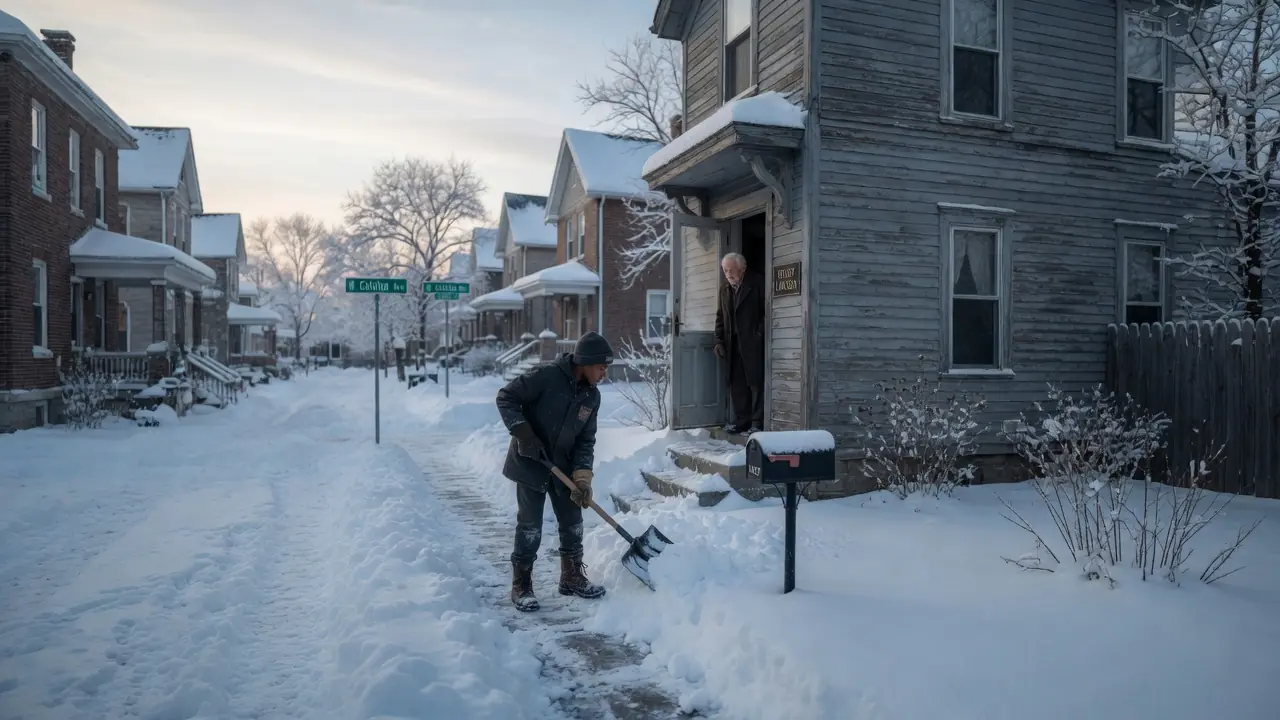
“Darius,” she said, “we received a concern regarding your final image.”
“My image?”
“Yes. Witness.”
Darius looked at the tablet in her hand.
A second man, one of the judges, cleared his throat.
“We have been shown an archival photograph from a private collection that appears very similar to your submitted work.”
Darius stared at him.
“What?”
Ms. Bell turned the tablet around.
On the screen was a black-and-white photograph of Mr. Lawson, much younger, seated by a window with a camera on a desk. The composition was similar: window, camera, man in profile, evening light.
Below it was a message from someone claiming Darius had copied or recreated an existing photograph without disclosure. The accusation was careful but sharp.
It suggested dishonesty.
It suggested manipulation.
It suggested Darius had staged his strongest image from someone else’s work and presented it as original documentary photography.
Monica’s face hardened.
“My son did not cheat.”
The judge raised both hands.
“No one is making a final determination tonight. But given the seriousness—”
“Seriousness?” Darius repeated.
His mouth had gone dry.
He looked at the old photograph on the tablet.
He had never seen it before.
But it did look similar.
Not identical.
Similar enough to make his stomach drop.
The director spoke gently.
“We may need to pause your award consideration until this is reviewed.”
Darius felt heat rise behind his eyes.
Outside the office, he could hear people still talking near the gallery walls, still admiring photographs, still living in the world where his name had not just become a question mark.
He looked at Mr. Lawson.
The old man was staring at the tablet.
Not shocked.
Not confused.
Angry.
Quietly, deeply angry.
“Where did this come from?” Mr. Lawson asked.
The judge looked at him.
“And you are?”
“Henry Lawson.”
The judge blinked.
“The subject of the photograph?”
“The subject of both photographs. And the maker of the old one.”
The room went still.
Ms. Bell looked at the tablet again.
“You took this archival image?”
“I did.”
The judge adjusted his glasses.
“Then perhaps you can understand our concern. If Darius had access to your archive—”
“He did not have access to that image,” Mr. Lawson said.
His voice had changed. It was still calm, but it carried weight.
The kind of weight that made people stop interrupting.
“That photograph was taken in 1978 by remote release while I was testing light for a portrait series. It was never published. It has been in a sealed contact box for decades.”
“Then how did someone get it?” Ms. Bell asked.
Mr. Lawson’s jaw tightened.
“My nephew has been digitizing parts of my archive without understanding what stewardship means.”
Darius looked at him, stunned.
Mr. Lawson continued.
“But the more important issue is this: similarity is not theft. A young photographer took a truthful image of an old photographer in his own home, in the room where he has sat for many years. Of course the room remembers its own shape.”
The judge looked uncertain.
“We still need verification.”
“You shall have it.”
Mr. Lawson turned to Darius.
“Call my house.”
“What?”
“Call Mrs. Jenkins. Tell her to bring the red archive box from the lower left shelf. The one labeled Self-Portraits and Tests. Tell her to bring the small envelope on my desk as well.”
Darius stared.
“Now?”
“Yes, now.”
Monica pulled out her phone and made the call because Darius’s hands were shaking too hard.
Mrs. Jenkins answered on the third ring, listened, asked no unnecessary questions, and said, “I’ll get my son to drive me.”
The next forty minutes felt longer than the whole winter morning when Darius first shoveled Mr. Lawson’s walkway.
He sat in the office beside his mother, unable to stop hearing the word pause.
Pause your award consideration.
Pause your future.
Pause your name before it gets too close to something good.
Mr. Lawson sat across from him, both hands folded over his cane.
“Look at me,” the old man said.
Darius looked up.
“You know what you made.”
“I know.”
“Then breathe like it.”
“I can’t.”
“You can. You are simply refusing because panic feels more urgent.”
Darius almost laughed despite himself.
Monica reached for his hand.
“I believe you,” she said.
“I know.”
“No. Hear me. I believe you before anybody proves anything.”
That was the sentence that kept him from breaking.
Mrs. Jenkins arrived with her son, carrying the red archive box like it contained legal evidence, which in a way it did.
Mr. Lawson asked Ms. Bell to clear the table.
Then he opened the box.
Inside were contact sheets, negatives, notes, and old prints organized in sleeves. Every page was dated. Every test image had markings. The 1978 photo was there, along with the full series showing Mr. Lawson adjusting the camera, testing exposure, changing positions, and writing notes about the window light.
“This establishes the older image,” the judge said.
Mr. Lawson gave him a look.
“I am not finished.”
He opened the small envelope from his desk.
Inside were photographs Darius had taken over the years.
Early prints.
His mother laughing at the kitchen table.
Mrs. Jenkins salting steps.
Mr. Perry with a bicycle wheel.
Mr. Lawson’s hands labeling a photograph.
And several test shots leading up to Witness.
Not just the final image.
The whole process.
There were frames where Mr. Lawson was reaching for tea. Frames where the light was too dark. Frames where the camera on the desk was cut off. Frames where Darius had stepped too close. Frames where Mr. Lawson looked annoyed. Frames where the final composition gradually appeared through trial and adjustment.
Mr. Lawson placed them in order.
“Here is the young man’s work,” he said. “Not an imitation. A process.”
Ms. Bell leaned over the table.
The judge said nothing.
Mr. Lawson then removed one final item.
It was the black-and-white photograph he had given Darius years ago, the snow-covered street with the old woman sweeping her steps. On the back, in Mr. Lawson’s handwriting, was a date and a note.
Given to Darius Green after he cleared my walkway and refused payment. First conversation about seeing.
Mr. Lawson placed it beside Witness.
“This boy did not enter my house to steal my past,” he said. “He entered because he shoveled snow for an old man no one else stopped to help. He earned lessons with patience, labor, and attention. He has carried mail, groceries, boxes, cameras, and more memory than most adults in this room would know what to do with.”
Darius looked down.
His eyes burned.
Mr. Lawson’s voice grew stronger.
“If you disqualify him, do it because the work fails. Do not do it because someone found an old picture and mistook influence for dishonesty. Every artist has ancestors. Darius Green had the decency to sit with his.”
The room went silent.
Ms. Bell looked at Darius.
“I am sorry,” she said quietly. “We had to review the concern, but this is clear.”
The judge nodded.
“Your submission stands.”
Darius let out a breath he had been holding for what felt like years.
Monica squeezed his hand so hard it hurt.
Mr. Lawson gathered the prints slowly.
“Good,” he said. “Now perhaps we can return to pretending tiny coffee is a meal.”
Darius laughed then.
He could not help it.
He laughed with relief, anger, embarrassment, and gratitude all mixed together.
Later that evening, Darius won first place.
When his name was announced, Monica stood before anyone else. Mrs. Jenkins clapped so hard her bracelets rattled. Mr. Perry shouted, “That’s our boy!” in a room where people had been speaking softly all night. Mr. Lawson remained seated, but his smile was wide and proud.
Darius walked to the front in his borrowed blazer.
The award felt heavy in his hands.
The director invited him to say a few words.
He had not prepared anything.
He looked out at the room.
At his mother.
At Mr. Lawson.
At the photographs on the wall.
Then he said, “When I was eleven, I shoveled snow for Mr. Lawson because he was stuck in his doorway. I thought I was just clearing steps. But he gave me a photograph and taught me that ordinary people are important before anybody calls them important.”
The room grew still.
“He taught me that a camera should not steal dignity. It should pay attention honestly. My mother taught me that work matters even when nobody claps for it. This photo essay is about people who hold up a block without asking to be famous.”
He looked toward Mr. Lawson.
“And tonight, I learned something else. Sometimes the people you help become the people who can speak for you when others doubt your name.”
His voice shook slightly.
“So thank you, Mr. Lawson. For the photograph. For the lessons. For keeping the proof.”
Applause filled the room.
Mr. Lawson looked down at his cane, but Darius saw him wipe one eye behind his glasses.
The summer mentorship changed Darius’s life.
He worked at the newspaper five days a week, learning from photographers, editors, archivists, and reporters. He learned how captions could honor or flatten a person. He learned how photographs were selected, cropped, printed, and misunderstood. He learned that truth needed both heart and structure.
He also learned that being talented did not protect him from doubt.
But now he knew how to answer doubt.
With process.
With proof.
With people who knew the path he had taken.
Before Darius left for college two years later, Mr. Lawson called him over to the house.
The old man’s steps had slowed. His hands shook more than they used to. But his mind was still bright.
On the desk sat a small camera bag.
Darius frowned.
“What’s that?”
“A camera.”
“I can see that.”
“Then why ask?”
“Because you’re doing that thing where you act casual before giving me something too big.”
Mr. Lawson smiled.
“You have become suspicious. Good.”
He opened the bag.
Inside was the old film camera Darius had first learned on.
Not the most expensive camera in the house.
Not the rarest.
The first one.
“I want you to take this with you,” Mr. Lawson said.
Darius shook his head.
“No.”
“Yes.”
“You still use it.”
“I have many cameras.”
“This one matters.”
“That is why it should keep working.”
Darius touched the worn strap.
“I don’t know what to say.”
“Say you will not become impressed with yourself.”
Darius laughed.
“I will not become impressed with myself.”
“Say you will photograph people as if they might one day sit across from you and ask why you showed them that way.”
Darius stopped laughing.
“I will.”
“Say you will come back sometimes.”
Darius swallowed.
“I will.”
Mr. Lawson nodded.
“Then take the camera.”
Darius did.
No fortune changed hands.
No building opened.
No sign went up.
But the camera felt heavier than any prize he had ever held.
Mr. Lawson passed away during Darius’s sophomore year of college.
The call came from Mrs. Jenkins on a rainy Thursday evening.
Darius sat on the edge of his dorm bed for a long time afterward, the old camera bag at his feet.
Grief did not feel like a photograph.
It did not freeze anything.
It moved through him instead, changing the shape of every memory it touched.
At the memorial, the church basement was filled with pictures. Mr. Lawson’s photographs lined the walls: street corners, families, workers, children, elders, musicians, bus stops, snowstorms, summer porches, and ordinary faces made unforgettable by attention.
People stood in front of them telling stories.
“He took my wedding picture.”
“He photographed my father’s barbershop.”
“He gave me a print when my mother passed.”
“He made us look like we mattered.”
Darius stood near the back, listening.
Monica came beside him and slipped her hand into his.
“You okay?”
“No.”
She nodded.
“That’s honest.”
After the service, Mrs. Jenkins handed him an envelope.
“He left this for you.”
Inside was a letter written in Mr. Lawson’s steady, slanted hand.
Darius Green,
If you are reading this, I have finally stopped arguing with my knees.
Do not make me sound wiser than I was. I wasted time, misjudged people, lost patience, and took some bad photographs. Keep that in mind when you tell stories about old men.
You once cleared snow from my steps and refused five dollars I could afford to give but did not know how to make you accept. So I gave you a photograph. It turned out to be a better bargain for both of us.
You noticed before you understood what noticing would cost.
That is the work.
People will doubt you. Some because they doubt everyone. Some because they cannot imagine a boy from your block making beauty without permission. Do not answer every fool. But keep your negatives. Keep your notes. Keep your witnesses close. Process is armor for truth.
Most of all, remember this: the photograph is not the person. It is only a doorway. Treat every doorway with respect.
The red archive box is yours when Mrs. Jenkins is ready to release it. Not because you own my memories, but because I trust you to protect them until they can teach someone else.
Pay attention honestly.
H.L.
Darius read the letter once.
Then again.
Then he folded it carefully and placed it in the camera bag.
Years later, when people asked Darius why he became a documentary photographer, he never began with the award.
He began with snow.
He told them about wet boots, a borrowed shovel, and an old man stuck in a doorway.
He told them about the ten-dollar job he lost and the five dollars he refused.
He told them about a black-and-white photograph of a street that seemed to be telling him something.
He told them that kindness did not come back as a miracle.
It came back as mentorship.
As discipline.
As evidence.
As an old man who had kept every print and date because he understood that memory needed protection.
Darius built a career slowly. He photographed neighborhoods, workers, elders, schools, kitchens, block parties, bus stops, and family rituals people often overlooked. His work appeared in newspapers, magazines, books, and galleries. But he remained careful.
He never photographed someone’s hardship without asking what else in their life deserved to be seen.
He never used poverty as decoration.
He never forgot that being famous was not the same as being important.
One winter, many years after Mr. Lawson’s passing, Darius returned to 79th Street for a community photography workshop. He brought cameras, printed examples, and a box of old contact sheets from Mr. Lawson’s archive.
The room was full of teenagers, most of them restless, some curious, a few pretending not to be either.
A boy in the back raised his hand.
“Why should we take pictures of regular stuff? Like, if nobody famous is there?”
Darius smiled.
He had once asked the same question.
He looked at the boy, then at the contact sheet in his hand.
“Because regular stuff is where most of life happens,” he said. “And most of life deserves a witness.”
He passed around copies of Mr. Lawson’s snow photograph.
The one from the beginning.
The street.
The footprints.
The old woman sweeping.
The students looked at it.
At first, they saw snow.
Then they saw more.
Darius watched their faces change one by one.
That was the moment he loved most.
The moment someone began to notice.
After the workshop, he walked down the old block alone. Snow had fallen that morning, soft and light. Mr. Lawson’s former house had new curtains now. The railing had been painted black again. The mailbox was no longer green.
Darius stood at the gate for a moment.
He could almost see the old man in the doorway.
One hand on the frame.
One hand on the cane.
Waiting for someone to notice.
A neighbor across the street was struggling with a shovel, trying to clear heavy snow from her steps while a little boy stood beside her in mismatched gloves.
Darius smiled.
He walked over.
“Need a hand?”
The woman looked up, surprised.
“Oh, no, I couldn’t ask—”
“You didn’t,” Darius said, taking the shovel gently. “I offered.”
The little boy watched him.
Darius cleared the steps carefully, the shovel scraping concrete.
That sound still meant progress.
When he finished, the woman thanked him, and the little boy stared at the camera hanging from his shoulder.
“You take pictures?” the boy asked.
Darius nodded.
“Sometimes.”
“Of famous people?”
Darius looked down the block, at the snow, the windows, the footprints, the ordinary world holding more stories than it could ever tell at once.
“Sometimes,” he said. “But mostly important ones.”
The boy frowned.
“What’s the difference?”
Darius smiled.
Then he gave the answer Mr. Lawson had given him years before.
“Being famous is not the same as being important.”
The boy thought about that.
Darius hoped the sentence would stay with him.
Some sentences were like seeds.
Some photographs were like doors.
Some acts of kindness were like footprints in snow, easy to miss if nobody looked in time, but powerful enough to show where a life had changed direction.
And Darius Green, who had once chosen an old man’s walkway over his own dry boots, knew that the smallest path cleared for someone else could one day become the road that carried you forward.