At the bus stop, a small boy from the poorest block froze as the driver barked, "No pay, no ride," and slammed the door in the face of an elderly woman trembling in the snow after losing her purse.
Despite having only $5, he still couldn't ignore the cruelty unfolding in front of him.
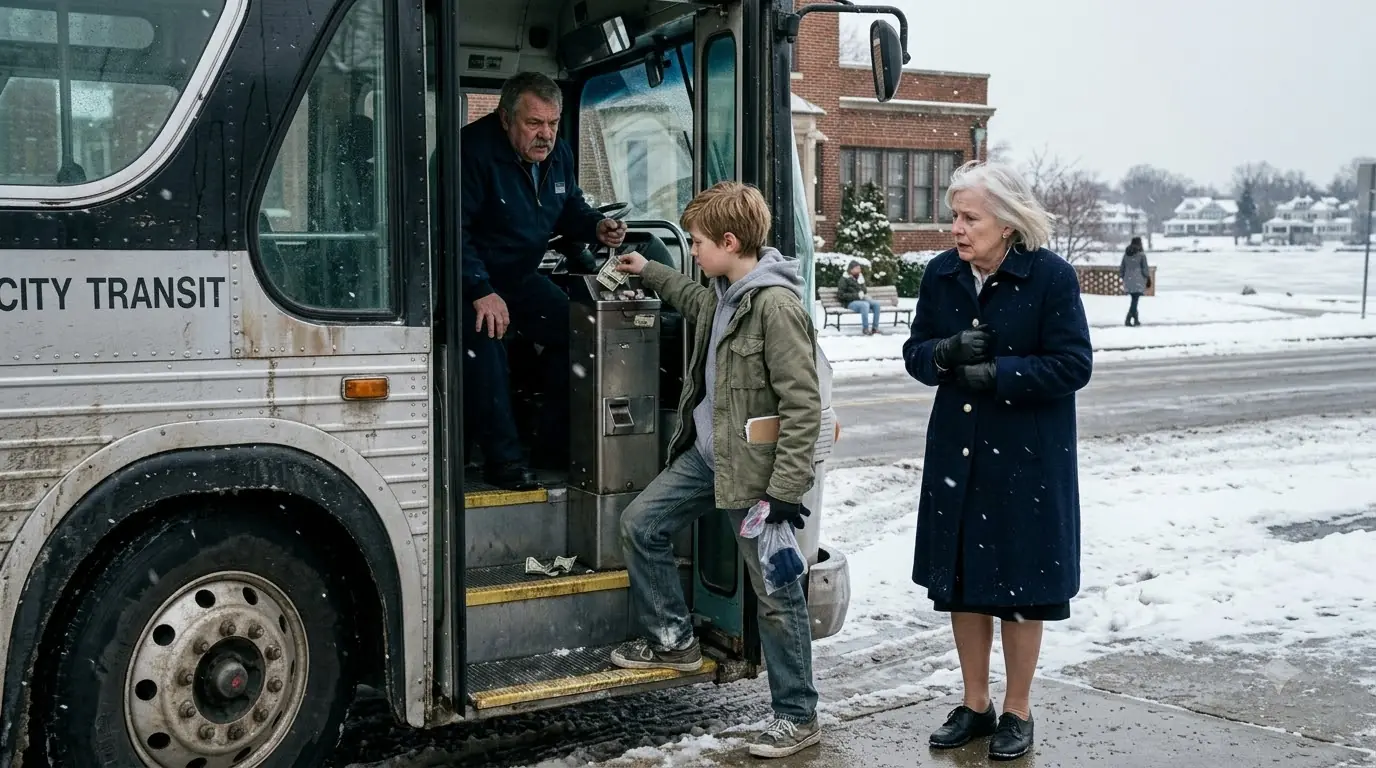
So, he made a choice. He stepped forward and paid for the stranger. T
hat single act of courage would change everything because the woman he helped was the mother of one of the richest men in the state. And when that billionaire learned what happened, his entire world was about to be turned upside down.
Twelve-year-old Tommy Reed stood on the corner of the wealthiest street in Riverside, clutching a worn notebook in one hand and his bus fare in the other. He watched the sleek cars glide by, wondering if anyone inside them ever worried about how they would get home. The January wind in Riverside was different than the wind in Millbrook. Here on the wide avenues lined with oak trees and wrought-iron gates, the breeze carried the smell of wood smoke from fireplaces and the faint scent of expensive evergreens. It whispered through bare branches with a polite reserve even as the sky darkened with the promise of snow.
In Millbrook, where Tommy lived, the wind had teeth. It howled through window cracks and carried the metallic bite of coming storms and the diesel smell of buses that never ran on time. Tommy tightened his grip on the plastic grocery bag he carried. Inside were his father's work gloves, forgotten on the kitchen counter that morning. His father, Robert, was still at the construction site three blocks behind the mansion, working a double shift in the freezing cold.
Robert had been an office worker until six months ago, a data analyst who could find patterns in numbers the way other people found shapes in clouds. But his manager had made sure that talent went unrewarded. When Robert's cost-saving analysis threatened to make his boss look incompetent, the termination paperwork appeared within a week. "Performance issues," it claimed. A lie that stuck like tar.
So Robert took whatever work he could find. His hands, meant for keyboards, now gripped shovels and hammers. The work was hard, the pay worse, but it kept the lights on. Barely.
Tommy adjusted his thin jacket against the wind. He was small for 12, with sandy brown hair and watchful green eyes. He checked the time on his old watch. The number 40 bus was due in three minutes. If he missed it, he would have to walk four miles in the dark, and his mother needed her evening medication by six.
The bus stop sat at the borderline between two worlds. Behind him, the Riverside mansions stood proud on the hill. Ahead, the road sloped down toward the highway, the factories, and the row houses where people like Tommy lived. He wasn't alone at the stop. An older woman sat on the far end of the bench, looking like a piece of fine porcelain left out in the weather.
She wore a coat that had once been expensive, navy wool with pearl buttons, but now it looked rumpled and soiled at the cuffs. Her white hair was pinned up, though strands had escaped and blew across her forehead. She sat with rigid posture, her gloved hands folded in her lap, staring at the street sign as if it held answers to questions she couldn't remember. Tommy studied her from the corner of his eye. She didn't belong here.
The number 40 carried tired nurses, construction workers, and people like Tommy who were invisible to the rest of the world. This woman looked like she belonged in one of those mansions on the hill. Yet here she sat, shivering as the temperature dropped and the first snowflakes began to fall. The woman suddenly patted her coat pockets with urgency. She looked down at the ground, then at the empty bench beside her. Her movements became frantic.
"Ma'am," Tommy said quietly, "are you okay?"
The woman turned to him, startled. Her eyes were sharp and intelligent, a striking pale blue, but clouded with confusion.
"My bag," she said. Her voice was refined, cultured, but edged with fear. "I had a handbag. I know I did. I set it down somewhere."
Tommy looked around the empty sidewalk. "Did you maybe leave it where you were walking?"
"I went to see the gardens," the woman said, her voice faltering. "The winter gardens at the Riverside Botanical Center. They were beautiful. I just kept walking."
"I must have... I don't know. I can't remember." She pressed a gloved hand to her forehead. "My phone, my wallet, everything."
Before Tommy could respond, the diesel engine of the number 40 rumbled around the corner. The bus was a scarred beast, rust-streaked and grimy. The doors hissed open, and the driver glared down at them. His name badge read Gus.
Tommy knew Gus. Everyone knew Gus. He didn't wait, didn't smile, didn't care.
"Let's go," Gus barked. "I'm behind schedule."
The woman stood shakily and approached the steps. "Sir," she said, trying to maintain dignity, "I seem to have lost my purse. If you could just..."
"No pay, no ride," Gus cut her off with a harsh laugh. "Read the sign, lady."
The woman's face flushed. "I'm not asking for charity. I'm in distress. If you could just..."
"Three bucks or hit the pavement. Your choice."
The cruelty hit Tommy like a punch. He watched the woman shrink, watched her step backward as if pushed. It wasn't just embarrassment. It was shock, the shock of being treated like garbage. The woman stepped back onto the curb.
"I see," she whispered. "I apologize for the delay."
Gus snorted, reaching for the door lever.
"Wait." Tommy's voice was louder than intended. He stepped forward, jamming his foot between the closing doors.
"Get your foot out of there, kid!" Gus yelled.
Tommy didn't move. His heart hammered as he reached into his pocket, feeling for the bills and coins. Five dollars, his mother's medication co-pay, the milk money, everything. But watching this woman being cast out into a January night felt worse than an empty refrigerator.
He climbed the steps and dropped the money into the fare box. The coins clattered loudly. "That's for both of us," Tommy said, looking Gus in the eye.
Gus stared at the money, then grunted. "Whatever. Sit down."
Tommy turned back to the woman. He extended his hand. "Come on. It's okay."
The woman looked at his hand as if it were the most precious thing she'd ever seen. Her eyes glistened. She took his hand, soft, papery, cold, and let him help her up the steps.
The bus lurched forward. Tommy guided her to a seat in the middle, away from the noise in back and Gus's glare up front. They sat on cracked vinyl. The bus smelled of wet wool and tired people. Outside, snow fell harder.
"You didn't have to do that," the woman said. "That was your money."
"It's just money," Tommy said, though his stomach knotted thinking about dinner. "My dad always says nobody should be left behind when they need help."
The woman studied him. "What's your name?"
"Tommy. Tommy Reed."
"I'm Margaret," the woman said, extending her hand. "Margaret Hartley."
They shook hands solemnly.
"Why is a 12-year-old riding the bus alone?" Margaret asked softly.
"My mom's home sick. She has MS. Today's not a good day, so I'm heading home to make dinner and give her medicine."
Margaret's expression flickered. "And your father?"
"Still working. Construction. He used to work in an office, but he got laid off."
"I see." Margaret's voice went quiet.
They rode in silence, watching the landscape change as the bus descended into neighborhoods where houses pressed close together. Snow fell in earnest now, coating everything white.
"This is my stop," Tommy said as the bus slowed near Maple and Third. He gathered his bag, then looked at Margaret's pale, confused face. "Where are you going?"
"The downtown terminal, I suppose," Margaret said uncertainly. "I can find a phone there."
Tommy bit his lip. He knew the downtown terminal. At night it filled with danger. The thought of sending this lost woman there made his stomach clench.
The bus stopped. The doors hissed open, cold air rushing in. Margaret stood to follow him off. As her feet touched the curb, she suddenly swayed, gripping the pole. Her face went pale. Her breathing became rapid.
"Ma'am." Tommy dropped his bag and grabbed her arm. "Are you okay?"
"I just... I feel dizzy. Lightheaded." Margaret pressed her hand to her chest, breathing hard. "The cold, I think. I just need a moment."
Tommy looked around frantically. Snow fell thick now, wind picking up. Margaret was shaking, either from cold or shock or both. The bus pulled away, leaving them on the dark street corner.
"My house is right there," Tommy said, pointing half a block down. "Please, just come inside. You need to sit down and get warm."
"I couldn't..." Margaret started.
"Please." Tommy's voice was urgent. "You're not okay. It's not safe."