Ethan never expected a simple act of kindness to change his life forever. After working late at the company banquet, he found his wealthy CEO, Victoria Hale, sitting alone in the parking lot drunk, heartbroken, and unable to drive. While everyone else walked away, Ethan quietly took responsibility and brought her home safely. The next morning, Victoria woke up confused but unharmed.
As Ethan prepared to leave, she stared at him for a long moment before asking a question that made his heart stop. Have we met before? Neither of them knew that one forgotten night from years ago was about to rewrite both their futures. There are people who exist in a company the way furniture exists in a room: useful, unnoticed, and easy to overlook.
Ethan Cole was one of those people, 38 years old with calloused hands and a name badge that simply read maintenance. He arrived every morning before the sun finished rising and left long after the executive floors had gone dark. He fixed broken pipes, replaced flickering light bulbs, patched drywall in the conference rooms, and repainted the lobby walls when management decided they wanted a slightly different shade of gray. He did all of this without complaint and without ceremony.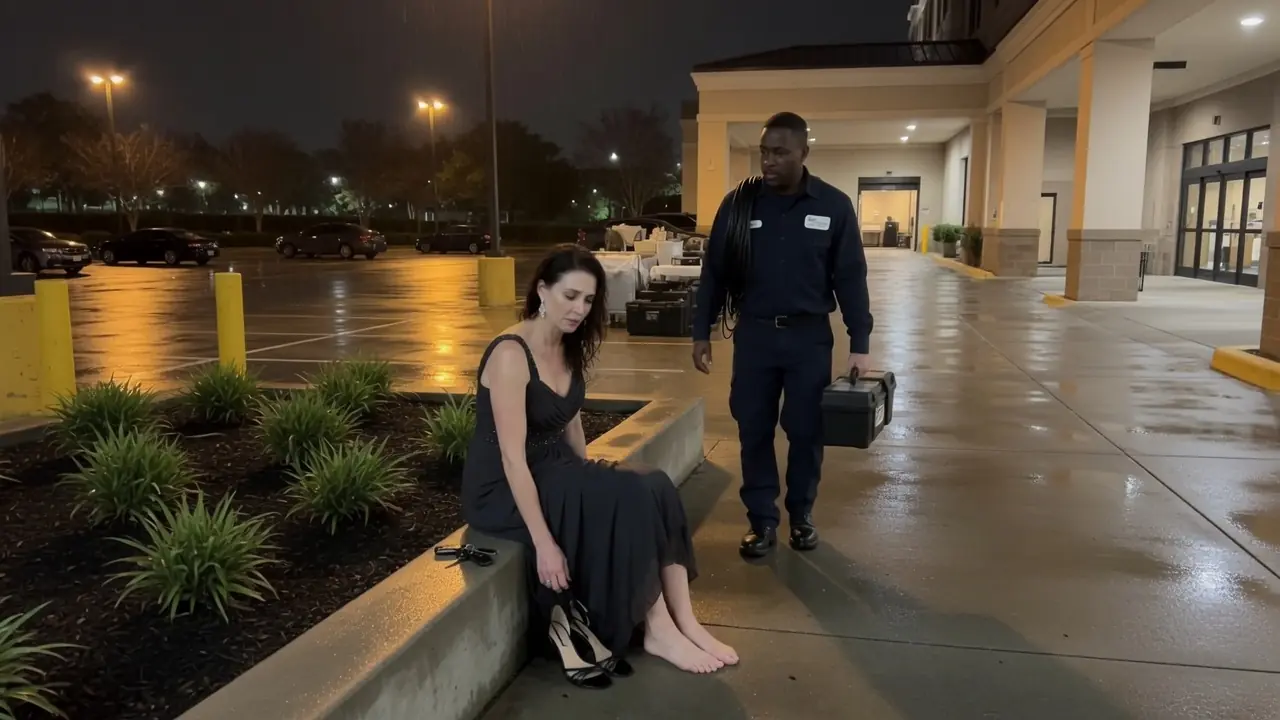
Most of his colleagues at Hale and Associates had never learned his last name. A few of the longer-tenured employees weren’t entirely sure they had ever heard him speak more than a handful of words at a time. He had that quality that certain quiet men develop after enough years of hard, honest labor, a kind of practiced invisibility, as though he had trained himself to take up as little space in the world as possible. He was a father, though most people at the office didn’t know that, either.
His daughter, Lily, was 11 years old and lived with him full-time. Her mother, Claire, had remarried and moved to Portland three years earlier, a departure that had been as quiet and uncomplicated as most departures eventually become when both parties have already spent years grieving the marriage long before the divorce papers are signed. Ethan didn’t talk about it. He picked Lily up from school every afternoon that his schedule allowed, packed her lunches with small handwritten notes tucked under the sandwich, helped her with her homework at the kitchen table while dinner simmered on the stove and read to her until she fell asleep.
He was a man who gave everything he had to the small, specific life he had built, and he had made his peace with the fact that this life would never look impressive from the outside. Victoria Hale, by contrast, could not have occupied a more different position in the visible architecture of the company that bore her name. She was 3nine years old and had been the chief executive officer of Hale and Associates for the past six years, elevated to the role after her father’s retirement through a combination of ruthless preparation, genuine intelligence, and an almost terrifying capacity for work. She was beautiful in the sharp, composed way of someone who has learned to use their appearance as a kind of armor, always dressed with precision, always arriving in a room at exactly the right moment, always saying exactly what needed to be said without wasting a syllable on anything unnecessary.
The employees of Hale and Associates admired her from a distance. They respected her completely and almost without exception, they were afraid of her. Not in the way people fear cruelty, but in the way people fear weather: unpredictable, powerful, and ultimately indifferent to any individual’s comfort. Victoria did not cultivate warmth in her professional relationships, and she did not apologize for this.
She had learned early in her career that warmth, when deployed carelessly, was simply a vulnerability with better marketing. The contrast between these two people, the invisible maintenance worker and the untouchable CEO, was the kind of thing that might have made a good illustration in a business school lecture about organizational hierarchy. Ethan moved through the building’s lower floors and service corridors. Victoria occupied the executive suite on the 14th floor.
Their orbits did not overlap in any meaningful way. On the rare occasions when they did occupy the same physical space, an all-hands meeting, a corridor crossing, the elevator on a slow afternoon, Victoria’s eyes passed over him with the efficient blankness of someone scanning a familiar room for anything out of place. Ethan, for his part, noticed her in the careful, distant way that a man notices weather, aware of the force without expecting any personal relevance. He went about his work.
She went about hers. The company moved forward, and no one, least of all either of them, would have predicted what a single evening was about to set in motion. The annual company gala was held on the last Friday of November in the ballroom of the Meridian Hotel, 11 blocks from the Hale and Associates headquarters. It was an event that the company’s marketing department described in their internal materials as a celebration of the year’s accomplishments and a toast to the future, which was a generous framing for what most employees privately understood as a mandatory social performance disguised as a party.
The tables were dressed in white linen. The catering was excellent. An open bar ran from 7:00 until whenever the last executive finally decided that the appearance of good morale had been sufficiently maintained. Attendance was not technically required, but everyone attended because the alternative was to make a statement about yourself that you would spend the following year quietly paying for.
Victoria arrived at 8:00, 45 minutes after most of the staff had already settled into their seats, and the timing was not accidental. She wore a charcoal dress that cost more than Ethan’s monthly rent, and moved through the room with the practiced ease of someone who has spent decades learning how to seem effortlessly present in rooms that are designed specifically to evaluate you. But underneath the precision of her entrance, something was wrong. It had been wrong for weeks.
In fact, the Meridian deal, a partnership that was supposed to cement Hale and Associates’ expansion into the Pacific Northwest, a transaction worth $230 million, had collapsed four days earlier. The board of directors had not been kind about it. They had convened an emergency session and spent three hours distributing their disappointment in that particular corporate manner that is technically professional, but lands with all the warmth of a public execution. The lead investor had sent a letter.
She laughed at the appropriate moments and listened with visible attentiveness when the company’s regional managers described their holiday plans. She gave a brief, well-constructed speech about resilience and forward momentum that was met with appreciative applause. And then she went to the bar and did something she had not done in years. She started drinking in earnest, not elegantly, the way that accomplished people sometimes drink at professional events, with one glass maintained as a prop while they conduct actual business.
She drank the way people drink when they are no longer trying to manage an impression steadily, mechanically, with the grim intentionality of someone who has made a private decision and is simply executing it. By 9:30, the control that she wore like a second skin had begun to loosen around the edges. By 10:00, several of the senior staff had noticed and were making careful decisions about where to position themselves. By 10:45, the room had begun to empty.
And the people who were still present had developed a remarkable ability to look directly at Victoria without appearing to see her at all. Ethan was not supposed to be there. He had been called in at 7:00 to fix a malfunctioning sound system in the anteroom off the main ballroom. A 30-minute job that turned into 90 minutes because the wiring behind the panels was 1five years old and had been repeatedly patched in ways that made it actively hostile to anyone trying to understand it.
By the time he finished, the gala was in full swing and his supervisor had texted him to stay until the event ended and help with breakdown and cleanup. He didn’t mind. Lily was at his sister’s place for the night. He had nowhere to be.
He rolled up his cables, stowed his tools, and settled into the rhythm of cleanup work, moving quietly around the perimeter of the room. Collecting glasses, breaking down equipment, existing in the functional background the way he always did. It was after 11:00 when he walked out through the service exit to move some equipment to the loading dock and noticed, in the far corner of the parking lot, under one of the yellow sodium lights that gave everything a slightly jaundiced tint, a figure sitting on the edge of a planter box with her heels in her hand. It took him a moment to register who it was.
Victoria Hale, CEO of the company that employed him, one of the 40 most powerful women in the Pacific Northwest, according to a magazine that had profiled her the previous spring, was sitting alone in a hotel parking lot in a charcoal dress, barefoot, with her shoes dangling from two fingers and her eyes fixed on the middle distance with the unfocused quality of someone who has temporarily misplaced their relationship with the present moment. Ethan stopped walking. He looked at her. He looked at the parking lot around her, which was mostly empty now.
The last few cars belonging to the cleanup crew and a couple of hotel staff. He thought about the various things a reasonable person might do in this situation. He could walk back inside and tell someone. He could call the front desk.
He could continue to the loading dock and pretend he hadn’t seen anything, which would have been the easiest choice and the one that carried the least personal risk. He stood there for a moment longer. Long enough to notice that her car keys were sitting on the planter box beside her. And that she had the glazed, slightly tilted posture of someone who should not be making any major decisions.
Including the decision to drive. He walked over. He said her name, Miss Hale. Quietly, the way you might address someone who was standing very close to the edge of something.
She looked up at him with the slow, slightly delayed focus of the significantly intoxicated. And for a moment, there was nothing in her expression except the blankness of someone trying to locate the relevant context for a situation she hadn’t anticipated. Then something settled in her eyes. Not recognition, exactly.
More like a provisional acknowledgement that he existed and was apparently speaking to her. Everyone left. She said. It was not a complaint. It was a statement of fact delivered with the flat affect of someone who has processed this information and reached a conclusion about what it means. I’m still here, Ethan said.
Are you all right to drive? She looked at the keys. She looked at her car, which was parked approximately 30 feet away. She performed what appeared to be an honest internal assessment of her current capabilities.
And then she looked back at him with something that might, in other circumstances, have resembled honesty. No, she said, probably not. He offered to call her a car. She shook her head slowly and said she didn’t want anyone else involved.
He thought about this for a moment and then made the decision that, in retrospect, was the one that changed everything. He said he would drive her home. She looked at him for a long moment, long enough that he thought she was going to refuse, which would have been the simpler outcome, and then she picked up her keys and held them out to him without saying anything. The drive to Victoria’s house took 22 minutes.
For the first 10, she sat in the passenger seat with her head resting against the glass, eyes open but not really looking at anything, and the silence between them was the particular silence of two people who are not comfortable with each other and have not yet determined what the appropriate form of discomfort is. Ethan kept his eyes on the road and said nothing because there was nothing obvious to say. He did not know her. She did not know him.
He was a maintenance worker driving his CEO home from a company party, a situation that had no established protocol and several obvious ways to go wrong. Then she spoke, not to him, exactly more in the way that people speak when the alcohol has lowered the barrier between their internal monologue and the outside world, and the words simply find their own way out. I failed, she said. $230 million. Four years of work.
And I failed. Ethan said nothing. The board thinks I’m losing my edge. She laughed, and it was a sound without much humor in it.
Maybe they’re right. Maybe I’ve been pretending so long I can’t tell anymore. Pretending what? he said, because the question presented itself before he could decide whether to ask it.
She was quiet for a moment. Then, that I know what I’m doing. That I’m not scared. That I don’t go home to a house with 22 rooms and eat dinner alone in the kitchen because the dining room feels too big. She paused.
I haven’t told anyone that in about nine years. Who would you tell? Ethan said. She turned her head slightly and looked at him. And for the first time, there was something genuinely present in her eyes.
That’s the right question, she said. That’s exactly the right question. And then she turned back to the window and didn’t say anything else for the rest of the drive. The house was exactly what Ethan had imagined it would be, and also nothing like what he had imagined it would be.
From the outside, approaching through a private gate at the end of a long driveway lined with mature oaks, it was large and geometric and lit with the subtle architectural lighting of a house that is used to being admired from a distance. But when he helped her through the front door and into the entrance hall, what struck him first was the quiet. Not the peaceful quiet of a home at rest, but the hollow quiet of a space that is very large and has very few people in it. There were no photographs on the entry table, no evidence of children, no stray jacket on the coat rack, no casual accumulation of a shared life.
The house was beautiful and immaculate, and it felt, in some essential way, like a showroom. He got her to the living room and onto the couch. He found the kitchen and filled a large glass with water. He found the medicine cabinet in the guest bathroom, not the master bedroom, because that would have been a boundary he had no reason to cross, and retrieved a bottle of ibuprofen.
He set the water and two tablets on the coffee table beside her. And then he found a notepad on the kitchen counter and wrote a short note in his careful, slightly cramped handwriting. Water and ibuprofen on the table. Keys on the counter. Nothing happened. You’re safe.
E. He folded the note and set it where she would see it. He was pulling on his jacket and preparing to call himself a rideshare back to the hotel when he noticed the bookshelf. It occupied most of the wall beside the living room window, floor-to-ceiling, the kind of shelf that speaks to a person who actually reads. And on the third shelf from the bottom, between a collection of business texts and what appeared to be an assortment of literary fiction, there was a framed photograph.
It was not a professional portrait. It was the kind of photograph that only makes it onto a shelf because the person in it means something. Slightly out of focus, the colors slightly warm, in the way of pictures taken before everyone had a camera in their pocket all the time. It showed a young woman, probably in her late 20s, standing in front of a small storefront.
She was smiling. Not the managed, professional smile of the woman currently asleep on the couch across the room, but a full, unguarded, somewhat dazzled smile. The smile of someone who has just received news so good they haven’t fully processed it yet. Beside her in the photograph was a man, slightly older, with an arm around her shoulders and an expression of straightforward pride.
Ethan stared at the photograph for a long time. His jacket was still half on. He was not moving. The expression on his face was the expression of a man who has just recognized something he had convinced himself he would never see again, something he had buried so thoroughly under the accumulated weight of subsequent years he had almost succeeded in forgetting it was real. Almost.
He set his jacket down on the armchair beside him. Very slowly, he sat down. And looked at the photograph and tried to figure out what you were supposed to do with a discovery like this. The morning came in through the tall windows the way morning comes into houses with no curtains drawn all at once, without warning, with a completeness that makes the previous darkness feel like a different country.
Victoria’s eyes opened. For a moment, she had the pure, blank disorientation of someone who is awake before their context has arrived. Then it arrived. The headache, the residue of the previous evening assembling itself in chronological order. The gala. The bar.
The parking lot. A car. Her house. She sat up. She was still in her dress. She was on her own couch.
She was alone. On the coffee table, a glass of water and two ibuprofen. On the notepad, a short note in handwriting she didn’t recognize. She read it twice. Nothing happened. You’re safe.
She sat with this for a moment. In her experience, when powerful people found themselves in vulnerable situations, other people almost always found a way to benefit from it. A story told at the right moment. A favor implied.
A leverage accumulated quietly for future use. She had been in this position before or near enough to it, and the outcomes had consistently instructed her in the cost of lowering her guard. But the note said nothing happened, and the house looked exactly the way it had looked when she left it the previous morning. Except for the water and the ibuprofen and the handwriting she didn’t recognize.
She called the office. She asked for Ethan Cole. The receptionist paused and said, I’m sorry. Who?
Victoria said it again. There was a longer pause, and then the receptionist said, Oh, Ethan from maintenance? In the particular tone that people use when they are surprised that someone on the 14th floor knows the name of someone in the maintenance department. Victoria said yes and asked him to come up when he arrived.
He knocked on the glass of her office door at 9:45. She looked up and saw him, the same man who had driven her home, standing in her doorway with a quietness about him that she was now seeing in a different light. She said, Come in. He came in and stood just inside the door in the way of someone who was not planning to stay long.
She studied him from across the desk. He was unremarkable in the way that people are unremarkable when you haven’t been paying attention to them. Medium height, dark hair threaded with the first signals of gray, the specific kind of lean that comes from physical labor rather than a gym membership, eyes that were a gray-green color, and were currently looking at her with a complete absence of the nervousness that most people brought into her office. That absence was itself notable.
I wanted to thank you, she said. For last night. You don’t have to, he said. I know I don’t have to, she said in the tone she used when people misread courtesy as obligation.
I want to. She paused. She looked at him again. The feeling that had been hovering at the edge of her consciousness since she read the note, the feeling of something almost recognized, something snagged on a corner of her memory, pressed closer. Have we met before? she said.
Before the company, I mean, outside of work. His expression changed. Not dramatically. It wasn’t a flinch or a sudden pallor. It was subtler than that.
Something in the quality of his attention shifted, like a landscape changing slightly when a cloud passes over the sun. Why do you ask? he said, and his voice was careful in a new way. I don’t know, she said.
You look familiar, or not even that. It’s something else. She shook her head slightly. It’s nothing. Forget I asked.
I don’t think I should, he said. She looked at him. There’s something I should tell you, he said. But I don’t know how to tell you, so I’m just going to say it.
10 years ago, in October, there was a night when it was raining very hard. You were sitting on the curb on Brennan Street, outside a building that used to be a restaurant. You were crying. He paused. I stopped. The room was extremely quiet.
Victoria did not move. She was looking at him with the concentrated, slightly stunned expression of someone who is rearranging a significant amount of furniture inside their mind. Ten years. October. The rain. She knew exactly what night he was talking about. She had never not known what night he was talking about.
That night had been the deepest point of the lowest valley of her life, and she had carried the memory of it and the memory of a stranger’s inexplicable kindness for every single day of the decade since. That was you, she said. It was not a question. Yes, he said.
She was quiet for a long time. Then, I’ve thought about that night so many times. I never knew your name. I never knew who you were.
She looked at him with something that might, in a person less practiced at control, have been the beginning of tears. I’ve wondered about it for 10 years. He nodded slowly. I saw a photograph in your house last night of you and Daniel Chen outside the East Side location.
I recognized the building. I was there that night, about three blocks away. He paused. I almost didn’t stop. I don’t know why I did.
10 years ago, Victoria Hale had not been Victoria Hale the CEO. She had been Victoria Marsh, 2nine years old, 18 months into a partnership with a man named Daniel, who was also her best friend, and in whom she had invested not just the $300,000 she had spent the previous seven years accumulating, but the full architectural weight of her ambition, her optimism, and her idea of what her future was going to look like. Daniel had presented her with dissolution papers on a Wednesday. By Friday evening, the company’s accounts had been restructured in ways that left her with almost nothing.
The lawyers had explained, with various degrees of discomfort, what the agreements she had signed three years earlier actually meant when interpreted against her interests rather than in her favor. She had sat in the rain on the curb outside the empty storefront that had been their first location and understood, for the first time in her life, what it felt like to have nothing. And then a man had sat down beside her on the curb. Not a man she knew, not a man who knew her, just a man who had been walking past, and had apparently made the decision to stop.
He had not asked a lot of questions. He had sat with her while the rain came down, and then he had bought her a sandwich from a deli two doors down. And then he had given her $40 for a cab because she had left her wallet at the office. And then, because she was still not moving, he had said something to her that she had carried every day since.
He had said, Whatever happened tonight is not the last thing that’s going to happen to you. I don’t know you, but I can see that you are someone who is not finished. So get up. And she had.
She had gotten up off that curb, and she had gotten in a cab, and she had not stopped moving since. She had never known his name. She knew it now, but knowing his name was only the beginning of what she learned. Over the following week, with the particular focused efficiency that made her effective at her work, Victoria quietly assembled the facts of Ethan Cole’s life.
What she discovered did not fit the narrow slot her assumptions had built for him. He had a degree in electrical engineering from a state university in Ohio. He had spent his late 20s and early 30s working for a midsize technology firm in Seattle, where he had risen to a senior engineering role. At 31, he had co-founded a company, a small specific technology operation, that serviced industrial equipment monitoring systems with his college roommate, a man named Marcus Webb.
The company had been modestly successful, not spectacular, but real, profitable with actual clients and actual growth. Then, in the space of about 18 months, two things had happened in close succession. First, Marcus had leveraged his co-founder position to negotiate a partnership agreement with a larger firm that effectively transferred the controlling interest in the company in ways that left Ethan with a minority stake and no operational role. Second, Ethan’s marriage to a woman named Claire had ended, partly, the timeline suggested, because the stress of the professional betrayal had left him in a state of protracted withdrawal that Claire had eventually concluded she could not sustain indefinitely.
He had lost the company and the marriage within the same calendar year. After that, the record became quieter. A few years working for a commercial maintenance firm, then the position at Hale and Associates, where he had been for the past four years. A daughter, a small apartment in a neighborhood across the river, no apparent ambition to reclaim anything he had lost, no evidence of bitterness aired publicly, no application submitted for positions that might have returned him to the professional tier where he had once operated, he had simply stopped.
Or not stopped, exactly. Redirected. He had aimed his considerable capability at a smaller target and hit it with complete consistency. Victoria found this remarkable. She had known men who lost everything and spent the rest of their lives auditioning their grievance for whatever audience would sit still long enough.
She had known men who lost everything and rebuilt it aggressively with a chip of compensatory anger that never quite left them. She had almost never known a man who lost everything and responded by becoming quieter and more present and more deliberate, who turned the wreckage into a kind of instruction about what actually mattered and then just lived accordingly. She found herself thinking about Ethan Cole at odd moments during the day, during meetings, while reviewing quarterly projections, while eating dinner alone in her kitchen. She found reasons to be in the lower floors of the building more often than she had ever previously been.
This was noticed because Victoria’s presence on any floor below the 10th was unprecedented enough to generate its own small weather system of speculation. She told herself it was building related. Inspection. Efficiency review. She was a practiced enough liar to almost convince herself. The first time she ran into Ethan in this way deliberately, though she would not have admitted it, she stopped and asked him about a structural issue she had read about in a maintenance report, a question she had researched specifically so that she would have something legitimate to ask him.
He answered it directly and without flattery, explaining the issue in the clear, patient language of someone who understands something well enough to translate it for someone who doesn’t. She found herself asking follow-up questions. He answered those, too. At some point, she realized they had been talking for 20 minutes and she had not once thought about the board of directors.
After that, it became easier. A lunch in the cafeteria that she told herself was coincidental. A conversation that ran past the point where both of them should have been elsewhere. He was not what she expected him to be in conversation.
Not deferential, not trying to impress her, not playing any of the subtle games that the people on the 14th floor played constantly and often without being aware of it. He was simply present and direct and occasionally said things that surprised her with their precision. He told her once while they were discussing something entirely unrelated that the problem with wanting to be in control of everything was that you could never actually rest because rest required trust and control required the perpetual absence of it. She had thought about that sentence for three days.
She helped him, too, in ways she didn’t fully articulate even to herself. She read the confidential performance review in his file and updated it with an accuracy that required her to admit, in writing, that she had been working alongside someone of significant capability without noticing it for four years. She connected him, through intermediaries, with a firm that did specialized infrastructure work and was looking for someone with exactly his background. She didn’t tell him she had done this.
She told herself she was simply correcting a misallocation of human capital, which was a CEO thing to do, which was true, even if it was not the only true thing about it. The mornings when they ate lunch at the same time. The afternoon he brought her coffee without being asked and set it on her desk without a word when he was fixing the heating unit in the executive suite. The evening she stayed late reviewing contracts and looked up to find him still in the building working in the corridor outside and they ended up talking through the window of her open office door for an hour about nothing consequential and then sat in silence for another 20 minutes and both of them were entirely comfortable.
She did not examine these things too closely. Examination was a dangerous activity. When the thing being examined was something you were already attached to the outcome of. But the situation had a gravity that pulled it forward regardless of what she examined or didn’t examine.
And eventually the inevitable happened. Someone noticed. His name was Richard Holt. And he had been on the board of Hale and Associates for 11 years. A position he occupied with the alert predatory patience of a man who understood that power within organizations was not fixed but fluid and that the moments when powerful people became distracted were the moments when other configurations became possible.
He had been watching Victoria since the Meridian deal collapsed looking for the precise angle that would give him sufficient leverage to begin the conversation he had been planning for two years. He found it in the form of a parking lot security camera still, a maintenance log, and a cafeteria receipt assembled into a presentation that was as efficient as it was unpleasant. He brought it to a closed session of the executive committee on the second Monday of January. He framed it with care not as an attack but as a concern about leadership judgment about the optics of a CEO in an intimate professional relationship with a maintenance employee.
About the questions this would raise in the minds of institutional investors who were already watchful following the Meridian situation. He was precise. He was measured. And he left the room having established without quite saying it explicitly that Victoria had two options.
End the relationship or face a formal vote on her continued suitability for the role. Ethan found out three days later through channels that were unofficial but accurate, and he came to her office at the end of the day when the floor had emptied and closed the door and told her he was resigning. He said it the way he said most things, directly, without embellishment. Without the dramatic framing that the situation might have invited.
He said he would not be the reason her career took a hit. He said it had been a privilege to know her. He said he hoped she understood why he had to go. Victoria looked at him from across her desk and felt something she had not felt in a professional context in as long as she could remember, the specific helplessness of a situation where the correct strategic move was also the thing that was going to cost you the most.
She had been in this business long enough to know what the right play was. Let him go. Issue a brief statement. Take the reputational bruise quietly. Move forward.
She knew how to do that. She had done it before with lesser things. She also knew, with a certainty that resided somewhere below the level of strategy, that if she let him walk out of this office and back into the invisible life she had pulled him halfway out of, she was going to be left with something that no amount of professional success was going to be sufficient to fill. She had spent 10 years in a house with 22 rooms.
She knew exactly what that felt like. Sit down, she said. He looked at her. Please, she said, and the word cost her something because she did not say it often.
He sat down. I’m not letting you resign, she said, and I’m not ending anything. I’m going to the shareholder meeting on Friday, and I’m going to say something true, and then we’ll see where we are. Victoria, I’m not asking your permission, she said.
I’m telling you what I’m going to do. You can leave the company after that if you still want to, but I need to do this first. The shareholder meeting was held in the main conference room on the 14th floor with remote access for the institutional investors who were joining by video. Richard Holt sat at the near end of the table with the composed expression of a man who believes the mathematics of a situation are settled.
He had spent the three days since the executive committee session consolidating his position quietly, speaking to the right people, planting the right seeds of doubt. He believed, with the confidence of someone who had navigated organizational power for 11 years, that he had built a case strong enough to survive whatever Victoria might say in her defense. He had underestimated her before. He would not have described it that way, but the evidence of the following hour would be relatively unambiguous on this point.
Victoria sat at the head of the table and waited until the preliminary items had been addressed, and then she set down her prepared remarks and said she had something to say that was not in the agenda. The room did not change in any visible way. But the quality of attention in it changed completely. She told them about the night 10 years ago.
She told them about the rain and the curb on Brennan Street and the stranger who had sat down beside her when she had nothing and told her to get up. She did not embellish this story. She did not perform it. She told it in the same flat, precise register she used for earnings calls because the facts of it were sufficient and anything added would only dilute them.
She told them that the reason they were all sitting in this room benefiting from the growth of Hale and Associates over the past decade was in some meaningful part traceable to that moment, to the decision of one person to stop when no one required him to stop, to say something true to someone who needed to hear it, and then to walk away without asking for anything in return. She told them that she had spent four years in the same building as that person without knowing who he was. She told them that this was the person Richard Holt was asking her to distance herself from or else surrender her position, as though the existence of this connection were a liability, rather than the most clarifying piece of information she had received about her own leadership in years. She told them everything calmly and precisely, and she did not cry because she had decided she was not going to cry.
And she watched the room watch her, and she kept going until she had said all of it. When she finished, she picked up her prepared remarks, set them aside, and waited. The silence lasted approximately eight seconds. In a room full of people trained to read financial data, eight seconds of genuine silence is a significant indicator.
Then she asked Ethan, who was standing outside the conference room glass because she had called him that morning and said, Simply, be there. And he had come without asking her to explain herself because that was the kind of person he was to come in. He came in. He stood at the far end of the room from Richard Holt.
And he did not look like a man who had been invisible for the past several years. He was wearing the same kind of clothes he always wore, clean, functional, without pretension. And he looked at the room with the calm directness of someone who has nothing to prove, and therefore nothing to lose by being seen clearly. He looked like a man who had been waiting for long enough that the waiting had become its own form of strength, and who had learned somewhere along the way that the kind of strength that came from patience was the only kind that couldn’t be taken away by other people’s decisions.
The vote was not close. Richard Holt sat through it with the expression of a man recalculating in real time, and then he gathered his materials and left without speaking to anyone. He resigned from the board the following week in a brief letter that cited personal reasons, which was the professional equivalent of closing a door quietly, rather than slamming it. The investor who had sent the critical letter called to express his renewed confidence in Victoria’s leadership, which was the kind of thing investors said when they had miscalculated the direction of public sentiment and wanted to position themselves on the correct side of the revision.
The trade press ran a story that was considerably more interesting than the previous one and considerably kinder. Over the following months, things changed in the specific ways that things change when two people have decided to stop pretending they are not already committed to something. Ethan was offered a position as a technical consultant at the firm Victoria had quietly connected him to and he took it, partly because the work was genuinely a good fit and partly because he had spent long enough in a life that was smaller than his actual capability and the time for that particular form of self-protection had passed. He remained affiliated with Hale and Associates in a formal advisory capacity related to infrastructure systems, which was both genuine and convenient and which gave the two of them a professional context that was easier than nothing and more honest than pretense.
He still picked up Lily from school on the days his schedule allowed and sometimes Victoria was there, too, standing slightly awkwardly at the school gates in her charcoal coat, learning what it looked like to be part of something that did not require her to be in charge of it. Lily accepted her with the pragmatic openness of children who have been raised by people too decent to make the adults in their lives into villains and who evaluate new people on the simple basis of whether or not they are actually paying attention. Victoria, who had spent her entire adult life being evaluated and had developed sophisticated defenses accordingly, found this experience unfamiliar and genuine in equal measure. She started showing up to the school gates with the particular expression of someone learning something new and slightly terrified by how much they want to get it right.
The house with 22 rooms was still quiet sometimes, but it was a different kind of quiet now, the kind that comes from two people who have figured out how to be still in the same space, who don’t need to fill every silence with performance or explanation, who have learned by this point in their lives that the ability to be quiet with another person is not a deficit, but a form of trust that most people never develop because they have never been sufficiently honest about how exhausting constant performance actually is. Victoria learned how to leave things unfinished on her desk when Lily needed help with her homework. Ethan learned how to walk through a room without trying to disappear into the walls, how to let himself be seen without bracing for the cost of visibility. These were not small things and neither of them pretended they were.
They were the kinds of recalibrations that only become available to people who have survived enough loss to understand what things are actually for and who have stopped confusing what they can manage with what they actually want. On a Saturday in March when the weather had turned and the light was doing the particular thing it does in late winter afternoons in the Pacific Northwest, coming in at a low angle through bare branches, making everything look both exposed and somehow warmer for it, more honest somehow. Stripped of the softening effects that summer green provides, Victoria was standing in the kitchen of the smaller house that had gradually become more important to her than the large one, looking at a photograph that Ethan had found in a box during a weekend of reorganizing and had set on the counter without explanation. He had not said anything about finding it.
He had simply put it where she would see it in the way of someone who understands that some things are better encountered than introduced. It was the same photograph she had kept on her bookshelf for years, the one of her and Daniel in front of the Eastside storefront, taken a few months before everything fell apart. She looked at her own face in the picture. The unguarded smile.
The completely undamaged optimism of someone who has not yet learned what betrayal costs or what it leaves behind. She thought about that girl and what she had survived and where she was standing now. And she thought about the specific geometry of a life, how it turns on these invisible points, how the same night that could have been the end of something was instead, because of one small unasked for act of ordinary decency, the beginning of everything that followed. She thought about how thin the thread was.
How easily the whole of it could have gone differently. Ethan came in from the other room. He saw her looking at the photograph. He stood beside her and looked at it, too.
And neither of them said anything for a moment. Because the photograph said most of what needed to be said. You saved me twice, she said finally. And you didn’t even know the first time.
He was quiet for a moment in the way he was quiet when he was actually thinking about something rather than just waiting for the appropriate moment to speak. Then he said, I think that’s the wrong way to count it. She looked at him. You got up off that curb, he said.
You built everything that came after. I just said something to someone who was already going to find her way. And maybe I just shortened the time a little. He paused. And the second time, I was the one going nowhere.
I was the one who had decided that shrinking was the same as being safe. You were the one who saw something worth seeing and decided to keep looking at it even when it cost you. He looked at her with the full unhurried attention that she had come to understand was simply his natural way of being present with another person. Something that had once been so unfamiliar she had not known how to receive it and was now something she could not imagine being without.
I think we saved each other. I think that’s what the math actually says, if you run it honestly. She considered this carefully, the way she considered things that mattered. She thought about the board meeting and the photograph on the shelf and the note that had said nothing happened.
You’re safe, written in careful handwriting by a man who could have walked away and didn’t. She thought about the $40 in the rain and the sandwich from the deli two doors down and the voice that had said whatever happened tonight is not the last thing that’s going to happen to you, spoken by someone who was a stranger and would remain a stranger for 10 years and then turn out to have been, in some essential way, the person the whole decade had been leading toward. She thought about all the invisible years in between, all the mornings both of them had woken up in different kinds of quiet and the morning question in the office, have we met before, that had opened the door to all of it. She nodded slowly.
Okay, she said. That’s what the math says. He reached over and picked up the photograph. He looked at it for a moment and then set it back down, face up in the light.
Should we keep this on the shelf? he said. Or put it somewhere else? She thought about it. The shelf, she said.
I want to be able to see it. Outside, the light was still doing that thing through the bare branches, catching the edges of everything and making them briefly luminous. And somewhere in the other room, Lily was watching something on the television with a laugh track that was a little too enthusiastic, the way laugh tracks always were. And in the kitchen, the coffee maker was making its particular sound of completion.
And the world was continuing to be ordinary and astonishing in equal measure, the way it always does for anyone paying close enough attention to notice both things at once.