"You smell like cow dung and poverty. Sit in the back where you belong."
"Yes, sir."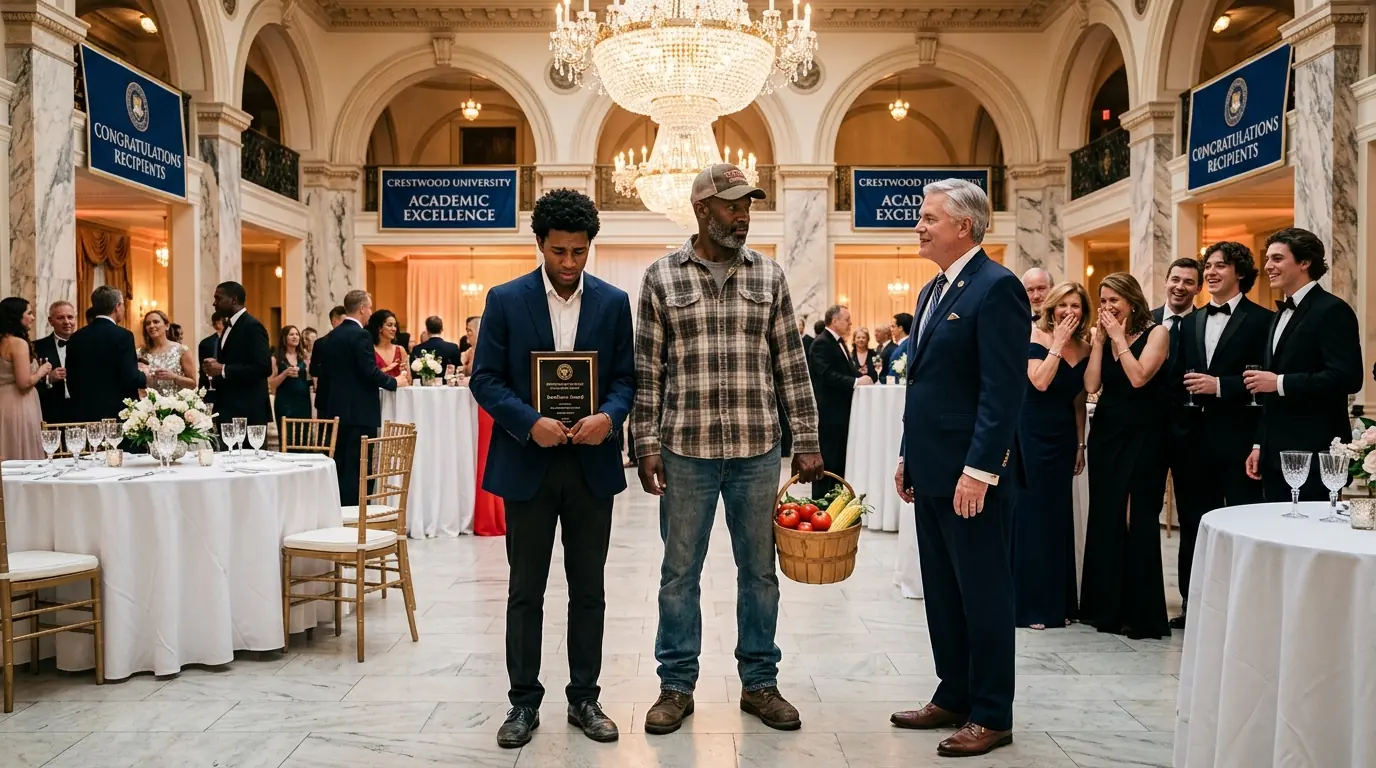
"Don't 'yes, sir' me. You think a scholarship makes you one of them?" Principal Whitfield leaned in close. "You're nothing, just a farmer's son. A dirty, worthless farmer's son pretending to be something he's not."
Adrian Sterling sat still, hands folded, eyes forward.
"Look at me when I'm talking to you, boy."
"I'm looking, sir."
"Good. Then understand this. You will never belong here. Your father shovels manure for a living. That's your bloodline. That's your future. Accept it."
Adrian said nothing. He picked up his bag and walked out quietly. But the next morning, a fleet of black SUVs surrounded the school. And Principal Whitfield discovered that the farmer's son he despised was the wrong student to break.
Crestwood University sat on 400 acres of Virginia hillside. Its brick buildings older than most family names on the donor wall. Tuition ran $62,000 a year. The parking lot held more German engineering than a Munich showroom. The students wore cashmere in October and complained about the Wi-Fi in buildings that cost more to heat than most families earned in a year.
Adrian Sterling did not belong here. At least that was the general consensus. He was 21, black, the only student in the agricultural sciences program who had actually worked a farm. His hands carried calluses from summers spent driving combines and mending fences on his father's land in rural Georgia. While his classmates spent breaks in the Hamptons, Adrian went home to 200 acres of red clay and soybean fields. While they posted pictures of yachts, he posted nothing at all. He was there on a full scholarship, top of his class, highest GPA in the department three semesters running. None of that mattered to the people who decided worth by last names and tax brackets.
Nathaniel Sterling visited once a semester. He always looked the same: flannel shirt rolled to the elbows, steel-toed boots, a John Deere cap faded from years of sun. He drove an 11-year-old Ford pickup with Georgia plates and a cracked taillight he never got around to fixing. The truck had more rust than paint and rattled loud enough to turn heads in the visitor lot.
On this particular October morning, Nathaniel pulled into the visitor lot between a Porsche Cayenne and a black Range Rover. The contrast was almost comical. He stepped out carrying a wicker basket filled with tomatoes, sweet corn, and a jar of his wife's peach preserves. He had been up since 4:30, finishing the morning feed before making the 6-hour drive north.
Victoria Prescott saw him first. She stood near the fountain with her son Caleb, both dressed like they were attending a governor's luncheon. Victoria's pearls alone could have paid Adrian's rent for a year.
"Is that a delivery man?" Victoria whispered loudly enough for three other parents to hear.
Caleb pulled out his phone, snapped a photo. Within minutes, it appeared in the sophomore group chat. The caption read, "Guess whose dad just rolled up looking like a scarecrow." 37 laughing emojis. Not one objection. Not one question about whether it was cruel.
Inside the lobby, Nathaniel found Adrian waiting by the staircase. He set the basket down and wrapped his arms around his son. Adrian held on a beat longer than usual. He could smell the Georgia clay on his father's shirt. Copper and earth and home.
"You okay?" Nathaniel asked, pulling back to study Adrian's face.
"Yeah." Adrian forced a smile. "Just tired."
What neither of them noticed was Harold Whitfield watching from the mezzanine above, arms folded, jaw tight. The principal studied Nathaniel the way a man studies a stain on an expensive rug: with distaste and a plan to remove it. And on Nathaniel's left wrist, half-hidden beneath a rolled flannel cuff, sat a watch worth more than every car in the visitor lot combined. Nobody noticed.
The annual academic excellence ceremony was Crestwood's crown jewel. It happened every October and it mattered. Not because of the awards, but because of the audience. White tablecloths stretched across round tables in the grand atrium. Crystal centerpieces caught the light from chandeliers that had hung there since the building opened in 1911. A string quartet played Vivaldi in the corner, their bows moving in perfect synchrony. The university's top donors sat in reserved rows near the front, their names etched into brass plaques on the armrests of their chairs. This was not a ceremony. It was a performance, and every seat in the house knew its role.
Adrian had been told to wear a blazer. He didn't own one. He borrowed one from Ethan Cole, his roommate and the only person on campus who treated him like a human being rather than a case study in affirmative action. Ethan was white, came from a middle-class family in Delaware, and couldn't have cared less about donor walls or family crests.
"You nervous?" Ethan asked, straightening Adrian's collar in their dorm room.
"Nah." Adrian exhaled slowly. "Just want to get through it."
He had every reason to be there. The Department of Agricultural Sciences had selected him for the Whitmore Research Prize, the most prestigious undergraduate recognition in the program, given to one student per year for outstanding contribution to applied research. Adrian's thesis on drought-resistant crop rotation using indigenous soil bacteria had already been cited by two peer-reviewed journals. He was 21 years old and already publishing work that tenured professors referenced in their own papers. And tonight, he would stand on that stage and accept an award that bore the name of the department's founder. He had earned it. Every hour in the lab, every weekend in the field, every semester of carrying a 4.0 while working part-time in the campus greenhouse to cover his books and meals. None of that would matter tonight. Not to the people in the front rows.