They laughed when Elijah Walker sat at the piano.
Principal Cartwright’s joke had worked perfectly. The quiet Black boy from Westside was now center stage for everyone’s amusement. The detention regular with secondhand clothes and downcast eyes made the perfect target for their mockery. Lincoln Heights Academy held its collective breath, phones ready to capture his humiliation. No one noticed his fingers, how they moved with practiced precision as they settled on the keys. No one knew about the broken keyboard in his apartment where he played in darkness, channeling his late mother’s gift. No one expected the haunting melody that suddenly filled the auditorium, silencing every whisper.
In that moment, as music transformed the space between mockery and mastery, Elijah Walker wasn’t just playing the piano. He was rewriting his story note by perfect note.
The autumn sun cast long shadows across Lincoln Heights Academy’s detention hall as Elijah Walker slipped quietly through the door, fifteen minutes late. His secondhand uniform hung loosely on his lanky frame, the navy blue blazer frayed at the edges from years of use by previous students. He kept his eyes down, navigating toward the last empty desk in the back corner of the room.
Mrs. Bradley, the English teacher supervising detention, barely looked up from her worn paperback novel. Elijah was grateful for the lack of attention. He settled into the hard plastic chair, pulling out a dog-eared notebook from his backpack and placing it on the desk. His fingers instinctively began tapping a silent rhythm on the desk’s surface, imaginary piano keys appearing beneath his fingertips.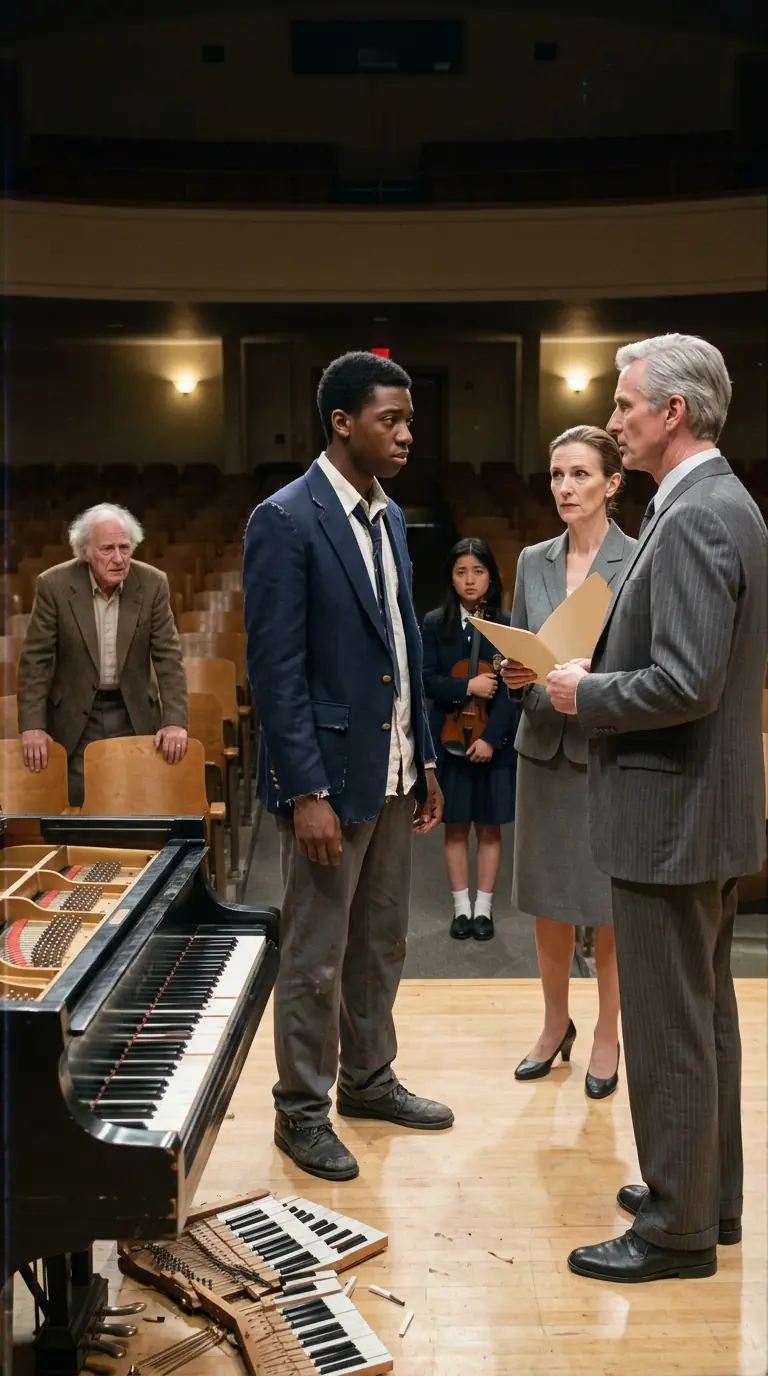
The classroom was eerily quiet except for the occasional shuffling of papers and muffled coughs. Twenty other students sat scattered throughout the room, serving their time for various minor infractions. Most stared blankly at textbooks or doodled in notebooks. A few had managed to doze off, heads resting on folded arms.
The peaceful monotony was shattered when the door burst open, banging against the wall with unnecessary force. Principal Cartwright strode in, his tall frame casting an imposing shadow across the room. His sharp, calculating eyes scanned the group of students like a predator assessing prey.
“Just checking in, Mrs. Bradley,” he announced, his voice carrying an artificial cheerfulness that didn’t reach his eyes. “Making sure our troublemakers are behaving themselves.”
Mrs. Bradley nodded deferentially. “Yes, sir. All quiet today.”
Cartwright’s gaze continued its journey around the room until it landed on Elijah, whose fingers were still moving in their silent dance across the desktop. The principal’s thin lips curled into a smirk as he walked over, looming above Elijah’s desk.
“What’s that supposed to be, Walker?” he asked loudly enough for the entire room to hear. “Practicing for a fantasy recital?”
Elijah’s hands froze mid-motion. Heat rushed to his face as several students turned to look at him.
“No, sir,” he replied softly, his voice barely audible.
“Just thinking.”
“Thinking,” Cartwright repeated with exaggerated surprise. “Well, that’s a new one.”
The doorway darkened again as Mrs. Drake, the vice principal, entered the room. She was a slight woman with sharp features and perpetually pursed lips.
“Everything all right in here, Richard?” she asked, addressing Cartwright.
“Oh, just fine, Vivien,” Cartwright replied. “Mr. Walker here was giving us a silent piano concert.” He gestured toward Elijah’s hands with mock reverence.
Mrs. Drake’s eyebrows arched as she approached. “Maybe if he practiced math like that, he’d pass algebra,” she said with a thin smile.
Several students snickered, and Elijah lowered his eyes, swallowing his embarrassment.
From the doorway came another voice belonging to Mr. Lambert, the music theory teacher. His lean frame leaned against the doorjamb, arms crossed over his chest.
“Even if he could play piano, who’d want to hear it? We already have enough noise in this school.”
The comment hung in the air, its coded undertones unmistakable.
Elijah didn’t respond. He never did. Instead, he offered a faint, tired smile, the same expression he had perfected over years of similar encounters. It was neither defiant nor submissive, just a mask he wore to hide the hurt underneath.
His non-reaction seemed to irritate Cartwright even more. The principal’s jaw tightened momentarily before he muttered, “Yeah, smirk all you want. Maybe we’ll get you a spot in the talent show for comic relief.”
The trio of administrators shared a knowing look before Cartwright addressed the room. “Well, enjoy your detention, everyone. I’m sure you’re all learning valuable lessons.”
With that, they filed out, leaving a wake of uncomfortable silence behind them.
For the remaining forty-five minutes, Elijah sat perfectly still, his hands flat on the desk. When the bell finally rang, he was the first one out the door.
The walk home took Elijah through the gradual deterioration of the city’s landscape. He started at the well-maintained grounds of Lincoln Heights Academy with its manicured lawns and newly paved walkways, then made his way through increasingly neglected neighborhoods. The sidewalks cracked beneath his feet, weeds pushing through the concrete like stubborn survivors. Abandoned storefronts with faded signs lined the streets, their windows either boarded up or shattered.
Elijah navigated this familiar route with practiced steps, avoiding the larger potholes and occasionally nodding to the few familiar faces he passed. An old man sweeping the stoop of a small convenience store raised a hand in greeting. Elijah returned the gesture with a nod before continuing on.
By the time he reached his grandmother’s apartment building, the sun was beginning to set, casting an orange glow over the weathered brick structure. The elevator was out of service, as it had been for months, so Elijah took the stairs to the fourth floor, the smell of various dinners wafting through the hallway as he made his way to apartment 4C.
“That you, Elijah?” his grandmother called out as soon as he unlocked the door.
“Yes, Grandma,” he replied, stepping into the small but meticulously clean apartment.
Mabel Walker emerged from the kitchen, wiping her hands on a faded floral apron. At sixty-seven, she moved more slowly than she once had, but her posture remained straight, her dignity intact despite the circumstances life had dealt her. Her eyes, the same deep brown as Elijah’s, lit up at the sight of her grandson.
“You’re late today,” she observed, pulling him into a quick embrace. “Detention again?”
Elijah nodded, dropping his backpack by the door. “Mr. Peterson didn’t like my essay.”
Mabel sighed. “That man never likes anything that makes him think too hard.” She studied Elijah’s face. “Something else happened. I can see it in your eyes.”
Elijah shrugged, trying to appear casual. “Just Cartwright being Cartwright. Nothing new.”
His grandmother’s expression hardened slightly. “That man,” she muttered, shaking her head. “One day he’ll eat his words. You mark mine.” She patted Elijah’s cheek gently. “Dinner’s almost ready. Go wash up.”
Elijah made his way to his small bedroom, closing the door behind him. The room was sparsely furnished: a twin bed with a navy blue comforter, a wooden desk that had seen better days, and a small bookshelf filled with secondhand books. In the dim corner of the room sat an electronic keyboard, its once white keys now yellowed with age. Several keys were missing altogether, creating gaps like missing teeth in a smile.
Dropping his bag, Elijah sat down on the small bench before the keyboard. He didn’t turn it on. The speakers had blown out years ago, but his fingers found their positions anyway. With his eyes closed, he began to play a melody only he could hear. His fingers danced across the broken instrument with surprising grace and precision.
As he played, a memory surfaced, sharp and painful despite the years that had passed. He was nine years old, standing on a small stage at the community center’s talent show. His mother had saved for months to buy him a new shirt for the occasion, and he remembered how proud she had looked as she helped him button it up.
“You play from your heart, baby,” she had told him, smoothing his collar. “That’s something no one can take away from you.”
But halfway through his performance, something had gone wrong. He had missed a note, then another. Whispers rippled through the audience, followed by a distinct sound of laughter from somewhere in the back. Panic had frozen his fingers and the music died. Through tears, he had seen his mother rushing toward the stage, her face a mixture of concern and fierce protection. But before she reached him, the memory faded to black as it always did.
Elijah opened his eyes, his fingers now still on the silent keys. His mother had been gone for six years now, a car accident that had left him with only his grandmother and these fragmented memories. Sometimes he wondered if he had imagined the talent she always said he had.
After dinner, Elijah sat at his desk with a torn notebook open before him. Instead of doing his algebra homework, he sketched music notes and piano keys in the margins, creating visual representations of the melodies that lived in his head. It was a habit he had developed over the years, a secret language only he could read.
The next morning at school, the hallways buzzed with excitement about the upcoming talent show. Posters plastered the walls announcing Lincoln Heights Academy’s annual showcase of stars in bold, glittering letters. Students clustered around the signup sheets, discussing their acts in animated voices.
Elijah kept to the periphery, moving between classes with his usual quiet efficiency.
He was waiting at his locker between periods when the PA system crackled to life.
“Good morning, Lincoln Heights,” came Principal Cartwright’s voice, smooth as polished marble. “Just a friendly reminder that signups for our annual talent showcase close this Friday. We encourage all students with genuine talent to participate.”
There was a pause, and when he continued, there was a hint of amusement in his tone. “Don’t worry, folks. Even the silent types might surprise us, right, Elijah?”
Laughter erupted in the hallway as several students turned to look at Elijah. Heat rushed to his face as he quickly gathered his books and closed his locker, keeping his eyes fixed on the floor. Without a word, he slipped away from the crowd, disappearing down a less traveled corridor.
He didn’t stop walking until he reached the east wing of the school, an older section that housed the arts classrooms. The hallway was deserted during this period, offering a momentary respite from the stares and whispers.
Elijah leaned against the wall, clutching his books to his chest as he took deep breaths.
A door creaked open nearby, and Elijah froze, hoping to remain unnoticed. But it was too late.
“You all right there, young man?”
The voice belonged to Mr. Delqua, the elderly music teacher who rarely interacted with students outside his classes. His accent carried traces of his New Orleans upbringing, warm and melodic even in simple conversation.
Elijah straightened up quickly. “Yes, sir. Just heading to class.”
Mr. Delqua studied him with keen blue eyes that seemed to see more than Elijah was comfortable sharing. “You’re Elijah Walker, aren’t you?”
Surprised to be recognized, Elijah nodded.
“I heard Cartwright’s announcement,” the old teacher said, his expression unreadable. “Not very professional, was it?”
Elijah shrugged, unsure how to respond to a teacher criticizing the principal.
Mr. Delqua gestured toward the open door behind him. “I was just about to have my lunch. Care to join me? My classroom’s quieter than the cafeteria.”
Elijah hesitated, then nodded. He followed the teacher into the music room, a spacious classroom with chairs arranged in a semicircle and various instruments stored along the walls. At the front of the room stood a grand piano, its polished black surface gleaming under the fluorescent lights.
“Have a seat anywhere,” Mr. Delqua said, moving to a small desk in the corner where a paper bag lunch awaited him. “I don’t bite.”
Elijah chose a chair near the door, still clutching his books like a shield. His eyes, however, kept drifting to the piano.
Mr. Delqua noticed. “Do you play?” he asked casually, unwrapping a sandwich.
“No,” Elijah replied automatically, the denial coming as easily as breathing.
The old teacher raised an eyebrow but didn’t push.
They sat in surprisingly comfortable silence for a few minutes, Mr. Delqua eating his lunch while Elijah gradually relaxed his grip on his books.
“Thank you, sir,” he said quietly.
Mr. Delqua nodded. “My door’s always open, Mr. Walker. Sometimes a quiet room is all we need to hear ourselves think.”
Elijah smiled slightly, a genuine one this time, before heading out into the bustling hallway.
The sun was already setting by the time Elijah finished his detention the following Thursday. Most students and teachers had long since departed, leaving the hallways eerily quiet as he made his way toward the exit.
As he passed the music wing, a faint melody drifted through the air — someone playing the piano with delicate precision.
Drawn by the music, Elijah slowed his steps. The door to the music room was partially open, a sliver of light spilling into the darkened hallway. He peered inside to see Mr. Delqua seated at the grand piano, his aged fingers moving across the keys with surprising agility. The melody was unfamiliar to Elijah, something classical with hints of jazz woven through it.
He must have made some small sound because Mr. Delqua suddenly looked up, his hands stilling on the keys.
“Is someone there?”
Elijah considered slipping away, but instead pushed the door open slightly. “Sorry for interrupting, Mr. Delqua.”
The old teacher’s face brightened with recognition. “Ah, Mr. Walker, come in. Come in.” He gestured invitingly. “Detention again?”
Elijah nodded, stepping hesitantly into the room.
“Well, their loss is my gain,” Mr. Delqua said with a warm smile. “I was just finishing up. Do you have time to stay a moment?”
Something in the teacher’s kind demeanor made Elijah nod again, though he remained near the door.
“I’ve been working on a new arrangement,” Mr. Delqua explained, running his fingers lightly over the keys without pressing them. “An old jazz standard reimagined with classical elements. Music is wonderful that way. Always evolving, always finding new expressions.”
Elijah’s eyes were drawn to the piano, its lid propped open to reveal the complex mechanism within. Without thinking, he moved closer, his backpack sliding from his shoulder to the floor.
“That thing won’t bite,” Delqua said warmly, noticing Elijah’s fascination. “Would you like to try it?”
Elijah’s instinct was to refuse, to maintain the protective shell he had built around himself. But something about the quiet room and Delqua’s gentle encouragement made him hesitate.
“I don’t really play,” he said, the words sounding hollow even to his own ears.
“Humor an old man,” Delqua replied, standing and gesturing to the bench. “Just feel the keys beneath your fingers. Sometimes that’s enough.”
After a moment’s hesitation, Elijah sat down on the bench, his posture stiff. The piano keys gleamed before him, whole and unbroken, unlike his keyboard at home. He lifted the fallboard that covered the keys, revealing the perfect pattern of black and white.
“Go on,” Delqua encouraged softly. “The piano’s been played by hundreds of students. One more won’t hurt it.”
Elijah placed his hands on the keys, the cool ivory smooth beneath his fingertips. He pressed one key gently, surprised by the rich tone that resonated through the room. Then another and another until he was playing a simple melody, one that had lived in his head for years.
Behind him, Delqua remained silent, but Elijah was too absorbed to notice. His initial hesitation melted away as his fingers found their rhythm, moving with increasing confidence across the keys. The melody evolved, growing more complex, blending elements of blues and classical in a way that seemed to flow naturally from his touch.
He wasn’t sure how long he played. Time seemed to suspend itself when he was immersed in the music.
When he finally stopped, the last notes hanging in the air like a question, he became aware of a small sound behind him. He turned to find Mr. Delqua hastily wiping his eyes with a handkerchief.
“I’m sorry,” Elijah said quickly, standing up from the bench. “I didn’t mean to—”
“No, no,” Delqua interrupted, waving away the apology. “That was extraordinary.”
He tucked the handkerchief back into his pocket and fixed Elijah with a penetrating look. “Where did you learn to play like that?”
Elijah shrugged uncomfortably. “My mom taught me some basics when I was little. I just mess around sometimes.”
“That wasn’t messing around,” Delqua said firmly. “That was music. Real music.”
He moved to a cluttered desk in the corner and picked up his phone. “I hope you don’t mind, but I recorded a bit of it. I wanted to make sure I wasn’t imagining things.”
Elijah’s eyes widened in alarm. “You recorded me?”
“Just for my own reference,” Delqua assured him. “I won’t share it without your permission.” He hesitated, then asked directly, “Why did you tell me you don’t play?”
Elijah looked down at his hands. “Because I don’t. Not really.” He gestured vaguely at the piano. “This is different. It’s a real instrument.”
“And what do you have at home?”
“An old keyboard. Half the keys don’t work anymore.”
Delqua nodded thoughtfully. “Yet you play like someone who practices hours every day.” He studied Elijah for a moment. “Would you be interested in using the school piano after hours? I usually stay late on Tuesdays and Thursdays. You could come by, practice a bit.”
Elijah’s heart raced at the offer. “I… I don’t know.”
“Think about it,” Delqua said, not pushing. “The offer stands.” He glanced at his watch. “It’s getting late. Do you need a ride home?”
“No, thank you. I’m used to walking.”
As Elijah gathered his backpack, Delqua added casually, “You know, we could call it a mentorship program, completely under the radar. You’ve got something special, Elijah. Something people either fear or try to exploit. Better to nurture it quietly for now.”
The words resonated with Elijah, acknowledging a truth he had felt but never articulated. He nodded, understanding the implicit warning.
“Thank you, Mr. Delqua.”
“Call me Dell,” the teacher replied with a smile. “Everyone does.”
As Elijah made his way home in the gathering dusk, his mind kept returning to the feeling of the piano keys beneath his fingers and the sound that had filled the room. For the first time in years, he allowed himself to remember the joy of playing without the shadow of that long-ago humiliation.
The next day at school, Elijah found himself in the cafeteria line, keeping to himself as usual. He had just paid for his lunch when Mrs. Drake appeared beside him, her clipboard clutched against her chest like armor.
“Mr. Walker,” she said crisply. “A word?”
Elijah followed her to a quiet corner of the cafeteria, aware of curious glances from nearby tables.
“I understand you were in the music room after hours yesterday,” she began without preamble.
Elijah nodded, his stomach tightening. “Mr. Delqua invited me in.”
“I see.” Her tone suggested she didn’t see at all. “And what were you doing there?”
“Just talking about music.”
Mrs. Drake’s thin lips pressed into an even thinner line. “Mr. Walker, let me be clear. Your academic record is barely passable. Spending time on distractions isn’t going to improve your college prospects.” She lowered her voice. “You’ll never get anywhere mumbling to yourself and fiddling with fake keys. Focus on your actual studies.”
Before Elijah could respond, she turned on her heel and walked away, leaving him standing alone with his lunch tray.
The interaction left a bitter taste in his mouth, but it also strengthened his resolve.
After school, instead of heading straight home, he found himself turning toward the music wing.
Mr. Delqua — Dell — was there as promised, grading papers at his desk.
“I’d like to take you up on that offer,” Elijah said without preamble. “If it still stands.”
Dell looked up, a slow smile spreading across his face. “It absolutely does.”
Over the next two weeks, a routine developed. Twice a week, Elijah would slip into the music room after detention or after school, spending an hour or more at the piano under Dell’s gentle guidance. The old teacher didn’t instruct so much as suggest, letting Elijah explore the instrument in his own way while occasionally offering technical advice or historical context.
On the third such session, Dell placed an old leather-bound book on the piano. “I think you might find this interesting,” he said. “It’s a rare collection of compositions and techniques written by some of the jazz greats. People who transformed pain into beauty through their music.”
Elijah opened the book carefully, its pages yellowed with age. Inside were handwritten notes, sheet music, and personal reflections from musicians whose names he recognized from his mother’s old record collection.
“You’ll find your mother in these pages,” Dell said softly. “Not literally, of course, but in spirit. The same tradition, the same soul.”
Elijah clutched the book like a treasure. “Can I borrow it?”
“It’s yours,” Dell replied. “I’ve had it long enough. Time for a new generation to learn from it.”
That same afternoon, as Elijah was leaving the music room, he nearly collided with someone in the hallway.
Stepping back, he found himself face to face with Alicia Tran, her violin case clutched in one hand.
“Sorry,” they both said simultaneously.
Alicia recovered first. “You’re Elijah, right? I didn’t know you played piano.”
Elijah nodded uncomfortably, unsure how to respond.
Alicia was Lincoln Heights’ star music student, first chair violin in the orchestra, and winner of numerous competitions. Her father was a music professor at the local university, and rumor had it she was already being courted by Juilliard.
“I heard you,” she continued, gesturing toward the music room. “Just now. What you played? It was insane.” Her dark eyes were alight with genuine enthusiasm. “You’ve got to do the talent show.”
Elijah felt his chest tighten at the mere suggestion. “No, I… I just mess around. It’s not performance ready.”
“Are you kidding? That improvisation was better than half the conservatory students I know.” She tilted her head, studying him. “Why don’t you ever play for anyone?”
The question hit too close to home. Images flashed through Elijah’s mind: the community center stage, the laughter, his mother’s face.
“I have to go,” he muttered, pushing past her and heading down the hallway at a brisk pace.
“Wait!” Alicia called after him.
But Elijah kept walking, his heart hammering in his chest.
That evening, Elijah sat on his bed with Dell’s book open before him, losing himself in the words and music of those who had come before. One passage in particular caught his attention, a reflection by a pianist who had faced discrimination throughout his career.
“They expected me to fail, to falter, to apologize for taking up space at the piano. So I played louder. I played with more heart. I made them hear me until they couldn’t pretend I was invisible anymore.”
The words resonated deeply, stirring something in Elijah that had long been dormant.
He closed the book and moved to his broken keyboard, turning it on despite the static-filled sound it produced. With the book’s inspiration fresh in his mind, he began to play, working around the missing keys, reimagining the melody to accommodate the instrument’s limitations.
The next day at school, Dell greeted Elijah with unusual excitement.
“I have a proposition for you,” he said as soon as Elijah entered the music room. “How would you feel about recording some of your playing properly? I mean, with good equipment.”
Elijah hesitated. “What for?”
“For you,” Dell replied. “So you can hear what I hear when you play. Sometimes we need that outside perspective to truly understand our own gifts.”
Before Elijah could respond, there was a knock at the door.
To his surprise, Alicia stood in the doorway, a tentative smile on her face.
“I hope I’m not interrupting,” she said. “Mr. Delqua asked me to help with some recording.”
Elijah shot Dell a questioning look, but the old teacher merely smiled.
“Alicia knows her way around audio equipment better than I do, and she’s already heard you play,” Dell said.
“Just once,” Alicia added quickly. “And I thought it was amazing.”
Caught between discomfort and a strange new desire to share his music, Elijah finally nodded. “Okay. Just one recording.”
For the next hour, Dell and Alicia set up equipment while Elijah warmed up at the piano, his initial nervousness gradually giving way to the familiar comfort of the music.
When everything was ready, he closed his eyes and began to play, a piece he had been developing in his head for days, inspired by Dell’s book and his own experiences. The music flowed from him without effort, his fingers finding the perfect keys even with his eyes closed. It was both structured and improvisational, drawing on classical training but infused with jazz rhythms and blues-inspired chord progressions.
As he played, he felt the weight of years lifting from his shoulders — the mockery, the silence, the loss — all transformed through his fingertips into something beautiful.
When he finished, the room was silent.
He opened his eyes to find both Dell and Alicia staring at him with expressions of stunned appreciation.
“That was…” Alicia began, then shook her head, seemingly at a loss for words.
“That,” Dell said firmly, “is what music is supposed to be.”
Later that evening, in the privacy of Alicia’s car parked outside his apartment building, Elijah listened to the recording for the first time. The sound quality was excellent, capturing every nuance of his playing with perfect clarity.
As the final notes faded, he sat in stunned silence.
“That’s really me?” he finally asked, his voice barely above a whisper.
Alicia nodded, a smile playing at the corners of her mouth. “That’s all you, Elijah.”
For the first time in years, Elijah smiled without fear, a genuine expression of joy that transformed his usually guarded face.
“It’s actually good,” he said with wonder.
“It’s more than good,” Alicia replied earnestly. “It’s extraordinary.”
Unknown to either of them, their conversation was being observed.
Principal Cartwright sat in his car across the street, having followed Alicia’s vehicle out of curiosity after seeing her and Elijah leaving the school together. His face darkened as he watched the two students talking animatedly in the car.
“This could be trouble,” he muttered to himself, pulling out his phone to make a call. “Lambert, it’s Cartwright. We need to talk about Elijah Walker in my office.”
The next morning, Cartwright paced as Lambert lounged in a chair, looking bored.
“Delqua is filling the boy’s head with ideas,” Cartwright complained. “Getting him to play, recording him — it’s irresponsible.”
Lambert shrugged. “What’s the problem? If the kid wants to embarrass himself, why not let him?”
“Because,” Cartwright replied tersely, “it complicates things. Walker’s mother was trouble enough. I don’t need history repeating itself.”
“His mother?” Lambert raised an eyebrow. “What’s she got to do with anything?”
Cartwright waved dismissively. “Ancient history. Just trust me when I say we need to nip this in the bud.” He stopped pacing and faced Lambert directly. “If that kid ends up on stage, we’ll have a riot on our hands.”
Lambert smirked. “Let him embarrass himself. It’ll be fun. One performance and he’ll crawl back into his shell for good.”
“Maybe you’re right,” Cartwright conceded after a moment. “One public failure might be exactly what we need.”
What neither man knew was that Elijah had no intention of failing.
That night, as rumors of his playing began to spread among students who had overheard snippets from the music room, Elijah sat at his broken keyboard with renewed purpose. He played around the missing keys, his mind translating the incomplete sounds into the full music he knew was possible.
For the first time since his mother’s death, he allowed himself to truly believe in his talent, to acknowledge the gift she had recognized in him long before anyone else. And with that belief came a quiet determination that would soon change everything at Lincoln Heights Academy.
The cold January air seeped through Lincoln Heights Academy’s old windows as students huddled in their winter coats between classes. But in the music room after hours, warmth radiated from more than just the aging radiator in the corner.
Elijah now spent every spare moment at the grand piano, his fingers dancing across the keys with growing confidence. Mr. Delqua — Dell — watched from his desk, occasionally offering guidance but mostly allowing Elijah’s natural talent to flourish.
Sometimes Alicia would join them, her violin case propped against the wall as she worked on homework while listening to Elijah play.
“You’re getting faster,” Alicia remarked one afternoon as Elijah finished a particularly complex passage. “That section used to trip you up.”
Elijah nodded, a small smile playing at his lips.
These after-school sessions had become the brightest part of his days, a sanctuary where his music could exist without judgment or mockery.
“Try the transition again,” Dell suggested. “But this time, let the melody breathe a bit more before the key change.”
As Elijah replayed the section with subtle adjustments, none of them noticed the small group of students who had stopped in the hallway outside the partially open door. Four white students from the school’s jazz band stood silently listening.
“That’s the kid Cartwright clowned at the assembly,” one whispered to another. “He’s actually good.”
“Better than good,” replied another. “That’s some next-level stuff.”
The group lingered for several minutes before reluctantly moving on when a teacher approached.
But the next day, they returned, this time with a few more curious listeners. And the day after that, the impromptu audience grew again.
Word began to spread through the student body.
The quiet Black kid from the wrong side of town, the one Principal Cartwright had publicly mocked, was secretly a piano prodigy.
Between classes, snippets of conversation about Elijah floated through the hallways.
“Have you heard him play yet? I stood outside for like twenty minutes yesterday.”
“Someone said he writes his own music.”
“My cousin goes to Franklin Prep and even they’re talking about him.”
Among those who took notice was Emily Parker, a junior who ran a music blog with a modest but dedicated following. One afternoon, she lingered in the hallway with her phone held discreetly at her side, recording the muffled sounds coming from the music room.
That evening, she uploaded a blurry, low-quality video with the caption: “Hidden Mozart in the hood.”
The post gained traction quickly, first among Lincoln Heights students, then spreading to other schools in the district.
Comments poured in.
“Who is this guy?”
“Why isn’t he in the school orchestra?”
“Someone get this man a record deal.”
By Friday of that week, the video had over a thousand views, a substantial number for Emily’s previously obscure blog.
During gym class, Troy Manning, the school’s star quarterback, watched the video on a teammate’s phone, his expression darkening with each passing second.
“What’s wrong, Manning?” the teammate asked. “Jealous someone else is getting attention for once?”
Troy scoffed, tossing the phone back. “Please. Playing piano isn’t exactly going to get him a scholarship.” He looked across the gym to where Elijah was half-heartedly participating in a basketball drill. “Better watch those fingers, Beethoven,” he called out loudly enough for everyone to hear. “You’ll need them for that comedy show.”
Several students laughed, but others exchanged uncomfortable glances.
The tide of public opinion was beginning to shift.
After gym, Elijah was changing in the locker room when he overheard two students discussing Emily’s blog post.
“Yo, have you seen that video of the piano kid? It’s blowing up.”
“What video?”
Elijah froze, his shirt halfway over his head.
By lunchtime, it seemed everyone in the cafeteria was watching something on their phones, glancing up at him when he passed. The feeling of being observed, of being discussed, sent a familiar anxiety crawling up his spine.
“Elijah!”
Alicia appeared at his side, looking concerned. “Have you seen it?”
He shook his head.
She pulled out her phone and showed him Emily’s blog post. The video was poor quality, the audio muffled through the door, but it was unmistakably him playing one of his original compositions.
“Who—?” he began, but was interrupted by Mrs. Drake’s sharp voice.
“Ms. Tran. Mr. Walker. No phones during lunch period.”
Mrs. Drake swooped down on them, her hand extended expectantly.
Alicia reluctantly handed over her phone.
“What were you watching?” Mrs. Drake asked, glancing at the screen. Her expression hardened as she recognized Elijah in the blurry video. With a few quick taps, she deleted the file.
“Hey!” Alicia protested. “You can’t just—”
“I can and I did,” Mrs. Drake replied coolly. “And I suggest you both focus on your studies rather than spreading delusions.” She looked directly at Elijah as she emphasized the last word. “Do you want to be responsible for promoting false hope?”
Without waiting for a response, she moved to another table where students were also watching phones, confiscating devices and deleting files as she went.
“She can’t delete it from the internet,” Alicia whispered after Mrs. Drake moved away. “It’s already out there.”
Elijah nodded, but his appetite was gone. The thought of people watching him, judging him, brought back the memory of that long-ago talent show and the humiliation that followed.
That afternoon, Elijah arrived at the music room to find Dell in an unusually excited state.
“There you are,” the old teacher exclaimed. “Have you checked your school email today?”
Elijah shook his head. “I don’t usually.”
“Well, you should. The school received a rather interesting letter this morning.” Dell handed him a printed email. “Read it.”
The letter was from someone identifying themselves only as an advocate for arts education. It proposed funding a schoolwide talent showcase with professional equipment, judges from local music schools, and a $20,000 music scholarship for the winner.
“$20,000,” Elijah whispered, scarcely believing the figure.
“For college,” Dell confirmed. “The donor is anonymous, but the offer is legitimate. The board has already approved it.”
“But why?”
“I don’t know,” Dell admitted. “But I have my suspicions.” He smiled cryptically. “Perhaps someone saw a certain video and recognized real talent.”
The news of the scholarship spread through Lincoln Heights like wildfire. Suddenly, the annual talent show, usually a minor event with minimal attendance, was the talk of the school. Auditions were announced for the following week, with the showcase itself scheduled for the month after. Signup sheets appeared on bulletin boards throughout the school, quickly filling with names of hopeful students.
Elijah passed by one such sheet daily, stopping to look but never adding his name.
“You have to sign up,” Alicia urged him after a particularly good practice session. “This is your chance.”
“I don’t know,” Elijah hedged. “What if I freeze up again? What if—”
“What if you win and get to go to any music school you want?” Alicia countered. “What if this changes everything?”
Her words haunted him for days.
On the final afternoon before the signup deadline, Elijah stood before the sheet, pen in hand. After a long moment of internal debate, he quickly scrawled his name at the bottom of the list and walked away before he could change his mind.
What he didn’t know was that Principal Cartwright had been watching from his office doorway.
As soon as Elijah disappeared down the hallway, Cartwright approached the signup sheet and examined it with narrowed eyes. Then, pulling out a pen, he crossed out Elijah’s name and rewrote it at the very top of the list.
“Let’s get the awkward part out of the way early,” he muttered to himself with a satisfied smile.
The next day, Dell stormed into Cartwright’s office without knocking.
“What’s the meaning of this?” he demanded, waving a copy of the audition schedule. “Putting Elijah first? That’s a deliberate setup for failure, and you know it.”
Cartwright leaned back in his chair, unfazed by the outburst. “The order was randomized. For fairness,” he lied smoothly. “Would you prefer I give him special treatment?”
“Don’t play games with me, Richard,” Dell said, his voice low and controlled despite his anger. “I’ve been teaching at this school longer than you’ve been an administrator. I know manipulation when I see it.”
Cartwright’s fake smile faded. “You’re clinging to some romantic idea of genius rising from the ashes. That’s not how the world works, Raymond. You’re setting that boy up for disappointment.”
“The only one setting anyone up here is you,” Dell retorted. “And I have to wonder why. What exactly are you afraid of?”
The question hung in the air between them, loaded with unspoken history.
After a tense moment, Cartwright turned his attention to some papers on his desk. “If there’s nothing else, I have work to do.”
Dell left without another word, his concern for Elijah deepening.
That evening, he called Alicia.
“We need to prepare him,” he said without preamble. “Cartwright put him first on the schedule.”
“First?” Alicia echoed, understanding the implications immediately.
“That’s deliberate,” Dell finished for her. “I’ve tried to get it changed, but Cartwright won’t budge. We need to help Elijah be ready.”
Across town, Alicia was facing problems of her own.
Her father, Professor Tran, had just confronted her about her after-school activities.
“I heard you’ve been spending time with that Walker boy,” he said during dinner, his tone making it clear he disapproved. “The one from Westside.”
Alicia set down her fork, meeting her father’s gaze steadily. “His name is Elijah, and he’s incredibly talented.”
“So I’ve heard,” her father replied dryly, “along with rumors about disruptive behavior and academic problems.”
“Those rumors are lies,” Alicia shot back. “And if you heard him play, you’d—”
“I forbid you from associating with him,” Professor Tran interrupted. “Your Juilliard audition is in three months. I will not have your reputation tarnished by some project case.”
Alicia stood up from the table, anger flashing in her eyes. “If Elijah’s name ruins my future, then the future isn’t worth it.”
She walked out of the dining room, leaving her father staring after her in shocked silence.
The night before the audition, Elijah stood before the mirror in his small bathroom. His grandmother had taken his only suit, a hand-me-down from a church donation, to be tailored with money she had saved from her disability checks. It fit him properly now, the dark blue fabric highlighting his lean frame.
As he adjusted the collar, his fingers began their familiar dance, playing an invisible piano on the edge of the sink. He closed his eyes, running through the piece he had chosen for the audition — an original composition he had titled simply “For Her.”
Taking a deep breath, he opened his eyes and looked at his reflection.
“This is for you, Mom,” he whispered.
The morning of the auditions dawned cold and clear.
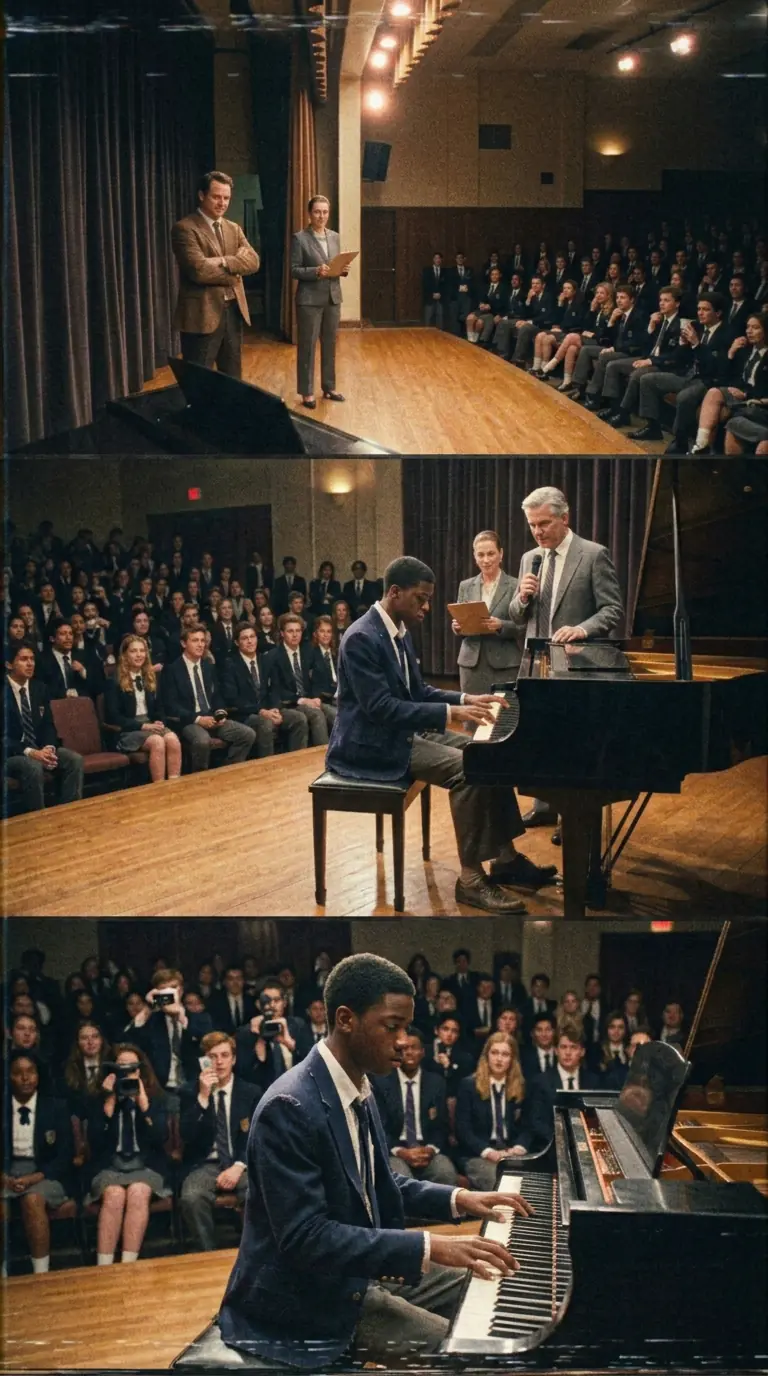
Lincoln Heights Academy’s auditorium, usually reserved for assemblies and the occasional drama production, had been transformed. Professional lighting equipment and an impressive sound system had been installed overnight, courtesy of the anonymous donor. A panel of three judges — music professors from nearby colleges — sat at a table facing the stage.
Behind the curtain, nervous students paced and practiced last-minute warm-ups.
Elijah stood apart from the others, perfectly still except for his fingers moving silently at his sides. He wore his newly tailored suit and a pair of dress shoes Dell had given him.
“My nephew’s, never worn. Would be ashamed to waste them.”
Alicia found him in his quiet corner.
“Remember what we practiced,” she said, squeezing his arm encouragingly. “Forget the audience. Forget Cartwright. Forget everything except the music.”
Elijah nodded, too nervous to speak.
From the stage came the voice of the event coordinator, a local radio personality volunteering her time.
“Welcome to Lincoln Heights Academy’s scholarship showcase auditions. Our first performer today is Elijah Walker, piano.”
A ripple of whispers spread through the audience. Most had come expecting Elijah to be somewhere in the middle of the program, giving them time to witness several other acts first.
Principal Cartwright, seated in the front row, leaned back with a smug smile, anticipating the disaster he was sure would unfold.
“That’s you,” Alicia whispered, giving Elijah a gentle push toward the stage. “You’ve got this.”
Elijah walked onto the stage, the bright lights momentarily blinding him. As his eyes adjusted, he could make out the packed auditorium. Far more attendees than usual for a school audition.
News of the video and the mysterious scholarship had drawn a crowd, including several local music teachers and even a reporter from the community newspaper.
He approached the grand piano, a beautiful instrument brought in specifically for the showcase, much finer than the school’s usual upright.
Some scattered chuckles came from the audience as he sat down, reminding him of Cartwright’s “comic relief” comment.
For a moment, doubt flooded Elijah’s mind.
He glanced toward the wings where Dell stood watching, giving him an encouraging nod.
Taking a deep breath, Elijah placed his hands on the keys and began to play.
The first notes were tentative, almost questioning. Then, as the melody took shape, his confidence grew. The piece he had composed, “Silhouettes of Her,” began as a delicate, wistful tune that gradually built in complexity and emotion. Each note a memory of his mother. Each chord progression a conversation they would never have.
Within seconds, the scattered chuckles died away. The audience fell completely silent, captivated by the unexpected beauty flowing from Elijah’s fingers.
In the front row, Cartwright’s smug smile faded, replaced by a look of disbelief.
Elijah closed his eyes, losing himself in the music. Under his touch, the piano sang with joy and wept with loss, telling a story more eloquent than words could express. The technical difficulty of the piece became apparent as it progressed — challenging runs, unexpected harmonies, and emotionally complex passages that professional pianists would struggle to interpret so effectively.
When the final notes faded into silence, Elijah opened his eyes to find the entire auditorium on its feet. The applause was deafening, punctuated by shouts and whistles. Several audience members were openly wiping away tears.
The judges, who had maintained professional composure throughout, exchanged looks of astonishment.
One leaned over to whisper to another, “Where’s this kid been hiding?”
In the front row, Cartwright clapped mechanically, his face a mask of forced politeness that couldn’t hide his displeasure. Next to him, Mrs. Drake looked as though she had swallowed something bitter.
Elijah stood, took a brief bow, and walked off stage in a daze.
In the wings, Alicia threw her arms around him. “You did it,” she exclaimed. “You were amazing!”
Dell approached more slowly, his eyes suspiciously bright. “You were never meant to be hidden,” he said simply, his voice thick with emotion.
The remainder of the auditions proceeded, but everyone knew they were witnessing the aftermath of something extraordinary. Students who had previously ignored or mocked Elijah now approached him with congratulations and questions about how long he had been playing. Teachers who had dismissed him as troublesome or unremarkable now saw him in a new light.
That evening, Elijah returned home to find his grandmother waiting anxiously.
“Well?” she asked as soon as he walked through the door.
“I think it went okay,” he said, downplaying his success as was his habit.
But his grandmother saw through it immediately. “Tell me everything,” she insisted. “Every detail.”
As Elijah recounted the performance and the reaction, his grandmother’s eyes filled with tears.
“Your mother would be so proud,” she said, squeezing his hand. “So very proud.”
The next morning, Elijah arrived at school to find himself the center of attention. Students he had never spoken to greeted him in the hallways. Teachers who had previously overlooked him now acknowledged him with nods or smiles.
It was disorienting after years of invisibility.
During lunch period, Alicia joined him at his usual isolated table along with several members of the school orchestra who had never given him a second glance before.
“Everyone’s talking about you,” one of them said. “Someone posted about your audition on social media and it’s getting shared like crazy.”
Elijah shifted uncomfortably under the attention. “It wasn’t that big a deal.”
“Are you kidding?” another student chimed in. “Mr. Patterson from Franklin Prep was there. He’s already asking if you’d consider transferring to their music program.”
The conversation continued, but Elijah noticed Alicia had grown quiet, her expression troubled.
“What’s wrong?” he asked when the others were distracted.
“Nothing,” she said quickly. “Just be careful, okay? Not everyone is happy about what happened yesterday.”
Her warning proved prophetic.
That evening, the school janitor discovered the music room door ajar. Inside, he found destruction. The grand piano had been vandalized — its keys ripped out, wires snapped, the beautiful instrument rendered unplayable.
He immediately called Principal Cartwright.
By the following morning, news of the vandalism had spread throughout the school. An emergency assembly was called, with Cartwright addressing the student body from the stage where Elijah had triumphed just a day before.
“This act of vandalism is not only a crime against school property but an attack on our entire community,” Cartwright announced, his voice grave. “Rest assured, we will find those responsible.”
His eyes scanned the auditorium before landing on Elijah, seated in the back row.
“We are investigating all possibilities,” he continued, “including the theory that perhaps someone wasn’t handling the pressure of sudden attention well.”
The implication was clear.
A shocked murmur ran through the audience as heads turned toward Elijah.
After the assembly, Elijah was summoned to Cartwright’s office where Mrs. Drake was already waiting. The atmosphere was heavy with accusation.
“Mr. Walker,” Cartwright began, folding his hands on his desk. “I think we all know why you’re here.”
“I didn’t do it,” Elijah said immediately, his voice firm despite his racing heart.
“Really?” Mrs. Drake interjected. “You were seen near the music room after hours.”
“I’m always near the music room after hours,” Elijah countered. “I practice there with Mr. Delqua’s permission.”
“Convenient,” Cartwright murmured. “Unfortunately, our security footage from last night appears to be missing. Mrs. Drake reports a corrupted file.” He leaned forward. “Until this matter is resolved, I have no choice but to suspend you pending investigation.”
“What?” Elijah’s voice rose in disbelief. “Based on what evidence?”
“Based on the fact that you had both motive and opportunity,” Cartwright replied coldly. “Perhaps the pressure of living up to yesterday’s performance was too much.”
Before Elijah could protest further, Mrs. Drake handed him a formal suspension notice.
“You are not to set foot on school property until this investigation is concluded,” she stated. “All your belongings will be collected and delivered to your home.”
As Elijah left the office in shocked silence, he found Dell waiting in the hallway, his face ashen.
“This is outrageous,” the old teacher sputtered. “They can’t possibly—”
“They already have,” Elijah interrupted quietly. “I’m suspended.”
Dell placed a hand on Elijah’s shoulder. “We’ll fight this. I’ll speak to the board. Call in every favor I’m owed. They can’t get away with—”
His words were cut short as he suddenly grimaced, pressing a hand to his chest. His face contorted in pain.
“Dell?” Elijah asked, alarmed. “Are you okay?”
The teacher tried to respond, but instead crumpled forward. Elijah caught him before he hit the floor, lowering him gently.
“Help!” he shouted. “Somebody help!”
Teachers and students poured into the hallway as Elijah knelt beside Dell, who was now breathing in shallow gasps, his face gray. Someone called 911 while others cleared space around them.
Paramedics arrived minutes later, quickly assessing Dell’s condition as a mild stroke.
As they loaded him onto a stretcher, he reached for Elijah’s hand.
“Don’t let them win,” he managed to say before being wheeled away.
Alicia found Elijah sitting alone on the steps outside the school, watching as the ambulance carrying Dell disappeared down the street.
“I heard what happened,” she said, sitting beside him. “Both things. The suspension and Dell.”
Elijah nodded numbly. “They think I did it. They think I destroyed the piano.”
“Nobody who knows you believes that,” Alicia insisted. “This is Cartwright’s doing. He’s trying to discredit you.”
“Why?” Elijah asked, genuine confusion in his voice. “Why does he hate me so much?”
Alicia shook her head. “I don’t know, but I’m going to find out.” She pulled out her phone. “The security footage doesn’t just corrupt itself. Someone deleted it, which means there was something on it they didn’t want anyone to see.”
“How can you prove that?”
“I can’t,” she admitted. “Not yet. But the system keeps logs of who accesses the files. My cousin works in IT for the district. I think it’s time I called in a favor.”
That evening, as Elijah walked home along the familiar route, he was surprised to see a familiar truck parked outside his grandmother’s apartment building.
Troy Manning stepped out, looking uncomfortable in the unfamiliar neighborhood.
“What are you doing here?” Elijah asked wearily.
Troy shifted his weight from one foot to the other. “I heard about what happened. The suspension.”
“Come to gloat?”
“No,” Troy said, looking genuinely distressed. “I came to tell you… I saw something last night after practice. I was heading to my car when I saw someone sneaking around near the music wing.”
Elijah’s heart raced. “Who?”
“I don’t know for sure,” Troy hedged. “It was dark and they were moving fast. But…” He took a deep breath. “It wasn’t a student. It was someone older. A teacher, maybe.”
“Did you tell Cartwright?”
Troy looked down. “No. I was scared. Coach says I can’t afford any trouble if I want that football scholarship.”
“So why tell me now?”
“Because it’s not right,” Troy said simply. “What they’re doing to you.” And he hesitated. “I saw your performance yesterday. It was incredible, man. Real talent. I guess I was jealous before, but this is different.”
As Troy drove away, promising to think about coming forward, Elijah felt a glimmer of hope for the first time since the suspension.
Someone had seen something. There was a chance to clear his name.
What he didn’t know was that someone else was already interested in his story.
Naomi Reyes, a journalist who had been assigned to cover the scholarship showcase for the local paper, had witnessed both Elijah’s stunning performance and the suspicious aftermath. Her reporter’s instincts told her there was more to this story than a simple act of vandalism.
As she sat in her small office that evening reviewing her notes and the limited information available online about Elijah Walker, she made a decision.
This wasn’t just about a talented kid or a damaged piano. There was something deeper here. Something that spoke to issues of opportunity, prejudice, and the systems that either nurture or suppress potential.
She picked up her phone and dialed Alicia’s number, which she had collected along with other contact information at the audition.
“Hello, Alicia. This is Naomi Reyes from the Herald. I’d like to talk to you about Elijah Walker.”
Morning light filtered through threadbare curtains as Elijah sat by his bedroom window, watching students make their way to Lincoln Heights Academy. Three days had passed since his suspension, and the enforced isolation felt like a physical weight on his shoulders.
He traced invisible melodies on the windowsill, piano keys appearing and disappearing beneath his fingertips as faint echoes of music played in his mind.
His grandmother appeared in the doorway, concern etched on her weathered face.
“You should eat something, baby. I made eggs.”
“Not hungry,” Elijah replied, his eyes still tracking the students outside.
Mabel Walker sighed, crossing the small room to sit on the edge of his bed. “This isn’t right, what they’re doing to you. I’ve been thinking maybe I should go down there.”
“No,” Elijah interrupted quickly. “Please don’t. It’ll just make things worse.”
His grandmother’s expression hardened with quiet determination. “Your mother would never have stood for this. She fought her battles, and sometimes they cost her, but she never backed down when she knew she was right.”
The mention of his mother sent a familiar ache through Elijah’s chest.
“I know,” he said softly. “But this is different.”
“Is it?” she asked. “Or is it the same story, just with different characters?”
Before Elijah could respond, his phone buzzed with a text from Alicia.
*Meeting journalist today after school. She wants your side of the story. Can you meet us at Riverside Park at 4:00?*
Across town, Alicia Tran sat in her AP English class, barely listening to the lecture on Shakespearean sonnets. Her mind was consumed with the investigation she had launched into the deleted security footage. Her cousin in the IT department had promised to check the access logs, but it would take time to do it discreetly.
When the lunch bell rang, Alicia hurried to find Naomi Reyes, who was waiting in her car outside the school grounds as they had arranged.
“Thanks for meeting me,” Naomi said as Alicia slid into the passenger seat. She was younger than Alicia had expected, perhaps in her early thirties, with sharp eyes that missed nothing and a notebook already open on her lap.
“Tell me everything you know about Elijah Walker.”
For the next thirty minutes, Alicia shared the story as she knew it — from Cartwright’s public mockery to Elijah’s hidden talent, from Dell’s mentorship to the shocking vandalism and suspension.
“And you’re sure Elijah didn’t damage the piano?” Naomi asked, her pen poised over her notebook.
“Absolutely,” Alicia replied without hesitation. “It would be like… like a poet burning libraries. That piano was his voice.”
Naomi nodded thoughtfully. “What about Mr. Delqua? I understand he’s in the hospital.”
“Mild stroke, they said. Elijah and I are going to visit him tonight. Would he be willing to talk to you?”
Alicia considered this. “Probably. Dell believes in Elijah more than anyone.”
After school, Naomi and Alicia met Elijah at Riverside Park, a small green space halfway between the school and Elijah’s apartment.
He arrived looking tired, the strain of the past few days evident in the shadows beneath his eyes.
“Thank you for meeting me,” Naomi began after introductions. “I think there’s more to your story than a vandalized piano.”
Elijah regarded her cautiously. “Why do you care? It’s just school drama.”
“Is it?” Naomi challenged gently. “A gifted musician silenced by an administration that seems determined to discredit him. That sounds like a story people should hear.”
For the next hour, Elijah shared his experience, hesitantly at first, then with increasing openness as Naomi’s genuine interest became apparent. He spoke of his mother’s musical influence, his years of playing on a broken keyboard, Dell’s discovery of his talent, and the brief moment of triumph before everything fell apart.
“There’s one thing I don’t understand,” Naomi said as their conversation wound down. “Why would Principal Cartwright go to such lengths to discredit you? It seems personal.”
Elijah shrugged. “I’ve been asking myself the same question.”
As the interview concluded, Naomi checked her watch. “I need to get back to the office, but I’d like to continue this conversation. And I’d like to speak with Mr. Delqua if possible.”
That evening, Elijah and Alicia sat beside Dell’s hospital bed.
The old teacher looked frailer than either of them had expected, his normally animated face subdued by medication and fatigue, but his eyes lit up when they entered the room.
“There you are,” he said, his voice weaker but his spirit undimmed. “I was beginning to think they’d banned visitors too.”
“How are you feeling?” Alicia asked, taking one of his hands in hers.
“Like I’ve been hit by a bus,” Dell replied with a weak smile. “But they tell me I’ll live.” His gaze shifted to Elijah. “What’s happening at school? Have they come to their senses yet?”
Elijah shook his head. “No change. Still suspended pending investigation.”
Dell’s expression darkened. “That’s outrageous. It’s a witch hunt, plain and simple.”
“We met with a journalist today,” Alicia said. “Naomi Reyes from the Herald. She wants to talk to you.”
“Good,” Dell nodded. “It’s time people knew what’s really happening at Lincoln Heights.”
He turned to Elijah, his expression suddenly urgent. “I need you to know something. I’ve been holding on to this for too long already.”
“What is it?” Elijah asked, leaning closer.
“It’s about your mother,” Dell said. “And Cartwright.”
Elijah’s heart skipped a beat. “What about them?”
Dell took a labored breath. “Your mother wasn’t just any pianist, Elijah. Before you were born, she was making a name for herself in the local music scene. Real talent, just like you.”
His eyes grew distant with memory. “She was offered a teaching position at Lincoln Heights. This was before Cartwright was principal, when I was just starting out.”
Alicia and Elijah exchanged a surprised glance as Dell continued.
“But right before she was to start, there was an incident. Money missing from the music department fund. A substantial amount.” His voice grew bitter. “Cartwright was the assistant principal then. He led the investigation, and somehow all evidence pointed to your mother.”
“That’s impossible,” Elijah protested. “She would never—”
“Of course not,” Dell agreed. “But the evidence was convincing enough. She lost the position and her reputation was damaged. Her performing career suffered. She never fully recovered professionally.”
Elijah struggled to process this new information. “Why didn’t you tell me this before?”
“Because I couldn’t prove anything,” Dell admitted. “I had suspicions but no evidence. And after she died…” He trailed off, looking genuinely remorseful. “I should have told you sooner. I’m sorry.”
The revelation added new depth to Cartwright’s animosity. It wasn’t just about Elijah. It was about his mother too — a connection Elijah had never suspected.
As they left the hospital, Elijah was quiet, lost in thought.
Alicia walked beside him, respecting his silence until they reached the bus stop.
“Are you okay?” she finally asked.
“I don’t know,” Elijah admitted. “It’s like finding a missing puzzle piece, but now the whole picture looks different.”
Back at his apartment, Elijah found his grandmother sitting at the kitchen table with a worried expression.
“What’s wrong?” he asked immediately.
She held up an official-looking letter. “Eviction notice. They say we’re three months behind on rent.”
“That’s impossible,” Elijah protested. “You always pay on time.”
“They claim they never received my last three payments,” she said, her voice tight with controlled anger. “And with the delay in my disability checks this month…”
Elijah took the letter, reading the cold bureaucratic language threatening to remove them from their home in thirty days if payment wasn’t received.
It felt like one more blow in a week full of them.
The next morning, desperate to contribute something to their dire financial situation, Elijah took his broken keyboard to a pawn shop in town.
The owner, a balding man with suspicious eyes, barely glanced at the instrument.
“Twenty bucks,” he offered. “And I’m being generous. Thing’s half dead.”
Elijah wanted to protest, to explain the keyboard’s value beyond its broken keys and blown speakers, but necessity outweighed sentiment. He accepted the money with a heavy heart and walked out, feeling as though he had sold a piece of himself.
Back at Lincoln Heights, Alicia was walking past the teacher’s lounge when she overheard Mr. Lambert’s voice through the partially open door.
“It’s almost poetic,” he was saying to someone. “The kid plays like a professional but can’t keep his hands off other people’s property. Typical Westside.”
He cut himself short as a student aide entered the room to deliver mail.
The young sophomore, Tyler Williams, had his phone in his pocket, the voice recorder running — a habit he had developed after repeatedly being accused of misremembering teachers’ instructions. This time, it captured Lambert’s racist commentary perfectly.
That afternoon, Tyler sent the audio clip to several friends, and by evening, it had spread throughout the student body.
The next morning, it appeared on social media, quickly gathering outraged comments from students, parents, and community members.
The school board, already facing questions about Elijah’s suspension, found itself under mounting pressure to address the apparent pattern of discrimination at Lincoln Heights.
Meanwhile, Naomi Reyes sat in Dell’s hospital room, recorder in hand, as the old teacher shared his perspective on Elijah’s situation.
He spoke eloquently about Elijah’s extraordinary talent, the systematic obstacles he had faced, and the suspicious circumstances surrounding the vandalism.
“Elijah isn’t just good for his age or good for a kid from Westside,” Dell emphasized, his voice growing stronger with conviction. “He’s a prodigy born into the wrong zip code, in a different neighborhood with different resources. He’d already be on his way to Juilliard.”
Before leaving, Dell handed Naomi a folder containing copies of Elijah’s handwritten compositions.
“Read the music if you can,” he said. “If not, just look at the complexity, the structure. This isn’t a student experimenting. This is a composer finding his voice.”
Back at the school, Principal Cartwright was working overtime to control the narrative.
In a meeting with the administrative staff, he outlined his strategy.
“There’s no formal recording of the Walker boy’s performance,” he stated confidently. “Just some unreliable mobile phone videos. We’ll emphasize that his playing, while promising, was nowhere near the level some are claiming.”
What Cartwright didn’t know was that Lewis Green, the school janitor who had admired Elijah’s playing from afar, had recorded the entire audition on his phone from the back of the auditorium.
That evening, he anonymously forwarded the audio file to Alicia with a simple message: *Kid deserves to be heard.*
Alicia, recognizing the opportunity immediately, uploaded the audio to a music sharing platform under the title “Unseen Genius – Silhouettes of Her.” She shared it first with a few music students she knew at other schools, then with some local musicians her father had connections with.
The recording began to circulate among musicians and critics, drawing stunned reactions from professionals who couldn’t believe the composer was a sixteen-year-old with no formal training.
“The maturity of emotion expressed through such sophisticated harmonic language is extraordinary. Reminiscent of early Keith Jarrett with echoes of Bill Evans, but wholly original in its synthesis of styles. If this is what he’s creating at sixteen, imagine what will follow.”
As pressure mounted from multiple directions, the school board scheduled a hearing to address both Elijah’s suspension and the broader issues raised by Lambert’s recorded comments.
Cartwright and Drake found themselves on the defensive, their previously unquestioned authority suddenly under scrutiny.
The night before the hearing, Elijah sat on the floor of his bedroom, surrounded by newspaper clippings, old photographs, and letters — a box of his mother’s possessions his grandmother had kept.
Among them, he found a faded program from a jazz festival featuring his mother’s name and a newspaper article about promising local musicians that included her photo.
“What if I’m just the joke they always said I was?” he asked his grandmother, who stood in the doorway watching him. “What if I can’t live up to her legacy?”
Mabel Walker crossed the room and sat beside him, picking up a dusty cassette tape from among the memorabilia.
“Your mother recorded this the week before you were born,” she said, turning the tape in her hands. “She said it was for you, for when you were older.”
She rose and retrieved an old cassette player from her bedroom.
The tape hissed and crackled as it began to play. But then a clear, resonant piano melody emerged — complex and beautiful, performed with the same soulful touch Elijah had inherited.
“You are her legacy,” his grandmother said simply as the music filled the room. “Not her troubles, not her disappointments — her gift.”
The morning of the school board hearing brought an unexpected scene to Lincoln Heights Academy.
A group of students had gathered outside the main entrance holding homemade signs reading “Let Elijah Play” and “Truth Has a Sound.”
Among them were members of the school orchestra, the jazz band, and even a few athletes who had been moved by Elijah’s performance and disturbed by the aftermath.
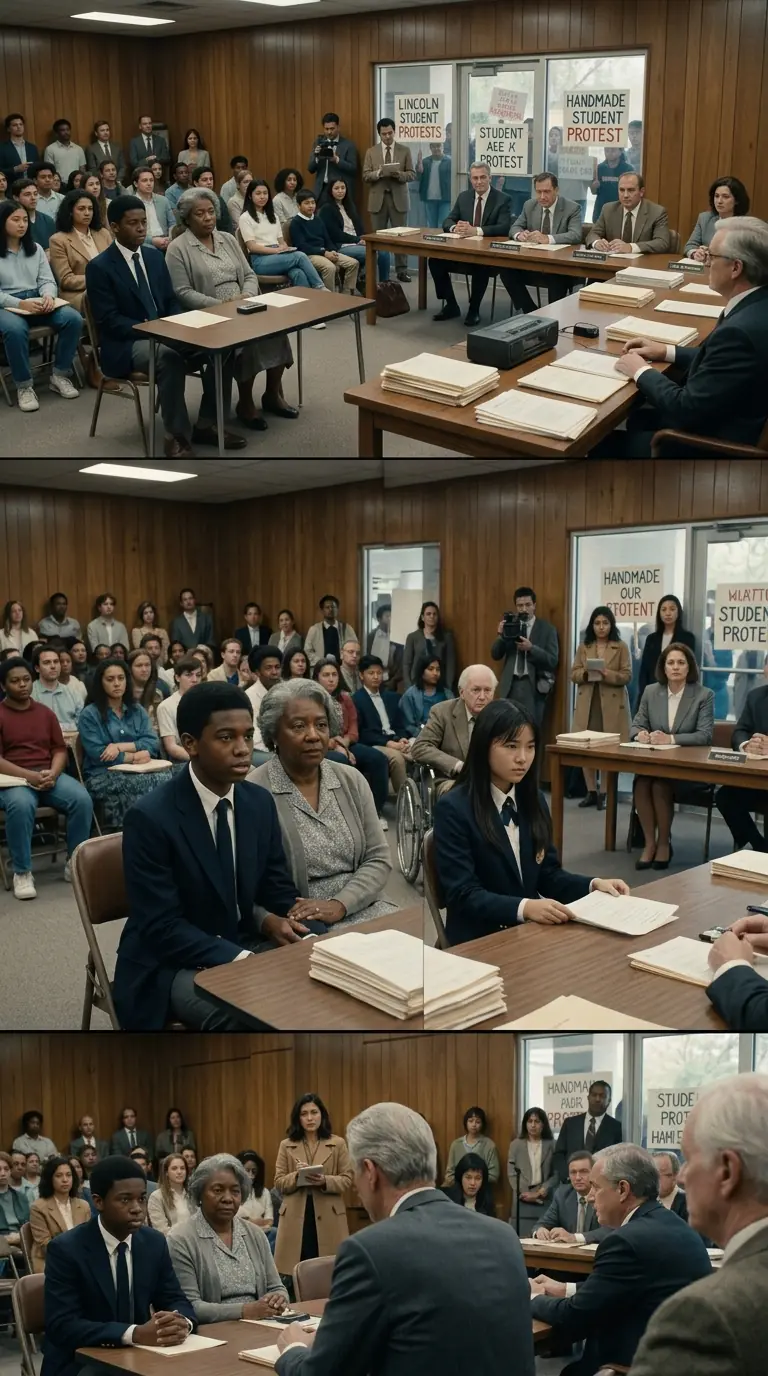
Inside the administrative building, the conference room was packed beyond capacity. Board members sat at the front looking uncomfortable with the unusual level of attention. Reporters from local papers, including Naomi Reyes, lined the back wall.
Cartwright and Drake sat stiffly on one side of the room while Elijah, his grandmother, and Alicia occupied the other.
The board chairwoman, Dr. Eleanor Wells, called the meeting to order with a sharp rap of her gavel.
“This hearing has been convened to address recent events at Lincoln Heights Academy, specifically the suspension of student Elijah Walker and related concerns about administrative conduct.”
She gestured to a wheelchair that had just been pushed through the door. “I understand Mr. Delqua wishes to speak first.”
Dell, looking pale but determined, was wheeled to the front of the room by a hospital attendant. Despite his doctor’s objections, he had insisted on being present.
“I’ve taught music at Lincoln Heights for thirty-seven years,” he began, his voice surprisingly strong. “I’ve seen talented students come and go, but I have never — never — encountered a student with Elijah Walker’s natural ability and depth of musical understanding.”
He went on to detail Elijah’s progress over the months they had worked together, the original compositions he had created, and the obvious passion he brought to his music.
Then his testimony took a darker turn as he described the manipulated audition schedule, the missing security footage, and the administration’s apparent determination to erase Elijah’s achievement.
“This isn’t about a vandalized piano,” Dell concluded. “It’s about a system that couldn’t reconcile its preconceptions with the reality of who Elijah is and what he can do.”
Next came Alicia, poised and articulate as she recounted her own experience working with Elijah and the resistance they had encountered.
“My father tried to stop me from helping Elijah,” she admitted, her voice wavering slightly. “He worried about my reputation, my Juilliard audition, but I defied him because Elijah showed me what real music sounds like, what it means to play from the heart instead of just the page.”
She described the anonymous recording that had captivated professional musicians, the online reaction to Elijah’s composition, and her own suspicions about the security footage.
Cartwright’s testimony came next, carefully constructed to paint Elijah as talented but unstable.
“No one denies the boy has ability,” he said smoothly. “But his academic record shows a pattern of disengagement, and his disciplinary file contains several incidents of concern.”
“Such as?” Dr. Wells prompted.
Cartwright shuffled through some papers. “Various tardiness issues, incomplete assignments, and withdrawn behavior that multiple teachers have flagged as concerning.”
Mrs. Drake followed with similar themes, describing Elijah as uncooperative and suggesting that the sudden attention had been destabilizing for a student already struggling with authority.
But cracks began to show in their narrative when board members questioned why key security footage was deleted.
“A technical glitch,” Drake insisted. “These systems aren’t infallible.”
“Yet somehow only the footage from that specific time frame was affected?” a board member asked skeptically.
Before Drake could respond, the door to the conference room swung open and Tyler Williams entered, clutching his phone.
“I’m sorry to interrupt,” he said, his voice shaking slightly. “But I think you all should hear this.”
He pressed play on his phone, and Lambert’s voice filled the room.
“It’s almost poetic. The kid plays like a professional, but can’t keep his hands off other people’s property. Typical Westside.”
The recording stopped abruptly, leaving a stunned silence in its wake.
Dr. Wells recovered first. “Is that Mr. Lambert’s voice?” she asked, though the answer was obvious to anyone who knew the music theory teacher.
Tyler nodded. “Yes, ma’am. I recorded it in the teacher’s lounge yesterday.”
Dr. Wells exchanged glances with the other board members.
“In light of this new information, I believe we should place Mr. Lambert on administrative leave pending further investigation.”
“Agreed,” said another board member. “And I move that we review all disciplinary actions taken against Mr. Walker with immediate effect.”
The meeting was beginning to shift decidedly in Elijah’s favor when Naomi Reyes raised her hand.
“If I may,” she said, standing. “There’s a piece of this puzzle I think the board should consider.”
All eyes turned to the journalist as she approached the front of the room.
“In researching Elijah’s story, I discovered something that may be relevant to these proceedings.”
She opened a folder and extracted several photocopied documents.
“Sixteen years ago, Elijah’s mother, Sophia Walker, was accused of stealing funds from the Lincoln Heights music department — an accusation that effectively ended her teaching and performance career.”
Murmurs rippled through the room as Naomi continued.
“The investigation was led by then-assistant principal Richard Cartwright, who filed the official report that resulted in her dismissal.”
She placed the documents on the table in front of the board.
“The signatures are all there.”
All eyes turned to Cartwright, whose face had drained of color.
“That’s… that’s irrelevant. Ancient history,” he stammered. “It has no bearing on the current situation.”
“Doesn’t it?” Naomi challenged. “A talented Black musician was accused of theft based on circumstantial evidence, her career destroyed. Sixteen years later, her equally talented son faces similar accusations after demonstrating extraordinary ability. The common denominator in both cases sits right there.”
She pointed directly at Cartwright.
The room erupted in whispers as Cartwright attempted to regain control.
“This is outrageous. You can’t possibly suggest I’ve harbored some kind of grudge for sixteen years. It’s absurd.”
“Is it?” Naomi countered calmly. “Or is it a pattern?”
Before Cartwright could respond, the conference room door swung open once more.
Troy Manning walked in, his letterman jacket a splash of color against the institutional beige walls.
“I need to say something,” he announced without preamble.
“I saw someone near the music room the night the piano was vandalized.”
Dr. Wells gestured for him to approach. “Go on, Mr. Manning.”
“I was leaving late after football practice,” Troy explained, visibly nervous but determined. “I had to get something from my locker, so I cut through the east hallway. That’s when I saw Mrs. Drake using her key card to enter the music wing.”
All eyes swiveled to Mrs. Drake, whose composed facade cracked visibly.
“That’s preposterous,” she hissed. “I wasn’t anywhere near the school that evening.”
“Actually,” Alicia interjected, rising from her seat and approaching the board, “you were.”
She placed a printed document on the table.
“This is a time-stamped record of key card entries for that evening. It clearly shows Mrs. Drake’s card was used to access the music wing at 9:47 p.m., well after hours and just before the estimated time of the vandalism.”
“Where did you get that?” Drake demanded, her voice rising.
“Does it matter?” Alicia responded evenly. “Is it accurate?”
Drake opened her mouth to protest, then closed it again, her expression hardening into a mask of silent fury.
Dr. Wells studied the document, then looked up at Drake with undisguised disappointment.
“Mrs. Drake, you are suspended effective immediately, pending further investigation into these allegations.”
As Drake was escorted from the room, the board conferred briefly before Dr. Wells addressed Elijah directly.
“Mr. Walker, on behalf of the Lincoln Heights School Board, I apologize for the treatment you have received. Your suspension is lifted immediately.”
A cheer erupted from the students gathered outside who had been receiving live updates via text from those inside.
“However,” Dr. Wells continued once the noise subsided, “given the attention this situation has generated, we believe the best way forward is to proceed with the talent showcase as planned. Your participation, which we strongly encourage, will be subject to the same criteria as all other performers.”
Elijah nodded, understanding what wasn’t being explicitly stated. He would need to prove himself again, this time with even more eyes watching.
As the hearing concluded, Elijah found himself surrounded by well-wishers and supporters.
Dell, still in his wheelchair, gripped Elijah’s hand tightly. “This is just the beginning,” he said, his eyes bright with vindication. “Now you get to show them who you really are.”
Outside, Naomi approached Elijah with a smile. “Quite a day,” she observed. “How does it feel?”
Elijah considered the question seriously.
“Like I’ve been holding my breath for years,” he finally said, “and I’m just now learning I can breathe.”
As they walked out into the afternoon sunshine, the scattered applause of students and community members washed over them like a wave — the first notes of a new composition just beginning to take shape.
Monday morning arrived with a clarity that seemed new to Elijah as he approached Lincoln Heights Academy.
The familiar brick building looked different somehow — not physically changed, but transformed by the events of the past weeks.
Students gathered in small clusters near the entrance turned to watch his approach, their expressions ranging from curious to supportive.
“Elijah!” a sophomore girl he barely knew waved enthusiastically. “Good to have you back!”
Others joined in with nods, smiles, and quiet greetings as he made his way up the steps. The whispers that followed him now carried a different tone — not mockery, but something closer to respect.
Elijah kept his head up, acknowledging the greetings with small nods, but maintaining the quiet dignity that had become his shield over the years.
Inside, the hallways buzzed with increased energy. The upcoming talent showcase, now elevated to a city-wide event due to Naomi’s article and the surrounding controversy, dominated every conversation. Scouts from prestigious music schools had requested tickets. Local celebrities had announced their attendance.
What had begun as a modest school function was transforming into Elijah’s unofficial debut to the wider musical world.
As Elijah approached his locker, a familiar figure emerged from a nearby office.
Principal Cartwright, his usual air of authority diminished by recent events, intercepted Elijah’s path.
His smile was forced, his hand extended in a gesture that fell somewhere between professional obligation and desperate damage control.
“Mr. Walker,” he said loudly enough for nearby students to hear. “Welcome back. I trust we can put recent misunderstandings behind us and move forward productively.”
Elijah looked at the offered hand, then at Cartwright’s face — the same face that had smiled mockingly at him for years. The same man who had accused his mother of theft and destroyed her career.
Without a word, Elijah walked past him, continuing toward his locker as if Cartwright were invisible.
A ripple of stunned whispers followed this small act of defiance.
Cartwright stood frozen for a moment, his hand still extended, before dropping it to his side and retreating to his office.
First period found Elijah in English class where his teacher, Mr. Peterson, called on him immediately.
“Mr. Walker,” he said, his tone warmer than Elijah had ever heard it. “Since you’ve been away, we’ve been discussing the concept of the hero’s journey in literature. Perhaps you could share your thoughts on the idea of trials and return.”
Several students snickered at what seemed like an obvious reference to Elijah’s own situation.
But Elijah, rather than shrinking from the attention, considered the question seriously.
“I think,” he said slowly, “that the return is never to the same place you left. Either the world has changed, or you have, or both.”
Mr. Peterson nodded appreciatively. “Well put.”
By lunchtime, Elijah had settled back into the rhythm of school, though nothing felt quite the same.
Alicia joined him in the cafeteria, sliding into the seat across from him with a grin.
“You’re the talk of the town,” she said, opening her lunch bag. “My dad called this morning to apologize for trying to keep me away from you. Apparently he’s been following the news and had a change of heart.”
Elijah raised an eyebrow. “Seriously?”
“Well,” Alicia amended, “he said your commitment to your craft is admirable and that he may have misjudged the situation, which for my dad is practically getting down on his knees and begging forgiveness.”
Elijah smiled, a genuine, unguarded expression that was becoming less rare with each passing day.
After school, Elijah and Alicia headed to the auditorium where preparations for the showcase were well underway.
Professional lighting and sound equipment had been installed, and a team of technicians was fine-tuning everything for optimal performance conditions.
At the center of the stage stood a gleaming grand piano — not the school’s old upright, but a brand new Steinway concert grand that had been delivered that morning.
“Anonymous donor,” the stage manager explained when Elijah asked about it. “Specifically requested for your performance.”
Elijah approached the instrument reverently, running his fingers lightly over the polished surface before sitting on the bench. The keys felt perfect beneath his touch, responsive and balanced in a way his old keyboard and even the school’s previous piano had never been.
He played a few experimental notes, then a brief scale, marveling at the rich, resonant tone.
“It’s magnificent,” he whispered.
Dell, who had been released from the hospital that morning and insisted on coming straight to the school, wheeled himself to the edge of the stage.
“It suits you,” he said, his voice still weak but his eyes bright with pride. “A proper instrument for a proper musician.”
Over the next week, Elijah divided his time between catching up on schoolwork and preparing for the showcase.
He and Alicia had initially planned to perform a duet, combining piano and violin in a piece they had been developing together. But as the event drew closer, Elijah felt a growing conviction that he needed to perform solo again — something more personal than even “Silhouettes of Her.”
Late one night, sitting at his grandmother’s kitchen table with staff paper spread before him, Elijah began to sketch out a new composition.
He titled it simply “The Joke.”
The piece began with jarring, discordant notes that mimicked laughter — mocking, dismissive, cruel — but gradually these harsh sounds transformed, finding harmony and purpose, building toward a powerful emotional crescendo that silenced the laughter and asserted its own voice.
He worked on it obsessively, refining and polishing every phrase.
When he finally played it for Dell and Alicia three days before the showcase, both were visibly moved.
“That’s it,” Dell said, wiping away tears. “That’s your statement to the world.”
On the day of the showcase, Lincoln Heights Academy was transformed.
Television vans lined the parking lot. Community members in formal attire mingled with students and parents. Inside the auditorium, every seat was filled, with people standing along the walls and sitting in the aisles. Despite the fire marshal’s objections, backstage, Elijah adjusted his tie — a new one purchased specifically for this night. His grandmother had splurged on a proper suit as well, using money from a community fundraiser Naomi had quietly organized after learning about their eviction notice.
“You nervous?” Alicia asked, peeking into the small dressing room assigned to him.
“Strangely, no,” Elijah replied truthfully. “For the first time, I feel like I’m exactly where I’m supposed to be.”
The showcase was scheduled to begin at 7:00 p.m. sharp.
At 6:45, the stage manager approached Elijah with a concerned expression.
“We have a problem,” he said. “Your name isn’t on the introduction list. Principal Cartwright submitted the final program this afternoon, and somehow you were omitted.”
Elijah felt a momentary flash of the old anxiety, but it was quickly replaced by a calm determination.
“It doesn’t matter,” he said. “Everyone knows why they’re here.”
What Elijah didn’t know was that Naomi had already gotten wind of the omission.
Within minutes, her tweet hit social media: *School tries to silence gifted Black pianist again. Let Elijah play.*
The online response was immediate and overwhelming.
As audience members scrolled through their phones while waiting for the show to begin, the hashtag spread through the auditorium like wildfire.
By 6:55, it was trending locally.
At 6:58, the superintendent of schools arrived, having been alerted to the situation. He found Cartwright in the wings and, after a brief intense conversation, escorted him from the building.
The audience, witnessing this drama unfold at the edge of the stage, erupted in spontaneous applause.
At 7:05, the show began.
The MC, a local radio personality, addressed the audience with barely contained excitement.
“Good evening, Lincoln Heights. We’ve had a slight change in our program tonight. It seems only fitting that we begin with the young man whose extraordinary talent brought us all together. Ladies and gentlemen, please welcome to the stage… Elijah Walker.”
The applause was deafening as Elijah walked onto the stage.
The spotlights were blinding at first, making it impossible to see the audience. But as his eyes adjusted, he could make out his grandmother in the front row, seated beside Dell in his wheelchair and Alicia’s family.
He approached the piano — his piano now, in a way none had ever been before — and sat down.
The audience fell silent, a collective breath held in anticipation.
Elijah closed his eyes, placed his hands on the keys, and began to play “The Joke.”
The opening dissonant notes caused a few puzzled looks, but as the composition developed, transitioning from harsh mockery to something profoundly beautiful, understanding dawned on the listeners’ faces.
This wasn’t just music.
It was Elijah’s story.
The story of pain transformed into beauty. Of mockery answered with dignity. Of silencing answered with sound.
By the final movement, when the triumphant melody soared above the remnants of those initial discordant notes, many in the audience were openly weeping.
Every note told the story of pain, mockery, survival, and ultimately beauty prevailing over ugliness.
As the final chord resonated through the auditorium, there was a moment of complete silence — a silence so profound it seemed to have weight and substance.
Then, as one, the audience rose to their feet in a thunderous standing ovation.
In the front row, a distinguished-looking man in his sixties turned to his companion and declared loudly enough for those nearby to hear, “That’s not a student. That’s a composer.”
As Elijah left the stage, he was met in the wings not by the stage manager, but by an elderly Black woman whose elegant bearing and knowing smile stopped him in his tracks.
“You don’t know me,” she said, her voice rich with age and emotion. “But I knew your mother. We played together back in the day. I’m Grace Wilson.”
Elijah’s eyes widened in recognition. His mother had mentioned Grace often — her mentor, her bandmate, her friend.
“She’d be proud,” Grace continued, placing a weathered hand on Elijah’s arm. “And now the world finally hears you.”
The rest of the showcase proceeded, but the evening had already reached its emotional peak. No one who was present would ever forget the night Elijah Walker silenced a room full of people with the power of his music.
The days following the showcase passed in a blur for Elijah.
His performance of “The Joke” had been recorded by multiple news outlets, and clips began appearing online with headlines like “Piano Prodigy Silences Critics” and “The Boy They Laughed At Becomes the Man They Applaud.”
Naomi’s full article, published the day after the showcase, went beyond the simple narrative of a talented teen overcoming obstacles. She delved into the systemic issues that had allowed Cartwright’s behavior to go unchecked for so long, the racial undercurrents that had shaped Elijah’s experience, and the transformative power of art to transcend circumstances.
The story was picked up by national outlets, bringing attention not just to Elijah, but to Lincoln Heights Academy and its troubled administration.
A documentary filmmaker approached Elijah’s grandmother about the possibility of a project tentatively titled *The Boy They Laughed At*.
Through it all, Elijah maintained the quiet dignity that had become his hallmark, granting interviews selectively and always redirecting attention to the music itself rather than the controversy surrounding it.
Two weeks after the showcase, Dell returned to school to a hero’s welcome.
Students and faculty lined the hallways, applauding as he made his way to the music room, now his in more than just name. The school board, eager to make amends and improve their public image, had promoted him to department head with a substantial budget increase.
“First order of business,” Dell announced to his first class back, “is establishing the Sophia Walker Mentorship Program for underserved musical talent.”
His eyes sought out Elijah, seated in the back of the room.
“Some lights shine too brightly to be hidden.”
The program would identify promising musicians from disadvantaged backgrounds and provide them with instruments, instruction, and performance opportunities — all funded by a combination of school budget and community donations that had poured in following the showcase.
Mrs. Drake never returned to Lincoln Heights.
The investigation into her role in the piano vandalism resulted in her dismissal along with criminal charges for destruction of property and evidence tampering.
Cartwright, facing similar scrutiny and mounting evidence of years of discriminatory behavior, submitted his resignation for personal reasons before the board could formally act against him.
In a joint statement, the school board and district leadership issued a formal apology to Elijah and his family, acknowledging the grave injustice done to both him and his mother years before. The statement promised sweeping changes to hiring practices, disciplinary procedures, and cultural competency training for all staff.
The mysterious donor behind the scholarship and the new piano finally revealed himself: Dr. James Harrington, a renowned music educator who had taught briefly at the conservatory where Elijah’s mother had studied.
“I failed her,” he admitted when he finally met with Elijah. “I saw her talent, but I didn’t fight hard enough when she was accused. I let institutional pressure silence me.” He looked at Elijah with genuine regret. “I won’t fail you.”
The scholarship money, combined with offers from several prestigious music schools eager to recruit Elijah, ensured that his educational future was secure.
But the most immediate change came in the form of a housing grant that allowed Elijah and his grandmother to move into a better neighborhood closer to school and with reliable public transportation.
On moving day, as movers carried their modest belongings into a small but well-maintained townhouse, Elijah insisted on carrying one item himself — his broken keyboard.
Despite offers of new instruments from various supporters, he kept it, placing it in a corner of his new bedroom as a reminder of where he had started.
“You don’t need to hold on to that old thing,” his grandmother said, watching him position it carefully beside a sleek new digital piano provided by a local music store.
“Yes, I do,” Elijah replied softly. “It’s part of the story.”
At school, the social dynamics had shifted dramatically.
Students who had once ignored or mocked Elijah now sought his attention, sometimes awkwardly, sometimes sincerely.
Troy Manning, perhaps the most unexpected ally to emerge from the ordeal, approached Elijah after English class one day with an unusually serious expression.
“I’ve been thinking a lot about everything that happened,” Troy said, scuffing his shoe against the hallway floor. “About how I treated you, how everyone did.” He looked up, meeting Elijah’s eyes directly. “I want to do better.”
This sentiment evolved into action when Troy started a podcast called *Second Chances*, where he interviewed former bullies and their victims, exploring themes of redemption, growth, and perspective. His first guest was himself, candidly discussing his treatment of Elijah and what he had learned in the aftermath.
Alicia’s dream of attending Juilliard remained on track, bolstered now by a new composition she and Elijah had written together — a piece that had captured the attention of the admissions committee during her audition.
But beyond their musical collaboration, a deeper bond had formed between them. Not romantic in nature, but soul-deep. A connection forged through shared purpose and mutual respect.
“We’re going to change things,” she told him one afternoon as they worked on a new piece in the music room. “Not just for ourselves, but for everyone who comes after us.”
In the wider world, Elijah’s story continued to resonate.
Naomi’s article won a regional journalism award, leading to a book deal for a project examining young artistic talent in underserved communities. The working title: *Silhouettes of Her: The Elijah Walker Story.*
As for Elijah himself, invitations began to arrive from venues across the country and beyond — a small jazz club in New Orleans, a community arts festival in Chicago, a youth concert series in New York.
Carefully balancing these opportunities with his schoolwork, Elijah began touring during breaks and weekends, developing a reputation not just as a performer but as a composer whose work defied easy categorization.
His performances blended elements of jazz, blues, classical, and even hints of hip-hop, creating a musical language uniquely his own.
Critics struggled to pigeonhole him, eventually settling on phrases like “cross-genre innovator” and “boundary-defying prodigy.”
But audiences simply came to hear what would emerge from his hands next.
Every performance, regardless of venue or audience, ended the same way — with “The Joke.”
Over time, the piece evolved, growing more nuanced, incorporating new elements while maintaining its core message of transformation.
And every time, Elijah would introduce it the same way:
“This is for anyone who’s ever been silenced, overlooked, or underestimated. Your voice matters.”
And with that, he began to play, his music flowing outward like ripples in a pond, touching each young listener with the possibility of their own unleashed legacy.