"Who let this kid in here?" The voice cut across the gym like a slap. Marcus Webb, whose name appeared on nearly every trophy in the hallway, stood in the center of the floor, looking at the new boy like he was something that had wandered in off the street. 50 athletes stopped moving. The new boy had a worn duffel bag, a broken zipper, and shoes held together at the heel with athletic tape. He'd been at Ironwood Boxing Academy for less than 4 minutes.
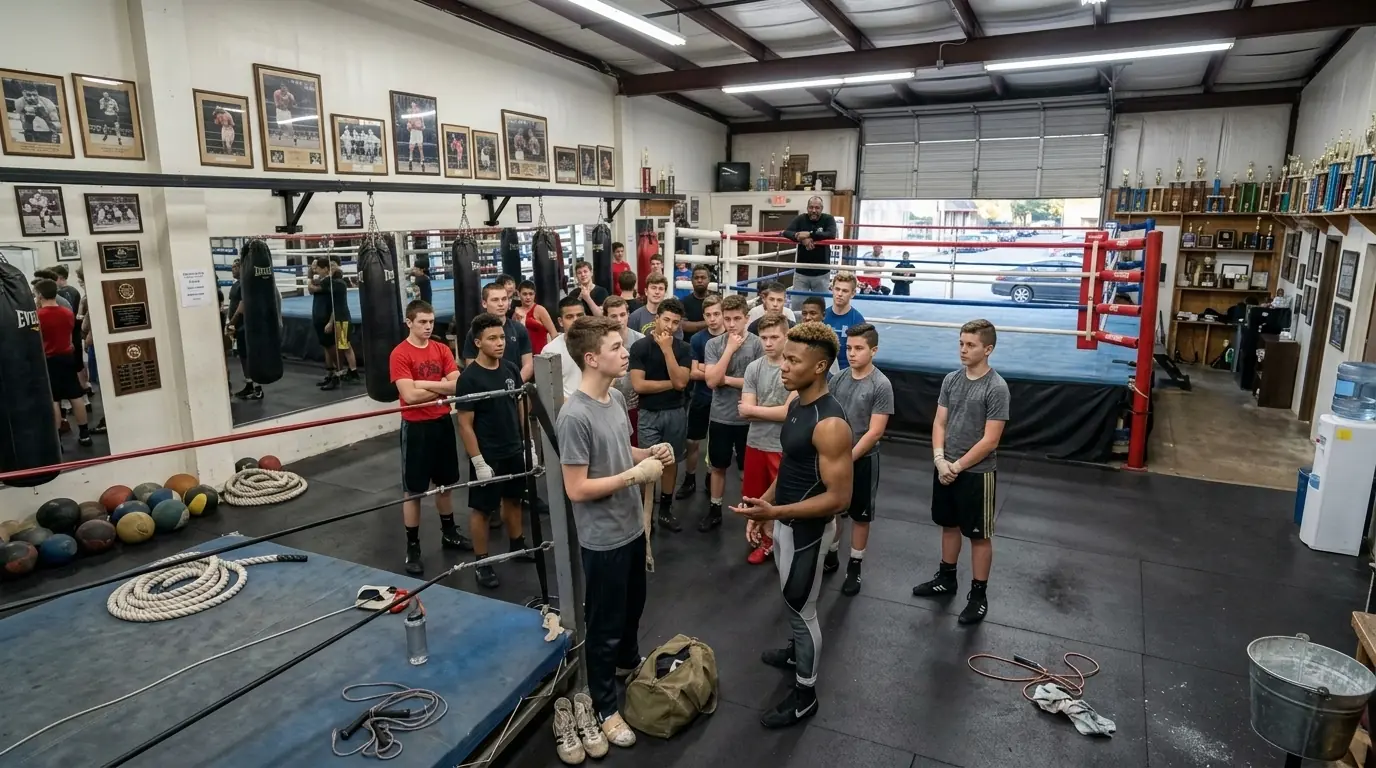
"Hey, I'm talking to you." The boy set his bag down slowly. Then he walked to the equipment rack and started wrapping his hands like no one had said a word. Marcus watched him. Something shifted behind his eyes. He had no idea what he just walked into.
Blake Foster had been boxing since he was 12 years old in a garage two blocks from his mother's apartment that smelled like rubber mats and motor oil. No coach, no ring, just a heavy bag duct taped to a ceiling beam and a boy who showed up every day after school because the alternative was the street and the street had already taken enough from his neighborhood. His mother, Diane, worked the night shift at a garment factory off the interstate. She came home at 6:00 in the morning with her hands stiff and her eyes tired.
And she never once told him to quit. She just asked if he'd eaten. And when he said yes, she believed him, even when the fridge said otherwise.
By the time Blake was 16, people in the neighborhood knew his name. Not from school, from the amateur circuit. Small venues, folding chairs, judges who wrote scores on paper napkins. He won 14 of his first 17 bouts, and the three he lost taught him more than the 14 combined. He learned that power without timing was just effort.
He learned that the fighter who stays calm in the third round usually wins it. When a video of one of his sparring sessions found its way onto a coaching forum, head coach Raymond Wilson of Ironwood Boxing Academy watched it twice. The second time, he watched with the sound off. He wanted to see the footwork without the noise. What he saw was a teenager moving like someone who had been trained for years.
The head movement, the weight transfer, the way the boy reset his stance after every exchange as if he were checking a list only he could see. Wilson made one phone call. Blake received a full scholarship 3 weeks later. Ironwood sat 2 hours north of the city, tucked behind a state forest and a long access road that felt longer in January.
The academy had been running for 22 years and had produced three national youth champions. Its hallways smelled like liniment and old wood, and every surface that could hold a trophy did. The boys who came here were already good. The ones who stayed became something else.
Blake arrived on a Tuesday morning in early September with a duffel bag that had a broken zipper on the front pocket and a pair of boxing shoes where the left sole had started to separate at the heel. He'd patched it with athletic tape the night before. It held well enough. The main gym was large and loud and smelled exactly like the garage back home, which helped. Two rings occupied the center of the floor.
Heavy bags lined the far wall. About 30 athletes were already in the middle of their morning session, skipping rope, hitting mitts, stretching in pairs along the mat. Blake was watching the room when the laughter started. Marcus Webb didn't walk across a gym so much as he moved through it. The way water finds the lowest point without thinking about it.
He was 19 years old, a third-year athlete who had spent the better part of his time at Ironwood collecting titles and the kind of unspoken authority that tends to follow them. He was built like someone who had never missed a training session with hands that had already won two national junior titles and a way of looking at people that made them feel they owed him something. He crossed the floor in eight or nine strides, stopped in front of Blake, and looked him over the way you'd look at a car with a dent in the hood. Who let this kid in here? The room responded the way rooms do when someone powerful decides something is funny.
Not everyone laughed, but enough did that the sound became a wall, and Blake stood on the inside of it, duffel bag still in his hand, shoes still taped at the heel. He said nothing. He set the bag down beside the equipment rack, unzipped the working pocket, and took out his hand wraps. He started with the left hand the way the older man from the garage, who had shown up one afternoon when Blake was 13 and never really left, had taught him: thumb first, three loops at the wrist, four across the knuckles.
Marcus watched him do it. Then he got bored and walked away. That was the first morning.
What followed those first days was not loud. Marcus Webb did not operate loudly. He understood that loud drew attention and attention could complicate things. What he did instead was quiet and consistent and effective. He controlled the gym the way some students control a classroom.
Not through anything written down, but through a system everyone understood and no one discussed. The best training slots at Ironwood ran from 9 to 11 in the morning when the gym was fully lit and both assistant coaches were present and the equipment was fresh. Marcus had those slots. His crew of four or five athletes had the hours immediately after. Everyone else arranged themselves around what remained.
Blake was given a slot at 5:30 in the morning. The overhead lights in the main gym didn't fully warm up until 6:00. So, for the first 30 minutes, he worked by the light that came in through the high windows along the east wall. Gray and thin and good enough. He didn't complain.