"Useless, lazy black kid. Wake up."
Professor Caldwell grabbed Uriah Thompson by the ear, yanked him upright. 200 students stared. The boy stumbled, hoodie falling back.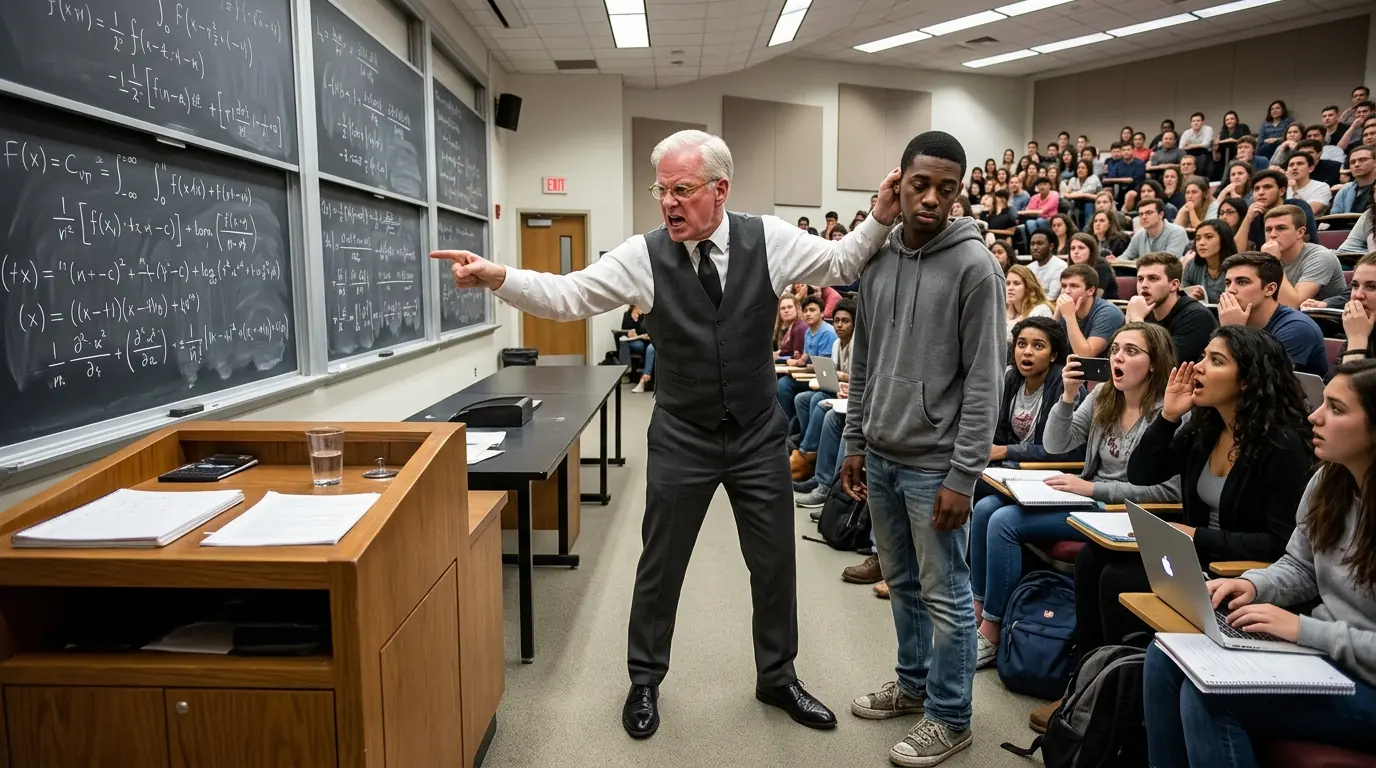
"A lazy slob like you has no right sitting in my classroom." He released his grip. "Get out."
"Sir, I'm sorry. I just got off my shift."
"I don't give a damn. I won't tolerate a stupid, brainless deadbeat in a room where I teach."
"Sir, I'm not stupid," the boy whispered.
Caldwell laughed. Loud, ugly, bouncing off every wall. "Not stupid. Solve that problem on the board or get out. Pick one."
Silence. Every eye on Uriah. He stared at the equation, then picked up the chalk and walked toward the podium. But the professor didn't know he'd just made the worst mistake of his career. By the time he realized it, it was far too late.
6 hours before that chalk touched the board, Uriah Thompson was standing behind bulletproof glass at the Fuel and Go on Ridgemont Avenue. 11 at night, the fluorescent lights hummed like dying insects overhead. The linoleum floor was sticky with spilled soda and bootprints. Outside, the parking lot sat under a single orange light that flickered every 30 seconds, casting shadows that moved like living things.
Uriah wore the same gray hoodie he would wear to class. The name tag pinned to his chest said, "Uriah Thompson - Night Shift." His eyes were bloodshot. His fingers smelled like gasoline from refilling the pumps at 9:00.
A man walked in at 1:15, bought a pack of Marlboros, and looked straight through him. Didn't say thank you, didn't nod. Uriah handed back the change, and the man left. That was the whole interaction. That was most interactions.
His manager, Dale, a thick-necked man with a permanent scowl, came out of the back office at 3:00. "You didn't restock the cooler."
"I did. The delivery was short. They only sent—"
"I don't want excuses. I'm docking you 15 minutes."
Uriah said nothing. He never said anything. He had learned a long time ago that arguing with people who had already decided what you were only made things worse.
He clocked out at 5:00, walked 22 minutes home in the dark, past the check cashing place and the liquor store with iron bars on its windows. The apartment was on the third floor of a building where the elevator hadn't worked since before he moved in. He climbed the stairs. The hallway smelled like carpet cleaner and cigarette smoke. Inside a studio, one room, one mattress on the floor, no frame, a folding table by the window where his sister did her homework, a hot plate, a mini fridge with a crack running down the door.
Norah was asleep, 14 years old, dark skin just like his. Her braids fanned out across a flat pillow. She was still wearing her school uniform because she'd fallen asleep studying again. A biology textbook lay open across her chest. Uriah slid it off gently, pulled the blanket over her, checked her backpack, homework folder, lunch bag. He opened the fridge, made her lunch for tomorrow. Two slices of ham between white bread, an apple, a juice box, put it in the bag, zipped it.
Their mother had died 2 years ago. Ovarian cancer. She was 41. Their father had left when Uriah was six and Norah was born. No phone calls, no letters, no child support. Just gone.
After the funeral, Uriah had two choices: let the state take Norah or figure it out. He figured it out. He got the apartment. Got the night shift at Fuel and Go, enrolled at Whitmore on a need-based scholarship that barely covered tuition. The rest—food, Norah's school supplies—came from 6 hours behind bulletproof glass every night.
Nobody at Whitmore knew any of this. They saw a kid in a wrinkled hoodie who slept through lectures and turned in assignments late. That was the whole picture as far as they were concerned.
But there was another life, a secret one. Uriah sat on the edge of the mattress. It was 5:40 in the morning. He should sleep. He had class at 9. Instead, he reached under the mattress and pulled out a notebook. Not a school notebook. This one was different. 400 pages, college ruled, every margin filled. The cover was soft from years of handling. The spine held together with electrical tape. Inside: equations, hundreds of them, proofs that climbed across pages like ivy on a wall, annotations in three languages, English, French, German. He had taught himself French at 15 from a library book, German at 17 from YouTube lectures by a professor in Heidelberg.
He had started this notebook at 14, the year his mother was diagnosed. While she slept through chemotherapy sessions, he sat in the hospital waiting room and read abstract algebra, then calculus, then topology, number theory, library books, stolen PDFs, free MIT open courseware videos on the library computer. 6 years of work, 6 years of questions no teacher had ever assigned. Six years of building something that nobody knew existed.
He wrote for 35 minutes, closed the notebook at 6:15, slid it into his backpack between a crumpled syllabus and a gas station receipt, walked to campus with his eyes half shut. Row 17, last seat on the left, head down.
And then Caldwell called his name.