An 82-year-old Black man was just sitting on a bench, coffee in hand, newspaper in lap, when a white cop tried to force him up, accuse him of loitering, and search his bag. But what the officer did not know, that old man was a living civil rights legend. And sitting just a few feet away, watching everything, was a federal prosecutor with a badge and a camera. What happened next shook an entire police department.
It began with a bench. Nothing ornate, just weathered wood and rusted bolts nestled beneath an old oak in the heart of Forsyth Park, Savannah. Tourists often passed by without a second glance. Children climbed over it.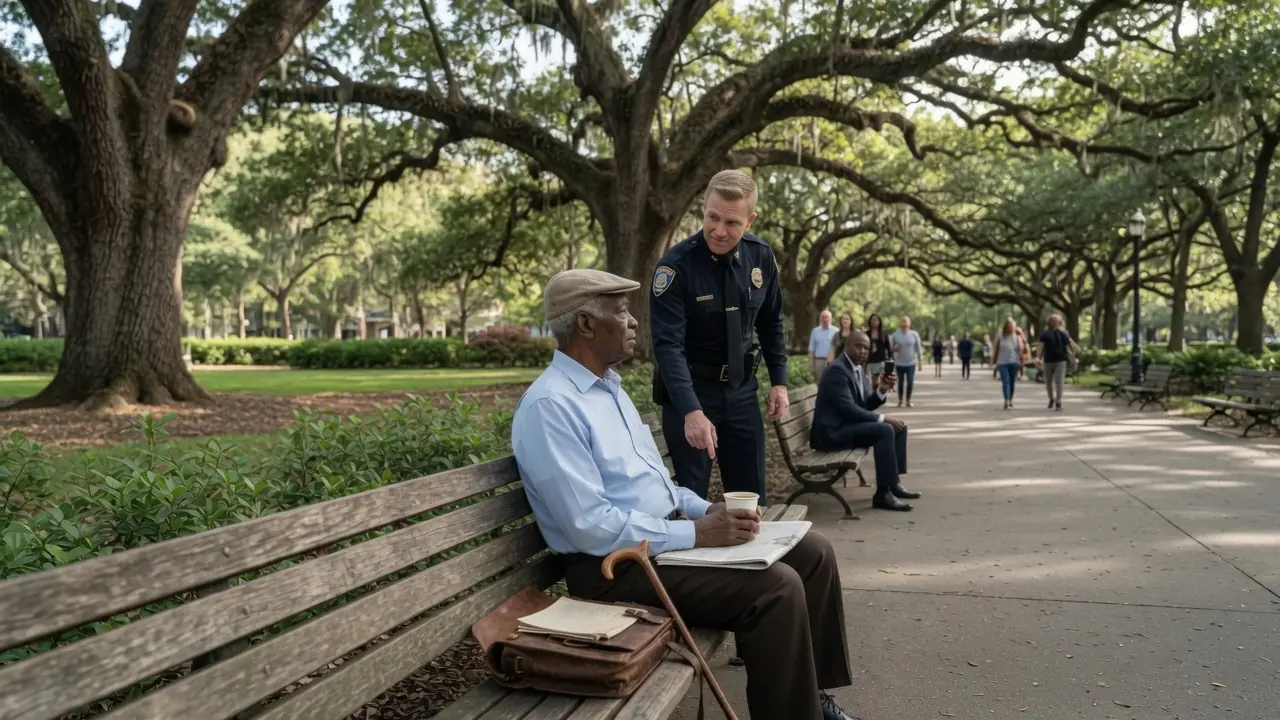
Joggers ignored it. But for one man, that bench was hallowed ground. Every morning at 7 a.m. he would arrive. Same bench, same paper cup of coffee, same polished shoes and pressed slacks.
His name was Solomon Reed, and to most passersby he was just another elderly Black man watching the world pass him by. But that morning, the world was about to notice him, and not for the reasons it should have. Solomon was 82 years old, a retired historian, a widower, and once upon a time, one of the architects behind a landmark desegregation policy that reshaped Georgia's public institutions. But no one in the park that morning knew any of that.
They saw only age and color. And for one police officer, new to town, hungry for authority, and drunk on the power of his badge, that was all it took. Officer Ryan Callahan was patrolling on foot. Young, white, and impatient, he had a record of proactive enforcement, which often translated into profiling disguised as vigilance.
When he saw Solomon on that bench, coffee in one hand and a leather satchel beside him, something in him twitched. Maybe it was bias. Maybe it was arrogance. Maybe it was just the desire to prove something.
Whatever it was, he locked eyes on Solomon like a hound spotting prey. He did not approach immediately. Instead, he circled, observing from a distance, watching Solomon flip through the pages of the Savannah Morning News with slow, deliberate fingers, watching the pigeons gather near his shoes, waiting for crumbs that never came. Watching as if waiting for Solomon to make a mistake that would justify what he already wanted to do.
But Solomon was not about to flinch. Because he had felt eyes like Callahan's before. In the back of buses, in courthouses, in the hostile stares of shopkeepers, eyes that did not see a man, just a question mark in the wrong place at the wrong time. Callahan radioed in casually, voice smooth.
Got a suspicious individual loitering in Forsyth. Elderly male, unknown intentions. Going to make contact. No backup requested.
He thought he had it handled. After all, what could one old man possibly do? Solomon heard the crunch of gravel and did not look up. He knew that kind of walk, the heavy boots, the swagger, the sense of ownership over every square inch of public space.
But he kept his eyes on the paper. An op-ed about redistricting held his attention. He sipped his lukewarm coffee and turned the page, the crinkle of newsprint louder than the approaching footsteps. “Morning,” Callahan said flatly.
Solomon nodded without looking. “Morning, officer.” Callahan stood there a beat too long. “Can I ask what you are doing here?” Solomon finally looked up. His gaze was clear, direct, and unafraid.
Callahan's jaw tightened. His hand drifted near his holster, not to draw yet, but to remind. The power play had begun. “You fit the description of someone we got complaints about,” he said, lying.
“Oh.” Solomon raised an eyebrow. “Elderly Black historian sitting quietly on a bench with arthritis and a newspaper. Must be a real crime wave out here.” The sarcasm did not sit well. Neither did the calm.
Bullies do not like mirrors. “I am going to have to ask you to stand up,” Callahan said, “so I can search that bag.” “No, you are not,” Solomon replied, voice low but ironclad. Callahan's eyes narrowed. “You refusing to cooperate?” “I am refusing to be harassed.” around them.
The park went on. A couple tossed a Frisbee. A dog barked at ducks in the fountain. Life moved as if history was not being rerun in real time.
As if a familiar tragedy was not quietly staging itself on that patch of grass. Then it happened. Callahan reached for Solomon's arm, not roughly, but firmly, intending to assert dominance. In one swift, startling motion, Solomon stood up, steadier than expected.
He did not shove. He did not curse. He simply spoke six words, soft as a whisper, sharp as a blade. “You do not know who I am.” The moment froze.
Callahan scoffed. “I do not care who you are,” but someone else did. Unbeknownst to them both, seated on another bench just yards away, was assistant U. S.
attorney Marcus Langston. Black, in his 40s, sharply dressed, sipping a coffee of his own. He had been watching the exchange unfold. Not because he expected trouble, but because he had seen too many good men humiliated for daring to exist in the wrong skin.
Marcus did not rise. Not yet. But he reached into his jacket pocket where his DOJ credentials rested, waiting like a storm on the edge of silence. Because what Officer Callahan did not know was that Solomon Reed was not just a man sitting on a bench.
He was a survivor of Selma, a speaker at Morehouse, a scholar who had mentored senators and dismantled policies with nothing more than a pen and the Constitution. And if Callahan thought he had stumbled upon someone expendable, he was about to learn the cost of his ignorance. It started with something so small, a bench, a cup of coffee. But what was about to unfold would shake not just the officer, not just the department, but the entire city of Savannah.
And Solomon Reed, calm as ever, knew it. He had waited his whole life for this fight. And he was not standing alone anymore. Solomon Reed did not flinch.
Not when Officer Callahan's grip tightened on his arm. Not when the officer's voice dropped into that controlled edge that masked threat with procedure. In the past, Solomon had seen fear and hatred in uniform, real and unfiltered. This was different.
It was performance laced with entitlement. A rehearsed power trip by someone too young to know the weight of what he was playing with. “I am going to have to ask you again, sir,” Callahan said, louder now, his tone calibrated for public approval in case someone was listening. “Please comply, or I will be forced to detain you.” Solomon held the officer's gaze.
“Detain me for what? Drinking coffee while Black?” Callahan blinked, taken aback. The crowd that had been indifferent moments earlier began to shift. A dog walker slowed her pace, earbuds removed.
A man on a bicycle looped back around. People began to sense something was not right. And there, still seated beneath the canopy of a nearby tree, Marcus Langston quietly closed his coffee lid and rose to his feet. Callahan, however, did not notice.
He was focused on Solomon, this old man who had refused to bow. Something in Solomon's calm only further ignited his insecurity. Power demands submission, and Callahan was not getting it. So, he tried to force it.
“I am not going to ask again,” he barked. “Stand up and hand me that bag.” The satchel, old cracked leather fraying at the seams. Callahan's attention had shifted to it now. A potential threat, a potential excuse.
Solomon moved first, not toward the bag, but toward his cane, resting quietly against the bench. “Let me be very clear,” Solomon said, his voice low and unshaken. “This bag contains decades of documents, civil rights history, testimonies, letters from Martin Luther King, handwritten notes from Thurgood Marshall, photographs from marches you have only read about in footnotes. If you read about them at all. If you lay a single hand on it without a warrant, Officer Callahan, you will not only be violating my civil liberties, you'll be desecrating a legacy larger than you seem able to comprehend.” The silence that followed was thunderous.
And then Marcus Langston stepped in. “Officer,” he called out calmly. Callahan turned, already defensive. “Sir, this is a police matter.” Marcus did not flinch.
“That matter is a constitutional violation unfolding in broad daylight, and I would advise you to unhand Mr. Reed immediately.” “And who the hell are you?” Callahan snapped. Marcus reached into his coat with the same slow, deliberate movement he had practiced for years. Smooth, measured, unmistakably non-threatening. and pulled out a leather badge wallet.
He opened it with one hand. The seal of the United States Department of Justice caught the morning sun like a flare. “Marcus Langston, assistant U. S.
Attorney for the Southern District of Georgia,” he said. A ripple moved through the bystanders. Callahan stared at the badge, then at Marcus, then back at Solomon. And for the first time since he stepped into the park that morning, doubt flickered in his eyes.
“Now,” Marcus continued, stepping closer, but not looming. “You are going to let go of Mr. Reed, take three steps back, and explain to me why you initiated contact without cause, attempted an unlawful search, and escalated a peaceful moment into a constitutional crisis.” Callahan released his grip on Solomon's arm like it burned him. Solomon took a single breath, deep and deliberate. He straightened his back and lifted his cane with dignity, not weakness.
The look he gave Callahan was not one of anger. It was disappointment. A look that said, “You could have done better. You still can. But right now, you have chosen the wrong path.”
“You need to understand something,” Marcus said, shifting so that his body subtly blocked Solomon from the officer. “You did not just pick the wrong target. You picked the wrong era.
You see, this is not 1963. There are cameras in this park. There are people watching. There are platforms where this story can be told.
And most importantly, there are laws now with real consequences. Do you understand me?” Callahan did not answer. More people were gathering now. Phones raised.
A couple whispered to each other as they recorded. A local journalist who happened to be walking her dog had already texted her editor. Solomon stepped forward, tapping his cane once on the pavement. The sound echoed like a gavel.
“Young man,” he said to Callahan, “You came here expecting silence, but silence is a luxury we no longer afford oppressors. And let me be clear, what you have done here today will be remembered not because I am famous, but because I am ordinary. And when injustice happens to ordinary people and it gets caught on camera, that is when it becomes undeniable.” Callahan opened his mouth, but Marcus raised a hand. “I would advise you not to say another word until your union rep and a federal investigator are present.” Sirens began to wail in the distance. Not the panicked wail of chaos, but the summoned response to a system alert.
Savannah PD was sending a supervisor, but it was already too late. The damage had been done. Solomon turned to Marcus. “Thank you,” he said simply.
“You should not have needed me,” Marcus replied, his jaw tight. “No,” Solomon agreed. “But I am grateful you were here.” As uniformed officers arrived and Marcus prepared to give his official statement, Solomon eased himself back onto the bench. He picked up his coffee, now cold.
He sipped it anyway. He looked out over the park, his park, and saw not the confrontation that had just unfolded, but the movement that was about to ignite. Because sometimes change doesn't come with fire or marches. Sometimes it begins with a man sitting on a bench and the decision not to move.
The moment Officer Callahan stepped back, the entire atmosphere in Forsyth Park shifted. It was subtle at first, a slight change in the breeze. The quiet murmur of conversations that had been too cautious to begin. But it was also profound, as if the park itself was exhaling after holding its breath for far too long.
Solomon Reed remained seated, both hands resting on the handle of his cane. His chest rose slowly as he allowed himself the smallest reprieve from the tension that had coiled tight in his bones. He was still recovering, not physically, but emotionally, from the strain of having to stand once again for something that should never have been questioned. His right to sit in peace.
Marcus Langston did not move from his position. His badge, still visible, was not just a symbol of federal authority. In that moment, it was a shield. And it had done what it was meant to do.
Protect the vulnerable from a system that too often failed to recognize them as worthy of protection at all. The crowd that had formed continued to grow. People who had previously passed without noticing now lingered with wide eyes and raised phones. But for all the whispers and flickers of shock, it was a single voice that broke the moment wide open.
“Is someone going to explain why that man was being harassed for sitting on a bench?” The voice belonged to a young woman, early 30s, sharp blazer, camera bag slung over her shoulder. Nora Delgado, a local independent journalist with a following that had grown in the wake of her unfiltered reporting on community policing. She was live streaming now. Her phone lifted, capturing every detail.
“Sir,” she said, turning to Solomon. “Are you okay? Do you want us to call someone?” Solomon gave a small nod. “Thank you, young lady.
I believe help already arrived.” Marcus addressed her calmly. “He is safe now, Miss Delgado, but we will be making sure this incident is investigated fully.” “Is the officer going to be charged?” someone else called out from the crowd. Officer Callahan, still standing a few feet away, shifted uneasily. His face, previously locked in an expression of smug certainty, was now strained with unease.
He opened his mouth to speak, but Marcus turned to him first. “You are not to say another word,” Marcus said, his voice low but firm. “This matter has escalated beyond your department. You are being placed under federal observation, effective immediately.
Any further action on your part will only complicate the outcome.” Callahan visibly bristled, but he did not speak. The authority in Marcus's voice was absolute. At that moment, two senior officers from the Savannah Police Department arrived, summoned by a dispatcher who had picked up the escalating radio chatter. One of them, a gray-haired man named Captain Rivers, took one look at the crowd, the DOJ badge, the streaming cameras, and Solomon's cane, and knew the narrative before a word was spoken.
Marcus approached him. “Captain, I suggest you separate Officer Callahan from the scene immediately and begin your internal documentation.” “I will be contacting the Civil Rights Division in D. C. within the hour.” Captain Rivers nodded grimly.
“Understood.” Callahan was escorted away without protest. That too was a shift not just in the energy of the moment but in the fragile structure of power itself because here was a young white officer being removed from the field in front of dozens of witnesses and a black federal official and he was not being protected by the badge. He was being held accountable by it. Marcus turned back toward Solomon.
I know this is not what you came here for today. Solomon shook his head, his voice soft now. But I suppose I always knew it might be. “What do you mean?” Marcus asked, kneeling slightly so they were eye level.
Solomon looked toward the tall oaks that frame the park's entrance. “You do not spend your life fighting for dignity and expect it to stay yours without effort. That bench has seen more of me than most people have. It holds memories and ghosts.
I sit there because I remember when I could not.” Marcus did not respond right away. Instead, he stood scanning the faces around them. Strangers, witnesses, citizens who now had to decide how this moment would live on, whether it would vanish into another headline or transform into something larger. I would like to walk with you, Marcus said.
If you are up to it, Solomon grunted. Where to? To the precinct to file a statement and then to the courthouse. Because this is not going to end in the park.
Solomon looked at the satchel resting by his side, the same one that had nearly been manhandled minutes earlier. With deliberate care, he slung it over his shoulder, and pushed himself to his feet. I have marched across bridges, faced fire hoses and dogs. I have buried friends who did not make it home.
One more walk will not break me.” As the two men moved forward, the crowd instinctively parted for them. The cameras followed, and so did the weight of what had just happened. What began as a confrontation had evolved into a reckoning. And though Solomon had entered the park as a quiet figure seeking solitude, he now left it with a city behind him and a country watching.
When news of the park incident broke across Savannah, it did more than stir public interest. It tore open a wound the city had long pretended had healed. The footage spread quickly, first through social media, then local news, then national outlets. A still image of Officer Callahan gripping Solomon Reed's arm, an elderly Black man simply sitting on a bench, appeared on screens across the country.
But it was not the image alone that triggered outrage. It was what followed. Because the man who intervened was not just a bystander. He was Marcus Langston, assistant U.
S. attorney of the U. S. Department of Justice's Civil Rights Division.
And the badge he flashed came with the authority to not only stop injustice in real time, but to take it apart brick by brick. Within forty-eight hours, a formal federal investigation into the Savannah Police Department was launched. It began with Officer Callahan. But it did not stop there.
Marcus moved fast. He returned to Washington only long enough to mobilize a team of forensic auditors, civil rights attorneys, and oversight officers. When he returned to Savannah, he was not alone. ten agents from the DOJ's public integrity section came with him alongside two officials from the Office of Civil Rights and the Inspector General's Office.
Their presence was not symbolic. It was surgical. Captain Rivers cooperated, but tension rippled through the department. Some officers felt betrayed, others quietly welcomed the scrutiny.
What became clear almost immediately was that officer Callahan's behavior was not an isolated incident. It was a symptom of something far more entrenched. Anonymous tips began pouring in. Officers who had been silenced for years suddenly had backup.
One black officer admitted to being reassigned after filing a complaint against a superior for racial slurs. Another recalled dash cam footage being erased following an unjustified traffic stop. The stories varied, but the pattern was unmistakable. Solomon Reed, meanwhile, continued walking the same path through Forsyth Park every morning, not out of defiance, but conviction.
The bench was his still, and he was not going to let one man's ignorance steal that from him. But even Solomon could not have predicted how deep the roots of the investigation would reach. Marcus arranged a private meeting with him at the historical society. Solomon arrived with his usual quiet dignity, satchel in hand, the same one filled with letters and photos from a lifetime of civil resistance.
They sat in a windowed room surrounded by artifacts of Savannah's history, portraits of governors, paintings of battles, and near the corner, a faded photograph of a sit-in Solomon had once led. “I wanted to tell you first,” Marcus said. “We found something.” Solomon said nothing at first. Waiting.
There's a trail of misconduct reports dating back fifteen years. Marcus continued, “Many were sealed or lost. Internal reviews that never happened. In some cases, evidence was falsified.
At least three officers were promoted after being accused of civil rights violations. And more than that, a whistleblower just gave us something else.” He slid a folder across the table. Solomon opened it slowly. Inside were scanned copies of a memo written by a former deputy chief, one that described a quota-based patrol system in predominantly black neighborhoods.
The language was veiled, clinical even, but the intent was clear. Increased presence. Proactive engagements and containment zones. “It was policy,” Marcus said, his voice low.
Not random behavior. “It was institutionalized.” Solomon's hands trembled slightly as he closed the folder. “You going to bring it down?” We are not just bringing it down, Marcus replied. We are rebuilding from the ground up.
That night, a press conference was held on the steps of city hall. Marcus stood beside the mayor, who after reviewing the findings, issued a public apology. Her voice cracked as she acknowledged a failure of oversight and a betrayal of community trust. But words were not enough.
By the end of the week, Officer Callahan had been suspended without pay, pending charges for unlawful detainment and civil rights violations. Internal affairs had begun audits of every complaint filed over the last decade, and the DOJ had invoked Section 14141, allowing federal oversight of the entire department until systemic reform was achieved. Still, change did not come without resistance. Some residents rallied behind Callahan, claiming he had been set up or caught in a political stunt.
Conservative pundits fanned flames of division, painting Solomon as a manipulator and Marcus as an outside disruptor. Threats were sent, anonymous letters, emails, whispers in city council halls. But the movement did not falter because for every voice that tried to silence Solomon, a dozen more rose to stand with him. One morning as he returned to the park, Solomon found someone had left a bouquet of white lilies on the bench.
A small note was tucked underneath. For your strength, for our future. And that weekend, hundreds gathered at Foresight for a peaceful demonstration. Neighbors, students, veterans, ministers.
They did not march. They sat shoulder to shoulder on the grass, the benches, the curbs. A silent statement that this park, like every inch of the city, belonged to everyone. A young man spoke at the gathering, a high school senior named Devonte.
He stood in front of the crowd and said, “Mr. Reed showed us that sometimes you fight by sitting still. That courage does not always look like shouting. It looks like refusing to move.” Solomon stood quietly at the back, cane in hand, eyes misted with tears he did not wipe away.
And Marcus, watching from nearby, knew that they had not just uncovered corruption. They had ignited a reckoning. The city of Savannah would never be the same, and neither would the people in it. Autumn settled gently over Savannah like a final blessing.
The thick summer heat had given way to cool golden mornings, and Forsyth Park was quieter now, its oaks shedding the first of their leaves onto the worn brick paths. But something had changed in the rhythm of the city. It was not loud or sudden. It was subtle, like a wound healing just beneath the skin.
The federal investigation had brought indictments, reform, and oversight. Officer Callahan had been stripped of his badge and now awaited trial. His actions, once buried beneath layers of departmental protection, were exposed, cataloged, and broadcast. But more than that, the city had begun looking inward.
Old ghosts were being named. Conversations once whispered were now spoken clearly. It was, as Solomon Reed would often say, the beginning of something, not its conclusion. On a bright October morning, a modest ceremony was held at the edge of Forsyth Park.
A small crowd gathered near the bench where it all began. Though today it looked different. New pavers had been laid. The bench had been restored.
And just beside it stood something no one expected. A sculpture cast in bronze. It depicted an elderly man seated calmly on a bench. A newspaper folded in his lap.
One hand resting gently on the curve of a cane. The figure's face was not Solomon's. Not exactly. The artist had chosen to leave the feature soft, symbolic, meant to represent many.
But everyone in the crowd knew who it was meant for. Marcus Langston stood at the edge of the crowd, not behind a podium, not as a guest of honor, just present, watching. Solomon was seated front row, his satchel by his feet as always, cane across his knees, hat tilted back. He was not smiling, but his eyes shone with a quiet, satisfied gleam.
The mayor took the mic first, delivering brief remarks about healing, unity, and responsibility. Her voice wavered only once when she said Solomon's name. Then she stepped back and gestured toward him. He stood slowly.
The crowd hushed. “I did not ask for this,” Solomon said plainly, looking up at the sculpture. Then back at the people gathered. Didn't march all those years ago to become a statue.
Didn't sit on that bench expecting cameras or headlines or applause. A pause. Long and thoughtful. “I just sat because I was tired.
Tired of the long fight. Tired of seeing the same battles dressed in new uniforms. But mostly I sat because I believed, still believe, that if we do not hold space, someone else will take it from us.” He scanned the crowd slowly. This is not just a statue of me.
This is for every elder who never made it home. Every voice silenced. Every child who asked, “Why do they look at us that way?” This is for the ones who stood when it was not safe to stand. And for those who are just learning how.” Applause swelled, not thunderous, but deep, resonant, respectful, the kind of sound made by people who understand they are part of something larger.
Later, as the crowd dispersed, Marcus approached Solomon. They did not speak at first. They just stood beside the sculpture side by side. “You changed this place,” Marcus said eventually.
Solomon shook his head. “We all did. I just happened to be sitting down when the world needed to see someone still standing.” They both chuckled at that. “I will be going back to D.C. next week,” Marcus added, his voice softer now, “but we will keep the oversight in place for years if necessary.” “Good,” Solomon replied. “Do not let the light dim just because the cameras turn away.” The breeze picked up, rustling the newly fallen leaves.
Children laughed in the distance. Somewhere, a musician was playing slow jazz near the fountain. Solomon turned to leave, but Marcus placed a hand gently on his shoulder. “One more thing,” he said, reaching into his coat and handing Solomon a folded letter.
It bore the seal of the Department of Justice. “It is official. We are launching a national task force based on what happened here. Civil rights violations in small-town police departments. We are naming it after you.” Solomon opened the letter, but did not read it. He just stared at the seal. Then closed it gently and slipped it into his satchel. “I would rather they remember the truth,” he said, almost to himself, “that all it took was a man with a cup of coffee, a cane, and a bench.” And with that, he walked away, not into silence, but into legacy.
What began as an ordinary morning in Savannah's Forsyth Park, a quiet cup of coffee, a folded newspaper, a man enjoying the breeze, unfolded into a story that would shake the foundation of a city. Solomon Reed, 82 years old, never set out to become a symbol. He was not chasing recognition. He was not marching for the cameras or demanding attention.
He was simply present, a living witness to history, resilience, and quiet dignity. But when a young, arrogant police officer tried to reduce that presence to suspicion, to question a lifetime of earned respect with a badge and a smirk, Solomon did not back down. What followed was not just a confrontation. It was a reckoning.
Thanks to a hidden observer, Deputy Attorney General Marcus Langston, Solomon's calm refusal to be erased triggered an investigation that unraveled years of corruption. What started on a bench turned into federal indictments, new laws, and the restructuring of an entire police department. Yet more than the headlines, the real impact was found in the lives touched. The boy who saluted Solomon in the park.
The protester who spoke out for the first time. The officers who finally chose integrity over silence. Solomon reminded us that courage does not always come with fists raised or megaphones blaring. Sometimes it comes with stillness, with refusing to move when everything and everyone tells you to.
With saying, “I belong here.” Not loudly, but with such unshakable conviction that the world has no choice but to listen. The lesson is this. True power is not always in the system. It is in us.
In the moments we choose not to shrink, in the everyday acts of standing our ground, of protecting our dignity, of defending someone else's right to be seen, heard, and respected. Whether you are in a boardroom, a classroom, a park, or at your kitchen table, every single one of us has a role in shaping the kind of society we leave behind. So ask yourself, where is your park bench? What injustice are you overlooking because it is easier to keep walking?
And when the time comes, will you sit in silence or will you speak? Solomon Reed did not expect to lead a movement, but he did. Not because he shouted louder, but because he stood quietly, firmly for what was right, and because someone else was watching and chose to act.