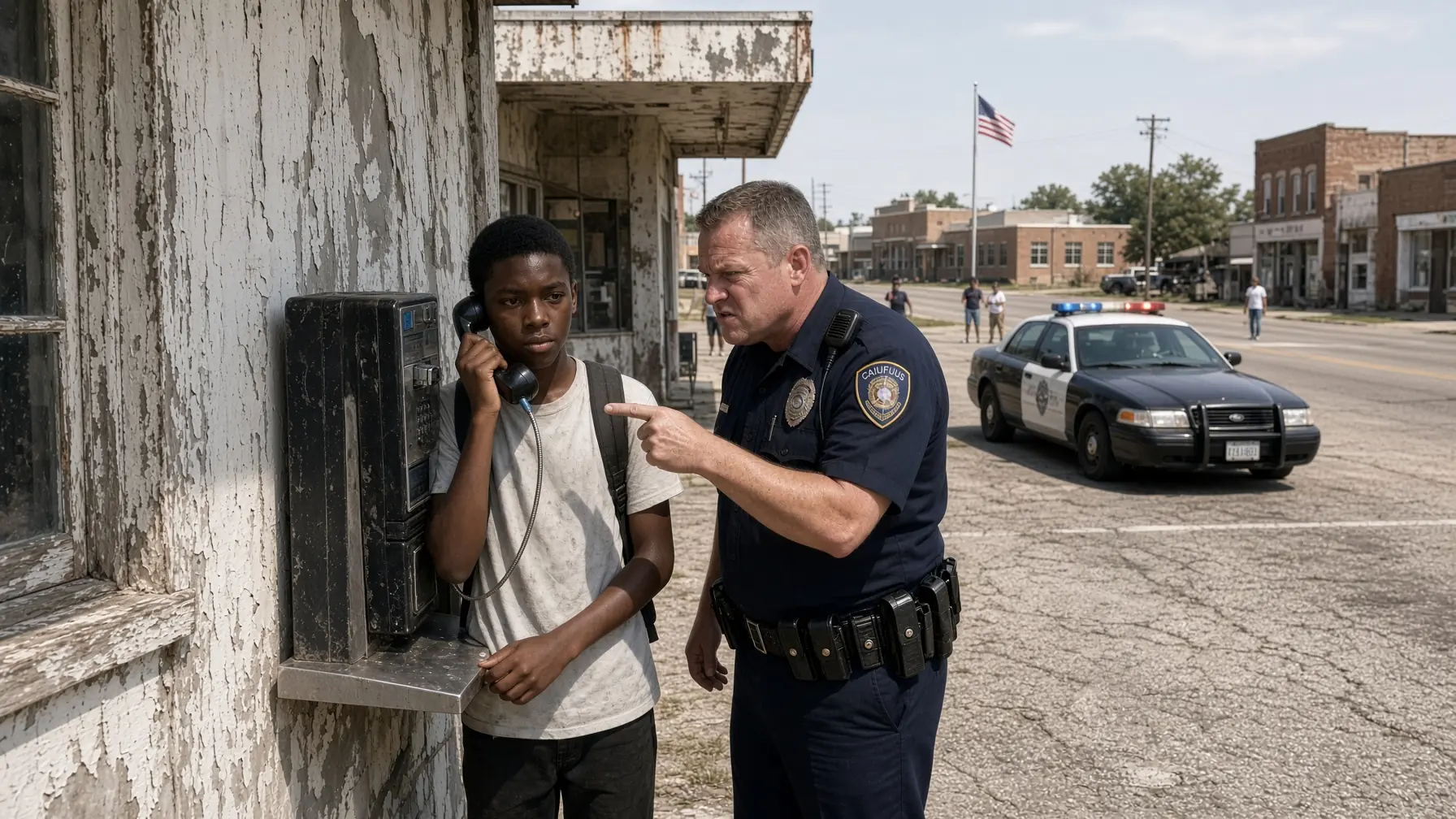
It was the kind of town where the air always carried the scent of gasoline and gossip, and the silence only broke when trucks rumbled through or trouble arrived. A 13-year-old boy named Malik Hayes stood alone in front of a public payphone outside a rusted gas station on Highway 7. The sun beat down hard on the cracked concrete. In his hand, the receiver was slick with sweat, not from fear, but from precision. Every word he spoke carried weight.
"Asset 7, alpha in progress, code blue, location locked, target under observation, across the street." Officer Grady leaned against his patrol car with the easy confidence of a man who held power in a place where it never should have reached him. When he spotted Malik, his jaw tightened. A black boy using a public phone with that kind of focused look was not something he saw every day. It was not the quiet of a small town. He crossed the parking lot the way a man approaches a stray dog, slow, suspicious, already assigning blame.
"You making prank calls?" he asked, voice thick with condescension. Malik kept his eyes straight ahead, calm. "I'm reporting something." Grady stepped closer. "To who?" "The FBI." That was all it took. The officer laughed with his whole mouth, but not with his eyes.
"The FBI doesn't talk to kids. Who do you think you are?" Malik did not blink. He lowered the receiver just enough to speak clearly. "I think I'm someone who sees things you don't want seen." The laughter stopped. Grady's hand drifted toward his belt, not quite drawing the weapon, but close enough.
"You think you're smart? Don't lie to me, boy." And that word, liar, hung in the air like smoke. Malik raised the phone again, speaking slowly, deliberately. "This call is being monitored. Officer's name logged.
Protocol 9 activated." Grady's smile cracked. It did not shatter all at once. It tightened, fought, then faded. He snatched the phone from Malik's hand and slammed it down. "Nobody talks to the FBI." He muttered, "Not in my town." But then his own phone vibrated once, twice, three times.
The kind of triple ring no local line ever made. He looked down. The number was blocked. The screen flashed white. Malik stepped back slowly, hands raised, not in fear, but in formality.
"They're calling you." He said, "You should answer." Grady hesitated, finger hovering. When he finally pressed accept, the voice on the other end was not local, not casual, and not kind. "Officer Grady." It said, cold as steel, "Step away from the child. You are being recorded." The world did not tilt. It shifted quietly, like a lock turning from the inside.
No sirens. No shouting. Only the unbearable weight of understanding. Because what Malik had seen, and what he knew, was not merely dangerous. It was federal.
And this time the softest voice in the room was not asking for help. It was offering it. Malik Hayes had never been built for chaos. He had been built for precision. Even as a child, everything about him was measured.
His words, his silence, his footsteps. He did not speak much at school, but when he did, the teachers stopped. Not because he was loud, but because he was exact. His classmates never quite knew what to make of him. A quiet black boy who earned the highest grades, who liked reading court transcripts, whose notebooks were always ordered, whose eyes studied people the way other children studied puzzles.
They called him strange. His mother called him prepared. Her name was Nicole Hayes, and in the circles of Washington, she carried more weight than most judges. Nicole was a decorated FBI counterintelligence agent who specialized in operations where identities stayed hidden, and survival meant seeing three steps ahead. The country did not know her name.
That was the job. What mattered most was that her son did, because if anything ever happened to her, Malik was the fail-safe, a living archive, a breathing backup, a witness trained to be trusted. Nicole raised Malik inside a quiet that held power. No shouting, no panic, only structure. She did not read him bedtime stories.
She taught him encryption. She never spoke down to him. She spoke as if one day he would have to testify. Malik did not receive hugs at the door. He received instructions.
Memorize this route. If someone follows you, take the third alley, not the first. Do not run. Do not shout. Stay calm.
State the facts. Call this number. Use this code. It was not a childhood, it was a mission. When Nicole was sent on a long-term undercover assignment, Malik was placed with his grandmother, Ms. Delilah Brooks, in a forgotten southern town where last names meant everything, and justice arrived late, if at all.
Ms. Delilah was sharp, older than most of the buildings downtown, and so respected that even the sheriff called her ma'am. But that respect did not extend to Malik. He was new. He was different. And in a town like that, different meant danger.