What happens when the person you are illegally detaining out of sheer prejudice turns out to be one of the most powerful military commanders in the United States? Officer Bradley Jenkins thought he had caught a nobody, a woman he could bully to inflate his own ego. He thought her worn-out hoodie and quiet demeanor meant she was an easy target. He was dead wrong. Hartsfield-Jackson Atlanta International Airport was a sprawling chaotic metropolis of its own.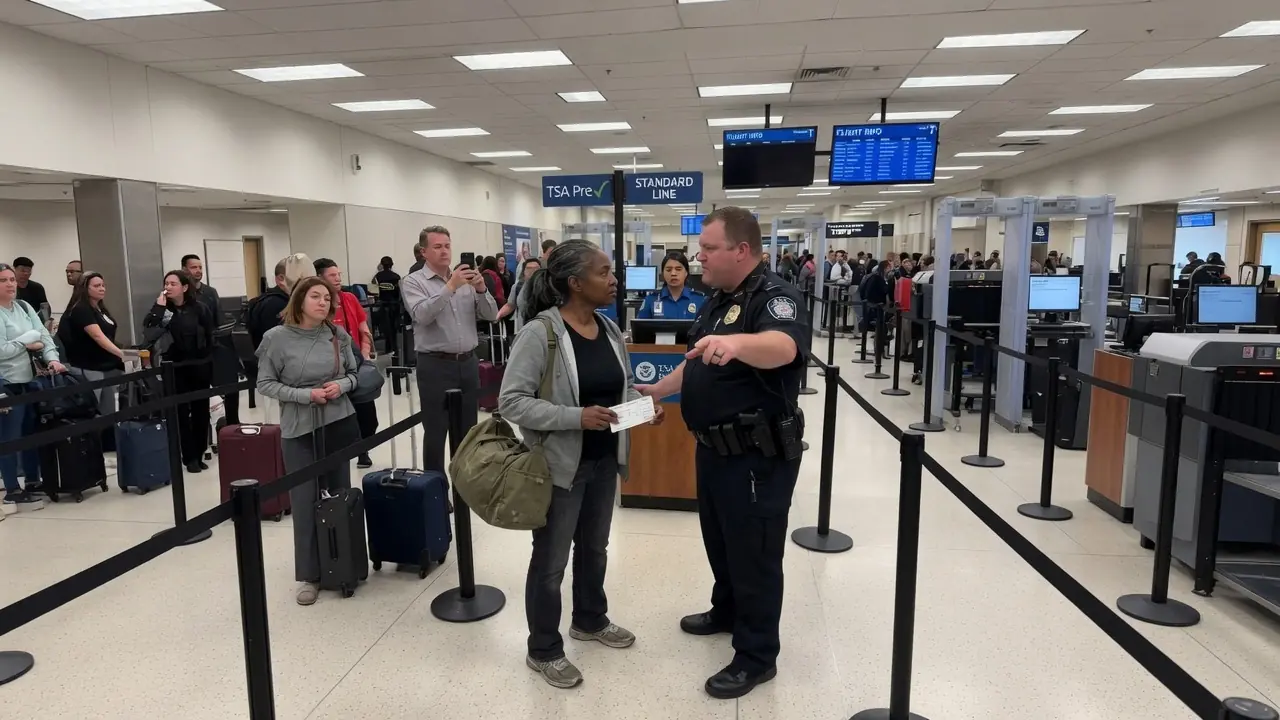
It was a labyrinth of steel, glass, and humanity. It was 11:45 p.m. on a muggy Tuesday night, the kind of hour where the terminal echoed with the distinct sound of rolling suitcases and the exhausted sighs of delayed passengers. General Sarah Mitchell just wanted to go home. At 52, Sarah had spent more than three decades navigating the treacherous male-dominated echelons of the United States Army. She had commanded battalions in Afghanistan, orchestrated massive logistical overhauls at the Pentagon, and had been quietly pinned with her fourth star just three weeks earlier, making her one of the highest-ranking military officials in the free world.
But tonight, she didn't look like a four-star general. She didn't have her aide-de-camp trailing behind her. Nor was she wearing her impeccably pressed dress blues adorned with a chest full of ribbons and medals. Tonight she was just Sarah. She wore a faded gray zip-up hoodie over a plain black t-shirt, comfortable dark denim jeans, and a pair of scuffed running shoes.
Her hair, usually pulled into a strict regulation bun, was tied back in a loose, messy ponytail. She was flying commercial, a rare personal choice she had made to quietly visit her ailing mother in Chicago, without the fanfare and security detail that usually accompanied her every move. She carried only a battered olive drab duffel bag, a remnant from her early days at Fort Bragg. She blended in perfectly. And in America, blending in while being a Black woman in a worn hoodie often meant becoming completely invisible, or worse, becoming the wrong kind of visible.
Officer Bradley Jenkins belonged to the latter school of thought. Jenkins was a 12-year veteran of the Airport Police, a man who had peaked in high school and spent the rest of his life desperately trying to claw back that sense of authority. He had a reputation among his colleagues as a hard charger, a polite euphemism for a bully who thrived on intimidation. He paced the perimeter of Terminal T's security checkpoint with his thumbs hooked into his duty belt, his eyes scanning the thinning crowd for anyone who didn't fit his narrow, prejudiced view of a respectable traveler. When Jenkins's eyes landed on Sarah, his internal alarms, calibrated by years of unchecked bias, went off.
He saw a Black woman traveling alone, dressed down, looking exhausted, and carrying a worn-out bag. In his mind, she didn't belong in the priority security lane, despite the fact that she held a first-class ticket paid for with her own hard-earned money. Sarah was standing in the TSA PreCheck line, her eyes heavy with fatigue, checking the time on her simple black watch. She just wanted to get through the metal detectors, find a quiet corner at the gate, and sleep. Excuse me.
A sharp, grating voice cut through the ambient hum of the terminal. Sarah didn't look up immediately, assuming the voice wasn't directed at her. She shifted her duffel bag higher onto her shoulder and took a step forward in the queue. Hey, I said excuse me, lady. A heavy hand clamped down on her shoulder, pulling her backward with enough force to make her stumble slightly.
Sarah's combat instincts flared instantly. Years of training surged through her veins, a deeply ingrained reflex to neutralize a physical threat. But discipline won out. She stabilized her footing, turned around slowly, and found herself face-to-chest with Officer Jenkins. Jenkins was a large man, his uniform straining slightly at the buttons, his face flushed with the exertion of his own manufactured authority.
He loomed over her, a tactic meant to physically intimidate. Can I help you, officer? Sarah asked, her voice calm, level, and entirely devoid of the fear he was accustomed to instilling. You're in the wrong line. Jenkins stated not as a question, but as an undeniable fact.
He pointed a meaty finger toward the standard security queue, which wrapped around the stanchions several times over. Coach and standby are over there. This line is for priority passengers. Sarah looked at him, her dark eyes analyzing the situation with the same cold, calculating precision she used to assess a battlefield. She noted the lack of a respectful sir or ma'am.
She noted that the physical contact was completely unwarranted. She noted the sneer on his face, the absolute certainty in his eyes that she was beneath him. I'm in the correct line, officer, she replied smoothly, reaching into her pocket to pull out her boarding pass. She held it out so he could see the bold First Class and TSA PreCheck markings on the heavy paper. Jenkins didn't even bother looking at the ticket.
He scoffed a wet, dismissive sound. Right, let me see some ID. Now, on what grounds? Sarah asked, her tone shifting from polite to firm. She wasn't argumentative, merely precise.
I haven't committed a crime, nor have I given you reasonable suspicion to believe I am about to commit one. I am simply waiting in line to board my flight. Jenkins's face darkened. The flush on his neck crept up to his cheeks. He wasn't used to being questioned, especially not by someone he had already categorized as subservient in his mind.
The fact that she was articulate, calm, and knew her rights only infuriated him further. I don't need grounds to verify the identity of a suspicious person in a secured airport terminal. Jenkins barked his voice, rising intentionally, drawing the attention of the surrounding passengers. Now hand over your ID or I'm pulling you out of this line and detaining you for interfering with an investigation. Sarah took a deep breath.
She could end this right now. She could pull out her Department of Defense identification card flash the four stars and watch this man shrink into nothingness. She could make one phone call to the Chief of Airport Police and have Jenkins stripped of his badge before her flight even took off. But as she looked at Jenkins and then at the few other minority passengers in the adjacent lines who were watching the exchange with familiar quiet dread, she made a tactical decision. If this is how he treated her when he thought she was a nobody, how many others had he harassed?
How many people without her power, rank, and resources had had their lives upended by this man's prejudice. She wasn't going to pull rank. Not yet. She was going to let him dig his own grave, and she was going to map every inch of it. Fine, Sarah said quietly, pulling her standard civilian driver's license from her wallet and handing it to him.
Is that right? He tapped the license against his palm. And how exactly did you afford a first-class ticket to Chicago? You don't look like you're flying first class. The sheer audacity of the question hung in the air.
A TSA agent at the nearest podium, a young Hispanic woman named Brenda Hodges, paused what she was doing, her eyes widening in disbelief at the officer's blatant disrespect. My financial status is none of your concern, Officer, Sarah replied, her voice dropping a fraction of an octave, taking on the subtle crushing weight of command. I have provided my identification. I have shown you my boarding pass. I would like to proceed to my gate.
You'll proceed when I tell you to proceed, Jenkins snapped, stepping closer, invading her personal space. Grab your bag. You're coming with me for additional screening. The atmosphere in Terminal T shifted. The low hum of travelers checking their phones and shuffling luggage ceased, replaced by a tense, palpable silence.
Dozens of eyes were locked onto the confrontation. Jenkins grabbed the strap of Sarah's olive drab duffel bag. Sarah's hand shot out, her grip like a vise around the heavy canvas handle, stopping him cold. I can carry my own bag, she said, her voice a low warning. For a fraction of a second, Jenkins looked startled by her strength.
He yanked his hand back, trying to cover his surprise with a scowl. Then carry it. Step out of the line and stand over there against the wall. Sarah stepped out of the queue, her posture impeccably straight despite her casual clothing. She moved with a quiet, undeniable dignity that seemed to irritate Jenkins even more.
He wanted her to cower. He wanted her to cry, to beg, to cause a scene that would justify his aggressive behavior. Instead, she stood by the wall, her hands resting loosely at her sides, watching him with an unnerving, analytical gaze. Empty your pockets, Jenkins ordered loudly. Am I under arrest?
Sarah asked. You're being detained for suspicious behavior. Define suspicious? She countered effortlessly. Was it standing quietly, or was it holding a first-class ticket while black, a low murmur, rippled through the crowd of onlookers?
A middle-aged white man in a business suit two lanes over, shook his head in disgust, pulling out his smartphone and holding it up to record the interaction. Jenkins noticed the camera, and his posture stiffened. He was suddenly aware of the audience, but rather than de-escalating, his ego demanded that he double down. He had to prove he was right. Watch your mouth!
Jenkins snarled, pointing a finger mere inches from Sarah's nose. You think you can play the race card with me? I know your type. You come in here wearing rags, trying to sneak into the priority lanes, probably carrying a bag full of stolen goods or narcotics. People like you think the rules don't apply.
Sarah didn't blink. People like me. Yeah, trash. Jenkins spat the word out, lowering his voice just enough so the cameras wouldn't pick it up, but Sarah heard it loud and clear. The TSA agent, Brenda Hodges, tentatively stepped forward.
Officer Jenkins, the passenger's ID, cleared the scanner. She's legitimate. We can just run her through. Back off, Hodges, Jenkins barked, turning his fury on the young agent. I handle law enforcement here.
You just look at X-rays. This woman fits a profile, and I'm doing a thorough search. He turned back to Sarah. Open the bag. Dump it on the floor.
No, Sarah said simply. Jenkins blinked. What did you say? I said no. If you want to search my property, you will need a warrant or you will need to establish probable cause that a crime has been committed.
Being a Black woman with a first-class ticket is not a crime in the state of Georgia, nor under federal law. I am airport security. I have jurisdiction. You are Airport Police. Sarah corrected him.
Her knowledge of jurisdictional law was flawless. TSA has the authority to conduct administrative searches at the checkpoint. You, as a sworn law enforcement officer, are bound by the Fourth Amendment of the United States Constitution. Unless I am under arrest, I am not opening this bag. Jenkins was seething.
He was losing control of the situation, and he knew it. The crowd was entirely against him now. The man recording on his phone spoke up. Leave her alone, man. She hasn't done anything.
Interfere with an investigation and you'll be arrested, too. Jenkins yelled at the bystander. He turned back to Sarah, his hand resting aggressively on the butt of his taser. You think you're smart? You think because you memorized some legal jargon, you can disrespect an officer of the law?
You're coming to the back room now. Are you forcefully relocating me against my will? Sarah asked, ensuring her voice carried clearly to the cell phone cameras recording them. Because if I am not under arrest, forcing me into a secondary location constitutes unlawful detention and false imprisonment. Jenkins grabbed her arm, roughly digging his fingers into her bicep.
Move. Sarah could have dropped him. With three precise strikes, she could have disarmed him, put him on the floor, and restrained him before he even realized what hit him. But she allowed herself to be led. She committed the pressure of his grip to memory.
She memorized his badge number, his name plate, and the specific cadence of his threats. She was guided away from the public eye down a sterile, brightly lit hallway adjacent to the security checkpoint and shoved into a small windowless interrogation room. There was a metal table in the center and two chairs. The door clicked shut behind them, cutting off the murmurs of the crowd. Jenkins leaned against the door, crossing his arms, a smug, triumphant smile spreading across his face.
No cameras back here. No witnesses. Just you and me. Now you're going to open that bag and you're going to answer my questions with yes, sir and no, sir or you are not getting on that flight. In fact, you might just spend the night in the Fulton County Jail.
Sarah stood in the center of the room. She didn't sit down. She looked at Jenkins, a profound sense of pity and disgust washing over her. Officer Jenkins, Sarah said, her voice echoing slightly in the small room. It wasn't the voice of a scared traveler anymore.
It was the voice of a commander who had sent thousands of troops into battle, a voice accustomed to absolute obedience. I highly suggest you think very carefully about your next move. You have bypassed protocol, violated constitutional rights, and engaged in racial profiling. I will give you one opportunity to open that door, apologize, and let me catch my flight. Jenkins let out a loud, mocking laugh.
Are you threatening me? You are nobody in a dirty sweatshirt. You have no idea who you're dealing with. Sarah slowly reached up and pulled the hood of her sweatshirt down, straightening her spine. No, officer.
You have no idea who you are dealing with. The air in the small room felt dense, suffocating under the harsh glare of the fluorescent tubes overhead. Officer Jenkins chuckled, but the sound was brittle. Something in Sarah's demeanor, the unyielding eye contact, the absolute lack of panic, the way she held her ground, was beginning to unnerve him. He shook off the feeling, relying on his anger to fuel his bravado.
Put the bag on the table, Jenkins commanded, stepping away from the door and slapping his hand hard on the metal surface to emphasize his point. I'm not asking again. Sarah slowly walked over to the table. She unslung the olive drab duffel from her shoulder and set it down with a heavy thud. She didn't open it.
She just stood there looking at him. Open it! He barked. As I stated previously, you do not have my consent to search my belongings, Sarah replied, her tone conversational. But I see that if you proceed, you do so in direct violation of my civil rights.
I have probable cause, Jenkins lied, reaching for the heavy brass zipper of the bag. You were acting evasive, sweating, and refused to comply with lawful orders. That's enough for a search. I am not sweating, Sarah pointed out calmly. I answered your questions directly, and your orders were not lawful.
They were rooted in bias. Jenkins ignored her, yanking the zipper open. He began haphazardly pulling items out of the bag and tossing them onto the metal table. Out came a pair of neatly folded civilian clothes, a heavily annotated copy of The Art of War, a simple black toiletry bag, and a few manila folders. He sneered at the book.
What is this, you trying to look smart? He aggressively ruffled through her folded clothes, finding nothing. Frustrated, he reached into the side pocket of the duffel bag. His hand brushed against something heavy and metallic. He pulled it out, a triumphant grin on his face.
What do we have here? He asked, holding up a heavy solid bronze coin. It was intricately minted, roughly two inches in diameter. Looks like stolen property, or maybe some kind of gang token. Who did you take this from?
Sarah stared at the object in his hand. It was her personal challenge coin. On one side, it bore the insignia of the Joint Chiefs of Staff. On the other, four prominent stars curved over a deeply engraved eagle, with the words General S. Mitchell—Excellence in Command etched into the metal. It was a token given only to those she personally deemed worthy of the highest respect.
That does not belong to you, Sarah said, her voice dropping to a dangerous, quiet register. I suggest you put it down. Jenkins squinted at the coin, turning it over in the harsh light. He wasn't military. He didn't understand the significance of a commander's coin, let alone the insignia of the Joint Chiefs.
To him, it was just a fancy piece of metal. General S. Mitchell, Jenkins read aloud, mispronouncing the rank with a sarcastic draw. He looked up at her, laughing cruelly. General? You, a Black woman in a dirty hoodie?
What? Did you buy this at a pawn shop? Or did you steal it from some old veteran at a bar? It belongs to me, Sarah said, her eyes narrowing slightly. Right.
And I'm the President of the United States, Jenkins scoffed, tossing the heavy coin onto the table. It landed with a loud clatter, spinning before coming to a rest against the Manila folders. Jenkins grabbed the top folder, the tab on the side clearly read, Classified. Do not duplicate in stark red lettering. It was a briefing packet regarding global logistical troop movements, declassified enough for her to carry on her person, but strictly confidential.
Sarah's hand slammed down on top of the folder before Jenkins could open it. The sheer speed and force of her movement made him jump back instinctively. Do not open that, Sarah commanded. And this time, the four-star general was fully present in her voice. It was a voice that echoed across briefing rooms at the Pentagon, a voice that commanded immediate, unquestioning obedience.
You lack the security clearance to view those documents. If you open that folder, you are committing a federal offense under the Espionage Act. Jenkins swallowed hard, his bravado wavering for a fraction of a second, but his fragile ego couldn't handle being ordered around by someone he considered a suspect. He drew his taser, pointing the red laser sight directly at Sarah's chest. Back up!
Back away from the table right now! Jenkins shouted, his finger hovering over the trigger. You're assaulting an officer. You're carrying classified government documents. You're going away for a long, long time, lady.
Sarah didn't flinch. She looked down at the red dot on her chest and then back up to Jenkins's eyes. She saw the fear behind his anger. He was in over his head, entirely out of his depth, grasping at straws to maintain control. I am not assaulting you, Officer Jenkins.
Sarah said, her voice perfectly even. I am preventing you from committing a felony. Put the weapon down. I give the orders here. Jenkins screamed, his hand shaking slightly.
Step back against the wall. Slowly, deliberately, Sarah lifted her hands to shoulder height, palms open. She took two steps back, putting distance between herself and the table. Jenkins let out a shaky breath, keeping the taser trained on her as he reached out with his free hand, and flipped open the manila folder. He stared at the pages inside.
They were filled with dense military jargon, maps of Eastern Europe, with unit designations and logistics tables. At the top of the first page, a memo was addressed to General Sarah Mitchell, USA Commander from Office of the Secretary of Defense. Jenkins read the name again. Then he looked at the ID card he had confiscated earlier. Sarah Mitchell.
He looked at the heavy bronze coin on the table. General S. Mitchell. A cold sweat broke out on the back of Jenkins's neck. He looked at the woman standing against the wall. She wasn't cowering.
She was standing at parade rest, her hands clasped behind her back, her posture impeccable, watching him with the predatory patience of a hawk, observing a cornered rat. Who? Who did you steal this from? Jenkins stammered, though the absolute certainty in his voice was gone, replaced by a creeping, suffocating dread. You're trying to impersonate a military officer.
That's a federal crime. Officer Jenkins, Sarah said quietly. Look at my driver's license again. Look at the date of birth. Then look at the date of birth on the military dossier.
Jenkins scrambled for her civilian ID. His hand trembled as he held it up next to the first page of the folder. They matched. The names matched. The physical description matched.
No, Jenkins whispered to himself, shaking his head. No, this is a fake. You're pulling some kind of scam. My phone is in the front pocket of my bag, Sarah instructed him, her voice ringing with unquestionable authority. Take it out.
Jenkins, seemingly operating on autopilot, reached into the bag and pulled out a heavy encrypted government-issued smartphone. Press the power button, she ordered. He did. The lock screen illuminated. It didn't show a picture of family or pets.
It showed the official high-resolution seal of the United States Army with a banner across the bottom that read property of the U.S. Department of Defense. Authorized access only. There is a number on the back of the phone on a white sticker. Sarah continued. It is the direct line to the Pentagon switchboard.
Call it. Tell the operator you have detained General Sarah Mitchell and you want to verify her identity. Jenkins stared at the phone. He looked at the taser in his hand. He suddenly realized he was pointing a weapon at a high-ranking official of the United States government.
He slowly lowered the taser, his mouth dry. Call the number, Officer, Sarah repeated, stepping away from the wall and walking back to the table. She didn't ask this time. It was a direct, lethal command. Jenkins, his hands shaking so violently that he could barely press the digits, dialed the number on his own department radio phone.
It rang twice. Department of Defense, Pentagon Operations Center. How may I direct your call? A crisp, professional voice answered. Jenkins swallowed hard.
Yeah. Hi, this is Officer Jenkins, Atlanta Airport Police. I have a woman here claiming to be General Sarah Mitchell. There was a brief pause on the line. Then the operator's voice shifted from polite to intensely serious.
Officer, please hold, transferring you to the Office of the Joint Chiefs of Staff. Jenkins felt the blood drain completely from his face. The line clicked and a deep authoritative male voice came over the speaker. This is Captain Reynolds, aide-de-camp to General Mitchell. Who am I speaking to?
Officer Jenkins. Atlanta Airport Police. Officer Jenkins, Captain Reynolds said sharply. General Mitchell's flight tracking shows she is currently delayed at your security checkpoint. Is she in your custody?
She is here, Jenkins stammered. Put her on the phone immediately, Reynolds demanded. Jenkins slowly held the phone out to Sarah. She took it, her eyes never leaving Jenkins's pale, terrified face. David, it's me, Sarah said into the phone.
General, Reynolds replied, his relief evident. Are you all right, ma'am? We saw the delay. Do we need to dispatch federal agents? That won't be necessary, David.
Sarah said softly, watching Jenkins begin to physically shake. Officer Jenkins and I are just having a slight misunderstanding regarding constitutional rights and jurisdictional authority. I'll handle it from here. Understood, ma'am. We are standing by.
Sarah hung up the phone and placed it gently on the metal table next to her challenge coin. The silence in the room was deafening. The power dynamic hadn't just shifted. It had completely inverted, crashing down on Jenkins like a tidal wave. So, General Mitchell said, crossing her arms and leaning slightly forward.
Let's talk about profiling, Officer Jenkins. Officer Bradley Jenkins looked at the encrypted government phone resting on the metal table, then at the heavy bronze challenge coin, and finally up to the cold, unyielding eyes of General Sarah Mitchell. The silence in the interrogation room was no longer just tense. It was a physical weight pressing down on his chest, squeezing the air from his lungs. The manufactured authority he had worn like armor just minutes ago had completely evaporated, leaving behind a terrified small man who realized he had just destroyed his own life.
General Mitchell, Jenkins whispered, his voice cracking. He wiped a bead of sweat from his forehead with a trembling hand. Ma'am, I had no idea. You have to understand from my perspective. Stop right there.
Sarah interrupted, her voice not raised, but carrying the sharp crack of a whip. Do not insult my intelligence, Officer Jenkins, and do not attempt to justify your actions by claiming ignorance of my rank. She took a slow, deliberate step toward him. Jenkins instinctively took a step back, his shoulders hitting the cinder block wall. You did not detain me because you thought I was a threat.
Sarah continued, her dark eyes locking onto his. You detained me because you thought I was a civilian. Specifically, a civilian you deemed powerless. You didn't see a threat to airport security. You saw a target for your ego.
You saw a Black woman in a hoodie, and you calculated that I lacked the resources to fight back. You banked on my silence. No, ma'am, that's not true. I was following. You were following your own prejudice.
She cut him off smoothly. You bypassed standard TSA protocols. You ignored the verification provided by Agent Hodges. You violated the Fourth Amendment, threatened me with a deadly weapon, and attempted to unlawfully search classified Department of Defense materials. My rank is irrelevant to the crimes you committed tonight.
My rank is only relevant because it is the reason you are finally going to face consequences. Before Jenkins could formulate another pathetic excuse, the heavy metal door of the interrogation room swung open, violently hitting the rubber wall stop with a loud crack. Standing in the doorway was a breathless, panicked-looking man in a crisp white command uniform. It was Captain William Carter, the shift commander for the Airport Police division. Behind him stood a man in an expensive tailored suit, Richard Lawson, the night shift duty director for the Department of Aviation.
They had not been summoned by Jenkins. They had been summoned by the sheer undeniable reality of modern technology. The crowd outside had been filming, and the young TSA agent, Brenda Hodges, recognizing a disastrous liability in the making, had bypassed Jenkins entirely and sprinted to the command center. Furthermore, the Pentagon operations center had already pinged the federal liaison at Hartsfield-Jackson. The digital alarms had sounded across three different agencies in less than 10 minutes.
Captain Carter took one look at the scene. His patrol officer sweating against the wall, a casually dressed Black woman standing with impeccable military posture and a table littered with classified military documents and a four-star challenge coin. Officer Jenkins. Captain Carter barked, his face flushed with a mixture of rage and profound embarrassment. What in God's name is going on here?
Secure your weapon and step away from the passenger. Captain, I can explain. Jenkins stammered, his hands fluttering nervously near his duty belt. I was conducting a routine secondary screening based on suspicious— Shut your mouth, Jenkins, Carter roared, stepping into the room. He turned to Sarah, his posture instantly shifting from aggressive to intensely deferential.
He had already been briefed on the phone by a furious Department of Defense liaison. General Mitchell, I am Captain William Carter. I cannot begin to express my profound apologies for this situation. Are you unharmed, ma'am? I am physically unharmed, Captain, Sarah replied evenly, picking up her challenge coin and rolling it thoughtfully across her knuckles.
However, I cannot say the same for the integrity of your precinct. Richard Lawson, the aviation director, stepped forward, wiping his brow with a silk handkerchief. He knew that the general manager of the airport, Balram Bheodari, and the office of Mayor Andre Dickens, would be breathing down his neck by morning if this escalated to the press. A four-star general unlawfully detained by a rogue cop was a public relations nightmare of catastrophic proportions. General, I assure you, this is an isolated incident, Lawson pleaded smoothly, offering a placating smile.
Hartsfield-Jackson prides itself on treating all passengers with dignity. Officer Jenkins has severely deviated from our operational standards. If you are willing, we can have you escorted to the VIP Delta Sky Club, get you on your flight to Chicago, and handle this internal matter quietly. Sarah looked at Lawson, her expression unreadable. She recognized the bureaucratic pivot, the desperate scramble to sweep dirt under the rug before the media caught the scent.
Director Lawson, Sarah said, her voice dropping to a glacial chill. Do not mistake my calm demeanor for a willingness to be placated. This is not an internal matter. This is a blatant civil rights violation caught on camera by a dozen bystanders perpetrated by an officer who felt entirely comfortable referring to me as trash while his hand rested on his taser. Lawson visibly blanched, his eyes darting to Jenkins.
He drew a weapon on you. He pointed a live taser at my chest when I prevented him from committing a federal crime under the Espionage Act by opening my classified briefing files. Sarah stated clearly, ensuring every word was logged in the minds of the men present. He did this after unlawfully detaining me without probable cause. He did this because the culture of your police force allowed him to believe he could act with impunity.
Captain Carter turned slowly to Jenkins. The look in the captain's eyes was lethal. You drew your taser on a four-star general over a baggage dispute. She refused a lawful order. Jenkins cried out, his voice, breaking in a pathetic whine.
She wouldn't open the bag because you didn't have a warrant, you absolute fool. Carter shouted, his restraint finally snapping. He pointed a shaking finger at Jenkins. Give me your badge. Hand over your service weapon, your taser, and your radio right now.
Jenkins froze, his eyes wide with shock. Captain, you can't be serious. I have 12 years on the force. You're going to fire me over a misunderstanding. It is not a misunderstanding, Bradley.
It is a career-ending violation of the law. Carter snarled, stepping into Jenkins's personal space. Badge and gun now or I will have the port authority arrest you on the spot. The air in the interrogation room was thick with the finality of a ruined career. Officer Bradley Jenkins's hands shook uncontrollably as he unclipped his taser, placed it on the metal table, and unholstered his service weapon.
He unpinned the silver shield from his chest, a piece of metal he had used as a bludgeon against the vulnerable for over a decade and dropped it next to the guns. It landed with a hollow metallic clink. General, Captain Carter said, turning back to Sarah, his tone carefully measured. The officer has been stripped of his authority. He will be suspended without pay, effective immediately pending a full internal affairs investigation.
We will gladly turn over all precinct security footage to the military police or federal authorities, whichever you prefer. Sarah watched Jenkins. The towering, intimidating bully from the TSA line was gone. In his place stood a defeated, humiliated man staring at the floor, his face pale and slick with nervous sweat. A small part of her, the part that had spent a lifetime defending the citizens of her country, felt a flicker of pity for how entirely pathetic he looked.
But pity was not a substitute for justice. An internal affairs investigation is insufficient, Captain Carter, Sarah said quietly, packing her classified folders back into her olive drab duffel bag. Officer Jenkins's behavior tonight was not born in a vacuum. He acted with the supreme confidence of a man who has done this before and gotten away with it. She zipped the heavy canvas bag shut and slung it over her shoulder.
When I land in Chicago, my first call will be to the Department of Justice, Sarah continued, her voice echoing in the small room. I am formally requesting a federal civil rights probe into the policing practices at this terminal. I want an audit of every secondary screening Officer Jenkins has conducted in the last five years. I want to know exactly how many people who look like me, who didn't have the rank of general to protect them, had their rights violated in this exact room. Lawson closed his eyes, rubbing his temples as a massive headache bloomed behind his eyes.
A DOJ probe was the ultimate nightmare. It meant federal agent subpoenas and months of brutal media scrutiny. But looking at the resolute, unmovable force of General Mitchell, he knew there was absolutely nothing he could do to stop it. Yes, ma'am, Captain Carter said softly, accepting the reality of the situation. We will fully cooperate with the Department of Justice.
Sarah nodded. She picked up her government phone and slid it into her pocket. Then she looked down at the heavy bronze challenge coin resting on the table next to Jenkins's discarded badge. In the military, a general's challenge coin was an incredible honor. It was given to soldiers who demonstrated exceptional courage, brilliant tactical acumen, or unwavering moral integrity.
It was a physical manifestation of a commander's respect. Sarah picked up the coin. She walked over to Jenkins, who couldn't even bring himself to make eye contact with her. Look at me, she commanded softly. Jenkins slowly raised his head.
His eyes were red-rimmed, swimming with a mixture of fear and regret. Sarah held the coin out, pressing it flat onto the center of his chest, right where his badge used to be. He instinctively reached up and took it, his fingers curling around the cold bronze. Usually I give this coin to individuals who represent the absolute best of what this country has to offer, Sarah said, her voice completely devoid of anger, which somehow made the words cut even deeper. I am giving it to you for a different reason.
Jenkins stared at the four stars etched into the metal, his breathing shallow. I want you to keep it in your pocket. Sarah told him, her gaze piercing right through his fragile ego. And every time you touch it, I want you to remember tonight. I want you to remember the moment you realized that the uniform you wore didn't make you a better man than the people you swore to protect.
I want you to remember that power without empathy is just tyranny. And I want you to remember the woman in the dirty hoodie who finally held you accountable. She stepped back, leaving Jenkins standing frozen, clutching the coin as if it were burning his hand. Sarah turned to Captain Carter and Director Lawson. Gentlemen, I have a flight to catch.
Of course, General, Lawson said quickly, stepping aside to open the door for her. We will provide an escort directly to your gate. That won't be necessary, Sarah replied. I know the way. General Sarah Mitchell walked out of the interrogation room and back down the sterile hallway.
As she emerged into the main terminal area of Concourse T, the atmosphere shifted. The crowd of passengers that had witnessed the initial altercation was still there, many of them having missed their boarding calls just to see how the situation would unfold. When they saw her walk out alone, unbothered, with her head held high, and then saw Captain Carter carrying Jenkins's gun belt and badge, a profound silence fell over the security checkpoint. Then the man in the business suit, who had been recording the incident on his phone, started to clap. It wasn't a roaring ovation, but a slow, deeply respectful applause.
A few others joined in the sound, echoing lightly off the high glass ceilings of Hartsfield-Jackson. Brenda Hodges, the young TSA agent who had bravely escalated the situation to command, caught Sarah's eye and gave a small, reverent nod. Sarah nodded back a silent acknowledgment of the young woman's integrity. Sarah didn't stop to take a bow or give a speech. She simply adjusted the strap of her battered olive drab duffel bag, bypassed the standard queues, and walked toward her gate.
She was exhausted. Her flight was going to be delayed, and the air conditioning in the terminal was too cold. But as she walked, she felt a profound sense of peace. She had spent 30 years fighting enemies overseas to protect the freedoms of the American people. Tonight she had fought a completely different kind of battle on domestic soil.
And as she finally settled into her first-class seat, pulling her gray hoodie tight around her shoulders, General Mitchell knew with absolute certainty that this was a victory that truly mattered. By the time General Sarah Mitchell's flight touched down at O'Hare International Airport in Chicago, the digital world was already on fire. The bystander in the business suit, a corporate litigator named Arthur Pendleton, hadn't just recorded the altercation. He had livestreamed it. The footage captured everything: Jenkins's aggressive physical contact, his blatant refusal to acknowledge Brenda Hodges's clearance, the sneering disrespect, and the terrifying moment he dragged Sarah toward the interrogation room with his hand resting on his weapon.
By 6:00 a.m. Wednesday morning, the video had amassed four million views across social media platforms. The hashtag #AtlantaAirportAbuse was trending number one worldwide. In the immediate aftermath, Hartsfield-Jackson Airport's general manager Balram Bheodari and Atlanta Mayor Andre Dickens convened an emergency press conference. They attempted to control the narrative, announcing the immediate suspension of Officer Bradley Jenkins and promising a transparent review. But the internet had already done its own sleuthing.
Within hours, Jenkins's badge number had been identified, and stories from other minority travelers who had suffered under his harassment began flooding the comment sections. But Bradley Jenkins was not a man who knew how to surrender gracefully. Desperate to save his pension and his shattered reputation, Jenkins reached out to Thomas Granger, the combative president of the local police union. Granger, a man known for defending indefensible behavior under the guise of officer safety, saw an opportunity to turn Jenkins into a martyr. Three days after the incident, as the Department of Justice officially announced its civil rights probe, Jenkins and Granger appeared on a popular controversial local radio show.
The video is entirely out of context. Jenkins lied smoothly into the studio microphone, his voice wavering with practiced victimhood. I was conducting a standard randomized security check. The passenger was uncooperative. She was evasive.
And let's be clear, she never identified herself as military personnel until we were in the private room. This is a case of military overreach trying to destroy a dedicated local cop who was just trying to keep the airport safe. Granger leaned into his mic, adding, It's a disgrace. General Mitchell used her political weight to circumvent standard security protocols. Officer Jenkins is a scapegoat.
The radio interview was a massive calculated gamble. Jenkins hoped to rally public sympathy by portraying himself as a blue-collar worker crushed by the Washington elite. He hoped to muddy the waters enough that the DOJ would back down, categorizing the event as a simple miscommunication. He severely underestimated the tactical brilliance of the woman he had crossed. General Mitchell did not take to Twitter to defend herself.
She did not go on morning talk shows to cry about her trauma. Instead, she let her actions speak through the devastating methodical machinery of federal law. In Washington, D.C., Sarah sat at her massive oak desk inside the Pentagon, reviewing the morning briefing files. Her aide-de-camp, Captain David Reynolds, stood at attention, a tablet in his hand, playing the audio of Jenkins's radio interview. Should we issue a statement from the Department of Defense, General?
Reynolds asked, his jaw tight with barely concealed anger. His claims are entirely fabricated. No, David, Sarah replied calmly, signing a logistics authorization with a heavy fountain pen. Never interrupt your enemy when he is making a mistake. He has just publicly stated that I was uncooperative and that he was following standard procedures.
He has tied his defense to official protocol. Sarah looked up, a cold strategic glint in her eyes. Call Attorney General Garland's office. Tell the lead investigator to pull the Atlanta Airport Police precinct's security manual Section 4, Subsection B. And then have them subpoena the CCTV footage of the interrogation room hallway. The twist was elegant in its simplicity.
Jenkins had forgotten, or perhaps in his arrogance, never realized that while there were no cameras inside the interrogation room, there was a high-definition camera pointing directly at the door from the hallway. That camera recorded audio. Two days later, the DOJ released a 50-second clip to the major news networks. The footage showed Jenkins shoving Sarah toward the door, and the audio picked up his voice crystal clear, echoing off the tile floor. You think you can play the race card with me?
I know your type. You come in here wearing rags, trying to sneak into the priority lanes. People like you think the rules don't apply. Yeah, trash. The release of the audio was a tactical nuke.
The public sympathy Jenkins had desperately tried to manufacture evaporated in an instant. The police union, realizing they were backing a sinking ship, immediately dropped his legal representation. Thomas Granger issued a terse statement retracting his prior defense and claiming he had been misled by Officer Jenkins. Bradley Jenkins was suddenly entirely alone, caught in the crushing jaws of federal justice, and the DOJ audit had only just begun. Six months later, at the United States District Court for the Northern District of Georgia, the courtroom was packed with a sea of reporters, civil rights advocates, and federal marshals.
The air was thick with anticipation. Officer Bradley Jenkins sat at the defense table looking utterly unrecognizable. He had lost 20 pounds. His hair was thinning and his skin was a shallow, sickly gray. The expensive private defense attorney he had hired with a second mortgage on his house sat beside him, looking equally defeated.
The DOJ probe had uncovered a staggering level of corruption. The audit of Jenkins's past five years of service revealed 142 documented instances of illegal secondary screenings. Over 90% of those targeted were Black or Hispanic travelers. Jenkins had routinely confiscated cash under dubious civil asset forfeiture claims, destroyed legal documents, and intimidated passengers into silence. Because of General Mitchell's refusal to be a victim, those 142 people had finally been given a voice.
A massive class action lawsuit was currently bankrupting the city's municipal insurance and a federal consent decree was forcing the entire Airport Police division to undergo radical restructuring. But today was about criminal accountability. Jenkins wasn't just facing termination. He was facing a federal indictment for deprivation of rights under color of law. 18 U.S.C. Section 242.
General Sarah Mitchell sat in the first row of the gallery. She was not wearing a gray hoodie today. She was in her Army service uniform. The dark blue fabric was immaculate, the four silver stars gleaming on her shoulders, a chest full of ribbons testifying to a lifetime of service. She sat perfectly still, her posture radiating quiet absolute power.
Judge Harrison Carter, a no-nonsense federal judge with a reputation for handing down maximum sentences to corrupt officials, looked down at Jenkins from the bench. Mr. Jenkins, Judge Carter's voice boomed through the quiet courtroom. In my 20 years on the bench, I have rarely seen a case of such blatant unchecked malice. You were given a badge and a gun to protect the public. Instead, you weaponized your authority to terrorize citizens based on the color of their skin and their perceived vulnerability.
Jenkins kept his eyes glued to the defense table, his hands trembling in his lap. Inside his right suit pocket, his fingers compulsively rubbed a heavy bronze object. You believed that because these people were in transit, because they were exhausted, and because they lacked institutional power, they would be easy prey. Judge Carter continued. But you made a fatal miscalculation.
You pulled the wrong woman out of line. The judge adjusted his glasses, looking directly at General Mitchell before returning his gaze to Jenkins. For the charges of violating civil rights under the color of law and false imprisonment. I sentence you to 96 months in federal prison to be followed by 3 years of supervised release. You are remanded into the custody of the United States Marshals.
A collective exhale rippled through the courtroom. Eight years. It was a staggering sentence for a police officer. A definitive message sent by the federal government. As the marshals approached Jenkins to place him in handcuffs, he finally looked up.
He turned slowly toward the gallery, his eyes locking onto General Mitchell. Sarah didn't gloat. She didn't smile. She simply met his gaze with the same unyielding analytical stare she had given him in the airport terminal. Jenkins reached into his pocket.
The marshals instantly tensed, reaching for their weapons. Wait, it's just a coin, Jenkins cried out, pulling his hand out slowly and opening his palm. Resting in his shaking hand was the four-star challenge coin. It was slightly tarnished, now worn down by six months of anxious rubbing. He had carried it every single day since the incident, a crushing physical reminder of his own hubris.
I kept it, Jenkins whispered across the aisle, his voice breaking. Just like you told me to. I kept it. Then take its lesson with you, Sarah replied softly, her voice carrying easily in the quiet room. Your authority is gone.
Now all you have left is the time to build a conscience. The marshals snapped the cuffs onto Jenkins's wrists, the harsh metallic click echoing like a gavel strike. They led him away, his head bowed, the challenge coin confiscated and tossed carelessly into a plastic evidence bag by a bailiff. Outside the courthouse, the Atlanta sun was blinding. Reporters shouted questions as General Mitchell descended the marble steps, flanked by her security detail.
General Mitchell, does this verdict bring you closure? A reporter from CNN called out over the noise. Sarah paused at the door of her waiting black SUV. She looked at the cameras, her expression solemn but undeniably resolute. This verdict is not about closure for me, Sarah stated clearly.
This is about the 142 citizens who were harassed before I ever stepped foot in that terminal. Today, the justice system worked because we forced it to work. Let this stand as a reminder. No one is invisible and no one is above the law. She stepped into the vehicle, the tinted door sliding shut behind her, leaving the chaotic media circus behind.
Later that evening, back in the quiet sanctuary of her Pentagon office, Sarah stood by the window, looking out over the Potomac River. The world was slightly fairer today. The Atlanta airport was implementing new oversight boards. Brenda Hodges, the young TSA agent who had tried to intervene, had been promoted to a supervisory role, and a tyrant with a badge was sitting in a federal holding cell. Sarah reached into her uniform pocket and pulled out a fresh, newly minted bronze challenge coin.
She turned it over in her hand, feeling the weight of the four stars. True leadership, she knew, wasn't about the power you wielded over others. It was about standing as a shield for those who had none. She placed the coin on her desk, ready for the next battle, knowing she would never stop fighting for the invisible.