What the hell is that smell? Oh, it's you. Sergeant Wade Pruitt stood over booth 6 with the slow, satisfied posture of a man who had never once been told no. His thick fingers were already curling around the edge of the lunch tray before the words had finished leaving his mouth. The entire diner went quiet in the particular way that rooms go quiet when something ugly is about to happen and everyone present has already decided in the half second before it does that they will not be the one to stop it.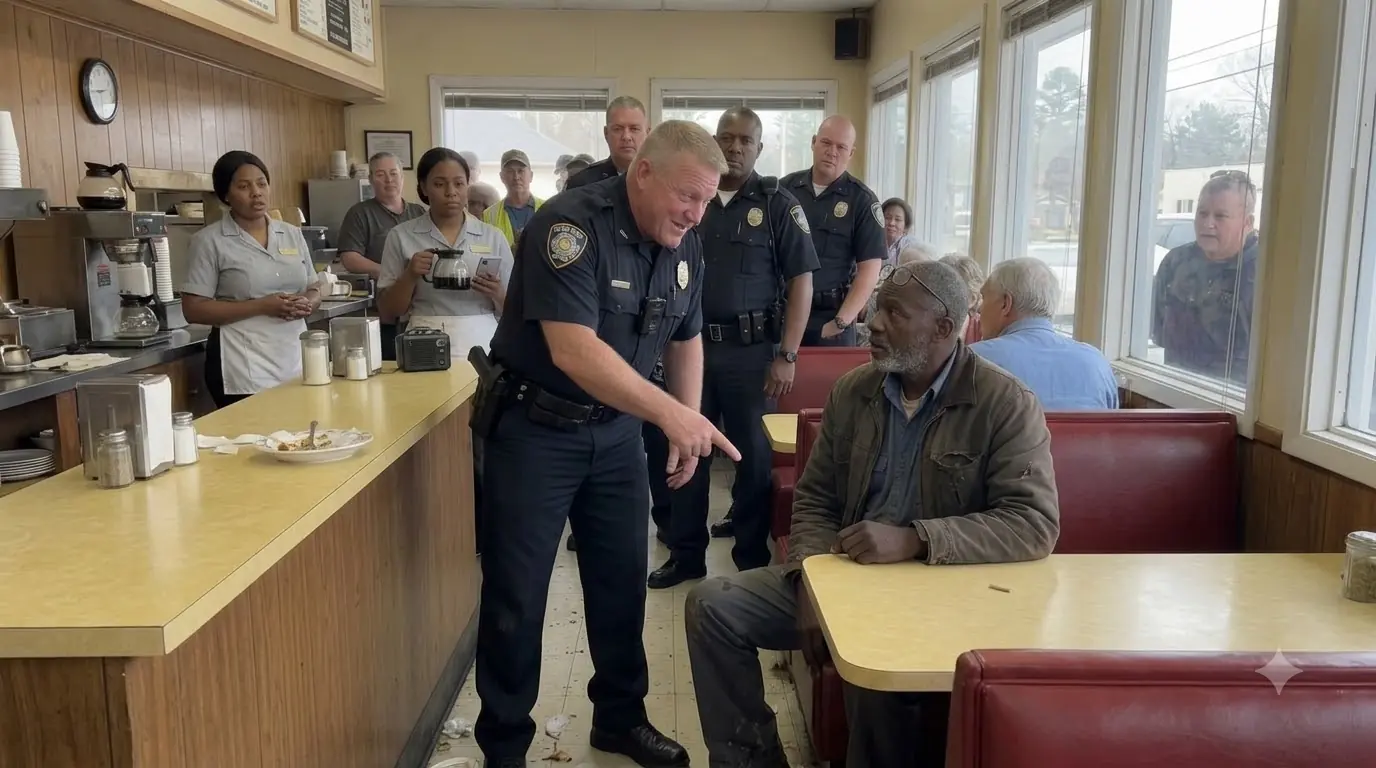
Nobody moved. Nobody spoke. The fork of the elderly woman in the corner stopped halfway to her mouth and stayed there. Pruitt's hand shot forward and the tray left the table. The way a wave leaves a beach fast, complete, and without apology.
The plate cracked clean down the middle when it hit the tile. Gravy sprayed in a wide dark arc across the floor and up the pants leg of the man sitting in booth six. The glass of sweet tea tipped and rolled and shattered, and ice cubes skidded across the linoleum in every direction, and the collard greens scattered like something that had been trying to hold itself together for a long time, and had finally given up. Pruitt straightened up, looked down at the mess, and smiled the smile of a man who had just confirmed something he already believed. "Now get on your knees," he said loud enough for every person in that room to hear it and lick it up.
"That's where dogs eat. 15 people in that diner, and not one of them made a sound. The man in booth six looked at the food on the floor, at the gravy on his shoes, at the broken glass still spinning slowly on the tile. He took his time. He let the silence breathe and stretch and fill every corner of the room.
Then he looked up at Pruitt with the steady, unhurried expression of a man who had been in rooms far more dangerous than this one. And he said very quietly, "Are you finished, Sergeant? What Pruitt did not know, and what no one in that diner knew, was that the quiet man in the worn canvas jacket had been watching him for 3 weeks. And what he was about to set on that table would end everything. 3 weeks earlier, on a Tuesday in late September, a Greyhound bus pulled into Caldwell Junction, Georgia, and barely slowed down to do it.
The kind of stop where the driver opens the door and checks his watch instead of announcing the name because there is no name worth announcing. Just a concrete bench under a rusted tin awning at the edge of a Chevron parking lot where the gas prices on the sign have been wrong for so long that the locals use it to argue about the economy. One man stepped off. Elijah Cross carried a single duffel bag over his left shoulder and a leather backpack that had been through enough years and enough miles that it had developed the particular softness of something that had earned its wear. He had on a canvas jacket with a torn left pocket work boots with scuffed toes and a pair of reading glasses pushed up on his forehead.
The way a man pushes his glasses up when he is not reading but is paying very close attention to everything around him. If you passed him on the street, you would think construction foreman, maybe a retired utility worker, maybe a man between jobs who was looking for a cheap room and a quiet week. That was entirely the point. Elijah stood on the sidewalk and looked down Main Street. Caldwell Junction, Georgia.
Population 14,200. 63% black. 17% below the poverty line. One public high school. One regional hospital.
One police department with 38 officers, 34 of whom were white. He had memorized every number before he got on the bus. 287 complaints of excessive force filed against the Caldwell Junction Police Department in the past six years. 287 families who had walked into the station, filled out the paperwork, signed their names in blue ink, and sat down to wait for something to happen. Not one complaint had resulted in any disciplinary action.
Not one officer suspended. Not one investigation opened. Not one family called back with an update that meant anything. Every single file had been stamped with the same two words in red ink reviewed. No further action, and every stamp had been authorized by the same signature, Chief Donald Leath.
Elijah had read those files in a windowless office in Washington, DC, 11 weeks ago, and he had read them once straight through, and then he had read them again, and then he had closed the folder and sat in silence for a long time. Not because the number was surprising. He had seen worse numbers in worse towns, but because of the signature, the same hand, the same ink, the same two words written across the top of every single one of those families lives, as if their broken ribs and bruised faces and stolen cash were nothing more than paperwork to be cleared before lunch. His supervisor, Deputy Assistant Attorney General Katherine Holt, had called him into her office the following Monday. She closed the door, pulled down the blinds, and said six words that put him on that Greyhound bus.
Go there. Be nobody. Watch everything. So here he was. Nobody.
Elijah picked up his bags and walked east on Caldwell Avenue, and he counted the patrol cars as he went, the way a doctor takes a pulse. Not alarmed, just measuring. Two cruisers idling in front of a black-owned barber shop on Fourth Street with no call on the radio and no reason to be there except to be seen. A third cruiser parked sideways across half the entrance of a corner grocery while a woman with two children pressed her grocery bags to her chest and squeezed past the hood with her eyes down, moving with the careful speed of someone who had learned a long time ago that eye contact was a risk she could not afford. By the time Elijah reached the end of Magnolia Road, he had counted six patrol cars in 14 blocks in a town with a violent crime rate below the state average.
Six cars not protecting anything occupying it. The address he was looking for was at the far end of Magnolia Road. A narrow two-story house with a wraparound porch flower boxes in the windows full of late season marigolds and a handpainted sign hanging from the porch railing that read, "Rooms available weekly rates in careful unhurried letters. But before he knocked on that door, Elijah stopped at the corner and stood for a moment with his bag on his shoulder and let himself remember why he was here because it mattered to him even after 23 years doing this work that he not let it become routine. He thought about the files.
The first one was a man named Thomas Reed, 51 years old, who had been pulled from his car on Route 17 and had both arms twisted behind his back until something popped and who had filed a complaint the very next morning while his shoulder was still swollen, and who had received a letter four weeks later, informing him that his complaint had been reviewed, and no further action was required. and who when Elijah read between the lines of that letter had simply been told that what happened to him did not count. The second was a woman named Gloria Simmons, 67 years old, who had been handcuffed on her own front porch for the crime of asking a police officer why he was in her backyard without a warrant and who had filed a complaint and who had received the same letter with the same stamp signed by the same hand. By the time Elijah had read 50 of the files, the stamp had stopped being a bureaucratic detail, and had become something else, a pattern built one family at a time over 6 years by people who believed that nothing they said would ever matter, and who had been proven right every single time. 287 times, to be exact. He thought about the signature on those stamps, Chief Donald Leath, and the particular kind of corruption that does not announce itself loudly, but simply makes itself available year after year to anyone willing to look the other way, until looking the other way becomes the only way anyone in the building knows how to look.
Elijah picked up his bags and walked to the door with the Marigolds. The landlord of the house on Magnolia Road was Ida May Greer, 67 years old. a woman who had owned that house for 29 years and raised three children in it and buried a husband from it and still woke up every morning at 5:15 out of pure habit and the refusal to let the day start without her. She had sharp eyes that had seen enough to know the difference between a man who was lying to her and a man who was carrying something heavy and had chosen not to put it down yet, and she did not always know which one she was looking at, but she had a feeling about this particular man in the canvas jacket that she could not quite put a name to. She showed him the room upstairs, small, clean, a single bed with a quilt. There was a dresser with a warped bottom drawer, a window that faced the street and let in more light in the afternoon than the morning. "$14 a night," she said, leaning against the doorframe with her arms folded.
The way a woman folds her arms when she is not hostile, but is simply conserving her energy for whatever comes next. "That works," Elijah said. "You here for work?" hoping to find some. She studied him for a moment with the careful patience of someone who had been lied to enough times to know that the truth sounds different. Not louder, not more elaborate, just more willing to sit with the silence after it's been said.
She didn't push. She just nodded once slowly. The way people nod when they've decided to give someone the benefit of a doubt they haven't fully extended yet. "I run a lunch counter two blocks south, she said already turning for the door. Greer's Lunch Counter.
Breakfast starts at 6:00, lunch ends at 2:00. You look like you could use a real meal. "I appreciate that. She reached the door frame and her hand found the knob and her voice dropped not to a whisper, but to the register that people use when they are saying something they have said so many times that the words have worn grooves in their throat. Something they were tired of saying but cannot stop saying because stopping would mean deciding it no longer mattered.
My son Damon, she said 24 years old last April. Sergeant Pruitt pulled him over on Route 17. Said he matched a description. There was no description. Damon asked what description.
Pruitt grabbed him by the arm and threw him against the hood and broke his collarbone right there on the shoulder of the road in front of two other officers who stood there and watched it happen and said nothing and reported nothing. Elijah waited. Damon spent 3 days in the hospital. He filed a complaint the morning they discharged him, which took some courage because he was still in pain when he did it. Her voice did not break.
Complaint went in. Complaint disappeared. Pruitt is still driving that same cruiser. Still pulling over the same kids on Route 17. Still doing the same things he's been doing for 9 years.
And the department keeps stamping those papers with the same two words and acting like that ends it. She looked at Elijah with eyes that had stopped expecting answers a long time ago and had moved on to something harder and quieter. The kind of watchfulness that exists not in hope, but in the refusal to stop witnessing. So whatever you're here for, be careful. The uniform in this town doesn't protect you.
It's the thing you need protecting from. She closed the door behind her. Elijah sat on the edge of the bed and listened to her footsteps fade down the stairs. He reached into his backpack and removed a laptop, not a consumer model, but a government-issued ThinkPad with an encrypted drive and a biometric lock that required his right index fingerprint to open. He pressed his finger to the sensor.
The screen lit up. A file was already open. The header read: U. S. Department of Justice Civil Rights Division, case CR-2025-1147.
Subject: Caldwell Junction Police Department. Pattern and practice investigation. Classification: Confidential undercover field assignment. Lead investigator Elijah James Cross, senior investigator. He scrolled through the first 20 pages, said nothing, and looked out the window at the street below, where a patrol cruiser was moving slowly past Ida's house for the second time in an hour, its headlights sweeping across the porch like a search light that had learned to be patient.
He did not step back from the window. He had 3 weeks. The next morning, Elijah walked the two blocks south to Greer's lunch counter at 6:50 and took a seat in booth 6, which was the second booth from the back on the right side, positioned with a clear sight line to the front door, and the counter and both exits a choice that looked like habit, and was in fact calculation. Greer's was the kind of place that had not changed since it was built and did not need to and knew it the same yellow Formica tabletops, and the same spinning stools at the counter with the cracked vinyl seats repaired with electrical tape in colors that almost matched the same smell of butter and black pepper and something sweet from the oven that Elijah couldn't identify, but that made him feel for just a moment like somewhere in the country things were still the way they were supposed to be. A gospel station played low from a radio behind the counter.
Not loud enough to sing along to, just loud enough to let you know it was there. Ida May was behind the counter. She brought him coffee without being asked, and the young woman who worked the floor, Naomi Burke, 26, with quick hands and eyes that cataloged the room with the efficiency of someone who had learned early that awareness was its own form of protection, refilled his glass of sweet tea before he had taken three sips of it, and then disappeared back into the rhythm of the morning without a word. Elijah ordered chicken fried steak and ate it slowly, and he watched the door. At 7:22, the door opened and the diner shifted.
Not loudly, not dramatically. The way a classroom shifts when the principal walks in, unannounced conversations didn't stop. They shrank, and forks moved more carefully, and nobody looked directly at the door, because in this room, not looking had become its own form of survival. Sergeant Wade Pruitt was 44 years old, broad through the shoulders, with close-cropped blonde hair going silver at the temples, and the kind of face that had probably been handsome in a generic way 20 years ago, and had since hardened into something that communicated authority as its first and only language. His badge caught the morning light when he walked in.
He wore his uniform the way some men wear their skin, not as clothing, but as identity, as proof. He went to the booth by the window. his booth, the one closest to the door, the one that no other person in Caldwell Junction had sat in for at least nine years, not because it was posted or signed, but because the town had learned one small humiliation at a time, that some things belong to certain people, whether or not those people have any right to them. He did not look at Elijah right away. But Elijah looked at him with the calm, unhurried attention of a man who had been doing this for 23 years and had learned that the most important things people reveal, they reveal in the first 10 minutes before they know they're being read. Deputy Ray Cotton followed Pruitt in 4 minutes later, 38 lean, with the particular eagerness of a man who had built his identity out of standing near someone more powerful, and had been doing it long enough that he had stopped noticing the cost.
He was not bad the way Pruitt was bad. He was something worse. A man who had made cowardice into a career, who had watched the things Pruitt did, had written the reports that made those things disappear, and had told himself for 9 years that this was just how it worked, until telling himself that had become the only story he knew. Elijah noted both men returned to his chicken fried steak and did not look up again for the rest of the meal. By the second morning, Elijah had become part of the furniture in the way that only very still, very patient people become part of the furniture.
Easy to overlook. Impossible to forget once you've noticed. He arrived at 6:50, the same as the day before. Booth six, chicken fried steak, sweet tea, and whatever newspaper ID had left on the counter. He spoke to Naomi when she brought his food, thanked her when she refilled his tea, said good morning to anyone who passed his booth, and then sat with the calm, unhurried patience of a man who had nowhere else he needed to be, and no reason to pretend otherwise.
He was not reading the paper so much as using it the way an investigator uses stillness as a tool, as a statement, as the kind of presence that tells a man like Pruitt, "I am still here," without ever having to say it out loud. It was the staying that bothered Pruitt. Elijah could see it from across the room. The way Pruitt's eyes went to booth six before they went to his coffee. The way his jaw moved slightly when he looked over and found Elijah still there reading still not afraid, still not gone.
On the third morning, Pruitt crossed the diner. He didn't stop at the edge of the booth the way a person stops when they're approaching a conversation. He sat down directly across from Elijah, uninvited, with the deliberate weight of a man who has never needed an invitation anywhere in his adult life, and the table shifted an inch toward Elijah's side when Pruitt's mass settled into the vinyl seat, and he left it there, tilted the way men like him always leave things tilted, because the imbalance itself is the message. Elijah lowered his newspaper to the level of his chest. He did not set it down.
He did not fold it. He simply held it there, looking at Pruitt over the top edge, with the patient, slightly curious expression of a man who has been interrupted while reading something mildly interesting and is willing to hear what you have to say before returning to it. You're still here, Pruitt said. Not a question. I am.
I told you how things work in this town. You did. The newspaper came down folded once set beside the plate. Elijah picked up his sweet tea, took a long, slow sip, set it back precisely where it had been. "The chicken fried steak is too good to leave," he said.
Pruitt's jaw moved a fraction of an inch, a small involuntary tightening that Elijah had been trained to see, and that Pruitt probably didn't know he was making. He asked where Elijah was from. Elijah said, "Georgia. Pruitt asked, "What part? Elijah said, "The quiet part.
Pruitt asked what he did for a living. Elijah said, "Government work mostly retired. The words landed between them and sat there vague enough to mean nothing and specific enough to mean everything. Pruitt's fingers drummed the table once index middle ring pinky, a rapid sequence that told Elijah everything he needed to know about the calculation happening behind the man's eyes. Then Pruitt leaned back and said, "I think a man who sits in the same booth three days in a row and gives vague answers about where he's from is either hiding something or looking for something.
Which one are you? Elijah looked at him for a long moment the way a doctor looks at a scan clinical thorough already forming a conclusion. Then he asked, "How long have you been serving this community, Sergeant? The words were ordinary. The tone was ordinary, but something in the construction of the sentence serving this community landed on Pruitt's ear differently than he expected, and the fingers on the table stopped mid drum, and for three full seconds the man, who had silenced rooms for 9 years, sat perfectly still, with something unfamiliar moving behind his eyes, something brief and quickly buried.
Pruitt stood up without answering. He walked back to his booth. He sat down hard and picked up his coffee and didn't drink it, just held it, staring out the window at the parking lot, turning that question over and over in a part of his brain he rarely used. That evening, in the small room above Ida's house, Elijah opened his case file and typed day three. Subject escalates when provoked by stillness.
Does not adapt when provocation fails. Recommend continued observation. Subject will self-escalate. He closed the laptop, looked out the window, and watched a patrol car drift past Ida's house for the second time in an hour. He had measured Pruitt in 3 days.
The authority was real, but it was built entirely on the silence of others. Remove the silence, and the authority had nothing left to stand on. All Elijah had to do was keep sitting in booth six, keep eating the chicken fried steak, and wait for Pruitt to do what men like Pruitt always do when they cannot make someone afraid. They get louder. They get reckless.
They make mistakes. And Elijah would be there watching. In the afternoons after Greer's closed, Elijah walked. He walked the same streets twice from different directions at different times. The way an investigator walks a neighborhood, not to be seen, but to see, and to let the town reveal itself at its own pace, which towns always do if you're patient enough and quiet enough to let them.
On the second afternoon, he watched a black man named Leonard, who drove a blue pickup with a cracked tail light get pulled over on the same halfmile stretch of Route 9. Twice in 20 minutes by two different officers and two different cruisers. Each stop, identical license registration, a slow walk around the vehicle, a long look through the windows, and each time Leonard handed over his documents with his hands visible and his eyes forward, and each time he was let go without a citation, because the stop was never about the tail light, and both of them knew it, and neither of them said so. On the third afternoon, Elijah stood across the street from a Black-owned hardware store on Fifth Street and counted how long a patrol cruiser sat diagonally across the delivery entrance before it moved 41 minutes. Engine running.
Officer reading his phone while the store owner's delivery truck sat in the alley unable to unload and two customers who had driven to the store turned around in the parking lot when they saw the cruiser and didn't come back. On the fourth afternoon, a teenager was asked by an officer to leave a public bench in Caldwell Park for the stated reason of loitering. And the boy, who could not have been more than 16, who was wearing headphones and eating a sandwich and doing absolutely nothing except sitting, gathered his things without a word, and walked away. And what struck Elijah was not the boy's compliance, but the completeness of it, the way he moved with the practiced resignation of someone who had been through this enough times to know that asking why would only make it worse. On the fifth afternoon, Elijah walked into Greater Peace Baptist Church on the corner of Burch and 7th and found Reverend Otis Bowmont in the back office behind the sanctuary, a 71-year-old man with white hair and reading glasses on a beaded chain, and the particular calm of someone who has sat with grief for so long that it no longer frightens him, only informs him.
Informs. Elijah did not introduce himself by his real title. He said he was a researcher, which was technically true. He said he was documenting what daily life looked like in communities like this one, which was also technically true. Reverend Bowmont looked at him over his glasses for a long moment, then said, "Son, I don't know who you are, and I'm not going to ask, but I will tell you this.
Most of the names on your list have sat in those pews. I know their stories. I've prayed with them and I've watched them go home and decide not to fight anymore. Not because they didn't have the right to fight, but because they'd been taught one rejection at a time that fighting didn't work. Elijah wrote nothing down.
He simply listened. This town isn't mean, Reverend Bowmont said, leaning back in his chair with the weight of 20 years in his voice. It's tired. There's a difference. Mean towns want to harm you.
Tired towns have just stopped believing that anything will ever change. And that kind of tiredness is its own kind of damage because it keeps people from trying. He looked at the window at the afternoon light coming through the stained glass that threw a bar of blue and gold across the office floor. But I'll tell you something else. The day somebody comes in here who isn't tired, who isn't scared, and isn't flinching and isn't asking permission that day things start to shift.
People can feel that. They feel it before they understand it. He looked back at Elijah that while you're sitting in that booth every morning, Elijah met his eyes and said nothing. Reverend Bowmont nodded slowly. "Thought so," he said.
"Then keep sitting. What Elijah noticed about Naomi Burke beyond the efficiency of her movements and the quickness of her hands and the way she managed the lunch rush at Greer's with the quiet authority of someone who had been doing it long enough to stop thinking about it was the positioning. Every time Pruitt came in, Naomi moved differently. Not dramatically, not in any way that would draw attention from Pruitt himself, but Elijah watched and he saw it. the slight adjustment in her route between the tables, the way she would find some reason to be standing between Pruitt's booth and booth six. When Pruitt's eyes were wandering the extra seconds she spent at the counter near Elijah's table on the mornings the sergeant arrived with mood already written on his face like weather.
She was not protecting Elijah. She probably didn't think of it that way, but she was doing something, and she had been doing it for a long time, and it had the practiced quality of a habit formed not by choice, but by necessity. On the sixth morning, she set his tea down and paused just for a moment. The pause so brief that anyone watching from more than three feet away would have missed it entirely and slipped a small folded piece of paper under the edge of his plate without looking at him without breaking the rhythm of her work without giving anyone in the room any reason to notice what she had done. Elijah did not open it immediately.
He finished his meal. He paid. He thanked her for the refill. He folded his napkin and walked out into the morning and turned the corner onto Magnolia before he stopped and took the paper from his pocket and unfolded it. One line, one name, an address on the south side of town.
Jerome Hadley, 114 Sycamore Court. No explanation, no context, just a name and a street written in the careful, unhurried handwriting of someone who had been thinking about whether to write it down for a long time before they finally did. Elijah folded the paper back, put it in his jacket pocket, and kept walking. He would go to that address. He already knew from the complaint files that Jerome Hadley was one of the 287.
He knew there was a medical report attached to Hadley's file, something unusual because most of the complainants had not been able to obtain or were too afraid to submit medical documentation. He knew the report described three fractured ribs and contained a single sentence that he had read three times in the windowless office in Washington. Patient states injury occurred during a traffic stop. Patient declined to identify the officer involved. What he did not know and what Naomi apparently did was what Jerome Hadley would be willing to say if someone sat in front of him with the full weight of the federal government behind them and told him it was finally safe to say it.
That evening in the case file NB asset aware of case in ways she has not disclosed operating on instinct and courage. Do not engage directly. She already knows what needs to be done. He thought about the paper she had slipped under his plate, and the risk that represented a 26-year-old woman who served coffee to Pruitt every morning, who knew exactly what he was capable of, who had been living within reach of that knowledge for years, and who had still, quietly, without asking for anything in return, put a name in front of the one person who might be able to do something about it. She was braver than most people he had worked with.
By the fifth morning, the diner felt different in the way that a room feels different when the weather outside is about to change. Not visibly, not loudly, but in the pressure, in the quality of the air, in the small, involuntary adjustments people make when they can feel something coming, even if they can't name it. Elijah was already in booth 6 when the first customers arrived. He had ordered his chicken fried steak, and it had come hot. the batter exactly the way it always was, heavy, peppery, cracking cleanly under the fork, and he had taken two bites and set the fork down and begun watching the door, because he had felt it coming since the previous evening. The shift in Pruitt's rhythm, the particular stillness of a man who has stopped circling a problem, and started moving directly toward it.
The diner filled a couple in their 70s, sharing biscuits and gravy near the window, a young mother with two small children who kept reaching for the sugar packets. Three construction workers in dusty boots hunched over their coffees at the counter. A group of older women from what looked from their blouses and their quiet intensity like a church committee meeting over sweet tea. 18 people, maybe 19, all of them doing the ordinary impermanent things people do in the morning before the day takes over. At 7:28 the door opened.
Pruitt came in first boots belt badge, the full weight of the Caldwell Junction Police Department, compressed into one man's walk. And behind him came Cotton, and behind Cotton came two younger officers Elijah had already cataloged. Officer Torres, 29, dark hair, broad-shouldered three years on the force, and Officer Fisk, 26, who had been described in two separate complaint files as laughing when he should have intervened. four uniforms, four sets of boots hitting Ida May's tile floor in a sequence that was not quite in formation, but close enough to formation that the message was impossible to miss. This was not a conversation. This was a demonstration performed for the benefit of every person in the room, and the room understood because the room had seen it before, and the room responded the way it always responded by going dead quiet.
The kind of quiet that is not peaceful but heavyweighted. The kind of quiet that lives in your chest for days after. Pruitt did not go to his booth. He walked straight to booth six. And the three officers spread out behind him in a loose arc, not blocking the exits exactly, but positioned in a way that communicated very clearly that there were exits and that they were aware of them.
Elijah looked up from his plate. His fork was in his right hand. His napkin was on his lap. His face held the same expression it had held for 5 days straight, steady, unhurried, without fear or performance. "Morning, Sergeant," Elijah said. did not return the greeting.
He stood at the edge of the booth and looked down at the plate, the chicken fried steak with two bites taken out of it. The collard greenss untouched the sweet tea, sweating in the summer heat, and something moved across his face. That was not anger exactly, but was the thing that lives underneath anger in people who are accustomed to having their authority treated as a fact of nature and are encountering perhaps for the first time a man who regards it as negotiable. "You know what your problem is, Oliver? He said loudly enough for the entire room to hear, using the wrong name deliberately, because that was part of how this worked.
The small erasers, the casual refusals to see you correctly, the accumulated weight of being misnamed in your own presence. You don't listen. I told you how things work here. I told you this wasn't your kind of place. And here you are, 5 days, same booth, same food, sitting there like you own something.
I'm having lunch, Sergeant. That's all. Having lunch? Pruitt turned to the officers behind him with a short, dry laugh. You hear that, boys?
He's having lunch. He turned back and placed both hands on the edge of the table and leaned forward until he was close enough that Elijah could see the individual pores on his nose, the thin sheen of perspiration along his hairline. Despite the air conditioning, the faint tremor in his jaw that came not from nerves, but from the effort of maintaining a performance when the audience was refusing to react the way the script required. Let me tell you something about lunch, Pruitt said very quietly. Now the volume dropping in the particular way it drops when the performance becomes personal.
Lunch is a privilege. Sitting in this booth is a privilege. Breathing my air in my town is a privilege and privileges can be revoked. He held the position for 3 seconds for his eyes moving across Elijah's face with the focused probing attention of a man searching for the flinch. the flicker, the drop of the eyes that would confirm what he needed to believe that this man, like every other black man who had ever sat in this diner, could be bent. Elijah set his fork down carefully, placed it parallel to his knife, straightened the edge of his napkin, and looked up.
"Is there something I can help you with, Sergeant?" he said in a voice so level it could have calibrated instruments. The hand came down fast. The tray left the table the way a decision leaves a man once it's been made completely without hesitation, without the possibility of being recalled, and the plate hit the floor. First, cracking clean down the middle with a sound that was somehow both enormous and precise. the two halves spinning away from each other across the linoleum while the chicken fried steak landed face down in a wide splatter of gravy that sprayed up against the booth leg and across Elijah's pants and shoes and the glass of sweet tea rolled off the edge of the table and exploded on the tile ice cubes scattering in every direction. the liquid spreading in a slow dark stain that moved with patient unstoppable indifference across the floor toward the feet of 18 people who were not breathing. The sound was enormous and then it was gone.
And the silence that replaced it was worse. The kind of silence that presses on the chest that makes you aware of every small sound. The sweet tea still dripping from the booth seat. the slow spin of a surviving ice cube on the linoleum. Ida Greer's breath catching behind the counter like a door slamming shut inside her chest. Pruitt straightened up.
He looked down at the mess, the broken plate, the scattered greens, the gravy spreading across the floor, and then he looked at Elijah, and he smiled the particular smile of a man who has just done something in public and is waiting for the room to confirm that he was right to do it. Now clean it up," he said, and his voice carried to every corner of the room, to every booth and every stool and every pair of hands that had gone still. "Get on your knees and clean it up, or I'll find a reason to put you in cuffs. 18 people in that diner. Not one sound, not one chair pushed back, not one hand reaching for a phone, except one.
Naomi Burke was standing three feet behind Officer Fisk, holding a coffee pot in her left hand and her phone in her right pressed flat against her apron with the camera pointed at Pruitt's back. She had started recording 11 seconds before the tray hit the floor, not in planning, but in the particular reflexive clarity of someone who has watched something building for a long time and recognized in the last possible moment that this was the time to stop being a witness and start being a record. Her hands were shaking, her face had gone white, but her thumb was steady on the screen, and the small red dot in the corner of the display was blinking steadily, capturing everything. Elijah looked at the food on the floor. He looked at the gravy on his shoes.
He looked at the broken glass still spinning in the puddle of sweet tea. And he let the full weight of the moment sit in the room because that weight belonged to the room to all 18 people in it, and they had earned the right to feel it completely before anything else happened. Then he looked up at Pruitt. Are you finished, Sergeant? The smile faltered.
Not dramatically, a millimeter, maybe less, but it faltered. And Elijah saw it because he had been trained for 23 years to see exactly that kind of small, involuntary moment of recalibration in the faces of people who had expected a specific response and received a different one. Pruitt had expected fear. He had expected the man to slide out of the booth and walk out the door the way black men in this town had been walking out of doors for years, quickly, quietly, with their dignity folded into their pocket like something they were not allowed to use. Instead, Elijah reached into his jacket.
The movement was slow and deliberate, his right hand crossing his chest and slipping inside the left panel of the canvas jacket and emerging. holding something small and flat and dark. Not a weapon, not a wallet. A slim black leather credential case, government issued with a gold seal embossed on the front that caught the overhead fluorescent light and sent a single bright flash directly across Pruitt's face. Elijah set it on the table. He did not open it.
He did not explain it. He set it on the table the way a man sets down something that speaks for itself, centered and deliberate, and facing Pruitt with the gold seal, catching the light, and the room went so quiet that you could hear the ice cube on the floor, still moving, still crossing the tile in its slow, inevitable journey toward the wall. Pruitt's eyes dropped from Elijah's face to the credential case, and stayed there fixed the way a man stares at a sound in the dark before his brain decides what to do with it. Open it, Elijah said, and something underneath the words had shifted a gravity that had not been there before the quiet authority of a man who was no longer observing. Pruitt reached for the case.
His fingers touched the leather and trembled, not dramatically. Not the trembling of a man performing fear, but the fine involuntary vibration of a nervous system receiving information that the brain is still refusing to process. He flipped it open. On the left panel, a photograph. Elijah James Cross, clean shaven in a suit and tie, looking directly at the camera with the expression of a man who has nothing to hide and never did.
Beside the photograph, a name, a title, and a seal that had only ever seen on television. United States Department of Justice, Civil Rights Division. Elijah J. Cross, Senior Investigator. On the right panel was a heavy gold federal badge.
Pruitt's mouth opened. Nothing came out. Elijah stood, and he was 3 in taller than Pruitt, a fact that had been invisible for 5 days of sitting in booth 6, folding newspapers and eating chicken fried steak, and playing the quiet man who bothered nobody. And he reached inside his jacket again and produced a white envelope, legal size, heavy bond paper, a blue federal seal stamped across the flap, and laid it beside the credential case on the table. pattern and practice investigation order case number CR-2025-1147 authorized by the attorney general Elijah said it names the Caldwell Junction Police Department as the subject of a federal civil rights investigation active for the past 3 weeks. I have spent those three weeks living in this town, eating in this diner, walking your streets, and watching what this department does when it believes no one of consequence is looking.
He paused in the way a man pauses, not for effect, but because what comes next deserves its own space. "I am not finished. The two words landed in the room like a door slamming. Pruitt's mouth closed. Sergeant Pruitt Elijah said in the same even register he had used to ask for the chicken fried steak every morning for 5 days over three weeks.
I have documented 11 incidents of verbal intimidation, seven illegal detentions, three uses of excessive force and a pattern of racial targeting covering every shift in this department. I have body camera footage, radio transmissions, your personnel file, and as of approximately 90 seconds ago, 18 eyewitnesses to a federal officer being assaulted by a local law enforcement officer in a public establishment. He let that sit for exactly 2 seconds. "That is a federal felony, Sergeant. It carries up to 20 years.
The diner was so quiet, you could hear the compressor in Ida May's refrigerator cycling behind the counter. You could hear the sweet tea still dripping from the booth edge. Drip, drip, drip. Like a clock counting down something that had already ended. Item stood behind the counter with both hands pressed flat on the surface, tears forming slowly in her eyes that she did not wipe away because she had served that man's coffee for 9 years and swallowed her words and watched him break her neighbors and her son.
And now she was watching him stand with shaking hands in her diner. His badge meaning nothing. A federal seal on her table meaning everything. Cotton had backed against the wall, his hand gripping his radio the way a drowning man grips a rope when he is not sure whether pulling it will help or only confirm how far from shore he is. Torres and Fisk stood like statues at the edge of the room, frozen in the posture of men who had just understood that the authority they had been following for years let off a cliff and they were standing at the edge of it.
Elijah picked up the credential case closed it, slipped it back inside his jacket. He held the envelope out to Pruitt. Pruitt took it. His hands were shaking badly enough that the envelope made a small papery sound against his fingers, rattling in the silence, like something fragile being handled by hands that had forgotten how to be gentle. Elijah stepped over the broken plate, over the scattered greens, over the puddle of sweet tea, over the remains of the lunch that Pruitt had dumped 5 minutes and an entire lifetime ago, and walked to the door.
He did not look back. Behind him, the sweet tea kept dripping. Drip, drip, drip. Then Ida May Greer exhaled a long, shuddering breath that sounded like 9 years, leaving her body all at once. Naomi Burke sat in her car in the parking lot behind Greer's for 14 minutes before she looked at her phone.
She had clocked out as soon as Pruitt and the others left. Told Ida May she needed some air, which was not a lie. not entirely, because the air inside the diner had felt for the last several minutes, like something that had been used up and needed replacing. She had walked straight to her 10-year-old Honda Civic with the cracked windshield and the air freshener that had stopped smelling like anything 2 months ago, and she had sat down and put both hands on the steering wheel and concentrated on breathing in and out at a pace that felt manageable. Then she looked at her phone. 2 minutes and 22 seconds.
The audio was muffled in places because the phone had been pressed against her apron, but the visual was clear enough that you could see everything. Pruitt standing over booth 6 with his hands on the edge of the table, the fast motion of his arm as the tray went airborne, the crack of the plate, the spray of gravy across Elijah's pants, the glass shattering, and ice scattering across the floor. You could hear Pruitt say it. Get on your knees and clean it up or I'll find a reason to put you in cuffs. And you could see what came after the credential case placed on the table the moment Pruitt's hands went still.
The federal badge, the envelope, the silence. Naomi watched it twice. The second time she paused on the frame where Pruitt's face changed the exact millisecond when the smirk collapsed, when the certainty behind his eyes broke like a window hit by a stone you didn't see coming. and she held the image there and looked at it for a long time because for three years she had been waiting to see something break behind Wade Pruitt's eyes. And here it was caught on the camera of her phone frozen in the moment of its happening. She needed to think.
She knew what posting this meant. She knew Pruitt would find out who had filmed it. There were only so many people in that diner and she had been standing close enough to the officers that anyone paying attention might have noticed the angle of her arm. She knew that her apartment was on Locust Street and that Pruitt drove past Locust Street on his regular route. She knew that three years ago, after her older brother Calvin had filed a complaint against Pruitt following an incident at a gas station on Route 11, Pruitt had appeared at the door of their mother's house at 9:30 on a Tuesday evening, not in his personal vehicle, but in his cruiser in full uniform, and had stood on the porch for 4 minutes without knocking and without speaking, and then had gotten back in his car and driven away.
He had not said a word. He had not needed to. Naomi had started sleeping with her bedroom light on after that because the dark had stopped feeling safe and she had never quite managed to convince herself that it was safe again. She thought about all of this. She thought about her brother who had eventually withdrawn his complaint because the silence from the department had become its own kind of pressure.
She thought about Jerome Hadley and the way he had stopped coming to his front porch in the evenings after Route 17. She thought about the way Ida May moved in her own diner when Pruitt walked in smaller, more careful, like a woman, making herself less visible in a space she had built with her own hands. She thought about the man in booth 6 who had sat there for 5 days, and had not been made smaller by any of it. and she thought about the fact that she had this video and that she was perhaps the only person who had it and that if she deleted it, she would be making for the 400th time in her adult life in this town the choice to protect herself by erasing something that mattered. She opened TikTok. She typed cop dumps black man's food on the floor.
Watch what happens next. She added no filters, no music, no edits. She pressed post. She put the phone on the passenger seat, started the car, and drove home without looking at it again. She lay in bed that night with the light on, which was how she always slept now, and thought about whether she had made the right decision, and eventually decided that right and wrong were perhaps not the most useful framework for this particular moment, that the more honest question was whether she had done the true thing. the thing that matched what she actually believed.
And the answer to that question was yes, and that was enough to let her close her eyes. In the morning, the video had 2,400,000 views. By noon, it had 14 million. By the following evening, it had 43 million, and Naomi's phone had stopped being something she could keep up with, and had become instead a small vibrating record of the fact that the world, when it finally saw something, could not look away. She turned the ringer off and put it face down on her kitchen table and she went to work the morning shift at Greer's.
And when Ida May saw her come through the door, she looked at her for a long moment without saying anything. And then she walked around the counter and put her arms around the young woman who had been refilling her customers tea for 3 years and had finally quietly done the thing that none of the rest of them had been able to do. The video didn't go viral so much as it detonated. The algorithm caught it within the first hour. The way it catches anything with a completion rate above 80% and a share velocity that tells the machine people are not just watching this, they are handing it to other people with both hands.
And the completion rate on this particular video was 96%. which meant that nearly everyone who started watching it stayed until the end, until the credential case, until the badge, until the face, and almost no one turned it off before that moment because almost no one could. The first hashtag appeared in a comment from a college student in Memphis who typed # booth6justice without much premeditation and watched it begin to climb the trending board within 4 hours pulled upward by the accumulated weight of millions of people sharing a video with the same three-word caption. Did you see this? The second hashtag # Elijah cross arrived later and created something more complicated. A split in the conversation that hardened fast the way opinions harden when something touches a nerve that people have been pretending not to feel.
On one side, pure clean, unified outrage. The kind that floods comment sections and lights up group chats and is shared by people who watched the tray hit the floor and felt something drop inside their own chest because they recognized it because they had felt that particular weight before or had watched someone they loved carry it or had been waiting their whole lives to see someone refuse to. On the other side arriving by the following morning, DOJ entrapment. This was staged. federal overreach targeting local law enforcement who just happens to be filming at exactly the right moment. The police union issued a statement calling the incident a coordinated federal operation designed to manufacture a confrontation with a dedicated officer.
Conservative commentators framed the story not as accountability but as attack. Fox News ran a segment under the headline, "DOJ Sting Targets Small-Town Cop, where are the limits? CNN countered with a panel titled, "Caldwell Junction is Every Town. Twitter became a battlefield. Reddit threads stretched for thousands of comments, and in the middle of all of it, 43 million people had watched a man have his lunch thrown on the floor and respond with five words and a federal badge.
And the image of that, the stillness, the credential case on the table, the way Pruitt's hands had stopped moving, was not something that could be argued away because it had happened in front of 18 witnesses and one phone camera and now in front of anyone in the world who wanted to look. The department issued a statement, three paragraphs. The last sentence, Sergeant Pruitt has been placed on administrative leave with pay pending internal review. With pay. The phrase landed on the internet like gasoline on an open flame, and what came next was not a spark, but a roar.
Carla Dennison had lived in Caldwell Junction her entire life, which meant she had grown up watching Pruitt's Cruiser roll past her grandmother's house on Magnolia, and had learned the way children learn things in towns like this, that there were certain things you did not ask about out loud. Certain doors you knocked on gently and then accepted the silence from certain patterns you noted and filed away in the back of your mind and tried not to let make you too angry because anger in the absence of power is just pain. She was 33 now, the only full-time reporter at the Caldwell Courier, a twice weekly paper with a circulation of 2,800, a newsroom that consisted of Carla, an editor named Phil, who also handled advertising, and a part-time photographer who was also Phil's nephew, and who in four years of working there, had never once arrived for an assignment without being reminded twice. The courier covered school board meetings and high school football and the occasional zoning dispute and had never in Carla's tenure broken a story that anyone outside of Caldwell County had cared about. But Carla had something that the national outlets with their satellite trucks and their live correspondents and their breathless chyrons did not have.
She had names. She had been collecting them for 4 years quietly without much hope that they would ever matter. filing public records requests that were delayed or denied attending hearings where nothing was decided. Interviewing people who spoke to her on background because speaking on record felt like announcing your own address to someone who had already proven they knew where you lived. Her first article went up on the Courier's website at 9:15 that morning under the headline, "The man in booth 6: What Caldwell already knew. It was not a long article.
It did not need to be. It named 19 specific people who had filed complaints against the Caldwell Junction Police Department in the past 6 years. And for each one, it listed the date of the complaint, the nature of the allegation, and the departmental response. Every single entry ended with the same four words, no further action taken. It named dates.
It named case numbers. It named Sergeant Wade Pruitt in 12 of the 19 entries. and it named Chief Donald Leath as the authorizing signature on every dismissal. The article was shared 47,000 times in its first day. The courier's website, which typically received 300 visitors a month, crashed twice before Phil figured out how to call the hosting company's emergency line. Local television stations in Atlanta picked it up by noon.
By 4 in the afternoon, it had been cited in 17 national outlets as the most complete documentation of the department's complaint history that had yet appeared anywhere. Carla sat at her desk through all of it, answering emails, responding to calls from producers and editors she had never spoken to before and might never speak to again. And feeling something she had not quite felt before in four years of writing stories that nobody read, the particular vertigo of being heard by more people than you had been speaking to the strange disorientation of a voice that has been talking into a wall suddenly finding itself in an open field. That evening, she received a call from a woman in Birmingham who said she was a federal investigator and asked if Carla would be willing to share her sourcing notes. Carla said yes before the sentence was finished.
Behind the department's carefully worded three paragraphs and the institutional language of internal review and highest professional standards, there was a closed-door meeting happening in the chief's office. And the door was not merely closed, but locked, which was a thing Chief Donald Leath did only when he was having a conversation he did not want to have. Chief Donald Leath was 63 years old, heavy set with the ruddy complexion of a man who considered bourbon a legitimate food group, and the particular confidence of someone who had been signing those dismissal stamps for 18 years without consequence, and had at some level below the level of conscious thought, begun to regard consequence as something that happened to other people. He had been chief for 18 years. In that time he had signed 287 complaint dismissals, had approved Pruitt's use of force reports without reading most of them, and had run the department on the understanding never stated, never written down, simply operated, that the job of law enforcement in Caldwell Junction was to maintain a certain order, and that certain people in the town had agreed by their silence to be maintained.
Pruitt sat across from him in the same chair he had sat in after every incident for nine years. Clifton Hargrove, the department's attorney, a man who had managed to be present for every quiet settlement and every buried complaint, and had told himself presumably that this was just how law worked in small towns, sat beside with his phone face down on his knee, which Le noticed but did not comment on. This blows over," Leath said, leaning back in his chair with the weight of a man accustomed to being believed. "We've had federal inquiries before. They come in, they make noise, they write a report, and 6 months later, it's in a drawer somewhere collecting dust.
Hargrove did not answer immediately. He was looking at his phone screen up now, scrolling through Carla Dennison's article, reading the complaint numbers, the dates, the names, the four-word conclusions that he had helped produce now displayed on a screen that 43 million people had already seen. Leath noticed the silence. Clifton Hargrove said carefully, "This isn't a local inquiry. In the parking lot of a gas station on Route 82, Deputy Ray Cotton sat in his personal truck with the engine running, not going anywhere.
His phone in his hand scrolling through comment threads that contained his name. Not prominently, not yet, but there in the background of other people's stories, the officers who stood there and did nothing, which was he was beginning to understand a category with its own specific consequences. He had been in that diner. He had been one of the four. He had watched Pruitt throw the tray and had not moved, not spoken, not done anything except stand in the loose arc of four officers who were sending a message together.
He picked up his phone, put it down, picked it up again, stared at it for a long time, put it back in his pocket, pulled back out of the parking lot, and drove toward the highway. not toward home, but in the direction of Birmingham, because there was a phone number he had found online that afternoon, and he was not yet sure whether he was going to use it, but he was, he realized, already driving toward it. The room Elijah worked from was on the fourth floor of a federal building in downtown Birmingham. A beige windowless space that smelled like recycled air and the particular brand of government-issued cleaning solution that had apparently been the same since 1974 with fluorescent lighting that made everything look slightly more clinical than it needed to be and a metal desk that was bolted to the floor which Elijah had always found oddly reassuring. He had set it up himself 5 weeks before he got on the Greyhound bus. The whiteboard, the filing system, the secure laptop, the encrypted phone line that connected directly to Katherine Holtt's office in Washington.
No assistant, no team, just Elijah and the work and the particular kind of patience that comes from doing this long enough to know that the thing you are looking for is always there if you are willing to look at enough paper for long enough without deciding in advance what you are going to find. The white board now covered the entire east wall and it was full. At the center, written in large block letters and circled twice in red marker. Radiating outward from that name in four colors were lines connecting to dates and incident reports and complaint numbers and a map of traffic stops color-coded by the race of the driver, which looked when you stood back far enough like a heat map of the whole southern end of town. the black neighborhoods glowing in red, the rest of the map almost entirely clear. But Pruitt was no longer the center of what Elijah was looking at.
Because on the second day, after the diner incident running the standard background checks on the primary subject, Elijah had found the money. It was not hidden cleverly. It did not need to be because no one had been looking, or more precisely, no one with the authority and the resources to look had ever been given a reason to. Pruitt earned $87,000 a year. He owned a three-bedroom house on Birch Lane assessed at $174,000.
He drove a department-issued cruiser and a personal Ford F250 with 71,000 miles on it. He had two credit cards and a checking account at the Caldwell Junction Community Bank. He also had a second account. It was at a savings bank in Monroeroe, 70 miles east, far enough that the tellers would not know his face close enough to reach in an afternoon. The account had been opened 6 years ago under Pruitt's legal name with a mailing address listed as a P.
O. box in a strip mall on the edge of town. The current balance was $211,400. Elijah stared at the number for a long time. $87,000 a year in salary, $211,000 in a separate account with a P. O. box for an address. The math did not work.
It had never worked. And when the math doesn't work, the money is trying to tell you something. You just have to learn its language. Elijah called agent Sandra Yates on a Tuesday evening, and she arrived in Birmingham the following morning with a team of three, a forensic accountant named Burroughs, who wore short-sleeved dress shirts in every season and spoke in paragraphs. You had to work to follow a data analyst named Kim who could find a pattern in anything given enough columns of numbers and enough coffee. and a paralegal named Torres, who specialized in municipal finance and had once over a long working dinner explained to Elijah that the most dangerous financial crimes in American local government were almost never sophisticated because sophistication required effort and the people who committed these crimes had usually found by the time they committed them that effort was entirely unnecessary.
They were right. Sandra Yates was 44, tall and methodical and genuinely boring to listen to in conversation, a quality that Elijah had found over two previous cases to be an investigative asset of the First Order because suspects consistently almost comically underestimated her. She had 16 years of public corruption cases and the particular quality of investigator who does not speculate about what the evidence means until the evidence is finished speaking. By their third day in the Birmingham room, the picture had taken shape. The Caldwell Junction Police Department had over the past six years seized 2,740,000 in cash and property through the civil asset forfeiture program. the controversial but still technically lawful practice in Georgia that allows officers to take cash vehicles and property from people suspected of criminal activity without requiring a conviction and in many cases without requiring an arrest operating on the legal theory that the property itself, not the person, is the subject of the action.
The premise sounded abstract until you looked at the actual cases. These were not drug kingpins. These were not cartel operations or organized crime takedowns. These were traffic stops. A broken tail light, a failure to signal doing seven miles over the limit on route 9 at 11 in the morning.
An officer pulls someone over, finds cash in the console or the glove box or a purse on the passenger seat and takes it, labels it as suspected criminal proceeds, files the paperwork, keeps the money. Kim ran the demographic breakdown and the numbers came back clean and damning and simple. Of the 486 individual seizures documented over six years, 444 of them. 91.4% involved black residents of Caldwell Junction. The average amount seized was $4,200.
The median was $3,100. $4,200. That was not a number that existed in the abstract. That was a semester's tuition at a community college saved over 13 months of overtime. That was 3 months of rent for a family living in the part of town where the foreclosure notices were still tacked to the mailboxes. That was the cash someone had been carrying in an envelope in their glove box because they were on the way to make a car payment or pay a medical bill or cover a month of expenses while they waited for a paycheck. and instead they had been standing on the shoulder of a road in the dark while an officer counted their money under his headlights and explained to them in the language of civil procedure that it was no longer theirs.
Elijah had Yates request the forfeiture logs from the department. What came back was a spreadsheet with 486 entries, dates, names, amounts, and a column labeled disposition. In that column, for 433 of the 486 entries, the same two words appeared. Retained departmental use. 89.1% of all seized assets, never returned, never put before a judge, never given back.
He followed the money from the forfeiture fund into the department's operating budget. What he found was not sophisticated. It did not need to be. The fund was managed by one person, Chief Donald Leath, who authorized every deposit approved every withdrawal and signed every quarterly report filed with the city council. Those reports listed expenditures under categories so broad they could mean anything.
Equipment maintenance, training and development, community outreach, operational support, no invoices attached, no vendor names, no receipts. The reported spending from the forfeiture fund over six years, $2,200,000. The actual verified departmental expenditures that could be traced to real purchases, $1,020,000. The gap, $1,180,000. Unaccounted for simply gone into the categories that meant everything and verified nothing.
Except it wasn't gone. Money doesn't disappear, it moves. And Elijah was beginning to see exactly where it had moved to, and the lines on the whiteboard were converging with the slow, inevitable certainty of rivers flowing toward the same place, whether anyone is watching or not. Yates ran financial backgrounds on every officer in the department with more than 4 years of service. 11 officers qualified.
The results came back in 3 days and they told a story that was simultaneously surprising and entirely predictable. Surprising because of the brazeness, predictable because of how long it had been going on without anyone looking. Four officers had secondary bank accounts with deposits that could not be explained by their salaries. Deputy Ray Cotton had an account in Augusta with $58,000. Officer Torres had an account in Savannah with $34,000.
Officer Fisk had an account in Columbus with $29,000. Combined with Pruitt's $211,400 in Monroe, the four accounts held $332,400 in amount. That, while substantial, still left a gap of nearly $850,000 between what the four officers held and what the forfeiture fund had paid out beyond verified expenditures. That $850,000 had gone somewhere else, somewhere higher. Elijah did not write Chief Leath's name on the whiteboard that night because it was already there.
Had been there since day two, written in small black letters in the upper right corner of the board, connected by a single line to the forfeiture fund column, waiting for the verification that would turn inference into evidence. Burroughs. The forensic accountant found it on a Thursday afternoon sitting at his desk in the room next to Elijah's with a thermos of cold coffee and a legal pad covered in handwritten columns. He knocked on the wall between their offices, their agreed upon signal, and Elijah came through the door and stood behind Burrow's chair and looked at the screen. A series of transfers, forfeiture fund to a municipal account labeled discretionary chief's office. from that account to a private brokerage in Atlanta, Georgia.
The brokerage account was held in the name of Donald R. Leath, and it had received over 6 years in a series of transfers that were individually small enough to avoid certain automatic reporting thresholds and collectively large enough to represent a second career $848,000. Elijah looked at the screen for a long time without speaking. Then he called his supervisor in Washington. Katherine Holt answered on the second ring, and Elijah told her what they had found.
The forfeiture fund, the hidden accounts, the transfers, the gap, and where the gap had gone. He told her it was not one officer. He told her it was a departmental operation built over 6 years that had taken money directly from the pockets of people who could not afford to lose it and distributed it to the men who wore badges and called it law enforcement. You'll have expanded authority by morning, Holt said and hung up. Elijah turned off the light in the Birmingham room and stood in front of the whiteboard in the dark.
The dry erase lines catching the green glow of the emergency exit sign above the door. And he thought about Jerome Hadley's $3,800. the money that had been saved over 13 months of overtime shifts and taken on the shoulder of a dark road and about the column of numbers on the whiteboard and about how small one number looks when it is sitting next to a large one and how that smallness is the lie that the large number tells. Deputy Ray Cotton called Agent Yates at 11:53 on a Tuesday night. He was in his personal truck parked at the edge of a rest area on Route 82 with the engine running and the radio off and the dome light on because the dark outside the windows had started to feel in the last several days like something that was pressing in rather than simply being present. He had been awake for most of the past three nights.
Not from guilt exactly. He had been carrying what he knew about this department for long enough that guilt had become something more like furniture, something you stopped noticing because it had always been there. But from the particular growing fear of a man who watches a small fire, he chose not to extinguish become something that is now burning toward him. He said he wanted a deal. He said he had something they needed.
Yates asked him what. 22 recordings, Cotton said, and his voice carried the low, fast frequency of someone who has rehearsed this sentence many times and is now discovering that saying it out loud is different from saying it in his head. Audio recordings of Chief Leath giving direct orders. Ordering body camera footage deleted after use of force incidents. I've been keeping them for 2 and 1/2 years.
Yates was quiet for 3 seconds. How soon can you be in Birmingham? Cotton looked out the windshield at Route 82, the road that led east toward Mon toward the bank where Pruitt kept his $211,000. He thought about the rest area behind him and all the nights he had driven past it. He thought about the young mother who had called the department after her boyfriend was beaten, and the way he had stood at her door in his uniform and told her in the careful language of a man who had said this to enough people that it no longer felt like a threat, even as he was making it, that filing a report would not necessarily lead to the outcome she was hoping for.
"I'm already on 82," he said. He arrived at the federal building at 7 the next morning carrying a personal laptop and an external hard drive and he sat down across from Yates and Elijah and he put the drive on the table and the 22 recordings on it were in their casual institutional clarity among the most devastating pieces of audio evidence Elijah had encountered in 23 years of this work. Elijah had been carrying the folded piece of paper from Naomi Burke in his jacket pocket since the morning she had slipped it under his plate because there are things an investigator carries that are not yet evidence but are also not. Nothing. Hunches leads the name of a person whose story might complete a picture that is otherwise just shapes.
Jerome Hadley, 114 Sycamore Court. He had found Jerome's name in the complaint files on his second day reading them in the windowless office in Washington 11 weeks ago. The file was brief, a single page, a date, a description of a traffic stop on Route 17, an allegation of excessive force and property seizure, and it was marked like all the others with the red stamp and the two words and the chief's signature. But it had something attached that most of the others did not. A medical report from Caldwell Junction Regional dated the morning after the traffic stop describing three fractured ribs on the left side and noting in the precise careful language of a physician who is recording what he observes and nothing more that the pattern of injury was consistent with blunt force trauma applied from behind to the floating rib region. and one sentence written at the bottom of the attending physician's notes that Elijah had read three times and then written down in his own notebook.
Patient states injury occurred during a traffic stop. Patient declined to identify the officer involved. Declined to identify not. Did not know. Not could not remember.
Declined. That word told a story of its own. Elijah knocked on the door of 114 Sycamore Court on a Wednesday evening, six days after the diner incident in the plain canvas jacket and the reading glasses without the credential case visible and without any introduction more formal than his name and the agency he represented. Jerome Hadley opened the door and looked at him. He was 38 years old, broad through the shoulders, with the build of a man who worked physically for a living, and the face of a man who had carried something heavy for a long time, and had learned to make the carrying invisible.
He looked at Elijah for a moment at the credential case Elijah had produced, and held open at waist height, and his expression moved through several things in quick succession. recognition, weariness, something that might have been hope but was being held at a careful distance. The way you hold something at a distance when you have been burned before by hoping. My name is Elijah Cross. Elijah said, I'm a senior investigator with the Civil Rights Division of the Department of Justice. I'm investigating the Caldwell Junction Police Department, and I'd like to hear what happened to you.
Jerome didn't invite him in right away. He stood in the doorway with one hand on the frame and looked at Elijah with the expression of a man who has been offered water in a desert and is not yet sure if it is real or a mirage, who has been told by experience that mirages look exactly like water, that they have the same shimmer, the same promise, and that the only difference is what happens when you reach out toward them. He said he would make sure my daughter grew up without a father, Jerome said. Not as context, not as explanation, but the way you say. The thing you have been not saying for three years.
The thing that has been sitting at the front of your chest, pressed against the inside of your ribs, waiting. He can't touch you now, Elijah said. I'm asking you to tell me what happened. Not for me, not for the case, but for every person in this town who has been too afraid to say it out loud. Jerome stepped back from the door.
Jerome's wife, Delia, sat beside him on the couch with her hands folded in her lap, and as he talked, she listened with the still focused attention of a woman who had watched her husband carry something for 3 years, and had not until this moment understood the full weight of what he had been carrying. The night it happened had been a Thursday in October. Jerome had been driving home from his shift at the regional distribution warehouse on Route 17. Both hands on the wheel, radio playing low, doing the speed limit, the way every black man in Caldwell Junction had learned to do the speed limit with the careful precision of someone for whom the speed limit is not merely a rule, but a small daily act of self-preservation. The blue lights appeared in his mirror at 9:31.
He pulled over immediately, turned off the engine, placed both hands on the wheel at 10 and two, the way his father had taught him when he was 16. The way fathers in towns like this one teach their sons to survive a traffic stop. Hands visible. Voice calm. Do not surprise anyone.
Make yourself as legible and unthreatening as possible because your safety in this moment depends entirely on the judgment of a man who already has a story about you and has pulled you over to confirm it. Pruitt came to the driver's window alone. No partner body camera. Jerome would learn later was not recording. License and registration.
Jerome handed them over. Hand steady voice level. Pruitt said his left rear tail light was out. Jerome said he had checked it that morning. That was the sentence.
Five words polite, factual, accurate. That changed the entire trajectory of what came next. Pruitt told him to step out of the car. Jerome stepped out. Pruitt told him to place his hands on the hood.
Jerome complied. Pruitt asked if he had any cash in the vehicle. Jerome said yes. There was $3,800 in an envelope in the glove box. His daughter Simone's first semester tuition at Caldwell Community College saved over 13 months of overtime shifts, a number he had memorized because it represented not just money, but time. the specific quantity of extra hours worked and meals skipped and small pleasures deferred that had produced that envelope.
Pruitt took the envelope. He counted the bills under the headlights of his cruiser, flipping through them with his thumb with the casual efficiency of a man performing a task he had performed many times. Jerome asked what investigation. Pruitt didn't answer. Jerome asked how he could get the money back.
Pruitt said to file a claim with the department. Then Jerome said quietly in the most careful voice he had ever used in his life. That money is for my daughter. Please. Pruitt hit him from behind.
Not with a baton. Not with anything but his fist. A short compact punch into the left side of Jerome's rib cage aimed at the floating ribs the way a man aims who knows exactly which part of the body produces the kind of pain that is not visible on the outside. Jerome's legs gave out. He went down on one knee on the gravel shoulder of Route 17, unable to breathe the pain so complete and so sudden that his vision went white at the edges.
Pruitt crouched down very close, and said into his ear quietly, pleasantly, with the particular calm of a man who had said this kind of thing before, and knew how long it stayed. "You talk about this, and I'll make sure Simone grows up without a father. Nod, if you understand me. Jerome nodded. He drove home with three broken ribs and $3,800 less than he'd had an hour earlier.
And he did not tell Delia the full truth about what had happened. And he did not go back to the hospital for a follow-up because going back would require explaining, and explaining would require saying the name out loud. And saying the name out loud felt in those weeks and months afterward, like something that might actually get him killed. Beside him on the couch, Delia had her eyes closed and both of her hands around one of his, her knuckles white. Jerome pulled the hem of his shirt aside and showed the scar along his lower left ribs, faded now, paler than the surrounding skin, but still there, still visible, the permanent record of a fracture that had healed slightly wrong because he had never gone back.
Pruitt said, "Nobody would believe me," Jerome said. Elijah looked at the scar. He said nothing for a moment. Then quietly, I believe you, and after next week, so will the rest of the country. Jerome Hadley was not the only one.
Over the nine days that followed, Elijah and Yates worked through the complaint files, systematically contacting 26 individuals whose names appeared in the records, approaching each one carefully with the federal credentials present, but not leading because the first thing a person who has been failed by institutions needs to know is not what the institution is promising, but who the person at the door actually is. whether they are someone who will stay or someone who will file their statement and disappear back into the machinery. Four people agreed to provide sworn testimony under federal protection. The first was Leonard Graves, 52 years old, a licensed electrician whose work truck, a 2017 F-150 that contained his tools and his livelihood, and had been paid off after four years of monthly payments he had managed without missing one. had been seized by officer Fisk during a traffic stop on Route 11 18 months ago on the stated grounds of suspected criminal involvement and had never been returned and without which Leonard had spent 3 months unable to work his trade. The second was Deacon Albert Moore, 73, who had been handcuffed on his own front porch on a Sunday afternoon when he declined politely, clearly citing the Fourth Amendment, which he had looked up the night before because he had suspected they were coming to allow two officers to search his home without a warrant. The third was a young woman named Shereice Brown, 29, who had been visited at her apartment door by Deputy Cotton 3 days after her partner filed a complaint alleging a beating during an arrest and who had been told by Cotton standing in her doorway in full uniform that if she encouraged her partner to pursue the complaint, child protective services might receive an anonymous concern about the welfare of the two children she was raising, which was not a threat, but was the shape of one in the same way that a man stepping closer to you without raising his hands is not a threat but carries the meaning of one.
And the fourth was Naomi Burke, the young woman who had slept with her light on for 3 years and had still on a Tuesday morning in September pressed record and then two hours later pressed post. Four voices, four lives interrupted by the same pattern wearing four different faces. The Hugo L. Black Federal Courthouse in Birmingham sits on the corner of Richard Arrington Jr. Boulevard and 5th Avenue North.
And it is the kind of building that exists to remind you through the weight of its limestone and the height of its bronze doors and the particular quality of the silence inside its corridors. That what happens here is not subject to the ordinary pressures of the world outside. That the decisions made under this roof are not reversible by whoever is currently in charge of something. somewhere that they go into the record and the record does not negotiate. The hallway outside courtroom 3B was full by 8:15 in the morning. Reporters occupied the first two rows of the gallery, NBC, Fox News.
The Associated Press Reuters, 11 local Georgia outlets, and three national newspapers whose correspondents had driven through the night from Atlanta. Camera crews lined the back wall. An overflow room down the hall had been opened with a live feed for the 60 plus people who could not fit inside. Outside the building on the sidewalk in the morning heat, a crowd had gathered people who had driven from Caldwell Junction from other towns in the county. from as far as 3 hours away. People who had no seat in the courtroom and no way to be present for what was about to happen except to stand on the pavement and be near the building where it was happening because sometimes proximity is its own form of witness.
The live stream had reached 2.3 million viewers before the hearing began. At the defense table on the left side of the room, Sergeant Wade Pruitt sat in a gray suit that did not fit him well across the shoulders, his hands flat on the table, his face the color of cold oatmeal. His attorney, a man from Mon, whose name would not be remembered after today, had his own papers in front of him and was writing something, but his pen had not moved in several minutes. At a separate table behind Pruitt, Chief Donald Leath sat in his dress uniform, pressed and pinned every button in place, every crease deliberate, wearing the costume of authority, the way a man wears it when the authority itself is already gone, and he has not yet found a different way to sit in a chair. His eyes moved constantly, scanning the gallery, the cameras, the faces searching for something in the room that was not there and had not been there since the morning a federal investigator had stood in a diner and set a credential case on a table and said, "I am not finished.
On the right side of the room at the prosecution table, Agent Yates sat with Burroughs and the paralegal three bankers boxes of documents beside their chairs labeled in black marker financial personnel. audio testimony. One empty chair at the center of the table. At 9:00 exactly, Judge Adrienne Hollis entered. She was 60 years old, silver-haired, with the particular quality of presence that does not require volume, the kind of authority that sits quietly in a room and does not announce itself because it has never needed to. She had presided over federal civil rights hearings for 22 years.
She had seen men in uniforms lie under oath. She had seen institutions produce documents designed to say nothing while appearing to say everything. She had learned over two decades that the most important thing she could do in a courtroom was not speak. It was listen and then make absolutely clear in the fewest possible words what she had heard. This hearing is convened pursuant to the authority of the United States Department of Justice Civil Rights Division in the matter of case number CR-2025-1147.
The United States v. the Caldwell Junction Police Department, she said her voice carrying to every corner of the room without effort. "Lead investigator, please take the stand. The side door opened. Elijah Cross walked into the courtroom in a charcoal gray suit, navy blue tie and black Oxford shoes polished to a mirror finish. And the transformation from the man in the worn canvas jacket who had sat in booth 6 eating chicken fried steak and folding newspapers was total and complete and utterly intentional.
He looked nothing like the man Pruitt had stood over with his hands on a tray. He looked nothing like the man whose lunch had been thrown on a diner floor while 18 people watched in silence and said nothing. He looked like what he was a senior federal investigator with 23 years of service who had spent 3 weeks inside the machinery of a corrupt police department and was now prepared to take it apart piece by documented piece in front of the entire country. He took the stand. He adjusted the microphone.
He opened his folder. 6 weeks ago, he said, "I sat in a diner in Caldwell Junction, Georgia, and ordered lunch. It ended up on the floor. The courtroom was silent. Not the uncomfortable silence of people waiting for something to happen, but the deep, compressed silence of people who understand that what is happening right now will be remembered and are trying to be present enough to remember it correctly.
What I am about to present is the result of a 21-day undercover investigation into the pattern and practice of civil rights violations by the Caldwell Junction Police Department. He presented the data the way a surgeon presents a diagnosis without emotion, without editorializing letting the numbers carry their own weight because numbers, when they are true, do not need decoration. $2,740,000 seized through civil asset forfeiture over 6 years. 91.4% of seizures targeting black residents. 89.1% of seized assets never returned, never adjudicated, never given back. 287 complaints filed.
Every single one dismissed by Chief Leath. Zero disciplinary actions. Zero investigations opened. Zero families called back. He displayed the financial analysis on a screen above the witness stand.
The forfeiture funds reported expenditures versus verified expenditures. The gap $1,180,000 sitting in the space between what the report said and what the department had actually bought. The hidden accounts. Pruitt's $211,000 in Monroe Cotton's 58,000 in Augusta. Torres's 34 in Savannah, Fisk's 29 in Columbus.
He paused. He looked at Leath. The remaining $848,000, Elijah said in the same even tone he had used for every other number in the presentation was traced through a series of transfers from the forfeiture fund through a municipal account labeled discretionary chief's office and from that account into a private investment portfolio at a brokerage in Atlanta, Georgia, held in the name of Donald R. Leath. The room was perfectly still.
Leath did not move, but the two cords of muscle in his neck had gone rigid, running from his collar to his skull, like cables holding up a structure that was already beginning to sway. Then Elijah played the recordings. The courtroom heard Chief Donald Leath's voice for the first time, calm, quiet, administrative, with the unhurried cadence of a man giving instructions he has given so many times they have lost all texture. Delete it, Rey. all of it. If it doesn't exist, it didn't happen.
That's how this works. That's how it's always worked. The second recording, I don't care what the camera shows. The camera shows what I say. It shows.
Wipe the drive. File the report. Move on. The third puit handled it. That's all the council needs to know.
We clean our own house. Elijah played six of the 22. Each one fell into the courtroom like a stone dropped into still water. Not loud but irreversible. The impact spreading outward in all directions simultaneously.
Somewhere in the room, a woman in the gallery pressed her hand over her mouth. The live stream comment feed, which had been scrolling at a rate of hundreds per second, slowed almost to a stop, as if four million people had simultaneously held their breath and had not yet decided to release it. After the recordings, Jerome Hadley took the stand. He wore a white dress shirt buttoned to the collar and dark trousers pressed with a crease sharp enough to cut through the silence in the room. And he walked to the witness stand with the particular deliberateness of a man who has rehearsed this moment not in his mind but in his body in the way that people who have been afraid for a long time carry the memory of their fear in their posture and their walk and the way they hold their shoulders and who have decided finally that they are going to walk differently today.
He told the courtroom about Route 17, about the tail light that wasn't broken, the question he had been taught from childhood never to ask a police officer, but had asked anyway, because it was true, about the $3,800 in the envelope in the glove box, his daughter Simone's college tuition, 13 months of overtime, a number he had memorized, the way you memorize a number that represents something larger than itself. about Pruitt counting the bills under the headlights. The civil forfeiture explanation delivered with the board efficiency of a man who has given it many times the money going into a uniform pocket. The words that came before the punch. That's what they all say. He told them about the punch itself, the sound it made, the way the pain arrived before his brain had finished processing what had happened. the gravel on the shoulder of Route 17 against his knees, the cold and the dark, and the voice that leaned down close and told him quietly and pleasantly, that his silence was not optional, and that Simone's future depended on it.
He told them about the 1100 days of silence that followed. And then Jerome Hadley stood up from the witness chair, unbuttoned his shirt, and pulled the fabric to the side, exposing his left rib cage to the courtroom, and to four million people watching on a live stream. The scar was faded and pale and slightly irregular along its lower edge, where the bone had healed at a small angle instead of straight because he had never gone back to the hospital for the follow-up. That would have corrected it. Because going back meant explaining, and explaining meant saying the name, and saying the name had felt for 3 years, like the kind of thing a person doesn't survive.
He did this, Jerome said, and his voice was steady, and he told me nobody would believe me. The courtroom was completely silent. Elijah let the silence fill the room completely without gaps, without mercy. And then he turned to the defense table to the man in the gray suit who had spent nine years using the silence of other people as the foundation of his authority. And he asked in the same ordinary voice, with the same ordinary cadence, the question he had asked on day three in the diner.
Sergeant Pruitt, he said, "How long have you been serving this community?" the same words, the same phrasing, the same quiet weight underneath them. But in this room under oath, with the badge meaning nothing and the evidence meaning everything, the question was no longer just a question. It was the precise measurement of a distance between what a man had claimed to be and what the record showed he actually was delivered in the form of a sentence he had refused to answer twice and was now going to have to refuse to answer in front of the entire world. The court reporter's fingers stopped moving above her keyboard. The CNN camera in the back of the room panned slowly from Elijah's face to held and held and held.
18 seconds of silence. The camera zoomed in on Pruitt's hands resting on the surface of the defense table. They were trembling a visible, undeniable tremor that moved from his fingers to his wrists to the edge of the table. The same hands that had sent a tray of chicken fried steak crashing to a diner floor. The same hands that had punched Jerome Hadley in the ribs on the shoulder of a dark road and taken $3,800 from an envelope now shaking in front of 4 million witnesses under the gaze of the man they had mistaken for nobody.
Judge Hollis waited until the silence had said everything it needed to say. She waited the way someone waits who knows that the moment does not require addition, that adding anything to it will only diminish it. And then she picked up her pen and looked at the room at the reporters and the cameras and the families who had driven from Caldwell Junction and she spoke. Based on the evidence presented in this proceeding, this court finds sufficient grounds for federal prosecution on the following counts. She did not raise her voice.
Sergeant Wade Pruitt, six counts of civil rights violations under Title 18, United States Code sections 241 and 242. Chief Donald Leath. Three counts of obstruction of justice, two counts of corruption, and misuse of public funds. She looked at the remaining officers at the table behind Pruitt. Officers Torres and Fisk cases referred to federal grand jury pending further investigation.
She looked at the gallery at the cameras at the people standing in the overflow room down the hall and outside on the pavement. Additionally, this court orders an immediate and comprehensive federal review of the Caldwell Junction Police Department under the pattern and practice statute with an independent federal monitor to be appointed within 30 days. She picked up the gavel. This hearing is adjourned. The gavel came down once a single clean sound that moved through the limestone walls of the Hugo L.
Black federal courthouse and settled into the record alongside everything else, the numbers, the recordings, the scar on Jerome Hadley's ribs, the 18 seconds of silence, and the question that Wade Pruitt had been asked three times and had never, not once, answered. The sentencing came 4 months later, and Pruitt arrived in the same courtroom in the same gray suit, and the suit still didn't fit him well across the shoulders, which somehow made the whole thing feel more honest. a man reduced to the size of the clothes he had chosen. His attorney had filed three motions for dismissal. Judge Hollis had denied all three each time in language that was brief and complete and left nothing to argue with. The police union had issued a statement of support 2 weeks after the hearing.
It had been quietly retracted after the audio recording of Chief Leath saying, "We clean our own house was played for the seventh consecutive day on national television. Pruitt's wife had filed for divorce during the second week of hearings. His house on Birch Lane had been listed for sale the week after that. Judge Hollis read the sentence without inflection the way a doctor reads a result that is serious and no longer surprising. 7 years federal prison, no parole eligibility before five.
Pruitt stood with his hands at his sides. He did not speak. He did not look at the gallery or his attorney or the cameras along the back wall. When the US marshals came with the handcuffs, he extended his wrists without being asked the mechanical reflexive compliance of a man who had spent 9 years putting metal on other people's wrists and was now learning in the most direct way available what the cold weight of it felt like from the other side. As the cuffs clicked shut, there was no sound in the courtroom except the sound they made.
Chief Donald Leath received six years on three counts of obstruction and two counts of corruption. His dress uniform hung in a closet that no longer belonged to him. The signature that had stamped 287 lives with no further action would never appear on a departmental document again. Deputy Ray Cotton, 18 months, reduced in exchange for his cooperation and his 22 recordings, which had proven to be the loadbearing evidence of the entire case. Torres and Fisk were suspended without pay, their files referred to a federal grand jury.
The Department of Justice issued a consent decree placing the Caldwell Junction Police Department under federal oversight for a minimum of 5 years. An independent monitor was appointed. Body cameras became mandatory on every shift with footage stored on a federal server that no officer in the department could access or delete. The civil asset forfeiture program was suspended pending a full independent audit. And the money came back. $2,740,000 a federal judge ordered.
It returned in full to the community through a restitution fund administered by an independent board. The fund opened for claims on a Monday morning in February, and by noon, 412 people had submitted applications. The first name on the list was Jerome Hadley. His notification arrived on a Thursday afternoon, a text message from his bank, the kind with a balance update, the kind Jerome had been checking every few days since January, because he hadn't quite believed it would actually happen, that the number he was told to expect would actually appear in the account he had opened specifically for this purpose, that after 3 years and three broken ribs and 1,100 days of silence, the money his daughter should have had all along would finally find its way to her. It was there, the full amount plus interest plus the additional compensation the settlement had authorized.
Jerome sat in his car in the bank parking lot for 25 minutes, not moving, not looking at his phone again, just sitting with the particular stillness of a man who has been holding his breath for 3 years and is only now in this moment allowing himself to exhale. Then he called his daughter Simone, who was in her second year at Caldwell Community College, who was studying nursing, who had gotten there with borrowed money and her own two jobs, and the particular determination of a young woman who had watched her father carry something without telling her what it was, and had decided quietly that the carrying was not going to stop her. He didn't explain everything. He just said, "Simone, I need you to know that I'm sorry it took this long, and I'm sorry I was quiet when I should have said something sooner. She said, "Dad, are you okay?
He looked out the windshield at the parking lot at the ordinary Thursday afternoon at the sky that looked exactly the same as it always had. "I am now," he said. On a Saturday morning in late March, 6 months after the hearing, a Greyhound bus stopped at the Chevron parking lot on the edge of Caldwell Junction, and a man stepped off carrying a duffel bag and a leather backpack. the same jacket, the same scuffed boots, the same reading glasses pushed up on his forehead. Elijah Cross walked east on Caldwell Avenue and counted the patrol cars, the way he always counted them, the way he had counted them every time he walked this stretch of pavement since the day he arrived. Two cruisers, one moving at normal speed, past the barber shop on Fourth Street, not idling, not watching, simply passing through the way patrol cars pass through when that is all they are doing.
The second was parked near the community center with the officer inside filling out paperwork visible through the window occupied with something other than surveillance. Two cars moving, not occupying. He turned onto Magnolia Road and walked to the end of it and pushed open the door of Greer's lunch counter, and the bell above the door jingled once the same as it always had, and the smell of butter and black pepper and something sweet from the oven was exactly the same as it had been on the first morning he walked in and sat down in booth 6, and waited for Sergeant Wade Pruitt to do what men like Pruitt always eventually do. Ida May was behind the counter. She saw him come through the door and she looked at him at the canvas jacket, the reading glasses, the man who had sat in her diner for 5 days and eaten her chicken fried steak and refused to be moved.
And for a moment she didn't say anything because there are things for which the ordinary words are not the right size, and gratitude is one of them. and she had learned a long time ago that when you don't have the right words, the truest thing you can do is be still with the person and let them know through the stillness that you understand. She walked out from behind the counter. She pulled a clean tray from the shelf beneath the pass through. She set it down on the table in booth six, chicken fried steak collard greenss, sweet tea, and a square of golden cornbread that was not on the menu and never had been. She set it down carefully, the way you set down something you have been waiting to set down for a long time.
This one's on me, she said. And it's staying on the table. Elijah sat down. He looked at the tray. He looked at Ida May.
And for the first time in 3 weeks and 21 days, and one federal hearing, and four months of sentencing, and six months of watching a town begin to remember what it felt like to exist without the constant low hum of organized fear for the first time. Through all of it, he smiled. A small, quiet, unhurried smile, the smile of a man who has done what he came to do, and found in a plate of chicken fried steak that stayed on the table the only receipt he needed. He ate slowly.
He thanked Naomi for the refill. When he was finished, he folded his napkin, set it beside the plate, and left a $100 bill tucked under the edge of the tray so it wouldn't move. Then he picked up his bags, and walked back out into the morning. The bus pulled out of Caldwell Junction at 2:17 in the afternoon, and through the window, Elijah watched the water tower pass the town's name, painted in letters, beginning to fade at the edges, the way paint does when it has been too long since anyone thought to renew it.
Inside Greer's lunch counter, Ida May wiped down booth 6 for the third time that afternoon, not because it was dirty, because it was hers again. In the kitchen, in this drawer beside the stove, where she kept the things that mattered most, was a key. The old spare key to Damon's apartment, the one she had kept for three years, because keeping it was the only way she had known how to keep holding on to the hope that things would change. She didn't take it out, but for the first time since October, she also didn't need to look at it every morning to remind herself to keep standing.