“Smile more when you serve me, sweetheart.” The words dripped from Richard Cain’s mouth like poison disguised as charm. He was a tall white man in his forties, with slick hair, whiskey breath, and a smirk that never quite left his face. He leaned against the narrow bathroom wall, blocking the only exit. His fingers pinched the collar of Alicia Morgan’s uniform, twisting it just enough to wrinkle her dignity.
The back hallway of Haven House Bistro was empty now. It was closing time, the lights were dim, and dishes clattered faintly from the kitchen. Alicia stood still and breathed slowly. Her brown skin glistened beneath the flickering fluorescent light. She was not trembling, though Richard thought she was.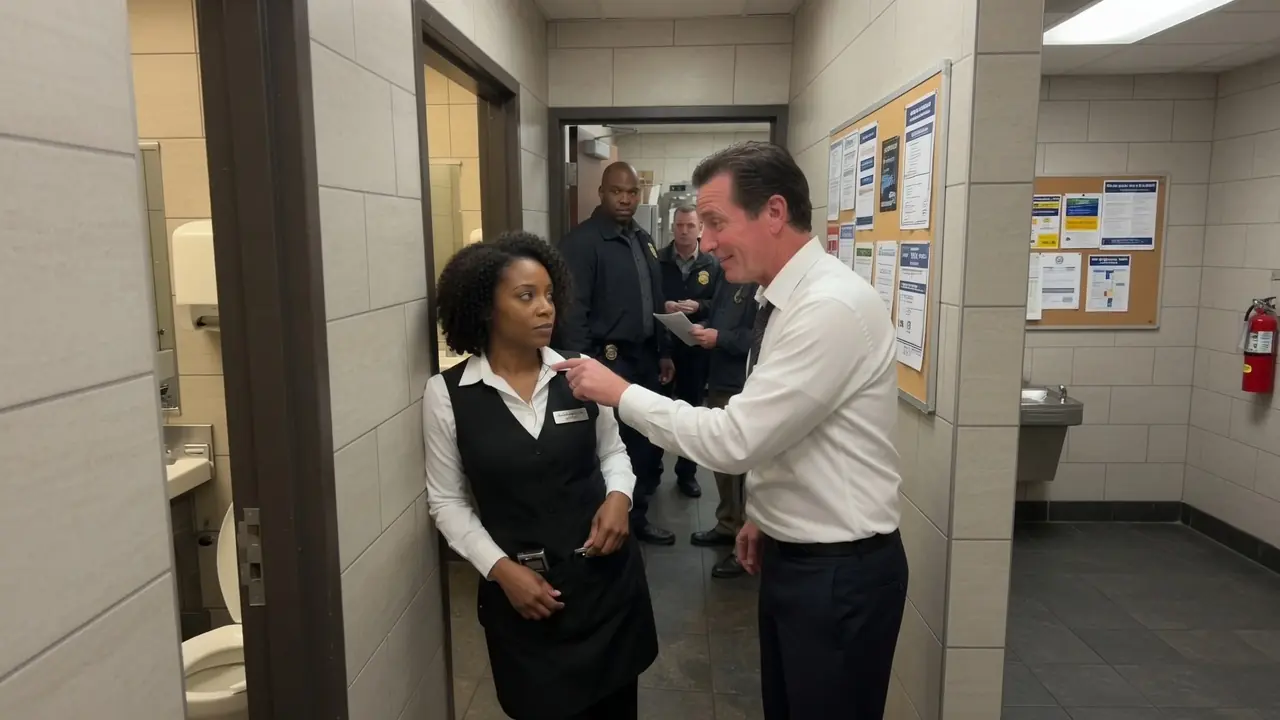
He mistook silence for submission, as he always had. “Girls like you should be grateful you even got this job,” he sneered. “You think being cute gives you power?” “You people always think you’re owed something.” Her eyes lifted to meet his, calm, controlled, and calculated.
If Richard had looked closer, he might have noticed the thin wire tucked beneath her collar or the faint green blink of a recorder in her pocket. But arrogance blinds more completely than darkness ever could. Alicia had worked for months for this, playing her role, collecting evidence, and enduring every insult. Tonight was only confirmation, the final piece. Richard moved closer and lowered his voice.
He frowned in confusion just as her phone buzzed inside her apron pocket. A single-word message appeared on the screen: “Ready.” The shift had begun, not the restaurant’s shift, but the operation’s. Alicia slipped one hand behind her back and pressed a small button on the recorder. Her voice changed, becoming measured and formal.
“Subject confirmed, audio log 47.” Richard blinked and asked, “What did you just say?” She looked up and replied, “You’ll find out soon enough.” He laughed dismissively, still believing he was in control, and asked, “What’s that supposed to mean?”
Outside, faint headlights slowed beside the curb. Unmarked black SUVs came to a stop. Inside, Alicia adjusted her apron and stepped aside. “You really should have read the menu better, Richard.” He scoffed and asked, “What the hell are you?”
A distant sound interrupted him as a door opened. Boots struck the tile, followed by low, sharp voices. The storm had arrived. The night air outside the restaurant had shifted from quiet to heavy, like the moment before thunder breaks. Down the block, the two black SUVs sat with their headlights dimmed.
Doors clicked open, and men and women in dark tactical jackets stepped out while radios murmured. Their leader, Captain Jordan Wells, looked toward the glowing Haven House Bistro sign with his jaw set. Inside those walls was his wife and the man who had crossed every imaginable line. Back in the tiled corridor, Richard leaned closer again, his voice slick with disdain. “You think you scare me?”
“You’re just a server with an attitude.” His words slurred slightly from whiskey, but his arrogance remained sober and sharp. Alicia did not flinch because she had seen worse faces in worse rooms. Her thumb brushed the edge of her apron again, signaling the open line to the team waiting outside. Through the earpiece barely visible beneath her curls, a calm voice said, “Green light confirmed.”
Richard kept talking, unaware that he was narrating his own downfall. “Women like you only get far when someone like me lets you.” The sentence hung in the air just long enough for the door behind him to creak open. The sound was not loud, and it did not need to be. Richard turned and froze.
A tall Black man in plain clothes stood in the doorway, his badge catching the dim light. His tone was calm and measured, but its weight filled the room. “Take your hands off my wife.” Richard’s face drained of color. “Your wife?”
Jordan stepped forward, his presence filling the small space like a storm cloud blocking the sun. Behind him, two agents entered with unreadable expressions and their weapons held low but ready. Alicia stepped to Jordan’s side with squared shoulders and a steady gaze, then said simply, “He’s all yours.” Richard’s voice cracked as he protested, “You can’t just do this; this is a misunderstanding.”
One agent handed him a folded document headed “Federal Warrant: Controlled Substance Investigation.” Richard stumbled backward, his eyes darting between them. “You’re making a mistake,” he stammered. Jordan’s voice remained calm and cold. “The only mistake was thinking no one was watching.”
As the agents moved in, Richard’s bravado finally collapsed. The restaurant’s quiet hum was broken by the sound of handcuffs clicking shut. For the first time that night, Alicia allowed herself to breathe. By morning, Haven House Bistro no longer smelled of wine and roasted lamb. It reeked of betrayal.
Yellow tape sealed the doorway where guests had once entered wearing silk and perfume. Inside, investigators moved like shadows through the kitchen, the manager’s office, and the storage rooms where Richard’s secret had lived for years. Hidden inside imported wine crates were plastic packages of white powder, wrapped tightly and stamped with coded numbers. Beneath a stack of invoices, a ledger recorded cash deliveries disguised as supplier payments. The empire Richard had built behind polished smiles unraveled hour by hour.
Alicia stood at the threshold in the same uniform she had worn for months. Now she was not serving tables; she was closing a case. Her dark skin caught the flash of cameras outside, but she did not flinch. This was the part she had prepared for: exposure. Agents passed her carrying boxes of evidence, and one nodded respectfully.
They all knew her name now. She was the waitress who had never really been a waitress. She was the woman who had spent months recording every deal, every coded call, and every shipment that passed through the back door. Jordan watched her from across the room. He was not in command that day; she was, and she had earned it.
He had seen soldiers hold their ground under fire, but never with the composure she had shown in that tiny bathroom. As the press gathered outside, a reporter shouted, “Is it true you were undercover this entire time?” Alicia paused before answering, her voice steady. “I just did what needed to be done,” she said. “Some people wear badges to stop crime, and some wear aprons.”
It was not bravado; it was the truth. Every insult, every racist comment, and every long shift during which Richard looked at her as though she were beneath him had built toward this moment. Through the window, Richard was escorted to a waiting vehicle with his head down and his cuffed hands trembling. For once, he had no words left to twist. Alicia turned toward the sunlight and let it warm her face for the first time in months.
Justice did not roar; it arrived quietly, like dawn after a storm. When Jordan joined her, she did not look back. “It’s over,” she said softly. He smiled faintly and replied, “For him, yes, but for you, it’s just beginning.” Weeks passed before the city of Ravencrest stopped buzzing about the scandal at Haven House Bistro.
The once-famous restaurant that had bragged about its exclusive clientele was now a boarded-up shell with its signs stripped bare. The newspapers called it the downfall of a gourmet empire, but for Alicia, it was something far more personal. It was the closing of a wound. In court, Richard sat shackled in a gray suit that hung loosely on him. The confidence he had once worn like armor was gone.
Prosecutors read charges that stretched longer than a dinner menu: drug trafficking, tax fraud, harassment, and intimidation. Each accusation tightened the air. Alicia sat in the gallery beside Jordan with a straight posture and an unreadable expression. When the verdict came back guilty on all counts, she did not smile. Justice was not about celebration; it was about balance finally being restored.
After the trial, reporters surrounded her outside as cameras clicked and microphones crowded forward. One asked, “Do you have anything to say to the people who doubted you?” She looked directly into the lens. “You don’t need permission to stand up for yourself,” she said. “Sometimes the strongest voice in the room is the one that refuses to stay silent.”
The quote appeared on every evening broadcast that night. Within weeks, Alicia was invited to speak at seminars on workplace safety and equality. What had begun as one woman’s undercover mission became a spark for policy changes across several restaurant chains and hotels. Her story proved that real heroes do not always wear badges. Sometimes they wear aprons.