The officer picked up my wife’s judicial badge, turned it over twice in his hand, and laughed.
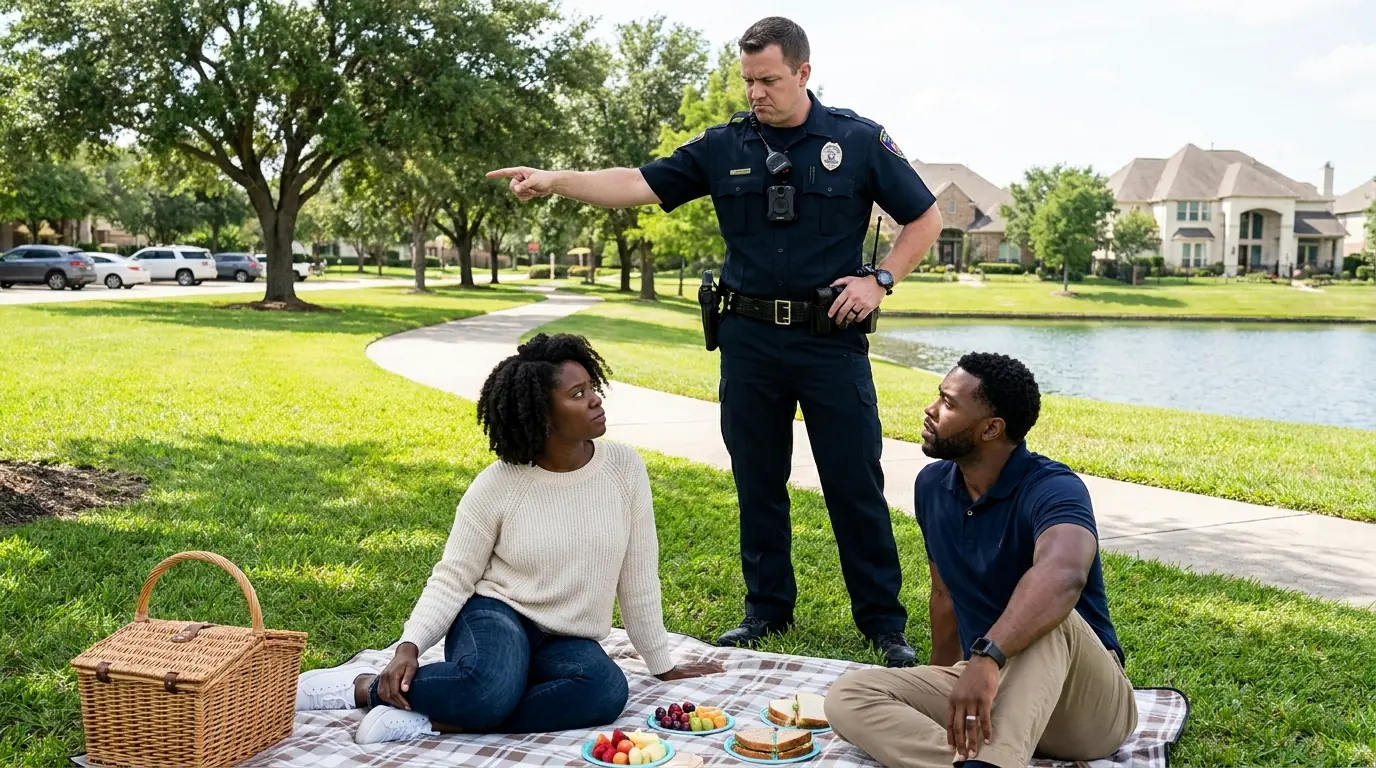
“This is fake.”
The sentence landed harder than the accusation that came before it.
My wife, Judge Simone Carter, sat on a wooden picnic bench less than four feet away wearing white sneakers, linen pants, and one of my old Howard University sweatshirts.
Her hair was pulled into a loose bun.
No robe.
No courtroom.
No clerk.
No deputy.
Nothing about her looked like the woman attorneys stood for every morning at the Franklin County Courthouse.
That was the point.
It was Saturday.
She was supposed to be nobody important.
Just my wife.
Just a forty-eight-year-old Black woman trying to eat grilled chicken beside a lake with her husband before the weather turned cold.
Officer Caleb Rourke looked at the gold-and-blue judicial credential again.
Then he looked at Simone.
“You expect me to believe you’re a judge?”
Simone did not answer immediately.
She had spent nineteen years on the bench learning that silence made certain people uncomfortable.
Rourke became uncomfortable.
He filled it.
“Because I’m telling you right now, ma’am, impersonating a judicial officer is a serious offense.”
I looked at him.
“You asked for identification.”
Rourke turned toward me.
“I wasn’t talking to you.”
“I know. I’m reminding you why she showed it to you.”
His eyes narrowed.
“Sir, I’ve already told you to stay seated.”
I was seated.
Had been for almost ten minutes.
My name is Malcolm Carter.
I was fifty-one years old at the time, six feet two, about two hundred fifteen pounds, and an architect by profession.
I had been married to Simone for twenty-four years.
We had two children in college, a mortgage we were finally close to paying off, and one rule for Saturday mornings:
No work before noon unless somebody was bleeding.
That weekend, we broke the rule only because Simone had spent the previous three weeks presiding over one of the ugliest domestic-violence trials of her career.
When the verdict came down Friday afternoon, she came home exhausted.
I found her sitting at the kitchen table in silence.
No television.
No music.
Just one glass of water untouched in front of her.
“Picnic tomorrow,” I said.
She looked at me.
“I have motions.”
“Picnic.”
“I have sixty-two pages of sentencing memoranda.”
“Picnic.”
“Malcolm.”
“Lake. Food. You. Me. No lawyers.”
She stared at me.
Then sighed.
“Fine.”
That was how we ended up at Lake Ashford Park at eleven thirty the next morning with a cooler, a plaid blanket, two folding chairs, and enough food for six people because I had never learned how to cook for two.
Lake Ashford sat twenty minutes outside the city in a wealthy suburban township called Brighton Hills.
The park was public.
That mattered later.
Not private.
Not residents-only.
Not part of the nearby gated community.
Public.
There were walking trails, boat docks, tennis courts, and several picnic areas overlooking the water.
Simone had been there dozens of times.
So had I.
We chose a table near the lake.
I set up the portable grill.
Simone read a novel she had been carrying around for three months.
For almost two hours, nothing happened.
That was why I remember the peace so clearly.
A father taught his daughter to ride a bicycle near the path.
Two elderly men played chess under a pavilion.
A white couple walked a golden retriever along the shoreline.
A group of teenagers threw a football near the parking lot.
Normal Saturday.
Then a woman in a pink windbreaker appeared.
She walked past our table once.
Then again.
On the third pass, she slowed down.
I noticed.
Simone did not.
She was reading.
The woman stopped about fifteen feet away.
“Excuse me.”
I looked up.
“Yes?”
“Do you have a reservation?”
I glanced at the table.
“For what?”
“This area.”
“No.”
Her eyebrows rose.
“These tables are usually reserved.”
I looked around.
There were five empty tables.
“No sign.”
She frowned.
“You’re not from Brighton Hills, are you?”
There it was.
Not rude enough to challenge.
Just pointed enough to recognize.
I said, “We’re from Franklin.”
Her expression changed.
Slightly.
“Oh.”
Then she looked at our cooler.
At our car parked several spaces away.
At Simone.
Then back at me.
“Well, you should check. There are rules.”
“Okay.”
She walked away.
Simone turned a page.
“Don’t.”
I smiled.
“I didn’t say anything.”
“You were about to.”
“I was going to compliment her jacket.”
“No, you weren’t.”
“No.”
Simone kept reading.
Ten minutes later, the woman stood near the parking lot talking on her phone.
I looked once.
Then forgot about her.
At 1:17 p.m., a police cruiser pulled into the lot.
I did not connect the two events.
Not until the officer got out and looked directly toward our table.
He was maybe thirty-eight.
White.
Square jaw.
Close-cropped light brown hair.
Mirrored sunglasses.
Dark patrol uniform.
Nameplate:
ROURKE
He walked past two other occupied picnic tables.
Past the dog walkers.
Past the teenagers.
Straight toward us.
“Afternoon.”
I put down the grill tongs.
“Afternoon.”
Simone looked up from her book.
Rourke stopped beside the table.
“What are we doing today?”
I almost asked whether he needed the menu.
Instead I said:
“Having lunch.”
“You have a permit?”
“For the grill?”
“For the area.”
“No.”
He nodded as if I had confirmed something.
“Okay.”
Simone closed her book.
“Is one required?”
Rourke looked at her.
“For reserved picnic space.”
“Is this reserved?”
“That’s what I’m trying to determine.”
Simone glanced at the small post beside our table.
No placard.
No number.
No reserved notice.
She looked back at him.
“Then perhaps determine that first.”
I knew the tone.
Courtroom Simone had arrived.
Still calm.
Still polite.
But precise.
Rourke did not like it.
“Ma’am, I’m asking the questions.”
Simone tilted her head slightly.
“You asked whether we had a permit. I asked whether one is required.”
“I heard you.”
“Good.”
I looked down at the grill because I knew smiling would make things worse.
Rourke walked around the table.
“You two been drinking?”
“No,” I said.
He looked at the two glass bottles near the cooler.
“Those look like beer.”
“Ginger beer.”
He picked one up.
Non-alcoholic.
The label was clear.
He put it down.
“Any weapons?”
Simone looked at me.
Then him.
“What does that have to do with a picnic permit?”
Rourke’s expression tightened.
“I received a complaint.”
“About us?” I asked.
“Yes.”
“What complaint?”
“Suspicious activity.”
I actually laughed.
One breath.
Not because it was funny.
Because I could not help it.
Rourke turned toward me.
“You find something amusing?”
“No.”
“You just laughed.”
“I did.”
“Why?”
I looked around at the table.
Chicken.
Potato salad.
Fruit.
Simone’s paperback.
A thermos.
Paper napkins.
“Because I’m trying to identify the suspicious part.”
Rourke took one step closer.
“Your attitude can make this harder than it needs to be.”
Simone said:
“Officer, what exactly were we reported as doing?”
He turned toward her.
“The caller said you appeared to be occupying a reserved area without authorization and possibly casing vehicles.”
I stared.
“Casing vehicles?”
“Yes.”
“We’ve been sitting here for two hours.”
“That doesn’t answer the allegation.”
Simone’s voice stayed calm.
“Did the caller report seeing either of us touch, approach, photograph, or attempt to enter a vehicle?”
Rourke hesitated.
“I’m investigating.”
“That is a no.”
“I didn’t say that.”
“You didn’t need to.”
His face hardened.
“IDs.”