She overheard men planning to destroy a duke, so she bought his debt instead.
Now they were trapped at the same house party. He thought she did it for power. She let him believe it, because pride was easier to swallow than kindness. And when he finally learned the truth, he would have to decide what was harder: thanking the woman he underestimated, or admitting he never deserved her protection.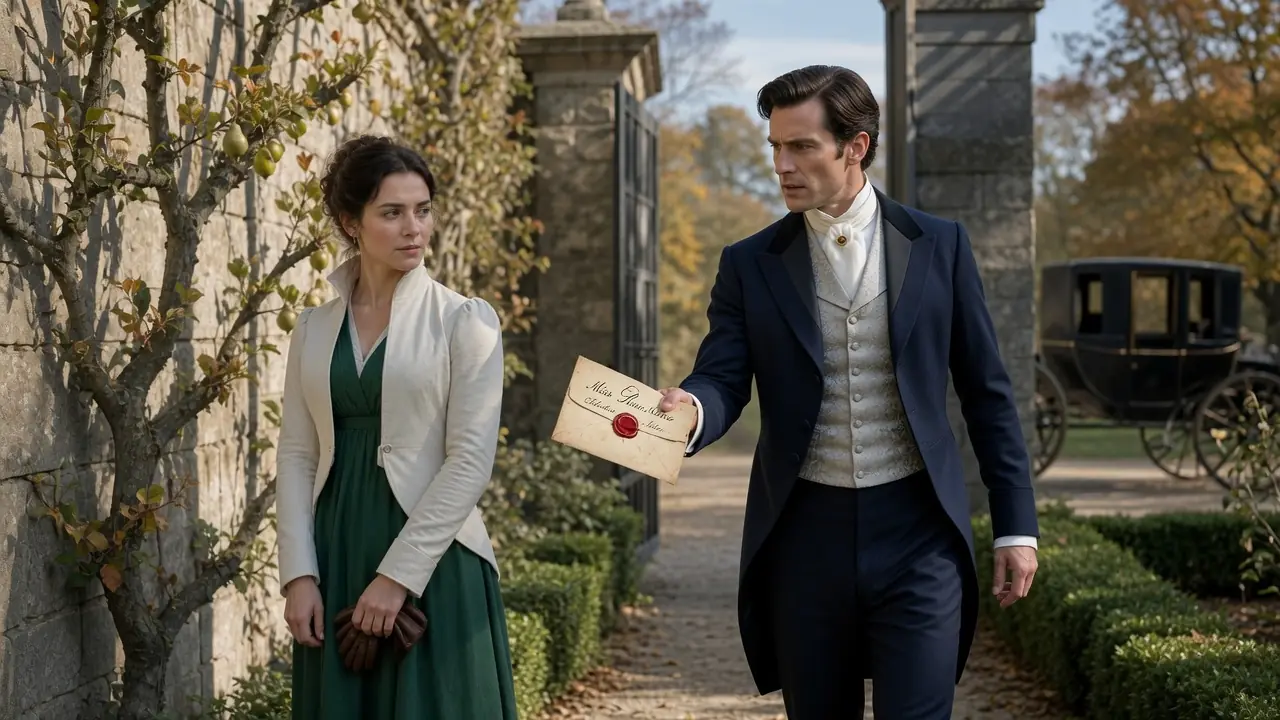
The carriage turned through Rolston Abbey's gates at four, and Clara Dace had precisely fourteen minutes before she would be required to be charming. She used them to finish her calculations.
The figures were not complicated. They never were, once you stripped the sentiment away. Thirty-eight thousand pounds, transferred from the consortium solicitor to Dace and Sons in September, reissued under new terms in October, and sitting now in her traveling case beneath a change of gloves and a novel she had not opened.
The debt was hers. It had been hers for six weeks and would remain hers for as long as she chose, under terms that gave the Duke of Blackfen eighteen months to begin repayment at a rate that would not break him.
She had not told her father the full of it. She had told him she was managing the Rolston matter personally, which was true, that the countess's financing was proceeding well, which was also true, and that she expected the week at the abbey to be entirely without incident.
She looked out the window at the approaching house, limestone, three stories, older than it pretended, and thought, Probably.
Beside her, Mrs. Pell slept with the serene reliability of a woman who had been Clara's father's housekeeper for twenty years and who had agreed to accompany Clara to the abbey on the understanding that she would be comfortable, attend to nothing strenuous, and be required primarily to exist. She was fulfilling this brief admirably.
Rolston Abbey in autumn was the sort of place that made a certain kind of person feel the world was correctly ordered. The grounds were raked. The windows caught the last of the afternoon light and gave it back gold.
In the entrance hall, the Countess of Stern received her guests with the unhurried warmth of a woman who had arranged everything precisely as she wanted it and saw no reason to pretend otherwise.
"Miss Dace." The countess took both her hands. Helena Stern was sixty-one and looked fifty, not because she tried, but because she had always been interested in things, and interest kept a person sharp. "You are the only guest who has arrived exactly on time. I find that either admirable or alarming. I have not decided."
"My father keeps his clocks accurate," Clara said. "It becomes a habit."
"Mm." The countess studied her with the frank assessment of someone who had been reading people for four decades. "Come. Lord Raine is in the drawing room and will be delighted to have someone sensible to talk to. He has been making conversation with the curtains for twenty minutes."
Lord Callum Raine was not, in fact, talking to the curtains. He was standing near them, examining a watercolor of the abbey's east wing with the expression of a man who had run out of opinions about art and was waiting for rescue. He turned when they entered, and his face arranged itself into genuine relief.
"Miss Dace." He crossed the room.
They had met three times before, twice at her father's offices and once at a city dinner where Raine had been the only titled guest who seemed to understand what was being discussed. He was forty, easy in his manner, with the kind of face that gave nothing away until it gave everything away at once.
"You look entirely too composed for someone who has survived the North Road," he said.
"The roads were tolerable," Clara said. "The company in my carriage was a novel I have been meaning to abandon for two months."
"What was wrong with it?"
"The heroine kept making decisions she did not mean."
Raine smiled. "A near-universal complaint." He gestured toward the chairs by the fire. "Come and sit. The countess has planned something ambitious for this evening."
They settled into the easy rhythm of people who were not quite friends but had decided to be comfortable, discussing the abbey's renovation, the east wing, the drainage work the countess had commissioned, and the small argument about load-bearing walls that Clara's father had resolved by simply paying for a second opinion.
She was in the middle of explaining why the second opinion had been correct when the drawing room door opened. She did not look up immediately. She was making a point about foundations.
Then Raine's attention shifted. A small thing, a slight realignment of focus, and Clara looked up.
The Duke of Blackfen stood in the doorway.
She had seen the portrait engravings in the political papers. They had not been wrong exactly, but they had flattened something. He was taller than she expected, and the engravings had not captured the way he carried himself, as if the room had been expecting him specifically and had the good sense to arrange accordingly.
His face was angular and composed, the face of a man who had learned that expression was a form of concession and had conceded very little since. He was thirty-four and looked it in the best possible way, not young, not old, simply present.
Clara looked back at Raine and finished her sentence about foundations.
Raine, to his credit, listened to the end of it. Then he rose, and Clara rose with him, and the countess sailed back into the room with the duke at her side and the expression of a woman who had just placed the final piece of a composition she had been arranging for some time.
"Lord Raine, you know His Grace, of course." The countess turned. "And Miss Dace, may I present the Duke of Blackfen. Miss Clara Dace, representing Dace and Sons in her father's stead."
Ambrose Sterling looked at her.
She watched him hear the name, a fractional settling, like a man who had filed something under a known category and closed the drawer. He knew Dace as a bank, as a name attached to figures and the machinery of money that kept the peerage solvent while the peerage pretended otherwise. He knew Thomas Dace as a useful man of no particular consequence. He did not know this woman's face.
She saw him recalibrate briefly before the composure closed over it.
"Miss Dace." He inclined his head. "I was not aware that Thomas Dace had a daughter attending."
"He has two," Clara said. "I am the one he sent."
A pause, minimal, barely measurable.
"Indeed."
"Your Grace."
She held his gaze for precisely the right amount of time, not defiant, not deferential, simply level, and then turned back to Raine.
She did not look at Ambrose Sterling again for twenty minutes. She was aware during those twenty minutes that he looked at her twice.
Dinner was at eight. The countess managed her fourteen guests across a long table with the quiet authority of a woman who understood that seating was a language and she was its most fluent speaker.
Clara was placed near the center, not beside Ambrose, but within range. Ambrose was four seats down on the same side. She could not see his face without turning her head, which she did not do.
The conversation moved as it always did at these gatherings, in overlapping currents, until someone said something interesting enough to damn the others. A discussion of the autumn season gave way to the theater, to roads, and then, as it always did in rooms like this, to politics.
Ambrose spoke across the table to Raine about the parliamentary session. His voice was measured and exact, a voice that had learned that precision was its own form of authority.
He spoke about the upcoming trade bill with the confidence of a man who had read the arguments and found them satisfactory. He made a claim about the bill's likely effect on port duties that was almost correct.
Clara picked up her glass.
She knew the bill. She knew it better than anyone at this table because her father had spent six weeks in consultation with the bill's opponents, and Clara had taken the notes. Ambrose's claim was off. Not wrong in principle, but off by enough that it would matter in practice.
She set her glass down. She said nothing.
Ambrose finished his point. Raine responded. The conversation moved.
She felt rather than saw Ambrose's attention move to her. Not his gaze. He was not looking at her directly, but she had been in enough rooms with enough men who believed they were the sharpest person present to recognize the quality of attention that meant she knows something.
He said to no one in particular in the lull between topics, "I imagine those in the financial trade have their own view of the bill's implications."
Clara looked up. He was looking at her now with the expression of a man who had extended an invitation dressed as an observation.
"Undoubtedly," she said.
He waited.
She returned to her plate. The table moved on.
Across from her, Raine concealed a smile behind his water glass.
After dinner, the party distributed itself across the drawing room. Clara was near the window, which looked onto the abbey's dark grounds, when Ambrose appeared at her left.
He did not sit. He was making his way, or appearing to make his way, toward the bookcase three feet farther along. He stopped at a small table in his path.
"Banking families," he said, examining a figurine on the table with the interest of a man who did not care about figurines, "have always had a particular appetite for acquisition."
It was general enough to deny intent. The word acquisition was doing considerable work.
Clara felt the arithmetic move through her, a reflex, her father's trick, the counting that cleared the head when a negotiation turned, and it steadied her.
"As have most families," she said, "when the alternative is decline."
He looked at her then, not the cataloging look from the introduction. Something more direct. He was trying, she thought, to determine whether she was as simple as she appeared or as complicated as she sounded.
"Your father is well?" he asked.
"Extremely."
"He was."
"I was unable to attend."
A pause.
"I should have liked to speak with him."
"He would have enjoyed that, I am sure." Clara's voice was entirely pleasant. "He finds conversations about acquisition most stimulating."
The silence that followed lasted approximately four seconds. In it, Ambrose looked at her with something that had not yet decided what it was.
Then he moved around the table to the bookcase, and Clara turned back to the window, and the dark grounds outside told her nothing she did not already know.
She counted backward from one hundred, which she had not needed to do since the day she sat across from Revel the solicitor and listened to him describe how he intended to ruin the Duke of Blackfen for sport and profit.
She reached eighty-seven before the urge to smile passed.
The second day arrived gray and mild, the kind of autumn morning that could not commit to weather and settled for atmosphere instead.
Clara came down to breakfast to find Raine, two other guests, and the countess, who was eating toast and reading correspondence with the serene efficiency of a woman who had long since stopped pretending she did not work at breakfast.
Ambrose was not there. Clara noted this with the completeness of a woman who was not noting it at all.
He came in at twenty past nine, clearly returned from a walk, boots recently, but not recently enough, cleaned. He took the seat at the far end of the table. He did not look at Clara.
Clara reached for the toast.
The countess had arranged the morning's entertainment, a walk through the grounds and kitchen garden, followed by a tour of the east wing's building works. The walk was optional, though the countess's use of the word carried the quality of a suggestion issued by someone who had organized naval campaigns.
Most guests attended.
Clara walked with a woman named Mrs. Holt, who had opinions about drainage that were, Clara was surprised to discover, largely correct. Ambrose walked ahead with two other men, talking about something with the authority of a man who had not yet encountered a topic he felt underqualified to address.
Raine fell into step beside Clara at the kitchen garden.
"How are you finding the abbey?" he asked.
"The drainage work is more substantial than I expected," Clara said. "The east wall had subsidence. They have relaid the footings."
Raine looked at her with an expression that mixed amusement and respect. "I meant the company."
"Adequate drainage," Clara said serenely, "is the foundation of all good company."
Raine laughed.
Ahead of them, Clara did not watch Ambrose turn at the sound of it.
The afternoon was unstructured. Clara spent two hours in the library with the countess's estate accounts, which she had requested under the guise of professional interest and which were, in fact, of genuine professional interest.
Dace and Sons' financing of the east wing renovation was proceeding well, but there were two entries that did not reconcile across the summer accounts, and Clara liked to find these things before they found her.
She was deep in the second half-year when the library door opened. She did not look up.
Footsteps crossed the room and stopped. A book was apparently located and removed, and she could hear the quality of the pause, not opened.
She looked up.
Ambrose was standing six feet away with a book he was clearly not going to read, looking at the estate accounts spread across the table with controlled curiosity.
"The library," Clara said, "is large enough for two people who have decided not to acknowledge each other."
"I am acknowledging you," he said. "I came in. You looked up. That is an acknowledgement."
"You are holding that book upside down."
He looked at it. He turned it over. He set it on a nearby shelf with the finality of a man who had decided not to compound an error.
"Are those the countess's accounts?" he asked.
"They are."
"She trusts you with them."
"She engaged the bank to manage them," Clara said. "Trust follows the engagement, in my experience, rather than preceding it."
He considered this with what she thought might have been genuine interest underneath the manner.
"Does it?"
"More reliably than the reverse."
He was quiet then.
"What are you looking for?"
"I have found it." She made a note in the margin. "Someone has been counting the timber twice in the summer entries."
Ambrose came slightly closer, enough to see the column she was indicating without reading the figures.
"How long were you looking?"
"About twenty minutes."
"And if you had not found it?"
"I would have found it eventually. I do not leave things unreconciled."
She looked up at him.
"It makes the final accounting unreliable."
"No," he said after a moment. "I imagine you do not."
He left shortly afterward, without the book, without having said whatever he had come to the library to say.
Clara sat with the accounts for another hour and only thought about him twice, which she considered satisfactory.
The card game was the countess's idea, which meant it was no one's idea and everyone's inevitability.
After dinner, the drawing room reconfigured itself around two tables, and the countess distributed players with serene authority. Clara found herself on the left. Raine was already there, shuffling with the ease of a man who played often and well. So was Colonel Marsh, broad, affable, thorough about pheasant and equally thorough about cards. And Ambrose, on Clara's left, close enough that she was aware of the precise distance between his shoulder and hers.
The countess announced partners. Clara and Ambrose. Raine and the colonel.
Neither of them said anything.
Clara picked up her hand and arranged it. Ambrose picked up his and arranged it. They did not compare, as partners sometimes did. There was no opportunity, not with opponents watching, but they fell into the game with an efficiency that surprised her.
He played precisely. She played precisely. In the second round, she took a risk on a low trump that only made sense if he held a specific card, and he held it, and they took the trick. He glanced at her afterward, the brief inventory of a man recalibrating, and she looked at her hand and decided what to lead next.
By the fourth round, they were winning, not by accident. Raine played well, and the colonel played with great enthusiasm, if limited subtlety, and none of that was enough. Clara and Ambrose had found something, a shared grammar of play, economical and mutually legible, that neither of them had produced by intention.
When they took the final trick, Raine leaned back in his chair and looked between them.
"You play as though you have done this before," he said.
"We have not," Ambrose said.
"The cards were straightforward," Clara said.
Raine said nothing, which was the most expressive thing he had done all evening.
During the sixth round, she adjusted her strategy in real time and felt the arithmetic flicker, quick, reflexive. Ambrose was watching her hand, but she felt his gaze move briefly to her face. When she looked at him, he was looking at the table, but he had seen it.
The table broke up. Clara was gathering the cards for no particular reason when Ambrose said beside her, "You took a risk in the second round."
"It was the correct risk."
"You could not have known I held the jack."
"You had played the hand as though you were conserving something significant. The jack was the most likely candidate."
She set the cards down.
"I thought you might understand the signal."
"And if I had not?"
"Then we would have lost that trick, but we would not have lost the game. I had sufficient reserve."
He was quiet for a moment.
"You factored in your own capacity to recover."
"One always should," Clara said. "Depending on another person's play is a risk. You have to know what you can manage if the gamble does not pay."
Something shifted in his expression, a small rearrangement she would not have caught if she had not been watching.
"That sounds like a broader principle."
"Most card principles are."
She met his eyes, and he held the look a second longer than necessary.
Then Raine reappeared with two glasses and a comment about the colonel's brandy selection, and the moment closed.
The third day brought rain, and the abbey turned inward.
Clara chose the library on the reasonable grounds that she had work to finish, and the unreasonable grounds that it was the farthest room from where Ambrose had established himself, which was the morning room, where Raine and the colonel were having a long and apparently competitive game of backgammon.
She found the minor error in the wages column, a copying mistake, nothing structural, and had begun a note to her father's chief clerk when the rain intensified against the windows.
The door opened at eleven. She did not look up.
The last time she had not looked up, it had been Ambrose. She had learned nothing from that experience.
It was Ambrose.
He came in, registered her presence without apparent surprise, and went to the same shelving he had visited the day before. This time he selected a book with more conviction, went to the chair on the opposite side of the table, and sat.
He read. She wrote. The rain made its argument against the windows.
After twelve minutes, Clara said without looking up, "What are you reading?"
"Hume," he said. "The essay on commerce."
"He is wrong about luxury goods."
A pause.
"Most philosophers are wrong about money," she said. "Hume less than most, but his argument about luxury and national wealth does not account for what happens on either side of the transaction. He sees the exchange. He does not see what it supports."
"And you do?"
"It is my profession to see what happens on either side." She set down her pen. "On the merchant side, there are small producers who depend on that demand to survive. Remove it and you remove their income. On the buyer's side, there is frequently debt. Debt creates obligation, obligation creates leverage, and leverage is the actual mechanism by which most social movement happens. Hume thinks money moves people. Leverage moves people. Money is what leverage is denominated in."
When she finished, the room was quiet enough that she heard the fire shift.
"That," Ambrose said, "is the most direct argument I have heard in this house."
"Most arguments here are made sideways."
"Is yours always direct?"
"Not always. But Hume has been dead long enough that there is no point being tactful with him."
She heard him turn a page.
They sat in shared silence for another thirty minutes, and at some point Clara became aware that she had stopped noticing the specific quality of quiet that meant another person was present, which was either comfort or inattention, and she was not sure which was more alarming.
When Ambrose left, he paused at the door.
"Your argument about Hume," he said. "Does it appear in any of your father's published correspondence?"
Clara looked up. "It is my argument."
A beat.
"I know," he said, and left.
The afternoon brought a cessation of active rain, which in October amounted to improvement, and with it a visit to the abbey's home farm. Clara walked with Mrs. Holt, listened to Sir Geoffrey Malt's account of his breeding program with half her attention, and spent the rest on the abbey's hedge boundary, which needed work she estimated at sixty pounds in the spring.
Ambrose was engaged by Sir Geoffrey in a longer conversation than any other guest about winter feed and the cost of hay. Clara overheard a fragment and heard in it the specific knowledge of a man who had looked at his own accounts and made careful choices about what could be afforded.
She moved away before she could hear more.
Lord Ferris found her on the return path. He was twenty-six, pleasant, and had been arranged into her proximity by the countess with her usual invisible hand.
Clara walked with him and answered his questions about London and did not find him unpleasant, which was the most she could honestly offer.
From across the farm track, she felt Ambrose's attention like a draft from a closed window. When she glanced in his direction, he was speaking to Raine. He was not looking at her.
She asked Lord Ferris a polite question about Hertfordshire.
Later, on the gravel path back, Raine fell into step beside Ambrose.
"How do you find Miss Dace?" Raine asked.
"Competent," Ambrose said.
Raine looked at the gravel. "Yes," he said. "Quite."
He changed the subject. Ambrose said nothing further about Clara Dace, which was, Raine thought, very nearly as informative as if he had.
That evening, the countess gathered a smaller group for a general conversation about the east wing works, which brought together herself, Clara, Ambrose, Raine, and Mrs. Holt. No one had manufactured reasons to be elsewhere.
The conversation turned structural. Clara had opinions. Ambrose had different opinions. They were not arguing. Their positions were adjacent rather than opposed, but there was a friction to it, the friction of two precise people who did not agree on the order of priorities.
"The foundation work is correct," Clara said, "but the order of works was inefficient. They should have resolved the subsidence on the east wall before commencing the upper-story windows."
"The upper-story windows were weather-critical," Ambrose said. "In October, you address what will cause the most damage if left."
"In October, you also address what will affect every subsequent stage. The subsidence is already showing in the second-floor room measurements."
"Have you measured the rooms?"
"I have read the architect's report."
"The architect's report," Ambrose said with faint dryness, "was written by an architect who preferred to manage his own order of works."
"Which is why you compare it against the surveyor's assessment, which you have also read. The countess has been good enough to share the relevant documents."
Ambrose looked at her. The countess looked between them with the expression of a woman at a particularly satisfying tennis match.
"The order of works," Ambrose said after a moment, "was driven by cost. In November, the window work would have required supplementary scaffolding."
"Yes," Clara said. "Forty-two pounds additional, which is less than adjusting the second-floor plan will cost." She paused. "But the decision was made in July, before the full extent of the subsidence was established. In context, it was a reasonable call."
He looked at her.
"You are correcting me and defending the correction simultaneously."
"I am providing context," she said. "The correction stands."
Raine made a sound that was not quite a laugh. Mrs. Holt said she had always felt subsidence was underestimated as a problem and was glad someone was taking it seriously.
Later, when the group had broken up, Raine found a moment beside Ambrose.
"She is very good," Raine said.
"She is thorough," Ambrose said.
"Thoroughness at that speed is what most people call intelligence."
Ambrose said nothing.
He was watching Clara explain something to Mrs. Holt across the room, and he had been watching for long enough that he was aware of the fact and had decided not to stop.
Day four arrived with a softening in the atmosphere that had nothing to do with the weather, which remained gray and unconvinced.
Small things. At breakfast, Ambrose passed Clara the butter without being asked, proximity and observation, no more than that, but in the accounting of small gestures, something. Clara thanked him. He said, "You are welcome," in the register of a man who had adjusted his default for one person without noticing he had done it.
Raine noticed. He spread his toast and said nothing.
Clara spent the morning in the sitting room with correspondence: a letter from her father requiring a response, two from the chief clerk requiring three responses between them, and a fourth from a solicitor's office asking for routine confirmation of a transferred instrument.
She wrote the confirmation, sealed it, and sat for a moment, looking at nothing in particular.
Downstairs, she could hear voices from the morning room. She recognized Ambrose's among them, measured, assured, the voice of a man who expected rooms to listen. She had heard it for four days now and had developed a sense of when he was speaking from certainty and when from the assumption of it, which were different things that sounded alike until you listened carefully.
She picked up the next letter.
In the afternoon, the party went to the walled garden. The countess had designed it in the geometric mode, beds laid out with the patience of someone who believed that good order improved the mind as well as the soil. The guests moved through it in pairs and small groups, ostensibly looking at late-season roses.
Clara was examining an espalier pear trained against the south wall when Ambrose appeared on her left.
"The pear will be better next year," he said. "They have taken the training too far this season."
"They have been ambitious," Clara said. "There is a difference."
"Ambitious and overextended produce the same result at harvest."
"If you leave them. But if you know what you have done and manage accordingly, you can correct for it." She kept her eyes on the espalier. "Overtrained trees are not a ruin. They are a different kind of project."
He was quiet.
The garden held its warmth, the last of the season's, and around them other guests were doing whatever they were doing and very successfully not being relevant to this particular wall.
"What does your father's bank do," Ambrose said, "with debt instruments once it holds them?"
He said it with the tone of a man asking a general professional question. Clara heard it as a precise one and answered accordingly.
"It depends on the instrument. The bank's interest is typically in recovery, orderly, on terms that do not prevent the debtor from functioning. A recovered debt is worth more than a foreclosed one. Most people understand this."
She paused.
"Some creditors prefer foreclosure. It depends on what they want."
"What do they want when they prefer it?"
"Something other than the money," Clara said simply.
He turned to look at her. She kept her eyes on the espalier.
"Not uncommon. People acquire instruments of obligation for reasons that begin in money and end in something else entirely. Power. Leverage. The correction of an old grievance. Things with no entry in a ledger that are nonetheless the actual currency of the transaction."
"That sounds like experience speaking."
"Three generations' worth," she said. "We have seen most varieties of the human appetite for advantage."
"Dace and Sons," he said. "What does it want when it holds the instrument?"
"The orderly retirement of the debt," Clara said, "and the continuation of a functional relationship with the debtor."
She turned back to the espalier.
"We are in the business of long-term stability. Short-term advantage tends to foreclose future opportunity."
Ambrose looked at the pear tree for a long moment.
"That is a more patient strategy than most."
"We are a patient family," Clara said.
She excused herself shortly after. Behind her, she did not look to see whether he watched her go.
He did.
Raine, from the garden's far entrance, noted it and found the gate stonework very interesting for a moment before looking back.
Dinner on the fourth evening was the largest yet. The countess had added three guests who had arrived that afternoon, expanding the table to seventeen. Clara sat well placed as usual, the countess's seating arrangements having a consistency she had begun to read as deliberate.
The meal progressed through its courses. The conversation was good, the kind that happened when a host had assembled people who were interested in things and placed them correctly.
Clara ate, talked, contributed two observations that landed well, deflected one question about her father's plans with pleasant vagueness, and managed Lord Ferris on her right with patient good humor.
It was in the third course that the countess, from her end of the table, made her remark.
She was responding to something one of the afternoon arrivals had said about the city. Nothing specific, just the general observation that the financial district seemed unusually active this autumn, that several significant transactions had been settled before the parliamentary session, which was early.
"I understand," the countess said with the warmth of someone sharing good news, "that Dace and Sons has made quite a significant acquisition recently. Your father has been busy, Miss Dace."
The table's attention turned to Clara.
"He always is this time of year," Clara said. "The autumn tends to be productive."
"Productive?" the countess repeated pleasantly. "I heard it was rather a substantial piece of business."
"The bank manages several instruments of varying scale," Clara said. "I am afraid I cannot speak to particulars in a social setting."
"Of course not," the countess said, entirely satisfied. "Very proper."
The conversation moved on. Clara picked up her glass.
Four seats down on the same side, she did not look at Ambrose Sterling.
The arithmetic crossed her mind in the moment the countess spoke. Not the nervous reflex of social calculation, but the specific counting of exposure, the measuring of what had been said against what it might mean to whom. It lasted a second. She was back before anyone could have caught it, or almost anyone.
What she did not see was that Ambrose, four seats down, had glanced at her when the countess spoke. He caught the moment, the small unfocusing, the half second of stillness. He had seen it twice before.
He filed it alongside the countess's remark, said something to the man on his right, and ate his dinner with great composure.
The countess, at her end of the table, refreshed a guest's wine, looked at nothing in particular, and was, by every observable measure, entirely satisfied with how the evening was going.
Ambrose went over it in his rooms.
He was not a man who paced. He found it undignified and only slightly more productive than standing still. But the countess's remark had set something in motion that would not be stopped by sitting in a chair and being above it.
So he stood at the window instead.
He thought, Dace and Sons has made a significant acquisition.
He thought, A substantial piece of business. Autumn. Before the parliamentary session.
His debt had transferred in September. He knew this because his solicitor had mentioned in passing that the instrument had moved. Not unusual. Debts were traded regularly by creditors who wanted ready money rather than patience.
He had not pressed for details because the terms had been represented as proceeding normally, and because there was a particular quality of information that a man in his position sometimes preferred to receive at a distance.
He thought about Clara Dace in the walled garden, explaining what creditors wanted when they preferred something other than the money. Power. Leverage. Satisfaction. The correction of an old grievance.
He thought about the card table, the risk she had taken.
I had sufficient reserve.
He thought, The orderly retirement of the debt and the continuation of a functional relationship with the debtor.
He stood at the window for a long time.
He would write to his solicitor in the morning, an express rider sent with enough urgency to justify the cost, requesting written confirmation of the current holder of the instrument. The reply could not arrive before the morning of the day after tomorrow at the earliest. That was the arithmetic of distance, and it was reliable.
He went to bed. He did not immediately sleep.
Day five. The express had gone at first light. There was nothing to do now but wait, and waiting was a thing he had made a practice of managing without appearance.
He came down to breakfast at his usual hour and found Clara already there, which was usual, and the morning paper between them, which was useful.
"Good morning," Ambrose said.
"Good morning," Clara said from behind the paper.
The butler brought toast. They ate. Raine arrived at eight, looked at the two of them, sat at the far end of the table, and reached for the coffee pot with the serenity of a man who had understood more than he was told.
The day passed in its segments. A morning ride that did not resolve anything but imposed the useful quality of forward motion. Luncheon. An afternoon in which the various guests occupied the abbey's rooms with the comfortable independence of people a week into one another's company.
Clara was in the library, as often. Ambrose was in the morning room with papers sent up from London.
At some point in the afternoon, he set the papers down. He had been reading the same paragraph for twelve minutes, which was not his habit. The paragraph concerned road drainage in the eastern counties, which was relevant to the estate and required his attention, and he could not hold it for more than three sentences before his mind returned to the walled garden, the pear tree, and the orderly retirement of the debt.
He took the papers upstairs. He changed his coat. He went to find Raine.
Raine was in the corridor, emerging from the direction of the drawing room.
"How do you find Miss Dace?" Ambrose said.
Raine looked at him. It was the first time Ambrose had asked this question, and Raine treated it with the seriousness it deserved.
"Formidable," Raine said. "Precise. Considerably less easy to read than she appears."
A pause.
"Why?"
"No particular reason," Ambrose said.
"Of course not," Raine said, and went back the way he had come.
After dinner, the party settled into the drawing room for music, a guest who played well, another who sang with competence, and the room took on the comfortable ease of a gathering that had found its register.
Clara was near the fireplace, listening. Ambrose found himself, at some point in the second piece, on the other side of the same fireplace.
They did not speak.
The music covered the silence between them, which was no longer the silence of two people ignoring each other, but something that had not yet decided what it was.
After the third piece, in the general movement and conversation that followed, he said quietly, "The countess's remark at dinner about the acquisition."
She did not look at him. "Yes."
"She timed it."
"The countess times most things."
"And yet you seemed calm."
She turned to look at him, and her expression was perfectly composed, and her eyes were completely attentive.
"Did I?"
It was not a question.
Raine, across the room, glanced in their direction, then looked back at the pianoforte with great interest.
Ambrose said, "The bank's acquisitions are on public record where registered."
"They are. Registration is a matter of legal form. It may take some weeks."
"Some weeks or fewer, depending on the instrument."
"Depending on the instrument," she agreed.
He said finally, quietly, "Miss Dace."
She looked at him.
He had begun the sentence without knowing where it ended, and the possible endings were numerous, and none of them were ones he would say in a drawing room with fourteen other people and a soprano.
"Your Grace," Clara said with perfect courtesy.
She turned back to the fire.
He used the next movement of the room to move away. He did not look back at her, which required a specific and definite decision.
That night, he sat at the small desk in his room and wrote out what he knew.
The debt. Approximately thirty-eight thousand pounds. Transferred in September. Terms represented as unchanged, but his solicitor had described them only as proceeding normally, which was not the same thing as unchanged.
Dace and Sons' known ready funds, considerable based on public record and reasonable inference. A transfer of this scale was within easy capacity.
The countess's remark. Substantial. Autumn. Before the session.
He looked at the figures.
Then he wrote one more line.
She was in the walled garden, and she told me exactly what she knew and told me nothing I could use.
He put the pen down.
He thought about Thomas Dace, whom he had met three times and assessed quickly and filed under useful, no further attention required. He thought about what it would mean for a man he had placed in that category to have a daughter who had done what he now strongly suspected Clara had done.
He thought about the first evening, when she had let him walk away from an error about the trade bill without correction.
The candle burned lower. He went to bed.
In the morning, there would be a reply from his solicitor. Then he would know, and knowing was, at minimum, a foundation.
The letter arrived on the morning of the seventh day.
Ambrose was at the small desk in his room when the abbey's footman brought it, a private arrangement he had made with the butler on day five, that any express addressed to him personally should come directly upstairs rather than be placed with the general post in the hall.
He recognized his solicitor's hand. He broke the seal.
Three paragraphs.
The first confirmed the transfer. The second named the current holder of the instrument: Miss Clara Dace, acting through Dace and Sons. The third outlined the revised terms, which his solicitor described in the careful language of a man who knew when something unusual required neutral presentation as materially more favorable than the original conditions of the note.
He read it twice, folded it, and put it in his coat pocket.
Materially more favorable.
Eighteen months at a rate of repayment graduated so carefully that the first year would barely register against the estate's income. No penalties for the first six months. No public registration until the instrument reached the halfway point, which meant no public exposure before the parliamentary session, no forced sale, no opportunity for the kind of credit damage that Revel's consortium had been building toward with such patient precision.
These terms were designed to let him function, to vote in the session without the shadow of a called debt hanging over the chamber.
He put the letter in his coat pocket. He went downstairs. He found Raine in the corridor outside the morning room and said with brevity that he needed an hour, and Raine looked at his face and said, "Of course," and stepped aside without further discussion.
He found her in the walled garden.
She was near the south wall looking at the espalier pear, the same tree, the last morning of the party. The carriages were due at eleven. She had a pair of gloves in her hand that she was not wearing, a habit he had noticed over the course of the week, and she was looking at the tree with the focused attention of a woman thinking about something other than what she appeared to be looking at.
She heard him coming. Her posture shifted very slightly, the small adjustment of a person who had registered an approach and decided how to receive it.
She turned before he spoke. She saw his face. Her expression did not change, but she went still in the way of someone who had been expecting a specific conversation and was noting its arrival.
"Your Grace," she said.
"Miss Dace."
He stopped six feet from her. The letter was in his coat pocket, and he was aware of its weight.
"I received a reply from my solicitor this morning."
"I see," she said.
"I think you know what it contained."
"I imagine it contained information about a financial instrument."
"It named you," he said. "The current holder is Miss Clara Dace, acting through Dace and Sons, under terms my solicitor described as materially more favorable than the original."
He watched her face. Nothing moved.
"I should like to know what you intend."
"The terms are in the documents," she said. "Available to your solicitor."
"I have read the terms." He kept his voice level. It cost him something. "I am asking about intent. They are not always the same thing."
"In this case, they are."
"Clara." He said her given name without deciding to, caught himself, and did not correct it.
She looked at him directly.
"What are you doing?"
"I am holding a debt instrument," she said. "On terms available in writing."
"The terms are extraordinarily generous," he said. "They are the terms of someone not interested in the debt."
A step forward.
"I want to know what you are interested in."
She was quiet. From somewhere beyond the garden wall, two guests were having a distant conversation, their voices reduced to texture.
"I am interested," she said, "in the orderly retirement of the instrument."
"That is not an answer."
"It is the correct one."
"It is the professional answer," Ambrose said. "I am asking for a different one."
Clara looked at him with something that might, in a less composed face, have been frustration.
"I have given you a letter of transfer, generous terms, eighteen months, and no public registration before the session. What is it that you think I owe you in addition?"
"An honest explanation, not a ledger."
"The ledger is honest."
"Then tell me what is not in the ledger."
She was still. He was closer now than the walled garden should have made comfortable, and she did not step back. He noted this. He also noted that she did not step forward, which was its own information.
"You bought this before the parliamentary session," he said. "The timing was deliberate."
"Timings generally are."
"There was a consortium, three creditors, a solicitor named Revel."
He watched her face.
"You know that name."
"I have been in my father's offices."
"Revel went to your father's offices because he needed ready capital to execute a public sale timed to expose my credit at the worst possible moment, before the session, when I needed to be untouchable."
He paused. The words had a quality he had not anticipated, said aloud in open air.
"Your father declined."
"He did."
"And then the instrument transferred to you personally."
"Through the bank," she said carefully. "The legal structure—"
"Clara."
The name again, and this time he did not try to correct it.
"Do not give me the legal structure."
She held his gaze. Something moved across her face. Not the arithmetic, not this time, but something underneath it. Something that had not been visible before and was visible now only because the distance between them had narrowed past the point where it was easy to maintain.
"The terms are what they are," she said. "The timing was mine. I acquired the instrument before the consortium could execute the sale because the alternative—"
She stopped.
"The alternative was not something I chose to allow."
"Why the terms?" he asked.
"Why?"
"Not the terms. Not the structure. Why did you personally acquire my debt?"
She looked at him for a long moment.
"Because I was in my father's offices when Revel outlined the plan," she said. "I heard what he intended. The instrument was available. I had the means, and the alternative seemed unjust."
"Unjust?" he repeated.
"Yes."
He looked at her. The word sat in the October air between them, plain, undefended, not a negotiating position. Just the word. Just the reason.
"You intervened," he said, "out of a sense of justice."
"If you prefer."
"I do not prefer it," he said. "I find it considerably harder to manage than the alternative."
"What was the alternative?"
"That you did it to have something over me," he said flatly. "That is what I assumed. That is what made sense."
Clara looked at him, and for a brief moment her expression was unguarded. Not wounded. She did not wound easily. But something adjacent, something that had been sitting quietly under the composure and was now briefly present.
"I know what you assumed," she said. "You said a great deal in this garden."
"I did."
He had. He had said things that were precise and aimed at the wrong target, and the wrongness of them sat in his chest now with considerable weight.
"You said something," she continued, "about my father."
He had, in the middle of his accusation, reaching for whatever would land. He had said something about Thomas Dace drawn from an assessment he had made years ago and had never once revisited.
"My father," Clara said in the same level voice, "built Dace and Sons from his father's work and his grandfather's work and his own thirty years of six-in-the-morning starts and no guarantees. He has been in rooms with men like you since before I was born, managed, tolerated, found useful, and put aside. He is the most capable man I know."
She paused.
"So when you called him, at the Marchmont dinner in November of 1812, a very competent sort of tradesman, he came home that evening, said nothing, ate his dinner, and afterward sat in his study for two hours. I was nineteen. I could hear him from the corridor."
She looked at Ambrose with clear, steady eyes.
"I never told him I was in the corridor."
He stood with this for a moment.
Then he said, "Clara."
"You do not need to—"
"I said something about your father," he said, "that I should not have said. Not this morning. In November of 1812. I was describing a category of man I had decided to understand quickly and without revision, and he is not that category. The error was mine."
She looked at him for a long time.
"That is a more precise apology than I expected," she said.
"Imprecise ones are useless."
The corner of her mouth moved. Not a smile exactly, the precursor to one, held in check by a composure that was, he thought, beginning to cost her something.
She looked at him, and the arithmetic crossed her face, not the reflex of nerves, but something deeper, the counting of what had just happened against what she had expected. It lasted less than a second. He saw it, and she felt him see it, and something in the garden changed.
He said very quietly, "You do that."
She went still.
"You go distant for a moment," he said. "And then you come back. I noticed it the first evening. I did not know what it was."
Clara looked at him.
"It is arithmetic," she said. "My father's habit. When I am uncertain, I count. It steadies the mind."
"What were you counting just now?"
She held his gaze.
"The distance," she said, "between what I prepared for and what actually happened."
The pear tree stood its patient ground against the south wall. The distant voices beyond the wall had moved off, and there was nothing now but the garden and the light and the particular quiet that descends when two people have said enough true things that the false ones are no longer available.
"Why did you come to the party?" he asked.
"The bank is financing the east wing. That is why my father sent a representative."
She said nothing.
"Why did you come personally?" he asked.
She looked at him for a long moment.
"I wanted to see what the instrument looked like in a drawing room."
Then she said very quietly, "More complicated than I expected."
Something in his chest, which had been arranged for several years in a particular tight formation, made a sound like a lock turning.
"Remember who you are speaking to, Miss Dace," he said, not as he had meant to say it an hour ago, when it had been armor, but differently, with a dryness that had become something closer to honesty.
She looked at him with clear eyes.
"I have never forgotten," she said. "Your Grace."
He took a breath and let it out.
"Ambrose," he said.
She held the word for a moment.
"Ambrose," she said.
And the arithmetic did not come.
He left the garden before her, not retreating. She was not the sort of person one retreated from, and he was not the sort of man who did, but stepping back to the particular privacy that a man requires when something has been dismantled in him that he considered structural.
He walked the long way to the abbey, around the east wall, past the kitchen garden, and stood for a moment behind the stables where no one from the house could see him and looked at the sky, which offered nothing useful.
He had come to the garden intending to know where he stood. He knew now that he was standing in a place he had not anticipated, having just apologized to a woman who had protected him from ruin out of a sense of justice and the long shadow of a remark he had made at a dinner table fourteen years ago about her father, whom he had dismissed in a sentence and who had apparently raised a daughter who bought dukes' debts and then said nothing about it.
He went inside and found Raine.
Raine was in the library. He looked up when Ambrose came in with the expression of a man who had been reading with one ear cocked for exactly this.
"Well," Raine said.
"I owe you nothing on this subject," Ambrose said, sitting down.
"I was at the garden gate," Raine said. "I came to tell you the carriages had been moved to eleven. I saw enough to know I would not interrupt."
He paused.
"You looked not as you usually look."
"I went to accuse her," Ambrose said. "I was wrong."
"Wrong about what she had done?"
"Wrong about why."
He was quiet for a moment.
"She bought it because she overheard Revel's plan and thought it unjust. No further motive. No leverage. No advantage sought."
He looked at the bookshelf opposite.
"And I stood in the garden and said things about her father."
Raine was still.
"At the Marchmont dinner in 1812," Ambrose said, "I called Thomas Dace a very competent sort of tradesman. She was nineteen. She heard about it. He came home and sat in his study for two hours."
"Ah," said Raine very quietly.
"I had not previously considered," Ambrose said, "that the things one says at dinner follow one."
"They generally do."
Raine picked up his book.
"What will you do?"
"I will go and see Thomas Dace," Ambrose said, "within a fortnight."
Raine turned a page. "And Miss Dace?"
Ambrose looked at the fire for a moment.
"The carriages are at eleven," he said. "I have some time yet."
He found her in the corridor outside the library, pulling on her gloves, the gloves she had carried all week and was now, for the first time, actually wearing, which struck him as significant in a way he did not examine too closely.
"I should like," he said, "to continue this conversation at some point that is not the last morning of the party."
She looked at him.
"You have my father's direction."
"I intend to call on your father."
"I know."
A pause.
"He will make you work for it."
"I expect him to."
She looked at him for a moment, one of her clear, complete looks, the kind that took in more than was visible and gave back only what she chose.
Then she said, "He takes his coffee at nine. He is always in the office by half past. He does not like people who are late."
"I am never late," Ambrose said.
"Then you will start well," Clara said.
She finished with the gloves and looked at him with something that was not quite a smile and was not not a smile.
"Ambrose."
He held the word.
"Clara," he said.
She walked on toward the staircase. He watched her go and did not manage this particular fact at all, which was new and which he suspected was going to continue.
The carriages assembled at eleven. The party gathered in the entrance hall with the deflated warmth of people who had been comfortable together and were now returning to their separate ordinary lives. The countess received her goodbyes with grace. She took Clara's hands last.
"A productive visit," the countess said.
"The east wing financing is in excellent order," Clara said.
The countess looked at her with her most honest attention.
"Come back in spring. The gardens are better."
"I should like that."
"I imagine," the countess said with complete serenity, "that you will not be the only one."
She released Clara's hands and moved to the next guest. Clara picked up her traveling case and went to where her carriage waited.
Ambrose was at his own carriage. He handed her something, a card, his solicitor's direction on one side, his own written on the other, in a hand as precise as she had expected.
"For any correspondence about the instrument," he said, with the faintest suggestion that he meant something else entirely.
"Of course," she said, with the faintest suggestion that she understood him perfectly.
He handed her in. He held her hand for a moment in the way that was not entirely functional. She sat. The door closed. The carriage moved.
She looked out the window as the abbey's gates passed. She did not look back.
She was thinking about spring and about a man standing at a carriage who had stopped pretending he was not watching her go, which was, she thought, a very good beginning.
She opened the novel. She read four pages. Then she put it away and looked at the road ahead and did not count anything at all.
The fortnight Ambrose had promised became ten days.
Clara was at her desk on a Tuesday morning, working through the correspondence that had accumulated in her absence, when Briggs appeared in the doorway with the particular expression of a man relaying information he found professionally interesting.
"The Duke of Blackfen is below, Miss Dace, asking for Mr. Dace."
Clara set down her pen.
"Show him to the private ante-room. Tell him my father will be with him at noon. He is in the Coventry meeting until then."
She paused.
"Tea, Briggs. And the good cups."
Briggs withdrew. Clara resumed her correspondence.
She heard from the floor below the measured quiet of a duke being received correctly, not like a common creditor, not in the public hall, but in the private ante-room with tea and a fire and the implicit message that Thomas Dace finished his prior engagements before beginning new ones.
This was not a slight. It was, in the language of Dace and Sons, a statement of position.
She worked until five to twelve. Then she straightened her desk, walked downstairs, and arrived at her father's office at the same moment Thomas Dace emerged from the Coventry meeting.
Thomas Dace looked at her. She looked back with the expression of a daughter who had something to say and was choosing when to say it.
"I see," her father said in a tone that meant he saw a great deal more than he intended to comment on in a corridor.
He turned toward the ante-room.
"Come."
Thomas Dace's office was a room that had been arranged once thirty years ago and not touched since on the grounds that it worked. There was a desk, three chairs, a window onto the street, and a fire that was always lit from October to April.
Ambrose was already standing when they came in. He had risen correctly at their entrance, and Thomas Dace looked at him with the steady attention of a man who had sat across from every variety of consequence and was not going to arrange his face for any of them.
"Your Grace," Thomas Dace said.
He sat. He gestured to the chair across the desk.
"Sit."
Ambrose sat. Thomas Dace folded his hands on the desk. He did not speak. He waited.
Ambrose said, "I owe you an apology."
Thomas Dace said nothing.
"At the Marchmont dinner in November of 1812," Ambrose said, "I described you in terms that were dismissive and wrong. I was describing a category of man I had decided to understand quickly, and you are not that category. The error was mine."
The office clock ticked. Somewhere in the building, the Coventry party was being seen out.
Thomas Dace looked at him for a long time.
"The Marchmont dinner," he said, "was fourteen years ago."
"Yes."
"It took you fourteen years."
"I required additional information," Ambrose said.
A pause.
"Clara provided it. Clara purchased my debt, preserved my credit, came to a house party, argued with me about espalier pears, and let me accuse her of doing it for advantage when she had done it for no advantage at all."
Ambrose said, "She provided a thorough education."
Thomas Dace was quiet for a moment. He looked at his daughter.
Clara said nothing. She had positioned herself to one side of the desk, not behind it, not across from Ambrose, but present, which was where she needed to be, since the instrument was legally hers and the business of its resolution was partly hers to conduct.
"Espalier pears," her father said.
"The order of works was ambitious," Clara said.
Something in her father's face rearranged itself, not a laugh, adjacent to one.
He looked back at Ambrose.
"You will answer my questions about the estate and your plans for the next five years."
"Yes," Ambrose said.
"Accurately."
"My accuracy is not in question."
"Your accuracy about things that mattered," Thomas Dace said, "has been in question for fourteen years. I am checking whether the revision is thorough."
Ambrose held his gaze.
"Ask your questions."
He did for forty minutes.
The estate's income. The outstanding works. The tenants. The north pasture drainage that had been deferred twice.
Ambrose answered each one with the complete precision of a man who had no intention of being caught in anything.
At one point, he said without prompting that the cash difficulty of the past three years had come from his father's estate and a winter that had cost more than anticipated, and that he had managed it without borrowing against the land because borrowing against the land was the beginning of a particular kind of ending, and he had not been prepared to countenance it.
Thomas Dace noted this without expression.
Clara, at the side of the desk, did not look at Ambrose. She looked at her father's notes, and the notes told her what they always told her: that her father had arrived at his conclusion in the first five minutes and was now building the evidence that supported it.
At the end of forty minutes, Thomas Dace set down his pen.
"You want to marry my daughter?" he said.
"I should like to ask your daughter if she will marry me," Ambrose said. "I thought it correct to speak to you first."
"She will have an opinion," Thomas Dace said.
"She has an opinion on everything," Ambrose said.
There was no indication that this was a complaint.
Thomas Dace looked at Clara.
"The instrument is yours," he said. "The decision is yours. I will say only this."
He picked up his pen.
"The north pasture drainage. I want it in the agreement."
"Done," Ambrose said before Clara could speak.
Thomas Dace wrote something in his notes.
"You may use the office," he said.
He rose. He went to the door and paused and looked at Ambrose Sterling with the expression of a man filing something under a revised and permanent category.
"Miss Dace," he said, meaning his daughter, "handles the accounts."
"I know," Ambrose said.
Thomas Dace left. The door closed.
The office was Clara's now, at least for the next few minutes, and Ambrose was standing in the middle of it, and the November light came through the window at the low, honest angle it always did at this hour.
Clara stood beside her father's desk, one hand on the surface, the way she stood when she was thinking clearly and wanted the room to know it.
"Ask me," she said.
He looked at her. He was not composing a speech. He was simply there, direct and considered, the face she had learned to read and intended to spend a considerable time reading further.
"Will you marry me?" he said. "Not because of the debt or the session or the espalier pears, but because I find you the most honest and capable and interesting person I have encountered in years. And the week at Rolston was the first week in some time when I did not have to perform the management of anything. I should like more weeks like that."
Clara looked at him.
"That is better than the version you had prepared when you came in this morning," she said.
He paused.
"What was wrong with the first version?"
"It began with the debt."
"That was the opening," he said. "I revised it."
"I know. It became honest around the third line."
She looked at him.
"Say the last part again."
"I should like more weeks like that," he said, "with you for the rest of them."
She was quiet for a moment. The clock ticked. November went about its business outside.
"Yes," she said.
He crossed the room and took her hands, both of them fully in the November light, and she let him.
For a moment, they stood in her father's office with the accounts on the desk and the Coventry correspondence by the door and the north pasture drainage settled between them, and it was not a romantic setting in the conventional sense, which was, she thought, exactly correct.
He kissed her properly, briefly, warmly, and she kissed him back with the composure of a woman who had been prepared for this since approximately the walled garden and was glad, and was already thinking about spring.
The wedding was in February, Thomas Dace's preferred month for completing transactions.
"You know where you stand in February," he said. "Nothing is pretending to be something it is not."
It was a small ceremony, which surprised people who expected a duke to marry at scale and did not surprise anyone who knew Clara. Raine stood beside Ambrose and said nothing useful during the ceremony, which was his highest form of support.
The Countess of Stern attended and looked extremely satisfied with herself, which no one commented on because it was accurate.
Thomas Dace walked his daughter in with the expression of a man whose calculations had come out correctly, which for Thomas Dace was the closest thing to visible emotion that could reasonably be expected.
Clara wore her mother's ring on the correct finger.
Blackfen in March was better than Ambrose had described it and different from what Clara had imagined from the accounts, which were always a partial picture. The house was large and cold and full of the dignity of buildings that had been maintained carefully and without show for several generations. The grounds were wet with early spring. The north pasture drainage was, she noted with private satisfaction, already half finished.
Ambrose showed her the estate books on the second morning. He came into the study where she had established herself, the room with the good east light, which was sensible, and sat across from her and opened the ledger.
"The south roof needs attention by autumn," he said. "I should like your view on the order of works."
Clara looked at the ledger. She looked at him.
"It depends on the drainage completion. If they finish the north pasture by May, the same men are available for the roof in June."
She ran her finger down the column.
"This entry, the east stable repairs deferred from the year before last."
"The year before."
"You will want those done before winter. The structural note is already showing strain."
She reached for the pen in her father's pen holder, which she had brought from London because it was the right weight, and made a note in the margin. He watched her make it.
"Give me the contractor estimates, and I will have a revised schedule by this afternoon."
"I have them upstairs."
"Bring them," she said. "I will have it done before dinner."
He looked at her for a moment. She looked at the ledger.
"I kept the same men through the connected works," he said. "Your advice from the abbey conversation about the east wing."
She had told him at Rolston that retaining contractors across sequential works was more efficient than sourcing new ones for each project. She had said it as an observation about the abbey. He had applied it to Blackfen.
She looked up.
"Good," she said.
He went upstairs to get the estimates. She turned back to the ledger and found the next entry that wanted attention, and the pen in her father's pen holder moved steadily through the columns, and the March light held, and Blackfen settled around her with the quiet of a place that had been waiting for something and had now received it.
June. London. A parliamentary dinner at which Ambrose was required, and Clara attended as his wife, and which, in certain quarters of the room, was still being calibrated.
Lord Hallwell made his way to Ambrose after the third course and began discussing the trade amendment with the authority of a man who had read a summary and found it sufficient. He addressed Ambrose entirely.
Ambrose heard two sentences, then said, "My wife has more current figures on the port duty question. Clara."
Lord Hallwell looked at Clara.
Clara looked at him with the composure of a woman who had been in rooms like this since she was nineteen.
"The projected revenue figures for the eastern ports are overstated," she said. "The calculation does not hold because it does not account for redistribution through the smaller inland routes, which absorbed a significant share of the volume when a comparable adjustment was made in 1819. If you are basing your position on the government's figures, I would recommend requesting the supplementary tables from the Board of Trade clerk directly. They are not widely circulated."
Lord Hallwell looked at Ambrose.
Ambrose looked back with the expression of a man who had nothing to add.
Across the room, Raine raised his glass without looking in their direction. Clara knew it was for her.
October. A morning at Blackfen, a year from Rolston.
Clara was at her desk. The estate accounts were current. The roof had been done in July, well within budget. The north pasture drainage had resolved the water problem that had cost the east hay crop twice running, and the accounts for the first full year at Blackfen were in a condition her father described, when he reviewed them, as rather more than satisfactory.
She was not working on accounts this morning. She was sitting with her hands flat on the desk and the pen untouched and the east light moving slowly across the surface.
And she was thinking about spring. Specifically about spring, about what spring would look like this year and what it would contain.
She heard Ambrose's step in the corridor. She had learned his step over the course of months, its quality, the way it changed between the house and the grounds, between purposeful and simply moving.
This was purposeful. He had come looking for her.
He appeared in the doorway. He looked at her, at her hands flat on the desk, at the untouched pen, at her face. He crossed the room without speaking and sat beside her in the chair that lived at the edge of the desk because it had been pulled there months ago and neither of them had moved it back.
He put his hand over hers on the desk.
She looked at him. He looked at her.
Neither of them said anything about spring because it was the kind of thing that did not need to be said to be entirely understood by both of them.
The arithmetic did not come.
She was not nervous. She had not been nervous, not the counting kind, in some time. She was something else, something that had no entry in a ledger and could not be denominated in any currency she knew, which was new and which was, she thought, sufficient.
Outside, Blackfen moved through its October morning. The grounds, the repaired roof, the north pasture, the stable block good for another decade, the east window catching the light correctly because the foundations were right.
She turned her hand under his. He held it.
The room held them both, and the morning held the room, and Clara Dace, Clara Sterling, did not count a single thing.