Ble Carrington pointed at the red fire hydrant in front of my house like it was a trash can somebody had left in the wrong spot. "Remove that hydrant today." I looked at the excavator idling behind her and I asked her exactly one question. "Have you called the fire district?" Bllythe laughed at me in front of the entire board. She told me to mind my own business because people like me did not decide what Redwood Crest looked like. I did not argue. I just stepped off the easement. Two days later, the fire marshal showed up and this time the person told to leave the property was not me.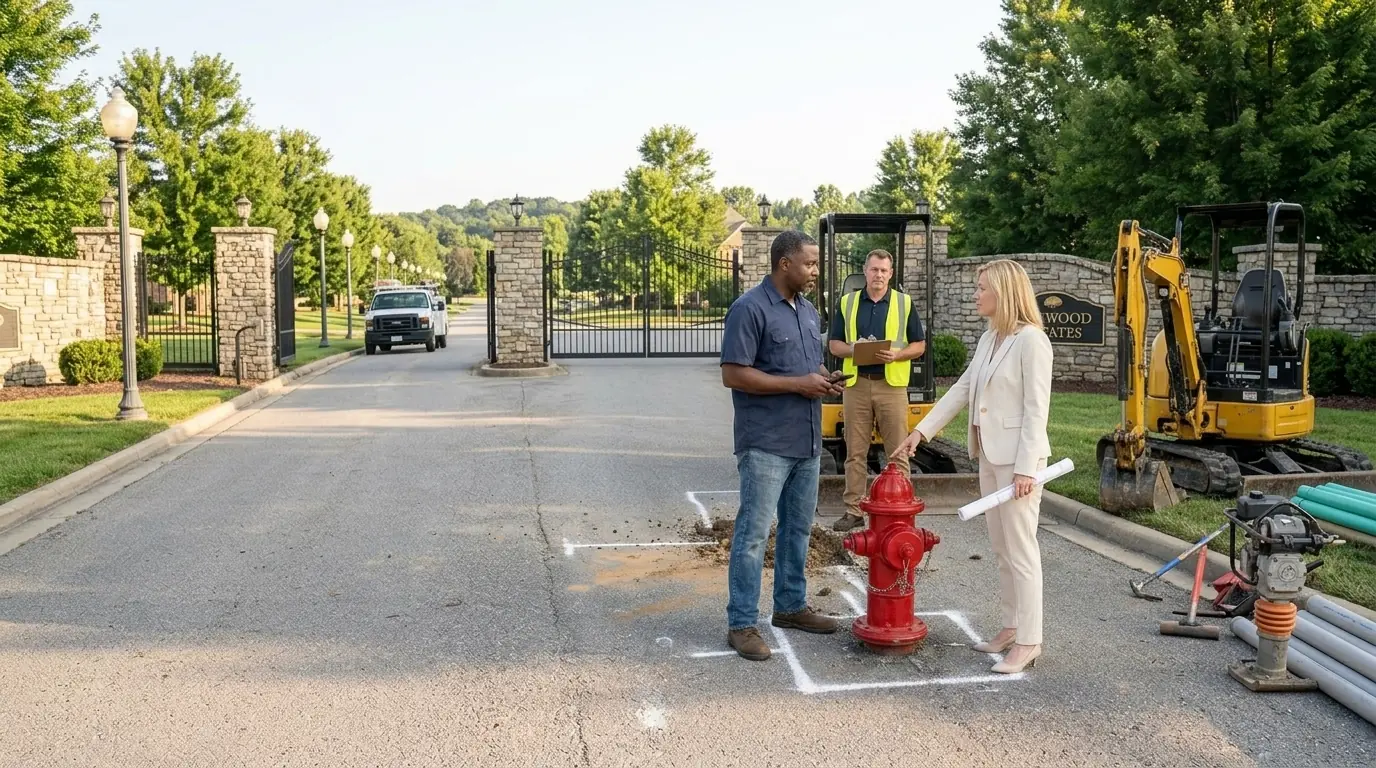
My name is Calvin Rhodes. I am 47 years old and I own the last house on the east side of Redwood Crest, right where the neighborhood meets the county road. It is a nice place, honestly. Wide streets, mature oaks, and a homeowners association that treats mailbox height like a matter of national security. I bought the house 11 years ago because the lot was deep and nobody else wanted a property sitting right beside the entrance where headlights sweep across the front windows at night. I never minded the headlights. I liked being at the edge of things, close enough to belong and far enough to breathe.
What most of my neighbors never understood is that my lot carries an old utility easement running the full width of the frontage. It was recorded long before Redwood Crest existed, back when this whole hillside was farmland and the county was laying water mains out toward the new schools. The easement is not decorative. There is a municipal water main under that strip of grass. And sitting on top of it, bolted to a barrel that goes down deeper than most people's basements, is a fire hydrant painted a very specific shade of red. That hydrant predates the subdivision, predates the clubhouse, predates every stone mailbox pillar in this neighborhood. It was there when the developer bought the land and the developer built around it because that is what you do.
Bllythe Carrington had just won her second term as board president when all of this started. She campaigned on property values, which in Redwood Crest is the closest thing we have to a religion. Her promise was a redesigned main entrance, a monument wall in cut limestone, twin stone pillars, uplighting, a bronze plaque, and two symmetrical rows of ornamental pears marching down both sides of the drive. She had renderings on foam board, a landscape architect, and a budget approved in principle before most residents understood what was being approved. And she had one problem, exactly one, standing in the way of perfect symmetry. The hydrant sat precisely where she wanted the eastern pillar.
I first heard her say it at the March meeting where 30 of us sat in folding chairs under fluorescent lights that make everybody look tired. She clicked to the rendering, said the entrance would finally reflect the caliber of the community, then paused, and her mouth did that thing where it tightens at the corners. "The only remaining obstacle," she said, "is an ugly red lump of iron sitting in the middle of the design."
A few people chuckled. I raised my hand, waited to be called on, and kept my voice as flat and friendly as I could manage. I told her the hydrant was not an HOA asset. I told her it sat on a recorded easement over a public main, that the association had no authority to relocate it, and that any work touching it would require sign off from the water authority and the fire district. I said all of that in about 20 seconds. No lecture, no attitude.
Bllythe looked at me the way you look at a stain on a tablecloth. Her eyes went from my face down to my clothes, which happened to be work clothes because I had spent the afternoon rebuilding a section of fence for a neighbor two streets over, and then back up again. "Calvin," she said, "fixing fences doesn't make you an engineer."
The room laughed. Not everybody, but enough. Graham Pike, our community manager, studied the tabletop like there was scripture written on it.
I did not correct her. I did not explain what I did for 19 years before I retired from it because I have learned that a man who leads with his resume is usually about to lose an argument and a man who leads with a permit number usually is not. So I sat back down and I let her have the room and I told myself it would sort itself out once somebody made a phone call to the county.
The next morning, I walked out to get the paper at 6:15, and the grass around my hydrant was marked with fresh white paint, a neat circle, offset lines, an arrow pointing toward the street. White paint means excavation. Anybody who has ever worked around buried utilities reads those markings the way other people read a headline. I stood there in my slippers with coffee going cold in my hand and followed the marks with my eyes and they did not stop at the hydrant. They ran out toward the center line of the frontage which meant somebody intended to open the ground above the main itself, not just the barrel.
That is a job requiring a licensed contractor, a permit, water authority shutdown coordination, and written notice to the fire district so responders know a supply point is going offline. I did not knock on Bllythe's door. I walked back inside, put on real boots, and waited until 8 when a white pickup with a magnetic sign pulled up, and a man in his early 50s climbed out with a clipboard.
Nolan Beckett ran the landscaping and hardscape outfit the association had hired for the entrance project. He was the sort of contractor who had been doing decent work for 20 years and had learned to say yes to whoever signed the checks. I introduced myself, told him I owned the property behind the easement and asked him a simple question. Did he have authorization from the water authority to work on that hydrant?
He hesitated. That hesitation told me more than any document could have. Then he flipped his clipboard around and showed me a work order. It was a one-page form on association letterhead describing removal and relocation of existing hydrant obstruction, entrance improvement phase one, and it carried a single signature at the bottom. Bllythe Carrington, president. No permit number, no county case number, no fire district reference, no water department approval line, not even a blank one because whoever drafted the form had never seen a real utility work order in their life.
"Nolan," I said "there's no permit on this."
He told me the association had assured him everything was handled on their end and that his scope was surface work anyway. I asked him what he intended to do with the barrel once the flange was exposed. He said the plan was to cut and cap. He said it the way you say something you have not thought about very hard. And then I watched him hear his own words and something moved behind his eyes. Cut and cap means you are not relocating anything. It means you are permanently removing a supply point from a live municipal system and sealing the stub.