"You get the hell out of my restaurant."
"Sir, we're just eating."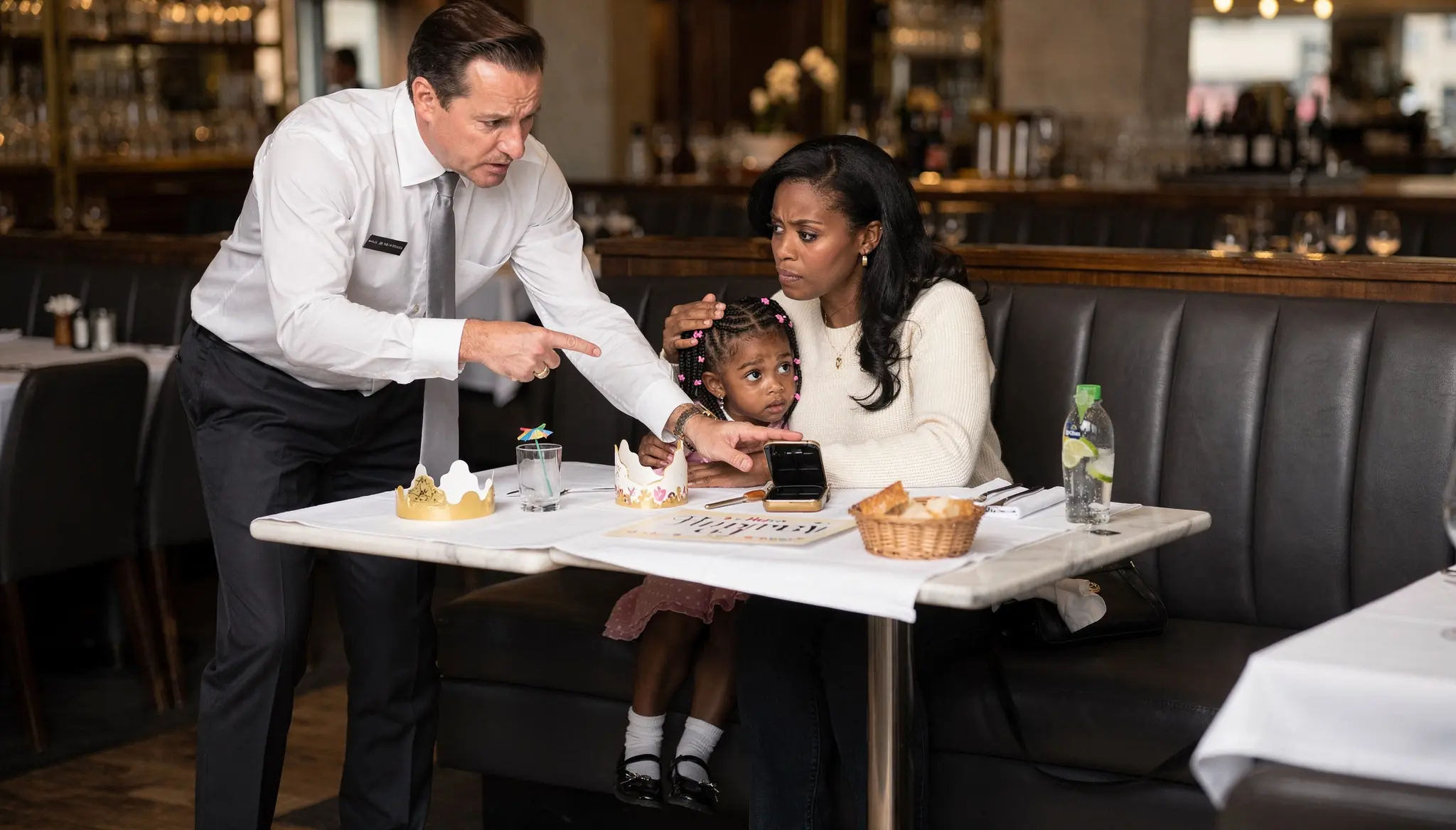
"Shut your stupid mouth. I said out. Now."
Maya's fork dropped onto her plate. "We have a reservation."
"Reservation? You're filthy, you and your kid. You don't belong in a real restaurant. Go eat at McDonald's, where your kind lines up. I'm calling the cops to haul you out like trash."
She lifted her own phone instead, smiled softly, and dialed one number. Brent laughed. He did not know that in eleven seconds he would be unemployed, and not because the cops were coming.
The September sun fell softly on Madison Avenue. It was Saturday afternoon at 2:15 when Ava Mitchell knelt on the sidewalk in front of the Hearth and Vine. She tightened the buckle on a small patent-leather shoe with the patience of a mother who had been here before.
"There," she said. "Princess feet, ready to march."
Maya giggled. She was six today, a real six, the kind that demanded a pink dress, a paper crown, and a folded birthday card she had drawn herself in green and gold crayon. The card was titled in shaky letters, "Mommy and Me Birthday Lunch."
Ava stood, brushed her dark jeans, and adjusted the cream cashmere sweater that hung softly on her shoulders. Gold studs rested at her ears. There were no designer logos, no car waiting, and no assistant on the phone. Today was not for the office. Today was for her daughter.
She had cleared the calendar three weeks ago. She had booked the table herself from her own phone under her own first name. She had told no one. The board did not know where she was, the driver did not know where she was, and even her assistant believed she was at the gym. This was the one Saturday a year that belonged to Maya. Just Maya.
Inside, the Hearth and Vine breathed gold and brass. Low jazz drifted from hidden speakers, and the dining room glowed under amber pendant lights. White linen stretched tightly over every table, crystal clinked against ice, and a pianist played something slow in the far corner.
At the host stand, a young waitress looked up. Her name tag read Hannah. She was twenty-four, her hair pulled back, and only two weeks into her first restaurant job. Her smile was real.
"Good afternoon," Hannah said. "Do you have a reservation?"
"Mitchell, 2:00," Ava said. "It's her birthday."
Hannah's eyes went wide in the way only a twenty-four-year-old's could. "Happy birthday, beautiful," she said, kneeling until she was level with Maya. "Six?"
Maya nodded, shy and proud.
"Then you are absolutely getting the window booth," Hannah said. "Best view in the city."
She tapped the screen, found the reservation, and turned to lead them across the floor. That was when Brent Whittaker stepped out from behind the second podium. He had just been laughing with a couple in their seventies, the wife in pearls and the husband in a navy blazer. He had promised them the finest port at the end of their meal, shaken the husband's hand, kissed the wife's hand, and laughed like an old friend.
He was tall, polished, and expensive in the way of men who confuse a clean shave with character. He wore a white shirt and charcoal tie, and his hair was combed back with the precision of someone who studied himself in the mirror more than the menu. His eyes found Ava first, then Maya, then the cream sweater, and finally the jeans. The smile he had been wearing for someone else slid off his face like grease from a plate.
He held up one finger to stop Hannah. He did not greet Ava. He did not greet the child. He did not greet anyone.
"Hannah," he said, his voice low, "not the window. Take them to the back."
Hannah blinked. "Sir, the reservation says window."
"Back."
Hannah's mouth opened, then closed. She glanced once at Ava. The apology in her eyes lasted half a second, but it was there. Ava saw it. She always saw it.
She did not say a word. She squeezed Maya's hand twice, a small, secret signal between mother and daughter that meant, "We're okay."
Hannah led them down a long aisle past white linen and crystal, past laughing couples and gleaming silverware, into a darker corner near the kitchen's swinging doors. The booth there was lit by a single weak sconce, and the leather was worn at the edge. She set the menus down and whispered, "I'm so sorry."
"It's not your fault, honey," Ava said. "Bring my daughter a sparkling water with a lime, and put a little umbrella in it if you have one."
Hannah's eyes flooded. She nodded and walked away quickly.
Maya looked around the booth. She looked at the kitchen doors, the brass coat hook beside her head, and then at her mother. "Mommy?" she whispered. "Is this the special table?"
Ava's jaw flexed once. She made it disappear before her daughter could see it. "It's whatever table makes you happy, baby," she said with a smile. "Today is your day."
Across the room, by the brass-railed entrance, Brent Whittaker was already watching.
"For the birthday princess," she whispered.
Maya's face lit up. She held the glass with both hands. "Mommy, look! I have a fancy drink!"
"You look like a queen," Ava said.
Hannah slid two paper crowns from the kids' menu box and placed them on the table. "One for you, one for Mom. House rule. Birthdays come with crowns."
Ava laughed, soft and real. She put the crown on, and Maya put hers on too, the gold paper sitting crooked over her tiny braids. They clinked their water glasses together. Ice. Lime. Sparkle.
Hannah came back with a basket of warm bread and a small dish of cultured butter. She tucked an extra napkin under Maya's elbow. "If you need anything, I'm right over there," she whispered.
Then she walked away with the worried smile of someone who had already noticed her manager noticing things. For sixty seconds, the back of the dining room was the safest place in the world. Then the safety ended.
Brent Whittaker did not walk to their table. He marched. Each step landed too hard on the polished oak floor. The pianist in the corner missed a note when he passed.
He stopped at the booth. He did not look at Maya or at the paper crown on her head. He looked at Ava, and only at Ava. He stood there for a beat longer than necessary, long enough for the dining room to feel it, long enough for Maya's smile to falter, and long enough for the pianist to glance over and forget his next chord.
"Ma'am, take that off."
Ava lowered her glass. "Excuse me?"
"The crown. We don't allow costumes in my dining room. We have a dress code."
"It's a paper crown from your own kids' menu."
"That's for children."
"My daughter is a child. The other crown is for her mother. That's me."
Brent's lips formed a thin, tight smile. "The dress code applies to all guests. Cashmere is fine. Costumes are not."
"Cashmere," Ava said, "is what I'm wearing."
He looked at her sweater, then at her jeans, and then at the cream color at her collarbone. "We get a certain clientele on weekends," he said. "I'm trying to manage expectations."
Maya looked up at her mother, her mouth opening slightly. She did not know the words. She knew the temperature.
Ava set her crown on the table slowly, the way someone puts down something fragile. "Sir, we are eating lunch. My daughter is six today. Please leave us alone."
Brent's nostrils flared. "Can I see proof of your reservation?"
"I showed it to your hostess."
"I'd like to see it myself."
Ava reached for her phone. She did not rush or slam it down. She tapped the screen twice and turned it to face him.
"Mitchell, party of two, 2:00 p.m., window booth, confirmed three weeks ago."
Brent leaned in. His eyes moved across the screen, and he pretended to read it three times longer than necessary. Then he straightened and made a small, performative shrug.
"I don't see this on my end. Could be a glitch in the third-party system."
"You are looking at a confirmation email from your restaurant," Ava said, "sent from your own domain."
Brent's smile grew smaller and harder. "I'm telling you what I see in my system. I don't see you in there."
He held her gaze the way a man holds a door closed against someone he never planned to let inside. Then he pulled out his own phone and made a show of typing.
"Yeah, nothing under Mitchell. We have a private event holding this whole side of the room from 3:00 onward, so we need this table."
He gestured toward the empty window booth across the floor, the one with city light pouring through it, the one no one was sitting in, the one no one had been sitting in all afternoon.
A man two tables away heard him. He was in his mid-thirties and wore a hooded sweatshirt over a plain white T-shirt. His name was Daniel Brooks, and his phone was already in his hand. He tilted the camera up slightly, the screen facing the booth. He did not raise it or announce it. He simply kept his hand still.
Maya tugged at her mother's sleeve. Her voice was small, smaller than her crown. "Mommy? Did we do something wrong?"
Ava turned all the way toward her. She knelt in the booth until her face was level with her daughter's and took both of Maya's small hands in hers.
"No, baby. We did not do anything wrong. We have a reservation. We are paying customers. We are staying."
She kissed Maya's forehead, then sat back up. "Sir," she said, her voice calm, steel wrapped in cotton, "we will not be moving. We will be eating our lunch. You can bring us a menu and a server, or you can keep standing there."
Brent's face flushed under the foundation he definitely wore. "I'm going to ask you one more time. Politely."
"You have been asked once politely."
"I am asking you to leave."
"And I am declining."
The dining room had gone quieter. Not silent yet, just quieter. Forks paused in midair, the pianist played more softly, and two more phones appeared in two more laps.
Brent stepped back half a pace and looked toward the bar. "Hannah."
She froze at the service station with a tray of bread in her arms.
"Hannah, did you authorize this seating without checking with me?"
Her lips parted, and her cheeks went red. "Sir, the reservation was in the system. I saw it."
"That's not what I asked. Did you check with me first?"
"No, sir. I—"
"Then we have a problem, don't we?"
Hannah looked down. Her tray shook just a little. A busser passing her stopped, leaned in, and whispered something quickly.
"She has a reservation," Hannah whispered back. "I saw it. I swear."
Brent turned toward Ava again. "You see, ma'am, this is what happens when corners get cut. We've had a string of issues lately. People walking in, trying to dine and dash. We have to be careful."
Ava did not move or blink. "You think," she said slowly, "that I am here to steal a meal?"
Brent shrugged theatrically. Two diners stopped chewing. "I'm just protecting my staff and my house. Nothing personal."
Maya's eyes filled, but she did not cry yet. She sat very still and slid her birthday card beneath the menu, as though hiding it from the room. Daniel adjusted his phone, angling it higher so the booth was clearly in frame.
Brent took half a step closer to the table. "Ma'am, I'm not going to make this any louder than it has to be, so I'll say it once more. Pay for whatever bread and water you've had, take the kid, and walk out the way you came in."
Ava felt the warmth leave her face, not from fear, but from clarity.
A diner two tables away chuckled. He had white hair, an expensive watch, and a dark gray suit despite the Saturday afternoon. He had watched the entire exchange. Now he spoke to his wife loudly enough for the booth to hear.
"Some people just don't know where they belong."
His wife laughed, polite and short. No one at the nearest table stood. No one said anything. A waiter passing with a tray of glasses looked down and kept walking. Nobody set down a fork.
The whole room had turned into one quiet, expensive shrug. A woman in a velvet jacket checked her phone as though nothing were happening.
Maya heard it. Maya was six, but she heard it. She turned her face into her mother's arm, and a small wet spot bloomed on the cashmere.
Something inside Ava locked into place. Quiet. Calm. Final. She did not raise her voice or her phone. Not yet.
"Sir, I am here for my daughter's birthday. We are paying customers. I would like to be served."
Brent stared at her. The polished smile was gone, and so was the polished face. What remained was a man who had decided what he saw the moment she walked in and would not be moved from it.
"Then you can pay your bill," he said, "because the kitchen isn't taking your order."
He turned and started to walk away. Halfway across the dining room, he stopped and looked back.
"You have ten minutes," he said, his voice carrying now. "Then I'm calling the cops."
Ava heard the words. So did the dining room. So did Maya. So did Daniel's phone.
The ten-minute warning hung in the room like a held breath. Nobody moved at first. Then someone coughed, and a fork clinked against a plate. The pianist tried to find his next note and failed twice.
Brent did not return to the booth. He walked to the bar and stood with his arms folded, watching Ava the way a man watches a sale he refuses to close. Three phones turned toward him, then four.
Daniel Brooks shifted in his seat. He pulled his hood halfway up and angled the lens just enough to keep Ava and Brent in the same frame. Brent did not see it.
A second pair of eyes appeared at Brent's side. A young man in a black vest stood there, his name tag reading Cole. He looked about twenty-three, with hair slicked back the way Brent's was. He stood like a soldier who had been told the wrong story.
"Stand at the host stand," Brent said quietly. "If she tries to leave, stop her. Tell her she has to settle her tab first."
Cole's eyes flicked toward the booth, then to Maya, and finally back to Brent. He nodded slowly. He did not look as though he wanted to.
In the booth, Ava reached across the table and took Maya's hand. "Hey," she said. "Look at me."
Maya looked up, her eyelashes wet.
"Mommy is right here. Mommy is not going anywhere. We are going to sit. We are going to eat. We are going to have your birthday lunch."
"He was mean," Maya whispered.
"He was."
"Why?"
Ava paused. She did not lie or soften the truth. "Because some grown-ups are wrong about people, and he is wrong about us."
Maya nodded. She did not understand all of it, but she understood her mother's hand and the way it did not shake.
Brent's voice cut across the dining room again, loud now, deliberately loud. "Hey, lady in the back."
Ava did not turn.
"I said, lady in the back."
The room went quiet again. Three more phones tilted toward him. The older couple at the window booth set down their wine glasses, the ones who had not been moved, the ones whose table was supposedly needed.
Ava turned her head slowly. "Yes?"
"Either you settle up for the bread basket and leave my restaurant, or I'm calling the police. Last chance."
"I'm not paying for bread that's free in every restaurant in this city," Ava said. "I'm waiting for a server."
"There isn't going to be a server. You're trespassing."
"I have a reservation."
"You have a basket."
A woman two tables away pushed back her chair. She was in her seventies, with white hair piled high, pearl earrings, and a soft fur shawl over her shoulders. She stood. Her hands were small, but her voice was steady.
"Excuse me, sir," she said. "I've been watching for ten minutes. This family has done nothing wrong. They are sitting. They are eating. They are quieter than half this room."
Brent waved a hand without looking at her. "Ma'am, sit down, please. This is restaurant business."
"This is my business," she said. "I have eaten at this restaurant for nine years. My husband and I are leaving."
Brent's smile snapped into place. "Ma'am, with all due respect—"
"With all due respect, sir, my husband and I are leaving, and we will not be back."
She picked up her purse. Her husband rose beside her, and they walked out without finishing their entrees. The room watched them go.
Brent watched the door swing shut behind them. He did not call after them or follow. He simply stood for a moment with one hand half raised, like a man whose script had skipped a line.
His jaw tightened. He turned back toward Ava. The cool facade was gone. What remained was anger.
He pulled his phone from his pocket and held it up like a weapon. He did not step away or move into the kitchen. He dialed in the middle of the dining room.
The 911 tone trilled three times. Then a calm voice answered. "911. What is your emergency?"
Brent put the call on speaker. He wanted the room to hear.
"Yes, I have a situation at 412 Madison Avenue, the Hearth and Vine restaurant. I have a guest who is refusing to leave. She has been asked multiple times. She is becoming aggressive."
The dispatcher's voice remained even. "Sir, can you describe the individual?"
Brent took a breath. He looked across the dining room, at Maya in her paper crown and Ava in her cream sweater.
"African American female, mid-thirties, with a child, causing a disturbance."
He emphasized African American female the way some men emphasize, We tried everything else.
Maya's head jerked up, and her small body went rigid. She had heard those words on the news before, always after something bad and always before something worse.
"Mommy."
Ava already had an arm around her. "Sweetheart," she said, her voice low and clear, "look at me. Look at me."
Maya looked.
"You and I did not do anything wrong. Sometimes grown-ups make mistakes. Big ones. This is one of those times."
"Are they going to take us away?"
"No, baby. They are not going to take us away. I promise."
Maya did not cry harder. She only tucked herself into her mother's side and stayed there, as though the cashmere were a wall.
Brent finished the call. "Five minutes? Thank you, officer."
He hung up and slid the phone slowly into his pocket for the benefit of the audience. Then he looked around the dining room with dazed satisfaction, like a man who had just won a fight he had not been told he was in.
"They'll be here in five minutes," he announced to no one and everyone. "Once they verify the situation, this is over."
Hannah stood at the service station. Her tray of bread had been set down, and tears slid silently down her cheeks. She did not wipe them.
A line cook came up behind her at the swinging doors. "Yo," he whispered. "Did he really just call the cops on the lady in the back booth?"
"Yes."
"Is the kid okay?"
"No."
The line cook stepped back into the kitchen. A minute later, the kitchen became very, very quiet. Two stations stopped plating, a sauté pan smoked off the heat, and the expediter set down his ticket gun. Nobody said a word, but everyone was thinking the same one.
Daniel Brooks had stood by then. He was in the aisle, no longer pretending. His phone was raised, filming Brent directly, and his thumb tapped the corner of the screen.
Live.
Across the room, someone else's phone went up, then another. Five phones. Eight phones. The restaurant had turned into a courtroom.
Brent saw them. He did not stop.
Ava sat very still, one hand on Maya's back, her mind moving quickly. It ran along two paths at once. One ended at the door with her daughter in her arms. The other did not.
She could leave. She could pick Maya up and walk out. She could write a corporate memo on Monday morning and end this man's career through human resources by Tuesday afternoon. Quiet. Civil. Procedural.
But Maya was watching. Maya was six, and she was learning what a grown-up did when treated as less than human in a public dining room on her own birthday.
Ava reached into her purse, neither fast nor slow, the way a surgeon reaches for the right scalpel. She lifted her phone, unlocked it with her thumb, and tapped a single contact at the top of her favorites list.
Brent watched from twenty feet away and let out a small, dry laugh. "Calling who?" he called across the room. "Your lawyer? Be my guest, sweetheart. They'll get here after the cops."
Ava did not answer or look at him. She held the phone to her ear. She did not put it on speaker. Not yet.
It rang once, then twice. A voice answered, crisp, professional, and already attentive.
"Mrs. Mitchell, good afternoon. How can I help?"
It was the kind of voice that ran corporate operations across several states without ever rising above a calm. The dining room did not hear him at full volume, but it heard Mrs. Mitchell clearly enough that two diners paused in mid-bite.
Hannah looked up slowly from the service station. The blood drained from her face, and her lips parted. She had heard that title before. She had been trained on that title before.
Brent did not hear it. He was too busy laughing.
Ava's voice was the only quiet thing in the room. "Trevor," she said, "I'm at the Hearth and Vine. I need you on the line, and I need you on speaker."
There was a small pause. "Yes, Madam Chair."
The dining room would never be the same room again.
Ava lowered the phone from her ear and tapped the speaker icon. Trevor's voice came into the room, clear, even, and expensive.
"Yes, Madam Chair."
The words moved through the dining room like a small electrical current. Two diners blinked at the same time. A waiter holding a check stopped breathing for a second, and Hannah's hand rose to her mouth.
Brent's smile did not change at first. He thought she was bluffing. He had seen women bluff before. He took a step closer.
"Madam Chair?" he said, his voice still light and mocking. "Of what, sweetheart? A book club?"
Several of the watching phones zoomed in.
Ava did not look at him. She kept her eyes on Maya, who was still tucked against her side. "Trevor," she said, her voice low, clear, and very ordinary, "please confirm for the manager in front of me. State my full title. State my relationship to this property."
There was another small pause, the kind a professional takes when he wants the next sentence to land exactly where it belongs.
"Ava Mitchell, chairman and chief executive officer of Crestmont Hospitality Group. Crestmont closed on the acquisition of the parent company of the Hearth and Vine eleven weeks ago, finalized August 4. You own the brand, the lease on this building, and the operating license. You are, in fact, the legal employer of every person on the floor of that restaurant at this moment, including the general manager."
The dining room did not breathe.
Brent's face changed in pieces. The smile went first, around the lips. Then the color left his cheeks. Then his eyes changed. He took half a step backward, and his knees did the rest slowly.
Daniel Brooks caught the entire thing in 4K. Cole, at the host stand, removed the manager's name tag from his vest without being asked. Hannah, at the service station, said one word.
"Oh."
Just, "Oh."
Brent's mouth opened. Nothing came out the first time. He tried again.
"I—I didn't know, ma'am. Mrs. Mitchell, I—I had no idea you were—"
"That is exactly the point," Ava said.
She set the phone on the table, screen facing up, so the room could hear Trevor breathing. She did not raise her voice. She did not have to.
"You did not know who I was. You only knew what I looked like. And that was enough for you to refuse my daughter a seat on her birthday. That was enough for you to call the police on a woman eating bread."
A woman two tables away actually said, "Yes," aloud. Someone began to clap slowly, then someone else joined.
Ava lifted one hand. The clapping stopped. This was not theater.
"Mr. Whittaker," she said, "please remain standing. You will want to be standing for this."
Brent was already standing, and already shaking slightly in the way men shake when their entire weekend disappears in front of strangers.
Ava spoke toward the phone without lifting it. "Trevor, please conference in human resources. I want Janet on the call. I want this on the record."
"Already dialing, Madam Chair."
Two rings sounded, followed by a new voice, crisp, female, and East Coast.
"Janet Walsh, Chief People Officer. Good afternoon, Madam Chair. I have you on a recorded line."
"Good afternoon, Janet. I am at the Hearth and Vine. I am here as a private customer with my six-year-old daughter."
"In the past forty minutes, I have been refused service, accused of theft, publicly humiliated, and reported to 911 as an aggressive intruder. All of it was done by your general manager, Mr. Brent Whittaker. The dispatcher's call is on a recorded line. The customer is me."
"Understood, Madam Chair. I am terminating Mr. Whittaker's employment effective immediately, for cause. No severance. No retention of restricted shares."
"Loop in legal. Have his system access revoked before he reaches the sidewalk."
"Confirmed," Trevor said.
Brent made a sound. Not a word. A sound.
"Mrs. Mitchell, please. I have a family. I have a mortgage. I was just—I was following protocol. There is a procedure for guests who—"
"There is no protocol in Crestmont," Ava said, "that authorizes calling 911 on a paying customer who is sitting quietly. There is no protocol that authorizes humiliating a six-year-old. You invented that protocol the moment you saw the color of my skin. You will not be inventing protocol for this company anymore."
The room broke, not into applause, but into something quieter and larger. People nodded. People wiped their eyes. A man at the bar set down his bourbon and stared at his hands.
In the kitchen, the line cook beside the swinging doors said, "Damn," under his breath, then crossed himself.
Outside, faint but growing louder, the first siren rounded onto Madison Avenue.
Brent did not turn toward the sound. He sank slowly into a chair no one had pulled out for him. Cole did not block the door. Cole stepped aside.
Hannah exhaled for what felt like the first time in fifteen minutes, and her shoulders dropped a full inch.
Ava reached across the booth and lifted Maya gently, as though Maya were the only thing in the room that still required care. Because she was. Ava settled her daughter on her lap, kissed the crooked paper crown, and smoothed a hand over the small wet spot on her cashmere sleeve.
"Happy birthday, baby," she whispered. "Mommy fixed it."
Officer Caldwell entered first, with Officer Hendricks half a step behind him. Both were NYPD. Both were calm. Both were already reading the room.
It was not the room they had been told to expect. Eight phones were raised. A line cook stood in the swinging doorway with a wet towel. A manager sat in a chair he had not been offered, his foundation streaked. In the back booth, a Black woman held her daughter on her lap.
Caldwell unhooked his radio and lowered the volume. "Who placed the call?"
Brent stood too quickly, and his chair scraped the floor. "Officer, I—it was me. There's been a misunderstanding."
"Step over there, please, just so I can talk to you."
Daniel Brooks lifted his phone without lowering it. "Officer, I have the entire incident on video, beginning to end. The 911 call is on the recording. The dispatcher is on the recording. The manager describing the suspect is on the recording."
"Thank you, sir," Caldwell said. "I'll get your details in a moment."
Hannah stepped away from the service station. Her apron was still tied, her tray was empty, and her voice was small, but it carried.
"Officer, I'm the hostess. I checked Mrs. Mitchell into the reservation system myself when she arrived. The booking was confirmed three weeks ago."
"The manager—the former manager—refused to seat her. There was no disturbance. There was a customer trying to eat lunch with her child."
Caldwell turned toward Ava, and his voice softened slightly. "Ma'am, are you the guest identified in the 911 call?"
"I am," Ava said. "I'm Ava Mitchell. I'd like to make my own statement. The call was fraudulent."
"I had a confirmed reservation. I was sitting quietly with my daughter. I'd like the misuse of emergency services placed on the record."
"Yes, ma'am."
Hendricks had already taken Brent gently but firmly by the elbow and walked him toward the host stand. Brent talked the entire way about protocol, corporate policy, and his fifteen years in hospitality. Hendricks' face remained perfectly flat.
Maya looked up from her mother's lap. Her voice was very small. "Mommy, are the policemen mad at us?"
Caldwell heard her. He turned and did something most officers did not do. He removed his hat, then knelt beside the booth until his face was level with hers.
"Sweetheart," he said, "we came to make sure you were safe. That's all. Are you safe?"
Maya nodded slowly.
"Good. Then we're happy."
He stood and did not look at Brent.
Twelve minutes later, the door opened again. A man in a navy suit came in carrying a briefcase, with no tie and breathing quickly, as though he had taken the corporate stairs two at a time. Trevor Ashford, regional vice president, had been twelve blocks away when the call came in and eight blocks away by the time he arrived.
He crossed the dining room without rushing. He stopped beside Ava's booth, leaned down, and spoke quietly. Ava nodded once.
Trevor straightened and turned toward the room. "Good afternoon. My name is Trevor Ashford. I am the regional vice president for Crestmont Hospitality Group, the parent company of this restaurant."
"Effective immediately, this location is under direct corporate oversight. Mr. Whittaker is no longer with this company. He will not be returning to this floor."
He paused, then found Hannah. "Hannah Reed, you are acting floor lead for the rest of the shift. You will report directly to me. Are you okay with that?"
Hannah's mouth opened. She nodded. Her eyes filled, but the tears did not spill.
A side door swung open. The line cook from earlier came out slowly, holding a small chocolate cake on a white plate. A single thin candle was already lit. The pastry chef had baked it three minutes after hearing whose birthday it was.
He set it on Ava's table. "Compliments of the kitchen. Happy birthday, princess."
Maya stared at the candle. She looked at her mother, then back at the candle. Her mouth formed a small O.
The dining room, all those strangers who had watched in silence, began to clap. It started softly, then grew steady.
Brent was being walked toward the front door by Hendricks. A small piece of metal rested in his hand: his own name tag, removed at the host stand and returned to him. The walk took eight seconds. It felt longer.
Ava cut the cake and handed Maya the first piece on a small white plate. Maya took a bite. She smiled, then laughed, the kind of laugh six-year-olds make when the world remembers that it is supposed to be kind to them.
Outside on the sidewalk, Daniel Brooks's phone reached one hundred thousand views. Forty-eight hours later, the video had eighteen million.
It opened on a paper crown. It ended on a hand cutting cake. In between, an entire country watched a small girl in a pink dress learn a new phrase from a stranger's mouth: African American female.
The hashtag was simple, and it would not stop: #JusticeForMaya. Then came #BlackMomsDeserveBrunch, followed by #FireBrentWhittaker, which was already technically redundant.
News crews parked along Madison Avenue, NY1 first, then CNN, then Good Morning America. By Tuesday, the doorman of the building next door had learned to say "no comment" in three languages. Two members of Congress posted statements by dinner, and a senator from Ava's state mentioned Maya by name on Sunday television. The video crossed one million reposts in nine hours.
Inside Crestmont headquarters, a human resources audit ran around the clock. Within thirty-six hours, it surfaced a pattern. Brent Whittaker had quietly been the subject of two previous complaints at another restaurant three years earlier. Both involved Black guests. Both had been settled with nondisclosure agreements and a transfer.
The previous owner had filed the complaints in a drawer and called them a personnel matter. That drawer was now open, and its contents were being read aloud.
On Tuesday morning, the New York City Commission on Human Rights opened a formal inquiry. False reporting of an emergency in New York was not something settled with an apology. It could carry a criminal charge.
Brent's defense attorney called Crestmont's general counsel that afternoon. He was told politely that Crestmont was a third party to the matter. They would not be returning the call.
At noon on Wednesday, Ava walked back into the Hearth and Vine. She wore the same cream cashmere sweater, the same dark jeans, and the same gold studs. She did not bring Maya.
Trevor had asked that morning whether she wanted Maya present, even briefly. Ava had said no. She said it the way mothers say no when they have already decided the difference between a stage and a childhood.
She had spent the morning rehearsing nothing. She had decided that no script could be more honest than the truth. She had already lived the truth.
Reporters filled the dining room, and cameras lined the brass railing. Hannah Reed stood at the host stand and welcomed each crew personally. She wore a clean black blouse and a brand-new name tag that read Assistant General Manager.
Ava walked to the same booth, the bad booth near the swinging doors. She turned to face it but did not sit. She spoke without notes.
"My name is Ava Mitchell. On Saturday afternoon, I came here for my daughter's sixth birthday. I was refused service. I was accused of theft. I was reported to 911. I was told I did not belong."
The room held very still.
"What happened to me was not unique. It was a familiar version of an old story. Millions of Black mothers know it by heart. The only difference is that I happen to own the building. Most do not. So today, we are not going to settle for one firing."
She paused. The cameras did not.
"Effective immediately, Crestmont Hospitality Group is committing twenty-five million dollars to a program we are calling the Hospitality Equity Initiative."
A few pens dropped audibly onto reporters' notebooks.
"There will be mandatory implicit-bias training across every Crestmont property nationwide. A customer bill of rights will be printed on the back of every menu. A confidential reporting hotline will be answered by a third-party firm, not by us. Full scholarships will be provided for Black hospitality students at five culinary schools by next fall. We will also conduct a complete audit of every manager hired under prior ownership."
She looked across the room. "If any unresolved complaint surfaces, we act. We do not transfer. We do not file. We act."
Off to the side, Hannah wiped one eye with the back of her wrist.
A reporter raised a hand. "Mrs. Mitchell, do you expect other hospitality groups to follow?"
"I don't expect anything from anyone," Ava said. "I'm doing this because my daughter watched a grown man treat her mother like an intruder in a room I own. I will not have her grow up wondering whether silence is a strategy."
By Friday, two competing hospitality groups had quietly announced similar programs.
Brent Whittaker tried to make his own move that week. He sat down with a small podcast and claimed that he had been made a scapegoat. The host was a Black industry veteran with thirty years of restaurant management behind him.
He let Brent speak for nine minutes. Then he played the 911 transcript on air. After that, he played the video frame by frame and paused on Brent's face at the moment he said, "African American female."
Listeners flooded the comments. Restaurant industry groups distanced themselves. Two of Brent's former colleagues went on the record and confirmed the pattern at the prior property.
Brent broke down at the microphone. He apologized in a voice no one was sure was about Ava or about himself. The clip lasted forty-two seconds, and it traveled farther than any of his fifteen years in hospitality ever had.
Crestmont's outside counsel filed a separate civil action on Maya's behalf. It was not for money. It sought a court-ordered public apology delivered on camera.
The case settled in three weeks. Brent read the apology from a folded piece of paper on a public sidewalk outside a courthouse in Queens. He no longer had an office from which to read it. He read it twice. His voice broke on the second pass.
Hannah Reed was formally promoted from acting floor lead to assistant general manager of the Hearth and Vine. Ava personally called Hannah's mother in Pittsburgh that evening.
"Your daughter held the line when nobody else would," Ava told her. "Thank you for raising her right."
Hannah's mother cried into the phone for a full minute. Then she said, "Tell that little girl happy birthday from me."
Daniel Brooks turned down four media buyout offers for his footage. He told one podcast, "I just hit record. The truth did the work."
He returned to his job teaching high school history in Brooklyn. He posted nothing else about the incident, not even when a network offered him a producer credit.
Brent moved out of the city by Sunday. He deleted his LinkedIn account. His phone did not stop buzzing with messages he could not bring himself to read. The version of his face now living on a million phones was not the version he had spent twenty years building.
That weekend, a Black mother in Atlanta posted a thirteen-second TikTok. She was sitting at a fine-dining brunch with her own daughter. Both wore paper crowns.
The caption read, "If they don't seat us, I'm calling Ava."
It received four million likes by Sunday night.
Three months later, the light through the window booth was winter light. It was thinner and cleaner than the September light. It fell across a small placemat covered in crayon drawings and a half-eaten plate of dinosaur-shaped macaroni.
Maya wore a red velvet dress and new shoes. The paper crown from her birthday now lived in a frame above her bed at home. The new crown on her head was made of silver foil and had been waiting for her on the table.
Ava sat across from her with her sleeves pushed up, laughing at a drawing of what appeared to be a brontosaurus eating a steak. Hannah Reed came by with a mug of hot cocoa topped with a tower of whipped cream and two tiny marshmallows.
"On the house, birthday-club member," Hannah said.
She wore her assistant general manager name tag. She also wore a small silver pin Crestmont had begun issuing that month, a plain circle marked with two letters: HE, for hospitality equity.
Maya beamed.
The dining room was full. The good booth by the window held a young Latina family of four. The booth across from Ava held two Black grandfathers laughing over coffee. At the piano, a young woman in a black turtleneck played something brighter than jazz.
It was not the same dining room. That was the point.
Crestmont's hiring policy had quietly changed in October. Forty-two managers across the country had been replaced or retrained. Six had been dismissed for cause. The customer bill of rights now hung in a small brass frame inside every host stand, and three other major hospitality groups had borrowed its language word for word.
None of it restored what had been lost that Saturday afternoon. Nothing ever could.
Yet across the country, in places Ava had never seen and might never see, a small thing kept happening. A Black mother walked into a restaurant. A host stood, smiled, found the reservation, and led her to a window booth without flinching.
In the quiet of that ordinary moment, a small girl in a paper crown sat down to eat without learning a new phrase from a stranger's mouth. That was the only metric Ava cared about.
A week earlier, a letter had arrived at Crestmont's corporate office in a plain white envelope with no return address. Inside was a single sheet of construction paper folded in half. On the front was a crayon drawing of two stick-figure women holding hands beside a door.
Inside, in careful adult handwriting, were the words:
"My daughter and I were turned away from a restaurant in Cleveland two years ago. I never said anything. I never told her why.
"Last month, after watching your press conference, I told her. She forgave me. We went back to that restaurant together last Tuesday. We were seated by the window.
"Thank you for the door."
Ava had read the letter twice in her office with the city skyline behind her. Then she cried for ninety seconds without making a sound. Afterward, she pinned it to the corkboard beside her desk, where it remained.
Back in the booth on Madison Avenue, Maya finished her cocoa and placed the foil crown on her mother's head. Ava laughed, and Hannah took the picture.
When they walked onto the sidewalk twenty minutes later, the December air was cold but not unkind. Ava held her daughter's hand, and Maya hummed.
A young Black couple passed them, the woman pushing a stroller and the man carrying a small bouquet. They smiled politely at Ava. They did not recognize her. Ava smiled back.
Maya tugged at her sleeve. "Mommy, are we going to come here for every birthday?"
"Every single one," Ava said. "And when you're old enough, you're going to bring your own daughter. She's going to wear a crown too."
Maya nodded, satisfied with this plan.
Somewhere on a Saturday afternoon, another mother walks into another restaurant. The host smiles. She is seated by the window. Her daughter wears a crown. No one asks to see her reservation twice.