Animals like you only deserve to lie on a plate, and you want to be served. We just want our table. You don’t have a pot to piss in. Bradley looked at the Black couple up and down, full of disgust.
And you’re loud. This table was reserved under our name. The man stepped forward, calm, not backing an inch. Bradley’s jaw tightened.
I don’t let lowlifes sit in other people’s seats. We won’t leave. Then just stand. Ninety minutes and you still don’t get it.
He smirked, turned his back, and waved the next white couple to the best seats in the house. The man just glanced at his watch, then up at the television above the bar. And in 90 minutes, that smirk would cost Bradley Hayes everything. Rewind 90 minutes.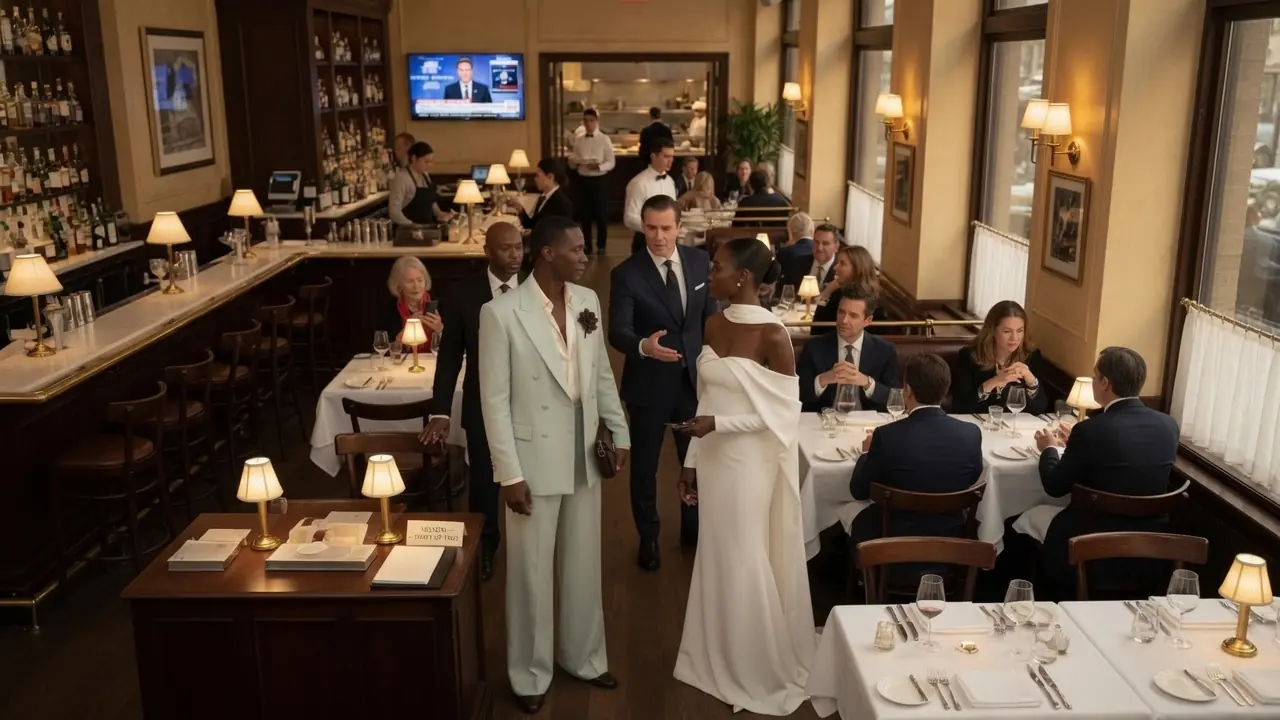
The man in the gray suit was named Carter Nelson. Six hours earlier, he had become the most talked-about person in the state. But right now, he just wanted dinner with his wife. The cab dropped them on a quiet Manhattan corner.
Carter stepped out first, then turned and offered his hand. Eleanor took it, laughing at something he’d said in the car. The cold air smelled like rain on warm pavement and roasted chestnuts from a cart down the block. You’re sure you don’t want to call somewhere fancier? She teased.
This is fancy enough, he said. And nobody knows us here. That’s the whole point. He loosened his tie as they walked.
For the first time in months, no cameras were pointing at his face. No reporters, no staff with clipboards, just the two of them and the soft hum of the city. They had earned this night. Carter had spent 18 months on the road shaking hands in diners and church basements.
Eleanor had spent those same months in courtrooms fighting cases most lawyers wouldn’t touch. They hadn’t sat across a dinner table alone in longer than either could remember. The restaurant was called Olivier Blue. 22 years on the same corner.
Gold light spilling through tall windows. A name people whispered when they wanted to impress someone. Carter had booked it weeks ago before any of tonight had happened. A small table for two.
Under the name Nelson, party of two, 8:00. Inside, the warmth wrapped around them. A piano played low in the corner. Crystal glasses caught the candlelight and threw little sparks across white tablecloths.
The air was thick with butter, fresh bread, and something rich simmering in the kitchen. And on the wall above the bar, a 75-inchch television glowed. It was tuned to the news. It had been all night.
Across the city, every screen carried the same story because tonight was election night, and the whole state was waiting to see how it ended. Diners at Olivier Blue kept glancing up between bites, watching the numbers roll in. Carter glanced up, too, just for a second, and a small smile crossed his face. Then he looked away.
At the bar, a man in a navy blazer squinted at Carter, then at the screen, then back again. Something tugged at his memory. He almost said something. Then he shook his head and went back to his drink.
Close, but not yet. Behind the host stand stood Bradley Hayes, the floor manager. Bradley ran the room like a man guarding a gate. He had a different face for everyone.
For the regulars, the ones in tailored coats and expensive watches, his smile was wide and warm. Mr. Caldwell, always a pleasure. Your usual table. He clapped backs.
He remembered birthdays. He poured charm like wine. The general manager, Gerald Marsh, drifted past and squeezed Bradley’s shoulder. You keep the room looking right, Brad.
That’s why I love you. Bradley grinned. That’s the job. Then Carter and Eleanor stepped up to the stand, and Bradley’s smile cooled by about 10 degrees. His eyes did a quick practiced sweep.
The suit was nice, but not flashy. No security, no entourage. No famous face he could place, just a Black couple dressed well, asking for a table. Beside him, the young hostess, Whitney Caldwell, glanced up from her screen and traded a look with Bradley.
He didn’t need to. He had already decided. Let me check on that for you, he said in a voice that meant the opposite. Might be a few minutes.
We’re slammed tonight. Eleanor glanced at the dining room. Half the tables sat empty. Their table, the one with the little reserved card that read Nelson, sat empty, too, right by the window.
The candle was already lit. She opened her mouth. Carter touched her arm gently. We can wait, he said.
He had no idea how long that wait would become. Neither did she, and neither, not yet, did Bradley Hayes. The first 10 minutes felt almost normal. Carter and Eleanor stood near the lounge where velvet chairs faced the bar.
A waiter offered them water. Carter thanked him by name, Daniel, and the young man smiled before hurrying off. The glasses sweated, leaving little rings on the marble ledge. Eleanor checked her watch. Ten minutes.
They’re busy, Carter said. But they weren’t. Not really. And both of them could see it. A white couple walked through the front door.
No reservation? Bradley asked. They shook their heads. He beamed. Anyway, I’ll find something for you. Right this way.
He seated them at a window table in under five minutes. The same kind of table that sat empty with a Nelson card on it just 20 feet away. Eleanor’s jaw tightened. Carter. I see it, he said quietly.
Give it another minute. Bradley came back. He still didn’t meet Carter’s eyes. Instead, he looked somewhere over his shoulder at a spot on the wall behind him.
Yeah, so the kitchen’s backed up, he said. Big party in the back. It’s going to be a little while longer. Our table is right there, Eleanor said.
She pointed at it. It has our name. That one’s being held, Bradley said. Private event. Sorry. It was the first lie.
There would be many more. Twenty minutes became 30. The candle on their reserved table burned down a full inch, and still no one sat there. Two more walk-in couples came and went, seated within minutes, handed warm bread and heavy leather menus.
Carter and Eleanor got nothing. Not a menu, not a basket of bread, just water and the slow drip of being ignored. Eleanor’s sparkling water went flat in her glass. She didn’t drink it.
She just watched the tiny bubbles rise and die. This is on purpose, she said low. I know it is, Carter said. So say something, please.
I will, just not yet. He glanced around the room at the phones, at the manager, at the empty chairs. Watch how he wants me to act. The second I raise my voice, I’m the angry one.
Then suddenly, it’s my fault, and his story holds up. Eleanor exhaled slowly. She knew he was right. She had argued that exact pattern in front of juries.
It still made her sick to live inside it. Then she did something Carter recognized at once. She slid out her phone, opened a voice memo, set it face up on the ledge, and pressed record. What are you doing? he murmured.
He’s loud, she said softly. And he keeps talking. So let him build our case for us. At the host stand, Whitney Caldwell had her own phone out, but she wasn’t recording the room.
She was recording them. She held it low, angled at the couple, her thumb moving fast across the screen. She was typing a caption. A second later, the staff group chat lit up across a dozen pockets in the building.
Whitney’s message read, Guess who thinks they can afford Olivier Blue. Then a little skull emoji. The replies came in a wave. Laughing faces. A crying laughing face.
Someone wrote Bold of them.. Someone else wrote, Escort them out already, lol. In the kitchen, a line cook chuckled at his phone. Down by the bar, a busser grinned and turned his screen to show the guy next to him.
It wasn’t one cruel man at a podium. It was a whole culture passed around like a private joke, and everyone seemed to be in on it except the two people standing right in the middle of the room. Almost everyone. A young server named Norahh Whitman saw the message and didn’t laugh. She looked up then across the floor at the couple.
The man was helping his wife into one of the velvet chairs, his hand careful and gentle at her elbow. They looked tired. They looked kind. They looked, she thought, like her own parents on their anniversary.
Norahh’s stomach turned. She took a step toward the lounge. Then Bradley’s voice cut sharply across the floor. Whitman, tables six and eight need clearing now.
She froze where she stood. Bradley signed her schedule every week. He decided who got the good shifts and who got sent home early with no tips. She looked at the couple one more time, then turned and walked the other way, her face hot with a shame she couldn’t shake.
At a table near the window, an older woman in a red scarf had watched the whole thing. She nudged the man across from her. Then, without anyone noticing, she lifted her phone to film. She kept it propped against the wine bottle, lens on the lounge, and let it run.
Forty minutes now, then 45. Bradley swung back around, and this time the patience was gone. The polite lies had bored him. Now he just wanted them gone.
Look, he said, finally looking at Carter, but with his lip curled. I’m going to be straight with you, okay? This might not really be your kind of place. The prices here, they’re, you know, pretty steep.
Eleanor’s voice turned to ice. Excuse me. I’m just saying. Bradley spread his hands like he was doing them a generous favor. There’s a nice little spot two blocks down.
More your speed, more your price point. You’d both be a lot more comfortable over there. The words landed like a slap. Price point. Your speed. Everyone within earshot heard it.
Two diners glanced over. One winced. Nobody said a word. Carter felt the heat climb up his chest. His hand resting on his knee curled into a fist, then opened again on purpose.
He breathed in through his nose. The smell of someone else’s steak drifted past him. Butter and char and rosemary, a meal he and his wife still hadn’t been allowed to order. He looked at Eleanor.
She gave him the smallest nod. Still recording, still steady. We’ll wait for our table, Carter said. Calm, even the one with our name on it.
Bradley’s smile twitched at the corner. He hated that calm. He had wanted a reaction, a raised voice, anything he could point to and blame. Carter gave him nothing.
And somehow that nothing made Bradley angrier than any shouting ever could. Suit yourself, Bradley snapped and stalked off. The clock kept moving. Fifty minutes, then a full hour.
The piano kept playing softly. Glasses kept clinking. Laughter floated over from the full tables. And in the lounge, two people sat inside a pocket of silence, treated like they were invisible, while the whole warm room glowed around them.
Eleanor leaned close to Carter. An hour? We have been standing and sitting here for an entire hour. I’m counting every minute, he said.
Then why are we still here? Her voice cracked just slightly. Not from weakness, from a fury she had held too long. We could go anywhere.
You, of all people, could have any table in this city tonight, of all nights. Carter turned to face her for just a moment. The public calm dropped away and she saw plainly what it was costing him to hold it. Because tomorrow it won’t be us, he said.
It’ll be somebody who can’t just walk out. Somebody who needs this job interview, this anniversary, this one nice night they saved for and gets treated like dirt and has to swallow it. He nodded toward Bradley. Look at him.
He does this all the time. It’s smooth. It’s practiced. So tonight, for once, he’s going to do it to exactly the wrong people. And every word of it is going to be on the record. Eleanor looked down at her phone, still quietly recording on the ledge.
Then she looked back up at her husband, and something fierce and certain settled into her eyes. Okay, she said. Then let him keep talking. At the 80-minute mark, Bradley reappeared.
He looked almost cheerful now, the way a man looks when he thinks he has finally won. Good news, he announced. Got a table opening up for you. He led them, not toward the window, not toward the empty spot with their name still on it, but toward the very back, past the swinging kitchen doors, to a small, wobbly two-top wedged in beside the bus station, where dirty plates stacked up and the door slapped the air every few seconds.
This work for you? he asked, already knowing that it didn’t. Eleanor stood up, her chair scraped loudly against the floor. We are not sitting there.
Our reservation was for a real table 90 minutes ago. It’s that or it’s the door, Bradley said with a shrug. The contempt was naked now, stripped of any pretense. And honestly, if I were you, I’d take the door.
Eleanor turned to Carter, ready to walk out, ready to be done with this place and this man forever. But Carter didn’t move. He looked at the table by the kitchen. He looked for a long moment at Bradley and then very quietly he said the two words that would change the entire night. We’ll stay.
Carter sat down at the wobbly little table by the kitchen. He pulled out Eleanor’s chair first like he always did, like the bus station, the slamming door and the smell of dirty dishwater meant nothing at all. Eleanor lowered herself slowly into the seat, her back straight, her eyes locked on Bradley the entire time. The swinging door hit her chair with a soft thud every time a server pushed through.
Each time a wave of heat and clatter rolled out of the kitchen, the hiss of a hot pan, a cook barking an order. It was the worst seat in the building, and Bradley had handed it to them on purpose, like a final little gift of spite. He should have walked away then. He’d won in his own small mind.
But men like Bradley never know when to stop. He lingered at the edge of the table. A new idea had crossed his face. Something meaner. And he liked it.
So here’s the thing, he said loud enough for the nearest tables to hear. Before my kitchen wastes any food on this, I’m going to need to see that you can actually cover the check. Card up front. He let the words hang there, then folded his arms, savoring it.
A waiter squeezed past with a tray of seared scallops for the window table, the smell of garlic and brown butter trailing behind him. Another meal Carter and Eleanor were watching someone else enjoy. Eleanor blinked. You don’t ask anyone else here to do that. I’m asking you.
Why us? Bradley smiled slow and ugly. Use your imagination. The words sat there in the air, filthy and clear.
A man two tables over sat down his fork. The woman in the red scarf, still filming, leaned her phone a few inches closer. Carter’s voice stayed level, but something underneath it had hardened. We came for dinner.
We have a reservation. You’ve made us wait 90 minutes. Insulted my wife. And now you want a deposit like we’re going to run.
People like you, Bradley said, do a lot of things. That was the moment the whole room seemed to tilt. Eleanor stood halfway out of her chair, her hand flat on the table. Her voice came out low and razor sharp.
The courtroom voice. The one that had made grown men sweat under oath. Be very careful, she said. Every word you have said tonight is being remembered, and several of them are actionable. Bradley laughed.
He actually laughed. Actionable. He said it like it was the funniest thing he’d heard all week. Lady, let me tell you something. You think you’re the first to come in here making threats?
You think anybody’s going to believe you over me? He leaned down close, his voice dropping to a hiss only their table could hear. This is my room. I decide who eats and who stands.
I’ve been doing it 16 years, and I know exactly what kind of people belong at these tables. You’re nothing here. You’re less than nothing, and you’re embarrassing yourselves in front of everyone. The smell of his cologne mixed with the kitchen grease.
Eleanor didn’t move. She didn’t blink. But under the table, Carter saw her hand trembling. Not with fear, with rage.
He reached over and covered her hand with his a small thing. Steady. It said, wait. It said, almost. She let out a slow breath and gave the smallest nod.
Then Bradley straightened up and did something that turned the whole room cold. He raised a hand and snapped his fingers at the security guard near the door. Hey, Mike, can you come keep an eye on this table just in case we have a problem with the check? Heads turned all across the dining room.
Now everyone was watching. A few diners lifted their phones, but sickeningly they pointed them at Carter and Eleanor, not at Bradley. The Black couple by the kitchen, accused, surrounded, made into a spectacle in front of a hundred strangers. The guard, a broad man in an ill-fitting blazer, ambled over and stood at the edge of their table.
He looked uncomfortable. He rested one hand on the back of Carter’s chair, hovering, a silent threat dressed up as caution. Bradley wasn’t finished. He fed on the attention now, playing to the room like a man who’d done it a hundred times.
Folks, sorry for the disturbance, he announced, turning to the nearby tables with a smarmy little grin. We’ve got a situation up here. These two won’t leave, won’t pay. You know how it is.
A couple of diners chuckled nervously. Most just stared. The woman in the red scarf gripped her phone tighter, her knuckles white, and kept recording every word. You hear that?
Bradley said, swinging back to Carter. Even my guests want you gone. So, let’s make this easy. You stand up, you walk out that door, and I won’t have Mike here call the police.
That’s me being generous. Eleanor’s eyes flashed. Call them, please. I would love for there to be an official record of tonight.
Something in the way she said it made Bradley hesitate just for a half second. Then he covered it with another sneer. Bluffing, he muttered. Typical. Across the room, Norahh Whitman stopped clearing table eight.
She stood frozen with a stack of dirty plates in her hands, watching her manager humiliate two people whose only crime was wanting to eat. Her eyes stung. She thought of her parents again. She thought about saying something.
And once again, she said nothing because she was 23 and broke and terrified of Bradley Hayes. But she did do one thing. She set the plates down. She pulled out her phone.
And from behind the service station, hidden from Bradley’s view, she started to record. That made three cameras now: the diner in the red scarf, two strangers with their phones up, and one frightened young server who had finally found the one small act of courage she could manage. Three cameras, all rolling, all pointed at a man who had no idea he was being filmed committing the most expensive mistake of his life. Bradley didn’t notice any of them.
He never did. That was always the thing about men like him. They were so sure no one was watching that they performed their cruelty in the open like it was a right. Carter looked up at the guard, then at Bradley.
Then slowly he reached into the inside pocket of his jacket. Bradley tensed. For one ugly second, you could see what he was hoping for. A wallet thrown down in anger, a raised voice, a shove, anything he could call a disturbance, anything that would let him say, See, I told you these people.
But Carter didn’t pull out a wallet. He pulled out his phone. He set it on the table, screen up, and tapped a single contact near the top of his favorites. He lifted it to his ear, calm as a man ordering coffee.
Lawrence, he said. It’s Carter. Carter Nelson. A pause. On the other end, a voice surprised and warm, then quickly confused. Yeah, I’m good, Carter said. Listen, I’m sitting in one of your restaurants right now, Olivier Blue, the Manhattan location. Another pause.
No, The food’s fine. I haven’t been allowed to order any. Bradley’s smile flickered, just slightly. The name Lawrence meant nothing to him yet.
But the easy way this man said one of your restaurants, like he had the right, like he had a direct line to someone who mattered. That landed somewhere in Bradley’s gut. The room had gone quieter now. People were starting to sense it, too.
That shift in the air when the person you’ve been laughing at turns out to be someone else entirely. I need you to do me a favor, Carter said into the phone. Turn on your TV, NBC, right now, then call me back in five minutes, because we’re going to have a much longer conversation about how this place treats people. I’ll wait. He lowered the phone, pressed it to his chest, and looked up.
For the first time all night, Carter Nelson smiled. It wasn’t a cruel smile. It wasn’t even angry. It was almost gentle.
the smile of a man who had been patient for 90 long minutes and was about to stop being patient. You should turn around, Carter said softly to Bradley. Look at the television, the big one right above your bar. Bradley frowned. What are you talking about? Just look.
And maybe it was the calm in Carter’s voice. Maybe it was the way the guard had quietly taken his hand off the chair. Maybe it was the cold little feeling crawling up the back of his neck, the first hint that something had gone very, very wrong. But Bradley Hayes turned around, and he looked up at the screen.
The 75-inch screen above the bar had been glowing all night. Nobody up front had really watched it. Now Bradley Hayes stared straight at it, and the bottom of his stomach fell out. The NBC anchor sat at a bright blue desk and behind her shoulder hung two enormous photographs.
A man and a woman smiling, standing at a podium under a banner of red, white, and blue balloons. The man was wearing a gray suit. Our top story tonight, the anchor said, her voice carrying across the suddenly silent dining room. History made in this state.
Governor-elect Carter Nelson and his wife, civil rights attorney Eleanor Nelson, are expected to make their first public appearance this evening following a stunning election victory just hours ago. The restaurant went dead quiet. The piano stopped. Even the kitchen seemed to hush.
A hundred heads turned slowly from the giant photo on the wall to the man sitting at the wobbly little table by the bus station. The same face, the same gray suit. The governor-elect of the entire state, parked next to a stack of dirty plates, told for 90 minutes that he didn’t belong. Bradley’s mouth opened.
Nothing came out. The color drained from his face so fast it looked like a trick of the light. He turned from the screen to Carter, then back to the screen, then back to Carter, his brain refusing to connect two things it could no longer keep apart.
That’s—that’s not, he stammered. You can’t be Carter Nelson, Carter said quietly and stood up from the little table. He buttoned his jacket unhurried. Governor-elect as of about six hours ago.
He tilted his head toward the screen. And that’s my wife next to me, Elellanar. The civil rights attorney you’ve been threatening for the last 90 minutes. The guard named Mike took two quick steps back from the chair like it had caught fire.
He suddenly wanted to be anywhere but at that table. A gasp rolled through the dining room. Then a low murmur growing. Phones came up again all over the restaurant, but they had all swung in one direction now away from Carter toward Bradley.
The hunter had become the thing everyone was filming. Eleanor rose beside her husband. She reached into her bag, calm and deliberate, and pulled out a small card. She held it up so Bradley could read it, then set it gently on the table in front of him.
Eleanor Nelson, she said, Senior partner, Civil Rights Division. Her voice was steady, almost kind, which somehow made it worse. Let me explain exactly what just happened here since you’re going to be hearing these words a lot in the coming weeks. She didn’t raise her voice.
She didn’t need to. The whole room had gone so quiet you could hear the ice settling in the bucket beside the window table. Bradley stared at the card. His hands had started to shake.
You refused service based on race. That’s a violation of federal public accommodations law. You did it in front of a full dining room of witnesses. You did it on at least three phone cameras that I counted.
She nodded toward the woman in the red scarf, toward the service station where Norahh stood frozen. And you did it to a civil rights attorney and the incoming governor of this state on the single most documented night of our lives. She let that sit. You didn’t just insult two people, Eleanor said.
You handed us a case and you wrapped it up on video. Bradley’s eyes darted around the room, searching for one friendly face, one person who’d back him up the way Gerald Marsh always had. He found none. The regulars who had loved his charm an hour ago now stared at their plates.
The diners who had chuckled at his cruelty now held up their phones to capture his ruin. He looked suddenly very small. Somewhere near the bar, a single person started to clap, then another. It wasn’t loud, and it wasn’t cruel.
It was the sound of a room realizing all at once which side of this it wanted to be on. Bradley flinched at every soft slap of it, like each clap was landing on his skin. I didn’t know who you were, he whispered. Carter’s smile faded.
When he spoke, his voice was low and every person in that silent room heard it. That, Carter said, is the entire problem. He stepped closer. Not a threat, just a man finally allowed to be seen.
You think this is bad because of who I turned out to be, but I was the same man two hours ago when you told me animals like me belong on a plate. I was the same man when you said I couldn’t afford to eat here. The only thing that’s changed is the face on your television. He paused. You should have treated me right when you thought I was nobody.
Because that’s who you do this to, isn’t it? The people with no TV waiting to save them. The phone in Carter’s hand buzzed. He glanced down.
The screen read, CEO. He let it ring once, twice. Then he looked up at Bradley Hayes and for the first time the patience was completely gone from his eyes. You told us we’d be more comfortable somewhere else, Carter said.
Funny thing: in about a day, so will you. He lifted the phone to his ear. Lawrence, Carter said into the phone. Yeah, you saw it. He listened.
Across the line, the CEO of Holloway Hospitality was talking fast, loud enough that the people nearest the table could hear the panic in it. He’s standing right in front of me, Carter said. Manager Bradley Hayes. He held the CEO’s words for a moment, then lowered the phone.
He’d like to speak with you, Carter held it out. Bradley took it with a trembling hand and pressed it to his ear. Whatever he heard made him go even paler. The man who a minute ago had owned this room now stood hunched over the phone, nodding, swallowing, saying, Yes, sir, in a voice that kept cracking.
He set the phone down on the table like it had burned him. Mr. Holloway is sending a regional director, Bradley said to no one in particular. His voice had gone flat and small. He’ll be here within the hour.
But Carter and Eleanor weren’t the only ones who’d been on a phone. The video the woman in the red scarf had taken was already uploading. So was Norahh’s. By the time the regional director’s car pulled up outside with its hazard lights blinking against the rain-slicked street, the first clip had crossed 200,000 views.
The director, a tired-looking woman named Patricia Boone, came through the door already apologizing. Her heels clicked fast on the tile. She looked at Carter, at Eleanor, then at the empty reserved table by the window, candles still burning, name card still sitting there. Governor-elect Nelson, she said.
Mrs. Nelson, I am so deeply sorry. Don’t apologize to us first, Eleanor said quietly. We’re fine. We’re going to be fine. Apologize to the people he’s done this to who couldn’t pick up the phone and call your CEO.
Patricia turned to Bradley, her face hardened. Bradley Hayes, you’re relieved of duty, effective now. I need your keys and your manager’s card. Bradley’s mouth opened.
Patricia, come on. You know me. This is a misunderstanding. You’ve got to understand the position I was in.
I watched the video in the car, Patricia said flatly. All of it. Keys now. His hands shook as he dug them out. The room watched in silence as he set the keys on the table beside Eleanor’s card.
The same hands that had snapped at a guard and waved white couples past now fumbled with a key ring like a scolded child. Eleanor leaned forward. One more thing, the general manager, Gerald Marsh. Patricia frowned. What about him?
He praised this man for keeping the room looking right. He’s signed off on this for years. Eleanor’s voice was even, but there was steel under it. If you fire Bradley and stop there, you’re cutting off one finger and calling the hand clean.
Marsh needs to be suspended, too, pending a real investigation. Tonight. Patricia held her gaze for a long second. Then she nodded slowly and made a note on her phone. Tonight, she agreed.
Then Carter did something no one expected. He turned to the staff gathered near the kitchen, the line cooks, the bussers, the servers watching wide-eyed from the edges. He found the young woman by the service station. You, he said gently.
You were recording from back there. Norahh went white, sure she was in trouble. Yes, sir. I’m sorry. I couldn’t watch it and do nothing. Don’t be sorry, Carter said.
You did the right thing when it was hard. Most people in this room didn’t. He looked at Patricia. Whatever happens here, she keeps her job.
The kitchen staff, who were just following orders, keep their jobs. The rot starts at the top. Don’t let it roll downhill. Norahh’s eyes filled.
She nodded, unable to speak. Two guards, the same ones who had hovered at Carter’s chair, now flanked Bradley and walked him toward the doors, past the window table, past the regulars who wouldn’t look at him, past the host stand where 90 minutes earlier he had decided two human beings weren’t worth a seat. The cold night air rushed in as the doors opened.
Then they closed behind him. And finally, at last, a server pulled out the chairs at the window table, the good one, the one with their name on it, and lit a fresh candle. Your table, he said softly. Whenever you’re ready.
Eleanor let out a long breath. She felt like she’d been holding for 90 minutes. Then, for the first time all night. She smiled. By sunrise, the whole country had seen it.
The clip the woman in the red scarf posted had a simple caption. Restaurant made the governor-elect wait 90 minutes because he was Black. Watch what happens. It opened on Bradley snapping his fingers at the guard.
It ended on the NBC screen and the color draining from his face. It did not stay small. By noon the next day, it had 52 million views. By evening, Norahh’s angle, the one shot from behind the service station, had been stitched onto the end, showing Bradley’s exact words up close.
The hashtag for the restaurant trended in three countries. Morning shows played it on a loop. The phrase animals like you became something people typed with shaking hands. The internet did what the internet does.
It found Bradley Hayes. It found his 16 years of five-star reviews from a very specific kind of customer. And it found Whitney Caldwell’s group chat message, the one with the skull emoji, which a horrified coworker had screenshotted and leaked by breakfast. Reporters camped on the wet sidewalk outside the darkened restaurant, their camera lights glaring off the gold lettering on the window.
The smell of the place, the butter and the bread that had drawn people in for 22 years, was gone now, replaced by the flat smell of rain and a padlocked door. Bradley deleted his social media by Tuesday. It didn’t matter. The screenshots were already everywhere, and his own face, frozen mid sneer, had become the thumbnail on a dozen news segments.
Holloway Hospitality moved fast because it had no choice. Within 24 hours, the company released a statement. Bradley Hayes was terminated. Whitney Caldwell was terminated.
Gerald Marsh, the general manager who had praised keeping the room looking right, was removed pending investigation. The Manhattan location of Olivier Blue was closed indefinitely while the company conducted what it called a full review of conduct and culture. But a corporate statement is just words. What came next was not.
The state attorney general announced a formal inquiry. Standing at a podium, she made it plain. Restaurants are what the law calls public accommodations, and under Title II of the Civil Rights Act of 1964, it is illegal to deny anyone service based on the color of their skin. The footage, she said, was some of the clearest evidence of a violation her office had ever seen.
She referred the matter for federal review. She didn’t raise her voice either. She didn’t have to. The video did the shouting for her, playing on the screen behind the podium while reporters scribbled and the cameras rolled.
Then the investigation found the thing that turned a bad night into a scandal. When investigators pulled the restaurant’s records, they discovered Olivier Blue had received complaint after complaint over the years. Guests of color who’d been seated by the kitchen. Guests who’d been told the reservation system lost their booking.
guests who’d simply gotten up and left humiliated and written a careful, polite email. No one ever answered. Gerald Marsh had received those complaints, and Gerald Marsh had quietly deleted them one after another for years. It was never one bad apple.
It was a barrel that had been rotting in the dark, and management had kept the lid shut tight. That discovery changed everything because now there wasn’t just one couple with a story. There was a documented pattern and a list of real people who’d been turned away and never heard from again. This is where Eleanor Nelson went to work.
She didn’t file a lawsuit for herself and Carter. They didn’t need the money and she was about to be the first lady of the state. Instead, she did what she had done her whole career. She found the others.
Her firm tracked down the guests behind those buried complaints. A nurse who’d been refused a table on her own birthday. An elderly couple who had been asked to wait at the bar for two hours on their 50th anniversary. The young father who’d brought his daughter for her graduation dinner and been turned away at the door while white walk-ins strolled past.
Eleanor brought them together and she built a civil rights case, not around a governor, but around the people no camera had ever saved. The case did not drag on for years the way these things usually do. The video was too clear. The deleted complaints were too damning.
The company, desperate to stop the bleeding, settled. A court approved a $4.2 million settlement divided among the documented victims of Olivier Blue’s conduct. The nurse and the elderly couple and the young father and all the others who’d been made to feel like nothing. Bradley Hayes and Gerald Marsh were named in the findings.
It would follow them for the rest of their lives. But Eleanor wasn’t done, and neither was Carter. When Holloway Hospitality came to the table, the Nelsons made demands that went past money. A full public apology signed by the CEO, not buried in a press release, but read aloud.
Mandatory anti-discrimination training for every employee in every location the company owned. Independent third-party audits twice a year with the results made public. No more deleting complaints in the dark. And one more thing, Eleanor’s idea, a fund, $10 million seeded by the company and the settlement to support Black entrepreneurs and restaurateurs trying to build the kind of business that would never treat a person the way Bradley treated them.
They called it the Nelson Equity Fund. There was a strange justice in it. The contempt of one man, the kind that almost cost a couple their anniversary, would now pay to open doors instead of close them. Bradley Hayes had spent 16 years deciding who belonged, and the money from his ruin would go to people who’d been told their whole lives that they didn’t.
Lawrence Holloway stood at a press conference and read the apology aloud, word for word, his voice tight. Behind him, a banner showed the new policies. In the front row, the nurse and the elderly couple and the young father sat with their hands folded. finally officially seen.
Eleanor stood at the side of the room as the father lifted his daughter so she could see over the crowd. The girl who’d been turned away from her own graduation dinner now watched a CEO apologize to her family on live television. It was a small thing. It was everything.
Carter watched it from home on the same kind of television that had changed everything that night. He didn’t smile. He just nodded slowly like a man checking one item off a very long list. Then he looked down at a notepad on his desk where he had already started writing something new.
Four months later, Carter Nelson placed his hand on a worn family Bible and was sworn in as governor. It was a cold, bright January morning. Eleanor stood beside him in a deep-blue coat, holding the book steady, her breath fogging in the winter air. Behind them sat the nurse, the elderly couple, the young father and his daughter, guests of honor in the front row, the people no camera had ever come to save, now watching history with the best seats in the house.
In his first month in office, Carter signed his first piece of legislation. It was a law strengthening protections against discrimination in public accommodations across the state with real penalties, real reporting, and real audits. The press called it landmark. Carter called it overdue.
When he signed it, he didn’t use a fancy pen from a drawer. He used a cheap one. And afterward, he handed it to the young father’s daughter, the girl who’d been turned away from her own graduation dinner. On his desk in the governor’s office, framed and small, sat a slip of paper.
It read Nelson, party of two, 8:00, the reservation that started everything. He kept it where he could see it every single day. Eleanor framed something too on her own desk, the little business card she’d set down in front of Bradley that night. A reminder, she said that the law only matters when someone is brave enough to actually use it.
Because here’s the thing the story can’t hide from. Carter Nelson got justice because a TV happened to be on. because cameras happened to be rolling, because he happened to have a CEO’s number in his phone. Most people don’t.
Most people who get told to wait, who get seated by the kitchen, who get asked to pay up front while everyone else gets bread and a smile, they don’t have a news anchor about to say their name. No camera saves them. They just go home quietly carrying it. That’s the real lesson here.
Contempt for another person because of their skin isn’t just ugly, isn’t just rude. It can end a career. It can shutter a business that stood for 22 years. It can rewrite the law of an entire state.
One manager, one cruel 90 minutes set all of that in motion. And not one bit of it had to happen. He could have just shown them to their table. Dignity was never supposed to be something you earn by being important.
The nurse deserved her birthday dinner. The father deserved to celebrate his daughter. They were always worth a seat long before any lawyer or any governor showed up to prove it.