“Did you just put those filthy hands on my Steinway?” Harrison Cole snarled. “I was cleaning around it, sir.” Cole shoved Julian’s hand off the lid. “Cleaning?” Then he stopped, looked at Julian, and looked at the empty bench. Something cruel lit behind his eyes. “You know what? My pianist isn’t here tonight, and you’ve got nothing better to do. Sit down.” He grabbed Julian by the collar, dragged him to the bench, and shoved him down so hard the keys rang out. “Play. Let’s hear what music from people like you sounds like.” Forty-three guests in tailored suits watched. Not one spoke. Julian’s hands were shaking. He had not touched a piano since his mother died. He closed his eyes, pressed the first chord, and every laugh in that room died with it.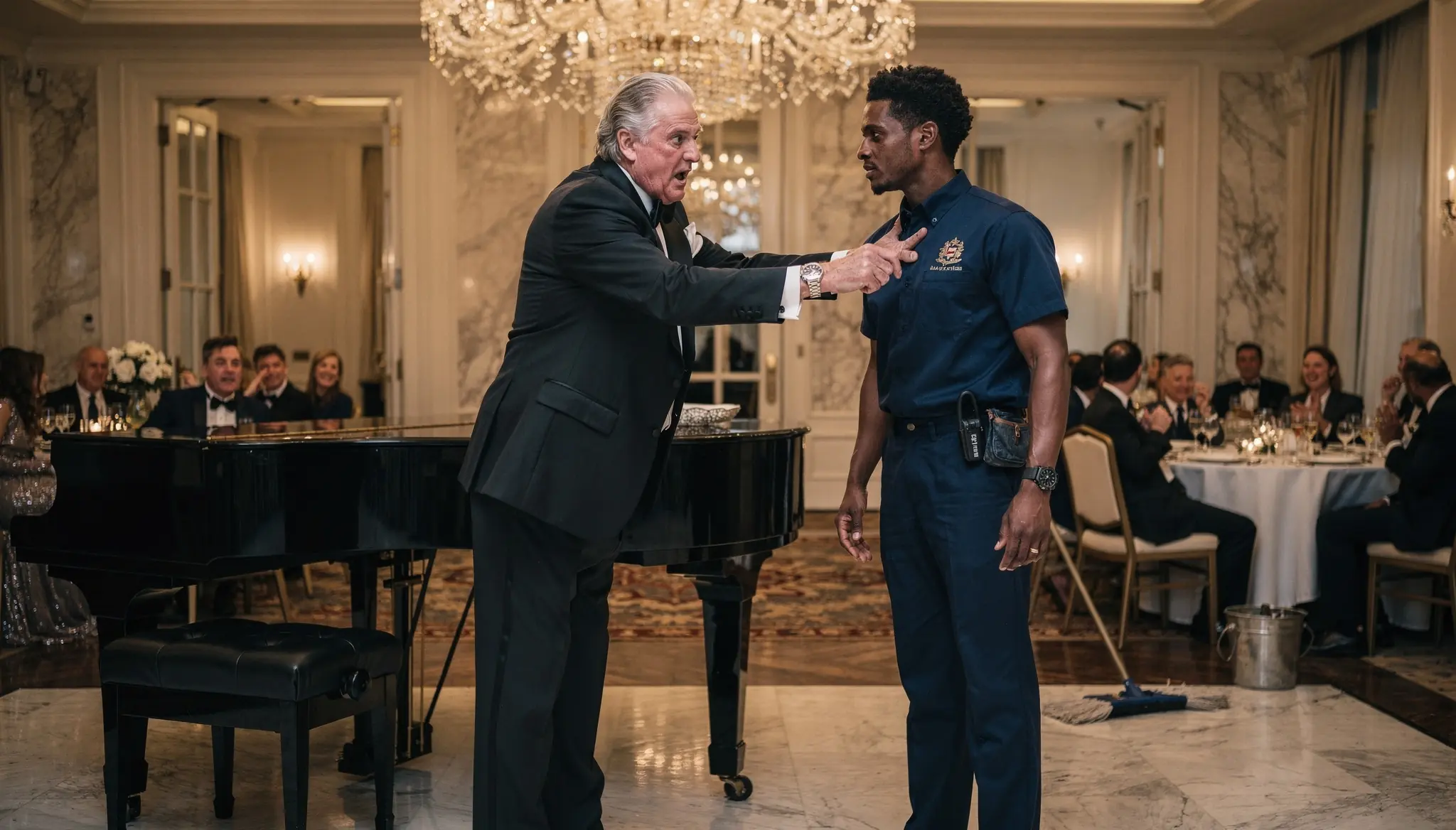
Three hours before Harrison Cole would grab a janitor by the collar and throw him onto a piano bench, the grand ballroom of the Langford Hotel was being set up for the kind of party that cost more than most people’s houses. Twelve thousand Austrian crystals hung from the chandelier. The tablecloths were Italian.
The champagne was French. Two-hundred-dollar bottles were poured by waiters trained to keep their eyes down and their hands steady. The forty-three confirmed guests included investors, attorneys, and wives wearing diamonds that could have funded a school. It was the kind of room where net worth decided who spoke and who listened. Harrison Cole was always the one who spoke. He was the sixty-two-year-old CEO of Cole Capital Group, with silver hair slicked back with the confidence of a man who’d never been told no by anyone he considered worth listening to. Tonight, he was celebrating the full acquisition of a $200 million tower six blocks south.
His name would be carved into the lobby stone before the month was out. He stood at the center of the ballroom, his Patek Philippe catching the chandelier light, and raised a glass. “To owning everything worth owning,” he said. The room laughed. The room always laughed. The pianist Cole had hired, a conservatory student in a rented tuxedo, sat at the Steinway Model D on the small stage, playing Debussy with careful, practiced hands. He was good. He was not great, but he was good enough for background music at a party where no one was really listening.
Cole listened just long enough to be dangerous. “What is that? Funeral music?” He did not lower his voice. He never did. “I am paying this kid three grand, and he is putting my guests to sleep.” The pianist’s hands faltered on the keys. “Hey, Liberace.”
Cole snapped his fingers. “Play something people actually want to hear. Or do they not teach that at whatever community college you crawled out of?” The kid’s face went red. His fingers hovered above the keys, trembling. He closed his sheet music, stood, and walked off the stage without a word. He was in the service elevator before anyone noticed he’d gone. Cole watched him leave and shrugged.
“See? No spine. That is the problem with artists. You push them once, and they crumble.” Nobody disagreed. Nobody ever did. The Steinway sat empty now, lid open, keys exposed under the spotlight. Nine feet of polished ebony and tensioned steel, waiting for hands that deserved it, or at least hands that Cole decided deserved it.
Two floors below, in the basement supply closet that smelled like industrial bleach and floor wax, Julian Perry clocked in for the night shift. He was thirty-four, six foot one, lean from years of work that paid enough to survive, never enough to live.
He pulled on his navy blue uniform. It carried the hotel’s gold crest over the left chest. He grabbed his mop bucket, the one with the bad caster that pulled left. Always left. He had submitted three maintenance requests and received zero responses. Gloria, the night shift manager, handed him his assignment sheet. “Ballroom level tonight,” she said.
“Cole’s party. Stay out of sight. Stay out of his way.” “I always do.” “I mean it, Julian. He already sent the pianist home crying. He called the valet a slur on his way in. He’s in one of his moods.” Julian took the sheet. “I’m just mopping floors, Gloria.” She looked at him the way she always did when the ballroom was on his route, like she knew something about him that he’d spent seventeen years trying to forget. “Just mopping floors,” she repeated.
His mother had framed the first one, hung it next to the kitchen window in their Harlem apartment where the morning light hit it just right. Eleanor Perry taught piano at the Mount Olive Baptist Church on 133rd Street. She wasn’t famous, never recorded an album, never played Carnegie Hall. But every Sunday, her hands turned that old upright Yamaha into something that made the whole congregation forget they were tired, forget they were broke, forget the world outside those doors had already decided what they were worth. Julian learned to play by watching her hands, not from sheet music, not from theory books, from the way her wrists floated above the keys, from the way she closed her eyes at the bridge of every hymn, like she was talking to someone only she could hear.
He would sit on the bench beside her, five years old, feet dangling, and she’d let him press single notes while she played around them, building his random plinks into something beautiful. “You hear that?” she would say. “Even one note matters, baby. Even one.” By seven, he was playing full pieces. By ten, he was better than every adult at Mount Olive. By twelve, a Juilliard professor named Arthur Winslow heard him play at a citywide recital and offered him a spot in the Pre-College program, full scholarship. Eleanor cried in the parking lot for twenty minutes.
Julian spent the next five years learning what his hands were actually capable of. Chopin, Rachmaninoff, Liszt. Professors who’d taught for decades said his phrasing was unusual, not technically perfect, but emotionally devastating. He played the way his mother played from the gut, from the grief, from whatever lives in the space between the notes that most pianists are too careful to touch. He was seventeen when the phone call came. Eleanor had been hiding the pain for months. By the time the doctors found it, the cancer had already spread from her lungs to her spine. No insurance.
The church took a collection and raised $3,000. The hospital bill was $97,000. Julian dropped out of Juilliard on a Tuesday. Sold his mother’s upright Yamaha on a Wednesday. The same piano she had taught him on, the same keys his five-year-old fingers had pressed while she built beauty around his noise. He got $800 for it. The buyer didn’t even ask why he was selling. Eleanor died on a Sunday.
During the service at Mount Olive, someone else played the piano. Julian sat in the front pew and didn’t look at it once. He was seventeen. That was seventeen years ago. In the years that followed, Julian worked jobs that used his hands for everything except what they were made for. Dishwasher, security guard, warehouse loader, overnight stock at a grocery store where the manager used a demeaning nickname and pretended it was friendly. He landed at the Langford Hotel six years ago, the night shift, cleaning floors and bathrooms and banquet rooms after rich people finished using them.
He never told anyone he played piano. Not the co-workers who shared cigarettes with him on the loading dock. Not the guests who walked past him like he was furniture. Only Gloria knew, and only because she’d found him once three years ago, standing alone in the empty ballroom at four in the morning, his hand resting on the closed lid of the Steinway. Not playing, just touching, like visiting a grave. “You play?” she had asked. “I used to.” “Why did you stop?” Julian had pulled his hand away from the piano like it burned him.
“Because some things, once you lose them, you don’t get to have them back.” Gloria never asked again, but she watched him every time his route took him past the ballroom. Watched his fingers grip the mop handle with the precision of someone who’d trained them for something else entirely.
Tonight, as the service elevator carried him up to the ballroom level, Julian could already hear the music. Except there was no music, the pianist was gone, just laughter and the clink of expensive glasses, and the voice of a man who believed the world belonged to him. Julian pushed his bucket into the corridor.
The bad caster squeaked left. He corrected right.
The ballroom was louder now. Julian could hear it through the service corridor walls. The rising pitch of a room full of people who had been drinking for three hours. Laughter that came too fast. Voices that competed to be heard over other voices. The kind of noise that money makes when it stops pretending to be polite.
He mopped the corridor outside the ballroom in careful, quiet strokes, left to right. Wring, repeat. The doors were still propped open, that same six-inch gap, and through it, the chandelier light spilled onto the corridor floor like something that had escaped. Julian kept his head down. Gloria’s words sat in his chest like a stone. Stay out of sight. Stay out of his way. He could see the Steinway through the gap, still empty, still lit.
The bench pushed back at that same careless angle. Nobody had closed the lid or moved it off stage. It just sat there gleaming like an open wound in a room full of people too drunk to notice they were bleeding. Julian mopped closer to the door, not on purpose. The bad caster pulled left and left happened to be toward the ballroom. That was all.
Inside, Harrison Cole was holding court. He stood at the center of a semicircle of guests, champagne in one hand, the other gesturing in broad strokes that took up more space than any one person needed.
His voice carried the way voices carry when they have never once been questioned. “The problem with this city,” Cole was saying, “is that everyone thinks they deserve something. The doorman thinks he deserves a tip for opening a door. The cab driver thinks he deserves a conversation. Last week, my housekeeper asked for a raise.” He paused for effect. “I told her, ‘You fold towels. The machine does the hard part.’” The laughter was not all comfortable, but all of it was loud enough.
A woman in a black dress, Victoria Ashworth, wife of a hedge fund manager, shifted in her seat but said nothing. A man by the bar stirred his drink and looked at the floor. These were people who had learned long ago that the price of being in Harrison Cole’s orbit was watching Harrison Cole be Harrison Cole. Cole drained his glass and snapped his fingers at a passing waiter, a young Black man of perhaps twenty-two carrying a tray of champagne flutes. “Another,” Cole said. “And make sure it is actually cold this time. The last one was warm. You would think people like you would learn the basics.”
The waiter nodded and walked away without expression. He had been trained not to show one. “See that?” Cole said to no one in particular, watching the waiter leave. “That is good help. He does not talk back or think; he simply does what he is told. That is how it should be.” Cole turned back to his guests. “You know what I love about this hotel? The staff knows their place. They do not talk. They do not make eye contact. They just”—he made a sweeping motion with his hand—“disappear, like furniture that moves.” That’s when he noticed Julian through the gap in the doors. A man in a navy blue uniform mopping the corridor floor, his back half turned to the ballroom. A black man with a mop six inches from a room full of people wearing more on their wrists than he’d earn in a year. Cole’s eyes locked on him, then drifted to the empty Steinway, then back to Julian. Something shifted in his face. Not anger, not curiosity. Something worse. Amusement.
“Hey,” Cole called out. “You, janitor.” Julian’s mop stopped mid-stroke. “Yes, you. The one dripping dirty water on my floor. Come in here.” Julian didn’t move. He knew that voice. Not Cole’s specifically, but the type. The voice of a man who’d already decided what you were before you opened your mouth.
“I said, come in here. Do not make me ask you twice.” Julian leaned his mop against the wall, straightened his uniform, took a breath, walked through the gap in the doors and into the ballroom, where forty-three pairs of eyes turned to look at him the way you look at something that wandered in from outside. The chandelier light was blinding after the dim corridor. Julian blinked. The marble floor was so polished he could see his own reflection. A dark figure in a blue uniform standing at the edge of a world made of crystal and champagne.
And people who’d never mopped anything in their lives. Cole walked toward him, slow, smiling. The way a cat approaches something it’s already decided is prey. “What is your name?” “Julian, sir.” “Julian.” Cole tasted the name like it amused him. “Tell me something, Julian. You see that piano over there?” He pointed at the Steinway without looking at it. “Do you know what that is?” “Yes, sir. I do.” “Do you?” Cole tilted his head, studied Julian the way a man studies a stain on his shoe.
“And how would a janitor know anything about a Steinway?” Julian’s heart kicked once against his ribs. He said nothing. Cole’s smile widened, and in that smile, Julian could see exactly what was coming. “I asked you a question, Julian.” Cole took another step forward, close enough now that Julian could smell the champagne on his breath, the cologne that probably cost more than his rent. “How does a janitor who mops floors for a living know anything about a Steinway?” Julian kept his eyes level. Not defiant, just steady.
The way you stay steady when you know that anything you say will be used against you. “I used to play.” The room rippled, not with shock, with amusement. A few guests exchanged glances. One man near the bar covered his mouth to hide a grin. Victoria Ashworth set down her champagne glass and stared at the tablecloth. Cole blinked. Then he laughed. Not a chuckle.
A deep, head-thrown-back laugh that bounced off the chandelier crystals and came back twice as loud. “You used to play.” He repeated it like a punchline. “Did you hear that, folks? The janitor used to play.” He turned to his guests, arms spread wide. “Where? In some church basement, banging on a broken keyboard while the preacher passed the hat?” More laughter. Louder now. The kind that feeds on itself. “Sir, I played at Juilliard.” The laughter stopped just for a second. A hiccup of silence that lasted maybe two heartbeats before Cole filled it.
Juilliard. Cole’s smile didn’t waver, but something behind his eyes shifted. Then he shook his head. “Right. And I played for the Yankees.” He turned to the crowd. “Juilliard. Can you believe this guy? Next, he will tell us he taught Beethoven.” The laughter came back.
Relieved now. Permission to keep laughing. Cole stepped closer, so close that Julian could see the vein pulsing in his temple and the tiny burst capillaries around his nose from years of expensive drinking. “Let me tell you something, Julian.” Cole said his name like it was something stuck to the bottom of his shoe. “I have known people like you my entire life. You clean up after people like me. That is what you do, and deep down, you know it.”
He jabbed a finger into Julian’s chest. “So do not come in here with your mop and your dirty uniform and tell me you played at Juilliard. It is an insult to the people in this room who actually earned their place.” Julian felt the finger against his sternum, felt the weight of forty-three stares pressing down on him like gravity. His jaw tightened. His hands, the ones that had played Chopin ballades, that had made a Juilliard professor cry, that had built beauty around his mother’s one note lessons. Those hands hung at his sides, trembling.
Not from fear, from something older than fear. “I do not want any trouble, sir,” Julian said quietly. “I will go back to my—”
“No.” Cole cut him off. The amusement in his voice had hardened into something colder. “You do not get to mention Juilliard and then walk away. You want to impress me? Sit down at that piano and play.”
“I would rather not, sir.”
“I do not care what you would rather.” Cole grabbed Julian by the back of his collar, the same way you’d grab a dog by the scruff and marched him toward the Steinway. Julian’s shoes squeaked on the marble. He didn’t resist. Not because he couldn’t, but because seventeen years of being grabbed and shoved and overlooked had taught him something about resistance. It only works when someone is watching who cares. Nobody in this room cared. Cole threw him onto the bench.
The keys rang out, a dissonant clash of notes that echoed through the ballroom like a cry. “There.” Cole straightened his jacket and stepped back. “Play, janitor. Entertain us. Show us what the streets taught you.” He pointed at Julian like an exhibit. “And when you embarrass yourself, which you will, I want you to remember this moment. I want you to remember what it feels like to pretend you are something you are not in front of people who actually are.” Julian sat on the bench.
His back was straight. His hands rested on his thighs. The keys were right there, 88 of them, black and white, gleaming under the spotlight. He hadn’t touched a piano in seventeen years. The last time his fingers had pressed these keys, not these exact keys, but keys like them, his mother was alive. She was sitting beside him on a different bench in a practice room at Juilliard, and she was smiling. The cancer hadn’t found her yet. The hospital bills hadn’t devoured everything.
The funeral hadn’t happened. The piano hadn’t been sold. That was a different Julian. He had been a Julian who believed that talent meant something, that hard work opened doors, that the world was fair. This Julian knew better. He looked at Cole. The man was already grinning, already turning to his guests with a look that said, “See, I told you.” Julian looked at the keys. He placed his hands on them.
And for the first time in seventeen years, something inside him that had been clenched shut, locked tight, sealed with grief and silence, and floors mopped at midnight began very slowly to open.
The ballroom held its breath. Not out of respect, out of anticipation. It was the kind you feel at a car crash. That horrible magnetic pull to watch something fall apart. Forty-three people leaned forward in their seats, drinks frozen halfway to their lips, waiting for the janitor to fail. Harrison Cole stood five feet from the piano, arms crossed, smile locked in place. He’d already won.
This was just the victory lap. Julian’s hands rested on the keys. His fingers, long, rough, scarred at the knuckles from years of industrial chemicals, lay across the ivory like they didn’t belong there. And maybe they didn’t. Maybe seventeen years of bleach and floor wax had erased whatever muscle memory Juilliard had built. Maybe Cole was right. Maybe a janitor was just a janitor.
Julian pressed a key, one note, middle C.
It rang out clean and true into the silence, and the sound hit Julian somewhere behind his sternum like a fist. He pressed another, then another. Slow, deliberate, not a melody yet, just notes, individual, separated, careful, like a man testing ice before he walks across a frozen lake. Cole snorted. “See? He is hunting and pecking like a secretary.” A ripple of laughter. Julian didn’t hear it. Something was happening in his hands.
Something involuntary. The notes were getting closer together. The spaces between them were shrinking. His fingers were finding paths across the keys that his brain hadn’t consciously chosen. Paths worn into his tendons by ten thousand hours of practice in a room at Juilliard, where the radiator clanked, and the light came through the window at three in the afternoon like liquid gold. The notes became a phrase. The phrase became a melody. And the melody became Chopin’s Nocturne in E-flat major, Op.
9, No. 2. The laughter died. It didn’t fade. It didn’t trail off. It died. Sudden and complete. Like someone had pulled a plug.
Julian’s left hand found the bass line. His right hand floated above the keys, drawing out the melody with a legato so smooth it sounded like a human voice. The nocturne poured out of the Steinway like water from a broken dam. Not forced, not performed, but released. Seventeen years of silence breaking open. Cole’s arms uncrossed. His smile didn’t disappear. It froze, stuck on his face like something that had been glued there and couldn’t be removed without leaving a mark.
The guests stopped moving. A woman near the front pressed her hand to her mouth. The man at the bar set down his glass so carefully it didn’t make a sound. Victoria Ashworth’s eyes were wet. Julian played with his eyes closed. He didn’t need to see the keys. His fingers knew where they lived the way your tongue knows where your teeth are. Without thinking, without looking, without ever having to be told, the nocturne’s famous melody rose and fell in waves, each phrase shaped with a rubato so natural it sounded like breathing.
In the back of the room, a man with silver hair and a quiet gray suit sat up straighter. His name was Leonard Whitfield. He was sixty-eight and retired. He had spent thirty-one years as the artistic director of Carnegie Hall. He’d heard Kissin play this nocturne. He’d heard Zimerman. He’d heard Argerich. He’d never heard it played like this, not with more technical precision, not with more speed, but with something the great sometimes missed.
The sound of someone playing not to perform, but to survive, to remember, to hold on to something that was already gone. Whitfield leaned forward and pressed his palms together, not in applause, in recognition. The nocturne reached its final passage. Julian’s right hand descended through the closing ornaments, each trill precise, each grace note placed like a pearl on a string, and landed on the final chord. E-flat major, soft as a whisper. The note hung in the air, then faded, then silence. Total silence. The kind of silence that happens when a room full of people realizes they’ve been wrong about everything.
Cole stood frozen. His champagne glass hung at his side, forgotten. The smile was gone now. In its place was something he hadn’t worn in decades. Uncertainty. Julian opened his eyes, looked at his hands. They were shaking again, but differently this time, not from fear or grief, from recognition. His hands remembered who they were.
And they weren’t finished. Julian didn’t pause, didn’t lift his hands, didn’t open his eyes to check the room or gauge the reaction or look at Harrison Cole’s face. He didn’t need to. The silence told him everything. Without a breath between the last note of the nocturne and the first note of what came next, Julian’s hands shifted on the keys and began the opening passage of Chopin’s Ballade No. 1 in G minor. If the nocturne had been a whisper, the Ballade was a storm. It began quietly, the way all real storms do, a simple, almost folklike melody in the left hand.
Gentle, modest, the kind of opening that makes you lean in because it sounds like a secret being told. Julian played it with a tenderness that made the room ache. Each note deliberate, each phrase shaped like a sentence spoken by someone who has been quiet for a very long time and is finally choosing to speak. Then the first shift came, the melody darkened. The left hand dropped into the bass register and began to build a rolling, churning undertoe of sound that pushed against the right hand’s melody like a current against a swimmer. Julian’s fingers moved faster now. Not frantic, controlled.
The way a river accelerates before it reaches the falls. You can feel the speed, but there’s no chaos. Not yet. Cole took a step back. Involuntary, the way you step back from a fire that just flared. The Ballade’s first climactic passage arrived like a wave breaking. Julian’s right hand erupted into octave runs, both hands pounding up and down the keyboard in parallel motion, each strike precise, each landing clean. The Steinway’s hammers slammed against the strings with a force that sent vibrations through the stage floor, through the marble, through the soles of every pair of designer shoes in the room.
A glass fell off a table. Nobody picked it up. Julian’s hands flew. The middle section of the Ballade, the lyrical second theme, emerged from the chaos like sunlight through storm clouds. His right hand sang a melody so pure, so heartbroken that Victoria Ashworth pressed both hands to her face and wept. Not quietly, openly. The kind of crying that happens when something reaches a place inside you that you forgot existed. Julian played the second theme like a love letter to someone who was already gone.
Because it was. Every phrase was Eleanor. Every rise and fall was the sound of a mother who taught her son that even one note matters. That music isn’t about proving anything. That you play from the gut and the grief and the space between the notes that most people are too careful to touch. The development section hit like a freight train. Julian’s left hand hammered a relentless bass pattern, while his right hand wove through chromatic passages at a speed that shouldn’t have been possible for someone who hadn’t touched a piano in seventeen years. But muscle memory isn’t stored in the brain.
It lives in the tendons, in the fascia, in the bone. And Julian’s bones remembered everything. The trills came next, rapid, sustained, perfectly even, each one vibrating the air like a struck tuning fork. Then the arpeggios cascading from the top of the keyboard to the bottom in sheets of sound that filled the ballroom the way water fills a canyon. Leonard Whitfield’s hands were pressed together so tightly his knuckles had gone white.
In thirty-one years at Carnegie Hall, he had heard this piece performed by musicians who’d spent their entire lives in conservatories, who practiced eight hours a day, who had managers and agents and recording contracts. None of them had played it like this because none of them had played it with this much to say. Cole was standing alone now. His guests had unconsciously shifted away from him, not toward Julian, but away from Cole, as if the humiliation was something they could catch. His face had gone from pale to red to something beyond color.
A man watching his own weapon turn in his hand.
The coda arrived. The Ballade’s final pages are among the most technically demanding in the entire piano repertoire. Fortissimo octave runs, chromatic scales at maximum velocity. Both hands pushed to the absolute limit of what ten fingers could do on eighty-eight keys. Julian played them like they were easy. Not because they were, but because difficulty stops mattering when you’ve spent seventeen years storing up everything you have to say. And someone finally puts a piano in front of you and says, “Play.” The final passage thundered through the ballroom.
The chandelier crystals vibrated. The champagne in every glass trembled. The Steinway’s frame, three hundred forty pounds of cast iron, hummed like a living thing. Then the last chord, G minor, fortissimo, both hands full weight. Julian brought his hands down with everything he had. Seventeen years of silence, seventeen years of mopping floors, seventeen years of being looked through and talked down to and told in a thousand small ways that he was nothing. The chord exploded through the room, then silence. Not the polite silence of an audience waiting to clap, not the uncomfortable silence of people who don’t know what to say.
The silence of a room that has just been broken open. Julian sat at the bench, breathing hard. His hands were trembling. Sweat ran down his temples and dripped onto the keys. His eyes were still closed. The ballroom was motionless. Forty-three people sat in their chairs like they’d been nailed there. Victoria Ashworth’s mascara had run down both cheeks.
The man at the bar was gripping his glass with both hands, staring at Julian like he was seeing a ghost.
Leonard Whitfield was the first to move. He brought his hands apart slowly and began to clap. One man, one pair of hands. The sound was almost absurd in the vast silence of the ballroom. Then Victoria, then the man at the bar. Then two more. Then five, then everyone.
Everyone except Harrison Cole. The standing ovation rolled through the room like a wave. Chairs scraped back. People rose to their feet. Some were crying. Some were shaking their heads in disbelief. One man, a real estate attorney who had known Cole for twenty years, was applauding so hard his palms were red. Cole stood in the center of it all, not clapping, not moving.
His champagne glass hung from two fingers, empty, tilted at an angle. He looked like a man who’d just lost something he didn’t know he’d bet. The applause was still echoing when Julian opened his eyes. He looked at the room, really looked at it. Forty-three faces staring back at him. Some tear streaked, some stunned, some wearing the particular expression of people who know they’ve just witnessed something they’ll tell their grandchildren about. He looked at Cole.
The man hadn’t moved, hadn’t clapped, was standing in the exact same spot, jaw set, fists at his sides, wearing the look of someone who’s been publicly corrected and doesn’t know which organ is bleeding. Julian could have stopped there. The Nocturne and the Ballade were enough. More than enough. He had already answered the question Cole had asked in front of forty-three witnesses. What made a janitor like Julian think he could play? Everything. Everything made him know he could play.
But Julian didn’t stop because there was one more piece. A piece no one in this room had ever heard. A piece no one in the world had ever heard. The applause faded. People sat back down, still buzzing. Whitfield leaned forward, curious. Victoria wiped her eyes with the back of her hand. Julian placed his hands on the keys again. “This one,” he said, and his voice startled the room because it was the first time he’d spoken since the bench. “This one is for my mother.” He began to play Eleanor’s Lullaby.
It started the way lullabies start. Simple, a melody in the right hand, gentle and rocking, built on intervals so natural they sounded like breathing, like a heartbeat, like the rhythm of a mother rocking a child in a dark room, while the city outside throws noise against the window, and none of it gets in. Julian had written this when he was sixteen, in the practice room at Juilliard, the one with a clanking radiator in the afternoon light. He had written it in one sitting, forty-five minutes, and when he finished, he’d sat at the bench and cried. Not because it was sad, because it was true.
It was the sound of his mother’s hands on the keys at Mount Olive, translated through his own hands, given back to the air. He’d never played it for anyone, never written it down, never recorded it. It existed only in his fingers, a song that lived in muscle memory and grief and love. And the seventeen years of silence that followed the night Eleanor Perry closed her eyes and didn’t open them. The melody grew. What started as a lullaby evolved into something larger. Julian’s left hand built a harmonic foundation beneath the melody.
Rich, complex chords that shifted and breathed like a living thing. The simple rocking rhythm became a pulse, steady and strong. And over it the right hand began to soar. The melody climbed note by note, phrase by phrase, it rose from the middle of the keyboard toward the upper register, gaining power with every measure. Julian’s dynamics swelled from piano to mezzo-forte to forte. Not abruptly, not dramatically, but the way daylight arrives gradually, inevitably until suddenly you realize the whole room is bright, and you can’t remember when it happened. Victoria Ashworth had stopped crying.
She was just watching now, mouth slightly open, perfectly still. The way you watch something sacred. Whitfield’s eyes were closed. His chin was trembling. The piece reached its center. The section Julian had always thought of as the sermon. Not because it preached—it did not—but but because it spoke with the authority of someone who has earned the right to be heard. The melody opened up into full-voiced chords, both hands working together, and the sound that came out of the Steinway was so complete, so whole that it didn’t sound like one person playing anymore.
It sounded like a conversation between a mother and a son. Her voice in the bass, warm and steady, his voice in the treble reaching and reaching and reaching. Julian was crying. He didn’t wipe his eyes. Didn’t need to. The tears fell onto the keys, and his fingers kept moving through them, finding the notes by feel, by memory, by something deeper than either.
He was playing for Eleanor, for the piano she’d taught him on, for the $800 he’d gotten when he sold it, for the funeral where someone else played because he couldn’t bear to sit at a piano and play for the one person who had taught him that even one note matters. Even one. The lullaby returned. The same simple melody from the beginning, but transformed now, richer, fuller, carrying everything the middle section had built. Julian played it softly. Pianissimo, and the room leaned in as one body. Forty-three people drawn forward by a sound so intimate it felt like eavesdropping on a prayer.
The final phrase descended gently. A falling line, a mother’s hand on a child’s forehead. A good night, a goodbye. The last note, a single E flat played with the softest possible touch, hung in the air for what felt like a full minute. Then it faded. Then it was gone. Julian sat motionless. The room was silent.
But this silence was different from the one after the Ballade. That silence had been shock. This silence was grief. This silence was the sound of forty-three strangers understanding all at once that the man sitting at the piano in a janitor’s uniform had just played them the most important piece of music they would ever hear and they would never hear it again. Leonard Whitfield stood first, not to clap, but to bow—a small, deliberate inclination of the head, the kind one musician gives another. The kind that says I see you. I hear you. You are real.
Then the applause came, but it was different this time. Quieter, slower, heavier. The sound of people clapping, not because they were impressed, but because they didn’t know what else to do with what they were feeling. Harrison Cole stood at the back of the room. His face was blank. Not angry, not humiliated. Something worse. Empty.
The face of a man who has just realized that the thing he spent his whole life measuring people by, money, status, power, doesn’t measure anything at all. The applause faded slowly like a tide pulling back. People settled into their seats, but didn’t settle into themselves. You could feel the room vibrating. The way a room vibrates after something has been detonated inside it.
Leonard Whitfield was the first to approach the piano. He walked slowly, not because he was old, though he was, but because he understood that what had just happened at that Steinway was fragile.
It was the kind of moment you approach with care, the way you approach someone who’s just surfaced from deep water. “Young man.” Whitfield’s voice was quiet, respectful, the voice of someone who has spent three decades around the best musicians in the world and knows when he’s standing in front of one. “What is your name?” “Julian Perry, sir.” “Julian.” Whitfield said the name differently than Cole had, without contempt, without amusement, with weight. “That last piece, the one you played for your mother—who composed it?” “I did, sir, when I was sixteen.” Whitfield was quiet for a moment. The kind of quiet that happens when someone needs a second to rearrange everything they thought they knew.
“Where did you study?”
“Juilliard. The Pre-College program. I did not finish.” “Why not?” Julian looked at the keys, still wet from his tears. “Life got in the way, sir.” Whitfield reached into his jacket pocket and produced a card. Plain white, black text. Leonard Whitfield.
No title, no company, just a phone number. The kind of card that belongs to someone who doesn’t need to explain who he is. “I spent thirty-one years at Carnegie Hall,” Whitfield said. “I have heard every major pianist of the last three decades play that Ballade. None of them played it the way you just did.” He placed the card on the music stand. “Call me tomorrow. I know people who need to hear what I just heard.” Julian took the card.
His hands were still trembling. Victoria Ashworth was next. She approached with mascara still streaked beneath her eyes and a look on her face that was half shame, half awe. “I am sorry,” she said, “for all of us—for sitting here and for not saying anything when he—” She could not finish. “You do not need to apologize, ma’am.” “Yes, I do, because I watched that man drag you to this piano and I did not say a word. None of us did.” She looked around the room. “That is on us.” Other guests followed one by one in that awkward shuffling way that people approach someone they’ve wronged and are only now realizing it. A handshake, a murmured apology, a business card pressed into Julian’s palm with a whispered, “If you ever need anything,” the small useless gestures of people trying to buy back their dignity with kindness that came twenty minutes too late. Through it all, Julian sat on the bench. He didn’t stand, didn’t perform gratitude, didn’t smile, and tell everyone it was fine. It wasn’t fine, and they knew it.
Harrison Cole had retreated to the far corner of the ballroom alone. His guests had physically moved away from him, not all at once, not dramatically, but in the unconscious way that people distanced themselves from something that suddenly smells wrong. He was holding an empty champagne glass, turning it in his fingers, staring at a spot on the wall. Nobody was talking to him. Nobody was laughing at his jokes.
The circle that had surrounded him all night, the investors, the attorneys, the wives had dissolved, and in its place was a single man standing in a corner with nothing but his net worth and the slow dawning realization that it wasn’t enough. Gloria appeared at the ballroom door. She’d been standing in the service corridor the entire time, watching through the six-inch gap, the same gap Julian had mopped past an hour ago. Her eyes were red. Her hands were gripped together.
She caught Julian’s eye and nodded, just once—the nod of someone who’d known for three years what those hands could do and had been waiting patiently, silently, faithfully for the night they finally did it. The hotel’s general manager, Thomas Briggs, materialized from somewhere in the back of the room. He was a careful man, the kind who never moved without calculating the angle first. He walked to Julian, leaned down, and spoke quietly. “Mr. Perry, I would like to see you in my office tomorrow morning. Not about your job—about a different position.” He glanced at the Steinway.
“We have been looking for a house pianist. I think we just found one.” Julian looked at Briggs, then at the piano, then at his own hands. Rough, cracked, still damp with tears. “I think I’d like that, sir,” he said. And for the first time all night, Julian Perry smiled.
Six months later, Julian Perry played a concert, not at Carnegie Hall, not at Lincoln Center. Leonard Whitfield had offered both, with the quiet persistence of a man who knew exactly what he’d heard that night. Julian chose somewhere else.
Mount Olive Baptist Church, 133rd Street, Harlem. The same church where Eleanor Perry had played every Sunday for twenty-two years. The same wooden pews that creaked when you shifted your weight. The same stained glass window that threw colored light across the floor at four in the afternoon, the hour Julian chose for his concert. A new upright Yamaha sat where the old one had been, donated anonymously. Victoria Ashworth denied knowing anything about it. Nobody believed her. Nobody needed to.
Every seat was full. One hundred twenty people. Not investors, not attorneys, teachers, bus drivers, nurses, the woman who ran the bodega on the corner, the old men who played chess in the park across the street. Eleanor’s people, Julian’s people, the people who never once doubted that music belonged to them. Whitfield sat in the third row beside a recording engineer and a producer from a small classical label that specialized in debut albums. One phone call, that was all it took. Julian had been the house pianist at the Langford for four months.
Three evenings a week, he played in the same lobby he’d mopped for six years. Guests who’d walked past him a thousand times without seeing him now stopped, listened, and sometimes cried without knowing why. Thomas Briggs had framed Julian’s Juilliard program, the old cream paper one Eleanor had kept by the kitchen window, and hung it in the hotel lobby beside the Steinway. Gloria sat in the front row. Her first night off in eleven years.
Julian walked to the concert grand, donated for the evening by the Langford, carried up the church steps that morning by four men in white gloves like a casket in reverse. On the music stand, he placed a single framed photograph. It showed Eleanor Perry sitting at her Yamaha, hands frozen mid-chord, smile caught between notes. He sat down and played Eleanor’s Lullaby. It was the same piece and the same notes, but different now. Fuller, richer, arranged over six months into something that breathed with space he’d never given it before.
Space for the grief, for the joy, for the seventeen years of silence, and for the night a man tried to break him and built a stage instead. The colored light moved slowly across the floor. Gloria’s eyes were closed. Whitfield’s chin was trembling again. When the last note faded, Julian looked at the photograph. “Even one note matters, Mom,” he whispered. “Even one.”
After the concert, Julian stayed. He pulled a folding chair up to the piano and sat with seven children from the neighborhood, ages five to twelve, and showed them where middle C was. “You hear that?” he said, pressing the key.
“Even one note matters.” He played every Sunday after that.