Sir, please just let me work off the debt. Richard Whitmore III looked up from his poker chips and laughed. Work it off? A cleaning woman like you paying back $15,000? He shook his head.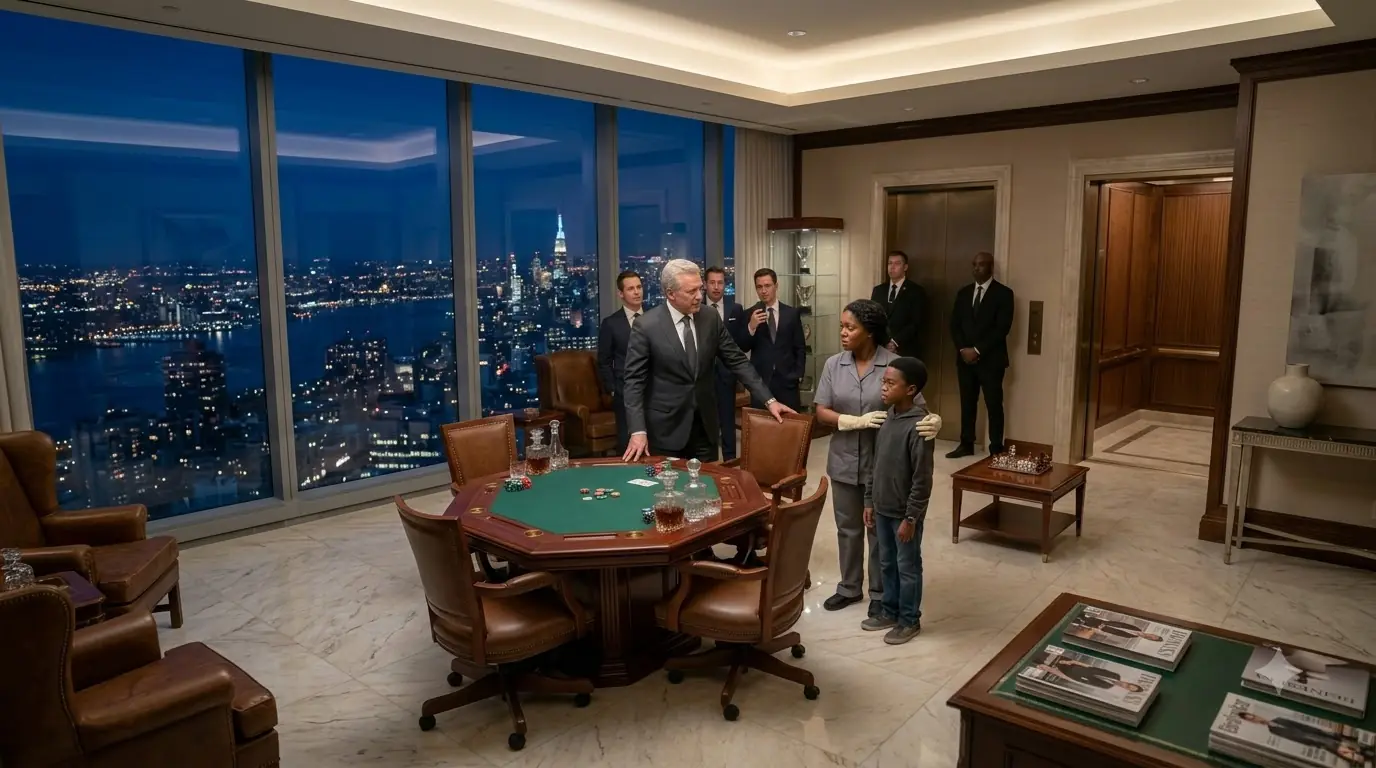
People like you can barely keep up with numbers like that. He stood towering over Denise in her stained uniform. 12 years mopping my floors. 12 years shuffling in here like you belong. You don't.
His lip curled. You smell like bleach and poverty. And that boy of yours in that cheap hoodie, he'll end up just like you, serving people like me forever. Executives laughed. Someone pulled out a phone and started live streaming.
Security guards watched with folded arms. Not one person moved. A 10-year-old boy stood frozen, watching his mother be torn down in public. But here's what none of them knew. that kid. He was about to sit at that poker table and in one hand he would take everything from the richest man in the room.
To understand what happened that night, you need to understand two different worlds. The first world sat 63 floors above Manhattan. The Whitmore Capital Penthouse, a palace of leather chairs, crystal decanters, and hand-rolled Cuban cigars. A private poker room with custom mahogany tables and green felt imported from Monaco. On the walls hung photographs of Richard Whitmore III shaking hands with senators, celebrities, and Fortune 500 CEOs.
In a glass case near the bar, three trophies gleamed under soft lighting. Amateur Poker Circuit Championships, Richard's Pride and Joy. He'd spent over $50,000 a year on private coaches, flew to Vegas six times annually, and never missed a World Series of Poker broadcast. He wasn't just rich, he was third-generation rich. His grandfather built the fortune.
His father doubled it. Richard, he'd never earned a single dollar in his life. But he'd learned something more valuable. How to make other people feel small. That was his real talent, not poker, not business, cruelty.
The second world was 5 mi north, a Harlem apartment on the fifth floor of a building with no elevator, cracked windows that let in winter drafts, radiators that clanked and groaned, but only worked half the time. A kitchen table covered in library books and a folding chair with duct tape on the seat. The walls were bare except for one thing, a framed photograph of a man in military uniform holding a deck of cards. This was Preston Foster's world. Preston was 10 years old, small for his age, the kind of small that made bullies think he was an easy target.
Quiet in a way that made teachers forget he was in the room. He wore glasses held together with tape and clothes from the Goodwill bin. Always clean, always pressed, because his mother insisted on dignity even when they couldn't afford it. He had his grandfather's eyes, dark, watchful, missing nothing. His mother, Denise Foster, was 42 years old.
She'd worked as a cleaning woman at Whitmore Capital for 12 years. 12 years of night shifts, weekend shifts, holiday shifts, 12 years of scrubbing toilets used by men who earned more in a minute than she made in a month. Her hands were rough, her back ached constantly, but she never complained. Not once, because every dollar went toward Preston's future. She dreamed of college for him, a scholarship, a way out.
What Denise didn't know, what she couldn't have known, was that her son had already found a way out. Just not the kind she expected. Three years ago, Preston's grandfather, William, had taught him to play cards. Not go fish, not old maid. Real poker, Texas Hold'em, the mathematics of probability, the psychology of reading people, the discipline of controlling your emotions when everything is on the line.
William Foster had been a Korean War veteran, a Black man from Alabama who'd learned poker in army barracks where soldiers who looked down on him would not let him sit at their table until they needed a fourth player and couldn't find anyone else. That night, 19-year-old William won 6 months of their wages in a single session. They attacked him afterward, called him a cheater, and left him badly hurt. But they couldn't take back what he'd learned. After the war, William played underground games in Chicago.
Back rooms, basement clubs, the only places a black man could play for real stakes in 1950s America. He made enough money to buy a house, lost it to a con man who stacked the deck against him. "The game was honest," he always told Preston. "It was the world that cheated." William died when Preston was seven. Cancer ate him from the inside out.
But in those last three years of his life, he'd poured everything he knew into his grandson. Every trick, every tell, every mathematical formula for calculating odds in real time. And Preston, Preston was better than his grandfather had ever been. At 10 years old, Preston could calculate pot odds faster than most adults could add single digits. He could spot a bluff from the twitch of an eyebrow.
The rhythm of breathing, the way someone's fingers moved toward their chips. He had what gamblers called the gift, an almost supernatural ability to read people. For the past 2 years, he'd been playing online poker under the username Ghost 12. No one knew his real identity. No one knew he was a child.
All they knew was that Ghost 12 had climbed into the top 200 players nationally, beating lawyers, doctors, professional gamblers, and Wall Street traders who had decades more experience. Preston never told his mother. She'd forbidden gambling after watching it consume her father's generation. So, he played in secret late at night on a cracked tablet he'd bought for $30 at a pawn shop. He wasn't playing for money.
The online sites didn't allow real cash for minors. He was playing for something else. He was keeping a promise. Now, back to the penthouse. Richard Whitmore III stood at the center of the room like a king surveying his kingdom.
58 years old, silver hair perfectly styled, a $5,000 suit, a Rolex that cost more than Denise's annual salary. Around him, the usual Saturday night crowd had gathered. Junior executives hoping to impress the boss. A few hedge fund managers nursing expensive whiskies. Security guards pretending not to watch while watching everything.
He knew talent when he saw it. He also knew injustice. Vincent Taylor, the building concierge, had already pulled out his phone. 80,000 TikTok followers, a specialty in filming rich people behaving badly. He recognized content when it walked through the door.
And tonight, content had arrived. Finally, there was Thomas Whitmore, 28 years old, Richard's only son, weak, quiet, constantly humiliated by his father in front of others. He stood at the bar nursing a whiskey he didn't want, watching the scene unfold with something like shame burning in his chest. This was the stage. These were the players.
And at the center of it all stood a 10-year-old boy in a secondhand hoodie watching his mother cry. Preston's hand moved to his wrist. To the watch he always wore his grandfather's watch, a cheap Timex that had stopped at 3:42, the exact moment William Foster took his last breath. He'd promised his grandfather he would play. He'd promised he wouldn't hide forever.
Tonight, in the most unlikely place against the most arrogant opponent, Preston Foster was about to keep that promise. He just didn't know it yet. Richard Whitmore wasn't finished. He was just getting started. He circled Denise like a shark smelling blood, his eyes bright with cruelty.
The broken wine bottle still lay on the floor. A $4,000 Château Margaux, its contents spreading across his custom poker felt like a blood stain. "$15,000," Richard said, his voice carrying across the silent room. "That's what you owe me. The wine, the felt, emotional distress." Denise's voice cracked. "Sir, I don't have—"
"Then you're fired." He said it casually like he was ordering coffee. And I'll make sure you never clean another building in Manhattan. How does that sound? Preston watched his mother's shoulders shake. 12 years of service.
12 years of sacrifice. 12 years of swallowing her pride and saying yes sir and no sir and pretending the comments didn't hurt. Gone in an instant because a rich man wanted to feel powerful. Something stirred in Preston's chest, something hot and sharp, an anger he'd spent his whole life learning to control. Then Richard noticed him.
Really noticed him. This is your son. Richard walked closer, looking Preston up and down like he was examining something unpleasant stuck to his shoe. The one who's going to make it out of the ghetto? Preston said nothing.
His grandfather had taught him that. He doesn't talk much, does he? Richard laughed. Maybe that's smart. Nothing intelligent to say anyway.
Probably gets that from you. The executives chuckled on cue. Always on Q. Richard turned back toward the poker table, then stopped. A new idea flickered across his face.
The kind of idea that men like him mistake for genius. Actually, Richard said slowly. I'm feeling generous tonight. He gestured to the mahogany table. The green felt the neatly stacked chips.
One hand, Texas Hold'em, your son against me. Denise stepped forward, her body between Richard and Preston. No, absolutely not. Let me finish. Richard held up a hand, his Rolex glinting.
If the boy wins, your debt disappears. All 15,000. Plus, you keep your job. I'll even throw in a bonus. Call it compensation for emotional distress.
He paused, letting the words hang in the air like poison. If he loses, you owe me 30,000 and you work for free until it's paid off. Could take years, could take forever. Gasps rippled through the room. Even the executives who laughed at everything Richard said looked uncomfortable.
"He's 10 years old," Denise whispered. Then this should be quick. Richard sat down at the table, shuffling the deck with practiced hands. Think of it as a life lesson. Some people are born to sit at the table.
Others are born to clean it. Might as well learn that early. Preston felt every eye in the room turned toward him. The laughing executives, the filming concierge, the silent security guards, they all expected him to cry, to hide behind his mother to prove exactly what Richard Whitmore believed about people who looked like him. But Preston wasn't looking at them.
He was looking at the cards. 52 cards. Mathematical probability. Psychological warfare. The only battlefield in the world where size, age, and money meant nothing.
His grandfather's voice echoed in his mind. The cards don't care about your skin color, boy, only about what's in your head and what's in your heart. Preston touched the watch on his wrist. 3:42. Then he walked to the table.
Preston, no. Denise reached for him. It's okay, Mom. His voice was quiet but steady. I'll play.
Before we see what happened next, you need to understand where Preston learned to play. You need to understand the promise. 3 years earlier, a Harlem apartment. Summer heat pressing through windows that didn't close properly. William Foster sat at the kitchen table, a worn deck of cards in his arthritic hands.
75 years old, oxygen tank by his side, a cough that rattled his whole body every few minutes. But when he shuffled those cards, his hands were steady, fluid, like a pianist returning to a beloved instrument after years away. 7-year-old Preston watched, mesmerized. "Poker ain't about the cards," William said, dealing two hands face down. That's the first thing you need to understand.
Most people think it's about luck, about getting good cards. They're wrong. Then what's it about, Grandpa? William smiled, the kind of smile that held decades of hard one wisdom. It's about the person holding them, their fears, their hopes, their tells.
He tapped his temple with one gnarled finger. You learn to read people, you can beat anyone. I don't care if they've got pocket aces and you've got nothing. If you can see inside their head, you win. How do you see inside their head?
You watch their eyes. Do they look at their chips when they're strong or when they're weak? Their hands? Do they tremble when they're bluffing or when they're excited? The rhythm of their breath?
The way they sit? William leaned forward. People can't help telling the truth, Preston. Their bodies betray them every single time. You just have to learn to listen.
Over the next year, William taught Preston everything. Pot odds, the mathematical relationship between the size of the pot and the size of the bet. Implied odds, calculating future value based on how opponents might react. Position play. Why acting last gives you power.
Hand ranges. thinking about all the possible cards an opponent might hold, not just one hand. They used dried beans as chips, a cardboard box as a card protector, the kitchen table as their casino. No fancy equipment, no expensive coaches, just a dying old man and a child who listened with everything he had. But more than techniques, William taught Preston philosophy. Your great great grandmother was born into slavery," William said one evening, the sunset painting the kitchen orange through the dirty windows.
Couldn't read, couldn't write, couldn't own nothing, not even herself. But you know what? They couldn't stop. Preston shook his head. William tapped his temple again.
Her mind. Nobody can chain what's in here. Nobody can take it. Nobody can buy it. It's yours.
The only thing that's truly yours. He told Preston stories, too, about the army. About the night he won 6 months wages from soldiers who thought a young Black man from Alabama could not possibly understand probability theory. about the beating that followed, and how he'd have done it again in a heartbeat, about the underground games in Chicago, the smoke-filled rooms, the danger of being a Black man with money in 1950s America, where success could make him a target faster than failure, about the house he bought, and the con man who stole it with a marked deck and a crooked dealer. The game was honest, William always said it was the world that cheated.
But you know what? I'd rather live in an honest game with cheaters than a crooked game where everyone pretends to be fair. One night near the end, William was too weak to sit at the table. Preston sat beside his hospital bed holding the old man's hand. "I never got to play where it was fair," William whispered, his voice barely audible.
No crooked decks, no rigged rooms, just pure cards, pure math, pure pure skill. He pressed something into Preston's palm. A watch, cheap, old, the kind you'd buy at a drugstore 40 years ago. I taught you everything I know, but you're better than I ever was. You see things I couldn't see.
Tears rolled down Preston's cheeks. Promise me, William said, his voice fading. When you sit at a table, a real table where it matters, you remember the cards don't lie. People do. Trust the math.
Trust your eyes. And never, ever let anyone tell you what you're worth. I promise, Grandpa. William Foster died at 3:42 a.m. on a Tuesday morning. The watch stopped at the exact same moment, and Preston never reset it.
Now, three years later, that watch sat on Preston's wrist as he faced Richard Whitmore across a poker table. The executives saw a poor kid in a hoodie. Richard saw easy prey. None of them saw what Preston really was. A promisekeeper.
Richard Whitmore dealt the cards himself. A power move. His way of controlling everything. The deck, the pace, the narrative. Two cards slid across the felt to Preston, two more to Richard.
Around them, the penthouse had grown quiet. Even the laughing executive sensed something different. A 10-year-old boy at a high stakes poker table wasn't just entertainment anymore. It was a spectacle, a moment. Vincent Taylor angled his phone for a better shot.
His live stream had jumped to 3,000 viewers. Comments scrolled past faster than anyone could read. "Let me explain the rules," Richard said, his tone dripping with condescension since I'm sure they don't teach Texas Hold'em in whatever public school you attend." Preston didn't respond. He hadn't looked at his cards yet. Instead, he was watching Richard.
The way he sat slightly back in his chair, confident, relaxed. The way he breathed, slow, controlled, but with a slight hitch when he was excited. The micro-expressions flickering across his face, tiny muscles around his eyes that tightened when he felt strong. In poker, these are called tells, unconscious signals that reveal what a player is thinking. Most people can't control them.
Most people don't even know they have them. Preston had been reading tells since he was 7 years old. Richard's tells were obvious. Amateur hour. When he was confident, he sat back and spread his arms.
When he was nervous, he touched his chips before betting, a self-soothing gesture. When he was bluffing, his left eye twitched just slightly, just for a moment. Preston cataloged all of this in the first 30 seconds. You going to look at your cards? Richard asked.
Or are you too scared? Preston finally glanced down, lifted the corners of his cards just slightly, a technique his grandfather had taught him, revealing nothing to observers. Seven of spades, eight of spades, suited connectors. Not a premium hand, not aces or kings or queens. But Preston's grandfather had taught him something crucial.
In poker, starting cards are only about 30% of the equation. The other 70% is how you play them. Richard peaked at his own cards. His posture changed immediately, subtle, but Preston caught it. A slight lean back, a tiny smile tugging at the corner of his mouth.
Richard had a strong hand, probably ace king, maybe ace queen. Big cards that made amateurs feel invincible. The kind of hand that looked great but could crumble against the right opponent. I'll start us off, Richard said, sliding a stack of chips forward. $5,000. Murmurs rippled through the crowd. $5,000 on the first bet.
Before any community cards had even appeared, he was trying to scare Preston out of the hand before it began. Standard bully tactics. Preston had seen it a thousand times online. He looked at the chips, then at Richard, then back at the chips, then he pushed his own stack forward. Call.
Richard blinked for just a moment, half a second. Surprise flickered in his eyes. He'd expected the boy to fold immediately, to cry, to run to his mother, to confirm every stereotype he believed about people who looked like Preston. Instead, Preston sat perfectly still, his face as blank as a wall. The executive dealing the community cards cleared his throat nervously.
The flop. Three cards landed in the center of the table. Four of spades. Five of diamonds. Six of spades.
Preston's heart rate didn't change. His breathing stayed even. But inside his mind was racing through calculations faster than most computers. He had an open-ended straight draw. Any three or any nine would complete his straight five cards in numerical sequence.
The board showed four, five, six. His hand held 78. A three would give him 3 4 5 6 7. A nine would give him 5 6 7 8 9. Eight cards in the deck that completed his hand.
Plus, he had two spades. And there were two spades on the board. Nine more spades in the deck could give him a flush. Five cards of the same suit combined. 15 outs.
15 cards that would make him a winner. Against Richard's ace king, which had connected with absolutely nothing on this board, Preston was actually the mathematical favorite. But Richard didn't know that. Richard saw a child who should have folded. 8,000, Richard said, pushing more chips forward.
His voice was steady, but Preston caught it. The chip touch before the bet. The tell. He's betting big because he has nothing. He wants me to fold.
He's scared. Preston's grandfather had taught him about this pattern. When a man bets like he's strong, William used to say, he's usually weak. When a man bets like he's weak, he's usually got the nuts. It's backwards from what you'd expect.
That's why most people lose. Richard was betting strong, very strong, which meant he was scared. Preston looked at the spot, calculated the odds in real time. The exact percentage chance of completing his straight or flush versus the risk of the bet. 32% chance on the next card alone.
If he missed, another card would come. Combined probability over 54% by the final card. He was the favorite. Mathematics didn't lie. More importantly, Richard thought he was playing against a scared 10-year-old who would crumble under pressure.
He was wrong. "All in," Preston said quietly. The room went dead silent. Someone dropped a champagne glass. It shattered on the marble floor, and no one moved to clean it up.
No one even looked at it. "What did you say?" Richard's voice was sharp, uncertain. All in. Preston pushed every chip he had into the center of the table. $30,000. His mother's debt and her future riding on two cards yet to come.
The game had truly begun. Let me explain exactly what was happening on that table. Because this is where Preston's genius becomes clear. In Texas Hold'em. After the flop, two more community cards will appear.
The turn, then The river. Each one can completely change who's winning. Preston's hand, seven and eight of spades, looked weak to anyone who didn't understand poker mathematics. Two middle cards. Nothing fancy.
The kind of hand most amateurs would have folded before the first bet was even made. But here's what Preston saw. The board showed four, five, six with two spades. His seven and eight meant he had an open-ended straight draw. Any three in the deck would give him a 3-4-5-6-7 straight.
Any nine would give him a 5-6-7-8-9 straight. That's eight cards out of the remaining 45 that complete his straight. Plus, he had two spades in his hand. Two more spades on the board. Nine more spades in the deck could give him a flush.
Five cards of the same suit, which beats a straight. Combined, 15 cards that would make him a winner. 15 outs against Richard's ace king, which had connected with absolutely nothing on this flop. Preston was actually a 54% favorite to win the hand by The river. More than half, better than a coin flip.
Richard didn't understand any of this. He saw a child who had bet everything on luck. He saw desperation where there was calculation. He saw weakness where there was strength. The executive dealer reached for the deck.
His hand trembled slightly. The turn. One card face up in the center of the table. Nine of hearts. Preston's face didn't move.
Not a muscle. Not a twitch. His grandfather had taught him about this, too. The discipline of showing nothing. Of becoming a statue.
But inside, inside fireworks exploded. He'd made his straight. 5 to 6 7 8 9. The best hand possible with these cards. Unbeatable unless Richard somehow made a flush or a full house on the final card.
The odds of that less than 4%. Richard was drawing dead. He just didn't know it yet. Well, Richard said, studying the board with false confidence. I can still win.
Any ace or king gives me top pair. That beats whatever garbage you're holding. He was completely wrong. Even if an ace or king came on the river, Preston straight would still beat Richard's pair. But Richard's ego wouldn't let him see the truth.
He'd already decided the story. Rich man beats poor kid. Natural order restored. Reality had other plans. Richard started talking.
Nervous players always talk. They fill silence with words because they can't stand the pressure. You know, I almost feel bad for you, Richard said, adjusting his cuffs. This was supposed to be educational, a lesson about knowing your place in the world. He leaned back, performing for his audience.
Your grandfather was a janitor, right? Your mother's a cleaning lady, and here you are pretending to be a poker player, pretending to belong at this table. his lip curled. Some people are born to sit at the table, boy. Others are born to clean it. That's just the natural order of things.
Denise's fist clenched so hard her nails drew blood from her palm. She wanted to scream, to fly across the room and defend her son. But something in Preston's posture kept her frozen. He was so calm, so still, like he knew something no one else did. Preston finally spoke.
My grandfather taught me something about cards. Richard raised an eyebrow, amused. Oh, and what's that? He said, "Cards reveal character." Preston's voice was quiet but steady. Far too steady for a 10-year-old facing down a billionaire.
"You've been talking for 5 minutes now, insulting my family, telling me what I am and what I'll never be." He paused. But you haven't looked at my hands once. Richard frowned. What? A real poker player watches everything.
Eyes, breathing, micro-expressions, the way someone holds their cards, the rhythm of their betting. Preston tilted his head slightly. You've been so busy performing for your friends, so busy proving how powerful you are that you haven't actually read me at all. The room went dead silent. That's how I know you've already lost.
Richard's face turned red. His jaw tightened. His hand moved toward his chips. The nervous tell, the self-soothing gesture, even though there was nothing left to bet. He was rattled, genuinely rattled by a 10-year-old child.
Vincent's live stream had exploded. 75,000 viewers, comments flooding faster than anyone could read. Who is this kid? He's so calm with the actual hell. Please tell me the rich guy loses.
This kid is built different. #JusticeAtTheTable. A news producer watching from her apartment across town was already calling her editor. Get someone to the Whitmore building now. This is going viral.
In the penthouse, the crowd had shifted. The laughing executives weren't laughing anymore. They were watching with something like fascination and something like fear. What if the kid actually won? A cleaner standing near the back, one of Denise's co-workers, made the sign of the cross.
Thomas Whitmore, Richard's son, set down his whiskey untouched. He stared at his father, red-faced, sweating, desperately trying to maintain control, and then at Preston, calm, composed, dignified. For the first time in his life, Thomas felt something he'd never allowed himself to feel before. Shame. Not for himself, for his father, for everything the Whitmore name represented.
Eleanor Davis had moved closer to the table. Her mind was racing. Ghost 12, the online player she'd followed for months. the mathematical precision, the psychological mastery, the complete absence of fear. It was him. It had to be him.
A 10-year-old boy had been beating professionals online for 2 years, and none of them had any idea they were losing to a child. Richard cleared his throat, trying to regain control. One card left. One card, and this is over. I've come back from worse.
You keep saying that, Preston replied. Because it's true. Preston tilted his head slightly. Then why are you sweating? Richard's hand shot to his forehead.
It came away damp. Something had changed in that room. You could feel it in the air. A shift like the moment before a storm breaks. At the beginning, this was entertainment.
A rich man teaching a poor kid a lesson. the natural order of things playing out in real time, confirming what everyone already believed. Now it was something else entirely. David versus Goliath. And somehow, impossibly, David was winning. James Wilson, the security guard, stepped away from his post by the elevator.
His eyes were glistening. 40 years of playing cards in Detroit basement and neighborhood games, and he'd never seen anything quite like this. "Come on, son," he whispered so quietly only he could hear. "Finish it!" behind him, other cleaners had gathered. Women in the same stained uniforms as Denise.
Men who mopped the same floors and cleaned the same toilets. People who had been invisible their entire working lives. Background characters in the stories of wealthy men. They weren't invisible now. They were witnesses and they were choosing sides.
Eleanor Davis had abandoned all pretense of neutrality. Her professional mask had cracked completely. She stood 3 ft from the table, arms crossed, watching Preston with something like awe. She'd seen Ghost 12 play online for months, studied his patterns, tried to figure out his strategy, the patience, the precision, the willingness to wait for perfect spots, the complete absence of fear or ego. Now she was seeing it in person.
And the mysterious online legend was a child. A 10-year-old boy from Harlem who had learned poker from his dying grandfather. It shouldn't have been possible. But it was. Thomas Whitmore had left the bar.
He stood near the window, physically unable to look at his father anymore. 28 years of being belittled. 28 years of being told he wasn't smart enough, tough enough, ruthless enough. 28 years of watching Richard Whitmore destroy people for sport. Tonight, someone was fighting back.
Someone was refusing to be destroyed. And it was a 10-year-old boy with taped glasses and a dead man's watch. Thomas felt tears prick his eyes. Not sadness, something else. relief maybe, or hope that another world was possible. Denise stood frozen, her cleaning cart completely forgotten.
Her son sat at that table like he'd been born there. His posture, the stillness, the focus, the quiet confidence, was exactly like her father's. All those nights Preston stayed up late studying, all those library books he'd hidden under his mattress. She'd thought he was falling behind in school. She'd worried about him.
He'd been learning something else entirely. Her father's legacy passed down in secret. She should have been angry. She should have felt betrayed. Instead, she felt something she hadn't felt in years.
Something she'd almost forgotten existed. Pride. Vincent's live stream counter climbed higher. 150,000 175,000 200,000 souls watching through a phone screen. The comments had shifted too.
This kid is a legend. Rich guy is absolutely shaking. Someone get this boy a sponsorship. #JusticeAtTheTable. The hashtag was already trending nationally.
Richard Whitmore looked around the room. For the first time, he noticed the shift. The cleaning staff watching with hope in their eyes. the security guards nodding with respect, his own son refusing to meet his gaze. The audience had changed sides and there was only one card left. The executive dealer's hand trembled as he reached for the deck.
Final card, he said quietly. The river. Every person in that room and 200,000 watching online held their breath. One card, one piece of cardboard. The difference between everything and nothing.
The dealer turned it over. Two of clubs. A blank. A nothing card. Complete air.
No help for Richard. No miracle. The final board read four spades, five diamonds, six spades, nine hearts, two clubs. Richard stared at the cards. His ace king had connected with absolutely nothing.
High card. Ace. That was all he had. The worst possible outcome for such a strong starting hand. Preston's straight, 5-6-7-8-9 was unbeatable.
For a long moment, no one moved. No one spoke. The silence was so complete you could hear the ventilation system humming 63 floors below. Then Preston spoke. Straight, he said quietly.
Nine high. He turned over his seven and eight of spades and laid them flat on the green felt gently, respectfully, like he was handling something precious. Richard looked at the cards, looked at the board, looked at the cards again. His face cycled through emotions, confusion, denial, understanding, and finally something that looked almost like fear. "That's... that's not..." His voice trailed off.
It's a straight, Eleanor said, stepping forward. Her voice was clear and calm. He made it on The turn. The nine. You've been drawing dead for two cards now.
There was nothing you could do. Richard's mouth opened, closed, opened again. For the first time in his adult life, Richard Whitmore III had no words, no comeback, no power play, nothing. Then James started clapping, slow, deliberate, each clap echoing through the silent penthouse like a gunshot. Vincent joined him, then a cleaner near the back, then another, then another.
The applause built like a wave, growing stronger with each second. It filled the room, bouncing off the marble floors and crystal chandeliers. 200,000 people watching online heard it through Vincent's phone. A sound like thunder, like justice, like something that had been waiting a very long time to happen. Preston didn't smile, didn't celebrate, didn't pump his fist or shout or gloat.
He simply sat there, hands folded, as calm as he'd been from the very first card. Richard snapped. He swept his arm across the table in a rage. Cards scattered everywhere. Chips flew across the felt and clattered to the floor.
A crystal glass crashed against the marble, shattering into a thousand pieces. This is ridiculous. His voice cracked high and desperate. He cheated. He must have cheated.
There's no way. Preston looked at him with something that might have been pity. 52 cards, he said quietly. You watched them shuffled. You watched them dealt.
Your own man ran the deck. Every card was face down until it was turned. He paused. No one cheated, Mr. Whitmore.
You just lost. Impossible. You're 10 years old. My grandfather was 19 when he beat soldiers who thought he was stupid. Preston touched the watch on his wrist.
Age doesn't matter at the table. only skill, only preparation, only heart. Richard turned to the room desperately, looking for support. Someone, anyone. He must have had help, a device, something. But no one answered.
The executives looked away, suddenly fascinated by their shoes. Security guards studied the ceiling. Even Thomas wouldn't meet his father's eyes. Richard Whitmore was alone. Completely, utterly alone.
Denise moved first. She crossed the room in five quick steps and pulled Preston into her arms, holding him like she might never let go. Tears streamed down her face. 12 years of exhaustion, humiliation, and sacrifice releasing all at once. "Baby," she whispered into his hair.
"How When did you learn? Grandpa taught me, Preston said softly. Before he died. He made me promise to play. Denise sobbed harder.
She understood now. Everything. The late nights, the hidden books, the way Preston had sometimes stared into space with that familiar focus. Her father wasn't gone. He was right here living in her son.
The elevator doors hadn't even closed before the internet exploded. Vincent's live stream hit 500,000 views, then a million, then 2 million. The clip of Richard's racist taunts, your kind can barely count to 10, was everywhere within minutes. TikTok, Twitter, YouTube, Facebook, Reddit, every platform, every corner of the digital world. Hashtags formed and spread like wildfire: #PokerProdigy, #JusticeAtTheTable, and #Whitmore.
By midnight, major news networks had picked up the story. Billionaire humiliated by 10-year-old in high-stakes poker bet scrolled across cable news chirons from coast to coast. Back in the penthouse, Richard hadn't moved. He sat at the ruined poker table, staring at the scattered cards like a man watching his entire world burn down around him. Eleanor approached him.
Her heels clicked against the marble floor, a sound that used to signal obedience, deference, fear. "Not anymore." "I've watched you bully people for 5 years," she said quietly, her voice steady as steel. the discriminatory comments, the jokes that weren't jokes, the way you make everyone feel small just so you can feel big. She pulled out her phone, showed him the screen. I documented everything, every incident, screenshots of emails, recordings of meetings, witness statements. HR buried Denise's complaint last year because you told them to.
They won't bury this. Richard's head snapped up. You wouldn't dare. I already have. Eleanor's voice was ice.
The board will have my full report by Monday morning. Before Richard could respond, another figure approached. Thomas, his own son, his heir, his legacy. Dad. Thomas's voice was hollow, exhausted, like he'd been carrying a weight his whole life, and had finally decided to set it down.
My whole life you told me winning is everything. Nice guys finish last. Power is all that matters. Crush or be crushed. He looked at the scattered chips, the overturned glasses, the chaos of a man who had lost control.
But you didn't lose tonight because you were nice. You lost because you were wrong about everything about people, about what matters, about the world. Richard reached for him. Thomas, you don't understand. I understand perfectly.
Thomas stepped back. I'm done. Done watching you destroy people. Done being ashamed of my own name. Done pretending that cruelty is strength.
He turned to leave, then paused at the elevator. That kid showed more class in 10 minutes than you've shown in 58 years. He beat you and then he offered to shake your hand. He gave you grace you never deserved. He stepped into the elevator, the doors closed.
Richard watched his son, his legacy, his future disappear. James, the security guard, stepped forward. His voice was calm, almost gentle. Sir, a million people just watched you target a child with a discriminatory insult and then lose to him at your own game. I don't think lawyers help with that kind of thing.
Richard looked around desperately. Someone, anyone, I can pay. But the security guards were stepping aside. The executives were gathering their coats and hurrying toward the exits. The cleaning staff stood together in silent solidarity, their invisible labor finally visible.
No one was protecting Richard Whitmore anymore. Outside the building, a crowd had gathered. Phones held high, lights glowing in the darkness, a chant building. Let him speak. Let him speak.
Preston and Denise emerged from the lobby into a storm of camera flashes. Microphones thrust forward, voices calling out questions. A reporter pushed through the crowd. Preston, you just beat one of the wealthiest men in New York. What do you want people to know?
Preston looked at his mother, at the crowd, at his grandfather's watch, frozen forever at 3:42. "My grandfather learned poker in a war," he said, his small voice somehow carrying over the chaos. "He played in back rooms and basement because those were the only places that would let him in. He taught me everything he knew." He paused. Tonight, a man bet against me because of what I look like.
He thought he knew what cards I was holding just by looking at my skin. Preston looked directly into the nearest camera. He was wrong. One week later, everything changed. For Richard Whitmore, the fall was swift, brutal, and complete.
The board of directors held an emergency meeting the Monday after the video went viral. Eleanor's documentation was damning. 5 years of harassment complaints, discriminatory remarks, hostile work environment, and systematic covering up of employee grievances. Three more employees came forward with their own stories within 48 hours. Then five more, then a dozen.
By Wednesday, major clients began pulling their investments. Pension funds managing retirement savings for teachers and firefighters, university endowments, charitable foundations that couldn't afford the association. The viral video was cited in every withdrawal statement. We cannot be associated with behavior that so clearly contradicts our stated values. By Friday, exactly one week after the poker game, Richard Whitmore III was forced to resign as CEO of his own family company, the company his grandfather had built, the company his father had grown, gone in 7 days because he couldn't resist humiliating a cleaning woman and her son.
His son, Thomas, was appointed interim chairman. His first official act was to issue a public apology and announce a complete review of company culture and practices. Richard's PR team attempted damage control, a hastily announced donation to inner city youth programs, a carefully worded apology that blamed poor judgment and the stress of the moment. An interview request with a sympathetic morning show where he could tell his side of the story. None of it worked.
The internet had already decided. Don't be a Whitmore became slang for arrogant failure. His face became a meme. Screenshots of his shocked expression when Preston revealed the winning hand, captioned with phrases like, "When you find out the kid you were bullying is actually a genius." One month later, Richard attended a charity gala, the same gala he used to dominate, where CEOs and politicians used to line up to shake his hand and laugh at his jokes. He was seated at a back table.
No one approached him. No one spoke to him. When he tried to join a conversation, people suddenly remembered somewhere else they needed to be. He left before dessert was served, alone. His empire hadn't just cracked.
It had crumbled to dust. For Preston, the aftermath was something else entirely. 3 days after the video went viral, MIT called. Not the admissions office, the mathematics department directly. We have a program for exceptional young minds, the professor said.
Full scholarship when you're ready for college, but in the meantime, we'd like to invite you to our summer institute. We've never had someone your age, but after watching that video, well, we'd be honored. The World Poker Tour reached out next. Youth ambassador program. They wanted to document his journey, provide coaching, prepare him for professional play.
When you're 21, we want you at the main event. You have the mind for it. We've never seen anyone read opponents the way you do. ESPN ran a 30-minute feature. The New York Times published a front page profile that explored the story of William Foster, the grandfather who'd learned poker in a war and passed his knowledge down through generations.
Morning shows competed for interviews. Talk show hosts wanted him on their couches. Through it all, Preston remained calm, polite, humble. He answered questions thoughtfully, never badmouthed Richard Whitmore, never celebrated the man's downfall. In every single interview, he wore his grandfather's watch.
A reporter finally asked about it during a national morning show appearance. Preston, I notice you always wear that watch. It looks old. Is there a story there? Preston looked down at the frozen hands.
3:42. "It's my grandfather's," he said. "It stopped at 3:42 in the morning. That's exactly when he died." The interviewer's face softened. "And you never fixed it.
It's not broken." Preston looked up and his eyes, his grandfather's eyes, were calm and clear. It just reminds me what time it was when my grandfather left this world. It reminds me that time is precious, that promises matter, that he's with me every hand I play, sitting across from me, teaching me. Plus, the clip went viral on its own. 30 million views within a week.
Comments flooded in from around the world. People sharing their own stories of grandparents who believed in them, of promises kept and legacies honored. But Preston wasn't interested in fame. He had something more important in mind. 6 months after the poker game, he launched something that would change everything.
He called it Grandpa's Table. A free after-school program in Harlem. No fancy equipment, no expensive entry fees, no barriers, just folding tables, plastic chips, and worn decks of cards. The curriculum wasn't really about poker, though they did play cards. It was about probability, game theory, critical thinking, reading people, making decisions under pressure, managing emotions when the stakes are high.
The same skills William Foster had learned in a war. The same skills he'd passed to his grandson, skills that applied far beyond any card table. 12 kids showed up the first week, then 20, then 40. Then they had to move to a bigger space. Denise quit her cleaning job to manage the program full-time.
After 12 years of mopping floors for people who looked down on her, she was finally doing work that mattered, work that honored her father's memory. For the first time in over a decade, she slept past 5:00 a.m. James Wilson, the security guard from Whitmore Capital, volunteered as an instructor. He taught the kids games he'd learned growing up in Detroit. His three grandchildren became regulars at the program.
Eleanor Davis left corporate life entirely and published an article that went viral. What I saw, 5 years of silent complicity. She now consults for organizations trying to fix toxic workplace cultures. On weekends, she helps with Grandpa's Table. Thomas Whitmore quietly funds the program anonymously.
He's in therapy now, working through decades of damage, learning to be the man his father never let him become. He hasn't spoken to Richard in months. One Saturday afternoon, six months after the poker game that changed everything, Preston stood at the front of a community center classroom. 20 kids sat around folding tables, cards in hand, kids from different backgrounds, kids from poverty, kids nobody expected anything from. Preston was explaining pot odds, making mathematics exciting.
So, if there's $100 in the pot and you need to bet 20 to stay in, you need at least a 20% chance of winning for the math to work. How do we figure that out? Hands shot up everywhere. Answers flew. These kids, overlooked, underestimated, written off, were learning advanced mathematics without even realizing it.
A small boy in the front row raised his hand. 12 years old, glasses held together with tape, clothes from the donation bin. He looked exactly like Preston had looked a year ago. Preston, what do we do when people say we're not smart enough for this stuff? Preston walked over and knelt down to eye level.
Then you invite them to sit down. He reached into his pocket, pulled out a single card, the ace of spades, and you show them exactly what you're holding. The boy took the card, looked at it, smiled. Behind them, on the community center wall hung a framed photograph. William Foster, young, strong, in military uniform, holding a deck of cards.
The same deck he'd used to win six months wages from men who thought he was stupid. Below the photograph, a handpainted sign. The cards don't lie, people do. Trust the math. Trust your eyes.
William Foster, 1932 to 2020. Preston touched his grandfather's watch. 3:42. The promise had been kept. But now it was bigger than one promise, bigger than one game, bigger than one victory.
Every kid who walked through those doors learned the same lesson Preston had learned. Circumstances don't define potential. Appearance does not determine intelligence. The table doesn't care about your last name, your zip code, or what anyone else thinks you're worth. 52 cards.
Everyone gets the same deal. What you do with those cards, that's on you. Richard Whitmore had wanted to teach a lesson about the natural order of things, about who belongs at the table and who belongs cleaning it. He was right. A lesson was taught that night, just not the one he expected.
A 10-year-old boy from Harlem walked into that penthouse, invisible, written off, dismissed before he ever sat down. He walked out unforgettable. And somewhere in that frozen moment at 3:42, William Foster finally got his seat at the table.