"Excuse me. May I clean when you're finished?"
A smirk split Bennett's face. "Christ, look where this stinking black monkey came from."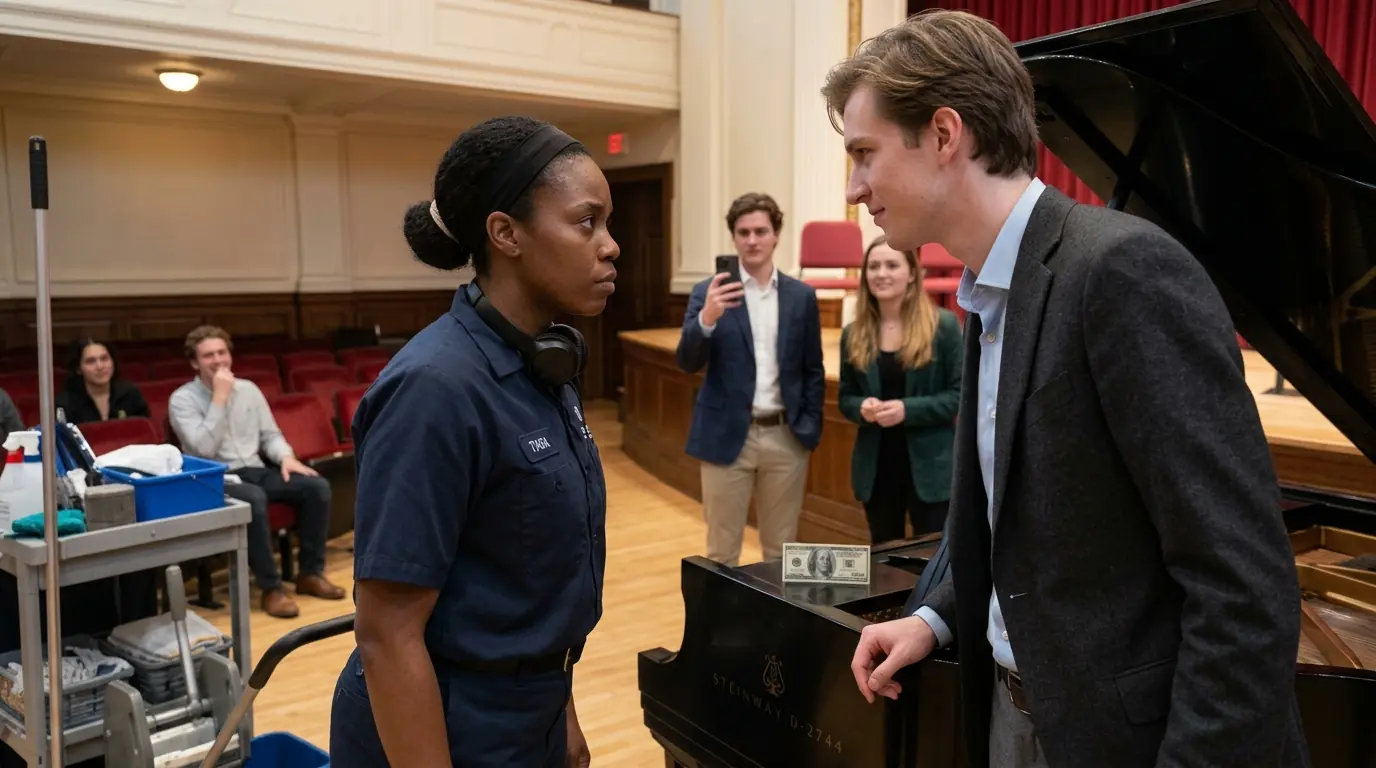
Tiana Anderson held his gaze. "Please don't say that."
"Did I say you could speak, you idiot black monkey?"
She tightened her grip on the trolley handle.
"Is that how the circus trained you? Terrible."
Spencer sneered, sticking a $100 bill on the piano lid. "Bet she can't hit five clean notes. Easy money."
Bennett's voice was full of delight. He folded a Chopin etude into a paper airplane and tossed it at her boots. "Play a song, bitch. Five clean notes wins you the hundred. Miss, and you mop my dorm floor till graduation."
The rich students laughed. In a few minutes, they wouldn't know who they had just challenged.
To understand what happened in the next nine minutes, you have to walk back 12 hours to the moment Tiana Anderson clocked in for her shift.
Wexford Conservatory of Music had stood on the corner of Huntington and Massachusetts Avenue for 130 years. Five floors of red brick. Tall windows shaped like the back of a violin. The kind of building people lowered their voices inside without knowing why.
At 8:15 on a Thursday evening, the hallways were quiet. A cello student was practicing somewhere upstairs—Bach, the prelude from the first suite, played one bar at a time. The air smelled like lemon floor polish and old wood. The floors were the originals. So were some of the pianos.
Tiana Anderson walked into the staff break room wearing a navy uniform. She pulled her hair back tight with a plastic band. She tied her sneakers. She slid headphones around her neck without turning them on.
Her hands were a contradiction: short nails, cracked at the cuticles from years of bleach and floor polish; a pale callus at the base of the right thumb where the cleaning rag pressed; but the middle joints of her ring fingers and pinkies stayed supple—the way a pianist's fingers stay supple, no matter what else the hands were made to do.
She liked the building best when it was empty. Her shift ran from 6:00 in the evening to 2:00 in the morning, four nights a week. She had been doing it for almost three years. The work was the same most nights: she wiped down music stands in the rehearsal rooms, emptied bins backstage, picked up reed shavings the clarinet students left in piles on the chairs, and polished the piano lids so the next morning students could see themselves in the lacquer.
She had a system: top floor first, then down; practice rooms before performance halls; Caldwell Hall last, because Caldwell Hall took the longest.
She moved through the building like weather. Students passed her without seeing her. Faculty nodded the small nod people give to anyone holding a mop. The older custodians, the ones who had been there 20 years, called her sweetheart and meant it. But mostly, she was furniture. She had learned to be furniture. It was easier than the alternative.
Once, this building had known her differently.
She had been 14 the first time she walked through the front doors—a scholarship kid from Roxbury, hauling a duffel bag and a folder of recordings her mother had stayed up nights to dub from cassette. Eleanor Anderson had taught piano in the front room of their apartment for $30 an hour. She had given her daughter every lesson Eleanor herself had never received.
At 15, Tiana won the Junior Chopin Medal, the conservatory's youngest. Her photograph went on the wall outside Maestro Beaumont's office. It was still there. She walked past it every Tuesday night when she vacuumed the second-floor hallway.
At 16, Eleanor was diagnosed with early-onset ALS. The doctors gave her three years; she had two.
There had been one last good day before the disease took her mother's hands: a Sunday in October, six months after the diagnosis. Eleanor had asked her daughter to play the Ballade—the G minor, the first one, the piece most pianists waited a decade to even attempt. Tiana had been 16 and angry and afraid, and she had played it badly. Her mother had cried anyway.
"The music doesn't care who's listening, baby," Eleanor had said. "It never did."
That was the last piece Eleanor ever heard her daughter play.
Tiana withdrew from Wexford the following month. She did not write a letter. She did not say goodbye to anyone. She turned in her practice room key at the front desk and walked out through the same doors she'd walked through at 14.
Eleanor died on a Sunday morning in March with her daughter's hand on her hand and the radio playing softly in the kitchen. Tiana was 18.
What happens to a 16-year-old prodigy who walks away from her gift?
She got a job. Two jobs. She finished high school at the public library in the evenings while her Aunt Marion sat with Eleanor during the day. She enrolled in community college because community college was free and Berklee was not. She studied accounting because numbers did not require her to feel anything.
When Marion had a stroke 18 months ago, Tiana moved into the back bedroom of the Dorchester apartment to take care of her. Marion was 68. She used a walker now. She needed help with bathing three days a week. The home aide cost $200. The only job within a 40-minute T ride that paid enough was the night shift at Wexford Conservatory.
So, Tiana came back. She wore the navy uniform. She emptied the bins. She walked past her own photograph every Tuesday and did not look at it.