A rich white woman in diamonds spat the words at a Black man in a worn jacket. He stood on a public sidewalk, silent and still.
“I’m Victoria Pemberton. My family owns this district. Dirty beggars like you don’t breathe the same air as people like me.”
“I apologize, ma’am. I meant no trouble.”
She slapped him hard across the face. His dark cheek burned red. He did not flinch. He did not speak.
He just watched her walk away.
Three weeks later, a private jet landed at her wedding venue. The door opened. A figure stepped out.
She looked up. Her knees buckled.
That face.
The man she had slapped.
Standing at the bottom of the jet stairs in a $3,000 suit.
Charleston, South Carolina. Late May.
The historic district breathed in the way only old Southern cities can: humid and honeyed, carrying the scent of magnolia and a history nobody wants to discuss too loudly.
Cobblestones gleamed from last night’s rain. Church bells rang from St. Michael’s, the same bells that had marked the hours since before the Civil War.
Tourists clustered on corners, cameras raised, capturing beauty without context.
Malcolm Sterling walked slowly down King Street. Worn jacket, plain cap pulled low, sneakers that had seen better years.
He blended in nowhere and everywhere. The kind of man people looked past without seeing.
He had been here eight days, watching, waiting, taking notes no one knew he was taking.
He passed a limestone building with brass letters on the cornerstone.
Pemberton.
His jaw tightened, then released. He kept walking.
His cover story was simple. He was assessing this neighborhood for a community investment project, a potential site for a foundation grant.
It was true, but it was not the whole truth.
His mother loved Charleston. Eleanor Sterling had visited once as a girl on a church trip, back when Black families from rural Georgia saved for months to afford the bus fare.
She always talked about coming back. The cobblestones. The church bells. The way the harbor caught the light at sunset.
She talked about it in her hospital bed near the end, when the morphine made her drift between memory and dream.
She never made it back.
Malcolm was finishing the trip she never took.
He stopped outside a high-end boutique. Magnolia Row, the sign read, cursive gold on white.
Through the window, he saw crystal chandeliers, polished floors, and price tags that could feed a family for a month.
A woman inside glanced at him through the glass. Her eyes moved up, down, then away.
Quick. Dismissive.
The kind of look that said, you do not belong here.
Malcolm was used to that look. He had been getting it his whole life.
His phone buzzed. He stepped aside to answer.
“The venue paperwork is finalized,” his assistant said. “Bellevue Plantation is fully under Sterling Holdings now. Two hundred acres, private airstrip. Ready for your signature whenever you want to announce.”
“Good,” Malcolm said. “Keep it quiet for now.”
“Understood. Anything else?”
“Not yet. I need to see something first.”
He ended the call and slipped the phone into his pocket.
From his wallet, he pulled a yellowed newspaper clipping, folded and refolded so many times the creases had turned soft.
The headline was partially visible.
Pemberton Mutual Insurance Faces Class Action. Dozens Claim Systematic Denial of…
He folded it back before the rest showed.
Twenty-two years he had carried this clipping. Twenty-two years since he found it in his mother’s things, tucked between unpaid hospital bills and a life insurance policy that never paid out.
He was twenty-two years old when she died, holding her hand in a room that smelled of antiseptic and endings, watching the monitors go flat, listening to the silence that followed.
He built Sterling Holdings from nothing. Tech investments, real estate, a charitable foundation that funded healthcare access in underserved communities.
He could have destroyed the Pemberton family a dozen times over. Hostile takeovers, legal warfare, the slow strangulation of their business interests.
He chose not to.
His mother did not raise him to destroy. She raised him to build. To watch. To wait. To give people a chance to show who they really were.
So he came to Charleston dressed like he had nothing, to see how the wealthy treated those they considered beneath them.
To find out if anything had changed in twenty years.
He muttered to himself, barely audible.
“Show me who you are now.”
The woman in the boutique was adjusting her sunglasses, preparing to leave. She had not noticed him yet, not really.
She would.
Malcolm paused near the boutique entrance, not blocking it, just standing in the shade of an awning, watching the street the way tourists do.
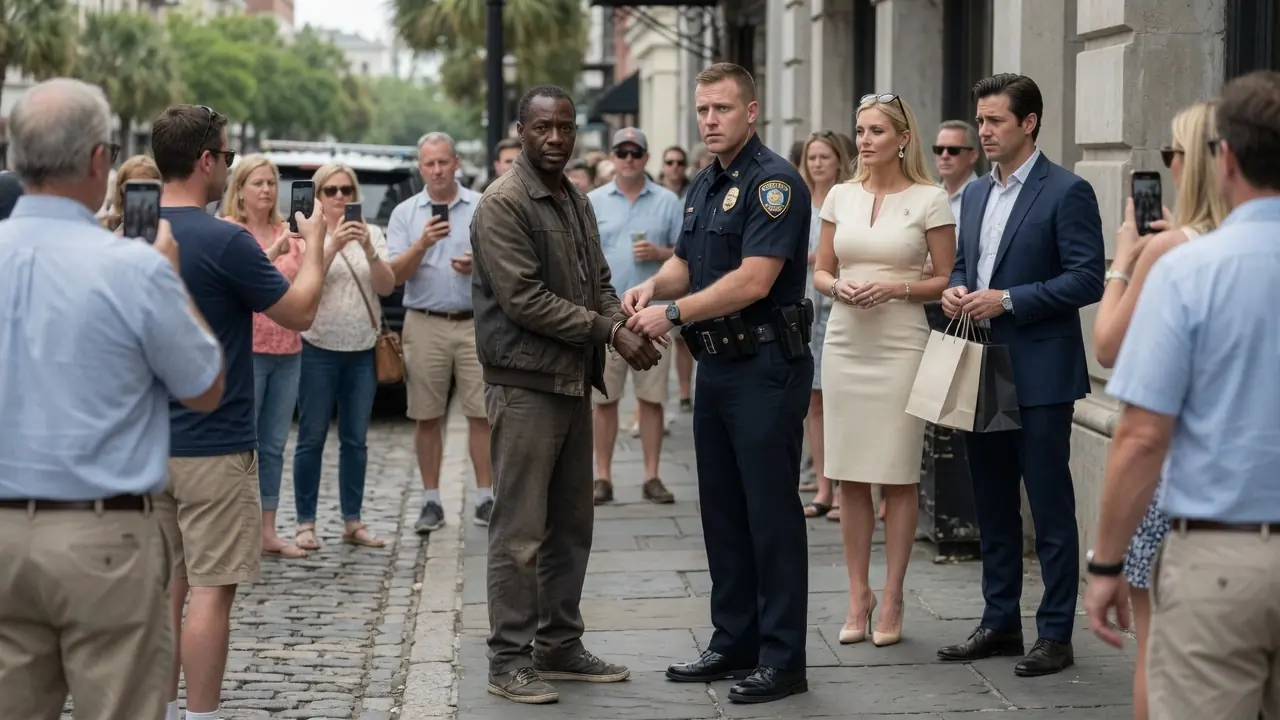
The door swung open. Victoria Pemberton exited first, shopping bags in both hands.
Designer dress, cream-colored, probably cost more than most people’s rent. Sunglasses pushed up into blonde hair. Heels clicking against the sidewalk with the rhythm of someone who had never had to hurry for anything.
Behind her was a man carrying additional bags. Tall, well-dressed. Expression tired in a way that suggested this was not his first shopping trip this week.
Garrett Holloway.
Her fiancé.
Though he looked less like a partner and more like a porter.
Victoria stopped. Her gaze landed on Malcolm. Her lip curled.
“Excuse me.”
Sharp. Loud enough for others to hear.
“You can’t loiter here.”
Malcolm said nothing. He met her eyes. Calm. Steady.
“This isn’t a shelter.”
“Move.”
Still nothing from Malcolm. He did not shift. He did not look away.
A bystander across the street, Derek Trent, twenty-eight, heading home from a lunch shift, pulled out his phone.
Something about the scene caught his attention.
He started recording.
Victoria noticed the phone. She did not care. Let them record. Let them see a concerned citizen dealing with a vagrant.
“Do you even speak English?” Her voice rose, performative outrage. “I said, move.”
Malcolm remained still, but something shifted in his expression.
Not anger.
Recognition.
Like a piece of a puzzle clicking into place.
Victoria drew herself up.
“I’m Victoria Pemberton. My family built half this district.”
She gestured at the street around them.
“You don’t belong here.”
Malcolm’s eyes flickered. Not at the name itself, but at the certainty behind it.
The absolute conviction that some people mattered and others simply did not.
He had heard that tone before. Twenty-two years ago, in a letter that began with the words, “We regret to inform you that your claim has been denied.”
Victoria’s patience snapped.
Her palm swung. Fast. Hard.
It connected with Malcolm’s cheek. The crack silenced the street.
Malcolm did not flinch. He did not step back. He did not raise a hand.
His cheek reddened. His eyes stayed locked on hers.
For three seconds, no one moved.
The humid air hung between them. A car horn sounded two blocks away. Someone’s phone rang and went unanswered.
A child asked their mother what happened. The mother pulled them away.
Then Malcolm spoke. Quiet. Almost gentle.
“Pemberton. Of course.”
Victoria froze. Her hand was still raised, trembling now. Not from regret. From adrenaline.
“What did you say?”
Malcolm tilted his head slightly.
“Your father, Richard Pemberton. He was in insurance, wasn’t he?”
The color drained from Victoria’s face.
“How do you know that?”
Malcolm did not answer.
He just waited, the same way he had been waiting for twenty years.
Garrett shifted uncomfortably behind Victoria. His expression was strange.
Not concern for his fiancée. Not outrage on her behalf.
Something else entirely.
Something that almost looked like interest.
“Victoria,” Garrett said, voice low. “We should go.”
“He knows things,” Victoria hissed. “He’s been stalking us. I’m calling the police.”
“I’ll do it,” Garrett said quickly.
Too quickly.
He pulled out his phone, but he did not call 911 right away. He hesitated. He looked at Malcolm one more time, studying his face.
Then he dialed.
Malcolm stood exactly where he was, cheek still stinging, eyes still calm.
Derek Trent, across the street, kept recording. He had forty-three seconds of footage now. The slap, the silence, the strange exchange that followed.
He did not know it yet, but that footage was about to become the most important forty-three seconds of his life.
And the most expensive.
The 911 call came in at 2:52 p.m. Garrett’s voice was steady, practiced.
“There’s a homeless man harassing my fiancée outside Magnolia Row Boutique on King Street. She had to defend herself.”
In the background, Victoria added her piece.
“He was aggressive. He knows things about my family. I think he’s been stalking us.”
Malcolm heard every word. He did not react.
He stood in the same spot, hands visible at his sides, watching the street fill with curious onlookers.
Some filming. Some whispering. None intervening.
His mind was somewhere else.
Twenty-two years ago, his mother sat in a waiting room at Charleston Memorial. She had a lump in her breast.
She had insurance, Pemberton Mutual, the policy she had paid into for eleven years.
She had hope.
The waiting room smelled like floor wax and anxiety. She held Malcolm’s hand and told him not to worry.
She told him the Lord would provide.
The denial letter came six weeks later.
Pemberton Mutual Insurance. Claim denied.
Reason: pre-existing condition exclusion.
Patient history indicates prior consultation for breast-related concerns.
Eleanor Sterling had never been sick a day in her life. The prior consultation was a routine exam two years earlier.
Nothing found. Nothing to report.
But someone at Pemberton Mutual flagged it anyway. Someone whose signature sat at the bottom of that letter in neat, confident cursive.
Richard A. Pemberton, vice president of claims.
Two police cruisers arrived at 3:04 p.m. Lights flashing, no sirens.
This was a wealthy neighborhood. Sirens would be gauche.
Officer Bradley Cole stepped out first. Thirty-one years old, close-cropped hair, the kind of jaw that suggested he had never had to question his own authority.
He walked straight to Victoria.
“Ma’am, are you okay?”
Victoria smoothed her dress, composing her face into something between distress and dignity.
“He was blocking the entrance. When I asked him to leave, he got aggressive. He mentioned my father by name. I think he’s been following us for weeks.”
Cole did not look at Malcolm, not yet. He was writing in his notepad, taking Victoria’s statement like it was already fact.
“He assaulted you?”
“I had to defend myself.”
Victoria touched her wrist as if it were sore.
It was not.
Cole finally turned. His eyes moved over Malcolm, the worn jacket, the plain cap, the dark skin.
Something hardened in his expression. A judgment made in less than two seconds.
“Sir, turn around. Hands behind your back.”
Malcolm complied.
Silent.
The body camera on Cole’s chest captured everything. Malcolm’s face composed, the handcuffs clicking closed, Victoria smoothing her dress again, satisfied, and Garrett standing slightly apart, watching with an expression no one bothered to read.
The crowd watched. Phones rose. Someone muttered that this did not look right, but no one spoke up loud enough to matter.
No one stepped forward. No one asked for Malcolm’s side.
Malcolm whispered something as Cole guided him toward the patrol car.
“Just like before.”
Cole paused.
“What was that?”
“Nothing, officer.”
By the time Eleanor got treatment, it was stage four. The cancer had spread from her breast to her lymph nodes, then to her lungs, then everywhere.
She spent her last three months in a hospital bed that cost more per day than she had earned in a week.
The bills bankrupted what little they had. Malcolm dropped out of college to work three jobs: warehouse, restaurant, night security.
He held his mother’s hand in that antiseptic room and promised her he would do something with his life.
Something that mattered.
She died at 4:47 a.m. on August 22, 2004.
The monitors went flat. The room went quiet.
And somewhere in Charleston, Richard Pemberton was probably signing another denial letter.
Another family.
Another death sentence dressed up in corporate language.
Malcolm was placed in the back of the patrol car.
Through the window, he watched Victoria whisper something to Garrett. She looked pleased.
Problem solved. Obstacle removed.
But Garrett’s expression was strange. He was watching Malcolm, too.
And there was something in his eyes that did not match his role as the loyal fiancé.
It looked almost like relief.
At the Charleston Police Department, Malcolm was booked and processed. Fingerprints, photographs, the whole ritual of presumed guilt.
He was allowed one phone call. He dialed from memory, a number he had saved for fifteen years.
“Carolyn,” he said when she answered. “I need you here. Now. And bring the file.”
“Which file?”
“The Pemberton file.”
Silence on the other end.
Then, “I’ll be there in forty minutes.”
Malcolm hung up, closed his eyes, and saw his mother’s face.
Not the way she looked at the end, but the way she looked when he was a boy. Strong, warm, full of a faith that the world would eventually make sense.
He had a choice now. He had had this choice for twenty years.
He could burn the Pemberton family to the ground. He had the resources. He had the evidence. He had twenty-two years of carefully accumulated leverage.
Or he could do what his mother would have wanted.
He opened his eyes.
The fluorescent lights buzzed overhead. The holding cell smelled of disinfectant and despair.
In the next cell, someone was crying quietly.
Malcolm waited.
Two hours later, a black sedan pulled up to the precinct. The woman who stepped out was fifty-two years old, silver-haired, and dressed in the kind of understated elegance that came from never having to prove anything to anyone.
Carolyn West, senior partner at West, Bradford and Associates, one of the most respected attorneys in the Southeast.
She walked into the Charleston Police Department like she owned it.
Carolyn West did not raise her voice. She did not need to.
“My client, Malcolm Sterling, was assaulted on a public sidewalk by Victoria Pemberton. He was then detained without investigation, without witness statements, and without any attempt to verify the accuser’s claims.”
She placed a leather folder on the desk sergeant’s counter and opened it slowly.
“I want him released immediately.”
The desk sergeant, a tired man in his fifties who had seen enough to know when the wind was shifting, looked at the folder, then at Carolyn, then at the name on her business card.
“Sterling?”
His voice wavered slightly.
“As in Sterling Holdings?”
Carolyn opened the folder wider. Inside were Malcolm’s identification, his corporate credentials, and a net worth statement that did not need to list specific numbers because the company name spoke for itself.
“My client is the founder and CEO of Sterling Holdings,” Carolyn said.
Her tone was patient, the way a teacher explained something to a slow student.
“He was conducting a site assessment for a charitable foundation when he was physically assaulted by Ms. Pemberton in front of multiple witnesses. He did not resist. He did not retaliate. He did not raise his voice. And he was arrested anyway.”
Officer Bradley Cole appeared in the hallway. His face had gone pale.
“Ma’am, we were responding to a 911 call.”
“I’m aware of what you were responding to.”
Carolyn did not look at him.
“I’m also aware that your body camera captured my client being handcuffed without being asked for his side of the story. I’ll be requesting that footage within the hour, along with the 911 audio and the dispatch records.”
Cole’s mouth opened, closed, opened again.
“Is there something you’d like to add, officer?”
“No, ma’am.”
Malcolm was released at 4:22 p.m. No charges filed.
The paperwork disappeared into a folder that would probably get lost by morning.
Outside, a small crowd had gathered. Someone must have tweeted.
A few reporters were setting up cameras, though they did not yet know why this particular arrest mattered.
Malcolm said nothing to them. He got into Carolyn’s sedan.
The door closed. The car pulled away.
Across town, Victoria Pemberton was getting a phone call from her father.
“What do you mean, be careful?”
She was pacing her living room, still in the cream dress from earlier.
“Sterling? I’ve never heard of— Daddy, what are you telling me?”
Richard Pemberton’s voice was ice on the other end. Controlled. Precise.
“Just stay away from him, Victoria. Don’t talk to anyone. Don’t post anything. I’ll handle it.”
“Handle what?”
The line went dead.
Victoria’s hand was shaking as she lowered the phone.
Garrett was sitting on the couch, watching her. His phone was in his hand. He had been Googling something.
“Sterling Holdings,” he read aloud. “Founded 2009. Headquarters in Atlanta. Specializes in tech investments, real estate acquisition, and philanthropic initiatives focused on health care access.”
He paused and scrolled.
“Net worth estimated at…”
He stopped, read the number again, and deleted his search history.
“Garrett.” Victoria’s voice was sharp. “Are you listening to me?”
“Yeah.”
He looked up. His expression was unreadable.
“Yeah, I’m listening.”
But he was already thinking about something else. Something that might finally give him a way out of this engagement, out of this family, out of the life he had been pretending to want for two years.
The man Victoria slapped was not homeless. He was one of the wealthiest Black men in the Southeast.
And Garrett Holloway was starting to realize that he might have found an unexpected ally.
Denise Monroe had been an investigative journalist for fourteen years. She had covered corruption at the state level, exposed a nursing home chain that was billing Medicare for patients who had been dead for months, and won a regional press award for a series on predatory lending in rural communities.
She had seen a lot of videos go viral. Most of them were noise, sound and fury, forgotten by the following week.
But this one was different.
She watched Derek Trent’s footage for the seventh time.
Forty-three seconds.
A woman in a cream dress slapping a Black man outside a boutique. The man not flinching.
The strange exchange that followed.
“Your father, Richard Pemberton, he was in insurance, wasn’t he?”
That line.
That was what caught her.
Why would a homeless man know that? Why would he say it like that?
Calm, almost knowing.
Like he had been waiting to say those words for a very long time.
She started with the store. Magnolia Row Boutique.
The manager refused to comment. Corporate policy. Ongoing situation. Legal had advised against any statements. You understand.
But a former employee did not have the same restrictions.
Janet Ellis was forty-one. She had worked at Magnolia Row for three years before quitting last spring.
Now she waitressed at a café on the north side of town, as far from King Street as you could get while still being in Charleston.
“They called it discretionary removal,” Janet said.
She was stirring her coffee, not meeting Denise’s eyes.
“If someone didn’t look right, we were supposed to make them uncomfortable enough to leave.”
“What does look right mean?”
Janet finally looked up. Her expression said everything.
“You know what it means. Everyone knows what it means. We just don’t say it out loud.”
Denise obtained the internal memo three days later. A source in the company, someone who was also tired of looking the other way, slid it across a table in a different café.
The language was careful. Legally careful.
Staff are empowered to ensure the shopping environment reflects our brand standards and the expectations of our core customer base.
Core customer base. Brand standards.
Code words.
Denise had seen them before. Different cities, different companies, same meaning.
She filed FOIA requests with the Charleston Police Department. It took a week, but she got what she was looking for.
Complaint records for Magnolia Row Boutique going back five years.
Four incidents, all involving people of color, all dismissed.
A Black woman accused of shoplifting. Security detained her for thirty minutes before checking the cameras, which showed she had paid for everything in her bag.
No charges. No apology. No consequences.
A Latino teenager told to wait outside while his mother shopped. The stated reason was customer comfort concerns.
A Black man asked to leave for making other customers uncomfortable. His crime was browsing the men’s section for more than ten minutes.
A young Black woman followed by security from the moment she entered until the moment she left, empty-handed, because she was too intimidated to buy anything.
Four complaints. Four dismissals. Four form letters thanking the complainants for their feedback.
Denise tracked down the victims. Most did not want to talk.
Too painful. Too risky. Too pointless.
But Lorraine Foster did.
She was fifty-five, a retired schoolteacher, thirty years in Charleston public schools. She was buying a birthday gift for her granddaughter the day it happened.
“They followed me through the store,” Lorraine said.
Her voice was steady, but her hands were not.
“Every aisle. Every rack. Like I was going to steal something. When I complained, the manager said I was being aggressive.”
She shook her head.
“That word. They always use that word. Like we’re the threat.”
Denise had enough for a story now. Pattern of discrimination. Multiple victims. Internal policy that enabled profiling under the guise of brand standards.
But something was still bothering her.
“Your father was in insurance.”
She dug deeper.
Victoria Pemberton. Family history. Source of wealth.
And she found something.
An old newspaper article from 2008.
Pemberton Mutual Insurance Faces Class Action. Dozens Claim Systematic Denial of Coverage.
The case had been settled out of court. Sealed. Pemberton Mutual dissolved in 2015. Its assets were folded into the family’s real estate holdings.
The details were buried under layers of legal paperwork and non-disclosure agreements.
But the headline was enough.
Denise made a note.
Who were the claimants? What were they denied? And who signed those denials?
She reached out to Malcolm Sterling’s office. A polite brush-off.
“Mr. Sterling has no comment at this time.”
Fine.
She would keep digging.
Because she could not shake that moment in the video. The way Malcolm said “Pemberton,” like he already knew.
Like he had been waiting to say it for a very long time.
Denise submitted her article draft on Friday afternoon. It was solid work.
Documented pattern. Multiple sources. Clear evidence of discriminatory policy.
Her editor called Monday morning.
“Kill it.”
“What?”
“We got a letter, Denise. Pemberton Family Trust. They’re threatening to sue if we publish anything connecting Victoria to a pattern of behavior.”
He sighed.
“We’re a small paper. We can’t afford this fight.”
Denise hung up and stared at her notes.
The story was dead, but she was not done.
Not even close.
Because now she knew there was something bigger here. Something the Pemberton family was willing to spend serious money to hide.
And she was going to find out what it was.
The cease and desist letter arrived on Pemberton Family Trust letterhead. Heavy paper. Embossed logo.
The kind of stationery that cost more per page than most people spent on groceries.
Any publication of defamatory statements regarding Ms. Pemberton or her family will result in immediate legal action. We trust you will govern yourselves accordingly.
Denise’s editor would not budge. The paper’s legal budget would not cover a week of fighting the Pemberton attorneys.
They had three lawyers on staff. The Pembertons had an entire firm on retainer.
The story was dead.
And the witnesses were disappearing.
Derek Trent, the bystander who recorded the slap, went silent overnight. His video stayed online, racking up views, but he stopped answering calls, stopped responding to messages.
His roommate told Denise he moved out suddenly. Got a check from somewhere. Did not say where. Did not leave a forwarding address.
Lorraine Foster withdrew her willingness to go on record.
“I can’t risk it,” she said over the phone.
Her voice sounded different now. Smaller. Frightened.
“I have grandchildren in this city. I can’t have the Pembertons coming after my family.”
One by one, the sources went quiet. The momentum died.
The story faded from social media, replaced by newer outrages, fresher scandals, shorter attention spans.
Victoria Pemberton attended a charity gala three days after the cease and desist letter went out.
She was radiant in emerald green, smiling for photographers, accepting air kisses from women who lunch and men who write checks.
In her mind, the incident was already fading. Just another obstacle, another inconvenience handled by Daddy’s lawyers.
“He was just some grifter,” she told a friend, laughing over champagne. “Probably wanted money. Can you imagine? Daddy says it’s all handled now.”
Garrett stood beside her. His smile did not reach his eyes.
It had not reached his eyes in two years.
But nobody at this gala knew him well enough to notice. Nobody here knew him at all.
Victoria’s attorney released a statement to the press.
“Ms. Pemberton acted in self-defense when confronted by an aggressive individual. She denies any pattern of behavior and will vigorously defend her reputation against false accusations.”
The narrative solidified.
Rich woman, innocent victim.
Homeless man, aggressive threat.
Case closed.
Except Malcolm Sterling was not returning Denise’s calls.
And that bothered her more than anything else.
If he wanted to destroy Victoria Pemberton, he could. He had the resources. He had the platform.
Sterling Holdings could buy the kind of media attention that made cease and desist letters irrelevant.
So why was he silent?
Denise sat in her apartment. The story was dead. Her editor had moved on. The Pembertons had won.
But she could not let it go.
She stared at her notes. The old article about Pemberton Mutual. The sealed class action. The phrase that kept echoing in her mind.
“Your father was in insurance.”
What if she had been looking at this wrong?
What if the boutique incident was not the story at all?
Just the surface.
What if the real story was buried twenty years in the past?
She called a friend at the state records office, someone who owed her a favor from a story she had killed to protect his marriage.
“I need everything you can find on Pemberton Mutual Insurance. Specifically, denied claims from 2000 to 2010.”
“That’s a lot of digging, Denise. Those records are archived. Some are sealed.”
“I know. But there’s something here. I can feel it.”
“Okay. Give me a few days.”
She hung up and looked out her window at the Charleston skyline.
Somewhere in this city, Victoria Pemberton was celebrating her victory.
Somewhere, Malcolm Sterling was waiting.
And somewhere in a dusty archive, a twenty-two-year-old denial letter was about to change everything.
Meanwhile, Victoria drove past Bellevue Plantation, her wedding venue. The place where, in three weeks, she would walk down an aisle lined with roses and become Mrs. Garrett Holloway.
She did not know who owned it now.
She did not know that the deed had changed hands six months ago, transferred to a holding company based in Atlanta.
She did not know that the man she had slapped had been quietly acquiring pieces of her life for years.
Not for revenge.
For this moment.
For the choice he had not made yet.
The document arrived as a scanned attachment. Yellowed paper. Official letterhead.
Pemberton Mutual Insurance, Charleston office.
Denise opened it on her laptop. Her hands were already shaking before she read the first line.
Claim number PMI-2004-8832.
Policyholder: Eleanor M. Sterling.
Condition: breast cancer screening follow-up.
Status: denied.
The reason was listed in bureaucratic language designed to obscure its cruelty.
Pre-existing condition exclusion. Patient history indicates prior consultation for breast-related concerns.
Denise cross-referenced Eleanor Sterling’s medical records. Her friend had found those, too, buried in a hospital archive that should have been purged years ago.
Eleanor had one prior consultation, a routine exam two years before the claim.
Nothing found. Nothing abnormal. Nothing to report.
But someone at Pemberton Mutual flagged it as pre-existing anyway.
Someone who needed to meet a quota.
Someone who got a bonus for denials.
The signature at the bottom of the denial letter was neat, confident. The handwriting of a man who signed dozens of these letters a week without thinking twice about the lives he was ending.
Richard A. Pemberton, vice president of claims.
Denise’s breath caught.
She checked the death records next.
Charleston County, August 22, 2004.
Eleanor M. Sterling, age fifty-two.
Cause of death: metastatic breast cancer.
The timeline was devastating. Denial in March. By the time Eleanor could afford treatment on her own, borrowed money, second mortgage, sold possessions, begged relatives, the cancer had spread.
Diagnosis delayed by four months.
Four months that made the difference between stage one and stage four.
Between treatable and terminal.
By treatment, it was everywhere.
Denise did the math. Eleanor Sterling died in 2004. She had a son.
He would have been twenty-two years old.
Malcolm Sterling.
The connection hit her like a physical blow.
Richard Pemberton’s signature killed Malcolm’s mother.
Twenty years later, Richard’s daughter slapped Malcolm in the street, called him homeless, called him nothing, called him aggressive.
He knew.
The whole time.
Denise called Malcolm Sterling’s office. This time, his assistant did not brush her off.
“Please hold. I’ll put you through.”
Thirty seconds later, Malcolm’s voice came through the line. Calm, measured.
The voice of a man who had been waiting for this call.
“Ms. Monroe.”
“Mr. Sterling. I found the letter. I know about your mother.”
Silence.
Long enough that Denise wondered if the call dropped.
Then, “I wondered how long it would take.”
“You knew who Victoria was before she slapped you.”
“I knew who her father was. I’ve known for twenty-two years.”
Denise’s pen hovered over her notepad.
“Then why? Why didn’t you say something? Why didn’t you destroy them the moment you had the chance?”
Malcolm was quiet for a moment. When he spoke, his voice was softer, less guarded.
“Because my mother didn’t raise me to destroy. She raised me to build, to give people chances, to see who they really are before judging them. And Victoria? Victoria showed me exactly who she is. Her father showed me who he is twenty-two years ago. Nothing has changed.”
Denise wrote quickly.
“Mr. Sterling, I want to publish this. All of it. The denial, the connection, everything.”
“I know you do.”
“Will you let me?”
Another pause.
“Tell the truth, Ms. Monroe. All of it. Even the parts that make me look less than heroic. Even the parts where I admit I came here hoping they had changed.”
He exhaled.
“But first, there’s something else coming. Someone unexpected is about to reach out to you.”
“Who?”
“You’ll know when you hear from them.”
The line went dead.
They met at a quiet café on the outskirts of downtown. Malcolm arrived first.
He was dressed simply, the same worn jacket, the same plain cap. Nothing about him suggested the net worth behind the name.
Denise sat across from him with a recorder and a notebook.
She did not turn the recorder on yet. Some conversations were better kept between two people.
“How long have you known about the Pembertons?”
“Since I was twenty-two.”
Malcolm’s hands rested on the table, still.
“I found the denial letter in my mother’s things two weeks after her funeral. I saw Richard Pemberton’s signature.”
“So you came to Charleston for revenge?”
Malcolm shook his head slowly.
“I came to see if they’d changed.”
He explained. Twenty years of building his company. Twenty years of watching the Pemberton family from a distance.
He could have destroyed them a hundred times over. Hostile takeovers, strategic lawsuits, the slow suffocation of their real estate holdings.
“But my mother didn’t raise me to destroy,” he said. “She raised me to build.”
“So you came to Charleston anonymously, dressed like someone with nothing, to see how the wealthy treat those they consider beneath them.”
“I gave them a chance,” Malcolm said. “Victoria answered.”
Denise wrote that down.
“The slap.”
“The slap.”
Malcolm’s jaw tightened just slightly.
“Twenty years and they haven’t changed. If anything, they’ve gotten worse.”
“What now? You could go public. You could destroy them tomorrow.”
Malcolm was quiet for a long moment.
“I thought about it. I sat in that police car handcuffed, and I imagined burning everything Richard Pemberton ever built. Every building, every account, every shred of his reputation.”
“What stopped you?”
“My mother’s voice.”
He looked at Denise directly.
“She used to say, ‘Don’t become the thing that hurt us. Build something instead.’”
Denise set down her pen.
“And Victoria?”
“She doesn’t know about her father.”
“No.”
Malcolm’s expression shifted, something like pity maybe, or sorrow.
“She doesn’t. She’s a product of what he built. But she made her own choices.”
“What do you want from me?”
“Tell the truth. All of it.”
“Even about me?”
“That I came here with an agenda. That I’ve been watching them for years.”
He paused.
“Let people decide for themselves what kind of man I am.”
Denise nodded slowly.
“And if I do, what happens next?”
“That depends on someone else. Someone who’s been looking for a way out for a long time.”
Malcolm stood and left enough cash on the table to cover both their coffees and a generous tip.
“You’ll hear from him soon.”
“Him?”
Malcolm was already walking toward the door.
“Victoria’s fiancé.”
The parking garage was cold, concrete and shadows. Garrett Holloway sat in his car with the window down, speaking quickly.
His eyes kept darting to the rearview mirror.
“I’ve been looking for a way out for two years,” he said, voice low. “Victoria isn’t who I thought she was. Maybe she never was.”
Denise leaned against the adjacent pillar, recorder running.
“Why now?”
“Because I watched her slap that man, and I watched him not react. And I saw myself.”
Garrett’s hands gripped the steering wheel.
“Someone who takes it. Someone who stays quiet. I don’t want to be that person anymore.”
He handed her a folder through the window.
Inside were internal Pemberton family communications, emails exchanged in the days after the incident.
Denise read the key passage aloud.
“Richard Pemberton to family attorney. Handle the witness. Handle the journalist. This cannot reach the Sterling acquisition.”
Sterling acquisition.
Garrett nodded.
“Richard’s been negotiating a major real estate deal for months. Forty million dollars. He found out two weeks ago who the buyer is.”
He slid another document across.
A contract.
Bellevue Plantation Venue. The property where Victoria was scheduled to be married in three weeks.
The buyer?
Sterling Holdings LLC.
“Malcolm Sterling owns Victoria’s wedding venue,” Garrett said. “Richard’s been trying to salvage the deal without telling her. He covered up the slap to protect the money, not his daughter.”
The money.
Denise stared at the contract. The irony was almost too perfect.
“He doesn’t care about Victoria’s wedding,” Garrett continued. “He cares about forty million dollars. That’s all he’s ever cared about.”
“Why are you doing this?” Denise asked. “Really?”
Garrett was quiet for a moment.
“Because when I looked at Malcolm Sterling standing there after Victoria hit him, after the police took him away, I saw someone who knew exactly who he was. And I realized I don’t.”
He opened his car door and stepped out.
“I’m done protecting people who don’t deserve protection.”
Two days later, Bellevue Plantation, sunny afternoon.
Victoria arrived in a limousine. She was here to finalize wedding details, take control, prove to herself that everything was still on track.
Designer dress, sunglasses, heels clicking on stone.
She walked through the garden like she owned it. The roses, the white tents, the honeysuckle hedges.
The venue staff greeted her nervously. They kept glancing at the sky.
Then she heard it.
A sound in the distance growing louder.
Engine whine.
She looked up. A private jet descended over the tree line, sleek and white, sunlight glinting off the fuselage.
Victoria frowned.
“Who’s landing here? I didn’t authorize—”
The jet touched down on the venue’s private airstrip, smooth and precise. The engines wound down.
Victoria walked toward the airstrip, annoyed, confused.
The jet door opened. Steps unfolded.
A figure appeared in the doorway, silhouette against the sun.
Suit. Confident posture.
He descended slowly, one step at a time.
Victoria’s eyes adjusted. She saw his face.
Her breath caught. Her arms dropped. Her mouth opened.
Malcolm Sterling.
The man she had slapped. The man she had called homeless.
Standing at the bottom of the jet stairs in a $3,000 suit.
He walked toward her, calm, unhurried.
“You.”
Victoria could barely speak.
“You’re…”
Malcolm stopped ten feet away. He looked at her the way she had once looked at him.
“Malcolm Sterling, CEO of Sterling Holdings.”
He paused.
“The company that owns this venue.”
Victoria’s knees weakened. She grabbed a nearby chair.
“This is impossible. You were… you were nothing.”
“No,” Malcolm said quietly. “I was dressed simply. You decided what that meant.”
Victoria’s whole body was shaking.
“The wedding. My wedding is here.”
“Was here. I’ve decided to repurpose the property.”
He took a step closer.
“But that’s not why I came today.”
“Then why?”
“Because I wanted to see your face when you realized.”
He paused. His voice dropped.
“And because there’s something you need to know about your father. About what he did twenty-two years ago.”
“My father? What does my father have to do with—”
“You’ll find out. In court. One week from today.”
He walked past her into the venue. The staff greeted him by name.
“Mr. Sterling, welcome back.”
Victoria stood alone. The woman who owned every room she walked into was now a stranger on land she thought was hers.
Her phone buzzed.
Father calling.
She did not answer.
Charleston County Courthouse. June 12, 9:00 a.m.
Civil injunction hearing.
Malcolm sat at the plaintiff’s table, calm. The same suit from the jet.
Victoria was across the aisle, her attorney beside her. Her father, Richard, sat in the row behind, silver hair, expensive suit, jaw clenched so tight the muscles were visible.
Garrett Holloway was absent. He had given his deposition last week. He was already on his way to Atlanta.
The gallery held Denise Monroe, Lorraine Foster, the other victims, Pastor Eugene Daniels from the community church, and witnesses who refused to stay quiet any longer.
Malcolm’s attorney presented the evidence methodically.
The body cam footage. The prior complaints. The store memo. Garrett’s documents showing the cover-up.
Then she produced the final exhibit.
A yellowed document.
Pemberton Mutual Insurance letterhead.
“Claim number PMI-2004-8832,” the attorney read. “Policyholder, Eleanor M. Sterling. Status, denied. Reason, pre-existing condition exclusion.”
She paused.
“Reviewing officer, Richard A. Pemberton.”
Victoria turned to look at her father.
“Daddy, what is this?”
Richard Pemberton’s eyes were fixed on the table. He did not answer.
The attorney continued.
“Eleanor M. Sterling died on August 22, 2004, from metastatic breast cancer. She was the plaintiff’s mother.”
Victoria’s face drained of color.
“Eleanor Sterling was denied coverage for a cancer screening follow-up. The denial delayed her diagnosis by four months. By the time she received treatment, the cancer had spread to stage four. Terminal.”
Victoria stood. Her voice was shaking.
“Daddy. Daddy! What did you do?”
“Sit down, Victoria.”
“Did you know? When you told me to make this go away, did you know who he was?”
Richard Pemberton said nothing.
Victoria’s breakdown was not rage. It was something deeper. The sound of a worldview collapsing.
Everything she believed about herself, about her family, about her place in the world.
She looked at Malcolm. Really looked at him for the first time.
“I didn’t know,” she whispered.
Malcolm’s expression was unreadable. He neither forgave nor condemned.
He simply witnessed.
The judge ruled.
Compensatory damages: $385,000. The store was ordered to revise its policies and undergo civil rights training.
Richard Pemberton’s involvement in the cover-up was referred to the state bar for investigation.
Victoria did not hear the ruling. She was still staring at her father.
Richard Pemberton would not meet her eyes.
Through his attorney, he released a statement later that day.
All claims decisions at Pemberton Mutual were made in accordance with policy guidelines at the time.
It was not a denial. It was not an apology.
It was nothing.
The gallery emptied. Reporters rushed to file their stories.
Victoria remained in her seat, motionless, until a court officer asked her to leave.
Malcolm walked out of the courthouse into the afternoon sun. Too bright for what had just happened inside.
Denise approached him on the steps.
“What now?”
Malcolm looked back at the courthouse doors. Victoria was emerging alone.
Her father was already gone.
“Now,” Malcolm said quietly, “I build something.”
Two weeks later, Bellevue Plantation.
The roses were gone. The white tents were gone. The venue that was supposed to host Victoria Pemberton’s wedding had been transformed.
Malcolm stood outside the main building. Fresh paint. New signage.
Sterling Community Center, in memory of Eleanor Sterling.
He donated the settlement. All of it.
Plus matching funds from his foundation.
Plus the property itself.
Two hundred acres of land that would now serve the community instead of the privileged few.
Lorraine Foster was there. Pastor Eugene Daniels. The other victims.
They cut the ribbon together.
Denise approached Malcolm as the small crowd dispersed.
“You could have destroyed them,” she said. “The forty-million-dollar deal. Everything Richard Pemberton built. One signature, and he loses it all.”
Malcolm watched the building.
“I thought about it.”
“What stopped you?”
“My mother.”
He paused.
“Build something, she used to say. Don’t just tear down.”
He turned to Denise.
“Besides, living with what he’s done is worse than anything I could take from him.”
Victoria Pemberton canceled her wedding. She had not spoken to her father since the hearing.
Sources said she was seeing a therapist, working through decades of lies she never knew she was living.
Some said she was planning to leave Charleston.
No one knew what she would become.
Garrett Holloway moved to Atlanta the day after his deposition. He sent Malcolm a letter.
Two words.
Thank you.
Richard Pemberton was under investigation by the state bar. His reputation was destroyed. His business partners were distancing themselves.
His daughter would not take his calls.
He had everything money could buy.
Except forgiveness.
Except peace.
Except his daughter’s respect.
Malcolm walked away from the community center. Worn jacket, plain cap. The same clothes he wore the day he arrived in Charleston.
A reporter called after him.
“Mr. Sterling. What do you want people to remember about this story?”
Malcolm stopped. Turned.
“Dignity isn’t something you grant or take away.”
His voice was calm, clear.
“And assumptions. They always have a cost.”
He kept walking. His footsteps faded on the gravel path.
The sun was setting over Charleston. The light caught the new sign on the building.
Eleanor Sterling’s name.
Permanent now.
Built into something that would outlast all of them.
She swung her palm. He did not flinch.
And when she saw him step off that jet, she finally understood.
She never knew who she was hitting.
She never knew who she was.
Malcolm Sterling did not destroy the Pembertons. He showed the world who they were and let them live with it.
That was his justice.
And it was enough.