The first thing Walter “Griff” Grayson noticed when he stepped into first class was the smell of expensive perfume.
It hung in the narrow aisle of Flight 2387 like a warning, sweet and sharp, mixed with new leather, fresh coffee, and the metallic chill of morning air conditioning. Griff had spent most of his life around gasoline, rain, sunburned asphalt, and diner coffee served too hot in chipped mugs. First class still felt strange to him, even after the last ten years had put him in rooms where men wore cuff links worth more than old motorcycles. He never dressed for those rooms if he could avoid it. That morning, he wore a clean black denim shirt, faded jeans, square-toed boots polished the night before, and a leather vest folded over one arm instead of on his back. The vest was old, patched, and scarred by miles. He had not worn it through the airport because he did not need attention. He had carried it because he never went anywhere important without remembering where he came from.
His seat was 2A.
A woman was already sitting in it.
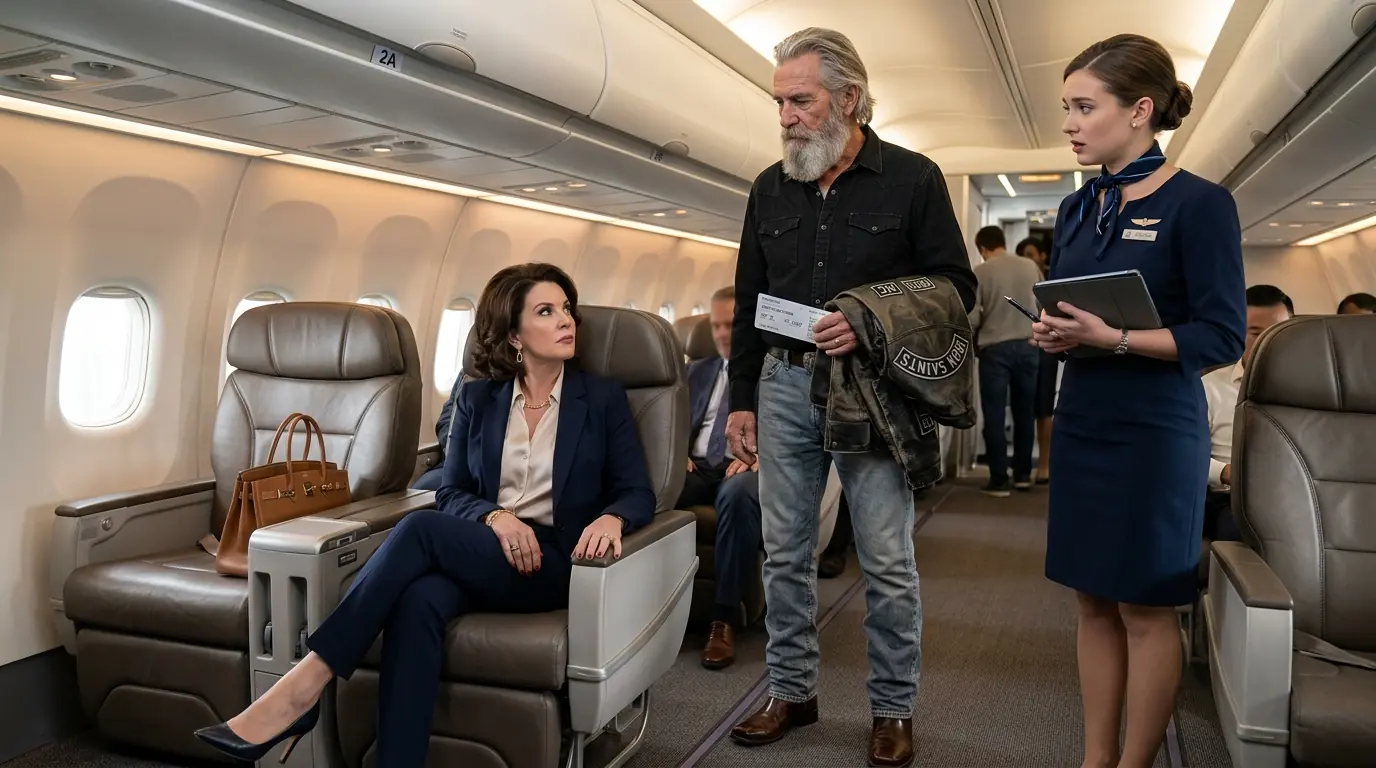
She had one leg crossed over the other, a designer heel lifted just enough to block the aisle without looking accidental. Her carry-on was tucked beneath the seat in front of her, her handbag rested on the armrest, and her phone glowed in her hand as she typed with quick, irritated taps. She did not look up when Griff stopped beside her.
“Excuse me,” he said quietly. “I believe you’re in my seat.”
The woman lifted her eyes slowly, as if his voice had interrupted something more important than boarding an aircraft. She gave him one long scan from his boots to his gray beard, pausing on the worn knuckles of his right hand, the faint oil stain near his cuff, and the folded leather vest under his arm. Her face tightened with immediate judgment.
“Seats like this aren’t for bikers,” she said, loud enough for the row behind her to hear. “Whatever upgrade mistake happened, you need to take it up with someone in the back.”
The cabin softened into silence.
A man in 1C lowered his newspaper. A young consultant in 3D froze with one earbud halfway in. Two phones rose almost at the same time, their owners pretending to check messages while angling their cameras toward the aisle.
Griff took a slow breath. He had been underestimated in bars, boardrooms, repair shops, county courthouses, charity auctions, and once at a funeral by a man who later asked him for a loan. Being judged did not surprise him anymore. It bored him. What interested him was what people did after they realized they were wrong.
“My boarding pass says 2A,” he said, taking the paper from his shirt pocket. “I’d be glad to show it to you.”
The woman laughed. It was not amusement. It was performance.
“Of course it does,” she said. “These days anybody can print anything. I fly first class every month. I know exactly what belongs in this cabin.”
Griff looked at the empty seat number above her head. Then he looked back at her.
“I belong in my assigned seat.”
Her expression sharpened. “Don’t get aggressive with me.”
“I’m standing still.”
“You’re looming.”
“I’m six feet tall, ma’am. That part is difficult to adjust.”
A few passengers exhaled nervous little laughs and immediately regretted it when the woman’s head snapped toward them. The young flight attendant standing near the galley shifted anxiously. Her name tag read Jessica. She looked no older than twenty-four, and her face carried the strained smile of someone trying to decide whether a situation was awkward or dangerous.
“Sir,” Jessica said, “can I see your boarding pass?”
Griff handed it to her.
The woman leaned back into the seat, arms folded, claiming the space with her whole body. “You should call your supervisor. I’m not being harassed by some road gang reject before takeoff.”
Jessica’s eyes widened. “Ma’am, please.”
“No,” the woman said. “I’m traveling alone. I don’t feel safe. He walked up here with that”—she nodded toward the folded leather vest—“and started demanding my seat.”
Griff did not unfold the vest. He did not defend the patch on the back, did not explain the club, did not explain that the old emblem had been retired when the charter became a foundation, did not explain that he had spent fifteen years riding escort for fallen firefighters, delivering Christmas bikes to children in mountain towns, and rebuilding flooded homes with men who frightened strangers only until those strangers needed help.
Explanations were wasted on people committed to misunderstanding.
Jessica compared the pass to the manifest on her tablet. Her mouth tightened.
“Ma’am,” she said carefully, “this passenger is assigned to seat 2A.”
The woman’s smile vanished.
“That is impossible.”
“It’s what the manifest shows.”
“Then your manifest is wrong.” She lifted her phone. “My husband will handle this.”
Griff watched the name flash briefly on the screen when she dialed. Richard Whitmore.
He knew the name.
Not personally, not exactly. But he knew Whitmore Meridian, the consulting firm that had spent the last six months courting his company for a nationwide contract. Griff also knew Richard Whitmore was desperate. The man’s logistics division had been bleeding clients since spring, and the only thing keeping his investors calm was the possibility of landing RoadSaint Distribution’s five-year fleet modernization deal.
A deal Griff had killed at 9:47 that morning, less than twenty minutes before boarding.
Not because of this woman. He had never met her before.
He had killed it because his legal team had found a pattern in Whitmore Meridian’s vendor treatment that looked too much like the old games Griff had spent his life fighting: small contractors squeezed, minority-owned trucking outfits delayed, independent operators buried under penalties that never seemed to touch the big firms. He had signed the termination decision in the airport lounge while drinking black coffee and watching rain slide down the glass.
Now Richard Whitmore’s wife was sitting in his seat, telling him he did not belong.
Life had a sense of humor as dry as desert dust.
The lead flight supervisor arrived from the galley, a tall woman in her fifties with graying hair pinned back tightly. Her name was Marlene, and she carried herself like someone who had kept order in thousands of metal tubes full of impatient strangers.
“What seems to be the problem?” Marlene asked.
“This biker is trying to take my seat,” the woman said before Jessica could answer. “He’s been intimidating me since he boarded. I want him removed.”
“Ma’am,” Jessica said quietly, “his boarding pass does show 2A.”
Marlene looked at the pass, then at Griff, then at the woman.
“Mrs. Whitmore,” she said, choosing each word like a step across ice, “your assigned seat is 3C.”
Darla Whitmore stared at her.
That was when Griff learned her first name. Darla. It suited the sharp corners of her voice.
“I was moved,” Darla said.
“I don’t show a seat change.”
“Then update it.”
“I can’t move another passenger out of his assigned seat without cause.”
Darla stretched her legs wider into the aisle, her red-soled shoe pressing lightly against Griff’s boot. It was a deliberate touch, just enough contact that any attempt to step forward would become something she could describe later.
“Then call security,” she said. “Because I am not moving for him.”
The cabin tightened again.
Phones rose higher.
Griff looked down at her shoe resting against his boot. He could have moved her leg with two fingers. He could have stepped over her. He could have let old instincts rise, the ones that had made him road captain of the Iron Saints when bad men thought numbers mattered more than nerve. He did none of those things.
He stepped back.
“I’ll wait,” he said.
Darla smiled as if she had won.
Airport security arrived seven minutes later. Two officers in navy uniforms moved down the aisle with expressions caught between routine authority and growing discomfort. Darla began before they reached her row.
“Thank goodness,” she said, pressing a hand to her chest. “This man has been harassing me. He’s trying to force me out of my seat. I feel extremely unsafe.”
One officer turned to Griff. “Sir, we’ll need to see your boarding pass and ID.”
“Of course.”
Griff handed both over. The officer studied the license. Walter Grayson. No title. No company. No hint that the quiet man with the weathered face controlled the largest independent motorcycle and specialty freight logistics network in North America, a company built from two tow trucks, a motorcycle trailer, and a promise made beside a hospital bed twenty-eight years earlier.
Darla narrated while they checked his ID.
“He came up here acting like he owned the place,” she told nearby passengers. “That’s what happens when airlines let anyone upgrade now. First class used to mean something.”
Griff looked at the folded vest in his hands.
It had meant something once, too. Brotherhood. Road discipline. A promise to stop when somebody broke down in the rain. A promise not to leave a rider behind. People saw leather and imagined trouble because trouble was easier to understand than loyalty.
The officer handed his ID back.
“Mr. Grayson, we’re going to ask you to step forward with us while the airline sorts this out.”
“My seat is confirmed.”
“I understand.”
“Then why am I the one stepping away?”
The officer’s face flickered. “For everyone’s comfort.”
Darla’s smile deepened.
“For everyone’s comfort,” Griff repeated softly.
He picked up his briefcase and stepped toward the front galley. Passengers watched him pass. Some looked embarrassed. Some looked relieved it was not them. Jessica’s eyes filled with apology she was too afraid to speak.
Darla called after him, “Maybe check his bag. People like that always carry something.”
Griff stopped.
For the first time since the confrontation began, he looked directly at her with the full weight of his attention. The cabin seemed to feel the shift. Darla’s smile faltered just a fraction.
“What is your husband’s company called?” he asked.
Darla blinked. “What?”
“You said your husband’s company keeps this airline in business. What company?”
Her arrogance returned quickly. “Whitmore Meridian Group. Not that someone like you would know it.”
“I know it.”
The lead supervisor looked from Griff to Darla, sensing the ground moving beneath them but not knowing why.
Darla gave a little laugh. “Do you?”
“Yes.” Griff checked his watch. “At 9:47 this morning, RoadSaint Distribution terminated its pending five-year contract with Whitmore Meridian. Effective immediately.”
No one moved.
The younger security officer frowned. “RoadSaint?”
Griff nodded once. “Walter Grayson. Founder and chief executive officer.”
The cabin went utterly silent.
A man in 4A whispered, “RoadSaint is worth billions.”
Griff continued, not loudly, not angrily, just clearly enough for the phones to hear.
“Whitmore Meridian’s proposal was under review for a five-hundred-million-dollar national fleet support contract. It was declined this morning after my legal team confirmed discriminatory vendor practices and retaliation against independent operators. I had not planned to discuss that on an airplane.” He looked at Darla. “You brought your husband into the conversation.”