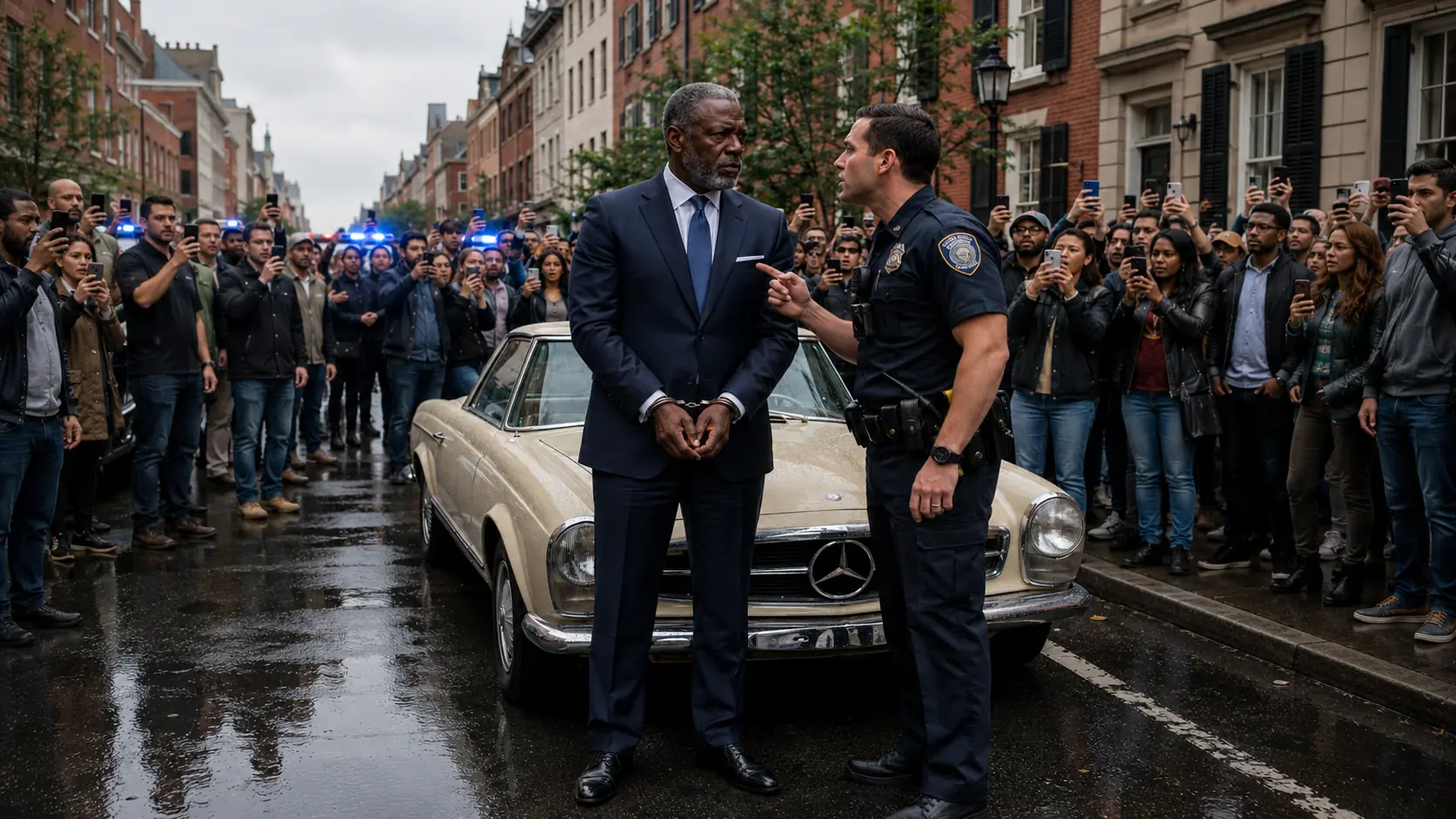
You think you know power. You think a badge and a gun make you the authority. Watch closely. In the pouring rain of a DC suburb, a rookie officer made the single biggest mistake of his life. He saw a black man in a luxury vintage convertible and saw a suspect.
He didn't check the plates. He didn't listen to reason. He just saw what he wanted to see. But the man in those handcuffs wasn't a car thief. He was the man who interprets the very laws that officers swore to uphold.
This is the story of how arrogance met absolute justice and the karma that shattered a career. The rain in Georgetown doesn't wash things clean. It just makes the cobblestone slick and turns the pavement gray. On a rainy night, the wind cut through coats and the street lights fractured into starry blurs on wet windshields. Justice Jeremiah Halloway adjusted the rearview mirror of his 1968 Mercedes-Benz 280 SL Pagoda.
It was a pristine cream white classic restored with the kind of money saved over a long and distinguished career. At 62, Jeremiah was a man of heavy silence. He had the posture of a former linebacker and the eyes of a man who had read too many death row appeals. He was an associate justice of the state supreme court. a position he had held for many years following a decade on the Federal Circuit. He was tired.
The oral arguments that day had been tedious, an endless debate that had drained his patience. He just wanted to get home to his wife, Martha, and the leftover pot roast he knew was waiting in the fridge. He turned onto Wisconsin Avenue, the engine purring with that distinct mechanical German precision. He wasn't speeding. He wasn't swerving.
He was listening to a jazz playlist, Miles Davis's Blue and Green, trying to decompress. Two blocks behind him, the narrative of his night was being written by someone else. Officer Marcus Brad Harland was young, only a few years on the force, and bored. He was sitting in his patrol car, a Dodge Charger that smelled of stale coffee and sanitizer, watching the rain pelt the hood. Harlon was the kind of cop who wore his sunglasses on the back of his head even at night and kept his hand resting near his holster while ordering a sandwich.
He was ambitious, but in the way a hammer is ambitious, looking for nails. Dispatch, 4 Alpha 2, Harlon radioed, his eyes narrowing as the cream Mercedes glided past his hideout near the pharmacy. Go ahead, for Alpha 2. The dispatcher's voice crackled, bored and tinny. I've got a suspicious vehicle.
Vintage Mercedes Cream heading north on Wisconsin. No plates visible. Haron lied. The plates were visible. He just hadn't looked hard enough through the rain.
But that wasn't why he pulled out. He pulled out because the car looked too expensive and the silhouette of the driver looked out of place for this time of night in Harland's mental map of the neighborhood. Copy that. Proceed with caution. Jeremiah saw the burst of red and blue lights in his rearview mirror before he heard the siren.
He sighed, a long, weary exhalation that fogged the glass slightly. He turned down Miles Davis. He checked his speedometer. He was well within the limit. He checked his signal.
He pulled over slowly and safely under the glow of a street lamp near end street. He didn't reach for his glove box. He didn't reach for his phone. He knew the drill. He had written opinions on the Fourth Amendment.
He knew exactly what was about to happen. And he knew exactly how dangerous it could be, regardless of who he was. He placed both large, scarred hands on the steering wheel at 10 and two and waited. Haron parked the cruiser at an aggressive angle, blinding the Mercedes with his spotlight. He stepped out into the rain, adjusting his belt.
He didn't put on his hat. He walked with a strut. Flashlight beam cutting through the drizzle, tapping the rear fender of the classic car as he passed. A dominance move. He shined the light directly into the side mirror, blinding Jeremiah.
Roll it down. Harlon barked, tapping the glass with his flashlight hard enough to make Jeremiah wse. The car was decades old. The glass was original. Jeremiah handc cranked the window down.
The cold wet air rushed in, smelling of rain and asphalt. Officer, Jeremiah said. His voice was a deep baritone, calm and resonant. Is there a problem? License and registration.
Now Harlon didn't say hello. He didn't explain the stop. His hand was already resting on the grip of his service weapon, just hovering. Officer, Jeremiah repeated, keeping his hands visible. I'm going to reach into my jacket pocket for my wallet.
My registration is in the glove compartment. I am informing you of my movements. I didn't ask for a commentary, Harlon snapped. I asked for the ID. Stop stalling.
I am not stalling. I am ensuring my safety, Jeremiah said, his eyes locking onto Harland's. May I ask why I was pulled over? You don't get to ask questions. The car fits the description of a vehicle reported stolen in Arlington earlier tonight.
Harlon improvised. It was a sloppy lie. A stolen 1968 Mercedes in Arlington. The odds were astronomical. Jeremiah's brow furrowed.
This vehicle has not left my possession all day. It has been parked in the judicial garage at the Supreme Court building since this morning. Harlon froze for a microsecond. The words Supreme Court registered, but his ego swatted them away. He saw a black man in an expensive car giving him attitude.
That was the only variable his brain was processing. "Get out of the car," Harlon commanded, stepping back and unclipping the safety strap on his holster. officer for a traffic stop unless you have probable cause or a reasonable suspicion of a threat. Asking me to exit the vehicle is I said get out of the car. Harlon shouted, his voice cracking slightly. Now or I will drag you out.
Jeremiah looked at the young man. He saw the fear masquerading as aggression. He saw the tremble in the officer's hand. He knew that arguing constitutional law on the side of a rainy road with an adrenaline spiked rookie was a good way to get shot. Slowly, deliberately, Jeremiah unlatched the door.
Hands on the hood, Harlon yelled, unsettled by the man's size. I'm complying, Jeremiah said softly. He turned and placed his hands on the wet, cold metal of his beloved car. Harlon kicked Jeremiah's legs apart. Wider.
This is unnecessary, Jeremiah stated. Check the license plate, officer. It's a vanity plate. JST, run it. Shut up.
Harlon hissed. He grabbed Jeremiah's wrist and twisted it behind his back, slapping a handcuff on. The metal bit into the skin. "You are making a mistake, son," Jeremiah said, his voice dropping an octave. "A very expensive, career-ending mistake.
The only mistake," Harlon said, tightening the second cuff, "was thinking you could joy ride through my district." The rain intensified, drumming against the roof of the Mercedes like a nervous heartbeat. Jeremiah stood cuffed in the rain, the water soaking through his wool suit, chilling him to the bone. He maintained a stoic dignity that seemed to infuriate officer Harlon even more. Harlon didn't put Jeremiah in the back of the cruiser immediately.
He wanted to parade his catch. He wanted to search the car. He left Jeremiah standing by the hood and leaned into his radio. Dispatch, subject in custody. One male non-compliant.
I'm conducting a search of the vehicle. incidental to arrest. Copy 4 alpha 2. Did you confirm the plates? Running them now. Harlon lied again.
He hadn't run them. He was too focused on the win. He walked over to the driver's side door of the Mercedes and began to rummage. He tossed the contents of the glove box onto the passenger seat. A tire pressure gauge, a packet of napkins, and a leather folio.
Harlon ripped the folio open. Inside was the vehicle registration and a laminated card. State of Maryland judiciary official identification. Harlon looked at it. He squinted in the flashlight beam.
Justice Jeremiah Halloway. His brain did a strange gymnastic routine. Instead of realizing, "Oh no, I've arrested a judge." His brain said, "Fake ID. Nice try," Harlon muttered to himself, tossing the ID onto the wet floor mat. really highquality fake.
He continued the search. He popped the trunk. Inside he found a black garment bag and a heavy wooden box. He opened the box. Inside, resting on blue velvet, was a ceremonial gavel with a gold band.
Engraved on the band, presented to Honorable Jeremiah Halloway for 20 years of service to the bar. Harlon paused. A seed of doubt finally cracked the shell of his arrogance. But he was too deep in. If he backed down now, he looked weak.
He had to find something, anything, to justify the cuffs. Drugs, alcohol, and unregistered weapon. By now, the commotion had drawn attention. Georgetown is a neighborhood that never fully sleeps. People were coming out of the bistro and townhouses.
Phones were coming out. A young woman with green hair and a nose ring was the first to start filming. Then a man in a jogging suit. Why is he handcuffed? The woman shouted.
He wasn't doing anything. We were watching from the window. Back up. Harlon shouted, shining his light into the faces of the gathering crowd. Police business.
Step back. He's an old man. The jogger yelled. Why are you treating him like a terrorist? Jeremiah turned his head slightly.
Please, he called out to the crowd, his voice projecting clearly despite the rain. Do not antagonize the officer. Record the interaction. Do not interfere. I need witnesses, not participants.
You be quiet. Harlon stormed back over to Jeremiah. He grabbed the justice by the arm and shoved him roughly toward the patrol car. Get in. I have a heart condition, officer.
Jeremiah lied. A tactical lie to test the officer's adherence to procedure. These cuffs are restricting my circulation. You should have thought about that before you stole a car. I did not steal this car.
If you look at the registration on the floorboard where you threw it, you will see my name matches the registration. Yeah, and the fake ID matches the fake registration. I know how this works. Harlon shoved Jeremiah's head down and forced him into the cramped back seat of the Charger. The door slammed shut.
The silence inside the cruiser was absolute, save for the muffled sound of the rain and the police radio. Jeremiah shifted his shoulders, trying to alleviate the pain in his wrists. He took a deep breath. He closed his eyes and began to recite the case law for title 42, section 1,983 of the US code, civil action for deprivation of rights. It kept him calm.
Outside, Harlon was pacing. He was hyped up on adrenaline. He called for a tow truck. Dispatch, I need a tow for the subject vehicle. Impound.
Then a second police cruiser rolled up. No lights, just a silent approach. A sleek, unmarked SUV followed it. Haron straightened up. "Finally, backup," he muttered.
A uniformed sergeant stepped out of the second cruiser. Sergeant Omar Miller was a veteran, many years on the force, thick around the middle, tired of rookie mistakes. And from the unmarked SUV stepped a tall woman in a trench coat. Detective Simone Vance, sharp, observant, dangerous. What have we got, Haron?
Miller asked, walking over, eyeing the crowd that was now 20 people deep and holding up smartphones like candles at a vigil. Stolen vehicle recovery, Sarge, Harlon said, puffing his chest out. Subject was non-compliant. Suspected DUI, though I haven't breathalyzed him yet. Found a bunch of weird paraphernalia in the trunk.
Gavl robes. Guys running a con. A con? Miller looked at the Mercedes. That's a 280 SL Pagoda.
Beautiful car. Yeah. Well, he picked the wrong night. Harlon scoffed. Who is he?
Detective Vance asked, her voice cutting through the rain. She walked past Harland toward the Mercedes. She peered inside at the mess Harlon had made. She saw the registration on the floor. "Some guy named Jeremiah Halloway," Haron said dismissively.
"Has a fake ID saying he's a judge. Miller stopped. He froze in the middle of lighting a cigarette. The flame of his lighter flickered and died. Say that name again, Miller said, his voice dropping to a whisper.
Jeremiah Halloway. Why? Miller looked at Vance. Vance looked at Miller. The color drained from the sergeant's face so fast it looked like he'd been shot.
Haron, Miller said very slowly. Where is the suspect? In the back of my unit. Miller threw his unlit cigarette into a puddle. He didn't run, but he walked with a terrifying urgency toward Harland's car.
He shined his flashlight through the back window. The beam illuminated the face of the man in the back seat. The man looked up. His expression was one of infinite patience and simmering rage. He looked directly at Sergeant Miller and nodded once.
Miller knew that face. Everyone in law enforcement in the state knew that face. That was the face that signed the warrants. That was the face that presided over the police oversight committee hearings. Miller turned around.
He looked at Harlon with eyes that promised murder. Harlon, Miller whispered. Give me the keys. What? Why?
I processed him. Give me the keys, Miller roared. A sound so loud it silenced the crowd on the sidewalk. Harlon flinched, handing over the keys. Sarge, what is it?
It's just a car thief. That Miller hissed, pointing a shaking finger at the back seat. Is Justice Jeremiah Halloway of the state supreme court? Harlon laughed nervously. "No, Sarge.
I saw the ID. It looked fake. I was in his courtroom recently for FOP testimony." Miller snarled. "That is him.
You just handcuffed a Supreme Court justice. You illegally searched his vehicle and you just ended your career." Miller ripped the back door open. "Justice Halloway," Miller said, his voice trembling. "I am so so sorry.
Please let me get these off you. Jeremiah didn't move his hands immediately. He looked past Miller directly at Harlon, who was standing in the rain, his mouth slightly open. The water dripping off his nose as the reality of what he had done began to crash down on him like a collapsing building. "Sergeant Miller," Jeremiah said calmly, "do not remove these cuffs yet.
I want Lieutenant Anderson here, and I want the body camera footage from Officer Harland secured immediately. I want everything by the book because I'm going to teach this young man a lesson about the law that he will never ever forget. The atmosphere on end street had shifted from a routine traffic stop to a crime scene of a different nature. The rain was still falling, but the flashing lights of three cruisers and an unmarked SUV painted the wet asphalt in a chaotic strobe of red and blue. Officer Marcus Harland stood by the fender of his Charger, water dripping from the brim of his nose, watching his career dissolve in real time.
He felt a cold knot in his stomach. Not remorse, but self-preservation. His mind was racing, trying to construct a narrative that would save him. Inside the cruiser, Justice Jeremiah Halloway sat in the dark, hands still cuffed behind his back. The pain in his shoulders was sharp, an old rotator cuff injury flaring up, but he didn't make a sound.
He stared at the back of the driver's seat, meditating on the fury that was building behind his calm facade. He wasn't just a victim right now. He was evidence. Minutes later, a black government-issued Tahoe tore down the street, hopping the curb slightly as it parked. The door flew open before the vehicle even fully settled on its suspension.
Lieutenant Victor Anderson stepped out. Anderson was a man who looked like he was carved out of granite and stress. He had been the one who invited Justice Halloway to the police academy graduation to give the keynote speech. He knew Halloway. He respected Halloway.
Anderson marched past Harland without looking at him. Straight to Sergeant Miller. Where is he? Anderson barked. Back of the unit.
Alpha 2. Miller said, looking at the ground, Anderson walked to the back door of Harland's car and ripped it open. The dome light flickered on, illuminating the justice. "Jeremiah," Anderson breathed, the informality slipping out in his shock. "Justice Halloway, my God, Lieutenant," Halloway said, his voice dry.
"I see you're making good time. Get him out of there now," Anderson yelled, turning his head toward Haron. Harlon, get the keys. Get these cuffs off him immediately. Harlon fumbled for his keys, his hands shaking so badly he dropped them on the wet pavement.
He scrambled to pick them up, the metallic clink echoing like an admission of guilt. He moved toward the door, key in hand. "Stop," Halloway said. The single word froze everyone. "Sir," Anderson asked.
I do not want Officer Harland to remove these cuffs, Holloway said, his eyes hard as Flint. I want to be processed. Justice, please, Anderson pleaded, leaning into the car, Rain soaking his uniform. This is a misunderstanding, a catastrophic screw-up. We can resolve this right here.
I'll drive you home myself. We'll expunge the record of the stop. No, Halloway said. If I were a 19-year-old kid from Anacostia, would you expunge the record on the sidewalk? If I were a brick layer driving home from a double shift, would you be offering me a ride home or would I be on my way to central booking?
Silence stretched between them. Officer Harland made an arrest, continued, his voice rising just enough to be heard by the crowd that was still filming. He claimed probable cause. He claimed I matched the description of a suspect. He claimed I resisted.
Those are legal assertions, Lieutenant. They require a legal conclusion. If you release me now, you are covering up his misconduct. I want the booking. I want the fingerprints.
I want the mug shot. I want every single step of this humiliation documented in the official record. Sir, you don't want that, Miller interjected. I need that, Haway corrected. Because when I sue this department and this officer, I don't want there to be a single gap in the timeline.
Take me to the precinct. Anderson closed his eyes, exhaling a breath that ghosted in the cold air. He knew Halloway was right. He also knew this was the nightmare scenario. Miller, Anderson said quietly.
Drive Harland's car. Take the Justice to the station. Do it by the book. Gentle transport. What about me?
Harlon asked, his voice small. Anderson turned to the young officer. The look on the lieutenant's face was terrifyingly blank. You, Anderson said, are going to ride with me, and you are going to pray that the dash cam audio wasn't recording when you decided to violate the civil rights of the highest ranking judge in the state. Get in the Tahoe.
The second district precinct was a fluorescent-lit box of noise and misery. Phones rang, drunk shouted, and the smell of industrial cleaner fought a losing battle against the smell of unwashed bodies. When the doors opened, and Sergeant Miller escorted Justice Halloway, still in cuffs, into the intake area, the room didn't go silent immediately. It took a moment. The desk sergeant, an older woman named Griggs, who had seen everything from homicides to lost kittens, looked up over her reading glasses.
She saw a Miller. Then she saw the tall, distinguished black man in the ruined bespoke suit. She dropped her pen. "Sarge," Griggs asked, standing up. "Is that is that Judge Halloway?"
"Book him, Griggs," Miller said, his voice filled with self-loathing. "Officer Harland brought him in." "On what charge," Griggs demanded, coming around the desk. "Being black on a rainy night," someone muttered. Grand Theft Auto and resisting arrest, Halloway answered for them.
Allegedly, Miller finally uncuffed Halloway. The justice rubbed his wrists. There were deep red indentations where the metal had bitten into the skin. He looked at them, then held his wrists up to the security camera in the corner of the room, documenting injuries. Holloway muttered.
"Sir, would you like water? Coffee?" Griggs asked frantically, looking for a clean cup. I want my phone call, Haway said. And I want to be processed.
Fingerprints first. It was a surreal scene. Usually, officers forced the suspect's hand onto the ink pad or the digital scanner. Here, Sergeant Miller stood back, looking like he wanted to vomit, while Justice Halloway voluntarily placed his hand on the glass scanner. Beep beep beep.
The machine accepted the prince. The system ran an automatic check. Within seconds, the computer screen flashed red. Warning, sensitive profile. Government official.
DOJ clearance level 5. System flagged him. Griggs whispered. Print it. Holloway commanded.
"Print the arrest sheet." While Griggs typed, trembling, the doors to the precinct swung open again. Lieutenant Anderson marched in with Harlon trailing behind him like a puppy expecting to be kicked. Harlon looked around the room. He saw the way the other cops were looking at him.
Not with solidarity, but with the look you give a man who just brought a live grenade into a bunker. Haron, into the interrogation room. Box one. Sit there and don't touch anything. Anderson ordered.
Harlon slunk away. Just as Anderson approached the intake desk. We have the lawyer you requested on the line, Marcus Barrett. The room went quiet again. Marcus Barrett wasn't just a lawyer.
He was the lawyer. He was the man who sued the city for millions the last time a cop shot the wrong dog. He was a shark who smelled blood in the water from miles away. Halloway took the receiver Griggs offered. "Marcus," Halloway said, his voice calm.
"Jerry." Barrett's voice boomed on the other end, loud enough to be heard through the earpiece. I'm getting bits and pieces. Tell me it's a joke. Tell me you aren't actually at the second district.
I am being booked. Marcus, Officer Marcus Harland, badge number 4922. He stopped me without probable cause, performed an illegal search, used excessive force, and arrested me on a fabricated charge of grand theft auto regarding my own vehicle. I'm leaving my house now, Barrett said, the sound of keys jingling in the background. Jerry, don't say another word to them.
Actually, knowing you, you've already trapped them in a procedural corner. I'll be there in 20 minutes. I'm bringing the press. No press yet, Haway said. I want the internal workings to play out.
I want to see if the system corrects itself or if it doubles down. I want to see the police report Harland files. You want to catch them in a lie?" Barrett chuckled darkly. "You always were a chess player."
"All right, I'm coming." Halloway hung up. He turned to Harlon, who was watching from the doorway of the interrogation room before Anderson shoved him inside. Halloway walked over to the glass window of the interrogation room. He couldn't hear what was being said inside, but he could see.
He saw Harlon sitting at the metal table, head in his hands. Detective Simone Vance walked up beside Halloway. She held a tablet. Just as Halloway, she said, her tone professional but apologetic. I've pulled the GPS data from Harland's cruiser.
He was sitting stationary for quite a while before he pulled you over. He wasn't on patrol. He was headhunting, fishing, Halloway corrected. He was looking for a prize and he caught a whale. So, we also pulled the stolen vehicle report he mentioned.
Vance continued, swiping on the tablet. There was no report of a stolen Mercedes tonight. There was a stolen Honda Civic in Bethesda. He made it up. Fabrication of evidence, Halloway noted.
That's a felony, detective. I know, Vance said. Sir, Lieutenant Anderson wants to know. Do you want to press charges or do you want his badge? Halloway turned to face the room of officers.
They were all watching him. The power dynamic had completely inverted. He wasn't the prisoner. He was the judge. And this entire precinct was his courtroom.
I don't want just his badge. Halloway said softly. I want to know who trained him. I want to know who signed off on his evaluations. I want to know why a man with that much bias and that little discipline was given a gun and the authority to take away a citizen's freedom.
I'm going to tear this department apart brick by brick until I find the rot. Just then, Harlon came out of the interrogation room. He looked defiant now, having had a moment to convince himself he was the victim. You can't keep me in there. Harland spat at Anderson.
I followed procedure. He was aggressive. Harlon pointed at Halloway. He refused to identify himself. Halloway took a step closer to the rookie.
The height difference was intimidating. But it was the intellect difference that was lethal. Officer Harlon Halloway said, "I identified myself three times. You chose not to listen because the truth didn't fit the story you were writing in your head. You saw a black man in a Mercedes and you decided I was a criminal.
That is not police work. That is prejudice. I have a gut instinct," Harlon argued, digging his grave deeper. Your gut, Halloway said, is about to cost the city millions, and it is going to cost you your freedom. Freedom?
Harlon scoffed. You can't arrest a cop for doing his job. No. Halloway smiled. A cold, shark-like smile.
But we can arrest a cop for filing a false police report, false imprisonment, and assault under color of authority. Halloway turned to Lieutenant Anderson. Lieutenant has officer Harland filed his official arrest report yet. He wrote the preliminary statement in the car. He submitted it digitally a few minutes ago.
Excellent, Halloway said. Then he has officially committed the crime. He put the lie in writing. Halloway looked at Vance. Detective, I am no longer the suspect.
I am the victim of a crime that just occurred in your jurisdiction. I would like to file a formal complaint against Marcus Harland and I expect him to be booked tonight in this cage with me. The room gasped. You want me to arrest him? Anderson asked, pointing to Haron.
Equal justice under the law, Haway said. If I am here for a crime I didn't commit, he should be here for the crimes he did commit. Cuff him. The precinct doors didn't just open. They were assaulted.
Attorney Marcus Barrett pushed through them with the kinetic energy of a category 5 hurricane. He was a small man, barely 5'7, wearing a tan trench coat over a tuxedo. He had evidently come straight from a gala, but he occupied space like a giant. He didn't check in at the front desk. He walked straight into the bullpen, spotting standing by the interrogation room window.
"Jerry!" Barrett shouted, ignoring the three officers who moved to intercept him. Don't say a word. Not one word. Mr.
Barrett, you can't just barge in here. Sergeant Griggs called out, though her heart wasn't in it. She knew who he was. Barrett spun around, pointing a manicured finger at her. I am Marcus Barrett.
My client is a sitting Supreme Court Justice of this state. He has been held without cause. Every second you keep him here is another zero on the check the city will be writing. Now, who is the commanding officer? Lieutenant Anderson stepped forward, looking like a man who wished he had taken a sick day.
I am Lieutenant Anderson. Anderson, Barrett said, sizing him up. I want the arrest report. I want the dash cam footage. I want the body cam footage.
And I want to know why the hell my client is still in handcuffs. He requested to remain in them. Counselor, Anderson admitted. Barrett looked at Jeremiah. Halloway nodded slowly.
Optics, Marcus, Halloway said calmly. Barrett's eyes gleamed. He understood immediately. Brilliant. You want the photo op?
All right, Lieutenant. Has the officer Harlon was it? Filed his report? Yes, Anderson said. Good.
Then the trap is shut. Barrett clapped his hands. Now release my client immediately and give me a copy of that report. Anderson signaled Miller. Miller approached Halloway and with a noticeable sigh of relief unlocked the handcuffs.
Halloway rubbed his wrists, the red marks stark against his skin. Detective Vance, Halloway said, addressing the investigator who had taken over the scene. The footage. Detective Vance held up a flash drive. We just finished reviewing the dash cam audio and video.
Justice, you were right. Play it. Barrett commanded. Here now, I want every officer in this room to see what their colleague did. Anderson hesitated.
Counselor, this is evidence. Play it. Halloway's voice boomed, regaining the command he held in his courtroom. This is a public building. That is a public record.
Play the tape. Anderson nodded to Vance. She plugged the drive into a large monitor on the wall used for briefings. The screen flickered to life. The rain streaked view from Harland's cruiser appeared.
The audio crackled. Harlon Vto. Dispatch, I've got a suspicious vehicle. No plates visible. The video clearly showed the Mercedes vanity plate JST illuminated by the street lights.
Lie number one. Barrett counted aloud. The video continued. Harlon pulled the car over. The interaction played out.
The officers in the bullpen watched in silence. They saw Harland's aggression. They heard Halloway's calm compliance. They heard the lie about the stolen car. But the damning moment came at the end of the clip after Haron had shoved into the car.
Harlon was walking back to the driver's seat of his cruiser. He thought he was alone. He muttered to himself audible over the rain. Cocky old prick thinks he owns the road. Let's see how he likes the cage.
I'll find something to pin on him. The room went deathly silent. Malice, Barrett whispered. Premeditated malice. He admitted to manufacturing a charge, Halloway said, staring at the screen.
He admitted it on a government recording. Just then, the door to interrogation room 1 opened. Officer Harland stepped out, looking pale. He hadn't seen the video being played. He saw everyone staring at him.
What? Harlon asked, defensive. The guy was resisting. I told you. Lieutenant Anderson turned to Harlon.
The look of camaraderie was gone. In its place was the cold, hard face of the law. Officer Marcus Harland, Anderson said, his voice echoing off the tile walls. Place your hands behind your back. Harlon blinked.
What, sir? You are under arrest. Anderson said, unclipping his own handcuffs. For what? Harlon shrieked, backing away.
He's the criminal. He's the one who for filing a false police report. Official misconduct and assault in the second degree. Anderson recited. Turn around.
Now Harlon froze. He looked at Miller. Miller looked away. He looked at the other officers. No one moved to help him.
The blue wall of silence had crumbled under the weight of undeniable video evidence and the rank of the victim. Slowly shaking violently, Harlon turned around. Click, click. The sound of the cuffs locking onto Harland's wrists was the loudest sound in the room. Halloway buttoned his jacket.
He smoothed his tie. He walked over to where Harland stood. You have the right to remain silent, Halloway told the young officer. I strongly suggest you use it because unlike you, I know the law, and I'm going to ensure it applies to you with its full weight. Barrett grabbed Halloway's arm.
Jerry, let's go. The press is outside. The press? Anderson asked, alarmed. I tweeted on the way over.
Barrett smiled aggressively. CNN is setting up a tripod on the sidewalk. Halloway walked out of the precinct, a free man. Behind him in the cage he had meant for the justice. Officer Harland sat alone, staring at the floor while the booking officer asked him for his belt and shoelaces.
The arraignment took place a few days later. It was the hottest ticket in town. The courtroom was packed. Reporters, community activists, police union representatives, and law students. Justice Halloway did not sit on the bench.
He sat in the front row of the gallery next to his wife, Martha. She held his hand tightly. Halloway wore a navy suit, looking every bit the statesman. He wasn't there to grandstand. He was there to witness.
The judge presiding was Judge Regina Whitmore. She was known as the scalpel because she cut through nonsense with surgical precision. She and Halloway had served on the appellate circuit together years earlier. They were not friends. They disagreed philosophically on many things, but they shared a mutual terrifying respect for the sanctity of the court.
"All rise," the bailiff announced. Judge Whitmore swept in, her robes billowing. She sat, adjusted her glasses, and looked down at the defense table. Officer Harland sat there. He was in a cheap suit that didn't fit well.
He looked smaller than he had in his uniform. His attorney was a union lawyer known for getting cops off the hook by delaying trials until the public forgot. Docket number 4992. The clerk read. The people versus Marcus Harlon. charges.
Perjury, falsifying business records, false imprisonment, assault. How does the defendant plead? Not guilty, your honor, the lawyer said, standing up. And we would like to move for immediate dismissal based on a lack of probable cause for the arrest of my client. Whitmore peered over her glasses.
Dismissal? Council, I have reviewed the preliminary evidence, including the dash cam footage. The probable cause for your client's arrest seems to be his own voice admitting to a crime. It was taken out of context, your honor, the lawyer argued. Officer Harland was venting frustration after a tense encounter.
It was not an admission of intent. The district attorney, a sharp woman named Angela Park, stood up. Your honor, the defendant explicitly stated, "I'll find something to pin on him." Minutes later, he filed a sworn affidavit claiming the victim was driving a stolen vehicle, a claim he knew to be false. That is not venting.
That is framing. We are requesting bail be set at a significant amount. The lawyer scoffed. Your honor, my client is a police officer. He is not a flight risk.
He has ties to the community. We request release on his own recognizance. Judge Whitmore leaned back. She looked at Haron. Mr.
Harlon," she said. Her voice was soft, which was usually a bad sign. "You stand accused of using the power of the state to terrorize a citizen. The fact that the citizen happened to be a Supreme Court justice is the only reason we are here so quickly." "But the law does not care about his title.
It cares about the act," she shuffled her papers. "However," Whitmore continued, "the court is concerned about the safety of the community. A man who carries a badge and gun and is willing to fabricate evidence is a danger to the public. Your honor, the lawyer protested. I am setting bail, Whitmore declared at a substantial cash or bond amount.
The courtroom gasped. That was a serious figure. This is punitive. The lawyer shouted. This is accountability.
Whitmore shot back. And council, I am also issuing a protective order. Your client is to have no contact with Justice Halloway or any witnesses, and he is to surrender his passport and all personal firearms immediately. Harland looked at his lawyer, panic rising in his eyes. I don't have that kind of money, he whispered.
Then you will await trial in county, Whitmore said coldly. Next case, the gavel banged. It sounded like a gunshot in the quiet room. As the baiffs moved to take Harlon back into custody, the young officer looked back at the gallery. He locked eyes with Halloway.
Halloway didn't smile. He didn't gloat. He just looked at Harland with a profound, heavy sadness. He saw a young life wasted by arrogance and hate. Haron was led away in handcuffs.
The irony was lost on no one. Outside the courthouse, the media swarm was intense. Microphones were shoved into Halloway's face. Justice Halloway. Justice Halloway.
Do you think justice was served today? A reporter yelled. Halloway stopped. He stepped to the microphones. The crowd hushed.
Justice was not served today, Halloway said, his voice deep and rumbling. Justice is a process, not a moment. Today, a step was taken. But let us be clear. If I were not who I am, if I were a custodian or a teacher or a mechanic, I would likely still be in that cell, and Officer Harland would still be on patrol.
The system worked for me because I am of the system. Our job, my job, is to make sure it works for the people who aren't. "Will you sue the department?" Another reporter asked. "My attorney, Mr.
Barrett, will be filing a civil rights lawsuit." Haay said. "Not for the money. I will donate every cent of the settlement to the public defender's office. I am suing to force a change in policy.
I am suing to ensure that the next time a young man is pulled over in the rain, the officer sees a citizen, not a suspect. He turned and walked away, Martha by his side, disappearing into the backseat of the same cream colored Mercedes that had started it all. But the story wasn't over. The legal system moves slowly, but karma moves fast. And for Marcus Harland, the nightmare was just beginning.
In the holding cell at the courthouse, Harlon sat on a metal bench. He was in the general population holding area. He was wearing his cheap suit, but he was surrounded by men in orange jumpsuits. A man on the other side of the cell looked at him. A man with tattoos on his neck and a distinct scar over his eye.
"Hey," the man said. "I know you." Harlon kept his head down. "Yeah, I do. The man stood up.
"You're officer Harlon, second district." Harlon looked up, terrified. "You arrested my little brother last year," the man said, stepping closer. "Planted evidence on him. He did several months because of you.
The other men in the cell stood up. They sensed the shift in the air." The guards were on the other side of the heavy steel door. They were slow to react. Harlon backed into the corner.
"Back off," he warned. his voice shaking. I'm a police officer. Not in here. The man smiled, showing a gold tooth. In here?
You're just another inmate. The holding cell in the basement of the courthouse was a cage of concrete and echoing noise. For officer Marcus Harland, the threat wasn't theoretical anymore. It was standing right in front of him, smelling of stale sweat and old rage. The inmate with the scar didn't rush him.
He let the silence do the work. Harlon backed against the bars, his heart hammering a frantic rhythm against his ribs. He looked for the guards. The viewing window in the heavy steel door was empty. I didn't.
I didn't mean to, Harlon stammered, his police training evaporating in the face of raw survival instinct. Didn't mean to what? The man stepped closer. Didn't mean to plant the evidence or didn't mean to get caught. Another inmate, a younger kid awaiting trial for burglary, laughed.
He looks scared. Look at him shaking. Where's that big bad wolf attitude now? The man shoved Haron. It wasn't a punch.
Just a hard push to the chest that slammed Harlon's head back against the steel bars. Clang, "You took years of my life." The man hissed, leaning in close. "My mom died while I was inside. You know that she died thinking her son was a criminal because you needed to hit a quota.
Haron raised his hands to protect his face. I'm sorry. I'm sorry. The man pulled back a fist. But before he could connect, the heavy steel door of the cell block buzzed and clanked open.
Step away. A correction officer barked, stepping in with a baton raised. The inmate scattered, moving to the benches with practiced innocence. The man smiled at Harlon. a cold, promising smile. See you in county, officer.
Harlon was pulled out of the cell, shaking, humiliated, and marked. He wasn't a cop anymore. In the ecosystem of the jail, he was prey. The trial of the people versus Marcus Harland was the most televised event in the state's judicial history for the year. The defense strategy was desperate.
The union lawyer tried to paint Harlon as an overworked, stressed rookie who made a good faith error in the heat of the moment. But the prosecution, led by DA Angela Park, was merciless. She didn't just use the video. She used Harland's own history. She dug up prior complaints of discourtesy that had been swept under the rug by his precinct.
The turning point came when Harland took the stand. It was a Hail Mary pass. He wanted to look the jury in the eye and explain himself. I was just trying to keep the neighborhood safe, Harlon said, his voice trembling slightly. It was dark.
The car looked suspicious. I thought I thought I was doing the right thing. Dia Park stood up for cross-examination. She didn't shout. She walked to the podium, placed a transcript on it, and looked at him over her reading glasses.
Mr. Harlon, she started. You said the car looked suspicious. Can you tell the jury exactly what is suspicious about a luxury vintage Mercedes driving within the speed limit? It it didn't fit the area, Harlon said.
Georgetown, Park asked. One of the wealthiest neighborhoods in DC. A luxury car didn't fit. I mean, at that time of night, Harlon pressed. Park leaned in.
Is there a curfew for luxury cars? No. So, if the car wasn't the issue and the speed wasn't the issue and the time wasn't the issue, what was left? The driver. Harlon froze.
I didn't see the driver until I stopped him. Lies, Park said, playing a snippet of the dash cam video again. The headlights clearly illuminated Jeremiah's silhouette before the lights went on. "You saw a black man. You assumed he stole it."
"That is the only variable, isn't it?" "I'm not a racist." Harlon snapped, losing his cool. I didn't ask if you were a racist, Mr. Harlon.
I asked if you profiled him. But your outburst answers the question quite well. Park turned to the jury. No further questions. The verdict came after the jury deliberated for only a few hours.
When they returned, the courtroom was packed. Justice Halloway sat in the back, silent, a sentinel of the law. We the jury find the defendant Marcus Harland guilty on all counts. Harlon closed his eyes. His mother sitting behind him began to sob.
Judge Whitmore didn't wait for a sentencing hearing. She had the guidelines ready. Marcus Harland, please stand. Harland stood, his legs feeling like water. You have disgraced your uniform, Whitmore said, her voice cutting through the room.
You took an oath to protect the Constitution. Instead, you treated it as an inconvenience. You assaulted a man not because of what he did, but because of who you decided he was, and then you tried to frame him to cover your tracks. She paused. I sentence you to a lengthy term in the state penitentiary with a significant minimum period to be served before eligibility for parole.
You are immediately remanded into custody. The gavel banged. It was final. Prison for a former cop is not like prison for anyone else. It is a solitary nightmare.
Harlon was placed in protective custody to keep him from being killed in the general population. But protective custody isn't safety. It's isolation. He spent most of each day in a small cell. He had no interaction with other humans except for the guards who looked at him with disdain.
To them, he was a dirty cop. The worst kind. The kind that makes their jobs harder. He lost everything. His girlfriend left him.
His friends from the force stopped writing after the appeal was denied. He went bankrupt fighting the legal battles. The hard karma wasn't just the physical confinement. It was the psychological erosion. He had defined himself by his authority.
Now he had none. He had to ask permission to shower. He had to ask permission to eat. He was stripped of his ego layer by painful layer until all that was left was the realization of his own stupidity. He had plenty of time to think about Jeremiah Halloway.
He thought about that rainy night every single day. He replayed it. If I had just looked at the plate, if I had just listened, if I had just apologized. Regret, he learned, tastes like cold oatmeal and iron bars. While Harlon rotted, Jeremiah Halloway thrived.
He won the civil suit against the city. The settlement was substantial. True to his word, Jeremiah didn't keep a dime. He founded the Halloway Initiative for justice, a legal aid clinic dedicated to representing victims of police misconduct and funding body cam analysis for public defenders. At the ribbon cutting ceremony, Marcus Barrett stood by his side.
"You turned a traffic stop into a movement, Jerry." Barrett said. No, Jeremiah said, looking at the fresh paint of the clinic. I just turned the lights on. The cockroaches were always there.
Now we just have a better way to catch them. Jeremiah continued to serve on the Supreme Court. His opinions becoming even more pointed, more focused on the nuances of power and individual rights. He became a legend. Not just a judge, but a symbol.
The man the system couldn't break. Years later, the final twist. The rain in Georgetown was just as cold years later. Jeremiah Halloway, now older but moving with the same quiet dignity, pulled his beloved 1968 Mercedes-Benz 280L, up to the entrance of the Willard, one of DC's swankiest hotels. He and Martha were attending a charity gala.
The valet stand was busy. A man in a red vest was sprinting back and forth, grabbing keys, opening doors, hustling for tips. He looked tired. His face was lined with premature aging, and his hair was thinning. He ran up to Jeremiah's car.
He didn't look at the driver. He looked at the hood ornament. "Good evening, sir. Valet parking is $40," the man said, his voice raspy. He reached for the door handle.
Jeremiah rolled down the window. Good evening. The valet froze. He knew that voice, that deep baritone resonance. The valet looked down.
It was Marcus Harlon. He was out on parole. He couldn't work in security. He couldn't carry a gun. He couldn't get a government job.
He was working for minimum wage plus tips, parking cars for the people he used to police. Haron stared at Jeremiah. His face went pale, then flushed with a deep, burning shame. He looked at the leather seats. He looked at the steering wheel he had once ordered Jeremiah to release.
Just as Halloway, Harlon whispered. Jeremiah looked at him. He saw the broken man. He saw the fear. He didn't see a monster anymore.
He just saw a tragedy. Mr. Haron, Jeremiah said calmly. Haron couldn't move. I I can get someone else to park it.
Sir, I shouldn't I can't touch this car. It's just a car, son, Jeremiah said. He opened the door and stepped out. He handed the keys to Haron. Harlon looked at the keys in his palm.
They felt heavy. "Be careful with second gear," Jeremiah said, adjusting his tuxedo jacket. "It sticks a little when it's cold." "Sir." Harlon looked up, tears forming in his eyes.
"After everything, you trust me with this?" Jeremiah placed a hand on Harland's shoulder. It wasn't a heavy hand, but it held the weight of the world. "I don't trust you, Mr. Harlon," Jeremiah said softly.
"But I believe in rehabilitation. You paid your debt. Now do your job." Jeremiah handed him a $20 bill. A tip.
"Keep it dry," Jeremiah said. He took Martha's arm and walked into the hotel, leaving Harlon standing in the rain, holding the keys to the life he had destroyed, weeping silently under the glow of the hotel lights. The karma wasn't that he was in jail. The karma was that he was free, but he had to serve the man he tried to break. And he had to do it with a thank you, sir.
And that is the story of Justice Jeremiah Halloway and Officer Marcus Harlon. It serves as a brutal reminder that authority is borrowed, not owned. Harlon forgot that the badge on his chest was a symbol of service, not a shield for his ego. He learned the hard way that when you strike at the law, the law strikes back, and it rarely misses.
Justice showed us that true power isn't about loudness or aggression. It's about composure, knowledge, and the unshakable belief in what is right. In the end, the roles were reversed. Not by magic, but by the inevitable grinding gears of justice.