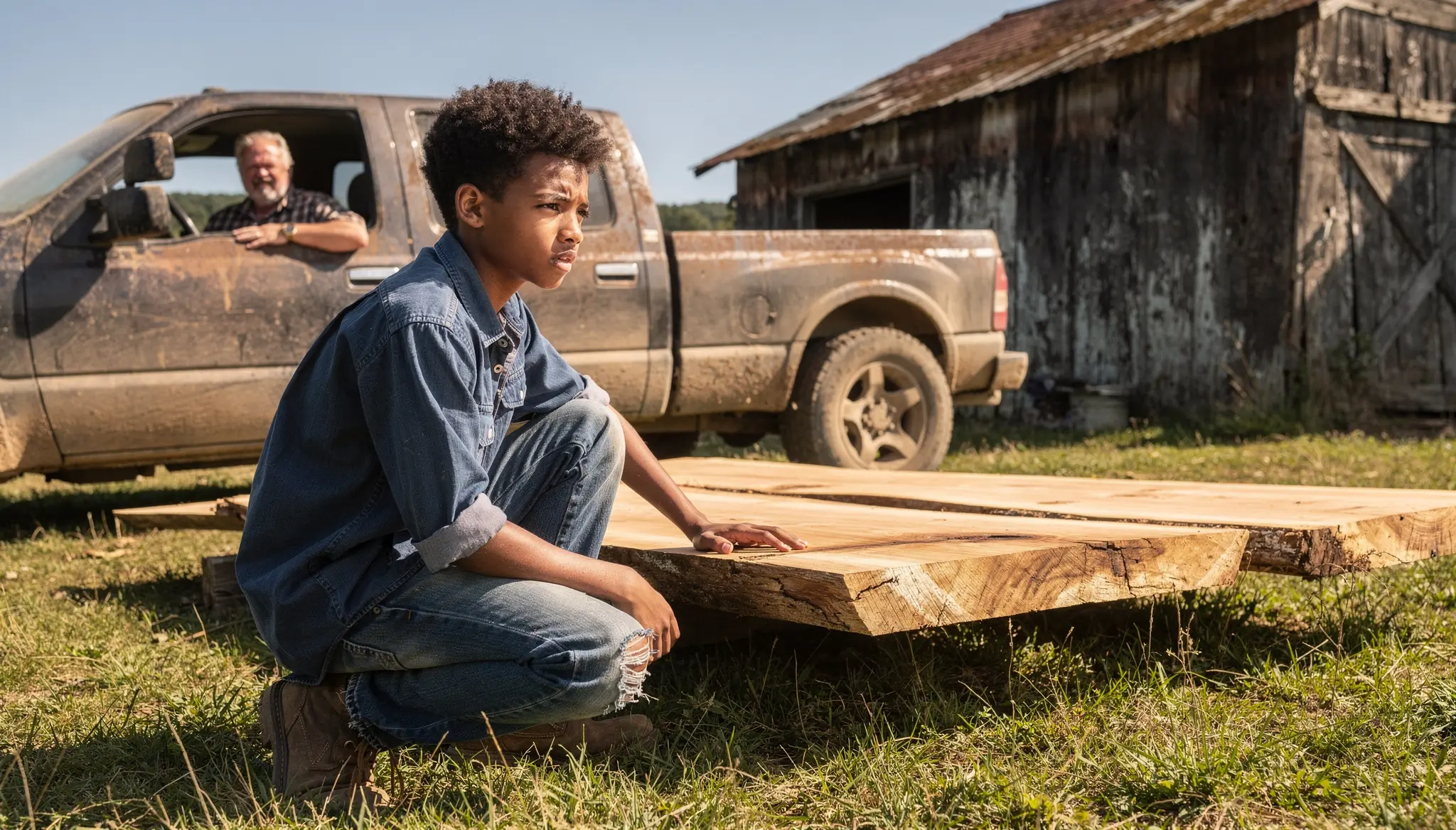
Marcus was 16. He looked at the massive maple slabs on the ground, then back at the neighbor."We made an arrangement," he said."An arrangement?" Roy Greer laughed from his truck window. "That's a real nice word for taking somebody's garbage. What exactly are you going to do with all that? Build yourself a bonfire?"Marcus crouched down and pressed his palm flat against the grain. "Not sure yet, but I'll figure it out."Roy shook his head and drove on. Eight years later, he would regret that laugh for the rest of his life.Calder Mills was the kind of place where people knew which families had been there for generations and which ones were still being tested. The Ellis property sat at the eastern edge of town: nine acres of thin soil and field grass that produced nothing of value and asked nothing in return. The barn at the back of the lot leaned slightly to the left, its roof holding against the weather through habit more than structure.Marcus had grown up looking at that barn the way kids look at things they've always known without really seeing them. His mother, Diane, worked the night shift at the Holt County Packaging Plant—a job that paid enough to keep the lights on and not much else. She was home by 6:00 in the morning, asleep by 7:00, and back on her feet by 3:00 in the afternoon, moving through the kitchen with the careful efficiency of someone who had learned not to waste motion. She didn't complain about the schedule; she didn't complain about much. What she talked about when she talked was Marcus: what he was reading, how he was doing in school, whether he was eating enough. She carried the future of that household in the same quiet way she carried everything else.Marcus's grandfather, Earl Ellis, had built the barn with two other men in the summer of 1971. Earl had been a woodworker by instinct and a laborer by necessity, a man who could read the grain of a board the way other men read weather. He passed when Marcus was nine, leaving behind a chest of hand tools, a workbench bolted to the barn floor, and a habit of saying things that only made sense years later.One of those things was this: "The land doesn't care what you think of it. It only cares what you do with it."Marcus had not known what to do with any of it: the land, the tools, the words. He was 16, doing well enough in school to stay out of trouble, working weekend hours at a hardware store in town, and trying not to think too hard about what came next. The future had a texture to it in Calder Mills that felt fixed. You could see it in the way people talked about college, like it was something that happened to other families. Marcus wasn't bitter about it; he just hadn't found a reason yet to believe it could go differently for him.That reason showed up on a Tuesday morning in the form of Dale Hutchkins.