“Boy, the sawmill is using your land as a dump now, and you are just going to stand there and smile about it.” Marcus was sixteen. He looked at the massive maple slabs on the ground, then back at the neighbor. “We made an arrangement,” he said.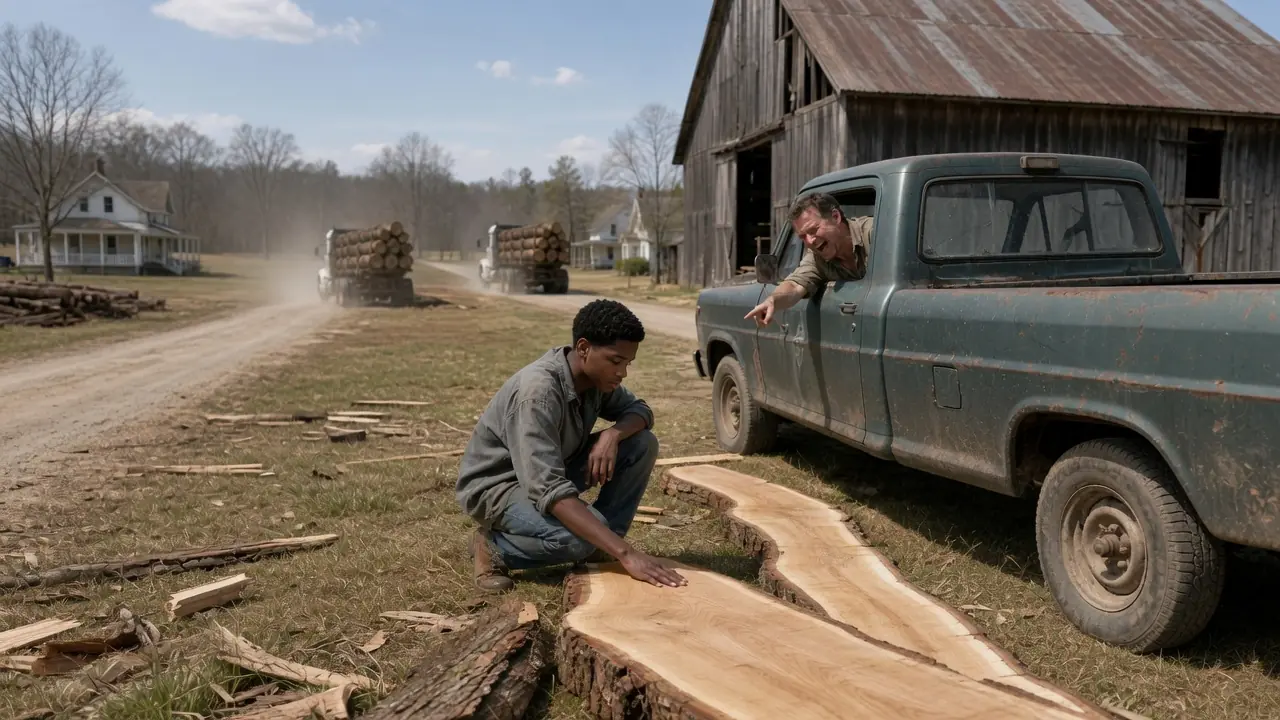
“An arrangement.”
Roy Greer laughed from his truck window. “That is a real nice word for taking somebody’s garbage. What exactly are you going to do with all that? Build yourself a bonfire?” Marcus crouched down and pressed his palm flat against the grain.
“Not sure yet, but I will figure it out.” Roy shook his head and drove on. Eight years later, he would regret that laugh for the rest of his life. Calder Mills was the kind of place where people knew which families had been there for generations, and which ones were still being tested. The Ellis property sat at the eastern edge of town, nine acres of thin soil and field grass that produced nothing of value and asked nothing in return.
The barn at the back of the lot leaned slightly to the left, its roof holding against the weather through habit more than structure. Marcus had grown up looking at that barn the way kids look at things they've always known without really seeing them. His mother, Diane, worked the night shift at the Holt County Packaging Plant, a job that paid enough to keep the lights on and not much else. She was home by 6:00 in the morning, asleep by 7:00, and back on her feet by 3:00 in the afternoon, moving through the kitchen with the careful efficiency of someone who had learned not to waste motion. She did not complain about the schedule.
She did not complain about much. What she talked about when she talked was Marcus, what he was reading, how he was doing in school, whether he was eating enough. She carried the future of that household in the same quiet way she carried everything else. Marcus’s grandfather, Earl Ellis, had built the barn with two other men in the summer of 1971. Earl had been a woodworker by instinct and a laborer by necessity, a man who could read the grain of a board the way other men read weather.
He passed when Marcus was nine, leaving behind a chest of hand tools, a workbench bolted to the barn floor, and a habit of saying things that only made sense years later. One of those things was this. “The land does not care what you think of it. It only cares what you do with it.” Marcus had not known what to do with any of it.
The land, the tools, the words. He was sixteen, doing well enough in school to stay out of trouble, working weekend hours at a hardware store in town, and trying not to think too hard about what came next. The future had a texture to it in Calder Mills that felt fixed. You could see it in the way people talked about college, like it was something that happened to other families. Marcus was not bitter about it.
He just had not found a reason yet to believe it could go differently for him. That reason showed up on a Tuesday morning in the form of Dale Hutchins. Dale was a broad-shouldered man in his mid-40s who ran operations at the Grantham Sawmill three miles east on Route 9. He drove a company truck and wore the same expression whether he was delivering good news or bad, steady, unhurried, like a man who had said difficult things often enough that the words no longer cost him anything. He knocked on the front door of the Ellis house at half past eight, held his cap in both hands, and introduced himself to Diane before asking if her son was around.
They were simply inconvenient ones. For years, the mill had been trucking them to a disposal yard at seventy dollars a load, and the cost had become steady enough to bother the accountants. Dale had driven past the Ellis property enough times to notice the unused back acreage. He was not there to do Marcus a favor. He was there because the back corner of that land solved a logistics problem.
The arrangement he proposed was direct. The mill would use the far end of the property as a drop point, pay a small monthly fee, and remove any remaining wood after six months if the family did not want it. Marcus looked past Dale at the truck idling at the edge of the gravel drive. Then he asked the question that had come to him immediately, the one he suspected most people in his position might not think to ask. “What is the wood actually worth?”
Dale considered the question without hurry. “To us, nothing. We cannot move it. The commercial buyers will not touch anything that does not fit standard specs, and we do not have the setup to mill it down further.” He turned his cap once in his hands.
“To someone who knew what to do with it, I honestly could not say.” Diane was standing behind Marcus. He could feel her hesitation without looking at her. Accepting castoffs from the mill, from an operation that had been running in this county since before the Ellis family had owned a square foot of it, carried a weight that had nothing to do with wood. She knew how it would read to certain people.
Knew the way the story would get told at the diner and the hardware store and the church parking lot. “The Black family is taking the sawmill’s garbage now.” Marcus knew it, too.
He thought about it for exactly as long as it took him to remember his grandfather’s workbench, still bolted to the barn floor. Still holding. He told Dale they would take the arrangement. The first load arrived the following Tuesday. Two enormous maple slabs, each one close to eight feet in length, bark still attached along the live edges, hit the ground with a sound that carried across the field.
Marcus walked out and stood over them. The wood was raw and heavy and smelled of something green and recent. He crouched down and ran his hand along the surface, the way he had watched his grandfather do it—slowly, without rushing, simply reading. His grandfather had said something once while doing exactly that. They had been in the barn together on a Saturday, Earl running his palm along a warped board someone had set out for trash collection.
Marcus had been young enough to find the whole thing strange. Why spend time on something that looked so broken? Earl had not answered right away. He kept moving his hand along the grain, and when he finally spoke, it was not loud. “People throw away what they do not understand. That is not cruelty. That is just limits. The question is whether you are going to let someone else’s limits tell you what something is worth.” Marcus had been too young to hold on to it then. But standing over those maple slabs at sixteen, with the mill truck already gone, and the neighborhood quiet in the way it got when people were watching without wanting to be seen watching, the words came back to him clean and whole.
That evening, Marcus sat at the kitchen table with a piece of paper and wrote two words at the top, “Wood Furniture.” He stared at them for a while. He did not have tools beyond his grandfather's old set, did not have money for equipment, did not have training of any kind. What he had was a barn, a workbench that had been waiting for over a decade, and a piece of land that people had just started bringing material to. He thought about what Dale had said, to someone who knew what to do with it.
He did not know what to do with it yet. That was the problem, and it was also, he was starting to understand the entire point. Diane found the paper the next morning when she came home from her shift. She stood in the kitchen reading those two words while her coffee brewed still in her work clothes, still carrying the night on her shoulders. She set the paper back down exactly where she had found it.
She did not say anything about it when Marcus woke up, but that afternoon she came home from an errand with two library books, one on basic woodworking, one on furniture joinery, and left them on the kitchen table without comment. That was Diane Ellis. She did not declare things. She just moved in the direction of what she believed. Marcus opened the first book that night and did not put it down until after midnight.
By the end of the week he had read both books twice. He had also gone out to the barn and spent an hour with his grandfather's tools, getting the feel of what was there. A set of chisels that needed sharpening, two hand planes, a mallet with a cracked handle that could be wrapped and saved, a measuring square that was still true. Not much. Enough to start making mistakes with.
The maple slabs sat outside on the ground. He understood from the books that they needed to stay there for a while. Green wood was unstable, liable to move in ways that would ruin any work done too early. He needed to wait. He marked the date on a calendar pinned inside the barn door and drew an arrow forward by twelve months.
A year. He had a year before the wood would be ready. That meant a year to learn something before the material was. He did not tell anyone what he was planning. There was nothing to tell yet.
But something had shifted in the way he looked at the barn in the evenings. It no longer looked like a leftover from someone else’s life. It looked like the beginning of something that had not been named yet. In a place where people had already decided nothing much was going to happen. Marcus had not decided that.
He had decided the opposite. And he went to bed that night the same way his grandfather used to finish a day in the shop with sawdust on his hands that was not from any real work yet. But would be.
The first year was mostly about being wrong. Marcus spent those 1two months reading, watching, and waiting for the maple to dry while he practiced on cheaper lumber bought in small quantities with money from the hardware store job. He learned that wood had opinions. It split when he rushed it, warped when he ignored moisture, and splintered when his chisels were not sharp enough, which was most of the time at the beginning. His grandfather's tools were good tools built for a man who knew how to use them. In Marcus's hands, they were a constant reminder of how much he still did not know.
By the time the maple was ready, he had ruined enough pine boards to fill half the barn with kindling. He had also gotten better. Not skilled, not yet, but better. His joints were cleaner. His measurements were more consistent.
He had learned to read the grain before making any cut, the way the lines in the wood told you where it wanted to go and where it would resist. He had learned that fighting the material was always a losing proposition. The wood had been growing for decades before he touched it. It had its own logic and his job was to understand it, not override it.
The first piece he attempted in maple was a small side table. He chose a slab that had dried, evenly milled the surface with his grandfather's hand plane until it was flat, and cut the legs from a secondary board that Dale had included in one of the later deliveries. The joinery was mortise and tenon, the most basic connection in furniture making and also the most unforgiving because if the fit was wrong, everything that followed was wrong. Marcus cut the mortises by hand, chiseling slowly, checking the fit every few passes. It took him three days to cut what an experienced woodworker might have done in an afternoon.
The table held. It was not beautiful, but it was level and solid, and when he pressed down on the top with both palms and felt no give at all, something settled in him that had been unsettled for a year. He kept going.
The second piece was a coffee table with a full live edge on one side, the bark preserved along the curve. He chose a simple oil finish, working it into the surface with a cloth in long even strokes. The grain came alive under the oil in a way that stopped him mid-stroke. He stood there looking at what the wood had been hiding under its raw surface, the depth of it, the way the figure in the grain caught light differently depending on angle. He understood then why his grandfather had spent so many evenings in that barn.
It was not just the making, it was the moment when the material became itself. The coffee table was the piece he brought to Cal Whitmore. Cal ran the only independent woodworking shop within forty miles of Calder Mills, a converted garage on the south end of Harding Road that smelled of linseed oil and cedar shavings. He was in his late sixties, a compact and deliberate man who had learned the trade from his own father and had been working alone for so long that the shop had taken on the particular silence of someone who preferred it that way. His reputation in local woodworking circles was modest but specific.
He was the person people mentioned when they wanted to describe what careful work looked like. Marcus had found Cal’s name through a woodworking forum he accessed at the library. He drove to Harding Road on a Saturday morning, the coffee table wrapped in moving blankets in the bed of his mother’s truck, and knocked on the shop door. Cal opened it, looked at Marcus, and said, “I do not take on students.” He said it the way people say things that have been said often enough to become policy.
Not unkind, just closed. Marcus thanked him and left. He sat in the truck for a few minutes with the engine off. Then he got out, pulled the moving blankets off the coffee table, and carried it to the shop door. He set it on the ground in front of the entrance and knocked again.
When Cal opened the door this time, Marcus stepped aside so Cal could see the table clearly. Cal looked at it for a long time. He crouched down and examined the joinery where the stretcher met the leg. He ran his thumb along the live edge where Marcus had cleaned up the bark transition. He tilted his head and looked down the surface of the top, checking for flat.
His expression did not change, but something in the quality of his attention did. “Where did you get the slab?” Cal asked. Marcus told him about the Grantham arrangement, the maple coming in every Tuesday, the nine acres, the barn, the year spent learning on pine before touching any of it. Cal stood up.
“I still do not take on students,” he said, “but I am in the shop most mornings by seven. I do not lock the door once I am working.”
He went back inside. That was the whole of it. No invitation, no terms, no acknowledgement of what it meant, but the door was not locked the following Tuesday morning when Marcus arrived at 6:55 and Cal did not tell him to leave. He just worked and Marcus watched. And when Marcus asked a question, Cal answered it without elaboration.
That was the arrangement for the better part of a year. What Marcus learned in that shop was different from what the books had given him. Books could describe technique, but they could not show him how Cal held a marking gauge or the particular angle at which he presented a hand plane to figured maple to avoid tear out. They could not replicate the way Cal would stop in the middle of a cut and hold the piece to the light coming through the north facing window, reading the surface slowly with complete attention, as if the wood were telling him something he needed to hear before he could continue. Marcus kept his mouth shut and his eyes open.
He drove to Harding Road three mornings a week before the hardware store opened and he brought every lesson back to the barn in Calder Mills, where the Tuesday deliveries had built up a supply of dried maple that was beginning to look to anyone paying attention like serious inventory.
One morning toward the end of that year, Cal watched Marcus work through a difficult section of figured grain without asking for guidance and without making the mistake Cal had expected him to make. Cal set down his own tools. “You do not need to keep coming here,” he said. It was not a dismissal. It was the closest Cal came to a compliment and Marcus understood it that way.
On his last morning on Harding Road, Cal handed him a marking gauge without ceremony, the one Marcus had watched him use on every piece since the first day, and went back to work without another word. Marcus drove home with the gauge on the seat beside him. He did not return to Harding Road after that. He did not need to.
By the time he was seventeen and a half, he had finished eight pieces, four tables of varying sizes, two sets of bookends cut from figured maple offcuts, a small wall shelf with butterfly joints inlaid across a crack in the slab, and a bench with a live edge top. He placed the bench at the end of the hallway at home, at the spot where he had watched his mother sit every morning to take off her work shoes. Diane had not asked for it. When she sat down on it the first time and ran her hand across the top, she did not say anything about the wood or how long it must have taken. She simply said, “Your grandfather would have liked this.” Marcus had not needed to hear anything else.
He entered three pieces in a regional craft market in Stowe the following spring, renting table space with money saved from the hardware store job and loading the truck before dawn. The organizers placed his booth at the far end of the exhibition hall past the pottery and hand-sewn quilts away from the main foot traffic. By the end of the day, he had sold nothing. He drove home with the truck still full and sat in the barn for a while without turning on the lights. The pieces were good, not because of pride, but because Cal had taught him to evaluate his own work honestly, and the work had passed that standard. But knowing something was good and finding the people who could recognize it were entirely different problems. He went back the following month. Same result.
A third time, a woman in her fifties stopped in front of the live edge coffee table, ran her hand across the surface the way people do when they're not thinking about it, stayed for almost two minutes without speaking, and then walked away. Marcus watched her go. He had stopped expecting the sale. He was there to understand what drew people in and what lost them.
Roy Greer happened to be at the same market that third visit browsing the stalls with his wife. He passed Marcus's booth and slowed. He looked at the pieces with the particular attention of someone recalibrating something. He did not stop, but as he moved on he said, “That is actual work.” He kept walking. Marcus heard it.
He went back to Stowe in June. A couple renovating a farmhouse outside Burlington bought the coffee table for two hundred forty dollars. They shook his hand, complimented the piece twice in the parking lot, and drove away. Marcus stood there and counted the cash. two hundred forty dollars for three days of work and months of dried wood. It did not cover what the time was worth.
What it covered was something harder to calculate, the fact that two people who did not know him had looked at his work and decided it deserved to come home with them. He put the money in his pocket and started planning the next piece. Then the bottom dropped out.
It happened on an otherwise ordinary Thursday in September. Marcus was in the barn when he heard Diane’s car come up the drive three hours before her shift ended. He came out and found her sitting in the driver’s seat still in her work clothes not moving. She had been struck by a pallet jack that a new operator lost control of in the loading bay. Her right knee had taken the impact.
She would need surgery. Recovery was estimated at twelve to fourteen weeks, and the plant's injury compensation covered a fraction of her normal wage. Marcus went inside and wrote the numbers out on paper. He looked at them for a long time. Without Diane’s full wages, the household ran short within two months, maybe three if they were careful about everything.
A job at the county packaging plant was the obvious answer. He knew the hiring manager through the hardware store. It would take one phone call. He did not make the phone call that night. He went to the barn instead and stood in the middle of it with the lights on looking at the inventory around him.
Eleven dried maple slabs, all of them usable material. No commercial operation had wanted them, yet all of them were waiting. He thought about what Dale had said more than a year ago to someone who knew what to do with it. He thought about the couple in the Burlington parking lot. He thought about his grandfather's words.
“The land does not care what you think of it. It only cares what you do with it.” Then he thought about his mother sitting in the driver’s seat not moving. That was the night that made everything harder and also everything clearer. The packaging plant job would solve the immediate problem and permanently close the one he was trying to open.
He understood that in the way you understand things at eighteen when the full weight of a decision is visible for the first time. He picked up a piece of maple from the stack. It was a long, narrow slab with a slight curve in the live edge and grain running clean and straight through the center. He set it on the workbench and turned on the lamp his grandfather had wired to the rafter above. He picked up a hand plane.
He worked until two in the morning. He did not contact the packaging plant. Instead, he approached the owners of three local businesses, a coffee shop, a barber and a small law office, and offered a single piece for display on a short-term loan, no charge, with his contact information attached. Two of the three said yes. He placed a narrow shelf in the coffee shop and a small side table in the barber's waiting area and taped a card with his name and number to the underside of each piece.
It was not a marketing strategy. It was the only idea he had. He did not know if it would work. He did not know if anything would work. What he knew was that the barn was full of material, his hands knew what to do with it, and doing nothing was a choice he had already ruled out.
He went home, checked on his mother, and set his alarm for five-thirty, so he could get two hours in the barn before opening the hardware store. He was eighteen years old. He had two hundred forty dollars in proven sales, eleven maple slabs, a workbench that had been there since before he was born, and a problem he had not yet solved. He also had the only thing that had ever turned overlooked material into something irreplaceable. He was paying attention, and he had not stopped.
The coffee shop piece moved first. Not sold, noticed. A woman came in on a Wednesday morning, ordered something she did not finish, and spent most of her time at the counter photographing the narrow maple shelf Marcus had placed near the east-facing window. She posted the image without tagging anyone or naming the maker. The caption said something about light and wood and mornings that feel like they're worth something.
The post found its way to people who responded to that kind of language, and one of those people was Brooke Sanderson.
Brooke handled interior design for cabin renovations across three states. She was practical in the way that people become practical when they are permanently overbooked. She made decisions quickly, trusted her eye, and had little patience for suppliers who could not deliver what they had promised. She had seen a great deal of furniture that tried to look handmade, and not much that actually was. The shelf in the photograph looked different to her in a way she could not immediately explain, which was precisely the kind of thing she had learned to follow.
She found the card taped under the shelf on a Thursday afternoon and called the number that evening. Marcus was in the barn when his phone rang. Brooke introduced herself without excess, explained what she did, and how she had found him, and asked two questions. What was his lead time on a dining set, and could he handle a consistent volume of work? Marcus told her six weeks on the dining set.
Brooke said to make it 8. She said she would rather wait than have him rush, and that she had been burned enough times by people who promised fast and delivered careless to know the difference mattered. She asked if she could come see the workshop before they went further. Marcus gave her the address.
She arrived the following Saturday without calling ahead, which Marcus would later understand was how she evaluated everyone. Show up unannounced and you see what is actually there, not what someone prepared for you. She walked into the barn and stood in the middle of it for a long time without speaking. She looked at the inventory along the wall. She examined the dining table Marcus had been working on, running her hand along the surface with the attention of someone who had touched a great deal of wood over the years and knew what they were feeling for.
She crouched down and looked at the joinery where the apron met the leg. Then she stood up and looked at Marcus directly. “How old are you?” she asked. “Eighteen,” he said. Something settled in Brooke’s expression, not surprise exactly, but the specific adjustment of someone who had expected one thing and found another.
“The dining set, eight weeks. And I will need two more pieces after that, probably within the quarter.” She named a price that was more than Marcus had made in six months at the hardware store. He kept his face steady. “I can do that,” he said.
What Brooke brought was not luck. It was the consequence of 3 years of work finding its way to someone equipped to recognize it. She placed his pieces in a cabin renovation outside Burlington and the designer who photographed the finished interior for a regional architecture publication included a detail shot of the dining table. It was a small mention, one image, one line of credit naming the material and the county, but not the maker. It was enough. Garrett Mosley saw the photograph.
Garrett was a developer who built high-end cabins across the Northeast and he had a specific problem that money alone could not solve. He was tired of furnishing properties with pieces that looked like they had come from a catalog. His buyers paid for the feeling that something was singular, grown from the specific geography of the place. He had been looking for a furniture maker who understood that instinctively rather than as a performance and the table in the photograph looked like someone who understood it. He contacted Brooke. She gave him Marcus's number.
Garrett drove to Calder Mills on a Tuesday, which meant he arrived at the same time as the Grantham truck. He pulled up to the property and sat in his car watching the driver lower the hydraulic bed and let a new slab slide to the ground. It was wide and curved along the live edge, with grain visible even from the distance of the driveway. Garrett got out and walked over to where Marcus was already crouching beside it, one hand on the surface. “What is that?” Garrett asked. Marcus explained the arrangement, Dale Hutchins, the disposal problem, the Tuesday deliveries, the stacks of maple built from what the mill could not sell. He did not frame it as a story. He just told it the way it was. Garrett listened, then walked into the barn and spent fifteen minutes moving through the space, finished pieces, works in progress, stacked slabs along the walls.
He came back out and stood in the yard. “Can you scale this?” he asked. “I would need help,” Marcus said. “Then get help.”
Garrett said it the way practical people state obvious things without drama, without the suggestion that it required further discussion. He needed to furnish six properties in the Champlain Valley. He named the scope. He named a rate that reflected the full market value of what Marcus was producing. It was the first time anyone had paid Marcus at the rate his work actually warranted.
After Garrett left, Marcus sat on the barn floor with his back against his grandfather’s workbench. He looked at the slab that had come off the truck that morning. He looked at the inventory. He looked at the tools on the wall, the chisels that had needed sharpening when he found them, the hand planes that had taken a year to use properly, Cal’s marking gauge on its hook above the bench. Getting help meant trusting someone else’s hands with material he had spent years learning to understand.
It meant the barn would need to change: better lighting, a stronger floor, and equipment that required more than one person’s income. It meant the operation that had been entirely his, built in silence while the county road ran past outside, would become something larger than he could contain alone.
He thought about it for exactly one evening. Then he called two brothers he had known since middle school, Ray and Curtis Dowell, who had grown up helping their uncle restore farmhouses across three counties, and who understood wood the way people understand a language they learned before they could read. Ray was twenty-two. Curtis was twenty. Neither of them had found work that used what they actually knew how to do.
Marcus explained what he needed: Garrett’s commission, Brooke’s ongoing work, the inventory, and the Tuesday deliveries that kept replenishing it. He told them what he could pay to start—honest rather than generous—and what he expected the work to grow into if they built it carefully. Ray asked one question. “The wood—is there enough of it?” Marcus told him to come look.
Ray and Curtis stood in the barn the following afternoon and looked at the stacked maple with the eyes of people who knew what they were looking at. Curtis pulled a slab from the middle of the stack and examined the end grain checking the growth rings. He set it back without comment, but the way he handled it told Marcus everything he needed to know.
They started the following Monday. The barn changed. Marcus reinforced the floor, added overhead lighting on two new circuits, and brought in a band saw and a thickness planer that Ray had located through a shop closing two counties over. The space that had been one person working alone became three people working in the particular quiet of people who respected what they were doing. There was not much conversation during work hours.
There did not need to be. The maple slabs, the ones with mineral streaks, the ones with irregular edges, the ones with wormhole patterns that commercial buyers had turned away for years—were now being pulled from inventory with intention, selected for specific commissions and matched to the requirements of each piece. What the mill had discarded as unusable, Garrett’s clients were now paying to own specifically because no two pieces could ever be the same. Diane’s knee healed through the winter. She returned to the packaging plant in January and came home to a barn that looked entirely different from the one she had watched her son disappear into for three years.
She stood in the doorway one February afternoon while all three of them were working, choosing not to come in because she did not want to interrupt. Marcus noticed her there and raised a hand. She raised one back and went inside to start dinner. She did not say much about what the barn had become. The bench in the hallway was still there, still in use every morning. Some things you say with what you make.
By the time Marcus turned twenty-one, Ellis & Kin—the name he had settled on, with “Kin” representing the men beside him and the grandfather behind him—had a three-month backlog and a list of designers who had come through Brooke’s network and arrived the same way she had unannounced looking for the real thing. Each of them found the same barn, the same inventory, the same three people who did not stop their work to explain themselves.
By his twenty-second year, the pricing had adjusted to reflect what the market kept confirming. Marcus no longer apologized for wait times or qualified the rates. Cal had told him once that the biggest mistake a craftsman makes is charging what they think the customer will accept rather than what the work actually costs to do well. Marcus had internalized that slowly and by twenty-two, it had become simply the way he operated.
Roy Greer read the profile of Ellis & Kin in a regional design magazine on a Saturday morning at the diner. He drove past the Ellis property on his way home, the same county road he had been driving past for years, and slowed down. The barn was lit from inside on a Saturday evening, all three of them still working. Roy sat idling at the edge of the gravel drive for a long moment. He had been the one who slowed his truck on the day the first load arrived and asked if the sawmill was using their land as a dump.
He had been the one who laughed at the word arrangement. He had been the one who told a sixteen-year-old boy that what he was looking at was somebody’s garbage. He pulled away from the driveway without stopping. There was nothing left to say that the barn had not already said better.
On a Tuesday in October of Marcus’s twenty-fourth year, the Grantham truck came down the road one more time. Marcus walked out in worn barn boots and a canvas jacket with sawdust pressed into the cuffs. The driver lowered the bed and a new slab came to the ground, thirty inches wide, the live edge curving in a long slow arc. Along one side, the grain ran straight through the center before rippling outward in the dense wavy lines that appeared only in maple grown under particular stress. Marcus crouched beside it.
He set his hand flat on the surface and felt the wood the way his grandfather had taught him without meaning to, slowly, without rushing toward a conclusion, reading what was actually there. Dale Hutchins had ridden along that day. He climbed out of the truck and stood a few feet back watching. After a moment, he spoke. “When I knocked on your door eight years ago, I genuinely believed I was the one doing you a favor.”
Marcus looked at the slab. “You were,” he said. “Just not the kind you thought.” Dale nodded and got back in the truck.
Marcus stayed crouched beside the wood a little longer. He thought about the bank teller who had looked twice at his name, about Roy Greer rolling down his window, about the craft market booth in the far corner of the exhibition hall, about Cal’s door and the two trips it had taken to open it, about his mother in the driver’s seat, about his grandfather’s voice on a Saturday in the barn, the words that had taken eight years to land correctly.
Earl Ellis had not been talking about wood. Marcus understood that now in the complete way, the way you understand something when you have lived it rather than just heard it. His grandfather had been talking about what happens when you refuse to accept someone else’s assessment of what a thing is worth. He had been talking about the specific kind of attention that does not announce itself, does not ask for recognition, and does not stop when the results are slow.
Marcus stood up. He brushed the sawdust from his knees. Ray appeared in the barn doorway and lifted one end of the slab without being asked. They carried it inside together, set it against the wall with the rest of the inventory, and got back to work. That is the part of Marcus’s story that does not make it into the design magazines or the profile pieces, the years when nobody was watching, when the barn held only a sixteen-year-old with borrowed books and his grandfather’s dull chisels failing quietly in a place where most people had already decided nothing much was going to happen.
The sawmill saw waste. The neighbors saw a pile of garbage on a Black family’s land. What Marcus saw was material that had not been understood yet. And that gap between what something looks like and what it actually is turns out to be where most real opportunity lives. Maybe you have something like that sitting in your own life right now.
Not maple slabs, but an idea people have already shrugged at. A skill that does not look like a business yet. A piece of land, literal or otherwise, that everyone else has written off. The question Marcus’s grandfather was really asking was not about wood. It was whether you can see past what something looks like right now to what it could become, and whether you are willing to keep showing up while that gap closes. Most people are not. That is not a flaw. That is simply where attention runs out.