The first thing Naomi Ellis noticed about Gate B7 was the way people looked at the sign before they looked at one another.
FIRST CLASS PRIORITY BOARDING.
The words glowed above the entrance to the jet bridge in white letters against a deep-blue screen, bright enough to be seen from halfway across the terminal.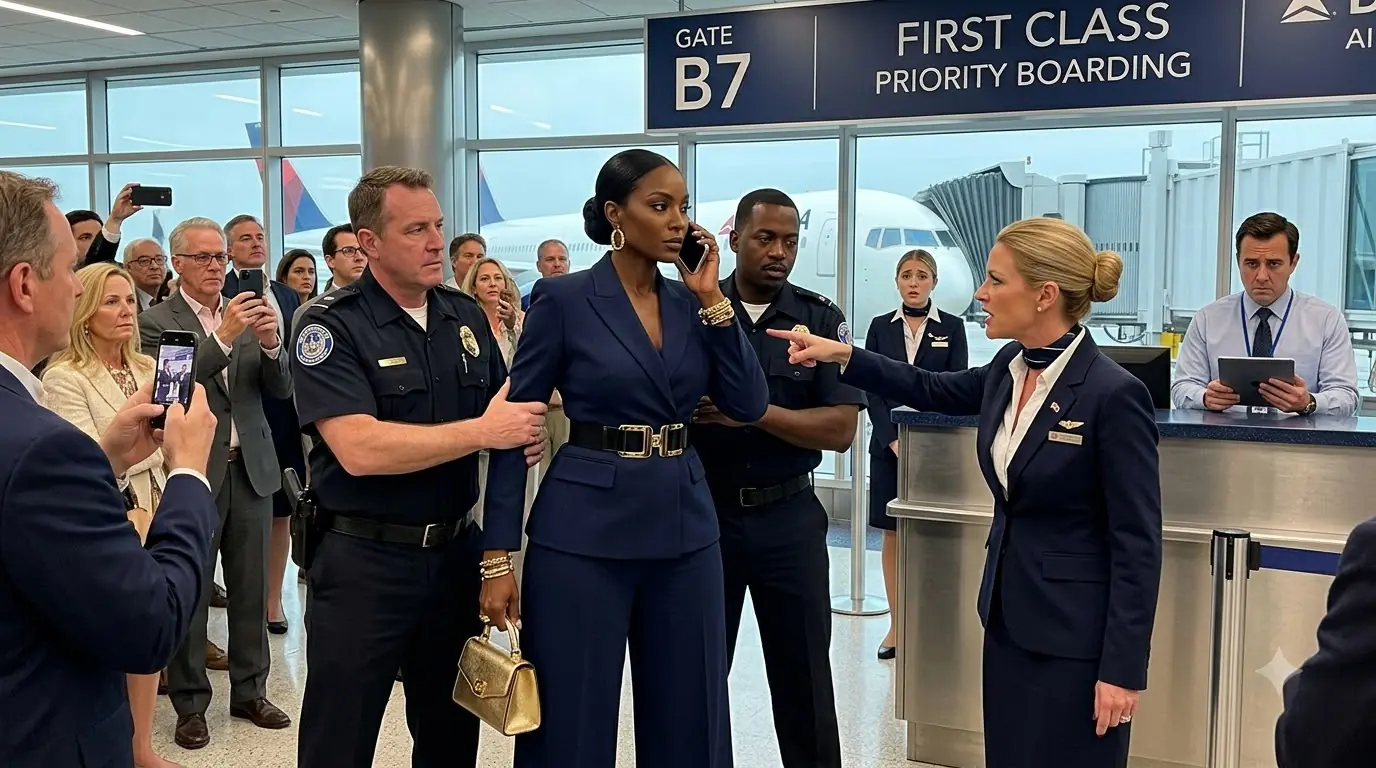
People seemed to straighten when they walked beneath it.
Shoulders back.
Phones lowered.
Suit jackets adjusted.
Boarding passes brought forward as though the paper or digital barcode carried something more important than a seat assignment.
Permission.
Naomi had spent enough time around money to recognize the ritual.
At thirty-nine, she had sat in private boardrooms where men worth hundreds of millions quietly compared aircraft memberships while pretending they were discussing logistics. She had attended dinners where nobody asked the price of anything because everyone understood that asking too openly might reveal you were still impressed by money.
She knew how status behaved.
That morning, however, she wanted to know how Meridian Atlantic Airways behaved when it believed status was absent.
That was why she had no executive escort.
No assistant.
No airport representative waiting at security.
No company car delivering her to a private entrance.
No one whispering her name to the gate staff.
Naomi had arrived like any other passenger.
She wore a deep-navy tailored power suit with broad structured shoulders, wide-leg trousers, and a black leather belt decorated with a heavy gold buckle. Large gold hoop earrings framed her face. Several bracelets rested around one wrist.
Her black hair was pulled into a sleek low bun.
In one hand she carried a small metallic-gold handbag.
With the other she rolled a compact black leather carry-on.
She had chosen the navy suit because she had a meeting after landing.
Not because she wanted to look important.
That distinction would become relevant soon.
Naomi approached the priority lane at 8:43 a.m.
Her flight to New York departed at 9:25.
Seat 2A.
First class.
She had deliberately purchased the ticket through Meridian Atlantic’s public website using her own name.
No corporate booking code.
No special passenger marker that she knew of.
At least none that should have been visible to ordinary gate personnel.
The boarding process had not yet begun.
Naomi stood near the counter reviewing a document on her phone.
The document mattered more than the flight.
Four point nine billion dollars.
That was the number waiting behind her signature.
Meridian Atlantic Airways had spent nearly a decade delaying fleet modernization.
Its long-haul aircraft were aging.
Maintenance costs were rising.
Fuel efficiency lagged behind competitors.
Three planned aircraft orders had been revised because financing costs climbed.
Then pandemic-era debt remained longer than expected.
By the previous year, Meridian Atlantic’s board had finally accepted that it needed outside capital.
Not a loan.
Not exactly.
A structured investment partnership.
That was where Ellis Horizon Capital entered.
Naomi had founded Ellis Horizon fifteen years earlier with twelve million dollars raised from pension funds, family offices, and institutional partners willing to trust a thirty-four-page thesis she wrote about transportation infrastructure.
Most of the first people she approached told her it was too complicated.
Transportation was asset-heavy.
Capital-intensive.
Regulated.
Exposed to fuel prices.
Weather.
Labor.
Politics.
Naomi agreed with every criticism.
That was precisely why she liked it.
Complicated industries punished lazy assumptions.
She understood that better than most.
Ellis Horizon invested in aircraft leasing, logistics platforms, airport infrastructure, rail systems, charging networks, industrial maintenance, and corporate mobility.
By the time Naomi turned thirty-nine, the firm controlled more than sixty billion dollars in committed capital.
But she remained largely unknown outside financial circles.
She liked it that way.
Meridian Atlantic’s proposed partnership was one of the largest transactions Ellis Horizon had ever considered.
The airline would receive staged capital across six years.
Aircraft replacement.
Maintenance modernization.
Sustainable fuel partnerships.
New routing technology.
Cabin refurbishment.
Operational resilience.
Debt refinancing.
If Meridian completed the milestones, all $4.9 billion would eventually deploy.
If it failed, portions could be withheld.
The board called the investment transformational.
Credit analysts called it necessary.
One executive inside Meridian privately called it survival.
Naomi called it unfinished.
Financial due diligence was nearly complete.
Governance review was nearly complete.
Technical assessment looked acceptable.
But something bothered her.
Customer-treatment complaints.
Not enough to destroy the deal.
Enough to make her curious.
Ellis Horizon analysts had found a cluster of complaints involving Meridian’s premium operations.
Passengers denied lounge access despite valid tickets.
Families treated dismissively at priority counters.
Travelers questioned more aggressively than others over ticket legitimacy.
Employees claiming managers encouraged them to “protect premium spaces.”
None of the complaints alone proved a systemic issue.
Meridian’s leadership described them as isolated incidents.
Naomi had heard that phrase too many times.
Isolated incident.
Bad apple.
Miscommunication.
Training opportunity.
Words that often meant nobody had bothered measuring repetition.
So Naomi decided to test the system herself.
Gate B7 was not randomly chosen.
Meridian’s Atlanta premium operations ranked among the airline’s highest revenue locations.
Its gate manager, Marissa Cole, had some of the strongest on-time boarding numbers in the Southeast.
Internal reports praised her for “protecting premium service integrity.”
Naomi wanted to know what that meant when no executive was watching.
She found out before boarding even began.
“Ma’am.”
Naomi looked up.
A blonde woman stood behind the gate counter.
Mid-forties.
Navy blazer.
White blouse.
Patterned neck scarf.
Hair pulled tightly into a bun.
Her badge read:
MARISSA COLE
GATE OPERATIONS MANAGER
“Yes?”
Marissa looked toward Naomi’s position near the priority lane.
“General boarding hasn’t started.”
“I know.”
“This area is for premium passengers.”
Naomi glanced upward at the sign.
“Yes.”
Marissa waited.
Naomi returned to her phone.
That should have been the end.
It wasn’t.
“Can I see your boarding pass?”
Naomi looked back.
“Of course.”
She opened the airline application.
Seat 2A.
First class.
Marissa took the phone.
Studied it.
Then Naomi’s face.
Then the phone again.
Something subtle happened.
Not disbelief exactly.
Suspicion.
Marissa scanned the code using the counter reader.
Green light.
Soft confirmation tone.
VALID BOARDING DOCUMENT.
Naomi saw it.
So did a young trainee standing beside the jet bridge.
The trainee looked perhaps twenty-three.
Brown hair pulled back.
Navy uniform slightly too new.
Name badge:
LENA HART.
Marissa looked at the screen.
Then frowned.
“Let me see your identification.”
Naomi reached into her handbag.
Georgia driver’s license.
Naomi Ellis.
The manager compared the name.
“Do you have another ID?”
Naomi looked at her.
“Why?”
“Verification.”
“My identification matches the reservation.”
“We occasionally need secondary identification for premium-ticket fraud.”
Naomi paused.
“Did the system flag fraud?”
Marissa did not answer directly.
“I’m asking for another ID.”
Naomi could have ended the interaction instantly.
Her passport was in her bag.
So was a corporate credential.
So was a black Ellis Horizon identification card that would likely have changed Marissa’s posture before Naomi even explained it.
She chose her passport.
Not the corporate card.
Marissa checked it.
Same name.
Same photograph.
No discrepancy.
She handed everything back.
“Where did you purchase the ticket?”
Naomi’s eyes narrowed slightly.
“Your website.”
“When?”
“Four days ago.”
“How much did you pay?”
Naomi stared at her.
“What relevance does that have?”
Marissa’s expression hardened.
“I’m trying to verify the booking.”
“You have the reservation.”
“Yes.”
“My ID matches.”
“Yes.”
“The boarding pass scanned green.”
Marissa hesitated.
“Yes.”
“Then what are you verifying?”
A couple nearby looked over.
Marissa noticed.
Her voice became more formal.
“Ma’am, we see fraudulent premium tickets regularly.”
Naomi said nothing.
Marissa continued.
“People sometimes manipulate digital passes.”
“Did I manipulate mine?”
“I didn’t say that.”
“You implied it.”
“I’m asking routine questions.”
Naomi glanced toward Lena.
The trainee looked uncomfortable.
“Do you ask every first-class passenger how much they paid?”
Marissa’s jaw tightened.
“This isn’t going anywhere productive.”
“I agree.”
Naomi reached for her phone.
Marissa did not give it back immediately.
Naomi looked at her hand.
“My phone.”
Marissa returned it.
Naomi stepped aside.
She could have stopped there.
She nearly did.
Then Marissa spoke quietly to the supervisor standing behind her.
Not quietly enough.
“Watch that one.”
Naomi turned.
A man holding a tablet stood beside Marissa.