The afternoon sun hung low over the elementary school in Houston, Texas, casting long golden shadows across the playground. It was that quiet hour between classes and dismissal, when the energy of the day began to settle but hadn’t yet faded.
Children’s laughter drifted faintly from inside the building, bouncing off the brick walls and echoing into the open space near the front gate. Parents had already started to gather, some checking their phones, others chatting softly while keeping an eye on the entrance.
It looked like an ordinary day. Nothing unusual. Nothing remarkable. Until a man approached the gate. His name was Samuel Brooks.
Seventy-two years old. A retired U.S. Army veteran. He walked slowly but with intention, each step steady despite the years that had shaped his body. His back was slightly bent, not from weakness, but from time. His gray hair was cut short, and his face carried the quiet lines of a life that had seen more than most.
He wore a faded olive jacket despite the Texas warmth, the kind of jacket that had outlived fashion and become part of its owner. A small rectangular pin rested above the left pocket, worn smooth at the edges. In one hand, he carried a folded paper bag. In the other, a manila envelope bent slightly from the pressure of his grip. He did not look like trouble. He looked like someone’s grandfather. Someone’s neighbor. Someone who had spent a lifetime showing up early and speaking little.
But appearances have a way of misleading people who think they are trained to read them.
The security guard at the gate, a broad-shouldered man named Darren Pike, noticed Samuel before anyone else did. Darren was thirty-four, former private security, recently hired by the district after a string of school safety concerns. He took his job seriously, maybe too seriously. In his mind, serious meant suspicion first, warmth later. Better to overreact than explain regret. That was the logic he carried like armor.
He stepped in front of the gate and raised a hand.
“Sir, you can’t come through here.”
Samuel stopped.
The old man looked up at him, not startled, not offended. Just patient.
“I’m here to see my grandson,” he said.
Darren’s eyes moved over him quickly. No visitor badge. No car in the pickup lane. No polished clothes. No sign that he belonged among the well-dressed parents gathering by the curb.
“Do you have approval from the office?” Darren asked.
Samuel lifted the envelope slightly. “His teacher called me this morning. She asked if I could bring something for class.”
“What class?”
“Fourth grade. Mrs. Palmer’s room.”
Darren did not move.
“You need to check in through the front office.”
Samuel glanced toward the locked front entrance beyond the courtyard. “That’s where I was headed.”
“No,” Darren said more sharply. “You were headed for the student gate.”
A few nearby parents began to notice. A woman in sunglasses looked over from the pickup line. A father in a business shirt paused mid-conversation. These small pauses happen before scenes become scenes.
Samuel looked at the gate, then back at Darren. “Young man, I’ve been standing outside this fence for thirty seconds. I haven’t gone anywhere yet.”
A flicker of embarrassment passed over one of the nearby mothers. Darren only stiffened.
“I’m going to need you to step back.”
Samuel did not argue. He took one small step back. The paper bag crinkled in his hand.
“What’s in the bag?” Darren asked.
The question landed differently.
Samuel’s face did not change, but something in the air did.
“Cupcakes,” he said.
Darren frowned. “And the envelope?”
“Photos.”
“What kind of photos?”
Samuel looked at him a long moment. “Old ones.”
By now, several parents were openly watching. A child pressed his face briefly to the glass of the hallway door before a teacher guided him away. Somewhere inside the building, the dismissal bell for one wing rang once and then stopped.
Darren took another step forward.
“Sir, I’m asking because we have protocols.”
Samuel nodded slowly. “And I’m answering because I was raised with manners.”
That should have ended it. It should have been enough for Darren to escort him to the office, confirm the teacher’s call, and let the matter dissolve into ordinary school-day routine. But Darren had the kind of pride that turned simple authority into performance whenever an audience formed.
He looked Samuel up and down once more.
“You military?” he asked suddenly, eyes catching the old jacket and the pin.
Samuel’s hand tightened slightly around the envelope.
“I was.”
Darren gave a dry little laugh through his nose.
“Was.”
He pointed to the pin. “That some kind of veteran thing?”
“Yes.”
“What branch?”
“Army.”
Darren folded his arms. “What unit?”
The question came too fast, too casually. Not respectful. A test.
Samuel’s blue-gray eyes rested on him without blinking. “Why?”
Darren shrugged, though the shrug was really a challenge.
“A lot of people wear old gear and pins to get sympathy. We’ve had all kinds around schools.”
Samuel looked at him, then at the children’s artwork hanging inside the glass hallway, then back again.
“I’m not here for sympathy.”
The words were quiet, but they carried.
Darren, however, had already committed himself to the role. He could feel the eyes on him now. The parents. The staff behind the glass. If he softened, it would look like weakness. So he pressed harder.
“You got ID?”
Samuel reached into his jacket pocket and handed over a worn wallet card and a driver’s license. Darren looked at the license, then at the old military identification card behind it, the one with the faded photo and the edges gone soft from decades in leather.
He squinted.
“This card’s ancient.”
“It is.”
“It doesn’t prove much now.”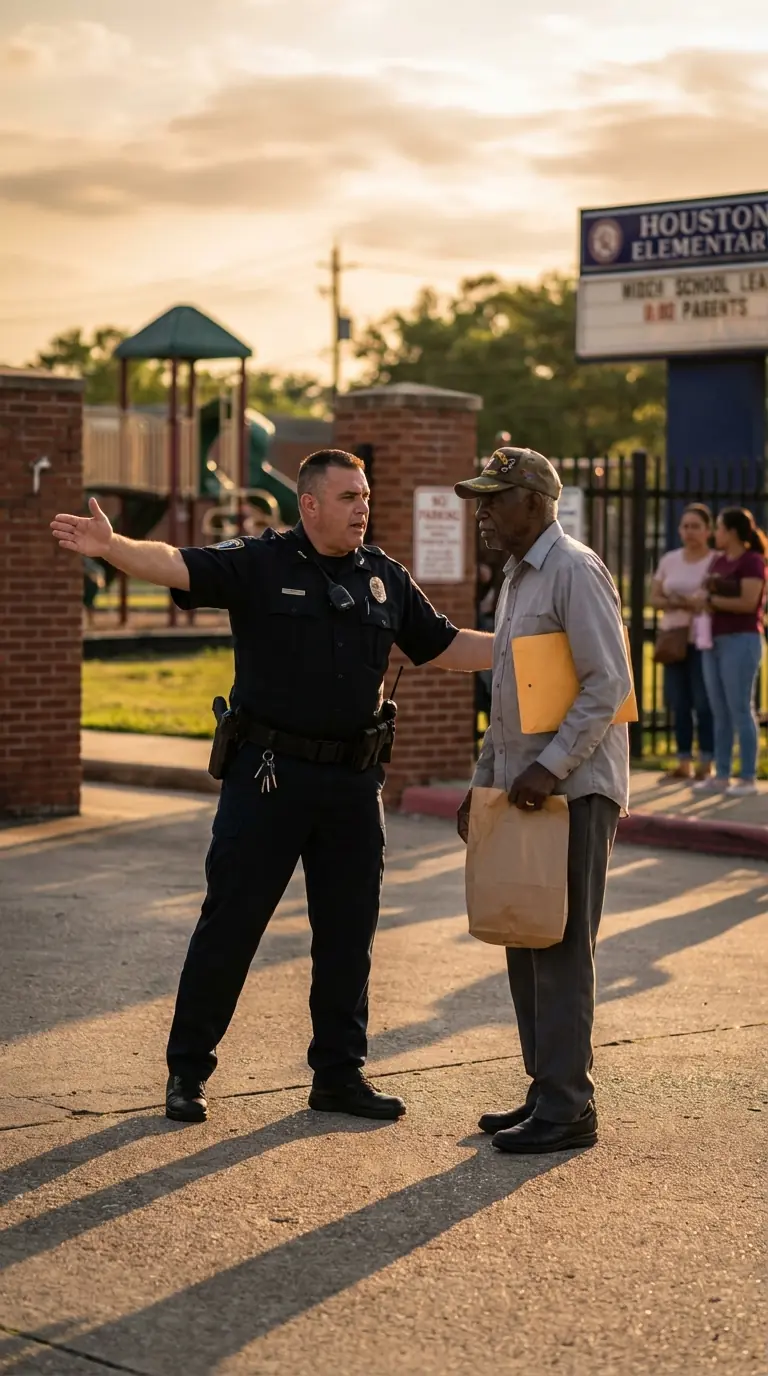
“No,” Samuel said. “It doesn’t.”
Darren handed it back as if it annoyed him.
A black SUV turned slowly into the faculty parking area on the side of the building. No one paid it much attention.
Darren gestured with two fingers toward the curb. “Wait over there.”
Samuel looked at him. “Mrs. Palmer’s class starts presentations in ten minutes.”
“Then I guess you should have arrived earlier.”
That was the line.
A hush, subtle but real, moved through the parents nearby. Even those who had no intention of intervening could feel when something crossed from caution into disrespect.
Samuel stood very still.
Then he said, “My grandson asked me to come in uniform stories, not in uniform clothes. So I came as myself.”
Darren frowned. “What does that even mean?”
Samuel lifted the envelope slightly. “It means his class is learning about service. He asked if I’d show them pictures from a long time ago and explain what courage really costs.”
There was no self-pity in the sentence. No boasting either. Just truth.
For some reason, that only irritated Darren more.
“All right,” he said. “Then you can explain it after the office clears you.”
At that exact moment, the side door near the administration wing flew open.
A woman in a navy dress stepped out quickly, nearly jogging across the walkway. Her name was Principal Elena Martinez, and she did not jog for small problems. She held a phone in one hand and looked equal parts alarmed and furious.
“Mr. Brooks!” she called.
Samuel turned.
Elena’s face changed instantly when she saw him still outside the gate.
“Oh no.”
She hurried forward.
Darren straightened instinctively. “Principal Martinez, I was just—”
“Open the gate,” she snapped.
He froze. “Ma’am, I was verifying—”
“Open. The gate.”
He did.
The latch clicked. The gate swung inward.
Elena reached Samuel and put a hand gently on his arm. “Mr. Brooks, I am so sorry. Mrs. Palmer told the office you were coming. We were expecting you.”
Samuel gave a small nod. “I gathered something got delayed.”
Elena turned sharply toward Darren. “Do you have any idea who this is?”
The question was dangerous, because it already carried the answer: no, you clearly do not.
Darren, suddenly unsure, said, “He said he was a veteran, ma’am. I was following procedure.”
Elena stared at him.
“This is Sergeant Major Samuel Brooks.”
The title hit the space between them like a dropped weight.
A few parents exchanged glances. One man straightened. The mother in sunglasses lowered her phone.
Elena continued, her voice tighter now. “Retired command sergeant major. Silver Star. Bronze Star with valor. Three Purple Hearts. And the namesake of our district’s Brooks Family Scholarship for military children.”
Darren’s face emptied.
Samuel said nothing.
Elena took the envelope from him with both hands, almost reverently, as if she understood that what he carried mattered.
“He funded our library renovation two years ago,” she said. “He has been volunteering with veterans and students in this district since before you worked here.”
The black SUV in the faculty lot had stopped. Two men in suits were now standing outside it, watching from a distance with the alert stillness of people accustomed to reading situations without being part of them.
Darren’s mouth opened once, then again. “I… didn’t know.”
Samuel finally looked at him fully.
And with that look, the whole thing became even worse.
Because there was no anger in it.
Only disappointment.
“You didn’t need to know,” Samuel said.
The words were gentle.
That made them cut deeper.
“You only needed to know I was a man at a school gate trying to see a child.”
No one spoke.
The parents nearby had stopped pretending not to listen.
Even the hallway inside seemed quieter.
Darren swallowed hard. “Sir, I apologize.”
Samuel studied him for a second, then said, “For what part?”
It was the exact kind of question that left no place to hide.
Darren looked down. “For how I spoke to you.”
Samuel nodded once.
“That’s a start.”
Elena stepped in before the moment could stretch any further.
“Mrs. Palmer’s class is waiting,” she said softly. Then to Darren: “We’ll discuss this later.”
Samuel followed Elena toward the building. As he passed the nearby parents, a man in a Houston Astros cap put a hand over his heart and gave a small nod. An older woman whispered, “Thank you for your service.” Samuel acknowledged both with the same quiet grace, as if public attention still sat awkwardly on him after all these years.
Inside the school, the mood changed immediately.
Children noticed things before adults named them. By the time Samuel reached the fourth-grade hallway, a dozen faces were already turned toward him through the classroom door glass. Mrs. Palmer opened the door with bright, relieved eyes.
“Class,” she said, “our guest is here.”
Twenty-two children sat up straighter.
At the back near the bookshelf, a boy with dark curls and a missing front tooth nearly leaped out of his seat.
“Grandpa!”
That was Micah Brooks. Nine years old. Skinny knees, untied sneaker lace, and the kind of earnest face that still made Samuel believe the world might yet be repaired one child at a time.
Micah stopped himself halfway across the room because classroom rules still held power over him, but his whole body vibrated with pride.
Samuel smiled then, and everyone in the room could see how it changed him. The old man at the gate disappeared. In his place stood the version of him that belonged nowhere and everywhere at once: a grandfather, a teacher, a witness, a man who had carried too much and still knew how to bend toward joy.
Mrs. Palmer took the paper bag from Elena and peeked inside.
“Cupcakes?”
Micah beamed. “He promised!”
That broke the tension in the room.
Children laughed.
Even Elena exhaled.
Samuel was guided to a chair near the front, but he remained standing at first. Mrs. Palmer introduced him properly, though even her voice carried a little extra awe now.
“Sergeant Major Brooks has come to speak to us about service, courage, and what it means to help other people.”
Samuel looked at the children and said, “That sounds like a lot for one afternoon.”
The class giggled.
Then he held up the envelope.
“Truth is, I just came because Micah asked me.”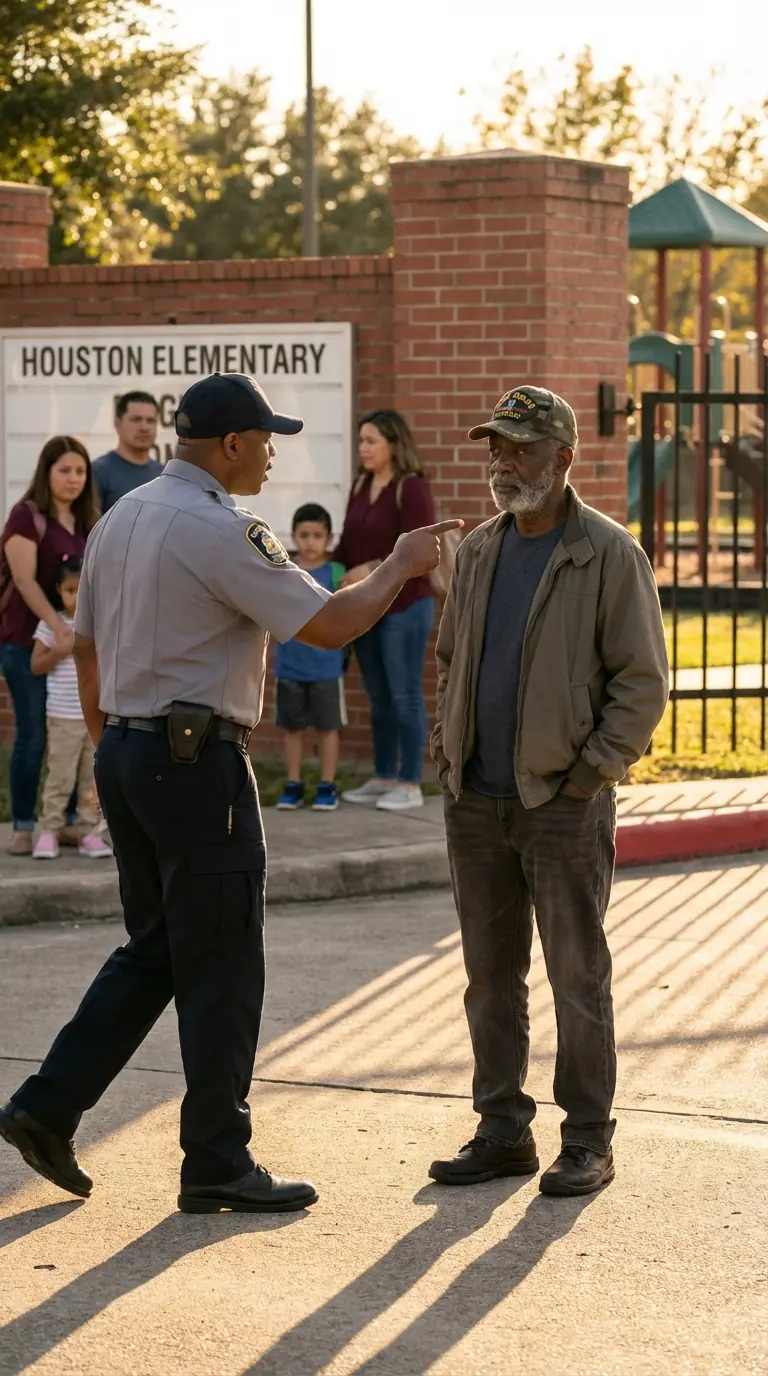
Micah sat up even taller.
Samuel took out the photos one by one. Young men in fatigues. A helicopter. A muddy road. A black-and-white photo of soldiers sitting on ammo crates and grinning into a camera that had probably captured the last easy moment of someone’s life. He did not glamorize war. He did not make himself large in the stories. He told them about heat and fear, about doing your job when you are tired, about helping the person next to you because no one gets through the hard things alone.
A girl near the window raised her hand. “Were you scared?”
Samuel nodded. “Many times.”
“What did you do?”
“I did what I was trained to do. And when that wasn’t enough, I did what I thought was right.”
Another boy asked, “Did being brave mean you weren’t afraid?”
Samuel shook his head. “No. Being brave usually means you were afraid and went anyway.”
Micah watched him the whole time with glowing eyes.
And somewhere down the hallway, Darren Pike stood outside the office door waiting to be called in, hearing the muffled rhythm of children laughing at some softer part of Samuel’s stories, and feeling smaller by the minute.
Principal Martinez did not make him wait long.
When he entered, she was seated behind her desk with a file open and both hands folded over it. She had the expression of a woman working hard not to let anger outrun usefulness.
“Sit down,” she said.
He did.
For a few seconds, she said nothing.
Then: “Walk me through the interaction from the beginning.”
Darren did.
Or tried to.
But stripped of the performance and the audience and the false confidence, the story sounded uglier than he had meant it to. Every line came out smaller. Petty. Needlessly sharp. Defensive. By the time he reached the part about the military ID, he could barely meet her eyes.
Elena listened without interrupting.
When he finished, she said, “Do you know what the job is here?”
“To protect the school.”
“Yes,” she said. “And?”
He hesitated.
She leaned forward slightly.
“And?”
“To keep students and staff safe.”
“Yes,” she repeated. “And that includes keeping them safe from humiliation, reckless escalation, and your need to turn caution into theater.”
He looked stricken.
“I wasn’t trying to—”
“I know what you were trying to do,” she said. “You were trying to look in control.”
He said nothing.
She let the silence teach him.
“Mr. Brooks is not the issue,” she continued. “The issue is that if he had been exactly who he appeared to be—an elderly Black grandfather in an old jacket trying to deliver cupcakes and family photos—you still would have treated him as disposable.”
Darren closed his eyes briefly.
That was the truth of it.
And it burned.
Elena sat back.
“You’re not being terminated today.”
He looked up in surprise.
“Do not mistake that for approval.”
“No, ma’am.”
“You will write a full incident report. You will undergo corrective review. And beginning next week, you will assist with parent access training under Assistant Principal Rhodes. You are also going to personally apologize to Mr. Brooks before he leaves this campus.”
Darren nodded slowly.
“Yes, ma’am.”
She held his gaze.
“And mean it.”
By the time Samuel finished in Mrs. Palmer’s classroom, the cupcakes were half gone, three children had asked if they could write thank-you notes to veterans, and Micah had corrected two classmates on the difference between a medal and a rank with the smug seriousness only fourth graders can manage.
When the dismissal bell rang, the children began gathering backpacks and folders, but several hovered near Samuel’s chair, still wanting one last answer, one last story, one last look at the old photographs.
He gave each of them his attention.
Not because he was trying to be inspirational.
Because children deserved the dignity of being answered fully.
Micah walked with him down the hallway afterward, carrying the now nearly empty paper bag.
“Grandpa,” he said quietly, “did that man at the gate make you mad?”
Samuel looked down at him.
“A little.”
Micah frowned. “I didn’t like how he talked to you.”
Samuel nodded.
“No,” he said. “Neither did I.”
“Are you gonna tell on him?”
Samuel almost smiled.
“Son, I think life already has.”
At the front office, Darren was waiting.
Not standing tall this time.
Not squared up like a man guarding territory.
Just standing.
He looked at Samuel, then at Micah, then back again.
“Mr. Brooks,” he said. “Could I speak with you for a moment?”
Samuel glanced at Micah. “Go wait by Principal Martinez’s desk.”
Micah obeyed, though not happily.
Darren drew a breath that seemed to cost him.
“I was wrong,” he said. “About the way I spoke to you. About all of it.”
Samuel waited.
Darren continued, “I told myself I was doing my job. But really, I made assumptions, and then I built everything else on top of them.”
That was better.
Still not enough.
But better.
Samuel asked the question anyway.
“If I hadn’t been me, would you still be apologizing?”
Darren did not answer quickly.
“No,” he said at last. “I probably wouldn’t.”
Samuel nodded once.
“That’s the part you need to remember.”
Darren looked ashamed.
“I will.”
Samuel studied him, then extended his hand.
After a tiny pause, Darren took it.
The old veteran’s grip was steady, dry, and stronger than he expected.
Samuel let go first.
“Do your job,” he said. “Just don’t confuse suspicion with wisdom.”
Then he went to collect Micah.
That evening, after the campus was quiet and the last buses were long gone, Elena Martinez sat in her office reviewing the day’s incident notes. She paused at Samuel Brooks’s name and looked through the district file again. The scholarship fund. The library contribution. Years of volunteer visits to schools, hospitals, and community youth programs. Quiet philanthropy. Quiet service. Quiet presence.
She looked at his personnel summary from long ago, the one the district kept only because someone once thought it relevant to a Veteran’s Day introduction:
Retired U.S. Army Command Sergeant Major
Silver Star
Bronze Star with Valor
Three Purple Hearts
Combat service in Vietnam and the Gulf
Later service in training and military family support programs
The file ended with a note from a former superintendent written years earlier:
Mr. Brooks never asks for recognition. Please do not make a spectacle of him. Just let the children listen.
Elena sat back.
Outside, the sky over Houston had turned violet and gold.
She thought of Samuel at the gate. Of the handcuffs that had not appeared today but so easily could have in another version of the story. Of the way institutions so often mistook control for care until someone carried the bruise of the difference.
The next week, she changed the school’s visitor engagement protocols.
Nothing dramatic.
Nothing performative.
But practical things that revealed whether people had learned. Staff training on de-escalation without humiliation. Clearer family access language. Mandatory administrative confirmation before public confrontation except in visible emergencies. Language matters modules for front-line personnel. A whole section titled: Being careful is not the same as being cruel.
Months later, the story of what happened at the gate would still circulate through the district—not because a veteran had turned out to be important, but because of what he said after.
You didn’t need to know.
You only needed to know I was a man at a school gate trying to see a child.
That was what stayed.
Not the medals.
Not the titles.
Not even the correction.
Just that line.
Because it stripped the whole thing down to the truth.
And as for Samuel Brooks, he kept coming to the school.
Sometimes for Micah’s reading celebrations. Sometimes for history week. Sometimes just to pick him up when Micah’s mother worked late at the clinic.
Darren always opened the gate.
Always greeted him properly.
And every single time, Samuel nodded back with the same measured grace, never warm too quickly, never cruel, never pretending the first day had not happened.
Some lessons do not require revenge.
Only memory.
And one spring afternoon, as children spilled laughing into the sunlight and Micah ran toward him with a spelling test held high in triumph, Samuel Brooks bent slowly, opened his arms, and caught the boy against his chest.
At the gate, Darren watched the reunion and looked away for a second.
Not out of shame this time.
Out of understanding.
Because he finally saw what had been standing in front of him that first day.
Not a threat.
Not a problem.
Not a suspicious old man in a faded jacket.
Just a grandfather carrying cupcakes, photographs, and the weight of a life that had earned better than suspicion.
And he had almost missed it.
That was the part he would carry forward.