The morning Mrs. Eleanor Hartwell arrived in Bath, the sky was doing what Bath skies so often did in early April, performing a kind of theatrical indecision, shifting between pale gold and pewter, as though the clouds themselves could not agree on the day's character. She stood outside the gate of Sydney Gardens with her traveling bag at her feet and her good wool pelisse buttoned to the throat and she breathed in the particular smell of the place. Mineral water and damp stone and something green and alive that she had almost forgotten existed. Fourteen years as housekeeper at Ashcombe Park had trained her to notice the condition of things: the exact degree of tarnish on a candlestick, the faint smell of damp behind a wainscot, the fraying at the hem of a curtain that would become an embarrassment if not addressed before company arrived.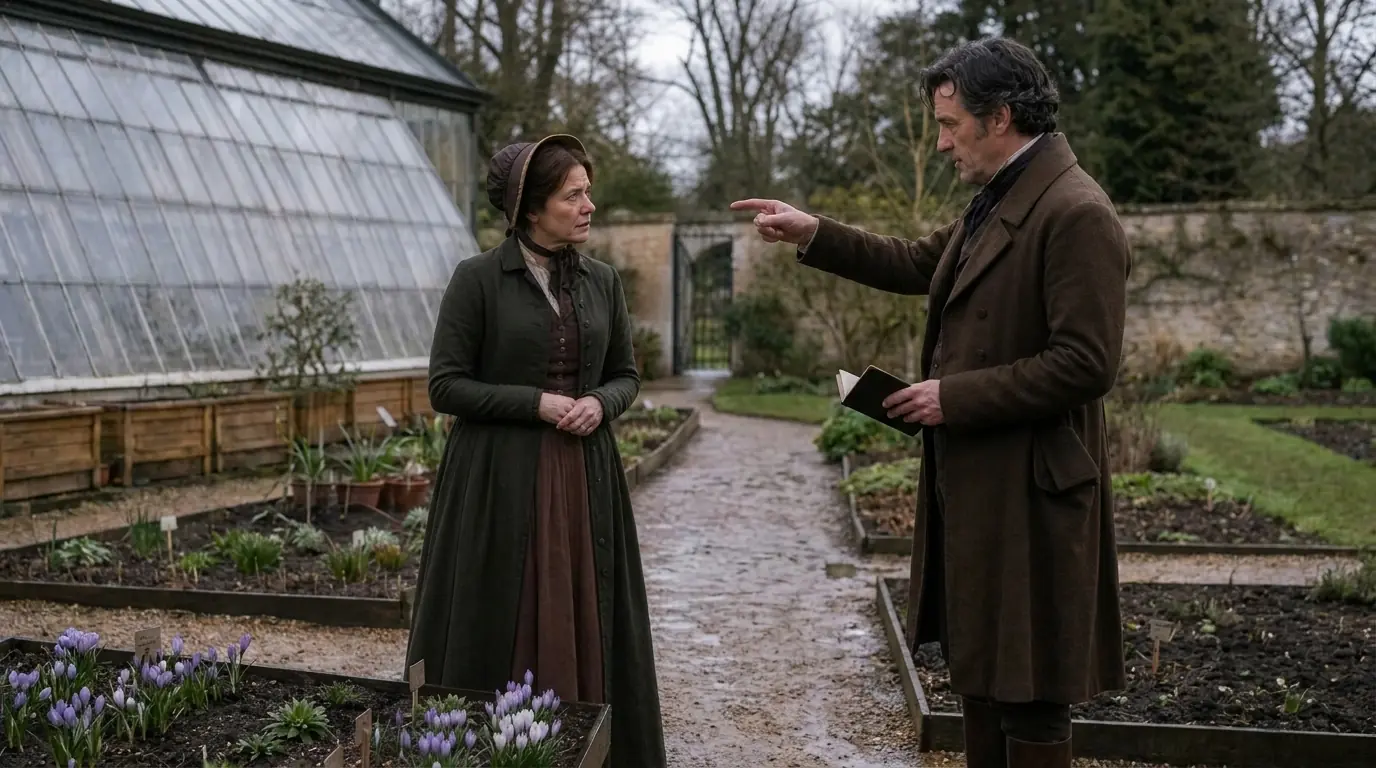
She brought that same precise attention to the gardens now the way she might catalog a new house, the iron gate, its paint slightly blistered at the hinge, the gravel path, raked and even. The first crocuses along the border, purple, white, a defiant yellow, pushing up through the dark earth with the sort of cheerful stubbornness she had always admired in small things. She had been given a month. That was Lady Ashcombe's gift to her, an entire month of leave following the disruption of the past year, following Eleanor's own illness in February—following all of it. You will go to Bath, her ladyship had said in that tone that was both a kindness and an instruction.
You will take the waters and walk in the gardens and do absolutely nothing useful, and you will come back to us restored. Eleanor had opened her mouth to protest that there was the spring inventory to consider, that the new scullery maid required close supervision, that the linen cupboard in the east wing, but Lady Ashcombe had raised one gloved hand, and Eleanor had closed her mouth again. After fourteen years, she knew that gesture. She had arranged lodgings in a quiet house in Pulteney Street. She had written the letter.
She had packed her trunk. And here she was, standing at the gate of Sydney Gardens on a Tuesday morning in April, with the improbable luxury of nowhere she needed to be. She picked up her bag and went in. The botanical section of the gardens was not yet crowded. It was early enough that only a few figures moved along the paths.
A nursemaid with a perambulator. A pair of elderly gentlemen walking at the pace of deep conversation. A young woman sketching at a bench with the concentrated frown of the genuinely absorbed. Eleanor followed the gravel path toward the section she had read about in the guidebook she'd purchased at the coaching inn. The new systematic planting, organized according to the Linnaean method with small wooden stakes bearing the Latin names of each specimen.
She had borrowed a book on botany from Ashcombe's library the previous winter during one of the long evenings when her hip had made the stairs unwelcome and she had found somewhat to her own surprise that the orderly beauty of classification pleased her deeply. She was leaning over a label, Helleborus orientalis, the Lenten rose, its drooping purple heads heavy with recent rain, when a voice behind her said with considerable irritation, That stake is incorrectly placed. She straightened and turned. The man standing three feet away was perhaps forty-five, with the weathered complexion of someone who spent more time out of doors than in. He was tall and lean, dressed in plain but good wool, his hat a practical affair with no particular pretention.
He carried a notebook under one arm and a pencil stub behind his ear, and he was looking not at Eleanor but at the stake she had been reading with an expression of genuine offense. I beg your pardon, she said. He gestured with his notebook. The Helleborus orientalis stake. It has been moved or placed incorrectly to begin with.
That plant there, he said, pointing, is Helleborus niger, the Christmas rose, quite a different species, and not in flower in April, in any case, which ought to have indicated the error to anyone paying attention. Eleanor looked at the plant. She looked at the stake. She looked at the man. You are right, she said.
Yes, he said after a moment. Precisely. You know the genus. I have been reading. I would not call it knowledge.
He seemed to consider this a satisfactory answer. He opened his notebook, made a mark, and turned away down the path without another word. Eleanor watched him go with a feeling that was partly amusement and partly something rather less comfortable. The feeling of having been assessed and found, if not wanting, then not particularly interesting either. She was quite accustomed to being overlooked.
It was in many ways the condition of her profession. A housekeeper of any competence made herself nearly invisible, a steady and reliable presence like the furniture. But there was something about being overlooked by a man who had first bothered to notice her that she found obscurely irritating. She turned back to the hellebores and spent another quarter hour in their company, which was considerably more rewarding. She saw him again the following morning.
He was crouched at the far end of the systematic beds, making a note of something near the ground, and he did not look up as she passed. She had decided in the interval that she did not like him. He was abrupt and had no social manners worth speaking of, and his coat, though good wool, had mud on the left cuff. She noticed the mud with professional disapproval. But then he looked up, not at her, but at the plant before him, and his expression was so entirely different from the irritated efficiency of the day before that she stopped walking.
He was looking at a small rosette of leaves from which a single stem had pushed up, bearing a flower of such improbable, tender purple that it seemed almost a glow against the gray morning. His face held an expression of unguarded delight. It was the face of a man looking at something he loved, and Eleanor, who had cataloged human expressions as carefully as everything else for fourteen years, had not expected it. He heard her stop and looked up. The expression shuddered, replaced with something more cautious.
Mrs.—? He said, with a question in his voice that was clearly an invitation to supply her name. Hartwell, she said. Eleanor Hartwell. Bramwell, he said, rising and dusting his knees.
James Bramwell. He hesitated. You were here yesterday. I was, as were you. Another small pause.
I was rude, he said, as though the admission had been extracted from him at some cost. About the stake, I spoke as though you could not understand the matter. That was not well done. Eleanor regarded him. In her experience, men of his approximate class and age.
She put him as a gentleman of some education but no great fortune, a professional man of some kind, rarely apologized unless they were either very good or working towards something. He appeared to be neither performing nor calculating. He simply looked uncomfortable and honest. You were not precisely rude, she said. You were merely speaking to the stake rather than to me.
His mouth moved. It was not quite a smile, but it was the architecture of one. That is, I am afraid, a habit. I have worse ones, she said, which surprised her. She was not in the habit of making small confessions to strangers in gardens.
They stood for a moment in the mild awkwardness of two people who have begun something without quite meaning to. Do you know this one? He asked, gesturing at the purple flower. I don't, she said, and crouched to look at it, which cost her hip something she did not allow her face to acknowledge. The label is missing.
Soldanella alpina, he said, crouching beside her at a respectful distance. The alpine snowbell. It blooms almost before the snow has gone at elevation. Extraordinary persistence. He paused.
I spent two years in the Alps. I saw them flowering through patches of ice. Two years, she said. That is a considerable time to be away from England. It was a considerable time, he agreed.
But the mountains— He stopped himself. Forgive me. I speak of plants the way other men speak of horses. I have never thought horses merited the enthusiasm they receive, Eleanor said. Continue about the mountains.
He looked at her then, a direct assessing look quite different from the absent-minded glance of the day before, and then he told her about the Alps. By the end of the first week, they had established a kind of routine, though neither of them had suggested it or agreed to it. Eleanor arrived at the gardens each morning at 9. Bramwell, she discovered, was usually there before her, having arrived at some earlier hour she did not inquire about. They would find one another by some unspoken navigation in whatever section of the gardens was most worth attention that day, and they would walk, and he would explain things, and she would ask questions, and occasionally she would notice something he had missed.
A label knocked askew by a pigeon, a path edge gone mossy with damp, and he would receive the information without resentment. She had learned that he was the estate steward to Sir Frederick Windham of Kellaway in Somerset, a position he had held for eleven years. He was in Bath for the month because Sir Frederick was taking the waters for his gout and required Bramwell's presence for various consultations relating to estate improvements he planned with optimistic ambition and a cheerful disregard for his steward's opinions. Bramwell expressed this last point with a dryness that made her laugh because she recognized it, the dry affection of a professional for an employer who was well-meaning and occasionally maddening.
She told him about Ashcombe Park, about Lady Ashcombe's household, about the spring inventory she had left behind. She did not speak about the illness in February, or about what had preceded it. Those were not things she shared with people she had known for a week, whatever the ease of their conversation. He was not, she decided, a man she liked in the ordinary sense. He was frequently distracted, occasionally sharp, and held opinions about the proper methods of soil preparation with a conviction that brooked no disagreement.
But he was interesting in the way that genuinely knowledgeable people were interesting, not impressive exactly, but real, his information connected to experience rather than drawing rooms. And he looked at the gardens as though they mattered. That Eleanor thought was not a small thing. The crisis arrived, as crises tend to, on a morning that had given no sign of being different from any other. It was the tenth day.
The weather had softened into something almost warm, and the gardens were beginning to draw more visitors. Families on morning constitutionals, invalid gentlemen from the pump room taking air on their physicians orders, young women in light spencers, who came for the society of the paths as much as the plants. Eleanor had arrived to find Bramwell already in the systematic beds, standing very still, looking at something in his notebook with an expression she had not seen before. What is it? She asked.
He looked up. Miss Lena Webb, he said. Sir Frederick's ward. She is—she was to meet me here this morning. She sent a note yesterday asking if we might walk together as she has been wanting to see the new planting.
He paused. She has not come. And I have been informed by the head gardener that she was seen here yesterday evening quite late after the gardens ought to have been closed and has not been seen since. Eleanor went still. Since yesterday evening?
Since yesterday evening. The full weight of it settled between them. A young woman, a ward, unaccounted for since the previous evening. Eleanor's mind, fourteen years trained to the management of a household, and every vulnerability within it, began immediately to work. How old is she?
she asked. Nineteen. She is— He stopped. She is not a silly girl. She is in fact unusually sensible, which is what concerns me.
A silly girl might have done something foolish on an impulse. Lena does not act on impulse. Does she have friends in Bath? Anyone she might have gone to? I don't know.
I know her less well than I ought. He said this with a kind of bleak honesty that she registered. Sir Frederick is not— He is fond of her, but he is not attentive. She has been somewhat isolated since her father's death 2 years ago. Eleanor was quiet for a moment.
Then she said, Tell me everything you know. The note she sent, the head gardener's account, anything else you have. He looked at her. Mrs. Hartwell, this is not your concern. Mr. Bramwell, she said, I am a woman alone, and I have been the manager of a large household for fourteen years.
I know how to be discreet. I know how to move through a house or a place without drawing attention, and I am not connected to Sir Frederick Windham in any way that would complicate matters if inquiries need to be made. Tell me what you know. The silence lasted perhaps five seconds. Then he told her Lena's note had mentioned a friend, a Miss Cecily Forham, staying at the Pelican.
The head gardener, a stout and apologetic man named Hodges, had seen the young woman near the house at six in the evening in conversation with a young gentleman he did not know. The young gentleman had dark hair and a blue coat, which was, as Eleanor observed, a description that might fit a third of the young men in Bath on any given day. But the hothouse, Eleanor said. They were walking quickly now back toward the entrance, the pleasure of the morning entirely transformed. The head gardener.
Does it lock at six? What's beyond it on the garden's east side? There is a service gate for deliveries and groundsmen. Eleanor thought of the service entries of Ashcombe Park, how she knew everyone, and how she had once found a footman using one for purposes that had nothing to do with his duties. A service gate can be unlocked from within, she said.
If the young lady left willingly, which it sounds as though she may have done, she might have exited that way without anyone in authority seeing. Bramwell stopped walking. You think she left willingly with the young gentleman in the blue coat? I think it is possible. I think Miss Webb may have wished to see someone she knew she would not be permitted to see and used the gardens as a convenient point of meeting.
She looked at him steadily. It is also possible something less pleasant occurred. We should not assume either way until we know more. I shall go to the Pelican, he said. We shall go to the Pelican, she said.
He opened his mouth, then he closed it. Very well, he said. Miss Cecily Forham was a small, bright-eyed young woman of twenty, who, under Eleanor's gentle and practiced management of the conversation, gave up considerably more than she had intended. Bramwell, to his credit, remained silent and let Eleanor lead, which she suspected cost him something. Lena Webb had been corresponding, it emerged, with a young man named Mr. Thomas Adler, a second son, a solicitor's clerk, a perfectly respectable young man with no money and no prospects that would satisfy Sir Frederick Windham's ideas about his ward's future.
They had met at a concert in November. They had been writing to each other since January through Miss Forham as intermediary. And yesterday evening, with Miss Forham's anxious assistance, Lena had slipped out of the Windham household to meet Mr. Adler for what she had called a brief walk, and what had evidently become something rather more than that, because neither she nor Mr. Adler had returned. She is not in any danger, Miss Forham said, twisting her gloves. She wrote to me this morning.
They are—they have taken lodgings at the White Hart. They wish to marry. She wants someone to know she is safe. Bramwell's face was a study. Eleanor watched him work through it.
The relief, the anger, the complicated tangle of responsibility for a girl he had described as unusually sensible, and who had behaved in the circumstances with perfect consistency. Outside on the street afterward, he stood very still for a moment. She could have told me, he said. Could she? Eleanor said not unkindly.
He looked at her. You have said yourself that you know her less well than you ought, Eleanor said. And Sir Frederick would not have approved of Mr. Adler. She had no reason to believe that anyone in her guardian's household would help her, so she helped herself. She is nineteen and unaccompanied at a public inn.
She is nineteen and in the company of a man she means to marry. That is not ideal by anyone's measure, but it is not catastrophic. And now that we know where she is and that she is safe, the question is what happens next. Bramwell was quiet. The street moved around them.
A sedan chair, a pair of women with market baskets, a boy leading a reluctant donkey. What would you do? he asked. I would go to the White Hart, Eleanor said. I would speak to Miss Webb privately without judgment.
I would learn something about Mr. Adler. And then I would consider whether Sir Frederick's objections are truly insuperable or merely a matter of pride and habit. You make it sound straightforward. Very little of it is straightforward, but most things become clearer once you've actually looked at them. He looked at her for a long moment.
You are a very practical woman, Mrs. Hartwell. I am a housekeeper, she said. Practicality is rather the point. It is more than that, he said. I have met many practical people.
They are not all, he stopped himself again, that characteristic self-interruption she had come to recognize. They are not all what? she asked. He looked slightly pained. Wise, he said, as though the word had been extracted against his will.
They are not all wise. Eleanor found, to her considerable annoyance, that she had no ready response to this. They went to the White Hart. Bramwell went first and alone, which Eleanor thought was correct. Whatever Lena's situation, a strange woman arriving alongside her guardian steward would have been alarming.
Eleanor waited in the coffee room with a cup of something hot and not quite good, and she thought about the gardens, and about Lena Webb, and about what it was to be 19, and in love with someone unsuitable, and to have no one you trusted enough to tell. She had been once in a version of that position, not at nineteen, but at twenty-six, in the first year of her position at Ashcombe, when she had been new enough to her role to still be uncertain of its borders, when a man, a solicitor's clerk, in fact, as it happened, which gave her a particular sympathy for Mr. Adler, had offered her something that had looked very much like a future. She had turned it down. She had been afraid of the risk, afraid of losing the position she had worked for, afraid of the upheaval of trusting someone with the unguarded parts of herself.
And the solicitor's clerk had gone to Gloucestershire and married a vicar's daughter, and Eleanor had been left with her position and her linen cupboards, and the quiet professional pride of a household run exactly as it should be. She had never in fourteen years allowed herself to think of it as loss. She thought of it now, for the first time in a long time, sitting in the coffee room of the White Hart, while April rain began to tap at the window, and somewhere upstairs, James Bramwell was talking to a young woman who had been braver than Eleanor had ever quite managed to be. He came back after forty minutes. He sat down across from her, and she poured him a cup of the not quite good coffee without asking, and he drank it, and said nothing for a moment.
She is well, he said at last. She is very well. Actually, luminous is the word I would use, if I used that sort of word. He looked at Eleanor with an expression she could not entirely read. Mr. Adler seems a decent man.
He is not what Sir Frederick had in mind, but then Sir Frederick had in mind Lord Harlow's second cousin, who is forty and drinks before noon, so I am not certain his judgment is to be relied upon. And what will you do? I shall speak to Sir Frederick. He set down the cup. I shall speak to him honestly, which is not always what he wishes, but which is generally what he needs.
And I shall tell him that his ward is safe and is requesting his blessing for a match that is by any sensible measure a reasonable one. And if he is reasonable in return, he paused. There are things I can do as steward to make Mr. Adler a more viable prospect in practical terms, if that should seem appropriate. Eleanor looked at him. That is—that is a generous thing.
It is what is right, he said, which was not quite the same thing, and she could see that he knew the difference. The rain tapped on. Someone at a nearby table laughed at something, a comfortable domestic sound. I was short with you, Bramwell said, on the first morning in the gardens. You have already apologized for that.
I know. I am apologizing again more specifically. He looked at his hands. They were good hands, she noticed, large and capable with ink stains on the right index finger and the kind of small scars you got from working closely with the land. I was short with you because I had spent the morning being unpleasant to Sir Frederick about the drain in the east meadow, and I brought the temper of that into the gardens with me.
And then I saw you reading the label, and I assumed you were one of the visitors who reads the labels the way they read menu cards, looking for something impressive to mention at dinner, and I was unkind before I had any reason to be. Eleanor was quiet. Outside, a cart horse plodded slowly past the window. Why are you telling me this? she asked.
He looked up. Because I have been walking with you for ten days and you have been, he stopped. You have been someone worth knowing. And I began by treating you as though you were not. That seems worth acknowledging.
The thing that happened in her chest was not something she named. She had spent a long time not naming things. You were less wrong than you might have been, she said carefully. I do sometimes read labels the way you describe the hellebores. The first morning, I had read it in the guidebook the night before.
I wanted to appear to know more than I did. But you did know the leaves. I had read about those, too. I was reading quite seriously because— She stopped. Because I was alone and unwell.
Not long before, and the books gave me something to think about that was not myself. So the knowledge was real, but the motive was less impressive than it might have appeared. He looked at her steadily. Are you better now? Unwell?
Was it serious? It was serious enough that Lady Ashcombe sent me away for a month, she said. Which tells you something about its severity because Lady Ashcombe does not give up a good housekeeper in the middle of the season without considerable reason. And are you better? She considered the question with the honesty he seemed to have earned.
I think I am becoming better, she said. This month—the gardens—it has been something I did not know I needed. She looked at him. You have been part of that. There it was.
She had said it. She did not look away. His expression shifted, moved through something she watched carefully. Not surprise, exactly. More like recognition.
The look of a man who has been hoping quietly without allowing himself the full weight of it, and now finds the ground more solid than he had let himself expect. Mrs. Hartwell, he said very carefully. Eleanor, she said. A pause. Eleanor.
The way he said it, not possessively, not with the satisfaction of a man claiming something, but with a kind of care, as though he were handling something that mattered. I am not good at this. I am not a man who speaks easily about the things that matter. He stopped and began again. In eleven years at Kellaway, I have been so entirely defined by my work that I had rather forgotten I was anything else. The Alps helped, the plants helped, but I had not. He looked at her.
I had not talked to anyone in a very long time. Nor had I, she said. Not really. The rain was easing outside. Through the window she could see the street beginning to lighten, the stones going from gray to dull silver.
We have eighteen more days, he said. We do. I should like to spend them in the gardens, he said, with you, and then I should like, if it would not be unwelcome, to write to you, when we are both returned to our respective houses and our respective duties. He said it with a precision she recognized as the precision of a man who did not allow himself to assume. I should like to continue the conversation.
Eleanor thought of the solicitor's clerk from twenty years ago and the position she had been afraid of losing and the linen cupboards that had been a very fine substitute for everything else. She thought of Lena Webb upstairs, luminous with the courage of having chosen. She thought of a snowbell flowering through ice, of extraordinary persistence, and of a man with ink on his fingers who had looked at a small purple flower with the unguarded face of someone who still knew how to love things. It would not be unwelcome, she said. He smiled then, a full smile, the first she had seen from him, and it changed his face entirely, creased it into something warm and a little rueful, and entirely itself.
Not a handsome man's smile or a charming one's, but the smile of someone who had not expected to be happy this particular morning and found himself so. Good, he said. Then shall we go back to the gardens? The rain is stopping. It is, she said.
They walked back to Sydney Gardens in the freshened air, the gravel paths still glistening, and the crocuses lifting their heads again after the rain, the way crocuses do, as though the difficulty had never occurred, as though nothing was required but persistence and the next good hour of sun. Bramwell told her something about the germination habits of the alpine snowbell, that she would not remember precisely, but that made her understand why he had looked at it the way he had. She told him about a kitchen garden at Ashcombe she had spent three years restoring a neglected space turned through stubbornness and good compost into something productive and even beautiful. He listened with the attention of a man who understood that a kitchen garden required its own kind of expertise and did not diminish it.
They passed Hodges, the head gardener, who gave them a nod of recognition, and did not appear to find it remarkable that yesterday's two unconnected visitors had become two connected ones. People in Bath often formed sudden friendships in the gardens. It was part of what the gardens were for. Near the end of the systematic beds, in the spot where the house threw a wedge of warmth across the path, Bramwell stopped. Here, he said, and crouched, and Eleanor crouched beside him, her hip its usual uncomplaining professional self.
The alpine snowbell was still there. In the aftermath of the rain, its petals had opened a little further, the purple darker and richer, the whole small plant emanating a kind of quiet determination. Soldanella alpina, Eleanor said. Soldanella, he corrected, from the Italian soldo, a small coin for the shape of the leaves. He looked at it.
Though I have always thought it a better name than the reason for it. A name can be true to something without explaining it, Eleanor said. He turned and looked at her. Yes, he said. Exactly that.
They stayed a little longer than the flower strictly required, and when they rose and walked on through the brightening morning, the distance between them was not quite the same as it had been, smaller by some important measure, warmer, easier, as though they had come through a long and indirect route to the place where they had always been meant to arrive. Eighteen days remained. Bramwell would speak to Sir Frederick, and Sir Frederick, confronted with the evidence of his steward's characteristic blunt good sense, would be persuaded, with a great deal of grumbling, to meet Mr. Adler. Lena Webb would return to the Windham household with her dignity intact and a tacit understanding reached, and would write to Eleanor six months later to say that she was married and very happy, and that she owed a debt she could not calculate to two people who had looked at a situation directly instead of away from it.
And in the gardens, day by day, the plants would come forward into their April fullness. The hellebores giving way to the first tulips, the early narcissus perfuming the morning air, the systematic beds unscrolling their Latin names like a patient and beautiful lesson in how much there was still to learn. Eleanor Hartwell, a forty-one-year-old housekeeper, sensible and resilient, and possessed of a hip that was improving daily, and a heart that was doing something similar, would walk those paths each morning for eighteen more days. And she would not be alone. The conversation, once begun, proved to have no particular ending.
It carried itself forward past Bath, past the carriages that returned them to their separate counties, past the first letter and the second and the many that followed, past the following autumn when Bramwell came to Ashcombe Park at Lady Ashcombe's cheerful invitation for reasons that had little to do with estate management. Past all of that and into something that had not been named and did not require naming, only the steady accumulation of days in which two people looked at the world with the same quality of attention and found it improbably and beautifully enlarged. Outside the gate of Sydney Gardens, the last of the morning rain dried from the iron and the gravel, and the crocuses stood in their small, defiant rows, purple, white, a persistent and enduring yellow. And the day continued in its excellent fashion, warm and various, and full of things worth noticing.