Seven women had promised to marry me.
All seven eventually fled after seeing what kind of man waited for them in Copper Hollow.
Some left quietly enough that only the stage driver knew until morning. One screamed before I had even introduced myself. Another refused to step down from the wagon, gripping the wooden rail so tightly that the driver finally turned the team around rather than listen to her begging another minute.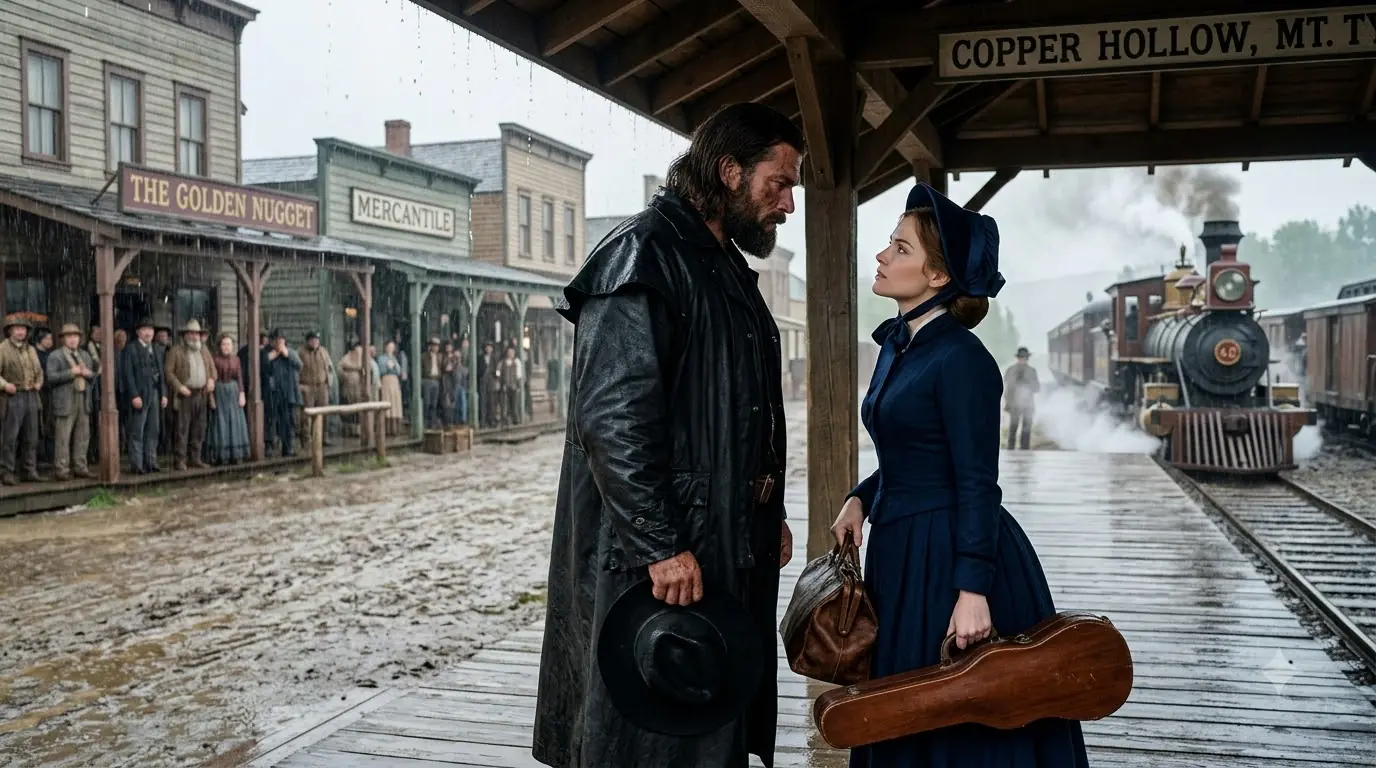
By the time the eighth woman was due to arrive, nearly everyone in town knew the train schedule.
They called me the Devil of Copper Hollow.
The name made me sound dangerous, which was almost funny considering how carefully I had spent my life trying not to frighten anyone. I had never murdered a man, never struck a woman, never started a saloon fight, and rarely drank anything stronger than coffee. Children were the only people in town who approached me without hesitation because they cared more about whether I could lift them high enough to touch the mercantile sign than what their fathers whispered after supper.
I was thirty-five years old and stood six feet seven inches without boots.
My shoulders were wide enough that I had rebuilt two doorframes in my house rather than continue turning sideways every time I walked through them. My hands made an ordinary coffee cup look foolish. I could load a hundred-pound feed sack onto a wagon without thinking, carry a newborn calf across a flooded pasture, and once lifted the rear corner of a buckboard long enough for a ranch hand to replace a broken wheel.
None of that was what truly made people whisper.
There were other things about my body.
Private things.
The kind decent people were supposed to leave private.
Copper Hollow had never possessed many decent people when gossip was involved.
The first woman I sent for discovered enough during our short courtship to become frightened. Perhaps she confided in another woman before leaving, or perhaps someone questioned her after she returned to town. I never learned exactly how it began.
I only knew that by the time Bride Number Three arrived, men at the barber shop were already laughing.
At church, women looked at me over hymnals.
At the mercantile, conversation occasionally stopped when I entered.
The cruelest part was that nobody spoke loudly enough for me to object without admitting I had been listening.
So I learned to pretend I had not heard.
The third woman was named Margaret Collins.
She stayed twenty-nine days.
For twenty-nine days, I allowed myself to imagine a different life.
Margaret laughed while kneading bread. She planted lavender beneath the bedroom window. She read newspapers aloud in the evenings because she said the silence in my house was too large for one person to fight alone.
Once, while we stood beside the washbasin after supper, her shoulder brushed my arm.
She did not pull away.
I remembered that touch far longer than any grown man should have remembered something so small.
Then one morning she borrowed my mule.
She rode down the mountain with her hair half pinned and terror in her eyes.
She left a note on the kitchen table.
I am sorry, Elias. I thought I could be the wife you require. I cannot.
I never asked what she believed I required.
Perhaps I was afraid of the answer.
After Margaret, there were four more.
One claimed her mother was dying in Nebraska.
One locked herself inside the guest room until I promised to return her to the depot.
The sixth stayed one night beneath my roof even though I slept in the barn, then told the stage driver at sunrise that she would rather risk crossing Montana alone than remain another evening.
The seventh never touched the ground.
She arrived in a yellow bonnet, saw me standing beside the wagon with wildflowers in my hand, and went so pale I thought she might faint.
“Turn around,” she whispered.
The driver cleared his throat. “Ma’am, we just climbed fourteen miles.”
“I don’t care.”
Then she looked directly at me.
I watched the rumors become real inside her imagination.
“Take me away from him.”
The wagon rolled back down the road.
I remained beside my gate holding flowers meant for a woman whose first act as my prospective wife had been asking another man to rescue her from me.
By supper, Copper Hollow knew.
Four years.
Seven women.
Seven failures.
Eventually, I stopped blaming them.
A man can endure many humiliations if he learns to call them facts.
Perhaps God had simply built me incorrectly for ordinary domestic life. Perhaps some men were meant to have wives waiting beside the stove and children racing down porch steps, while others were meant to return from winter cattle checks to a cold house and hear nothing but their own boots crossing the floor.
I owned nearly nine hundred acres north of town.
I had cattle, horses, timber, a creek that never completely froze, and enough money in the bank that I owed no man anything.
None of it spoke when I entered the kitchen.
None of it laughed upstairs.
None of it left tiny boots beside mine near the door.
I wanted a family so badly that eventually the wanting became another room in the house.
I kept that room locked.
Then, in early spring of 1887, a letter arrived from a matchmaker in St. Louis.
Mrs. Augusta Mercer wrote that she represented a respectable twenty-eight-year-old widow named Clara Vance who wished to leave Missouri and establish herself somewhere in the western territories.
Mrs. Mercer described Clara as educated, practical, capable of enduring hardship, and unusually independent.
I read the letter three times.
Then I put it in the stove.
I stood there for perhaps ten seconds before snatching it back out.
The corner had already begun to burn.
That should have been my answer.
Instead, two days later, I wrote to St. Louis.
I told the truth about everything I could describe without humiliating myself.
I explained that I lived fourteen miles north of Copper Hollow. I wrote that winters were difficult, that my nearest neighbor was nearly three miles away, and that my ranch required constant work. I told Clara I stood six feet seven inches, weighed considerably more than most men, and had been described by strangers as intimidating.
I also wrote that any woman who came west would have her own room.
Her door would lock from inside.
She would control her own money.
If, after meeting me, she decided she could not remain, I would pay for her return journey without argument.
There were details I left unwritten.
A decent man could hardly describe his most private physical characteristics in a letter to a woman he had never met.
And if the rumors reached Clara before she traveled, perhaps that would spare both of us another public humiliation.
Six weeks passed.
I repaired the guest-room roof.
I bought blue curtains from Ezra Cole's mercantile and endured Ezra's smirk while he wrapped them.
“Expecting company again, Thorne?”
“Yes.”
“Persistent man.”
I looked at him.
Ezra suddenly found the spool of twine in his hands extremely interesting.
I replaced a cracked pane beside the kitchen stove.
I sanded the dining table.
I built a narrow shelf in the guest room because Mrs. Mercer had mentioned Clara enjoyed books.
Every improvement felt foolish.
Every improvement also felt necessary.
Then the rain came.
For three days, water hammered Copper Hollow and the surrounding mountains. Wagon ruts became brown streams. The creek beneath my north pasture rose until logs and branches spun through the current.
On the morning Clara's train was scheduled to arrive, I nearly stayed home.
A man could survive loneliness.
I was no longer certain I could survive watching another woman look at me with disgust.
But Clara had crossed half a continent because of my letter.
Whatever happened afterward, I would not leave her alone on a wet platform.
I rode down the mountain before daylight.
By nine, my black oilskin coat was dripping onto the depot boards.
Across the street, curtains shifted inside the Copper House Hotel.
Three men stood beneath the saloon awning pretending to share a cigar.
Two women occupied the mercantile window for twenty minutes without buying anything.
They had come to watch Bride Number Eight.
More precisely, they had come to watch her run.
The train whistle sounded beyond the pines.
My heart betrayed me with one hard leap.
Smoke appeared first.
Then the engine came around the bend, iron wheels screaming against wet rails while steam rolled across the platform.
Passengers descended.
A traveling salesman.
Two ranch hands.
An elderly woman met by her son.
A mother carrying a sleeping boy.
Then no one.
The platform emptied.
The conductor began speaking to the engineer.
I looked at the floorboards.
I should have known.
Perhaps Clara had reached Omaha and changed her mind.
Perhaps Mrs. Mercer had finally told her what Copper Hollow said about me.
Perhaps there had never been a Clara Vance.
Then a brown boot appeared on the final step.
A woman descended through the steam.
She was much smaller than I expected.
She carried a worn leather satchel in one hand and a narrow wooden case with a polished brass clasp pressed against her waist.
Rain touched the edge of her dark-blue bonnet.
Chestnut-brown hair curled damply beside her face.
And she was beautiful.
Not the fragile, painted beauty of advertisements pasted outside city theaters.
Clara Vance possessed the kind of face a man remembered after looking away.
Her skin was fair and clear, her hazel eyes large beneath dark lashes, her mouth soft and naturally full. Fine rain had settled against her cheeks, and a tiny pale scar near her left temple somehow made the rest of her delicate features even more striking.
The conductor placed a small trunk behind her.
“That everything, Mrs. Vance?”
“Yes. Thank you.”
Her voice was calm.
The train pulled away.
Steam dissolved into rain.
Clara looked around Copper Hollow.
Then she saw me.
I prepared myself.
I knew the sequence.
Her eyes would widen.
Her chin would retreat.
She would stiffen as she realized how far upward she had to look.
Then fear would arrive.
It always did.
Clara's gaze began at my boots.
It moved slowly over my legs, my coat, my shoulders.
Then finally my face.
She stared.
Across the street, someone laughed.
Clara glanced toward the saloon.
She saw the men watching.
She looked toward the mercantile and found women pretending not to stare.
Something sharp entered her expression.
Then she looked at me again.
She did not step backward.
Instead, Clara walked directly toward me.
When only two feet separated us, she lifted her face.
“Mr. Elias Thorne?”
“Yes, ma'am.”
“My name is Clara Vance.”
I reached for her satchel.
She tightened her hand around it.
“I can carry it.”
“I believe you.”
Her mouth twitched.
Not quite a smile.