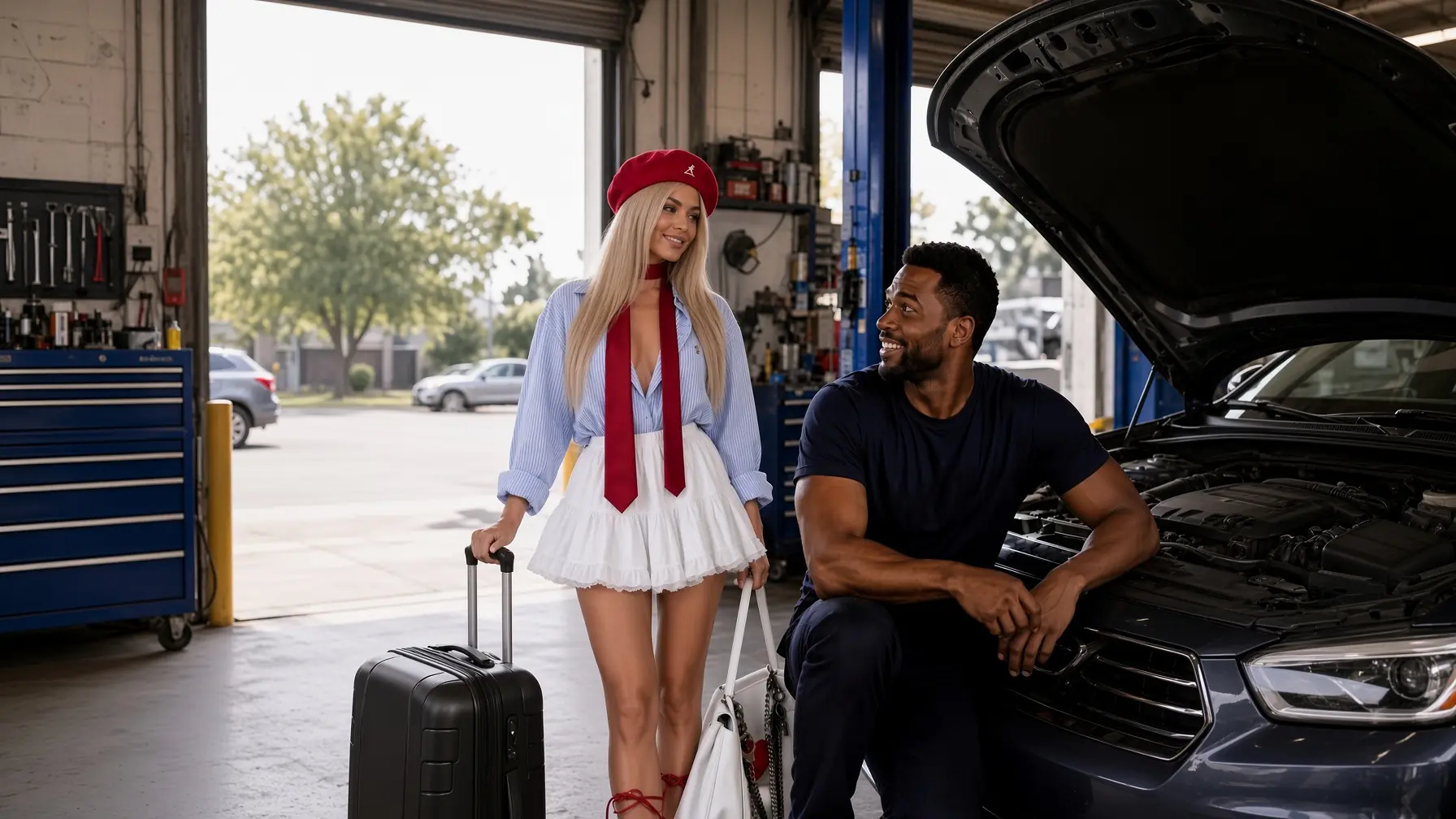
Darius Coleman slammed his fist on the metal desk so hard the coffee mug jumped and shattered on the floor and nobody in that shop said a single word. Not one. Because every man standing there knew exactly what had pushed him to that edge. A woman had just walked in off the street, slapped a resume down in front of him, and in 60 seconds flat. 60 seconds made him question everything he thought he knew about his business, his life, and himself.
He said something he couldn't take back. And what happened next nobody in Atlanta saw coming. The shop smelled like it always did. Motor oil, old coffee, and the particular kind of exhaustion that soaks into brick walls after 20 years of hard work. Coleman Auto and Restoration sat on the corner of Hollowell Parkway in the West End neighborhood of Atlanta, Georgia, sandwiched between a barber shop that had been there since 1987, and a vacant lot that the city kept promising to develop and never did.
The sign above the door was original, hand painted. His father, Marcus Coleman, had painted those block letters himself in the summer of 1989, standing on a wooden ladder, while Darius, 9 years old, skinny as a fence rail, handed him brushes from below. Darius hadn't changed the sign since his father retired. He told himself it was because the sign still did its job. But the truth was more complicated than that.
It was a Tuesday morning in late October, and Darius Coleman was losing an argument with a printer. Come on. He hit the side of the machine. It beeped at him in response. Three short contemptuous beeps.
Don't do me like that. He hit it again. Another beep. Seriously. From across the shop floor.
His lead mechanic, a thick- armed man named Terrence, who had worked at Coleman's for 11 years, looked up from the engine bay without sympathy. You got to hold the button and lift the tray. Terrence said. I know how to work a printer, Terrence. You clearly don't.
Mind your business. Terrence went back to the engine. I'm just saying what I'm seeing. Darius abandoned the printer, picked up a stack of papers that the machine had halfeaten, and walked toward his office, a small glasswalled room at the back of the shop that held a desk, a chair, a filing cabinet that no longer fully closed, and a photograph of his daughter Lily at age 4 sitting inside the hollow engine bay of a 1967 Mustang. While his father laughed beside her, he sat down.
He stared at the pile of invoices on his desk. He stared at the appointment calendar, which had 17 entries for the week and two mechanics scheduled instead of the four he needed. He stared at the mug of coffee that had been sitting on his desk since 6:30 that morning and was now stone cold. He picked it up, started to drink it cold anyway, then put it back down because he had some self-respect left. Barely.
I was 36 years old, and some mornings, not all of them, not even most of them, but some. He looked around at the life he had built, and felt the specific quiet weight of a man carrying something heavy alone for too long. The shop was his, truly his, the way things are yours after you've bled for them. He had worked beside his father every summer from age 9 to 18. He had gone to technical school on a partial scholarship, and a lot of stubbornness.
He had come back to Atlanta at 22 and spent the next four years learning every corner of this building, every quirk of every machine, every name of every regular customer. When Marcus retired at 63, his knees finally surrendering to 40 years under cars, he handed the shop to Darius with a handshake and a warning. "Don't let pride be your ceiling," Marcus had said. Darius had nodded like he understood. He was still figuring out what it meant.
The shop had been short staffed for 3 weeks. One mechanic had moved to Nashville to be closer to his family. Another had torn ligaments in his shoulder and was out for 2 months. Darius had posted the position online called the technical college down the road and put a handwritten sign in the window. Six people had applied.
Two had shown up for the interview. One had asked if they could start at 12:30 because he had a thing in the mornings. Darius had thanked him for his time and closed the door. So, when he heard the shop's front door open at 9:17 on that Tuesday morning, he assumed it was Richard Hayes coming in early. Richard always came in early and always wanted to talk for 20 minutes before getting to the point.
He pushed back from his desk and walked out onto the floor. It wasn't Richard. She was standing near the front counter and she was holding a resume. Darius's first impression, if he was being honest with himself and later alone he would be, was that she looked like someone who knew exactly why she was there and had no patience for anyone who was going to make it difficult. She was maybe late 20s with the kind of posture that came not from arrogance, but from years of having to stand straight in rooms that weren't built for her.
She wore a plain dark jacket over a collared shirt, dark jeans, and work boots that had actual wear on them. Not the kind you bought to look the part, but the kind that came from actually doing the work. She wasn't looking around the shop with curiosity the way most people did when they first walked in. She was looking at him waiting. Darius walked up to the counter.
Help you. I'm here about the mechanic position, she said. My name is Avery Brooks. She placed the resume on the counter between them. I'd like to apply.
Darius looked at the resume, then back at her. He couldn't help it. And later, he would spend a long time examining this moment, turning it over, asking himself why his brain went exactly where it did. But in that second, what he saw was not a candidate. What he saw in one exhausted, unguarded flash was the totality of his own collapsed personal life.
The cold coffee, the broken printer, the uneaten lunch from yesterday, still in its box on the shelf, the empty house he went back to every night after dropping Lily at her grandmother's. The silence, he laughed. It wasn't a cruel laugh. It wasn't a dismissive laugh. It was the laugh of a man who had been running on fumes for so long that his brainto- mouth filter had finally given out entirely.
"Honestly," he said, "I don't need another worker. He paused just half a second the window in which a smarter man would have stopped. He did not stop. I need a wife. The shop went silent.
Not the gradual kind of silence where noise fades. The immediate kind. The kind where every person within earshot hears exactly what was said and decides collectively not to breathe until they know what happens next. Terrence under the hood of a Chevy Tahoe in Bay 2 went very still. A younger mechanic named Deshawn, who had been sweeping near the tire rack, stopped mid sweep.
Even the radio tuned to a classic hip hop station that played continuously from open to close, seemed to pause, though it didn't. Avery Brooks looked at Darius Coleman for a long moment. Her expression didn't collapse into hurt. It didn't flash into anger, though anger would have been entirely reasonable. It did something more precise than either of those things.
It sharpened. You called me here, she said for a mechanic position. Her voice was controlled in the way that very calm, very focused people sound when they are choosing their words with great deliberate care. And your first thought is that I belong in your personal life. It was not a question.
Darius opened his mouth. I He stopped. That's not I didn't mean I know what you meant, Avery said. And then before he could fill the silence with more damage, she tapped the resume on the counter with two fingers. Read this before you decide what I'm qualified for.
She held his gaze for exactly long enough to make clear that she was not asking for his permission to be taken seriously. Then she stepped back from the counter and waited. Darius picked up the resume. He told himself later that he did it partly out of guilt, which was true. But the larger truth was that something in her voice had shifted his attention in a way he hadn't expected.