She stepped off that stagecoach carrying a Winchester rifle, a copper mare, and absolutely zero intention of becoming anyone's obedient wife. The men of Silver Ridge stared. The women whispered. And Victor Kincaid, the most powerful man in the valley, took one look at Vivian Mercer and made the worst mistake of his life. He underestimated her.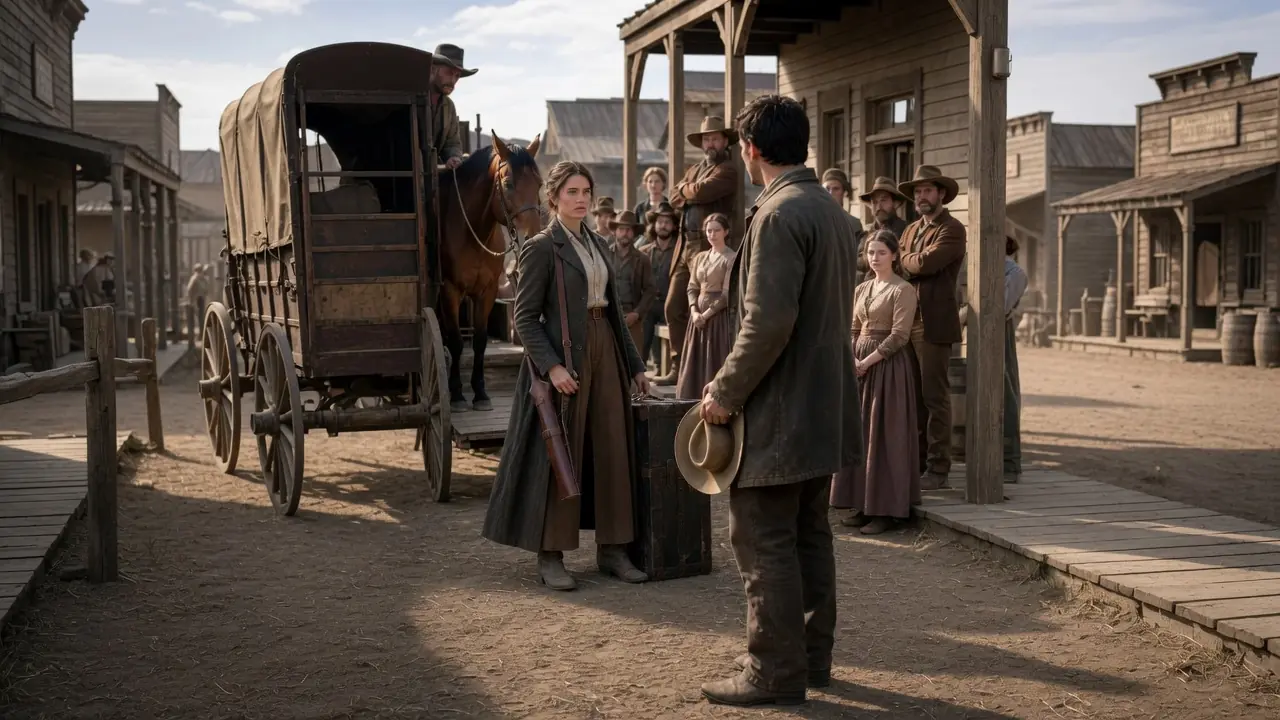
What followed wasn't a love story. It was a war. Fought with ink, law, and sheer stubborn will. Over land, water, and the right to exist on your own terms. The stagecoach from Pueblo arrived 40 minutes late, which was considered punctual by Silver Ridge standards.
Nathan Holloway had been standing outside Greer's General Store for the better part of an hour, turning his hat in his hands like a man at a funeral who couldn't remember which direction the church was in. He'd cleaned his boots twice that morning. His neighbor Cal Briggs had noticed and not let him forget it, remarking at breakfast that a man who polishes his boots twice before sunup is either going to a wedding or hanging, and in Nathan's case, it was starting to look like both. The town had known for 2 weeks that a woman was coming. Word traveled fast in a valley with only one road in and one road out.
Mrs. Prentice at the post office had mentioned it to her husband. Her husband had mentioned it to three men at the feed store. By the following Thursday, most of Silver Ridge had formed an opinion about Nathan Holloway's mail-order arrangement, and a fair number of those opinions were being expressed loudly and without his permission. "She'll take one look at that ranch and be back on the next coach," Pete Dunmore had said. "She's probably 60 years old and half blind," said someone else, and several men had laughed.
Nathan had said nothing to any of them. He wasn't a man who argued unless the argument was worth having, and other people's predictions about his private life didn't qualify. He had written to Vivian Mercer for eight months. He knew the shape of her thinking, the directness of her opinions, and the fact that she could calculate crop rotation yields faster than any farmer he'd ever met. Which she'd demonstrated in a letter so detailed it had kept him reading past midnight by lamplight with his coffee going cold.
He was not particularly worried about her being 60 or half-blind. He was, if he was honest with himself, worried about everything else. The stagecoach came rattling down the main street trailing a cloud of ochre dust, and Nathan straightened up and stopped torturing his hat. Three passengers climbed out. A traveling salesman with two heavy bags, an older couple visiting from Denver, and then the door swung open a third time.
She dropped down before the driver could offer a hand, landing clean and easy in the dirt. And she was already moving before most people had registered she was there. She went straight to the luggage rack on top of the coach and pointed at a specific trunk without asking anyone's help. The driver passed it down to her, then a second bag, then and this was the moment the crowd outside Greer's really started paying attention. A Winchester rifle in a worn leather scabbard, which she slung over her shoulder with the casual competence of someone who'd been doing it since before she could vote.
She was tall for a woman, dark-haired and dressed practically in a divided skirt and a wool coat that had seen better days. She wasn't beautiful in the way the dime novels described frontier women, not soft-faced and wide-eyed and grateful for rescue. Her face was angular, alert, like she was already assessing the town and making notes. She scanned the street once, thoroughly, and her eyes landed on Nathan Holloway standing in front of the general store still holding his hat. She walked toward him.
He walked toward her. They met in the middle of the street, which was exactly where Silver Ridge's population of 214 people could observe them most efficiently. "Nathan Holloway," he said, it came out slightly crooked, not quite a question, not quite a statement. "That's what I'm hoping," she said. "Vivian Mercer.
" "You're taller than I pictured. " "You're" He stopped himself. "Armed? " She offered. "My father's rifle.
It's been to Missouri, Kansas, and now Colorado. I wasn't going to leave it behind. " She looked at him straight. "I hope that's not going to be a problem. " "No," Nathan said.
"No, it's not. " A pause stretched between them, not uncomfortable exactly, but honest. The kind of pause that acknowledges that two people have been writing letters to each other for months, and now they are standing in actual sunlight, and everything they assumed has to be quietly renegotiated. "I've got a wagon," Nathan said. "I've got a horse," Vivian said.
He blinked. "You brought a horse on the stagecoach? " "She's in the stock car on the freight run behind. Should be in tomorrow morning. " She tilted her head slightly.
"Is that a problem? " "No," Nathan said again. He seemed to be doing that a lot. No, that's We've got room. " They looked at each other for another moment.
Behind them, at least a dozen Silver Ridge residents were watching with the focused attention of people who had very little entertainment and were making the most of what was available. "Well," Vivian said finally, "should we get my trunk loaded, or would you like to stand in the street a while longer? " The corner of Nathan's mouth moved. It might have been a smile. "Let's get your trunk.
" The Holloway ranch sat 7 mi south of Silver Ridge at the edge of a narrow valley where a creek called Danner's Run came down out of the foothills and spread into a series of shallow irrigation channels that Nathan's father had dug by hand 30 years earlier. The land was good. Or it had been good, and could be good again, which is a different thing. Nathan had inherited it four years ago when his father died of a fever, along with two mortgages, a broken grain auger, and 40 head of cattle that needed more attention than he could reasonably provide alone. Vivian rode beside him in the wagon for most of the 7 miles without talking much, which Nathan found he didn't mind.
She was looking at the land, not the way visitors looked at it, admiring the mountains, remarking on the scenery, but the way a farmer looks at land, reading it, slope and drainage and soil color, where the water went when it rained hard and where it pooled when it shouldn't. That field on the left, she said after a long silence, pointing to a wide stretch of pale grass stubble. What were you running there? Winter wheat last season, didn't do much. The drainage is wrong.
See how it's lower in the center? You're losing moisture to run off on the east edge and drowning the roots in the middle after a hard rain. She paused. You'd want to regrade it, raise the center line about 8 inches, and cut a draw channel along the east. Nathan looked at the field.
He'd farmed that ground for four years and hadn't seen it that way. That's Yeah, he said slowly. That would help. She glanced at him. Sorry, I I'm not trying to come in and tell you what's wrong with your ranch on the first day.
You can keep going, he said. I'd rather know. She studied him for a moment like she was deciding whether that was true or just politeness. Then she turned back to the land and kept looking. The creek bend there.
How's your water flow in dry season? Drops about a third. Does Kincaid's upstream diversion affect it? Nathan went quiet. You know about Kincaid?
You mentioned him in your March letter. Said he'd been pressuring some of the smaller ranchers in the valley. She looked at him directly. You didn't say much. I assumed there was more.
There's more, Nathan said. He told her the rest of it on the drive in. Victor Kincaid had come to the valley 3 years ago with Eastern money and the kind of confidence that comes from never having faced any serious consequences. He'd bought up two failed ranches cheap, installed a dam modification on the upper branch of Danner's Run that technically fell within the existing water rights, but practically reduced flow to the lower ranches by 15% in dry years, and had since been making quiet, reasonable-sounding offers to buy out his neighbors. The offers were never quite enough.
The pressure was never quite direct enough to fight legally, and the ranchers in the valley, hard-working, isolated men and women who had barely enough money to pay their mortgages and didn't have the resources or the knowledge to understand water law, property law, or the fine print in county land records, were slowly being squeezed. Three families had already sold and left. "He's patient," Nathan said. "That's the worst part. He's not threatening anyone.
He's just waiting. " "Waiting for a dry year," Vivian said. "Yes. " "And how long has it been since a good rain? " Nathan looked at the sky.
It had been pale and dry for 6 weeks. "Too long. " Vivian said nothing else about it that day, but Nathan noticed when they arrived at the ranch and he showed her around. The house, the barn, the equipment shed, the fields, that she was still reading the land, taking measurements with her eyes, adding things up. The house was not what she'd imagined, which was fine because she hadn't imagined anything in particular.
She'd learned a long time ago that imagining specific things about the future was a reliable way to guarantee disappointment. It was a two-room structure with a lean-to kitchen added on the back, solid enough, but plain, with a stone fireplace that drew well and floors that had been swept recently. She noticed that and didn't say anything about it. Nathan had made a real effort to have the place presentable and she wasn't going to embarrass him by pointing it out. He showed her the room he'd prepared for her, which was the smaller of the two main rooms.
There was a clean quilt on the bed and a wooden chest of drawers that was newer than everything else in the house, which told her he'd bought it recently. "It's not much," he said from the doorway. "It's a room," she said. "It's fine. " "I thought the arrangement being what it is.
" He stopped and tried again. "I didn't want you to think I'd assume. " "Nathan. " She turned around. "I know what the arrangement is.
We've been writing to each other for 8 months. I know you're not the kind of man who'd assume anything. " She held his gaze. "That's partly why I came. " He nodded.
Something in his posture settled slightly, like a knot loosening. "I'll get supper started. " "Tell me where things are. I'll help. " "You don't have to uh" "I know I don't have to," she said with just enough edge in it to make him understand that telling her she didn't have to do things was going to be a recurring source of friction between them.
"I want to. I've been sitting in a stagecoach for 2 days and I need to do something with my hands. " Supper was salt pork and beans and cornbread, which Vivian improved marginally by finding the dried herbs on the shelf above the stove and adding them to the pot while Nathan was outside seeing to the horses. He came back in, smelled something different, and didn't say anything about it, which told her he'd noticed. They ate at the small table by the window and the conversation was easier than it might have been.
That was the thing about months of letters. You'd already told each other the awkward things, already worked through the initial performance of being someone likable. There was less to prove. They talked about his cattle operation, about the grain harvest timing, about the water situation with more detail than he'd given on the wagon. She asked questions that he answered honestly, including the ones that were uncomfortable.
"How bad is the debt? " she asked. He told her in broad strokes in the letters. He told her the specific numbers now. She listened without expression, doing the arithmetic in her head.
"That's manageable," she said. "If the cattle prices hold through spring and you can get that Westfield producing better, you're not in a hole you can't climb out of. " "I know," he said. "I just need a good year. " "You need two," she said.
"A good year gets you out of the hole. Two good years gets you stable. " She looked at her plate. "I know something about that. " Nathan had read enough of her letters to know that her family's farm in Missouri had failed when she was 19, that her father had died the following winter, and that she'd spent 3 years working a neighbor's land before saving enough to not need anyone's charity.
He hadn't pressed for more than she'd offered in the letters, and he didn't press now. "The copper mare," he said instead. "What's her name? " Vivian's expression shifted slightly, something less guarded. "Clover.
" "Clover? " he repeated. "Good name for a horse. " "She's opinionated," Vivian said. "Doesn't like being told what to do.
She planted all four feet and refused. "She doesn't go with strangers," Vivian said, appearing beside the handler with the air of someone who'd been expecting this. She took the lead rope and spoke quietly to the mare, and Clover walked off the ramp like she'd always meant to. Nathan watched this from a few feet away. He had three horses of his own, a draft gelding named Chester and two working quarter horses, and he'd been curious how Clover would take to the company.
He needn't have worried. By midday, Clover was sharing the corral with Nathan's horses with minimal drama, having established within the first 20 minutes that she had opinions about the pecking order, and everyone else had agreed. The quarter horses gave her space. Chester, who had survived four Colorado winters and was unimpressed by most things, regarded her with a mild philosophical resignation. "She'll be good out here," Nathan said.
"She'll be better than good," Vivian said. "She's the best-footed horse I've ever had in rough country. " She spent that first full day learning the ranch with a systematic thoroughness that Nathan found slightly unnerving and increasingly impressive. She walked every fence line, checked the water channels, went through the tool shed inventorying what was in working order and what wasn't. She found a broken bolt in the grain auger that Nathan had been meaning to replace for a month and pointed to it without comment, and Nathan went to town that afternoon and got the replacement.
By the end of the week, she had reorganized the tool storage system, identified a rotational grazing pattern that would take pressure off the overgrazed south pasture, and started keeping a daily water level record for Danner's Run using a notched post she'd set in the creek bank herself. "What's that for? " Nathan's hired hand, a 20-year-old named Billy Tate, had asked, watching her drive the post in. "Tracking the flow rate," Vivian said, straightening up and pushing her hair back. If Kincaid opens or closes anything upstream, I want to know how fast the change reaches us and how much it costs us in real terms.
" Billy looked at Nathan. Nathan shrugged. Billy went back to work. The woman caused talk in Silver Ridge, which was not surprising. She walked into the county land records office on her second Saturday in town and asked to review the water rights filings for the upper and lower sections of Danner's Run going back 15 years.
The county clerk, a meticulous man named Horace Webb, who wore the same green eye shade every day of his working life, was so startled by a woman asking to review property records that he almost forgot to actually give them to her. These are public records, Vivian told him pleasantly when he hesitated. Yes, ma'am, Horace said. Yes, they certainly are. He gave her the records.
She sat at the reading table for 3 hours taking notes in a small leather book she carried everywhere. She was there when Mrs. Clara Reeves came in to record a deed transfer and stopped dead at the sight of Nathan Holloway's mail-order woman sitting at the records table surrounded by water rights documents. Word reached the Silver Ridge Women's Auxiliary by that afternoon. She's studying land law, Mrs. Prentice told the meeting. Is she now?
said Agnes Caldwell, who had owned the boarding house for 20 years and had opinions about everyone. Horace says she knew exactly what she was looking for. Didn't ask him for help, just asked for the files and sat down. That's unusual, Agnes said. That's what I thought, said Mrs. Prentice.
What neither of them knew, what Vivian hadn't told anyone, including Nathan, was what she'd found in those records. She sat across from him at the kitchen table that evening, her notebook open in front of her, and spread out the notes she'd taken. Kincaid's water rights claim has a problem, she said. Nathan put down his coffee. What kind of problem?
He filed the diversion modification under the 1876 senior rights allocation, which gives him priority claim in drought conditions. But that allocation was contingent on the original filing describing the intended use and the volume. She tapped a page in her notebook. The original filing describes livestock watering for no more than 300 head. He's running over 800 head on that land now.
Nathan was quiet for a moment parsing this. So, he's drawing more water than his rights allow. Significantly more. And here's the thing, that contingency clause was never formally amended. Either he didn't know about it, which I doubt, or he assumed no one would ever look closely enough to find it.
Most people wouldn't, Nathan said slowly. Most of us can barely read the standard deed language, let alone the contingency provisions. Most people, Vivian said, never had a lawyer father who made her read case law for fun. She closed the notebook. If we can document what he's actually drawing versus what the filing authorizes, we have grounds to challenge the modification.
Nathan looked at her for a long moment. The firelight moved across his face, a face that was, she decided, genuinely honest in its expressions, not schooled to hide things. He was turning this over, thinking about what it meant. That's fighting him, he said. Legally, but still, he's got money.
He'll hire lawyers. I know. He won't just let it go. I know that, too. She met his eyes.
I'm not suggesting this is easy. I'm telling you there's a real legal vulnerability in his claim, and that most of the ranchers in this valley have been afraid to look for one, or didn't know how. She leaned forward slightly. Nathan, he's counting on people feeling helpless. That's his whole strategy.
Take that away and he's just a man with money and bad intentions, which is not actually an unbeatable combination. Nathan sat with this for a while longer. Through the window, the Colorado stars were fierce and cold and close. In another month, the weather would turn, and the question of water rights would become a great deal less theoretical. I'd need to talk to the other ranchers," he said.
"Yes. Some of them won't want to hear it. They've already made up their minds that fighting is hopeless. " "Some of them," she said, "not all. You just need enough.
"Enough for what? " "Enough to make the challenge credible. Enough to make Kincaid understand that this isn't one ranch pushing back. It's a coordinated dispute with legal standing. " She looked at him.
"He can buy out one ranch. He can pressure one family. He can't buy a lawsuit. " Nathan picked up his coffee again, and she could see him thinking. He was a careful man, not slow, not timid, but careful in the way that meant he actually considered things before acting on them.
She found she respected that, even when it required patience. "You've thought about this a lot," he said finally, "since the day you told me about him on the wagon. " He looked at her across the table. The lamp light was low, and the room was warm, and the situation between them was still new enough that there were things neither of them said yet. But there was something in that look, direct, weighing, with a small component of something that wasn't quite surprise, but was adjacent to it.
"All right," he said. "Let me think about who to talk to first. " The first person Nathan talked to was a rancher named Dale Huff, who ran 200 acres bordering the eastern edge of the Holloway property. Dale was 53, thickset, with hands like shovels, and a persistent cough that had followed him through three winters. He had received one of Kincaid's offers eight months ago and declined it.
He had received a second offer, lower than the first, two months ago. He hadn't responded at all. They met at the fence line on a Tuesday morning, while Vivian stayed back at the ranch and gave them privacy. This was her suggestion. She understood that Dale Huff had not asked for her opinion, and might not welcome it from a woman he'd never met, and that Nathan needed to have this conversation as one neighbor talking to another.
"Water rights filing," Dale said when Nathan finished explaining. He squinted at the horizon. "You're sure about this? " "Vivian's sure. She's been through the county records twice.
" "Vivian? " Dale turned this over. "The one that came on the stagecoach with the rifle. " "Yes. " "Mhm.
" A long pause. "She know what she's looking at in those records? " "Her father was a lawyer," Nathan said. "She read case law growing up. She's not she's not guessing, Dale.
She found the specific contingency clause and she can show you the page. " Dale coughed deep and slow and spat at the ground. "You know what he did to the Carmichael place? " "I know. " The Carmichael family had been the first to sell.
They'd held out for 2 years, during which time Kincaid's upstream adjustment had reduced their water flow enough to cost them 30% of their cattle production. They'd had a bad winter on top of it, lost several head to a respiratory sickness, and in the spring they'd sold at a price that barely covered their debts and left with nothing. Their house had stood empty for 4 months before Kincaid had a crew come in to tear it down. "I don't want that to happen to my place," Dale said. "I got two boys that are supposed to inherit it.
" "Then help us make sure it doesn't," Nathan said. Dale coughed again and looked at the mountains for a while. "Who else you talking to? " "You're first. " "Talk to Ted Marsh," Dale said finally.
"He's been mad about this since the beginning. He just didn't know what to be mad at. " He looked at Nathan. "And tell that woman of yours, Vivian, tell her I want to see the page in the record she's talking about before I say yes to anything. " "I'll tell her," Nathan said.
Vivian showed Dale Huff the records page the following Sunday at the Holloway kitchen table while Dale's wife Martha sat beside him and Nathan leaned against the counter drinking coffee and trying to look like he wasn't paying close attention to everything. Dale read slowly. He read the contingency clause twice. He looked at Vivian's transcription of the original filing numbers and Kincaid's current stock count, which he'd obtained from a combination of county records and straightforward counting on the two occasions she'd ridden past the Kincaid operation. "840 head," Dale said.
"At last count," Vivian said, "it may be higher. The original filing authorizes 300. " "And this contingency? " "It's never been amended. I've looked at every amendment filing in the county records for that parcel going back to 1876.
There's nothing. " Dale looked at his wife. Martha was a quiet woman who had grown up in a quiet place and expressed most of her opinions through the angle of her silence. The angle of her current silence said, "This sounds serious and I want you to take it seriously. " "What happens if we challenge it?
" Dale asked. "Best case, the modification gets voided. Kincaid has to refile under current standards, which means he either reduces his herd to what his water rights support or he buys additional rights at market rate. " Vivian kept her voice level. "He's not going to be happy.
" "He's going to come after whoever files the challenge. " "Probably. That's why it can't be just one ranch. " She looked at him directly. "If it's Nathan filing alone, Kincaid can focus everything on pressuring this place.
If it's four ranches or six or eight filing a joint dispute, that's different. That's a community position. " "And you think you can get that many people to sign on? " "I think I can make the argument," she said. "I'm not certain people will listen.
That's always the risk. " Dale was quiet for a while. Martha was quiet. Outside the wind moved through the dry grass in the south pasture with a sound like something trying to get in. "All right," Dale Huff said.
"I'm in, but I want Ted Marsh in, too, before we go any further. " "Nathan's already set up a meeting with Ted for Thursday," Vivian said. Dale Huff looked at Nathan. "She organized all this? " "She organized all this," Nathan confirmed.
Dale looked at Vivian again in the way that men of his generation and situation looked at women who were not behaving as expected. Not hostile, not entirely comfortable, but with the particular expression of a person who is updating a long-held assumption. "Well," he said, "all right, then. " The Thursday meeting with Ted Marsh took place at Marsh's property, a smaller operation than Nathan's or Dale's, but efficiently run, with a kitchen garden that Vivian immediately identified as unusually well-maintained. Ted Marsh was a compact, energetic man in his mid-40s with reddish hair going gray at the temples, and a manner of speaking that moved fast and expected you to keep up.
He'd been furious about Kincaid since the upstream modification. He talked about it to anyone who would listen, and several people who would not, and the general community response had been sympathetic, but unactionable. When Nathan showed up with Vivian and the water rights argument, Ted Marsh sat down at his kitchen table and gave the papers his complete attention for 20 minutes without saying a word. Then he looked up. "Where'd you find this?
" "County land records office," Vivian said, "public filing. " "It's just sitting there? In the filing? " "Yes. " "And nobody's ever" He stopped.
"How? " "Most people don't know what to look for," Vivian said, "and they assume someone else already checked. " Ted sat back and rubbed his face. "Three years," he said, "three years I've been watching this happen, watching people sell and leave, and the whole time there's a contingency clause just sitting in a county file. " He looked at Nathan.
"Your woman found it. " "She did, Nathan said. She find anything else? I'm still looking, Vivian said. Ted Marsh laughed, a short, incredulous sound.
All right. I'm in. Who else? We'll see. By the end of October, they had six ranchers committed to the joint dispute filing.
Not enough to feel entirely safe, but enough to be credible. Vivian drafted the initial documentation herself, based on the legal forms she'd found in the county records, and her memory of the process law she'd read in her father's books. And Nathan took it into Silver Ridge to have it reviewed by the town's one practicing attorney. A cautious man named Elliot Foss, who specialized in property transactions, and hadn't had an interesting case in 3 years. Elliot Foss read the documentation for a long time.
Then he read it again. Where did this come from? He asked Nathan. My Vivian drafted it. Vivian Mercer.
Elliot set the papers down and looked at Nathan over his glasses. The woman who arrived on the stagecoach last month. That's her. This is legally coherent, Elliot said, in the tone of a man expressing measured amazement. The contingency clause argument is valid.
The filing methodology is correct. He picked it up again. There are two sections I'd want to strengthen, but the fundamental structure is He paused. Where did she learn this? Her father, Nathan said.
She read a lot. Elliot looked at Nathan for another moment. Get her in here, he said. I want to talk to her directly. This isn't the kind of thing I want to handle through intermediaries.
Nathan went home and told Vivian that the lawyer wanted to see her. She put on her coat and went to town the same afternoon. She sat across from Elliot Foss in his small office above the hardware store for an hour and a half, and by the end of it the attorney had stopped being surprised by her, and had started being useful, which was what she'd been waiting for. The two-week sections, she said, the volume documentation. I know.
I need a formal measurement record, not just my daily notes from the post in the creek. Who would need to certify that? A county surveyor, Elliot said. Or failing that, a signed statement from multiple property owners documenting the same observations over the same period. How many signatures for it to carry legal weight?
Three or more from separate parcels over a continuous 45-day period. I've had people logging water levels at three separate properties, Vivian said, for 6 weeks. Elliot looked at her. You've already done this. I thought it might be necessary, she said.
The lawyer sat back in his chair and folded his hands on his desk and looked at her in a way that was mostly professional assessment and only a small part something else. The dawning awareness that he was looking at a person considerably more capable than the situation she'd arrived in would suggest. All right, he said. Let me write up what we'll need and we can go through it piece by piece. I appreciate your time, Vivian said.
I know this isn't a typical case. Ms. Mercer, Elliot Foss said, with the careful politeness of a man trying to be accurate without being patronizing, "Nothing about this situation is typical, but that's not a complaint. " He picked up his pen. Now, let's talk about the volume documentation. Nathan found her on the porch that evening in the dark, sitting on the top step with her knees drawn up and her arms around them.
He brought two cups of coffee and sat beside her. The valley below them was quiet. The mountains were a pale ghost shape against the darker sky. The creek made its small sound in the distance. Long day, he said.
Long day, she agreed. She took the coffee and held it in both hands. They sat for a while without speaking. It was becoming a habit between them. A companionable silence that neither of them rushed to fill.
They'd been doing it for 3 weeks now and it had the quality of something that had been present all along waiting to be practiced. Elliot Foss is good, she said finally. Careful. He'll be useful when this gets contentious. You think it will get contentious soon?
Yes. She sipped the coffee. We filed the challenge. Kincaid finds out within the week. He'll respond fast because his whole strategy depends on people believing resistance is hopeless.
The moment they see it isn't she trailed off. The moment they see it isn't Nathan said. He gets scared. He gets dangerous, Vivian said. Which is different.
Nathan considered this. In the darkness his profile was serious and still. You're not worried. It wasn't exactly a question. He was reading her the same way she'd been reading the land when she arrived.
I'm worried, she said. I just don't find it useful to lead with. He almost smiled. She could hear it in his voice when he spoke. You know what Dale Huff said about you when I talked to him yesterday?
What? Said he's known plenty of stubborn people in his life. Said you're the first one he's met that he didn't want to argue with. Vivian was quiet for a moment. I'll take that.
I thought you might. The night spread out around them, immense and cold and full of the particular silence of the Colorado mountains in late autumn when the summer birds have gone and the winter ones haven't arrived yet and the world holds itself in a kind of held breath between seasons. Down in the valley lights were visible from the Huff place and the faint smear of Silver Ridge's lamps against the dark. Somewhere in between on land that used to belong to smaller, less ruthless men Victor Kincaid's ranch sat quiet and confident not yet understanding what was being built against it. "The mare settled in well," Nathan said.
"She has," Vivian agreed. "She likes Chester. " "Chester likes everything. He's the most agreeable horse I've ever owned. " "Clover doesn't like most things," Vivian said.
"It's meaningful when she does. " Nathan turned to looks at her and she turned to look at him and in the dark on the porch step it was just two people who'd been strangers five months ago and were figuring out what they were to each other now. Neither of them in a hurry, both of them certain enough that it was worth the figuring. "We're going to file the challenge this Friday," she said. "I know," he said.
"After that, things change. I know that, too. " He picked up his coffee. "You know what I thought when I first saw you step off that stagecoach with the rifle? " "Tell me.
" "I thought she's not going to need saving. " He paused. "I thought that might be the best thing I'd seen in a long time. " Vivian Mercer looked at Nathan Holloway in the dark for a moment and something in her face that was usually very careful became, for just a second, less careful. "Well," she said, "let's see if you still think that in 6 months.
" She turned back to the valley. He turned back to the valley. And below them, Danner's Run moved quietly through the dark, carrying its measured amount of water toward the fields in the future. And the challenge that would change the valley forever was 6 days away from being filed. The challenge went in on a Friday, as planned.
Elliot Foss filed it at the county clerk's office at 9:00 in the morning with Nathan standing beside him and Vivian waiting outside because the office was small and she thought her presence might make Horace Webb nervous enough to fumble the paperwork. She was probably right. She stood on the boardwalk in the thin November light watching the street. And when Nathan came out 15 minutes later and gave her a single nod, she She out a breath she hadn't entirely realized she'd been holding. It's done, he said.
It's done, she said. They didn't celebrate. There was nothing to celebrate yet. The filing was a beginning, not a victory, and Vivian understood better than most that beginnings had a way of feeling significant right up until the moment everything went wrong. They drove home mostly quiet, and that afternoon she went back to the creek to check the water level post and write the day's measurement in her log, same as she'd done every afternoon for 6 weeks.
The numbers hadn't changed. They wouldn't change until Kincaid responded, and he hadn't had time to respond yet, but she kept logging anyway because data collected consistently was the only kind that held up, and she'd learned that from her father who had believed in documentation with a religious devotion he hadn't extended to much else. The response came not from Kincaid himself, but from a man named Gerald Pruitt. Pruitt appeared at the Holloway Ranch on a Monday morning riding a clean horse and wearing a coat that cost more than most men in the valley earned in 2 months. He had a smooth, patient manner, the kind of manner that was assembled rather than natural.
And he introduced himself as representing certain property interests in the upper valley, which was the most polite way anyone had ever described working for Victor Kincaid. Nathan came out to the porch when he heard the horse. Vivian was in the barn checking on one of the cattle that had been off its feed, and she heard the voice and came to stand in the barn doorway where she could see and hear without being immediately visible. Mr. Holloway, Pruitt said from his horse. He hadn't dismounted, which was a choice.
I'm here to let you know that my employer has become aware of a filing at the county office and wanted to open a conversation before the situation becomes more complicated than it needs to be. It's already complicated, Nathan said. He made it complicated when he modified the upstream diversion. Pruitt's expression didn't shift. He'd been trained not to react to things like that.
My employer would dispute that characterization. He'd also like to point out that legal proceedings are expensive and time-consuming, and that he's prepared to make a very fair offer for the Holloway property. An offer that would let you walk away from this valley with enough to start over somewhere considerably more hospitable. Nathan looked at him for a moment. Tell your employer that the property isn't for sale.
I understand, but I'd encourage you to I said it's not for sale. Nathan kept his voice level. And whatever conversations you're planning to have with the other ranchers who signed that filing, you're going to get the same answer. Pruitt absorbed this. He glanced briefly at the barn doorway.
He'd noticed Vivian standing there, and she didn't step back. He looked at her for a second with the careful assessment of a man who is paid to understand situations quickly. "The filing has certain weaknesses," he said, still looking at Nathan, but clearly addressing both of them. My employer's legal team has already identified them. Your employer's legal team should read the volume documentation, Vivian said from the barn doorway.
Specifically, the section covering the 60-day measurement record from three separate properties. Pruitt looked at her fully now. He hadn't been told about her, or if he had, hadn't been told enough. "And you are? " he said.
"I'm the person who filed it," she said. He A pause. Pruitt looked back at Nathan. Something in his assembled manner had slipped slightly. Not much, but enough.
"This doesn't need to be a fight," he said. "No," Vivian agreed. "It doesn't. " "Your employer could reduce his herd to what his original filing authorizes, which would be 300 head, and file an amendment for the additional rights at current market rate. That would resolve the dispute without any of this.
" "That's not a realistic "That's exactly what the law requires," she said. "I'm sorry if that's inconvenient. She went back into the barn. Pruitt sat on his horse for another moment looking at Nathan. Whatever he'd expected to find at the Holloway Ranch, it hadn't been this.
Mr. Holloway, he said more quietly. Your situation here is precarious. Mortgages, debt, a drought that's looking worse every week. My employer has resources you don't. I'd encourage you to think carefully.
I have been, Nathan said. Good morning, Mr. Pruitt. He went back inside and let the door close behind him. Pruitt rode away and Vivian came out of the barn and they both watched him go down the road toward the valley. He'll be at Dale's place by noon, Nathan said.
And Ted's by mid-afternoon. She folded her arms against the November cold. Did that rattle you? Yes, Nathan said without pretending otherwise. The mortgage comment rattled me.
I know. She looked at him. It's supposed to. That's the point of sending someone like Pruitt instead of coming himself. Someone like Pruitt can say things Kincaid can't say directly without it looking like a threat.
Is that what that was? Not a threat? It was absolutely a threat, she said. It just came in a nice coat. Nathan exhaled.
What do we do? We wait, she said. We let the filing stand and we see what their lawyers actually do with it. If there were real weaknesses, they'd have filed a counter already. They're stalling.
She looked up the road where Pruitt had gone. And we warn Dale and Ted he's coming. Nathan went inside to send word. Vivian stayed on the porch a moment longer alone and let herself feel the things she didn't show. A cold thread of doubt tight in her chest that asked whether she had calculated this correctly, whether she had read Kincaid right, whether the ranchers who'd signed the filing were solid enough to hold when the real pressure came.
She didn't have answers. She had information and logic and a legal argument she believed in and the rest of it was the kind of thing you couldn't know until you were already inside it. She went back to work. The weeks that followed had a grinding quality, slow and pressured like weather moving in from the mountains. Pruitt visited Dale Huff and got the same answer Nathan had given him.
He visited Ted Marsh and Ted, who had been preparing for this visit since the filing and had written out what he wanted to say, read it to Pruitt from a piece of paper with a composure that surprised even himself. He visited two of the other four ranchers, a widow named Elsa Nordgreen and a quietly stubborn man named Frank Casper, and came away from both of those with the same result. The sixth rancher, a younger man named Burl Oats, who'd signed the filing somewhat reluctantly to begin with, received a visit from Pruitt on a Thursday and by Saturday had sent word to Nathan that he was withdrawing his name. Nathan told Vivian on Sunday morning in the kitchen over a breakfast that went cold while they talked. "He withdrew," she said.
"He's got a young family," Nathan said. "Young kids. He can't afford" He stopped. "I'm not blaming him. " "Neither am I.
" She was quiet for a moment. "Does it change the legal standing? " "Elliot says we still have five solid signatures and the volume documentation covers all three measurement properties. It weakens us, but it doesn't break us. " Vivian nodded.
She was turning something over in her mind and Nathan, who was learning to read her silences the way she'd read his land, waited. "Kincaid's smarter than I gave him credit for," she said finally. "He didn't go after the strongest people first. He found the one who was closest to the edge and pushed there. " "So he'll try again, try to find another weak link.
" "Yes. " She looked at the table. "Which means we have to know our people better than he does. Know who's close to the edge and why. And then what?
And then we help them, she said simply. Whatever it takes to make it easier for them to stay in than to get out. Nathan looked at her. We don't have much to spare, Vivian. I know.
I'm not talking about money necessarily. She finally picked up her fork. I'm talking about showing up, being present, reminding people that they're not standing alone. There was a quality in her voice when she said that. Not sentimental, not reaching for effect, just factual, the way she talked about water levels and soil drainage and the things that mattered because they were true.
Nathan looked at her across the table and thought, as he had been thinking with increasing frequency, about how the letters had been honest but had not prepared him fully for the actual person, who was more complicated and more certain and more quietly ferocious than pages could carry. All right, he said, who do we visit first? They spent the next two weeks doing that looked from the outside like nothing much at all. They rode out to Elsa Nordgren's place on a Wednesday and helped her repair a section of fence that had been down since September. And while they worked, Nathan and Elsa talked about the filing and the pressure and Nathan told her directly that he and Vivian were not going anywhere.
Elsa was 58, had run that ranch alone since her husband died 6 years ago, and was not a woman easily frightened, but she had been carrying a particular kind of dread that lifted somewhat from her shoulders over the course of that afternoon. When they left, she pressed a jar of preserved peaches on Vivian, who accepted it without protest. They went to Frank Casper on a Saturday and sat in his kitchen while Frank's wife Rosie made coffee, and Frank walked them through his specific fear, which was not Kincaid himself, but the idea of a lengthy legal process draining money he didn't have. Vivian asked Elliot Foss about this the following Monday, and Elliot, who had his own reasons for wanting to win this case and was becoming invested in a way that surprised him, agreed to defer his fees until the dispute was resolved. She told Frank Casper on Tuesday.
He stared at her for a moment. He agreed to that? He did. Frank Casper looked at his wife. Rosie was looking at Vivian with an expression that was not quite trust yet, but was moving in that direction.
All right, Frank said. All right. We're staying in. Dale Huff, meanwhile, had quietly started talking to two ranchers who hadn't signed the original filing, a pair of brothers named Jerome and Arthur Lund, who ran adjacent properties to the north and had been watching the dispute with the cautious attention of men trying to decide which way a storm was moving before they committed to cover. Dale didn't pressure them.
He just told them at the feed store and at the mill, and once over a fence line on a gray Tuesday morning, what the legal argument was and what Elliott Foss had said about it, and what Vivian Mercer had found in the county records. He told it plainly, the way Dale Huff told everything, without embellishment. Jerome Lund came to the Holloway Ranch on a Thursday afternoon, alone, asking to see the documentation. Vivian sat with him for an hour and a half and showed him everything she had. He asked good, specific questions.
He was a methodical man who needed to understand things fully before he acted on them, which she respected. When he left, he said he'd talk to Arthur. Arthur Lund was harder. Arthur had seen the Carmichael place torn down and had taken a lesson from it that was different from the one his brother had taken. Jerome had taken, this can be stopped.
Arthur had taken, this cannot be stopped and it will happen to us next. That kind of conclusion, once settled into a man's bones, didn't shift easily. It was Nathan who talked to Arthur, not Vivian. He'd known Arthur for eight years, since before his father died. And there was a history between them of the quiet, unspoken kind that exists between men who have worked neighboring land through hard seasons.
He went alone to Arthur's place on a cold evening in late November. And they sat on the porch because Arthur's house was warm, and sitting inside felt too domestic for what needed to be said. I know you think this is going to fail, Nathan said. Arthur looked at the mountains. I think Kincaid has more money and more patience than any of us.
He has more money, Nathan said. I'm not sure about the patience. A man with his kind of ambition he wants the valley. Not in 10 years. He wants it soon.
He paused. That means this is the time to push back. Not later. Pushing back costs things. Doing nothing costs the ranch, Nathan said, eventually.
Arthur was quiet for a long time. A cold wind came down off the foothills and moved through the dead grass on his south pasture with a dry rustling sound. That woman of yours, he said finally. Vivian. She know what she's doing?
Better than I do, Nathan said honestly. Better than most lawyers I've met. Another long pause. Jerome trusts her, Arthur said. Jerome's smart.
Jerome's always been smarter than me, Arthur said, in the way of a man who's made his peace with something true and doesn't mind saying it. He looked at Nathan. I'm not signing any filing. Nathan accepted this. But I'm not selling either, Arthur said.
Not to Kincaid, not at his price. He looked back at the mountains. And if this dispute of yours goes somewhere real, you tell me. It wasn't a yes, but it wasn't a no. Nathan rode home and told Vivian, and she counted it as a partial.
That's enough for now, she said. December came in gray and dry, and the concern about drought that had been theoretical became steadily less so. The creek ran lower than Nathan had logged in 4 years of records. The ranchers started watching the sky with the particular anxiety of people who understand how thin the margin between a viable season and a failed one actually is. Vivian's water level post showed a 12% reduction in flow since October.
Some of that was seasonal. Some of it, enough to matter, was Kincaid's upstream diversion running at full draw through the dry period. She wrote it all down. Every number, every date, every measurement. Her log was 60 pages now, dense with figures and notations.
And she kept it in the wooden chest in her room along with her father's case law books and the letters from the 8 months before she'd come to Colorado, which she hadn't reread since arriving but hadn't been able to throw out either. On the 14th of December, she had her first direct encounter with Victor Kincaid. It happened at Greer's General Store, where she'd gone to pick up supplies on a Tuesday morning. She had a list and a budget and was working her way through both with methodical efficiency when the bell above the door rang and a man came in who was not Victor Kincaid but clearly worked for him, followed a moment later by Kincaid himself. She'd seen him from a distance once, riding the road north of town.
Up close, he was not what she'd expected. He was perhaps 50 with a broad, ruddy face and the compact physical authority of a man who'd been strong when he was younger and had managed the transition to power without losing the habit of physical confidence. He was well dressed in a way that was meant to suggest ease rather than display. He looked at the store with the expression of a man who owned things and was comfortable in that fact. He registered Vivian's presence in about 3 seconds, which was fast.
"Miss Mercer," he said pleasantly, as though they'd met before. "Mr. Kincaid," she said and turned back to the shelf she was examining. "I don't believe we've had the chance to meet properly. " He moved toward her with the controlled ease of a man who'd managed hundreds of conversations like this one. I've been meaning to introduce myself since you arrived.
You sent Gerald Pruitt instead, she said. He introduced himself well enough. A brief pause. Gerald is very capable, Kincaid said. Though I understand the conversation didn't go the way he'd hoped.
His tone remained warm. I can respect that. I respect people who know what they want. That's kind of you. I also respect people who understand their limits, he said.
And just like that, the warmth was still present, but there was something underneath it, not quite a threat. The same way Pruitt's visit hadn't been quite a threat. Just a fact. Stated as though it were obvious. What you're attempting with this filing, it's admirable, genuinely.
But you're fighting an uphill battle with resources you don't have, and a drought coming that's going to make this valley a very difficult place to hold on to for people who are already stretched thin. Vivian set her selections on the counter and looked at him fully for the first time. Mr. Kincaid, she said, I'm aware of the drought. I've been tracking the water levels on Danner's Run since October. I have 60 days of measurements from three properties documenting the reduction in flow relative to your upstream draw.
She kept her voice conversational, the same tone she might use to discuss the weather. I'm also aware that your water rights modification was filed under a contingency clause that was never amended to reflect your current stock numbers. And I'm aware that our attorney has identified three additional procedural irregularities in your original filing that we haven't formally raised yet. She picked up her supply bag. So when you say I'm fighting an uphill battle, I'd encourage you to be specific about what hill you think I'm climbing.
Victor Kincaid looked at her. Whatever he had been expecting from Nathan Holloway's mail-order woman, it was clear this wasn't it. His expression didn't collapse. He'd spent 30 years learning not to let his expressions collapse, but something in it shifted. A recalibration.
The look of a man who has been told by subordinates that a problem is manageable and has just realized the subordinates were wrong. "You're a capable woman. " He said. "I know. " She said and walked out of the store.
She didn't tell Nathan about the encounter right away. She came home, put away the supplies, and went to check the water post before supper, logging the afternoon measurement in her notebook with the same steady hand she always used. She told him at supper while they were eating in the same tone she might use to describe an unremarkable errand. He put his fork down. He was there himself.
He was. He doesn't usually come to town. Nathan was thinking. He sent Pruitt for the conversation. He wouldn't come in himself unless he was what?
Curious? "Worried. " Vivian said, "or trying to decide whether to be. " "Pruitt reported back that the filing was more solid than expected, and I think Kincaid came to see for himself what he was dealing with. " She drank her coffee.
"He wanted to look at me. " "And? " "And I told him what three additional irregularities we hadn't formally raised yet. " Nathan looked at her. "Do we have three additional irregularities?
" "We have two. " She said, "I was rounding up. " He stared at her for a moment and then something cracked across his face that was somewhere between alarmed and admiring. "Vivian, the point wasn't to be precise. " She said, "The point was to make him uncertain about what we know.
The worst thing we can do is let him feel like he has a clear picture of our position. " She met Nathan's eyes. "He's good at this. He's done it to people who didn't know what they were walking into. We're not those people.
" Nathan was quiet for a while. Outside the wind had picked up, moving across the valley with the dry insistence it had carried for weeks. The creek was lower again. He'd checked that morning. "He's going to move faster now," Nathan said.
"Knowing you're the one running this. " "Probably. " "That's dangerous. " "It was already dangerous," she said. "I'd rather he move fast and make a mistake than move slow and keep wearing us down.
" She pushed her plate slightly to the side and leaned forward. "Nathan, we're building something here, not just the legal case, the community. The way Dale talks to people now, and Ted, and even Elsa, who never said two words to a county official in her life. They're different than they were 2 months ago. They believe it can be done.
" She looked at him steadily. "That's what Kincaid can't buy and can't pressure away. And that's what's really scaring him. " Nathan looked at her for a long moment. In the winter light from the window, with the cold pressing in against the glass, she looked tired.
She was tired, he knew, running on the particular fuel of a person who has committed completely to something and doesn't allow herself to stop. But there was underneath the tiredness something that hadn't wavered. He'd spent 4 years on this ranch alone with debt and a dry creek and a mortgage that pulled at him every morning, and the weight of it had settled into him as a kind of permanent low-grade despair that he'd mostly stopped noticing the way you stop noticing a sound you've lived with too long. She'd been here 7 weeks. The despair was lighter.
He hadn't found the right moment to say that to her, and he didn't say it now, but he thought it, clear and specific, while she watched him across the kitchen table. "There's something I've been wanting to tell you," he said. She waited. "When I wrote the first letter," he said, "I was honest in it. That part's true.
But I wrote it because I needed help and I didn't know what else to do, and I thought I thought maybe if I was honest enough someone might" He stopped, started again. "I wasn't thinking about partnership. I was thinking about survival. She looked at him. I know.
You knew? I suspected, she said. It didn't matter. I wrote back because your letters were the first letters I'd gotten in 3 years of correspondence that talked about the land instead of the arrangement. She looked down at the table for a moment.
You wrote about the west field and the drainage problem and what the water situation had been like the previous summer. You wrote about your cattle like they were animals you knew. You wrote like a man who actually lived somewhere. She looked up. That was rarer than you'd think.
Nathan was quiet. I came here because I wanted what I said I wanted, she said. A partnership. Someone who wasn't going to be frightened by me. She held his gaze.
So far you haven't run. I'm not planning to, he said. Good, she said. Because we still have Kincaid to deal with and I'm going to need someone who can ride to Silver Ridge at 5:00 in the morning when the counter filing comes in and I suspect that moment is about 12 days away. Nathan almost smiled.
12 days, give or take. How do you know? Because that's how long it would take me, she said, if I were him. She was wrong by 3 days. The counter filing came in on day nine and it was more aggressive than either of them had expected, which meant the next phase of this was going to be harder than the last and the drought was still coming and the valley was going to be tested in ways that paperwork alone couldn't answer.
But that was still nine days away. Tonight there was the kitchen and the wind and the coffee going cold and two people at a table who had found somewhere in the middle of a fight they hadn't finished, the beginning of something they hadn't expected. The counter filing was 43 pages. Elliot Foss spread it across his desk on a Wednesday morning and read through it twice while Nathan and Vivian sat across from him and the wood stove in the corner of his office ticked and popped in the cold. When he finished the second read, he took off his glasses and set them on top of the stack and looked at the ceiling for a moment.
"Well," he said. "How bad? " Vivian said. It wasn't a question. "It's not bad in the way that means we lose," Elliot said carefully.
"It's bad in the way that means this gets longer and more expensive. " He put his glasses back on and turned to a specific page. "They're contesting the measurement methodology, arguing that your water level post isn't a certified instrument and therefore the 60-day record doesn't meet evidentiary standards. " "That's thin," Vivian said. "It is thin, but thin arguments in property disputes can hold up proceedings for months while everyone argues about methodology instead of substance.
" He turned another page. "They're also filing a cross-claim against the joint dispute on grounds that the ranchers who signed acted in concert to damage Kincaid's business interests. It's a stretch, but it shifts some of the burden. " "They're trying to make it expensive enough that people drop out," Nathan said. "Yes," Elliot said.
"That's exactly what they're doing. " Vivian had been reading over Elliot's shoulder, following along in the document. She straightened up now and moved to the window that looked out over Silver Ridge's main street, where the December sky sat low and colorless over the rooftops. "The measurement methodology argument," she said, "what would it take to satisfy it? " "A certified surveyor's assessment of the post placement and calibration or an alternative measurement system that meets county standards.
" Elliot paused. "There's a surveyor in Pueblo who does water rights work. He's not cheap. " "How not cheap? " Elliot told her.
Nathan's jaw tightened slightly. It was not money they had lying around. "What's the alternative measurement system? " Vivian asked. Elliot hesitated.
"There's a provision in the 1879 Water Management Code that allows community documented flow records to serve as evidentiary basis if they meet specific criteria, consistent methodology, multiple observers, continuous record. He looked at her. You'd need daily readings from at least five properties documented identically over a 90-day period. "We have 60 days from three properties," she said. "You'd need 90 from five.
" "Then we extend the record," Vivian said. "We bring in two more properties and we keep logging. " Elliot looked at her. "That's 30 more days of documentation. This will still be tied up in proceedings.
" "I know. " She turned from the window. "But the surveyor costs money we don't have. The community documentation costs time and organization and we have both. " She looked at Nathan.
"Do you think Dale and Ted would keep logging and can we get Elsa and Frank to add their properties formally? " "Dale's been logging since November," Nathan said. "Ted also. " He thought about it. "Elsa I can ask.
Frank might take convincing. " "I'll talk to Frank," Vivian said. Elliot was watching her with the focused attention of a man revising his estimate of a situation. "If you can establish the community documentation record and hold all five signatures through the spring proceedings, you have a legitimate path. " He paused.
"Kincaid knows that. He's going to keep applying pressure. " "He can apply all the pressure he wants," Vivian said. "We just have to make sure the people he's applying it to don't feel like they're standing alone. " She picked up her copy of the counter filing.
"I'm going to read all 43 pages tonight. Can you mark the sections I should focus on? " Elliot marked six sections. She read all 43 pages anyway. Frank Casper's hesitation when she went to see him that Thursday was different from before.
In October it had been fear, fear of expense, of a long fight, of Kincaid's reach. This time it was something quieter and more stubborn. His wife Rosie met Vivian at the door with an expression that telegraphed the conversation before it started. "He's in the barn," Rosie said. "He's been in the barn since yesterday.
" Vivian found Frank in the back of the barn doing maintenance work on a piece of equipment that didn't particularly need it. He looked up when she came in and then looked back down. "Pruitt came again," he said. "I figured. Not to the house this time.
Stopped me on the road into town. " Frank set down his wrench. He was a compact, careful man, and when he was upset it showed in his stillness rather than his movement. Everything went a little too controlled. "He told me the cross claim they filed could make me personally liable for damages to Kincaid's business interests.
" "That's not true," Vivian said. "The cross claim is against the joint filing as an entity. They can't reach your personal assets under Colorado property law. Elliot confirmed this yesterday. " Frank looked at her.
"You're sure? " "I'm sure, and Elliot is sure. And if you want to sit down with Elliot himself, he will tell you the same thing in writing. " She kept her voice level. "Pruitt knows it's not true, too.
He's a smart man working for a smart man. That's why he stopped you on the road instead of sending a letter, because a letter can be checked and a conversation on a road can be anything. " Frank Casper was quiet for a moment absorbing this. "He's lying to me," he said slowly, not outraged, just arriving at it the way an honest man arrives at dishonesty in others, which always takes slightly longer than it should. "He's making you afraid of something that isn't real," Vivian said, "which is the only weapon he has left because the legal argument is holding.
" Frank picked up his wrench again, turned it over in his hands. "You really believe that? That it's holding? " "I believe it enough to keep fighting it," she said. "And I'm not a woman who fights things I don't believe in.
" Another silence. Outside the barn, the wind moved across the dry grass and the sky was the same low gray it had been for a week. Frank looked at his equipment and then at Vivian and then at something between them that was just his own tired reckoning. "What do you need from me? " he said.
"Daily water measurements, same format as the log I gave you in October. 90 consecutive days documented. " She pulled a folded paper from her coat. "I wrote out the methodology so it matches the county standard for community documentation. " Frank took the paper.
He read it. It was clear and specific and not complicated. "That's it? That's the most important thing right now. " She met his eyes.
"Frank, you and Rosie built this place. Don't let a man who showed up 3 years ago with Eastern money take it because he's willing to lie to your face on a road. " Frank Casper looked at her for a long moment. Something in his expression shifted. Not dramatically, just the way a door shifts when you find the right angle.
"All right," he said. "Give me the log sheet. " January came and the creek dropped again. Not catastrophically, not yet, but enough that every rancher in the valley who depended on Danner's Run felt it in a daily and practical way. Cattle needed water.
Fields, even dormant winter fields, needed soil moisture. The calculations that governed whether a ranch survived a dry year were not complicated, but they were unforgiving and they pressed down on everyone with a constant low weight. The ranchers began to argue, not with Kincaid's people, with each other. It started at the feed store on a Tuesday in mid-January when Ted Marsh made a comment to Jerome Lund about the upper draw on the eastern branch of the creek, a small tributary that fed both their properties. And Jerome took it wrong and both men had their separate frustrations and their separate worries, and they were looking at each other across a wooden counter with a combined 40 years of hard land pride between them, and the comment became an argument fast.
Nathan heard about it the next day from Billy Tate, who'd been at the store. He told Vivian that evening, and she sat with it for a while. "They're not really arguing about the water," she said. "I know," Nathan said. "They're scared.
It comes out somewhere. " "The problem is that scared people in a dispute like this start making separate calculations," she said. "Ted starts thinking maybe his property's position is slightly better than Jerome's, and maybe he doesn't need Jerome as much as he thought. Jerome starts thinking maybe he should have signed the filing when he had the chance, but now maybe it's too late and he's got no one. And Kincaid she stopped.
"Kincaid just has to wait while we do his work for him. " She went to see Ted the next morning early before he'd had time to settle into whatever posture he'd adopted about the argument. She didn't mention the argument at all. She showed him the updated log records from all five properties and walked him through what the combined data showed about Kincaid's draw. She made the numbers the center of the conversation instead of the feelings.
Ted, who was a practical man beneath his quick temper, listened. By the end of it he was looking at the numbers instead of his resentment, which was where she needed him. "Jerome's East Tributary drop is almost identical to yours," she said, showing him the comparative line. "Whatever's affecting your flow is affecting his the same way. You're not competing for water with him.
You're both losing it to the same source. " Ted was quiet for a moment. "I should probably about the other day "I don't need to know about the other day," Vivian said. "I need you and Jerome to be in the same room together when Elliot files the next response to Kincaid's cross claim. Can you do that?
" "Yes," Ted said. "I can do that. " She wrote to Jerome Lund that same afternoon and had a version of the same conversation. And Jerome, so methodical, careful Jerome, who trusted numbers more than words, looked at the comparative data and reached the same conclusion Ted had. "I was angry at the wrong person," Jerome said.
"It happens," she said. "The point is what you do next. " The meeting she called at the end of January was in the Holloway barn, which was the largest covered space any of them had access to, and which smelled of hay and cold leather and the particular mustiness of cattle in winter. She'd pushed Nathan's wagon to one side and set out whatever seating she could collect. Three chairs from the house, a pair of sawhorses with a board across them, several bales of hay that served well enough.
Nine people came. Dale and Martha Huff, Ted Marsh, Elsa Nordgren, Frank and Rosie Casper, Jerome Lund, a rancher named Owen Picard who hadn't been involved yet but had asked Dale about the dispute at the mill, and a surprise, Arthur Lund, who had told Nathan in November that he wasn't signing anything. Arthur came in last, stamped his boots, and sat on a hay bale in the back without speaking. Vivian had thought carefully about how to run this meeting. She understood that walking in as the person who knew the most about the legal situation, which she did, would create a dynamic that some of these people would resist.
Pride was real and practical in the lives of people who had so few resources that their pride was not a luxury but a necessary structure. So, she started with the numbers, not the argument. She put the water log on a board Nathan had propped against the wagon. 90 days of combined data from five properties, drawn into a line graph that took her most of a Tuesday evening to produce, and she let the line do the talking first. The line was not subtle.
It showed a consistent, measurable reduction in flow that corresponded almost exactly with the dates when Kincaid had increased to herd count. She had the herd count documented from county livestock records, which were public. And the correspondence was close enough that even a skeptical person looking at it would have had to work hard to explain it another way. That's the evidence, she said. Everything you're feeling about this winter, about the water, about the uncertainty, this is what's behind it.
Not weather alone, not bad luck. Elsa Nordgren, who rarely spoke at public gatherings, said, "Can we win? " "I believe we can," Vivian said. "But I want to be honest with you about what that means. It means staying organized when Kincaid's people try to divide us.
It means keeping the documentation through spring. It means not taking separate deals if Pruitt comes back. " She looked around the barn. "One family selling separately doesn't just hurt that family. It weakens the joint filing for everyone still in it.
" "He'll come back," Dale said. "He always comes back. " "Yes. ' She looked at them steadily. That's why I asked you here.
Not to give you orders, to give you information so that what he tells you next time doesn't land in a vacuum. " She spent the next hour going through the specific points, the contingency clause, the methodology argument, the cross claim, and what it could and couldn't actually do. She answered questions. Some of them were hostile questions. From Frank Casper mostly, who was working through his own ongoing distrust of the process.
And she answered those the same way she answered the others, without defensiveness. Owen Picard, who'd come on Dale's word and hadn't said much, raised his hand at the end like a man who hadn't been in school since he was 12 and found the gesture slightly awkward. "What about the water sharing in spring? " he said. "If the legal fight goes long and the creek's still low, how do we manage Because last drought we had, two ranches almost came to blows over the draw order.
The room went quiet. This was the question beneath the legal dispute, the one that was more immediate than any filing. If the spring came dry, the ranchers would need water in a sequence, an amount that the existing informal arrangements, handshakes, and habit had never been designed to handle under real scarcity. "I've been thinking about that," Vivian said. "And?
" Owen said. "I want to propose a rotation," she said, "based on property size and need rather than seniority. Not who got here first, who needs what and when, with a shared record so everyone can see everyone else's usage. " She paused. "I know that's going to feel like giving up something.
If you've always had priority draw, you're going to have to accept a schedule. But priority draw in a drought means your neighbor runs dry, and a neighbor who runs dry has to sell, and land that gets sold to Kincaid A's sold. " The room was very still. "She's right," Arthur Lund said from the hay bale in the back. Everyone turned to look at him, including Jerome, who looked faintly stunned.
"I don't like it," Arthur continued. "I've had priority draw on the East Branch for 22 years and I earned it, but I've also watched three families leave this valley in 3 years. And every time one leaves, the rest of us get a little smaller and a little more alone. " He folded his arms. "A rotation I can live with.
Kincaid owning the valley I can't. " The silence after Arthur Lund spoke had the quality of something shifting. Not perfectly, not without reservation from several faces around the barn, but shifting. "I'm not asking for yes tonight," Vivian said. "I'm asking you to go home and think about it.
Talk to your families. The rotation proposal is in writing and I'll get a copy to everyone in this room by the end of the week. " She looked around. "What I'm asking for tonight is this. If Pruitt comes to any of you before the next court date, you call Nathan before you give any answer at all.
Any answer, even I'll think about it, call Nathan first. Heads nodded. Not all of them, but enough. After the others had gone, Arthur Lund stopped in the barn doorway. Nathan was stacking chairs.
Vivian was rolling up the log graph she'd drawn. "That woman of yours," Arthur said to Nathan, "she always like this? " "Every day," Nathan said. Arthur considered this. "She's going to make enemies," he said.
Not a warning, just a statement of fact, delivered in the pragmatic tone of a man describing weather. "She knows," Nathan said. Arthur nodded and went out into the cold. February brought the hardest freeze of the season and with it a development that Vivian had not anticipated. The Silver Ridge Courier, a four-page weekly that mostly carried advertisements, livestock prices, and town meeting notices, published a front-page item about the water rights dispute.
It was not flattering. It described the joint filing as a legally questionable challenge by a group of small ranchers against established water rights and quoted an unnamed source with knowledge of the proceedings as saying the case was unlikely to survive the spring session. It referred to Vivian in one sentence as a woman recently arrived from Missouri who appears to be organizing the dispute. Nathan read it at breakfast and put it face down on the table. "Don't," Vivian said.
"Don't what? " "Don't put it face down like I can't handle reading it. " She turned it back over and read it. When she finished, she set it down right side up and drank her coffee. "The unnamed source," she said.
"Kincaid," Nathan said, "or Pruitt. Probably Pruitt. Kincaid's too smart to be directly quotable. " She tapped the paper. "This is a new move.
He's been working legally and through direct pressure. Now he's working public opinion. She looked at the ceiling for a moment. Which means he's worried about public opinion. Why would he worry about that?
He doesn't live here. He doesn't need these people to like him. He doesn't need them to like him, she said. But he needs the county commissioners to feel comfortable ruling in his favor. And commissioners pay attention to what a community thinks, especially in an election year.
She looked at Nathan. He's trying to establish the narrative before I do. So what do we do? She was quiet for a moment. Then Who runs the Courier?
Man named Pell. Martin Pell. He's been running it for about 8 years. Is he honest? He's practical, Nathan said carefully.
He prints what he thinks people will read and what won't get him in legal trouble. Would he print a response? I don't know. Maybe. She sat with this for another moment.
What about a longer piece? Not a response to this specifically, but a plain account of the legal situation. The contingency clause, the measurement records, the actual provisions of the water rights filing. Facts. She looked at Nathan.
Written clearly enough that anyone can read it and understand what's actually happening. You want to write for the Courier. I want to give people in this county real information instead of unnamed sources, she said. Kincaid is betting that most people don't know enough about water rights law to evaluate what he's doing. I think most people, given the actual information, are more capable than that.
Nathan looked at her for a moment. You'd be putting yourself in front of this, openly. He's been coming after the filing so far. This would make it personal. It's already personal, she said.
He called Pruitt to stop Frank on a road and lie to his face. That's personal. She folded the newspaper. I'd rather be a named target than an unnamed one. He drove her to the Courier office on a Thursday.
Martin Pell was a thin, ink-stained man with quick eyes who had the slightly defensive energy of a small paper editor who expected people to come complain about his coverage and had developed a preemptive posture accordingly. He looked at Vivian with professional caution when she came in. "Ms. Mercer," he said. He'd clearly known who she was before she walked through the door. "Mr. Pell.
" She set a folded piece of paper on his desk. "I'd like to submit a piece for publication. 1,400 words. It's a factual account of the water rights dispute in the lower valley with the specific legal provisions cited and the measurement data summarized. " She looked at him steadily.
"I understand you printed an item last week based on an unnamed source. I'm a named source offering documented information. I thought you might be interested in balance. " Pell looked at the paper without picking it up. "Kincaid's a significant advertiser," he said carefully, like he was explaining something to himself as much as to her.
"I'm aware," Vivian said. "I'm also aware that if this dispute goes to a full county hearing, which it will, a great deal of public attention will be paid to how this community was informed about the situation beforehand. " She paused. "I'm not threatening you. I'm I'm pointing out that accuracy tends to age better than the alternative.
" Pell looked at her for another moment. Then he picked up the paper and read it. His eyes moved quickly, the way a man reads who has spent years editing other people's words and automatically marks what's usable and what isn't. He read it twice. "This is accurate?
" he said. "These citations are real? " "Every one. The county filing numbers are at the bottom. You can check them against the records office yourself.
" Pell set the paper down and scratched the back of his head. He had the expression of a man being asked to make a decision he'd rather not have to make, which was the expression of a man who was, underneath basically honest. "I'll need to verify the citations," he said. "Of course," she said. "And I'll want to add an editorial note that this represents one party's perspective.
" "That's your right," she said, "as long as the factual content isn't altered. " "It won't be altered. " He looked at her over the paper. "You write clearly, Ms. Mercer, for someone who isn't a journalist. " "I read a great deal," she said.
She and Nathan were back in the wagon heading home when he said, "He's going to print it. " "Yes," she said. "How do you know? " "Because he read it twice," she said. "A man who isn't going to print something reads it once and puts it down.
" The piece ran the following Thursday under the headline water rights dispute, a factual account. It was printed under her full name. By Sunday she knew, because Dale Huff told her and Dale Huff was not a man who reported things he hadn't verified, that people as far as the northern end of the valley had read it and were talking. Kincaid's response came not through Pruitt this time. It came through his lawyer, a letter to Elliot Foss suggesting that the publication of the piece constituted an attempt to influence the proceeding and requesting that the court take notice.
Elliot read the letter, wrote a four paragraph response explaining why the publication of factual information in a newspaper did not constitute improper influence and filed it with the court the same day. Nathan read Elliot's response that evening and for the first time in months felt something shift in his chest, something that had been tight and low and constant, the weight of the debt and the drought and the uncertainty moving slightly. Not gone, not resolved, but different. "We're not losing," he said. He meant it not as a prediction, but as a realization.
"We're not losing," Vivian agreed. She was writing the second piece already at the kitchen table, her lamp pulling a yellow circle in the dark while outside the February wind pushed hard against the windows, and the creek ran thin and steady over the frozen ground. But holding. Still holding. She wrote through this cold, and Nathan sat across from her reading the water records for the hundredth time, and the ranch held its breath around them the way the whole valley was holding its breath.
Waiting for spring, waiting for the next move, waiting to find out what drought and pressure and the long slow fight would make of the people caught inside it. The second piece ran in the Courier on the first Thursday of March, and the third ran 2 weeks after that. By the time the third piece appeared, a detailed account of how water rights modifications had been used across three Colorado counties to consolidate land ownership with the Danner's Run situation presented as a case study. Martin Pell had stopped adding the editorial note about one party's perspective. He hadn't said anything to Vivian about this.
He just stopped doing it, which was its own kind of statement. Letters began arriving at the Courier. Not many at first. Two, then four, then a cluster of seven in the same week from ranchers and homesteaders in other parts of the county who had read the pieces and recognized in them situations that rhymed with their own. Pell printed three of them.
He sent Vivian copies of the others with a brief note in his cramped handwriting. "Thought you should see these. " She read them at the kitchen table on a Sunday morning while Nathan was out checking the cattle, and she sat with them longer than she normally allowed herself to sit with anything. The letters were from people she'd never met. A widow in the northern valley who'd been pressured to sell water access rights she hadn't understood she could protect.
A family in the eastern foothills who'd watched a neighboring property change hands three times in 4 years and never understood how. They wrote plainly, the way people write when they're not trying to impress anyone, just trying to be understood. She was still at the table when Nathan came in stamping mud off his boots. "How's the herd? " she asked without looking up.
"Two of the yearlings are thin. I want to move them to the south pasture today if the ground's not too wet. " He poured himself coffee and looked at what she was reading. "More letters? " "Seven more.
" She set them down. "Nathan, this is bigger than our valley. " "I know. " he said. He sat down across from her.
"I've been knowing that. " "What Kincaid is doing here? " "It's a pattern. " "The same method, slightly different circumstances, different counties. " She looked at him.
"Elliot needs to see these letters. " "For the case? " "For context. " "Judges pay attention to patterns even when they can't formally admit evidence from outside the jurisdiction. " She paused.
"And I want to write about it. " "Not just what's happening here, what's happening everywhere this method gets used. " Nathan drank his coffee and looked at her. She had the look she got when something had organized itself in her mind. Focused in a way that was slightly separate from the room, like part of her was already somewhere else working on the next problem.
He'd learned to recognize it and not interrupt it. "The Courier reaches maybe 800 households. " he said finally. "I know. I've been thinking about the Pueblo Examiner.
" He set down his coffee. The Pueblo Examiner was the largest paper in the region with distribution across six counties. It was a different order of magnitude from the Silver Ridge Courier. "You think they'd print you? " he said.
"I think they'd print a documented account of a water rights pattern affecting hundreds of families across their circulation area. " she said. "Whether they print me specifically depends on how I approach them. " She looked at him. "I'd need to go to Pueblo.
" "When? " "After the spring hearing. I can't leave before that. " The spring hearing was 3 weeks away. In those 3 weeks, the drought continued.
The rotation system she'd proposed held, imperfectly, with arguments at the margins that had to be managed mostly by Nathan riding from property to property with the patient diplomacy of a man who'd spent his whole life navigating neighbors who had to live with each other through everything. And the water level on Danner's Run dropped another 8%. Kincaid's response to the third Courier piece came in the form of a visit that surprised everyone, including Vivian. He came himself without Pruitt on a Thursday afternoon. Rode up to the Holloway Ranch alone and called from the gate in the manner of a man who understood frontier etiquette well enough to know you didn't ride into a yard uninvited.
Nathan came out. Vivian came out a moment later wiping her hands on a cloth. Kincaid sat on his horse and looked at them both. He'd had months to consider whatever he was about to say. "I want to talk," he said.
"You're talking," Nathan said. "Privately. Without the legal proceedings for a moment. " He looked at Nathan, then at Vivian. "I'd like 5 minutes of your honest time.
" Nathan glanced at Vivian. She gave him nothing, just waited. This was his ranch and his call. "Get down," Nathan said. "We'll talk on the porch.
" Kincaid dismounted and tied his horse to the post and came up to the porch, and they stood there, the three of them, with the cold March wind coming off the mountains and the thin creek audible somewhere below. "The pieces in the Courier are causing me problems," Kincaid said. Directly, which was not what either of them had expected. "Not legally, politically. The commissioners are paying attention to this in a way they weren't in January.
" "That was the intent," Vivian said. "I know it was. " He looked at her without hostility, just the level assessment she'd seen in Greer's store in December, recalibrated now. "You're a better opponent than I planned for. "I'm not your opponent," she said.
"I'm a rancher's a rancher's partner protecting a water right that was being illegally diminished. " Something moved across Kincaid's face. "The hearing in 3 weeks, we're ready for it," Elliot Foss said. He'd arrived from town that morning to go through the final documentation, and he came around the corner of the porch now, which startled Kincaid in a way that Vivian noted and filed away. Good.
Let him be startled. Kincaid looked at Elliot, then back at Nathan. "I'm prepared to offer a settlement," he said. "A formal amendment to the water rights modification, reducing draw to a level consistent with the original filing for the duration of the drought in exchange for withdrawal of the joint dispute. " Elliot's expression didn't change.
Vivian's didn't either. "And after the drought? " Nathan said. "We renegotiate. " "No," Vivian said.
Kincaid looked at her. "A settlement that lasts only until the drought ends gives us nothing permanent," she said. "The contingency clause violation doesn't go away because the creek recovers. Either you amend the filing to reflect your actual herd count, which means paying current market rate for the additional water rights, or this goes to the hearing and the court decides. " She looked at him.
"Those are the choices. " A long silence. The wind moved through the dry grass on the south pasture. "You understand? " Kincaid said carefully.
"That if this goes to the hearing and you win, I'll appeal. " "We understand," Elliot said pleasantly. "It could take years. " "We're aware," Vivian said. "We're also aware that every month this continues, the Pueblo Examiner receives another documented account of water rights consolidation methods in Colorado with specific case studies.
" She held his gaze. "You've built a business on people not knowing what they're legally entitled to. I'm interested in changing that, Mr. Kincaid, with or without the hearing. Victor Kincaid stood on the Holloway porch in the cold March wind and looked at a woman who had arrived in this valley five months ago on a stagecoach and in that time had built a legal case, organized a community, established a public record, and connected what he was doing to a pattern visible across the region. He had not become as successful as he was without the ability to accurately read situations that had shifted against him.
He put his hat back on. "I'll be in touch with my lawyers," he said. "We'll see you at the hearing," Elliott said. Kincaid went to his horse and rode out without looking back. The three of them stood on the porch until he was gone down the road.
"He's going to settle," Elliott said quietly. "Maybe," Vivian said, "or he's going to come to the hearing with everything he has and hope the measurement methodology argument holds. " She watched the road where Kincaid had gone. "Either way, we go in ready. " "Why?
" The spring hearing was held on a Tuesday in the county courthouse in Silver Ridge, a room that served triple duty as courtroom, town meeting hall, and occasional shelter during bad weather, which meant the benches smelled of wet wool and old wood and the particular staleness of a space that had held a great many difficult conversations. It was more crowded than county hearings usually were. Word had gotten around, partly because of the Courier pieces and partly because people in small communities track their neighbors battles the way they track the weather with the knowledge that what affects one affects everyone eventually. Vivian counted 34 people in the benches. She recognized most of them.
Owen Picard was there and Arthur Lund, who had not signed any filing but showed up anyway and sat in the third row with his arms crossed and his jaw set. Kincaid's legal team was three men from Denver. They were well-dressed, well-prepared, and had the smooth professional confidence of people who argued property cases for a living. Their lead attorney, a man named Chandler, had the kind of silver-haired authority that played well in courtrooms. Elliot Foss was one man, locally based, whose office was above a hardware store.
Chandler looked at Elliot the way a large fish looks at a smaller one. Not aggressive, just categorizing. Commissioner Warren, who was presiding, was 60 years old, a former rancher himself, and had the patience and perceptiveness of a man who had spent most of his adult life listening to people with competing claims to the same piece of ground, and had learned to hear what was underneath the argument, rather than just the argument itself. Elliot opened with his contingency clause. He presented it plainly, the way Vivian had coached him, not with legal theater, just with the actual document, the actual numbers, the actual text.
300 head authorized. 840 documented. Contingency clause never amended. He let those three facts sit in the room. Chandler's team responded with the measurement methodology argument, which was what Vivian had predicted they'd lead with.
Their contention was detailed and technically sophisticated, and would have been effective against a hand-drawn line on a notched post in a creek. It was less effective against 90 days of documented measurements from five properties, recorded in the specific format required by the 1879 water management code, signed and dated by the property owners, and cross-referenced with rainfall records from the county weather station. Commissioner Warren read the documentation for a long time. He asked Elliot three questions about it. The answers satisfied him in the methodical way of a former rancher evaluating evidence.
The hearing lasted 4 hours. Vivian sat behind Elliot and passed him notes when she needed to, which happened twice. The second time, the note identified a citation error in Chandler's argument about senior rights allocation. A case number that didn't support the point being made, and Elliott raised it so quietly and precisely that Chandler had to stop and check his own papers, and the pause that followed cost him something in the room's attention that he didn't entirely recover. In the afternoon session, Commissioner Warren asked Victor Kincaid directly Kincaid was present in the third row on the other side, which he hadn't been required to do whether his current livestock count was consistent with his original water rights filing.
Kincaid's lawyer started to answer for him. "I'd like to hear from Mr. Kincaid himself," Commissioner Warren said. A long pause. "My operations have expanded since the original filing," Kincaid said. He was careful.
He was always careful. "Have you amended the water rights filing to reflect that expansion? " Warren said. Another pause. "That is a matter of ongoing legal interpretation.
" "I see," Warren said, in the tone of a man who had heard every variety of evasion in 60 years and had long since stopped finding them interesting. the ruling came 11 days later in a document that Horace Webb delivered to Elliott Foss's office on a Wednesday morning. Elliott sent Billy Tate out to the Holloway Ranch with the news, and Billy arrived at a gallop, which told Vivian before she'd read a word that it was good. She read the ruling standing up in the yard with Nathan beside her, and Billy Tate trying not to visibly vibrate with the need to know what it said. Commissioner Warren had found in favor of the joint filing on the core question of the contingency clause violation.
He had ordered Kincaid to bring his water draw into compliance with the original filing within 60 days or file a formal amendment purchasing additional rights at current market rate. He had dismissed the measurement methodology challenge on the grounds that the community documentation record satisfied the 1879 standard. He had declined to dismiss the cross claim outright, but had found it without sufficient basis to proceed, which effectively killed it. He had also, in the final paragraph, made a note that he was referring the matter of the original modification approval to the county water board for review of the approval process. Vivian read that last paragraph twice.
"He's referring it to the water board," she said. "What does that mean? " Nathan said. "It means Warren thinks there may have been a problem with how the original modification got approved in the first place," she said slowly, "which is a different and bigger question than the contingency clause. " Nathan looked at her.
"How much bigger? " "Big enough that it might not just be about Kincaid's operation. " She folded the ruling. "Big enough that other modifications in other valleys might get looked at the same way. " Billy Tate finally broke.
"Is it good? " he said. "Can someone just tell me if it's good? " "It's good," Nathan said. He looked at Vivian.
"It's good. " Billy let out a sound that was somewhere between a cheer and a relieved exhale, and went to take the news to Dale Huff, who'd asked him to come by after. Vivian and Nathan stood in the yard alone. The March sky was still pale, still dry, but there was something in the air that felt marginally less like the breath being held before a catastrophe. Around them, the ranch sat in its winter-ending quiet.
The cattle moving in the south pasture, Clover visible in the corral watching the road with her characteristic opinionated attention. The creek running low, but running. "We should tell the others," Nathan said. "Yes. " She was still looking at the ruling.
"Nathan. " "Yeah. " "Go saddle up. I want to go tell them ourselves, not through Billy. " She looked at him.
"These people held on. They deserve to hear it from us directly. " They rode out to Dale's first, then Ted's, then Elsa's, then Frank and Rosie's, and at each place the response was different in its particulars and the same in its core. Dale Huff shook Nathan's hand and nodded at Vivian with a compact meaningful nod of a man who has revised his estimate of a person significantly upward and doesn't have words for it, but has the nod. Ted Marsh swore loudly and relievedly and hugged his wife.
Elsa Nordgren went very still, looked at the ruling in Vivian's hand, and then looked at the sky. And the expression on her face was not triumph, but something quieter and more durable. The look of a person who has been holding on for a very long time and has just been told they can put down some of the weight. Not all of it, but some. Rosie Casper cried briefly at the kitchen table and Frank put his hand over hers and didn't say anything, and neither did anyone else.
The hardest conversation was the one Vivian hadn't planned. Jerome Lund was at Frank's place when they arrived, and afterward walking to the horses he stopped her. "I should have signed the original filing," he said, "back in October. " "You weren't ready then," she said. "I was afraid.
Most people were. " She looked at him. "Jerome, you logged water measurements for 90 days. That documentation was part of what won this. " He looked at the ground.
"My brother was right to push me. " "Your brother has good judgment," she said. "So do you. It just works on a slightly different timeline. " Jerome Lund looked at her and something in his face was grateful in the uncomplicated way of a man who has been treated decently by someone who had no particular obligation to be decent to him.
"Tell Arthur we said hello," she said, and went to her horse, The rotation system held through the dry spring by roughly the same margin that the legal case had held. Imperfectly, with adjustments and arguments and two occasions when Nathan had to ride out at dawn to resolve a dispute over draw order that threatened to break badly. But, it held. No family went without enough water to get their cattle through. No one sold under pressure.
Kincaid filed an appeal of Commissioner Warren's ruling in April, which Elliot had predicted. He also quietly began the process of purchasing formal amended water rights at market rate, which Elliot had also predicted and which told the story of a man who had done his own private calculation and decided the appeal was a stalling measure rather than a real strategy. Vivian left for Pueblo in early April, two days after Kincaid's appeal was filed. Nathan drove her to the stage. They stood in Silver Ridge's main street in the thin spring light, and it was different from the first time she'd stood here.
She was not a stranger arriving, and he was not a man turning his hat in uncertain hands. They'd been through a winter and a drought and a lawsuit together, and there was between them a kind of ease that had nothing to do with smoothness. It was the ease of two people who had seen each other at their most tired and most frightened and most stubborn and had not looked away. "How long? " he said.
"A week. " she said. "Maybe 10 days if the examiner wants to discuss more than one piece. " "Take the time you need. " She looked at him.
"Nathan, the west field, the regrading we talked about in October. You were going to get the soil movement started before the planting season. " "I know. " "If Billy starts it without you there, he'll get the center line wrong. " "I'll be there.
" he said. "I'm not going anywhere. " She held his gaze for a moment. Between them, across the months since October, the Barton meeting, the creek measurements, the hearing, the nights at the kitchen table with the lamp burning and the documents spread out and the coffee going cold, they had become something neither of them had formally named, but both of them understood clearly. "I'll be back.
" she said. "I know you will. " he said. And the certainty in his voice was not performance. She climbed onto the stage and it pulled out into the pale April morning.
He watched it go until it rounded the south bend in the road and disappeared behind the stand of cottonwoods. And then he stood in the street alone for another moment. Not bereft, not anxious, just present. In the middle of a life that had, against the odds and through a great deal of stubborn work, started to look like something he'd actually chosen rather than merely survived. Martin Pell had told him last week at the store that the Courier circulation had increased by 40 households since January.
40 households that hadn't been reading it before Vivian started writing. Nathan had found this somehow both the smallest and largest possible measure of what had happened in this valley over the winter. He went back to the wagon and drove home to the ranch. He had a west field to regrade. She came back in 11 days, not 10.
She came back with a letter from the Pueblo Examiner agreeing to publish a four-part series on water rights consolidation patterns in Colorado. With her as named author and a compensation rate she hadn't expected and didn't tell Nathan about right away because she was still absorbing it herself. She also came back with a contact name at the Colorado State Land Office, given to her by an attorney she'd met at the Examiner who had been interested in the case and had his own thoughts about the water board review that Commissioner Warren had initiated. She told Nathan about the series contract over supper on her first night back. His face did several things in quick succession.
"Compensation," he said. "Not a large amount," she said. "But real. " "That's Vivian, that's He stopped. He didn't have an easy relationship with words when things mattered, which she'd known since the first week.
"That's something. " "It's a beginning," she said. "The series will reach people in six counties. And the state land office contact, if Commissioner Warren's water board review goes where I think it might go, there may be a case for a broader inquiry. Nathan was quiet for a moment, processing.
Outside the spring night was warmer than it had been in months. And somewhere down on Danner's Run, a frog had started its seasonal commentary, which meant the water was up slightly with the snow melt from the high country. "I want to ask you something," Nathan said. She looked at him. He was not a man who performed things.
When he had something to say, he said it with the same directness he brought to everything. No preamble, no strategic approach. Just the words. "I think you know what I want to ask. " "I think I do," she said.
"I'm not asking because of the ranch or the case or any of it. " He held her gaze. "I'm asking because I'd rather have you here than not have you here. And I think you know that's been true for a while. " It had been true for a while.
She'd known it. She'd been knowing it in the way you know things that are real and durable. Not with a sudden rush, but with a gradual accumulating certainty that builds the way water builds in a creek after a long rain. "Yes," she said. He looked at her.
"Yes, you know what I'm asking or yes? " "Both," she said. "Yes to both. " Outside the frog continued its commentary. The spring air moved through the window and brought the smell of wet soil and new grass and the creek running fuller than it had all winter.
Somewhere in the south pasture, Clover was making her opinion about the evening known in a minor key. And Chester was probably ignoring her with his customary philosophical calm. It was not a perfect moment. The appeal was still pending. The drought had damaged the fall harvest enough that the finances would be tight through summer.
The west field regrading had revealed a drainage problem worse than expected that would need additional work. There was a stack of documentation on the desk in the corner waiting for Vivian's attention, and two letters from families in the Eastern foothills who'd read the courier pieces and needed help understanding their own property situations. None of that was resolved. Life on the frontier did not resolve. It accumulated one season into the next, one problem addressing itself while three more formed.
Vivian had always known this, and it didn't frighten her. She looked at Nathan across the table. He was not the man she'd imagined writing letters in Missouri. He was something more specific and more complicated and considerably more worth knowing. He had never once in 6 months tried to diminish what she was in order to make himself larger.
That was rarer than it should have been. She knew that from enough experience to not take it lightly. "I want to keep writing," she said. "I know. The Examiner series will take me out of the valley sometimes.
There will be meetings, correspondence. " "Vivian. " He said it in the tone of a man addressing something that doesn't need to be addressed. "I read every letter you sent me for 8 months before you got here. I know who you are.
" She looked at him. "I'm not asking you to stop being who you are," he said. "I'm asking you to do it from here. " The night settled around the ranch. The creek ran.
The mountains held their shapes against the dark, and in the kitchen, at the table where they had spent a winter making decisions that mattered, the two of them stayed where they were, not rushing anything, letting the moment be exactly as large and as ordinary as it was. They married in June, on a Saturday, in the yard of the Holloway ranch. It was not a large ceremony. Neither of them had wanted large. What they had wanted was honest, and honest turned out to look like this.
Dale and Martha Huff standing near the fence post, Dale in a clean shirt that Martha had pressed twice. Ted Marsh with his wife Clara, who had made a cake that listed slightly to the left and tasted better than anything from a level cake had a right to. Elsa Nordgren in her good dress, standing straight and quiet the way she stood through everything. Frank and Rosie Caspar, the Lund brothers, Owen Picard, Billy Tate, looking young and scrubbed and slightly overwhelmed. Elliot Foss, who had driven out from town and stood at the edge of the gathering with a glass of lemonade and the expression of a man who has won something and is allowing himself carefully to feel it.
The justice of the peace was a compact business-like woman named Agnes Hollister, who had presided over enough frontier marriages to know that the ones that lasted weren't the ones with the most flowers. She read the words, Nathan and Vivian said theirs, and the whole thing took 11 minutes, which suited both of them exactly. Afterward, Martha Huff said to Dale quietly that she'd never seen a bride look so like herself at her own wedding. Dale didn't entirely know what that meant, but he understood it was meant well, so he agreed. Vivian, for her part, had worn her best dress and her father's pocket watch on a chain, which she'd carried for 10 years and never explained to anyone.
She explained it to Nathan that evening when the guests had gone and the yard was quiet and they sat on the porch in the long summer dark. She told him about her father, the lawyer who read case law for pleasure, who had taught her to argue a point before she was 12, who had died when she was 19 and left her nothing except a way of looking at the world that had turned out to be worth more than land or money. Nathan listened the way he listened to everything that mattered, fully, without hurrying her. He would have liked you, she said. Because I let you argue, Nathan said.
Because you know when you're wrong, she said. That's rarer. He looked at her in the dark. Am I wrong often? Less than most, she said.
More than you think. He almost smiled. That's probably fair. The pocket watch went back in her dress pocket and the summer night spread out around the ranch and Danner's Run moved through the dark below with a sound fuller than it had carried all winter. The snowmelt doing what it always did, arriving late, staying longer than expected, making up in June what it had withheld in January.
Kincaid's appeal was denied in September. The ruling came from the district court in Denver, a formal document that Elliott Foss read three times before he allowed himself to set it down. He rode out to the Holloway ranch himself to deliver it, which he had not done with any other piece of correspondence. And Vivian understood when she saw him coming up the road on a Tuesday afternoon that the news was final. She read it standing in the yard, same as she'd read the original ruling in March.
The court had upheld Commissioner Warren's finding on every substantive point. The contingency clause violation stood. Kincaid's draw reduction order stood. The referral to the water board stood. The cross claim dismissal stood.
The appeal had raised four arguments, each of which the district court had addressed and rejected with a thoroughness that suggested the judges had been paying attention to something larger than one valley's water dispute. "That's it," Elliott said. He was trying to maintain his professional composure and doing about 70% of a good job. "That's it," Vivian said. She folded the ruling.
She looked at the mountains, the same mountains she'd looked at from this yard for 11 months in every kind of weather, in every kind of light. And they looked back at her the way mountains look at everything, which is to say without opinion, but with a permanence that puts things in proportion. She went to find Nathan. He was in the north pasture with Billy moving cattle. She rode Clover up to the fence line and held up the folded document and Nathan looked at her face before he looked at the paper.
And what he read in her face told him everything. He left Billy with the cattle and rode over. "Done? " he said. "Done.
" she said. He took the ruling and read it sitting on his horse in the north pasture with the September sun on his back. He read it slower than she had. He always read slower, processing each sentence before moving to the next. When he finished, he held it for a moment and looked at nothing in particular.
"My father mortgaged this place three times. " he said. "Twice to keep cattle through a bad winter. Once because the grain auger broke and he couldn't afford to miss a harvest. " He looked at the pasture, the cattle moving in the amber grass, Billy working the far side, the mountains beyond everything.
"He used to say that a piece of ground is only yours if you can hold it. " Vivian waited. "He held it. " Nathan said. "And we held it.
" He looked at her. "I don't know if he'd understand everything that happened this year. The legal part, the newspaper part, but the holding. Yeah. He'd understand the holding.
" She understood then that for Nathan this was not just a legal victory, it was something he had needed to do for his father's land, for the version of himself that had spent four years barely keeping it together alone, for the particular stubbornness of a man who doesn't quit things even when he can't see his way through them. The filing had been her strategy. The holding had been both of them together and the distinction mattered to him. "We held it. " she said.
He handed the ruling back to her and went back to work. Victor Kincaid sold his Colorado operations in November and relocated to Kansas where as Elliot reported later with restrained satisfaction, he proceeded to attempt a similar water rights strategy in a different valley and encountered a community that had by that point read Vivian's series in the Pueblo Examiner and knew exactly what they were looking at. The State Land Office inquiry that Commissioner Warren's referral had initiated concluded in the spring of the following year with a set of recommended amendments to the Colorado water rights modification process. Amendments that required formal amendment filings for any operation that expanded beyond original authorized levels, and created a community documentation standard that formalized exactly the methodology Vivian had used in the Danner's Run case. Elliot sent her a copy of the amendments with a note that said simply, "See page seven, footnote three.
" Page seven, footnote three, cited the Danner's Run joint filing as the evidentiary basis for the community documentation standard. She read footnote three at the kitchen table on a December morning while Nathan was outside with Billy doing the winter prep on the north barn, and the feeling that moved through her was not pride, exactly. It was something more complicated. The particular sensation of watching something you built with your hands, and your attention, and your stubbornness become permanent in a way that outlasts the original fight. The contingency clause violation was resolved.
The appeal was denied. Those were endings. But footnote three was not an ending. It was a thing that would keep going in other valleys, for other families who would never know her name. Her father had spent his career fighting for people who couldn't fight for themselves, and had died without seeing most of the outcomes.
She had wondered sometimes whether that had embittered him. Standing in his law office at 19, sorting through his papers with hands that were still learning to be steady, she'd found letter after letter from clients he'd represented at reduced fees or no fees, from families who'd written years later to say that the ruling he'd won had let them keep the land they'd kept to this day. He'd kept every one of those letters in a box he labeled evidence in his dry, ironic way. And she'd understood even then that what he was collecting evidence of was not the cases, but the point of the cases. She put Elliot's note back in the envelope and put it in the chest in the bedroom next to her father's pocket watch and the letters from the 8 months before Colorado.
Then she went to the desk and started writing. The Pueblo Examiner series ran across 4 months and was the most read content the paper had published in 3 years, which the editor told her in a letter that also contained a request for a fifth piece. The fifth piece led to a column. The column ran bi-weekly, then weekly, and was picked up by two other regional papers by the second year. She wrote about water rights and property law and the specific practical ways that frontier families were vulnerable to the kind of pressure Kincaid had applied.
She wrote it plainly in the same voice she'd used in the Silver Ridge Courier. The voice that assumed her readers were capable of understanding complex things if the complex things were explained without condescension. She was right about that, consistently. The letters that came back were from people who'd understood, who'd used what she'd written, who'd found the legal provision or the filing weakness or the county record that had let them hold on. Some of the letters were from women.
Not all of them. Not most, even. But enough. And these she answered personally, everyone, because she knew what it cost to write a letter like that. What it cost to say, "I read what you wrote and I have this situation and I don't know what I'm entitled to and I am asking because I don't know where else to ask.
" She was not a lawyer. She said so clearly, consistently, in every letter she wrote back. She was a farmer's partner who had taught herself enough law to protect her own situation and was sharing what she'd learned. The line she drew was careful, but within it she was as useful as she could be, which turned out to be more useful than most. Nathan read every piece she published.
He read them at the kitchen table on the mornings they arrived with the focused attention of a man who is proud of something and wants to understand it fully, not just admire it. Sometimes he asked questions. Sometimes he pointed out when something was unclear. His eye for plain language was good, better than he knew, because he read as a farmer, not as an academic. And if something didn't land clear for him, it probably didn't land clear for most of the people she was trying to reach.
"This part," he said once, pointing at a paragraph in the third column, "about the senior rights allocation. I've read it three times. " She read it. He was right. She rewrote it before the next edition went out.
"You should be an editor," she told him. "I have enough to do," he said and went outside. The ranch itself changed slowly in the way that good land changes when it's worked well over time, not dramatically, not all at once, but with a kind of accumulating health. The westfield regrading that she'd identified in October of her first year paid off by the second harvest. The drainage correction improved yield by 30% on that section alone, which was enough, combined with the cattle operations improvement under the water rotation system, to put a real dent in the mortgage debt.
By the third year, they had paid off the second mortgage entirely and had renegotiated the first at a lower rate, which Nathan considered for a full 20 minutes before signing, turning the terms over in his mind with the particular satisfaction of a man who has been on the wrong end of debt for long enough that better terms feel slightly unreal. The cattle herd grew deliberately, which meant not faster than the land could support, which meant slower than some of their neighbors thought prudent, and which turned out to be exactly the right speed. Billy Tate, who had started at 17 and was 23 by then, had become someone who could run the operation for a week without Nathan, something Nathan had never been able to say about any hand he'd hired before. Clover, in her seventh year, remained definitively opinionated. She'd had one foal, a copper-red filly with the same black mane and the same intransigent temperament, which Nathan had named Patience with a straight face that lasted approximately 4 days before he admitted the name was ironic.
The house grew, too. Not by much. One room added to the back when the first child arrived, a girl they named Clara after a combination of both their mothers, and later another small room when the second came, a boy named after Nathan's father, who had mortgaged the ranch three times and held on anyway. The additions were rough-finished because Nathan built them himself over two winters with help from Billy and Dale Huff's oldest son. And rough-finished rooms built by people you knew had a different quality than smooth ones built by strangers.
The children grew up in them unconcerned about the difference. Dale Huff lived to see his sons take over the property. Ted Marsh's temper improved marginally with age. Elsa Nordgreen took on a hired hand in her late 60s when the physical work got to be too much. A young man fresh from Sweden who couldn't speak 10 words of English, but could work a fence line as well as anyone Elsa had ever seen.
And she taught him the land, and he stayed. Frank and Rosie Casper's oldest daughter married Owen Picard's son, which merged two properties in the valley in a way that made the combined acreage one of the strongest operations in the county. And nobody who'd sat in the Holloway barn in January of 1883 was surprised by this. Jerome Lund signed a formal water rights cooperative agreement with four neighboring properties in 1885 using a template that Vivian had helped draft. Arthur Lund characteristically signed it 6 months after Jerome when he'd satisfied himself that it would work.
The rotation system that Vivian had proposed in that cold barn meeting became over the years the informal standard for the lower valley, not legally codified, just practiced because the families that had tried it through the worst drought in recent memory had survived it, and the logic was hard to argue with once you'd seen it work. 11 years after she'd stepped off a stagecoach with a Winchester rifle and a copper mare, and absolutely no intention of becoming anyone's obedient wife, Vivian Holloway sat at the desk in the room she'd turned into a writing office. The small lean-to off the kitchen that had once been used for storage and now held her papers, her father's law books, the wooden chest, and a view of the south pasture that she'd decided she preferred to any other view she'd encountered. And finished the last piece in a series for the Denver Constitutional, the largest paper in Colorado, on the subject of property rights reform in frontier territories. It was the most significant thing she'd written.
She knew it when she finished it, not because of any dramatic sensation, but because of the absence of the feeling that something was still missing, the incompleteness that followed every other piece she'd written, the sense that there was more to say that she hadn't found the language for yet. This one was finished all the way through. She set down her pen and looked at the south pasture. Clara was out there, 9 years old, dark-haired, riding the young filly with the unselfconscious confidence of a child who has grown up around horses and never had occasion to be afraid of them. She rode the way Vivian had ridden at that age before the farm failed and everything got complicated, with her whole body, like the horse was an extension of thought rather than a separate creature to be managed.
The filly, for her part, was making her opinion about the pace known, and Clara was listening to about 40% of it and ignoring the rest, which was probably the correct ratio. Nathan came around the corner of the barn and stopped to watch his daughter ride. He was 41 years old, broader in the shoulders than when she'd met him, with more gray at his temples, and the kind of weathered permanence that men get when they've worked the same piece of ground for long enough that the land and the person start to resemble each other. He watched Clara for a moment and something in his posture was purely quiet. Not performing anything, not managing anything, just standing in his own yard watching his daughter ride a difficult horse and finding it entirely sufficient.
Vivian watched him from the window. She had written in the 11 years since her arrival about water rights and property law and frontier corruption and the specific vulnerability of people who didn't know what they were legally entitled to. She had written pieces that had been read in six states and had generated responses from legislators and ordinary families in equal measure. She had helped in specific and documentable ways change how Colorado handled water rights modifications. She was known in the region as a person whose name attached to an argument meant the argument had been carefully considered and was probably right.
None of that was what she'd come to Colorado for. She'd come for partnership, for a life built on something real. She understood looking at Nathan watching Clara in the South pasture that the writing and the partnership were not separate things. That the person who had organized a valley against a speculator with Eastern money had been the same person who had gotten on a stagecoach in Missouri with a rifle and a horse and a very clear sense of what she was not willing to accept. That courage and stubbornness and the willingness to be genuinely inconvenient when inconvenience was justified.
These were not traits she developed for the Danner's Run case. They were just what she was and Nathan had understood that from the first day and had built his life alongside hers on that understanding, not despite it. She thought about what she'd written in the final paragraph of the Denver piece. The part she'd worked on longest, revised four times and finally left in the version that said it plainly that the frontier tested people not by what it took from them, but by what it revealed. That the hardest thing on the frontier was not the drought or the debt or the dishonest men with eastern money.
It was the people who arrived expecting the land to give them a ready-made life and discovered instead that the land only offered the raw materials. What you built from them was entirely your own responsibility. That some people found that terrifying. That some people, the right ones, found it precisely what they'd been looking for. She'd taken that paragraph out twice during the revision, thinking it too personal for a political column.
She'd put it back both times. Her father's voice in her head, the one she still heard when she was working through a hard problem, said, "The personal is not separate from the argument. It is the argument's foundation. Leave it. " She'd left it.
That evening, Nathan read the finished piece at the kitchen table. He read it all the way through without speaking, which was his habit. Clara was asleep in her room. The boy, Thomas, 6 years old, already quieter and more methodical than his sister in a way that reminded Vivian of Jerome Lund, was asleep, too, which was unusual enough that she'd checked twice. Nathan finished the piece and set it down.
"The last paragraph," he said, "I know," she said. "It's the best thing you've written. " She looked at him. "You've said that about several pieces. " "I've been right every time," he said.
"This is the most recent best thing. " He looked at the pages for a moment. "The part about what the land reveals, you've been thinking about that a long time. " "Since before I got here," she said. "You knew coming out here what it would show you.
" "I knew what I hoped it would show me," she said, "that I was capable of building something real instead of just surviving. " She looked at the table. "That's different from knowing. " Nathan considered this in the way he considered things that mattered, fully, without rushing to a response. And and it showed me that, she said.
And more than that, she looked at him, it showed me I couldn't do it alone, which I thought I'd already accepted, but it turns out accepting it abstractly and actually actually needing someone specifically and admitting it to yourself, those are different things. Nathan said nothing. He had a quality of silence that was not absence, but presence, the kind that held space rather than filling it. I needed you, she said, not to rescue me, not to give me permission, just to be the person who stayed, who didn't flinch. She paused.
That turned out to matter more than I expected. He looked at her for a long moment. Outside the Colorado night was doing what it always did, enormous and cold and full of stars that in Missouri had seemed far away and here felt close enough to read by. Danner's Run was running well, the snow melt having done its work, the rotation system keeping the lower valley balanced through the dry months. The north barn was finished and weather tight.
The mortgage was paid. The west field, regraded properly, had produced three consecutive good harvests. The cattle were healthy. The children were asleep. Nothing was perfect.
Nothing on the frontier stayed solved. It just evolved into a different set of problems that required the same qualities to address. The writing would bring responses she hadn't anticipated, some of them hostile, some of them complicated. The valley would have another drought sometime, and the rotation system would be tested again. The children would grow up and make decisions she couldn't predict.
The ranch would demand more from them than it gave back in some years, and more from the land than she was comfortable taking in others. That was the truth of it, the constant negotiating tension of a life built in a difficult place. She had stopped sometime in the second year wanting it to be otherwise. You didn't come to the frontier for ease. You came because you needed the resistance to find out what you were made of.
And what she was made of, what they were made of, the two of them together, had turned out to be stronger than either of them had known when they'd started. "The piece is good," Nathan said. Send it. She sent it the next morning before the day's work started. Folded it, sealed it, handed it to Billy Tate to take to town with the supply list.
Then she came back to the yard where Nathan was already up on the fence checking the east line, and she caught Clover from the corral and saddled her, and rode out to the south pasture to see what the day needed. The mountains were clear above the valley. The creek ran below. The grass in the south pasture was the color of the light, amber in the morning, greening toward noon. Clara would be awake soon, and Thomas after her, and the ranch would fill with the particular noise of a family that had not become polished or resolved by the years, but had become themselves.
Fully, specifically themselves. Vivian rode Clover to the far end of the south pasture and stopped there for a moment, looking back at the yard where Nathan was working. He looked up across the distance, and she raised a hand, and he raised a hand back. Not a rescue. Not a transaction.
Not a compromise where each person got less than they needed in exchange for the security of not being alone. A partnership. Exactly what she'd crossed the frontier to find. She turned the horse and rode into the morning.
The story of what a person can build when they refuse to ask for less than what they deserve. That story doesn't have a clean ending. It keeps going in the children, in the law, in the footnotes of county records, in the letters from strangers that arrive on a Tuesday and say, "I read what you wrote, and I found the clause, and I kept my land. " It keeps going in the way Dale Huff's sons work that same piece of ground three decades on, and in the cooperative water agreement that still governs the lower valley, and in the amendments to the Colorado water rights code that nobody remembers began with a notched post in a creek and a woman who kept a notebook and refused to be told what she wasn't entitled to look for.
The frontier didn't give Vivian Mercer anything. It never gives anything. It only shows you what you brought with you. She had brought enough.