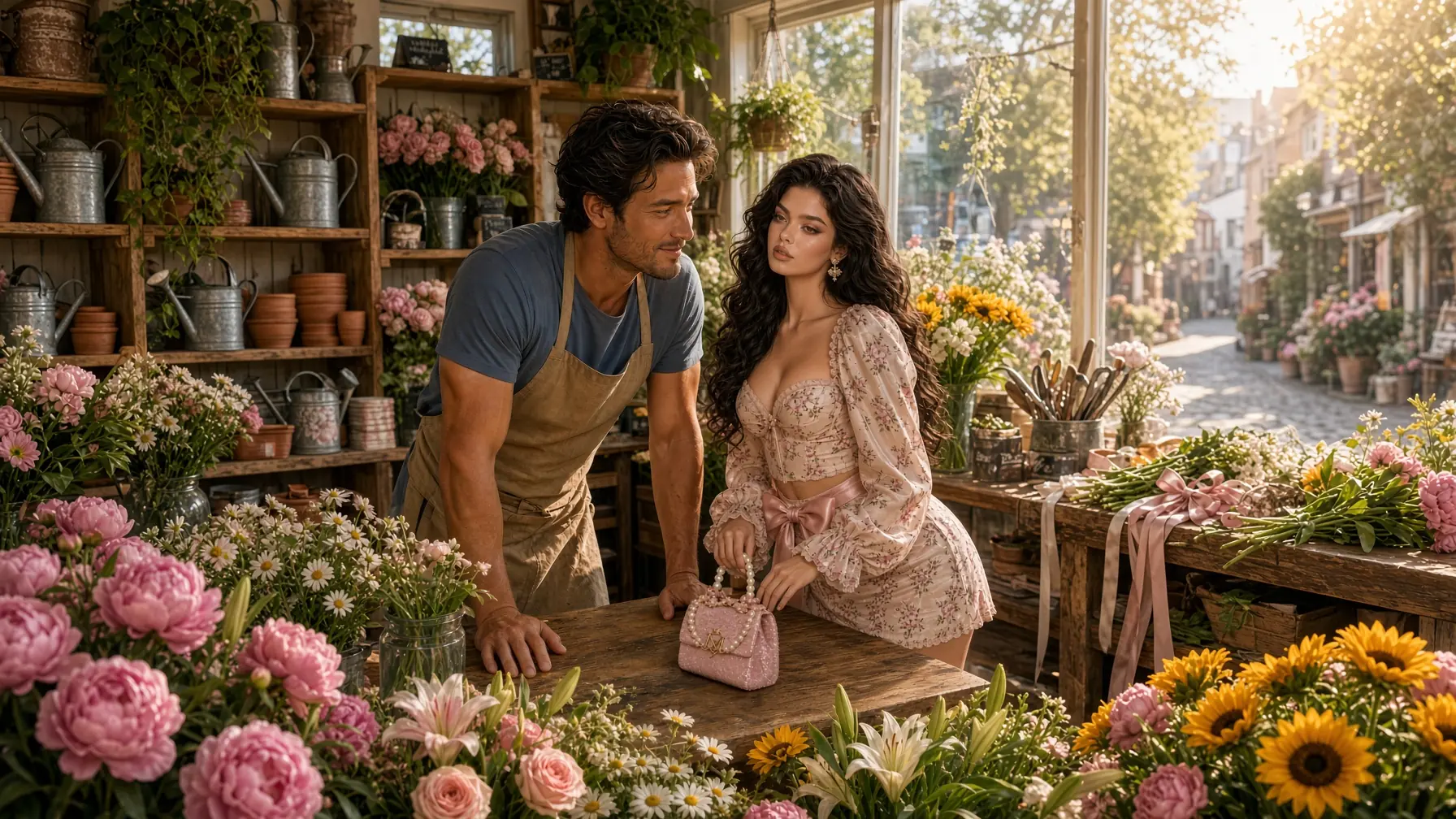
The day she walked into my flower shop, she wasn't looking for love. She was looking for a job, and the desperation in her eyes told me she needed one more than anyone I had ever met. I had no idea that 5 minutes after meeting her, I would say the most reckless sentence of my life. “I'm hiring a wife first.” She looked straight into my eyes, smiled through her exhaustion, and answered, “When do I start?”
At the time, I thought we were joking. I didn't know those words would change both our lives forever. My name is Daniel, and I had owned a small flower shop for almost 9 years. It wasn't the kind of store that appeared in magazines or attracted wealthy customers. It sat on a quiet corner between a bakery and an old bookstore, with wooden shelves, green plants hanging from the ceiling, and buckets of roses, lilies, daisies, and sunflowers filling every corner.
My mother had started the shop when I was a teenager, and after she passed away, I promised myself I would keep it alive. Flowers had become more than a business to me. They were memories. Every bouquet carried someone's apology, celebration, goodbye, anniversary, birthday, or final farewell. But while I was good at keeping flowers alive, I had become terrible at keeping myself alive emotionally.
My mother had died after a long illness, and my father had left our family years before that. My last serious relationship had ended badly when the woman I loved told me that my quiet life and struggling business were not enough for her. After she left, I stopped believing that anyone would willingly choose a man whose biggest dream was simply to keep a little flower shop open. Then, one rainy afternoon, she walked through my door. She looked about 30, with long brown hair loosely tied back, tired eyes, and a simple cream-colored blouse beneath a worn jacket.
Her jeans were slightly damp from the rain, and she carried a small handbag tightly against her side. She stood near the entrance for several seconds, as if she was gathering enough courage to speak. Then she asked if I was hiring. I told her I wasn't planning to add anyone; business had been slow. She nodded politely, but instead of leaving, she looked around at the flowers and quietly said she could do anything.
Arrangements, cleaning, deliveries, bookkeeping, customer service, anything. Something about the way she said that word made me pause. It wasn't ambition in her voice. It was survival. I asked about her experience.
She told me she had worked at a small event company until it closed, leaving her without a paycheck. She had applied everywhere for nearly 2 months. Her rent was overdue, her savings were gone, and she had a younger brother who depended on her. She wasn't asking for charity. She wanted to work.
I looked at her, then at the empty shop, and without thinking, I made a foolish joke. I told her, “I'm hiring a wife first.” I expected her to laugh, walk away, or perhaps tell me I was ridiculous. Instead, she looked at me for a long second, smiled, and said, “When do I start?” For the first time in months, I laughed.
She laughed, too. And somehow, that ridiculous moment became the beginning of everything. Her name was Emma. I hired her the next morning, not as a wife, of course, but as an assistant. She arrived before me, opened the shutters, watered the plants, organized the roses, and somehow managed to make the shop look brighter than it had in years.
She had a natural talent for arranging flowers, but what impressed me most was the way she treated customers. She remembered their names, listened to their stories, and somehow knew exactly which flowers they needed. Within weeks, customers started returning specifically because Emma was there. The shop began making money again, but something else was changing, too. I began noticing the small things, the way Emma hummed while arranging flowers, the way she always saved the slightly imperfect roses instead of throwing them away.
One evening, I asked why. She smiled and said that imperfect flowers were still beautiful. Sometimes they just needed someone willing to see it. That sentence stayed with me because I realized she wasn't talking about flowers. One night, after closing the shop, Emma received a phone call.
I watched her face change. She tried to hide her tears, but she couldn't. Her brother had been taken to the hospital after collapsing at work. She needed money for his treatment, and the fear in her eyes reminded me of my mother during her final months. Without asking questions, I gave her the money she needed.
She refused it first. She said she would work extra hours until she repaid every cent. I told her she didn't owe me anything. She had already saved my shop from becoming another thing I lost. That night, something shifted between us.
Not romance. Something deeper. Trust. Months passed, and the shop became busier than ever. We started offering wedding arrangements, and Emma created a small section where customers could write anonymous messages to people they loved.
It became surprisingly popular. People left notes for mothers, fathers, spouses, children, and even people they had lost. But just when life seemed to be getting better, I received a letter that nearly destroyed everything. The landlord wanted to sell the building. I had 30 days to leave.
The shop had been my mother's entire legacy. Losing it felt like losing her all over again. I didn't tell Emma immediately because I knew she would worry, but she found the letter beneath my desk. She read it silently, then looked at me with tears in her eyes. Instead of telling me to give up, she rolled up her sleeves.
For the next 30 days, we worked harder than we ever had. Emma organized a community flower festival. Customers came. Local businesses helped. People who had received bouquets from my mother years ago returned to support us.
Someone started an online fundraiser. A woman who had bought her wedding flowers from my mother 20 years earlier donated more than I could believe. The community wasn't just saving a shop. They were saving a memory. On the final day, I received a call from the landlord.
He had changed his mind. He had seen how much the neighborhood cared about the shop and decided to renew our lease at a lower rate. I sat behind the counter and cried. Emma came over and hugged me. And for the first time in years, I wasn't afraid of losing everything, because I finally understood that home wasn't the building.
Home was the person standing beside you when everything else was falling apart. A year later, the flower shop was thriving. Emma's brother had recovered and started helping with deliveries. We had expanded the store and added a tiny coffee corner near the window. Every morning, sunlight poured through the glass, touching the flowers and making the entire place glow.
One evening, after closing, I placed a small bouquet of white roses on the counter. Emma looked at them, then at me. I told her I still remembered the first day she walked into the shop asking for a job. I reminded her of the ridiculous joke I had made about hiring a wife. Then I told her that I had spent a year discovering that the joke wasn't as foolish as I thought.
This time, I wasn't joking. I asked her if she would marry me. She didn't answer immediately. She simply smiled, wiped away a tear, and whispered that she had been waiting for me to ask. We got married 6 months later in the flower shop my mother had built.
There were no expensive decorations, no giant ballroom, just hundreds of flowers, warm lights, our closest friends, her brother, and the little wooden sign above the door that still read, “Fresh flowers. Custom arrangements. Made with love.” And beneath it, Emma had added one handwritten sentence. Sometimes the person who comes looking for a job ends up becoming the reason you never want to work through life alone again. Because sometimes love doesn't arrive with flowers, music, or a perfect plan.
Sometimes it walks through a rainy door looking for a job. And sometimes, without either person realizing it, they aren't there to find work at all. They are there to find home.