Marcus Cole knew something was wrong before his car reached the driveway.
From half a block away, he could see two enormous concrete planters sitting where nothing had been that morning.
They were positioned at the bottom of the wheelchair ramp leading from his driveway to the front porch.
Between them stood a temporary metal construction barrier.
Marcus slowed his adapted SUV.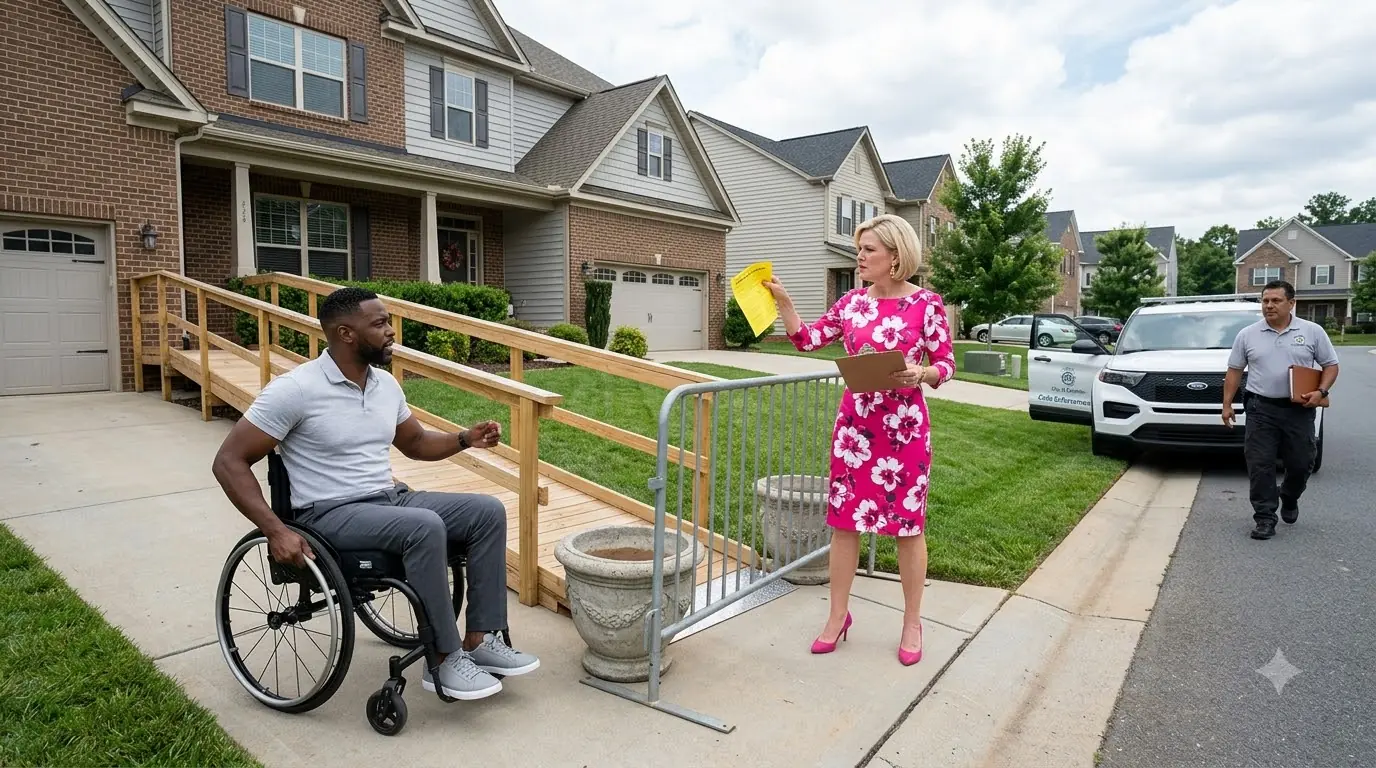
For three seconds he simply stared through the windshield.
Then he looked toward the porch.
Vanessa Whitmore was waiting for him.
Of course she was.
She stood beside the ramp with a burgundy blazer buttoned neatly over a white blouse, cream trousers, pointed heels, and a black clipboard pressed against one hip.
Her blonde bob barely moved in the mild North Carolina breeze.
She looked less like a neighbor and more like someone waiting to announce a foreclosure.
Marcus parked.
Turned off the engine.
Sat still.
He had learned, during the eleven months since the accident, that anger became expensive when people expected it from you.
He checked the space beside his vehicle.
Enough room to deploy the side ramp.
Good.
He pressed the control.
The door opened.
The mechanical ramp unfolded toward the driveway.
Marcus released the brakes on his black wheelchair and rolled down carefully.
Vanessa watched.
No greeting.
No explanation.
Marcus crossed the driveway until he reached the bottom of the ramp.
The barrier stood directly in front of him.
Not beside it.
Not partially obstructing it.
Directly across the only accessible path to his front door.
He looked from the metal rail to the planters.
Then at Vanessa.
“What is this?”
Vanessa tapped the clipboard.
“Enforcement.”
Marcus stared.
“Move it.”
“The board voted this morning.”
“I didn't ask what the board did.”
His voice remained quiet.
“I said move it.”
Vanessa’s chin lifted.
“The ramp remains closed until you submit the proper architectural modification package.”
Marcus looked at his house.
Gray siding.
White columns.
Dark front door.
The ramp was new cedar and composite decking with a simple black metal handrail, constructed along the left side of the porch and landscaped to match the house.
It was hardly an industrial loading dock.
The contractor had spent more time discussing stain color with Marcus than concrete.
“What modification package?”
Vanessa’s mouth tightened as if she had been waiting for the question.
“Form AR-17.”
“I submitted it.”
“No.”
“Yes.”
“You submitted a notice.”
Marcus frowned.
“I submitted the application your management company sent me.”
“The application was incomplete.”
“You approved it.”
Vanessa’s eyes narrowed.
“We approved preliminary review.”
Marcus laughed once.
Not because anything was funny.
He rolled closer to the barrier.
His front casters stopped six inches away.
“Vanessa, the city approved this ramp.”
“The city doesn't control Briar Glen architectural standards.”
“The city controls building permits.”
“The HOA controls external modifications.”
“I know.”
Marcus pointed toward the porch post.
A laminated sheet was attached beneath the exterior light.
City of Charlotte-Mecklenburg.
Residential alteration permit.
Inspection record.
Clearly visible.
“You received the plans before construction.”
Vanessa looked without turning her head.
“The board did not approve that handrail.”
“You approved the handrail color.”
“That is not the issue.”
“You emailed me the manufacturer link.”
Vanessa shifted.
“Marcus, this conversation is going nowhere.”
“Correct.”
He pointed toward the concrete planters.
“Move those.”
“No.”
Marcus looked at her.
“You blocked a wheelchair ramp.”
“We temporarily restricted access to an unapproved structure.”
“To my house.”
“You have a garage entrance.”
Marcus stared.
“The garage door opener is being serviced.”
“Then use the back.”
“There are three steps.”
Vanessa shrugged slightly.
“That's not an HOA issue.”
Marcus felt something tighten in his chest.
Not physical pain.
The other kind.
For eleven months, almost every ordinary action had required recalculation.
Getting out of bed.
Showering.
Driving.
Entering buildings.
Finding bathrooms.
Opening heavy doors.
He had become accustomed to architecture telling him no.
What he had not become accustomed to was another human being deliberately creating a barrier where none needed to exist.
He looked again at the planters.
Each probably weighed four hundred pounds.
Someone had not casually placed them there.
This had been organized.
Marcus asked:
“Who installed these?”
“Association contractor.”
“When?”
“This afternoon.”
“While I was gone.”
“The property exterior is subject to HOA enforcement.”
“My driveway isn't your storage lot.”
“They are temporary.”
Marcus rolled backward.
Reached into the side pocket of his chair.
Vanessa watched closely.
He removed his phone.
“What are you doing?”
“Taking pictures.”
Her face changed.
“Don't photograph me.”
“You're standing on my property.”
“I am here in my official capacity.”
“That doesn't make you invisible.”
He photographed the barrier.
Planter one.
Planter two.
The ramp.
Permit.
Vanessa.
She stepped toward him.
“I said stop.”
Marcus lowered the phone.
“Don't touch me.”
“I wasn't going to.”
“Good.”
Vanessa raised the clipboard.
“You need to understand something. The board is tired of you treating your personal circumstances as an exemption from the community standards everyone else follows.”
Marcus went still.
“Personal circumstances.”
“You know what I mean.”
“No.”
His voice sharpened.
“Say what you mean.”
Vanessa sighed.
“The ramp.”
“My wheelchair.”
“The structure.”
“The structure exists because of my wheelchair.”
“I am discussing architecture.”
“And I'm discussing what the architecture is for.”
Vanessa stepped closer.
“This neighborhood has standards.”
Marcus looked toward the houses lining Briar Glen Court.
Two-story homes.
Trimmed lawns.
Matching mailboxes.
Decorative stone facades.
A neighborhood built twenty-two years earlier and governed by a homeowner association that had once concerned itself primarily with dead shrubs and boats in driveways.
Then Vanessa became president.
Since then there had been fines for trash cans visible twelve minutes too early.
A warning because a child’s basketball hoop leaned three degrees toward the street.
A violation because one family painted its front door a shade Vanessa called “aggressive blue.”
Marcus had mostly ignored it.
Before the accident, he worked long hours as a logistics consultant and traveled often.
HOA politics belonged to people with more spare time than him.
Then a delivery truck ran a red light.
The collision crushed the driver’s side of Marcus’s car against a concrete divider.
Three spinal surgeries later, he left rehabilitation using a wheelchair.
The prognosis remained uncertain.
He had regained some sensation.
Limited movement in one leg.
Doctors refused to promise more.
Marcus refused to build his life around promises.
He rebuilt the house instead.
Wider interior doors.
Roll-under kitchen counter.
Accessible shower.
Lower switches.
And finally the front ramp.
The project cost nearly thirty thousand dollars.
Insurance covered part.
Marcus paid the rest.
The city approved plans.
A licensed contractor built it.
The HOA received copies.
Vanessa herself had sent three emails about appearance.
Marcus complied with each one.
Now she stood in front of him claiming none of it counted.
He looked at her clipboard.
“Show me the vote.”
“What?”
“The board vote.”
“You are not entitled to board records on demand.”
“I’m a homeowner.”
“You can request minutes through management.”
“So you don't have them.”
“I have the enforcement order.”
“Show me.”
Vanessa hugged the clipboard closer.
“No.”
Marcus laughed again.
“That's what I thought.”
Her face hardened.
“You always do this.”
“Do what?”
“Turn every conversation into a challenge.”
“You put concrete planters in front of my wheelchair.”
“And somehow I’m difficult?”
Vanessa pointed toward the permit on the porch.
“The city permit does not supersede private covenants.”
Marcus nodded.
“Fine.”
“Then enforce the covenant properly.”
“Send notice.”
“Hold hearing.”
“Fine me if you think you legally can.”
“Appeal.”
“Mediate.”
“Whatever your documents allow.”
He pointed down.
“But you don't get to physically block me from entering my house.”
Vanessa spoke slowly.
“I already explained.”
“No.”
“You made a decision.”
“That isn't the same as explaining it.”
She stepped toward the porch post.
Reached up.
Tore the laminated permit from the clip holding it.
Marcus stared.
The plastic sleeve bent in her hand.
“What are you doing?”
“This should never have been posted here.”
“It is an inspection permit.”
“It’s visual clutter.”
“Put it back.”
“No.”