“Kepler Farms has been dead for twenty years, Marisol. Seventy acres of nothing but weeds and ruin.”
Dwayne Federolf said it the first afternoon Marisol Doyle met him.
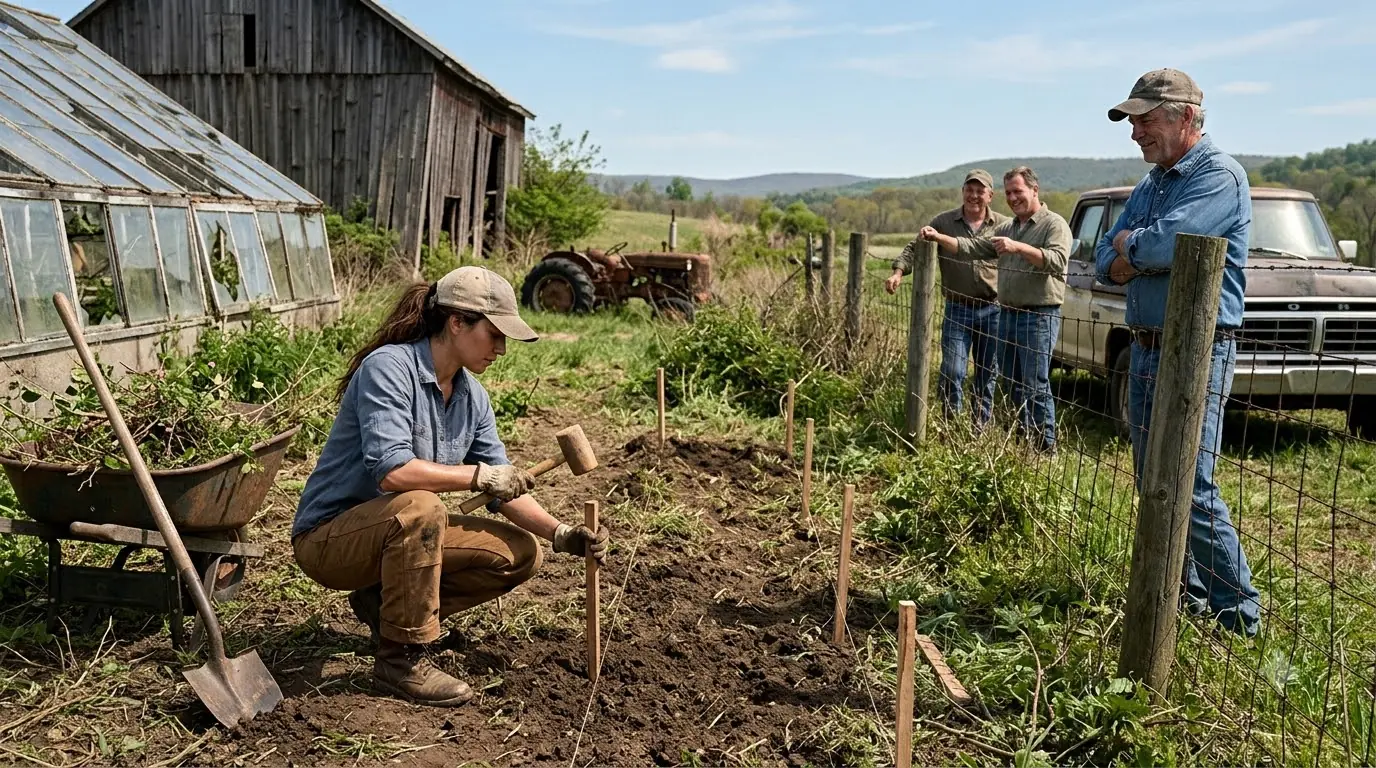
He stood on the other side of a half-collapsed fence with both hands resting on the top rail, his work shirt bleached nearly white across the shoulders from thirty summers in the Pennsylvania sun. Behind him, fifty black Angus cattle grazed a pasture so neatly maintained that the contrast between his land and Marisol’s looked almost insulting.
Her side of the fence was chaos.
Multiflora rose climbed shoulder-high through old wire.
Autumn olive crowded the field edges.
Young ash and maple trees had volunteered wherever sunlight reached the soil.
The barn roof sagged toward the eastern wall.
The greenhouse beyond it looked as though someone had thrown rocks through every third pane and then spent fifteen years waiting to see what weather could finish.
And somewhere behind all that brush sat seventy acres she had just spent almost everything she owned to buy.
Marisol wiped dirt from her forehead with the back of her glove.
“Twenty years is a long time to be dead.”
Dwayne nodded.
“Longer than most farms come back from.”
She looked across the property.
Morning rain still clung to the overgrown grass. Farther down the slope, where the land disappeared into a shallow valley, the tops of old fence posts barely showed through vegetation.
“Good thing land doesn't know when people have given up on it.”
Dwayne studied her.
She could not tell whether he found that answer admirable or foolish.
Probably foolish.
At thirty-four years old, Marisol was accustomed to people looking at her that way whenever she described what she was trying to do.
She had bought Kepler Farms in the spring of 2025 for a price so low that the clerk at the Franklin County recorder’s office had checked the transfer documents twice.
“Seventy acres?” the woman asked.
“Yes.”
“For this?”
She tapped the purchase price.
“Yes.”
“Have you seen the property?”
Marisol smiled.
“Unfortunately.”
The clerk stared at her.
Then laughed.
“All right. Just making sure.”
The farm sat on the edge of Franklin County, Pennsylvania, beyond a narrow township road that became increasingly unreliable after heavy rain.
The original Kepler property had once been much larger.
Elmer Kepler had farmed nearly two hundred acres in his prime.
Corn.
Hay.
Beef cattle.
Some dairy when he was younger.
According to county records, the farm had been assembled slowly by his father and grandfather before him, then expanded after Elmer returned from military service.
For close to fifty years, Elmer had been known as one of those farmers who seemed incapable of sitting still.
He repaired his own equipment.
Built his own fencing.
Raised cattle.
Cut hay.
Helped neighbors bring in crops when illness or accidents put them behind.
Then time began collecting its price.
First his knees.
Then his hands.
Arthritis turned ordinary repairs into painful work.
His cattle herd got smaller.
Fields went unplanted.
Fences stopped being repaired immediately.
By his late eighties, Elmer was managing only the easiest pieces of the farm.
When he died, his three children inherited property none of them wanted.
One lived in Baltimore.
One in Pittsburgh.
One had moved to Arizona.
They sold the best parcels quickly.
A developer bought the frontage.
A neighboring farmer purchased two accessible fields.
What remained was the seventy-acre back portion.
The roughest land.
The worst barn.
The broken greenhouse.
The overgrown pastures.
The least desirable access.
For nearly two years, nobody bought it.
Then Marisol Doyle came along.
For twelve years before that, Marisol’s world had been restaurants.
Not farming.
Restaurants.
She started as a hostess at nineteen while attending community college.
Within two years she was waiting tables.
Then supervising shifts.
At twenty-six she became assistant manager of a busy farm-to-table restaurant in Harrisburg.
Three years later, she was running the place.
Restaurant management taught her several things exceptionally well.
How to solve problems at terrible times.
How to function after four hours of sleep.
How to make twenty people with incompatible personalities work toward one dinner service.
How to calculate margins down to fractions of a dollar.
And how dependent supposedly sophisticated restaurants were on farmers most customers never saw.
A chef could write the most beautiful menu in Pennsylvania.
None of it mattered if the tomatoes arrived flavorless.
If lettuce wilted in transport.
If mushrooms didn't show.
If a storm delayed a distributor.
If an eighty-dollar dinner depended on basil that had spent four days inside refrigerated trucks before reaching the kitchen.
Marisol became obsessed with suppliers.
At first, because it was her job.
Later, because she genuinely cared.
She learned which farms cut greens the morning of delivery.
Which distributors padded invoices.
Which growers answered their phones when something went wrong.
She knew exactly how much chefs were willing to pay for herbs that arrived alive instead of bruised.
She knew what restaurants desperately wanted in March and what they could not give away in August.
During her last three years in Harrisburg, food prices climbed.
Transportation costs climbed.
Labor climbed.
One January, the restaurant paid nearly twice what it had paid three years earlier for certain greens.
Marisol stood in the walk-in cooler holding a plastic container of mediocre arugula that had traveled hundreds of miles and thought:
Why are we doing this?
There were farms within fifty miles.
There was land everywhere.
Yet the restaurant paid premium prices for vegetables that arrived tired.
The thought remained.
Then expanded.
Marisol began reading.
At first, during late nights after closing.
Books about market gardening.
Soil.
Greenhouses.
Rotational grazing.
Regenerative agriculture.
She watched university-extension lectures while doing inventory.
Listened to farming podcasts during her commute.
Visited farmers markets on Sundays.
Took notes.
Asked irritatingly specific questions.
“How many beds do you manage?”
“What’s your transplant schedule?”
“How much waste do you have in July?”
“What’s your biggest input cost?”
Several farmers assumed she was planning to open another restaurant.
When she told them she was thinking about farming, most smiled politely.
One older grower finally asked what everyone else had been thinking.
“You ever actually grown anything?”
“Herbs.”
“In a pot?”
“Yes.”
He laughed.
“Start smaller than seventy acres.”
She had not yet found Kepler Farms.
When she did, the listing almost looked like a joke.
70 ACRES. AS-IS. AGRICULTURAL IMPROVEMENTS IN POOR CONDITION. PROPERTY REQUIRES EXTENSIVE RESTORATION.
The photos were worse.
The barn.
The greenhouse.
The tractor.
Brush everywhere.
Marisol went to see it anyway.
The listing agent wore rubber boots and spent most of the tour apologizing.
“We haven't been able to access the lower pasture properly.”
“Why?”
“Brush.”
“How bad?”
He pointed.
Marisol stared into a wall of vegetation.
“That's not pasture.”
“It used to be.”
She walked anyway.
Branches grabbed her jacket.
Briars scratched her wrists.
She stepped into a hole hidden beneath grass and almost twisted her ankle.
The farther she went, the stranger the property became.
Buried fencing.
Old gates.
A collapsed chicken coop.
Rusted implements half-swallowed by weeds.
A length of irrigation pipe disappearing beneath fallen leaves.
But underneath the neglect, Marisol noticed something else.
Soil.
Not everywhere.
Some areas were badly compacted.
Others covered with decades of leaf litter.
But when she scraped away the surface beneath one sheltered patch, the earth underneath was darker than she expected.
She stood there holding a handful.
The agent watched her.
“What are you doing?”
“Looking.”
“At dirt?”
“At soil.”
“Difference?”
Marisol smiled.
“Potentially seventy acres.”
She made an offer a week later.
Low.
Very low.
The Kepler children accepted.
Marisol resigned from the restaurant eleven days before closing.
Her regional director stared at her across his office desk.
“You're leaving to become a farmer.”
“Yes.”
“You've never farmed.”
“Correct.”
“You're buying seventy acres.”
“Correct.”
“Do you hear yourself?”
“Constantly.”
“You manage a two-million-dollar restaurant.”
“I know.”
“You have benefits.”
“I know.”
“You're good at this.”
That was the hardest part.
She was good at it.
Leaving something you hated was easy.
Leaving something you had mastered was frightening.
The director leaned forward.
“What happens when you realize this farm thing isn't what you imagined?”
Marisol thought about that.
“Then I'll know.”
He shook his head.
“You're insane.”
“Probably.”
Her last night at the restaurant, the kitchen staff gave her a pair of bright green rubber boots as a joke.
MAKE GOOD CHOICES, someone had written across the box.
She kept them.
They became her favorite boots.
The first week on Kepler Farms corrected every romantic idea she had about agricultural independence.
Nothing worked.
The barn doors jammed.
The well pump sputtered.
The electrical service in the greenhouse had been disconnected years earlier.
The house plumbing leaked beneath the kitchen sink.
A section of the porch railing came off in her hand.
The pasture was worse.
Marisol rented a brush hog.
The rental company employee looked at satellite photographs of the farm.
“You sure?”
“No.”
He laughed.
“Good answer.”
She started nearest the house.
Six hours of work produced what looked like a tiny dent in the overgrowth.
The next morning, her shoulders hurt so badly she could barely lift a coffee cup.
By the third day, she had scratches from wrist to elbow.
On day four, Dwayne Federolf appeared.
He drove an old Ford pickup and parked along the road.
Dwayne was fifty-nine, lived on the neighboring farm with his wife Ellen, and had raised cattle for more than thirty years.
He looked at Marisol's rented machine.
Then at the field.
Then at her.
“You the new owner?”
“Depends who's asking.”
“Dwayne Federolf.”
“Marisol Doyle.”
He nodded toward the land.
“Kepler place.”
“Apparently.”
“Used to be good ground.”
“I'm hoping it still is.”
Dwayne looked toward the barn.
“Kepler Farms has been dead for twenty years, Marisol. Seventy acres of nothing but weeds and ruin.”
She did not argue.
Not because she agreed.
Because arguments did not clear brush.
Dwayne walked with her toward the equipment shed.
That was where they found the tractor.
An old International Harvester.
Faded red beneath dust and rust.
Tires collapsed.
Seat cushion torn open.
Mouse nests under the hood.
Dwayne whistled.
“That thing hasn't moved since Bush was president.”
“Which one?”
He looked at her.
“You're funny.”
“So I've been told.”
Dwayne lifted the hood.
He studied the engine.
Then straightened.
“Buy another tractor.”
“I own this one.”
“You own a very heavy lawn ornament.”
“How much to fix?”
“More than it's worth.”
“You sure?”
“No.”
He shut the hood.
“But I'd bet lunch.”
Marisol looked at the tractor.
“I’ll keep the bet in mind.”
Dwayne shook his head.
“You city people.”
“I lived in Harrisburg.”
“Exactly.”
Then he drove away.
The story traveled faster than Marisol expected.
By the end of the month, people she had never met knew who she was.
At Wilson’s Feed and Supply, two men stopped talking when she walked inside.
Marisol pretended not to notice.
She bought fence staples.
Salt blocks.
Work gloves.
A roll of electric fencing wire.
The cashier, a teenager with a baseball cap, asked:
“You the restaurant lady?”
Marisol looked at him.
“I used to manage one.”
“My dad says you're going to run cows on Kepler.”
“Eventually.”
“He says that ground's shot.”
“What does your dad farm?”
The teenager pointed toward a man near the mineral supplements.
He looked embarrassed.
Marisol smiled.
“I’ll ask him.”
The boy nearly panicked.
“I wouldn't.”
She laughed.
At first, the gossip bothered her.
Not enough to quit.
Enough to make the nights harder.
Because when Marisol lay awake in the farmhouse after twelve hours of work, every doubt she heard during daylight returned.
Too much land.
Not enough money.
No farming background.
No equipment.
No established market.
No livestock infrastructure.