The first tanker arrived at Boone Farm on a Thursday morning in November with three thousand pounds of fish nobody wanted.
The driver did not even bother shutting off the engine. He backed the dull silver truck toward the muddy pond, climbed down, and looked at the young woman waiting beside the bank as though he expected her to change her mind before he opened the rear hatch. Behind him, dark clouds dragged across the Arkansas sky, the wind smelled of wet leaves and diesel, and the pond water carried the flat brown-green color of late autumn.
Lila Boone did not change her mind.
She was thirty years old then, with a braid down one shoulder, mud on both boots, and exactly one hundred and seventy-eight dollars available after feed, taxes, and the repair bill on her father’s tractor. The farm was eighty-six acres of average ground outside Stuttgart, Arkansas, inherited from her parents with more obligations than money. Most people saw a struggling woman with a small hog operation and one neglected farm pond.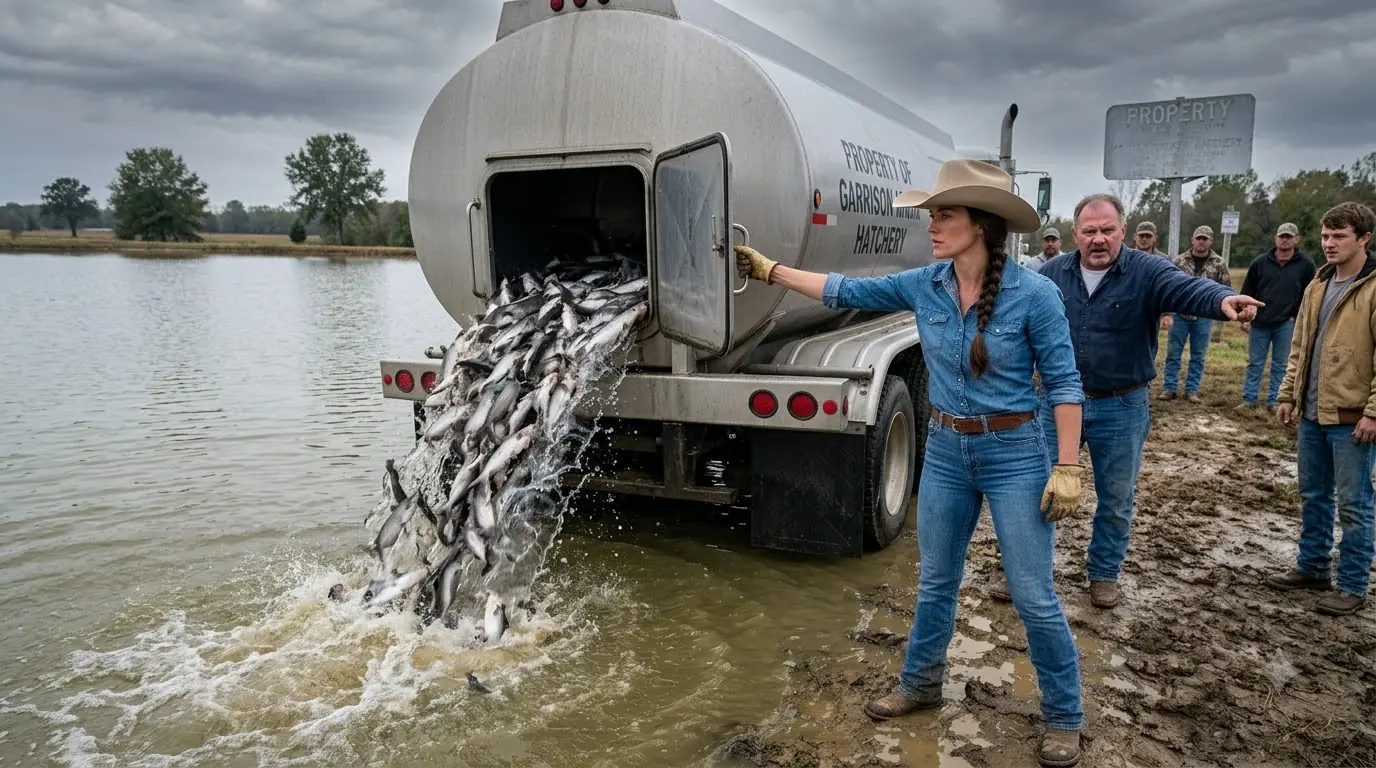
Lila saw unused capacity.
The tanker driver leaned against the cab.
“You sure about this?”
“Yes.”
“These are culls.”
“I know.”
“Some are bruised.”
“I know.”
“Some won’t grow right.”
“I know.”
“A few probably won’t make the afternoon.”
Lila looked toward the truck.
“How many did Wade say?”
“Whole load.”
“For thirty dollars?”
“Plus diesel.”
“We agreed twenty-five plus diesel.”
The driver laughed.
“You already bargain over garbage?”
Lila looked toward him.
“I bargain over everything.”
He grinned, opened the hatch, and the first rejected catfish spilled into Boone Pond.
They came in a silver-black avalanche.
Water.
Fish.
Mud.
Noise.
Thousands of bodies flashing beneath the gray light before disappearing into the pond.
The driver shook his head.
“Lady, I hope you know what you’re doing.”
Lila folded her arms.
“So do I.”
The truth was less comfortable.
She had an idea.
Not certainty.
Those were different things.
And Boone Farm could not afford many expensive ideas.
The rejected fish came from Garrison Delta Hatchery, seventeen miles east of the farm.
Wade Garrison owned it.
He had inherited the operation from his father, expanded it aggressively, and spent twenty years building the kind of reputation that made smaller producers either respect him or avoid him. By the time Lila first visited, Garrison Delta operated dozens of ponds, two hauling fleets, several oxygenated tankers, and enough annual fingerling volume that commercial growers came from three states.
Wade was fifty-two then.
Broad.
Gray beard.
Brown cap.
A man who spoke loudly even when nobody had challenged him.
Lila had gone there looking for fishmeal.
Not live fish.
Her hog feed costs had risen again, and she was trying to find cheap protein sources that would not destroy her margins. One hatchery employee mentioned they paid to dispose of culls.
Lila stopped walking.
“Disposed how?”
The employee shrugged.
“Depends.”
“Buried sometimes.”
“Rendered if there’s enough.”
“Some go to waste ponds.”
“Why?”
“Wrong size.”
“Bruised.”
“Bad growth.”
“Handling damage.”
“Not worth moving through production.”
Lila looked toward a holding pond where workers were loading fish into a truck.
“How much?”
“Thousands.”
“Per year?”
He laughed.
“Per month some seasons.”
That changed the shape of her thinking.
She asked to speak with Wade.
He arrived irritated.
“What do you want?”
“Your culls.”
He stared.
“My what?”
“The fish you pay to destroy.”
“What for?”
“Mine.”
He laughed.
Not politely.
Workers nearby heard.
One smiled.
Wade looked Lila over.
Denim shirt.
Old boots.
Notebook.
Nothing about her impressed him.
“You running a bait shop?”
“No.”
“You got catfish ponds?”
“One.”
“One?”
“Yes.”
“How big?”
“Three acres.”
Wade laughed harder.
“Lady, you don’t need my culls.”
“I didn’t ask what I need.”
“I asked what you charge.”
That changed his expression slightly.
Not respect.
Attention.
He quoted a price higher than disposal cost.
Lila knew because she had already asked the employee.
She shook her head.
“You’re charging me to solve your problem.”
“That’s business.”
“No.”
“That’s optimism.”
Wade stepped closer.
“You think you know hatchery economics?”
“No.”
“I know you’re paying seventy-five dollars a load to get rid of fish.”
The employee behind him suddenly became fascinated with his boots.
Wade’s face tightened.
“Who told you that?”
“Doesn’t matter.”
“I’ll pay twenty-five.”
“You load.”
“I cover diesel.”
“I take everything in the lot you designate.”
“No guarantees.”
“No mortality claims.”
“No hatchery responsibility.”
Wade stared.
Then smiled.
“You planning to feed pigs with them?”
“Some.”
“And the rest?”
“Mine.”
That answer irritated him.
“What are you hiding?”
“Nothing.”
“Then tell me.”
Lila folded her notebook.
“You don’t care what happens after you sell them.”
Wade laughed.
“Fair enough.”
He extended his hand.
“Thirty-five.”
“Twenty-five.”
“Thirty.”
“Twenty-five.”
He looked toward his workers.
“You always like this?”
Lila answered:
“When I’m awake.”
The workers laughed.
Wade did not.
Finally:
“Twenty-five.”
They shook.
Then he told his secretary to prepare a release.
The wording was blunt:
REJECTED STOCK — SOLD AS CULLS — NO PERFORMANCE GUARANTEE — NO CLAIMS AFTER TRANSFER.
Lila read every line.
Then asked for one addition.
ALL RIGHTS TO FISH TRANSFER TO PURCHASER UPON PAYMENT AND LOADING.
Wade looked amused.
“You worried I’ll come steal dead fish back?”
“No.”
“I like clear paper.”
He signed.
She signed.
Nobody in the hatchery thought the sentence mattered.
For years afterward, that would become Wade Garrison’s most expensive mistake.
Lila’s first plan was simple.
Use the weakest fish as supplemental animal feed.
Keep the healthier ones in the pond.
Observe.
She separated obvious mortalities immediately.
Nothing went raw directly into hog troughs the way gossip later claimed. Fish selected for feed were processed, cooked, mixed in controlled amounts with grain and other ration components, and used only where appropriate. Lila kept notes obsessively because she trusted memory less than paper.
Date.
Weight.
Condition.
Feed use.
Pond mortality.
Growth.
Water temperature.
Everything.
Most neighbors thought she had become desperate.
Clay Morris, who farmed north of her, stopped beside the road one morning.
“Heard you bought rotten fish.”
“They weren’t rotten.”
“Rejected.”
“Yes.”
“Same thing.”
“No.”
Clay leaned through his pickup window.
“What are you doing?”
“Working.”
“You put hatchery garbage in your pond.”
“Yes.”
“Why?”
“Because the fish are alive.”
“For now.”
Lila smiled.
“Then check back later.”
He did.
Everybody did.
Rural communities had no shortage of unpaid inspectors.
Winter taught Lila the first lesson.
The weak fish were not equal.
Some died quickly.
Some recovered.
Some simply remained undersized.
A surprising percentage adapted beautifully once stocking density dropped and stress disappeared.
By spring, Boone Pond held hundreds of fish Wade had considered economically worthless.
Not all grew.
Enough did.
Lila began sorting.