Three days before harvest, I smelled smoke before I saw fire.
That detail stayed with me longer than the flames.
People who have never stood inside a wheat field near maturity imagine fire announces itself with some great red wall visible from miles away.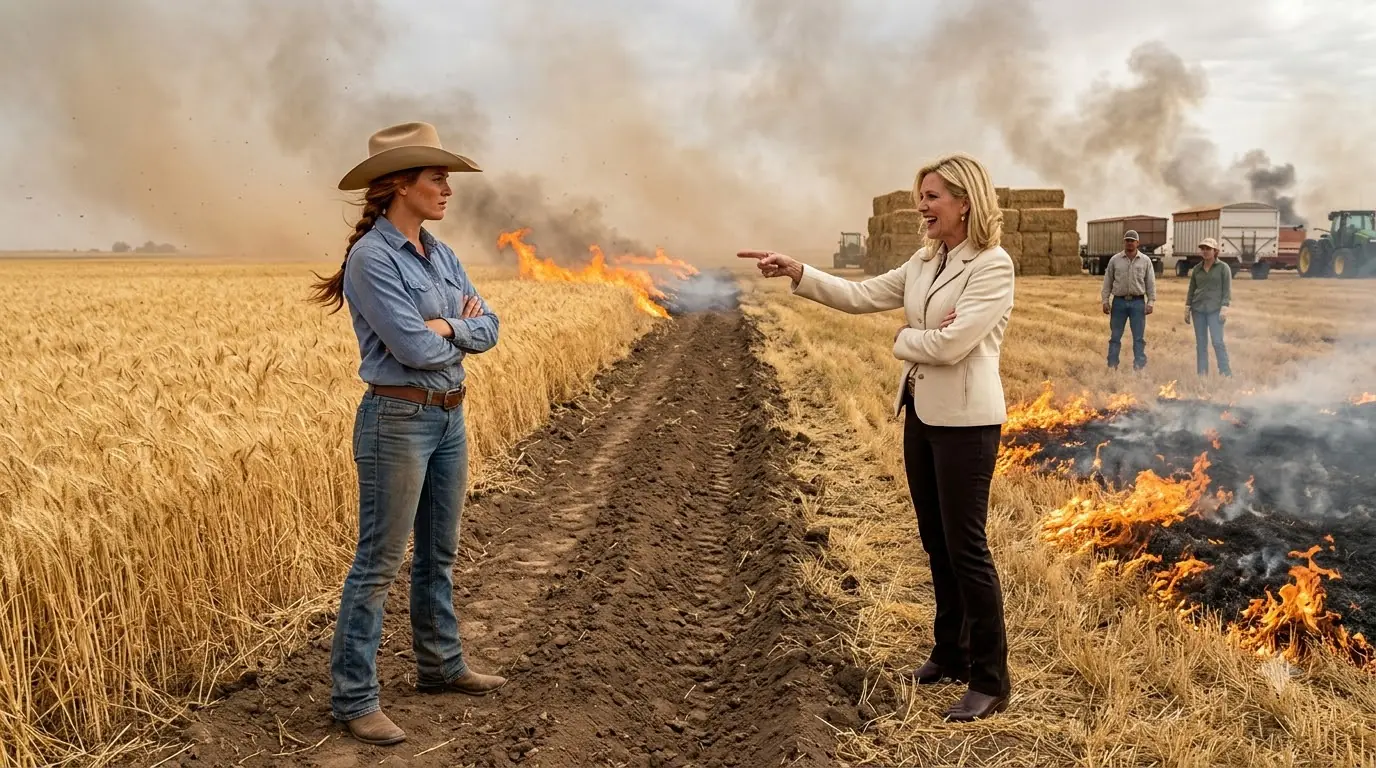
Sometimes it does.
Mine began with smell.
Dry grass.
Hot dust.
Something bitter riding beneath the wind.
I was standing beside the south header lane checking a bearing on our oldest combine when I stopped turning the wrench and lifted my head.
The afternoon had been wrong from the beginning.
Too dry.
Too restless.
Kansas could produce wind on a clear day that seemed to come from nowhere, pushing across miles of open ground until every wheat head moved together.
That afternoon the stalks did not sway.
They snapped back and forth.
My father used to call that kind of wind nervous.
I never liked the phrase.
Wind had no nerves.
People did.
But standing there beneath a pale sky with my braid whipping against the back of my blue work shirt, I understood what he had meant.
Something was changing.
I set the wrench down.
My name is Maggie Turner.
I was thirty-two years old when somebody tried to burn me out of Flint Ridge County.
Turner Farm had belonged to my family for three generations.
Six hundred and forty acres on paper.
A little less in reality after road easements, drainage strips, the farmhouse lot, machine sheds, creek bank, and the shelterbelt my grandfather planted in 1968.
Four hundred and eighty acres that year were winter wheat.
And nearly all of it was ready.
Not ready in the way city people use the word.
Ready meant millions of heads filled with hard red winter wheat, moisture dropping exactly where we needed it, stems turning from green to gold, grain that had survived cold, drought, two spring hail scares, and one late freeze that I had been certain would ruin us.
Ready meant money.
Not wealth.
Farmers understand the difference better than anyone.
A field worth hundreds of thousands of dollars at harvest can still belong mostly to the bank, the fertilizer company, the fuel supplier, the seed dealer, the equipment lender, and next year.
Harvest is when all those promises become numbers.
Three days before harvest, my numbers were finally beginning to work.
Then I smelled smoke.
I climbed down from the combine.
My hired hand, Cole Ramirez, was walking from the service truck carrying a grease gun.
“You smell that?”
He stopped.
The wind hit us.
Cole’s expression changed immediately.
“Yeah.”
We both looked south.
Nothing.
Then southwest.
A thin line of gray rose above the boundary ridge.
Cole dropped the grease gun.
“Maggie.”
“I see it.”
We ran.
The service truck was thirty yards away.
I reached it first, climbed behind the wheel, and started the engine before Cole had his door closed.
Our south field bordered Cole Agricultural Group.
No relation to my hired hand.
That name belonged to Vanessa Cole.
Everybody in Flint Ridge County knew Vanessa.
Fifty-two thousand acres owned, leased, managed, or contracted across three counties, depending on which number she wanted repeated.
Two grain elevators.
A trucking company.
Seed dealership.
Fertilizer distribution.
Custom harvesting crews.
Storage yards.
A cattle backgrounding operation farther west.
And enough influence inside the local cooperative that farmers joked the co-op board only met so Vanessa could hear herself agree with herself.
Vanessa had inherited about twenty-five hundred acres from her father.
The rest she built.
I respected that once.
She had been aggressive, brilliant with financing, and fearless about expansion during years when everyone else was shrinking.
Then something changed.
Or maybe I simply became old enough to see what had always been there.
Vanessa did not like owning land.
She liked controlling the people around it.
Turner Farm irritated her because we sat like a missing puzzle piece between two blocks she controlled.
She had tried to buy us four times.
The first offer came when Dad was alive.
The second came two weeks after his funeral.
I remembered that one best.
Vanessa arrived in a white pickup clean enough to eat from, stepped into my kitchen wearing boots that had never touched mud, placed a folder on the table, and offered me more money than I had ever seen written beside my name.
“I’m doing you a favor,” she said.
I was twenty-seven.
My father had been dead fourteen days.
I asked her to leave.
She doubled the offer three years later.
Then again last winter.
Each time I refused.
People assumed I was sentimental.
I was.
But sentiment was not the only reason.
Our south section sat over the most reliable shallow groundwater on the surrounding properties.
We also controlled an old county access lane that connected directly to the highway.
If Vanessa owned Turner Farm, she could move grain between two major blocks without using the longer township route.
She could also consolidate enough acreage to justify a private storage expansion she had been trying to finance.
Turner Farm was worth more to Vanessa than it was worth on the open market.
She knew it.
I knew it.
That made every conversation unpleasant.
Six months before the fire, she made her last offer.
I told her no.
She looked across my kitchen table and smiled.
“You understand there’s a number where stubborn becomes stupid.”
“I’m sure there is.”
“You’re getting close.”
“My farm.”
“For now.”
I remember that.
For now.
At the time, I thought it was arrogance.
Later investigators would ask me whether I interpreted it as a threat.
I told them the truth.
“No.”
Vanessa threatened people with money, contracts, lawyers, hauling rates, and access.
Not matches.
At least that was what I believed.
Until three days before harvest.
The service truck bounced across the rough southern lane.
The smoke thickened.
Then we saw orange.
Fire was moving through the western edge of my wheat.
Cole swore.
I grabbed the radio.
“Turner base, south field fire. Repeat, south field fire.”
My mother, Ellen, answered from the farmhouse.
“What?”
“Call county dispatch. Field fire. South boundary.”
Her voice changed.
“Are you safe?”
“Yes.”
“Where is it?”
“Section line near Cole property.”
Silence.
She understood the name.
“Maggie.”
“Call.”
I dropped the microphone.
Cole stared through the windshield.
“How fast?”
“Too fast.”
Dry wheat does not burn politely.
The outer strip caught first.
Then flame ran along the heads, jumping through the crop with a speed that made distance difficult to judge.
But I had something Vanessa apparently did not know about.
A firebreak.
Not a decorative strip.
Not a mowed path.
Forty-eight feet of bare soil running across the southern quarter.
I had plowed it two weeks earlier.
People laughed.
One neighbor asked whether I had suddenly become afraid of prairie ghosts.
Another said I was sacrificing good wheat for an emergency that probably would never happen.
I lost nearly two acres of potential yield creating that strip.
At current prices, it hurt.
But my father had been obsessive about fire.
He survived a field fire when he was nineteen.
Never forgot it.
Every year near harvest he cut or plowed strategic strips around the driest blocks.
After he died, I continued.
Not because I thought Dad was always right.
Because I had his records.
Twenty-seven years of field notes.
Wind events.
Lightning.
Equipment fires.
Neighbor burns.
Roadside ignitions.
The southern boundary had carried fire three times in thirty years.
Only one reached our land.
That was enough.
Cole looked toward the bare strip ahead.
“You think it'll hold?”
“It better.”
We stopped well away from the active edge.
No heroics.
No driving into flame.
No pretending a pickup could defeat fire.
We moved toward the safe side of the break and waited for the volunteer crews already racing from town.
Then another vehicle approached.
White pickup.
Vanessa.
Of course.
She stopped on her side of the boundary and stepped out.
Cream ranch jacket.
Dark pants.
Hair tied back.
Not dressed for field work.
Behind her came two employees in another truck.
For several seconds the three of us simply watched my wheat burn.
Vanessa folded her arms.
I looked at her.
Something about her expression bothered me.
Too calm.
Not shocked.
Not concerned.
Not even curious.
Cole noticed it too.
He leaned toward me.
“She know about this?”
“I don’t know.”
Vanessa walked closer to the property line.
Not close to the fire.
Close enough to be heard.
“Well.”
I stared.
She nodded toward the flames.
“Looks like harvest came early.”
Cole stepped forward.
I put one hand against his arm.
“No.”
Vanessa smiled.
“You should listen to him, Maggie.”
“Why are you here?”
“I saw smoke.”
“So did half the county.”
“My land is next door.”
“Your land isn’t burning.”
She looked toward the field.
“Yet.”
That word would matter later.
At the time, I barely noticed it.
I was watching forty acres of wheat disappear.
My throat tightened.