Margaret Collins liked to tell people she had lived on Willow Creek Lane long enough to know when something did not belong. She had been there twenty-one years, through new roofs, divorces, college send-offs, drought restrictions, and enough neighborhood arguments over fence heights to consider herself unofficially qualified in local government. 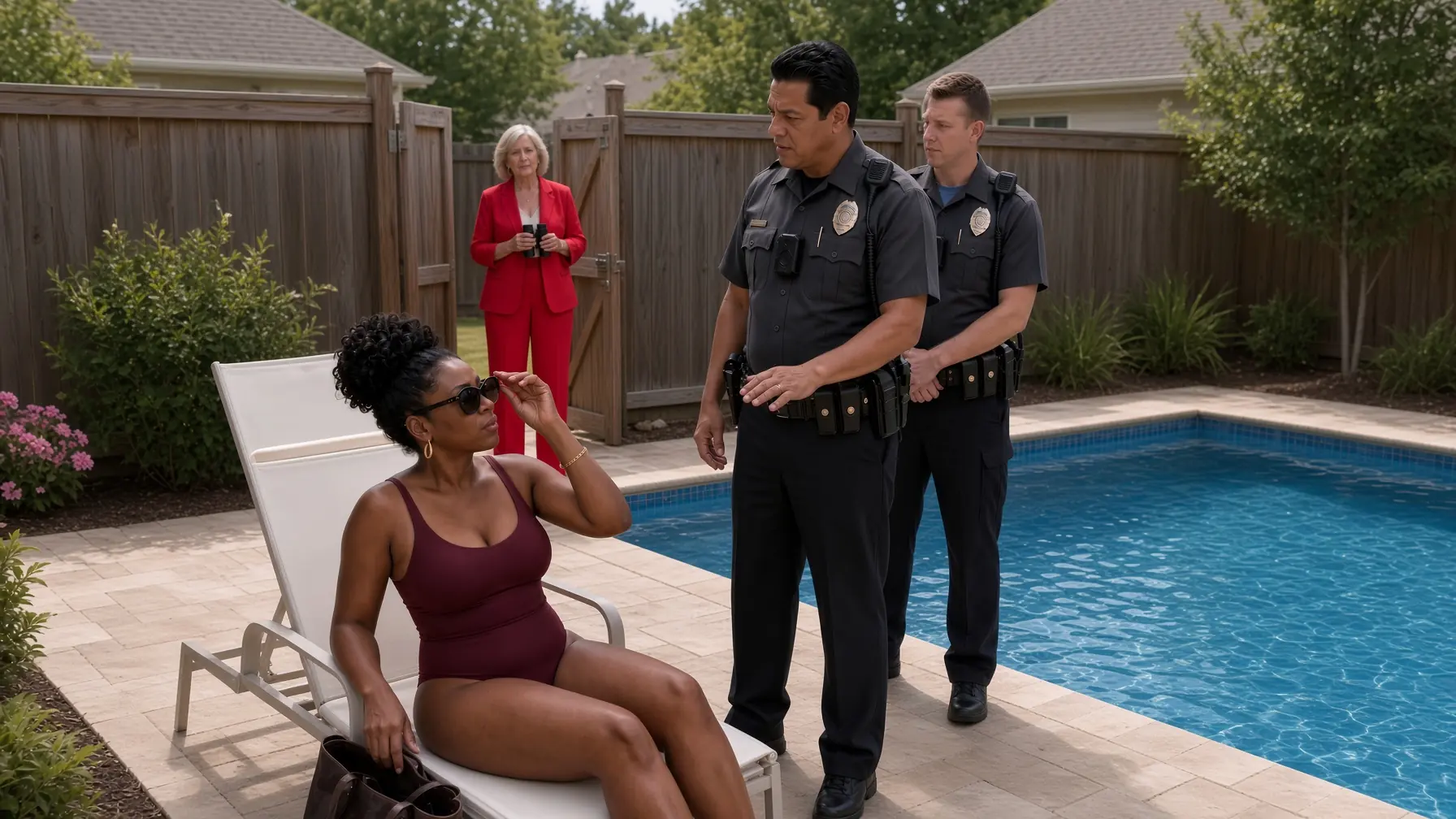
At fifty-five, she spent more time on her front porch than anywhere else in the house, usually with iced tea, a gardening magazine, and a pair of binoculars she insisted were for birdwatching. Most of the neighbors knew the binoculars were rarely pointed at birds.
The neighborhood sat outside Frisco, Texas, in one of those carefully planned developments where mature trees shaded wide sidewalks and nearly every house had a pool behind an eight-foot privacy fence. People waved during morning walks, remembered whose teenager drove which car, and knew within twenty-four hours when someone replaced a mailbox without HOA approval. Margaret loved that rhythm because it made the street feel predictable. Predictability, in her mind, was almost the same thing as safety.
The corner house across from her had belonged to George and Linda Patterson for fourteen years. They were retired teachers who finally sold the place after George developed arthritis severe enough that maintaining the pool became more punishment than pleasure. Margaret attended their farewell dinner, brought a lemon pound cake, and listened while Linda explained they were moving closer to their daughter in Santa Fe. Three weeks later, the FOR SALE sign disappeared, but no one on Willow Creek Lane seemed to know who bought the house.
That bothered Margaret more than she admitted. There had been no moving truck parked outside for an entire day, no family introducing themselves on the neighborhood Facebook page, and no cheerful message from the HOA announcing the new owners. She had seen a dark SUV in the driveway twice and caught brief glimpses of a woman entering through the garage. Whoever had moved in seemed uninterested in being properly introduced.
On a heavy Saturday afternoon in late August, Margaret stepped onto her porch wearing a wide straw hat and carrying a glass of lemonade. She settled into the wicker chair, opened her mystery novel, and spent approximately six minutes reading before curiosity won. The corner house was quiet, but faint jazz drifted over the fence from the backyard. Margaret reached for the binoculars.
A Black woman was lying beside the pool. She looked somewhere in her mid-forties, athletic but not particularly concerned with looking impressive, wearing a dark burgundy swimsuit and large sunglasses. A paperback rested open against one thigh while a glass of iced tea sat on the table beside her. Nothing about her behavior suggested she was hiding from anyone.
That made Margaret more suspicious, not less. She lowered the binoculars and leaned forward. The woman looked comfortable in a way Margaret believed people should only look when everyone else understood why they were there.
“Who is that?” she whispered. Nobody answered because she was alone.
Margaret picked up her phone. She told herself she was not calling because the woman was Black, even though race was one of the first details she would provide. She told herself she was calling because the Pattersons had moved and she had never met the new owner. By the time the non-emergency dispatcher answered, Margaret had already converted uncertainty into concern.
“Frisco Police, non-emergency line.” Margaret adjusted her voice into the soft, reasonable tone she used whenever she wanted to sound helpful rather than nosy.
“Yes, hello. I think someone may be trespassing at a house on Willow Creek Lane.” The dispatcher asked for the address.
Margaret gave it. Then came the obvious question.
“What makes you believe someone is trespassing?” Margaret looked through the binoculars again.
“There’s a woman in the backyard by the pool.” The dispatcher waited.
“Do you know the homeowner?” Margaret hesitated. “The house recently sold.”
“Have you seen anyone enter by force?” No.
“Broken window?” No.
“Damaged gate?” Margaret looked again. “Not that I can see.”
The dispatcher paused. “What exactly is the woman doing?” Margaret felt foolish for half a second.
“She’s lying beside the pool.” The silence on the other end made Margaret defensive.
“I just don’t think she lives there.” The dispatcher asked for a description.
Margaret gave one. “Black female, maybe mid-forties, swimsuit, sunglasses.”
“Any weapon?” No.
“Threatening anyone?” No.
“Trying doors or windows?” No.
Margaret tightened her grip on the phone. “She just looks out of place.”
The dispatcher did not respond to that statement. She collected Margaret’s name and explained that an available patrol unit would check the property. Margaret thanked her and ended the call feeling both relieved and strangely unsettled. She had expected the act of reporting something to make the situation feel more obviously wrong.
Instead, the woman turned a page in her book. She took a sip of tea. She dipped one foot into the water and continued reading.
Margaret stared longer. Somewhere beneath all the certainty, a smaller thought kept repeating itself. What if she lives there?
Margaret pushed it away. Neighbors introduced themselves.
Neighbors made themselves known. Neighbors did not simply appear behind fences and expect the street to accept them without explanation.
At least, that was the story Margaret told herself.
The woman’s name was Dr. Camille Harrison. She was forty-six years old, divorced, childless by choice, and had spent twenty-three years in federal law enforcement. Three months earlier, after serving in counterintelligence, organized crime, and domestic security assignments across several cities, she had been appointed Deputy Director of the Federal Bureau of Investigation. That Saturday was the first uninterrupted afternoon she had taken for herself in nearly six weeks.
The new job had dragged her repeatedly between Washington and regional offices. She had purchased the Texas house partly because her older sister lived twenty minutes away and partly because she wanted somewhere that did not feel like Washington. Camille still kept an apartment in Virginia for work, but Texas was supposed to be the place where she could sit beside a pool, read novels, and occasionally forget that people called her phone at two in the morning when something went wrong. She had moved in quietly because quiet was the entire point.
The movers had delivered most of her belongings on a Thursday while she was in Washington. Her sister supervised. Camille arrived the following Friday night, slept for six hours, spent Saturday morning unpacking boxes, and decided at noon she was finished being productive. By two, she was beside the pool listening to Miles Davis through the outdoor speakers.
She heard the side gate open at 2:41. The sound was subtle, but years of federal work had trained her to notice changes in an environment before her brain consciously named them. Camille lowered the book and looked toward the gate. Two uniformed officers stepped into the backyard.
One was Officer Daniel Reyes, forty-two, with fifteen years on patrol. The other was Officer Colin Price, twenty-nine, still young enough to appear uncomfortable whenever a situation did not fit the description he received from dispatch. Both stopped several feet from the patio.
“Ma’am?” Reyes called. Camille removed her sunglasses.
“Yes?” Reyes kept his hands visible.
“We received a report that someone may be trespassing at this property.” Camille looked toward the house, then back toward him.
“This property?” Reyes nodded.
“Yes, ma’am.” Camille placed the book on the lounge chair.
“I live here.” Price looked toward Reyes.
Reyes said, “Okay. Do you have identification showing this address?”
Camille almost laughed. Not because the question was entirely unreasonable after a trespassing report, but because she could already imagine exactly how the call had started. She stood slowly.
“Sure.” She walked toward a weatherproof cabinet beside the patio kitchen where she had left a small tote.
Reyes watched carefully. Camille noticed. She opened the bag, removed a leather wallet, and paused.
“May I ask something before I hand this over?” Reyes nodded.
“Do you normally enter people’s fenced backyards and ask residents sunbathing beside their own pools to prove they belong there?” Price looked away.
Reyes answered, “We’re responding to information we received.” Camille nodded.
“I understand that.” She held his eyes.
“I’m asking what information made this response necessary beyond one neighbor not recognizing me.” Neither officer answered immediately.
Camille smiled without humor. “That’s what I thought.”
She opened the wallet.
At first Reyes saw a driver’s license. The address matched the property.
Then Camille flipped to the federal credential beneath it.
The gold badge caught sunlight.
FEDERAL BUREAU OF INVESTIGATION.
Price read the title first. His expression changed immediately.
Reyes looked again. Then his eyes returned to Camille.
“Deputy Director?” Camille nodded.
“That would be me.”
For several seconds, neither officer spoke. Camille had seen the reaction before in different contexts. People’s posture changed when they learned a title that changed the amount of trouble attached to being wrong.
She disliked that reaction more than she enjoyed it.
“I bought the property four weeks ago,” Camille said. “Closing documents are inside if you actually need them.”
Reyes shook his head. “Your license is enough.”
“Good.” Camille returned the wallet to her bag.
Price cleared his throat. “We apologize for the interruption.”
Camille looked toward the gate. “Who called?”
Neither officer immediately answered. Camille already knew the department probably would not casually identify a caller at the scene.
She looked toward Margaret’s house instead. The porch was partially visible through a gap in the hedges. A pale straw hat disappeared behind a post.
Camille smiled faintly. “Never mind.”
Reyes followed her gaze. His expression told her everything she needed.
“Could you do me a favor?” Camille asked.
“Yes, ma’am.” She put her sunglasses back on.
“Tell whoever called that the woman by the pool lives here.” Reyes nodded.
“And perhaps remind them that not recognizing someone is not evidence of a crime.” Price nodded more quickly.
“Yes, ma’am.”
The officers left. Camille waited until the gate clicked shut before sitting again.
She tried reading. She made it through half a page.
Then she closed the book.
Across the street, Margaret stepped behind the porch column and waited for the officers to return. She expected one of them to stop and tell her what happened. Neither did.
Reyes walked directly to the cruiser. Price got into the passenger side.
The vehicle pulled away.
Margaret’s stomach tightened.
She looked toward the corner house. Camille was still beside the pool.
No handcuffs. No police escort.
No argument.
Nothing.
Margaret went inside and shut the door.
The air conditioning felt suddenly aggressive against her damp skin. She carried the lemonade into the kitchen, placed it on the counter, and stood there trying to organize what had happened.
Her phone buzzed.
A message from Lorraine Baxter two houses down appeared.
Police on Willow Creek? Everything okay?
Margaret ignored it.
Another message arrived.
Was it the new neighbor?
Margaret placed the phone face down.
Then curiosity defeated caution.
She opened her tablet and searched the name she heard faintly when one officer had repeated it.
Camille Harrison FBI.
The first photograph appeared immediately.
Camille stood behind a podium in Washington wearing a dark suit. Another showed her beside the Attorney General.
A third showed her testifying before a Senate committee.
Margaret’s face drained of color.
She opened an article.
Camille R. Harrison appointed FBI Deputy Director after 23-year career.
The story described counterterrorism investigations, international assignments, major organized crime cases, and her recent Senate testimony on domestic security threats. Margaret read several paragraphs without absorbing them.
Then the meaning settled.
She had called local police on the Deputy Director of the FBI for reading beside her own swimming pool.
Margaret covered her face.
Her first emotion was humiliation.
The second was fear.
Only later would she realize those emotions were still mostly about herself.
By four o’clock, the neighborhood Facebook group knew something had happened. Someone walking a dog had photographed two patrol cars outside Camille’s address.
The caption read, Apparently our new neighbor had an interesting welcome committee today.
Comments appeared quickly.
What happened?
Please tell me nobody called cops because they didn’t recognize her.
Then someone posted a screenshot of Camille’s FBI biography.
Oh my God.
Somebody called police on the Deputy Director of the FBI at her own house?
Margaret closed the app.
Her doorbell rang at 5:18.
She froze.
For a moment, she considered pretending not to be home.
Then she looked through the peephole.
Camille Harrison stood on the porch wearing loose linen pants and a white T-shirt. No sunglasses. No badge.
Margaret opened the door halfway.
“Good evening.” Camille’s tone was calm.
“Hi.” Margaret hated how small her voice sounded.
“I thought we should meet.” Margaret swallowed.
“Yes.” Camille waited.
Neither woman spoke for several seconds.
Margaret finally said, “I’m sorry about earlier.”
Camille looked at her. “What are you sorry for?”
The question caught Margaret off guard.
“For calling the police.” Camille nodded.
“Why did you call?”
Margaret began with the explanations she had prepared.
“I didn’t recognize you.” Camille waited.
“The house was recently sold.” Another pause.
“You hadn’t introduced yourself.” Camille raised one eyebrow.
Margaret continued anyway. “I thought someone might have gotten through the gate.”
“Did you see me climbing the fence?” No.