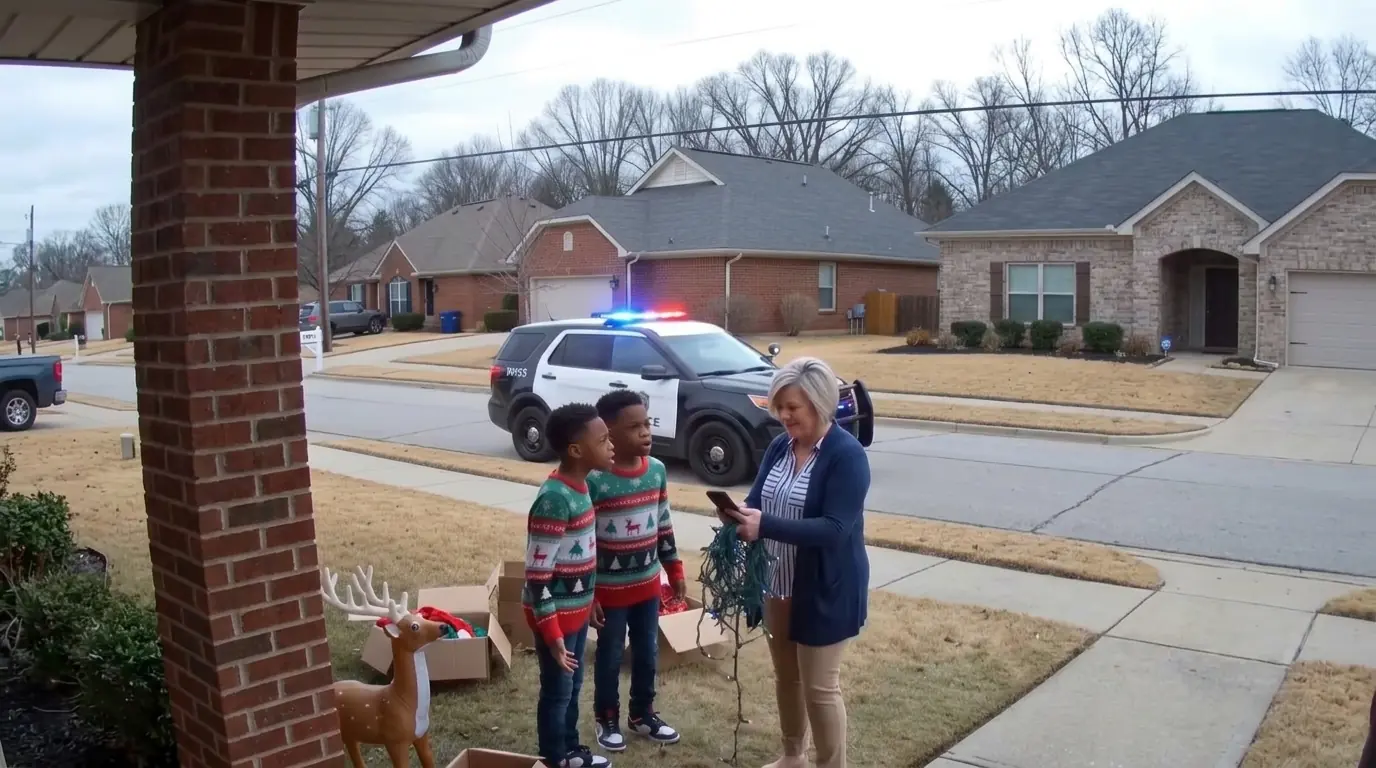
“Put the lights down.”
Eleven-year-old Caleb Bennett looked across the front lawn and thought for half a second that the woman was speaking to somebody else. His twin brother, Cameron, stood beside him holding one end of a tangled strand of red-and-white Christmas lights while an inflatable snowman lay half-open on the grass between them. A portable speaker on the porch played an embarrassingly loud version of “Rockin’ Around the Christmas Tree.”
Then Marjorie Whitmore crossed the street.
“I said put them down.”
Caleb lowered the strand slowly.
“Mrs. Whitmore?”
Marjorie reached them before he could say anything else. She was fifty-six, thin, carefully dressed even on a Saturday afternoon, with a silver-blonde bob, burgundy sweater, cream slacks, and the same gold bracelet she wore to every HOA meeting. Her expression suggested she had caught two burglars carrying televisions through a broken window.
She snatched the lights from Caleb’s hands.
“Don’t play stupid with me.”
Caleb stared at her.
“We’re decorating.”
“You’re stealing.”
Cameron’s face changed.
“No, we’re not.”
Marjorie turned toward him.
“Excuse me?”
“This is our stuff.”
Her laugh was short.
Cold.
“You expect me to believe that?”
Caleb looked toward the two-story brick house behind them.
“We live here.”
Marjorie followed his finger.
Then looked back at the twins.
For a moment, neither boy understood why she was smiling.
“You live there.”
“Yes.”
“In Willow Creek Preserve.”
Caleb nodded.
“That’s our house.”
Marjorie stepped closer.
“Do you have any idea what homes cost on this street?”
Cameron’s eyes filled.
“Our mom bought it.”
Marjorie laughed again.
This time she did not bother making it sound polite.
“Your mother.”
“Yes.”
“And where exactly is she?”
“At work.”
“How convenient.”
Caleb swallowed.
“She’s coming home.”
Marjorie folded the lights against one arm.
“You boys should sit down.”
“What?”
“The police are on the way.”
Cameron stared.
“Why?”
“Because people like you do not get to wander into neighborhoods like this and take whatever you want.”
Caleb’s face went still.
“We came out of that house.”
“I’ve lived here nineteen years.”
Marjorie pointed toward the street.
“I know who belongs here.”
Cameron began crying.
Caleb reached for his brother’s arm.
Marjorie stepped between them.
“No whispering.”
“We’re not doing anything.”
“Sit down.”
Caleb looked toward their front door.
The wreath he and Cameron had hung that morning was centered badly enough that their mother had promised to fix it when she got home. Two bicycles leaned beside the garage. Their basketball hoop stood near the driveway.
Everything around them said children lived there.
Marjorie seemed determined not to read any of it.
“My husband knows half the police command staff in this county,” she said. “They respond when we call.”
Caleb stared at her.
“Why wouldn’t they?”
Her smile returned.
“They know who keeps this community running.”
Three minutes away, Dr. Simone Bennett was turning off Magnolia Parkway.
She had left the county administration building later than planned after an emergency budget review involving sheriff’s department overtime. A folder containing next quarter’s projections sat on the passenger seat beside a laptop bag. She had promised Caleb and Cameron she would be home before they finished the first row of Christmas lights.
Simone checked the clock.
3:21 p.m.
She sighed.
The twins had almost certainly started without her.
They had been planning the decorations since the first week of November.
Caleb wanted every bush wrapped in lights.
Cameron wanted an inflatable Santa large enough to be seen from space.
Simone had approved neither idea.
Then she turned into Willow Creek Preserve.
The security gate recognized her windshield tag.
She drove through.
Two streets later, she saw the patrol car.
No emergency lights.
No siren.
Just a sheriff’s cruiser parked in front of her house.
Simone’s hands tightened on the steering wheel.
Then she saw her sons.
Standing on the lawn.
Hands visible.
Christmas lights scattered around them.
A uniformed deputy facing them.
And Marjorie Whitmore standing near the curb.
Watching.
Simone hit the brake harder than intended.
Her SUV stopped crooked in the driveway.
She stepped out.
Did not run.
Did not yell.
Thirty-nine years of life had taught Simone that Black women were often judged as much by how they reacted to a problem as by what created it.
She walked across the grass.
“Deputy?”
The officer turned.
He was white, mid-thirties, broad-shouldered, with a close military haircut and mirrored sunglasses. His nameplate read T. ROURKE. One hand rested near the radio clipped to his vest.
“Yes, ma’am?”
Simone stopped beside Caleb.
“What is happening?”
“Do you live here?”
“I do.”
She pointed toward the house.
“This is my home.”
Rourke looked at the twins.
“These are your children?”
“Yes.”
Caleb’s lower lip trembled.
Cameron wiped his face with the sleeve of his Christmas sweater.
Simone’s voice remained controlled.
“What happened?”
“We received a report of two juveniles possibly stealing exterior decorations.”
Simone looked at the tangled lights.
Then at the half-inflated snowman.
Then at her front door.
“My sons are putting decorations onto the property.”
Rourke said nothing.
Simone continued.
“They are not removing anything.”
“The caller described suspicious behavior.”
“Which behavior?”
Rourke shifted.
“Handling property around the residence.”
“They live at the residence.”
“Yes, ma’am.”
“So what made that suspicious?”
Rourke looked toward Marjorie.
Simone followed his eyes.
That was enough.
Marjorie’s face had changed.
The satisfaction Simone saw when she arrived was gone.
Now she looked uncomfortable.
Rourke looked back at Simone.
Then recognition reached his face.
He removed his sunglasses.
“Dr. Bennett?”
Simone’s expression did not change.
“Yes.”
“You’re the county executive administrator.”
“I am.”
The deputy straightened.
His hand immediately left his belt.
Caleb noticed.
So did Simone.
“I didn’t realize—”
She interrupted.
“You did not need to.”
Rourke stopped.
Simone looked toward her sons.
“Were they detained?”
“No, ma’am.”
“Were they suspected of committing a crime?”
“We were verifying the report.”
“Did you verify their address?”
“They stated they lived here.”
“Did you believe them?”
Silence.
That answer came without words.
Simone looked at Caleb.
Then Cameron.
“Are we free to go inside?”
Rourke nodded.
“Yes, ma’am.”
“Then we are finished.”
He hesitated.
“I apologize for the confusion.”
Simone looked at him.
“My sons were not confused.”
She turned away.
Marjorie took one step backward.
Simone called her name.
The woman stopped.
“Did you call?”
Marjorie’s mouth tightened.
“I reported suspicious activity.”
“You watched them leave this house?”
Marjorie said nothing.
Simone took a step closer.
“Did you?”
“I saw two unsupervised boys.”
“That is not what I asked.”
Marjorie glanced toward the patrol car.
“I acted out of concern for neighborhood security.”
Caleb whispered:
“She said we couldn’t afford to live here.”
Marjorie’s face changed.
Simone became very still.
Cameron looked toward his mother.
“She said people like us steal from nice neighborhoods.”
Rourke turned toward Marjorie.
For the first time, he looked surprised.
Marjorie folded her arms.
“They misunderstood me.”
Caleb shook his head.
“No, we didn’t.”
Simone looked at her sons.
Then at Marjorie.
“We’ll talk later.”
Marjorie smiled faintly.
“I don’t think threats are appropriate.”
“It wasn’t a threat.”
Simone’s voice stayed even.
“It was information.”
She took both boys toward the house.
Behind them, the deputy returned to his cruiser.
Marjorie stood alone on the sidewalk.
No one said another word.
Inside, Caleb dropped the lights beside the entry bench.
Cameron walked directly upstairs.
Simone followed him.
She found her son sitting on the edge of his bed with his Christmas sweater still on.
He stared at the floor.
“Cam.”
Nothing.
Simone sat beside him.
“You okay?”
He shrugged.
That meant no.
She placed one hand on his back.
“You did nothing wrong.”
“I know.”
His voice sounded smaller than usual.
“Then what is it?”
He looked at her.
“Why didn’t he believe us?”
Simone’s throat tightened.
“Sometimes adults make assumptions.”
“Because we’re kids?”
She waited.
Cameron’s eyes filled.
“Or because we’re Black?”
There are questions parents prepare for.
There are others they spend years hoping they can postpone.
Simone had grown up six miles south of Willow Creek in a neighborhood where police helicopters were common enough that children learned to sleep through them. Her father had given her the talk about traffic stops before she got her learner’s permit. Her mother taught her never to put her hands inside a purse when a store employee was watching.
Simone worked through college.
Then graduate school.
Then law school.