The quiet streets of Willow Creek were the kind people used in real-estate brochures to sell the idea of safety. Mature oak trees shaded wide sidewalks, sprinklers clicked across carefully edged lawns, and most houses looked as though somebody had washed the brick before sunrise. At fifty-four, Linda Harper believed she understood the neighborhood better than almost anyone because she had lived on Sycamore Lane in Plano, Texas, for twenty-one years. What she did not understand was how easily familiarity could turn into ownership inside a person’s mind.
Linda called herself observant. Her husband, before he died, used to call her nosy with a smile that softened the insult. She knew which family forgot trash day, which teenager came home after midnight, whose grass needed cutting, and which couple had quietly separated months before anyone admitted it. She told herself noticing things was part of caring about the community.
That Saturday afternoon, the Texas heat sat heavily over Willow Creek. Linda was on her shaded front porch with a glass of lemonade, a paperback mystery novel she had barely opened, and a pair of compact binoculars resting on the wicker table beside her chair. The binoculars had originally been purchased for bird-watching during a trip to Galveston. Over the years, they became useful for far more than birds.
Three weeks earlier, the house at the corner of Sycamore and Brookside had sold. The previous owners, George and Evelyn Walsh, had lived there nearly thirty years before moving to Arizona to be closer to their daughter. Linda knew the property well because she had attended cookouts in the backyard and helped Evelyn organize a neighborhood garage sale there. Whoever bought it had arrived quietly.
There had been no moving truck large enough for Linda to notice. No neighborhood email introducing the new owner. No basket of cookies exchanged on a doorstep.
The blinds opened gradually. A dark SUV began appearing in the driveway. Once or twice, Linda glimpsed a woman entering through the garage in the early morning or returning after dark.
That was all.
Linda did not like that.
In Willow Creek, people introduced themselves. They joined the neighborhood Facebook group, waved during evening walks, accepted invitations to block parties, and made it possible for everybody else to place them inside the social map of the street. The new woman had done none of those things.
Linda mentioned it to her friend Marjorie Wells during their usual Friday phone call. Marjorie lived four houses away and considered herself equally qualified to discuss every household on the block. “Maybe she travels,” Marjorie suggested at first.
“Or maybe she doesn’t want people knowing what she’s doing,” Linda replied.
Marjorie laughed. Linda did too.
Neither woman considered how strange the conversation would sound if the new neighbor heard it.
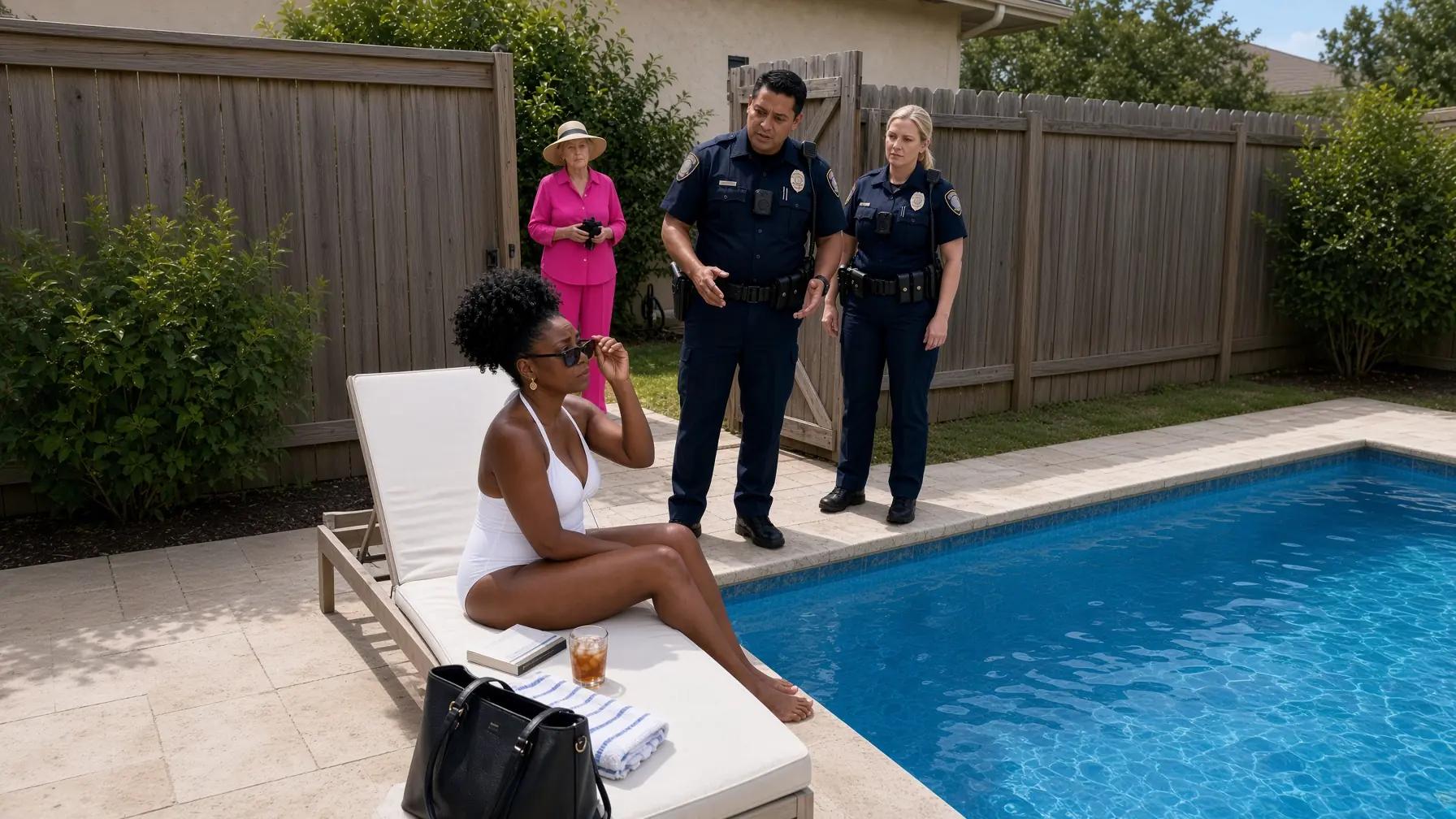
The following afternoon, Linda saw the woman clearly for the first time. She was in the backyard of the corner house, lying on a lounge chair beside the pool in a navy swimsuit with sunglasses covering her eyes. She appeared to be a Black woman in her mid-forties, athletic, with her hair gathered into a natural puff at the back of her head.
A book rested against her stomach. A glass of iced tea sat on the small table beside her. Soft jazz floated from outdoor speakers while sunlight moved across the surface of the pool.
She looked completely comfortable.
That bothered Linda more than it should have.
Linda sat forward. She could not remember seeing the woman unload furniture. She had never seen her speak with another neighbor.
For reasons Linda did not examine carefully enough, those facts became evidence instead of simply facts.
She reached for the binoculars.
Through the lenses, she could see a stainless-steel grill beside the patio and expensive-looking outdoor furniture arranged beneath a pergola. The landscaping was immaculate. Someone had planted fresh flowers along the back fence.
Linda lowered the binoculars.
“Interesting,” she whispered.
She watched another minute.
The woman turned a page.
No nervous glances. No hurried movement.
No attempt to conceal herself.
Instead of reassuring Linda, the woman’s comfort strengthened the suspicion she had already decided to feel. Perhaps, Linda thought, the person assumed nobody would challenge her.
She picked up her phone.
There was a moment, brief enough that she barely remembered it later, when her thumb hovered over the screen. She could have walked across the street. She could have waited until evening.
She could have done nothing.
Instead, she called the non-emergency police line.
“Plano Police, what can I help you with?”
Linda adjusted her voice into the concerned, measured tone she used when complaining to utility companies.
“Yes, hello. I’m calling from Sycamore Lane in Willow Creek.”
The dispatcher asked what was happening.
“I believe someone may be trespassing at the old Walsh property.”
“Do you see anyone forcing entry?”
“No.”
“Any damage?”
“No, but there’s a woman in the backyard by the pool.”
The dispatcher paused.
“Why do you believe she doesn’t belong there?”
Linda looked across the street.
“She’s not one of the owners.”
“How do you know?”
That question irritated her slightly.
“I’ve lived here twenty-one years. I know my neighbors.”
The dispatcher asked for a description.
Linda hesitated only a moment.
“Black woman, maybe mid-forties. She’s wearing a swimsuit and sunglasses.”
The dispatcher asked whether the woman was behaving suspiciously.
Linda stared toward the pool.
“She’s just lying there.”
Another pause.
“Anything else?”
Linda searched for something concrete.
“I just don’t recognize her.”
The dispatcher explained that an officer could check the property if Linda genuinely believed unauthorized access might be occurring, but without signs of forced entry there was little evidence of a crime. Linda insisted someone should at least verify who the woman was. She gave her full name, address, and phone number.
Two patrol officers were dispatched.
Estimated arrival: ten minutes.
Linda ended the call with a strange mixture of satisfaction and anxiety. She told herself she had done the responsible thing. If the woman lived there, everything would be cleared up quickly.
If she did not, Linda had protected the neighborhood.
That was how she framed it.
Ten minutes later, two patrol vehicles turned onto Sycamore Lane.
Linda stood quickly.
She moved toward her flower bed with a watering can so it would appear she happened to be outside when they arrived.
The first officer stepped from his cruiser. He was a Latino man in his late thirties with the name S. Delgado printed above his badge. His partner, Officer Kristen Hayes, appeared slightly younger.
“Are you Ms. Harper?”
Linda nodded.
“That’s the house.”
She pointed.
“The woman is in the backyard.”
Officer Delgado looked toward the corner property.
“You saw her enter?”
“No.”
“You saw her climb the fence?”
“No.”
“Damage anything?”
“No, but nobody knows who she is.”
Delgado glanced toward his partner.
Linda noticed.
“She doesn’t live there,” Linda added.
“How do you know?”
“I would know.”
That sentence would bother her later.
At the time, she said it confidently.
The officers walked toward the corner house.
Linda remained near her hedges.
She watched them approach the side gate. It was unlocked.
Officer Hayes called out before entering.
“Plano Police Department. Anyone back here?”
The woman beside the pool lifted her head.
Her name was Dr. Renee Wallace.
She had heard the gate before she heard the voices.
For almost twenty-five years, Renee had worked in federal law enforcement, beginning as a field analyst before moving through investigative and leadership roles in several states. Three months earlier, she had been appointed associate deputy director of a major federal investigative division based partly in Washington. She had purchased the Plano house because her sister and elderly mother lived nearby, and because after decades of moving for work, she wanted one place that felt permanently hers.
Renee had spent most of the previous two weeks traveling between Texas and Washington. She returned Friday evening after giving closed-door testimony at a congressional security briefing. Saturday was the first uninterrupted afternoon she had enjoyed in weeks. She intended to spend it reading beside her pool.
Then two uniformed officers entered her backyard.
Renee removed her sunglasses.
“Can I help you?”
Officer Delgado stopped several feet away.
“Ma’am, we received a report that someone might be trespassing on this property.”
Renee looked around her own yard.
Then she looked back at him.
“Someone reported me?”
“We’re just checking everything out.”
Renee sat upright.
“This is my house.”
Delgado nodded carefully.
“Do you have identification showing the address?”
For a second, Renee said nothing.
The request was not impossible. Police verifying an uncertain property complaint was not automatically unreasonable once they had arrived.
Still, the circumstances were impossible to ignore.
A woman lying beside a private pool had generated a call because a neighbor decided she did not look like she belonged there.
Renee stood.
“I have ID.”
She walked toward the small outdoor cabinet beside the patio and removed a leather tote.
Officer Hayes looked uncomfortable.
Renee noticed that too.
As she opened her wallet, she asked, “Did the caller report forced entry?”
Delgado answered honestly.
“No.”
“Broken windows?”
“No.”
“Did she see me climb a fence?”
“No.”
“Anything taken from the property?”
“No.”
Renee looked directly at him.
“So the suspicious behavior was me being here.”
Neither officer responded immediately.
Renee opened the wallet.
Her federal credentials appeared first.
Officer Hayes blinked.
Delgado’s expression changed.
Renee did not smile.
The badge identified her name, agency affiliation, and senior executive status.
Officer Delgado straightened slightly.
“Ma’am, I apologize.”
Renee closed the wallet.
“You don’t need to apologize for responding to a call.”
Her voice remained even.
“But I would like to understand why that call became enough to enter my backyard.”
Delgado explained what the caller had reported.
New resident. Unknown woman.
Possible trespassing.