Lucas Bennett was standing in his kitchen like he owned the place.
Because he did.
Work boots still carrying flecks of dried concrete. Flannel shirt dusted with drywall powder. Lunch pail swinging from one hand, hard hat tucked under the other arm. He had come home from the job site expecting the usual late-afternoon disorder: Mia’s stuffed animals scattered near the couch, Emily’s teaching papers spread across the kitchen island, the faint smell of whatever dinner she had started before rushing out for Mia’s pediatrician appointment.
He had not expected his mother-in-law to be standing by the sink calling 911.
Victoria Hayes turned so fast her silver earrings swung. One hand was pressed dramatically to her chest, the other gripping her phone as if the dispatcher were the only thing keeping her alive.
For one second—just one—fear crossed her face.
Not fear of him.
Fear of being caught.
Then she straightened her shoulders and lifted her chin.
“He’s inside now,” Victoria said into the phone. “He just came in through the back door.”
Lucas stopped with one hand still on the doorknob.
“Victoria,” he said slowly, “what are you doing?”
She backed toward the sink as if he had raised a fist instead of a question.
“Please hurry,” she said into the phone. “I don’t feel safe.”
Lucas looked around the room, half-expecting to find some real emergency he had missed. There was nothing. Just Victoria. Just his kitchen. Just the house he had bought in 2018—two full years before he ever met Emily.
“This is my house,” he said.
Victoria’s eyes sharpened. “Stay away from me.”
“I’m standing by the door.”
“You broke in.”
“I used my key.”
“You do not belong here.”
That sentence landed colder than it should have.
Lucas set his lunch pail down carefully. He had spent enough years on volatile job sites to know when stillness was safer than motion.
“I live here.”
Victoria gave a small, ugly laugh. “You live here because my daughter allows it.”
For a moment Lucas thought he had misheard her.
“What did you say?”
“This house belongs to Emily.”
“No,” he said quietly. “It doesn’t.”
Victoria’s mouth tightened.
“Do not start that nonsense with me.”
“I bought this house before I knew your daughter existed.”
“Liar.”
The word hit harder than he expected.
Victoria had insulted him before, usually wrapped in polite language. She had called his work “unstable.” She had asked whether construction workers received “real benefits.” At Thanksgiving she had told Emily in front of the whole table that men who worked with their hands often struggled with long-term planning.
Lucas had swallowed those things because Emily hated conflict with her mother, and because he believed marriage meant protecting peace even when peace had teeth.
But *liar* was different.
* Liar* turned his own kitchen into hostile ground.
He pulled out his phone.
“I’m calling Emily.”
Victoria’s face changed. “Leave my daughter out of this.”
“She’s my wife.”
“She has suffered enough because of you.”
Lucas stared at her, thumb already pressing Emily’s name.
Emily answered on the fourth ring, breathless and distracted. In the background Mia was crying—the high, exhausted wail that followed shots.
“Hey. What’s up?”
“Your mother is in our house.”
A pause.
“Okay?”
“She called the police and told them I broke in.”
The silence that followed was long enough to answer before Emily did.
“Lucas, I’m at the pediatrician’s office.”
“I know where you are.”
“Mia just got her shots. She’s screaming.”
“Emily.”
His voice dropped.
“Your mother told the police I’m an intruder in my own house.”
He heard a baby crying, a nurse’s voice, a door closing.
Then Emily came back on the line, quieter.
“I can’t deal with this right now.”
Lucas closed his eyes.
“You can’t deal with your mother trying to have me arrested?”
“I’m not saying that.”
“What did you tell her?”
Another pause.
Lucas looked across the kitchen. Victoria was watching him now. Arms folded. Chin lifted. Almost smiling.
“What did you tell her about this house?”
“Lucas, she may have misunderstood some things.”
“Misunderstood what?”
“That we live here together.”
“No.”
His hand tightened around the phone.
“She thinks you own it.”
Emily said nothing.
The silence cracked something open inside him.
“She thinks I live here because you let me.”
“Lucas, please lower your voice.”
“My voice is not the problem.”
“Mia is crying.”
“Emily.”
He could hear his heartbeat now.
“Did you tell your mother this house was yours?”
“I never said it like that.”
“Did you let her believe it?”
Emily’s voice hardened slightly, that little defensive edge she got whenever she felt trapped.
“We can talk when I get home.”
“The police are on their way now.”
“Then show them the deed.”
That sentence knocked the air out of him.
Not because it was wrong.
Because it was too practical. Too calm. As if this was a mess he could handle while she finished her errands.
“Emily,” he said, “your mother called the police on me.”
“No, I don’t think you do.”
“I said we’ll talk when I get home.”
“Why would she believe she had the right to do this?”
“Because my mother is dramatic.”
“No,” Lucas said, watching Victoria’s satisfied face. “This isn’t drama. This is a lie with a uniform on the way.”
Emily said nothing.
Then, softly, “I have to go.”
“Don’t hang up.”
“I have to.”
“Emily.”
The line went dead.
Lucas lowered the phone.
Victoria smiled.
“She’s not coming to rescue you.”
The old Lucas might have tried to explain everything—the closing date, the mortgage, the down payment saved penny by penny, the years of overtime, the winter he lived on peanut butter sandwiches so every spare dollar could go into the account labeled HOUSE.
But standing there, with police on the way and Victoria enjoying herself in his kitchen, he understood something.
Victoria did not want facts.
She wanted victory.
“You need to leave,” he said.
“This is not your house.”
“It is more mine than yours.”
“No,” Lucas said. “That is exactly what it is not.”
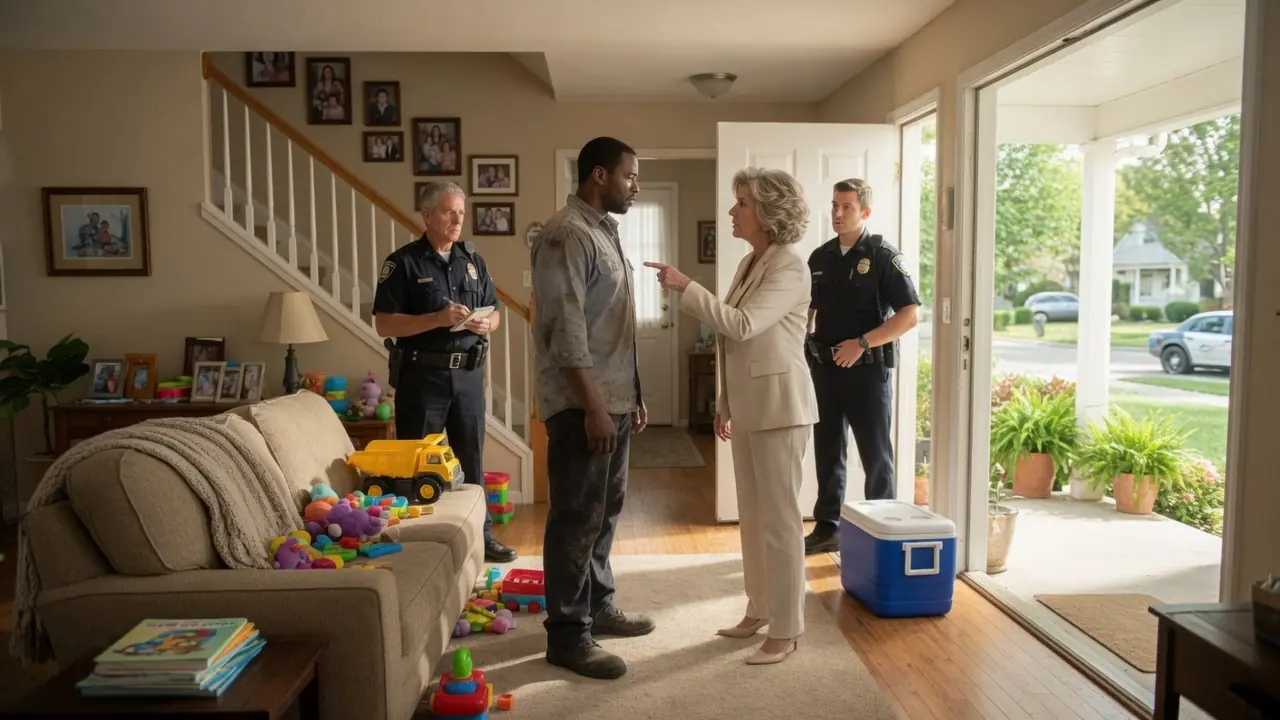
The police arrived without sirens.
Two patrol cars rolled up to the curb twelve minutes later, lights off, engines low. Lucas watched through the front window as two officers stepped out. The older one had close-cropped gray hair and a face that looked more tired than suspicious. The younger one kept his hand near his belt with the tense uncertainty of someone new enough to imagine every call could become a headline.
Victoria rushed to the door before Lucas moved.
“Thank God,” she cried, pulling it open. “He’s inside.”
The older officer looked past her at Lucas.
“Ma’am, step aside.”
“He forced his way in.”
Lucas stood in the living room with both hands visible.
“Sir,” the officer said, “what’s your name?”
“Lucas Bennett.”
“Do you live here?”
“Yes.”
Victoria snapped, “He says that, but this is my daughter’s house.”
The younger officer looked at Lucas. “Can you provide ID?”
Lucas took out his wallet slowly and handed over his license.
The address matched.
The older officer glanced at it, then back at him.
“Do you have proof of ownership?”
“Yes. Upstairs in the office.”
“He could have changed his address,” Victoria said. “My daughter owns this home.”
“Ma’am,” the officer said, “I’ll speak with you in a moment.”
Victoria looked offended by the idea that anyone could ask her to wait.
Lucas led the older officer upstairs.
The hallway felt different with a stranger in uniform behind him. The walls were lined with framed photographs: Lucas and Emily on their wedding day, Emily holding up a positive pregnancy test, baby Mia wrapped in a hospital blanket, Lucas carrying Emily over the threshold after their honeymoon.
He had always thought of those photos as proof of a life they were building.
Now they felt like exhibits.
The office was the small room at the end of the hall. Lucas had painted it soft gray before Mia was born, back when they were still deciding which room would become the nursery. Emily had chosen the larger room eventually, so this became the place where Lucas kept papers, tools, tax folders, and warranties for appliances he had installed himself.
He opened the file cabinet and pulled out the folder marked BIRCH LANE.
Inside were the deed, mortgage documents, property tax statements, insurance records, and closing paperwork from 2018.
The officer reviewed them carefully.
Lucas watched his face change.
“You purchased this property in March 2018.”
“Yes.”
“Before your marriage?”
“Yes.”
“Only your name is on the deed.”
“Yes.”
“Mortgage is only in your name too.”
“Yes.”
“Was there ever a transfer? Quitclaim? Refinance?”
“No.”
The officer paused.
“Any reason someone would think otherwise?”
Lucas almost laughed.
“Apparently.”
When they returned downstairs, Victoria was still talking.
“My daughter has been under enormous stress. He’s controlling. She doesn’t always say what she means when he’s around.”
The younger officer looked relieved when his partner came back.
The older officer held up the folder.
“Mrs. Hayes, Mr. Bennett has provided documentation showing he is the sole legal owner of this residence.”
Victoria blinked.
Then laughed.
“Impossible.”
“The deed is clear.”
“My daughter would not lie to me.”
“That may be a family matter. It is not a police matter.”
Victoria’s cheeks reddened.
“You’re taking his side.”
“I’m looking at documents.”
“He manipulated them.”
The officer’s tone cooled.
“Ma’am, falsely reporting a crime is serious.”
“I did not report falsely. He trapped my daughter.”
Lucas’s jaw tightened.
The officer turned to him.
“Mr. Bennett, do you want to file a complaint regarding the false report?”
Victoria went still.
For the first time, Lucas saw fear in her face.
He imagined saying yes. He imagined Victoria being taken to the station. He imagined Emily’s reaction. He imagined Mia, years from now, asking why Grandma had a police record because of him.
“No,” he said.
Victoria’s shoulders loosened.
“For now,” Lucas added.
The officer gave him a long look, then nodded.
“I’ll document what happened.” He handed Lucas a card. “Call us if there are any further issues.”
Then he turned to Victoria.
“Ma’am, if Mr. Bennett asks you to leave, you need to leave.”
“This is outrageous.”
The younger officer finally spoke.
“Don’t make it harder.”
Victoria snatched her purse from the couch.
As she passed Lucas, she hissed, “This is not over.”
Lucas looked at her.
“No,” he said. “It’s just finally honest.”
She slammed the door behind her.
After the officers left, the house became too quiet.
The refrigerator hummed. A dog barked somewhere down the street. The birch tree brushed against the front window.
Lucas stood alone in the living room, looking at the family photos.
A strange thought came to him.
Lies do not always enter a house loudly.
Sometimes they sit at your dinner table. Sometimes they hold your baby. Sometimes they kiss you goodnight.
His phone buzzed.
Emily.
We’re on our way home. Please don’t make this worse.
Lucas stared at the message until the words blurred.
*Please don’t make this worse.*
That was when he understood Emily still thought the fire was something happening to her, not something she had helped start.
Forty minutes later, Emily came through the front door with Mia’s car seat hanging from one arm and the diaper bag sliding down her shoulder.
Mia’s face was blotchy from crying. A tiny pink bandage covered one chubby thigh.
Lucas instinctively stepped toward them.
Emily shifted the carrier slightly away.
Not enough to refuse him.
Enough to say she was already defensive.
“She needs a nap,” Emily said.
Lucas nodded. “Put her down.”
Emily carried Mia upstairs. Lucas listened to the familiar sounds: the nursery door, the white noise machine, Emily’s soft voice, the crib creaking lightly.
This was the part that made betrayal cruel.
The ordinary things did not stop.
When Emily came downstairs, she paused at the bottom step. Her face looked composed in the way people look after rehearsing in the bathroom mirror.
Lucas stood near the couch.
“Why does your mother think you own this house?”
Emily folded her arms.
“I didn’t tell her that directly.”
He almost laughed.
Legal language already.
“Emily.”
“I let her assume some things.”
“Some things?”
“She misunderstood.”
“Your mother called the police.”
“I know.”
“She told them I was an intruder.”
“She shouldn’t have done that.”
“Why did she think she could?”
Emily looked away.
“Because she’s controlling.”
“No,” Lucas said. “Because you gave her a story where I didn’t belong here.”
“That’s not fair.”
“Then explain it fairly.”
Emily sat in the armchair across from him. Not beside him. Across.
Like a witness taking the stand.
“When we got married, she asked how we could afford the house. I said it was handled. She assumed I had bought it, or that my savings helped. I didn’t correct her.”
Lucas said nothing.
“Then she started telling people her daughter had bought a house. I still didn’t correct her. And then it got easier to let her think that than to listen to her say I married down.”
Lucas stared at her.
“You were embarrassed that I bought this house.”
“No.”
“I was embarrassed that she thought I needed saving.”
“So you let her think I did.”
Emily’s eyes filled.
“I was tired of being judged.”
“And what about me?” His voice cracked before he could stop it. “Did you ever get tired of her judging me?”
Emily wiped her face.
“I defended you.”
“When?”
“All the time.”
“Not with the truth.”
She had no answer.
Lucas sat down slowly.
“I bought this place before I knew you. I worked weekends. I skipped vacations. I drove the same truck for nine years. I closed on this house with my father sitting beside me because I was so proud I thought I might cry in front of the realtor.”
Emily covered her mouth.
“And you turned that into your achievement because your mother made you feel small.”
“I know.”
“No,” he said. “I don’t think you do.”
Emily leaned forward.
“I was wrong. I know I was wrong. But I did it because I was scared.”
“Of what?”
“Of her being right.”
“About what?”
Emily looked down.
“That I had no real accomplishments.”
The sentence sat between them like broken glass.
Lucas looked at his wife.
She had a college degree. A teaching job. A baby she had carried through months of sickness and fear. She had survived postpartum anxiety while Lucas took night shifts and learned to function on three hours of sleep. She had built a life with him.
Or at least he thought she had.
“You thought claiming my house would make you accomplished.”
“I know how that sounds.”
“How does it sound?”
“Awful.”
“It sounds like theft.”
Her head snapped up.
“I didn’t steal anything.”
“No?”
Lucas stood.
“Then why did First National Bank call me?”
Emily went completely still.
All the air changed.
Lucas had not planned to say it yet. But the truth was there now, standing in the room with them.
“What are you talking about?” she asked.
He almost admired the attempt.
Almost.
“Jennifer from the bank called while you were upstairs. Someone identifying herself as Emily Bennett called today. She asked about refinancing. She claimed to be the property owner.”
Emily looked toward the kitchen.
“Lucas—”
“She said you asked about adding your name to the deed.”
Emily closed her eyes.
His voice dropped.
“Did you try to add yourself to my deed without telling me?”
“I was going to tell you.”
“When?”
“After I had information.”
“No,” he said. “After you found someone who would help.”
“That’s not fair.”
“Did you claim to be the sole owner?”
Emily did not answer.
Lucas stepped back.
Not dramatically.
But she felt it. He saw her feel it.
“I can explain.”
“I’m done with explanations that arrive after evidence.”
Emily stood.
“I wanted us to refinance.”
“We talked about that someday. Together.”
“I wanted to help.”
“You wanted your name on my house.”
“Our house.”
“No.”
His voice was quiet enough to hurt.
“Not today.”
Emily started crying again.
Lucas no longer knew what tears meant.
“I thought if my name was on it, I’d feel secure.”
“For whom?”
“For me.”
“And if I said no?”
She opened her mouth.
Nothing came out.
“That’s why you didn’t ask,” he said.
She covered her face.
The marriage did not end in that moment. Not exactly.
But it shifted into a place where the old words no longer worked.
Love.
Trust.
Partner.
Home.
Those words suddenly had legal edges.
Lucas opened the front door.
Emily stared at him.
“What are you doing?”
“You need to leave tonight.”
“Lucas, please.”
“Take Mia to your mother’s.”
“My mother kicked me out over the phone after I told her the police were wrong.”
“Then go to your sister’s.”
“I can’t.”
“Emily.”
His voice sharpened.
“You tried to commit fraud against me today. I do not want to say that again while our daughter is asleep upstairs.”
Her face collapsed.
“I’ll pack a bag.”
He nodded.
Upstairs, drawers opened. A suitcase rolled across the bedroom floor. Mia fussed awake. Emily soothed her with a voice that kept breaking.
Lucas stood in the hallway with one hand against the wall.
He had hung those drywall panels himself after tearing out the old plaster. Behind the paint were studs he had reinforced, wires he had updated, insulation he had installed.
The house knew his hands.
Emily came down twenty minutes later with Mia on her hip and a duffel bag over her shoulder.
Mia reached for Lucas.
“Da.”
Emily froze.
Lucas stepped forward and took his daughter.
For one minute, he forgot Victoria. The bank. The deed. The police.
He held Mia against his chest and breathed in baby shampoo, milk, and warmth.
Then he kissed her forehead.
“I love you, peanut.”
Emily cried silently.
“Lucas—”
“Take her somewhere safe.”
“I will.”
“We’ll talk tomorrow.”
He handed Mia back.
It felt like tearing off skin.
He watched from the window as Emily buckled Mia into the car seat. The red taillights pulled out of the driveway. The house went still.
Lucas did not cry until the car disappeared.
Then he sat on the bottom stair, put his head in his hands, and let the sound come out of him like something being pulled from underground.
At 9:16, he called his brother Jacob.
Jacob answered on the first ring.
“I knew something was wrong.”
Lucas stared at the dark living room.
“I think my marriage just broke.”
Jacob was quiet for a moment.
“Tell me.”
Lucas told him everything. The police. The deed. Emily. The bank. Victoria. The years of little humiliations that suddenly looked less little.
When he finished, Jacob said, “You need a lawyer.”
“I don’t want a divorce.”
“I didn’t say divorce. I said lawyer.”
“She’s Mia’s mother.”
“She also tried to put her name on your deed without consent. That doesn’t disappear because you have a baby.”
Lucas hated how reasonable that sounded.
“I don’t want to destroy her.”
“Then don’t. Protect yourself. Those are different things.”
Jacob gave him a name: Amanda Torres. Family law. Property disputes. No nonsense.
Lucas wrote down the number but did not call.
Not yet.
At 10:02, Emily called.
He answered because Mia existed.
“Lucas.”
Her voice was ruined.
“Where are you?”
“In a grocery store parking lot.”
“What?”
“My mother wouldn’t let me inside.”
Lucas closed his eyes.
“Where’s Mia?”
“Asleep in the back seat.”
“Emily.”
“I know.”
Her voice broke.
“I told her the truth. She said I humiliated her. She said she spent three years telling people I owned that house. She said if I was willing to make her look stupid, I could sleep in the life I chose.”
Lucas gripped the phone.
Victoria had not simply misunderstood.
She had invested in the lie.
“Go to a hotel.”
“I don’t have enough on my card.”
He almost asked how that was possible, then remembered Emily had been on unpaid leave longer than planned after Mia’s birth. He remembered paying most of the bills. He remembered not minding because he thought they were a team.
“Come back,” he said.
Emily inhaled sharply.
“Lucas—”
“You and Mia can sleep here. Guest room. We are not discussing the marriage tonight.”
“Thank you.”
“I’m not doing this for you. I’m doing it because my daughter is not sleeping in a parking lot because adults lied.”
“I know.”
Twenty-five minutes later, Emily returned.
Lucas opened the door before she knocked.
Neither of them spoke.
He took Mia upstairs, changed her diaper, gave her a bottle, and rocked her in the nursery chair until her small body relaxed against him.
Emily stood in the doorway.
“She reached for you the whole drive,” she whispered.
Lucas did not answer.
When Mia was asleep, he laid her in the crib and stood there longer than necessary.
The nursery was painted soft yellow. Emily had picked the color. Lucas had painted it. Victoria had called it “a strange choice” and asked why they had not hired professionals.
Lucas remembered Emily laughing awkwardly instead of defending him.
At the time, he had let it go.
Now he wondered how many warnings had been disguised as small moments.
Downstairs, Emily sat at the kitchen table.
Lucas stood across from her.
“You can sleep in the guest room.”
She nodded.
“I deserve that.”
“This isn’t about what you deserve. It’s about what I need.”
“I know.”
He wanted to believe that.
He did not.
The next morning, Lucas called Amanda Torres from his truck before work.
Her assistant put him through after he summarized the police call and the bank inquiry.
Amanda’s voice was direct.
“Mr. Bennett, do not sign anything.”
“I wasn’t planning to.”
“Good. Do not refinance. Do not add your wife to the deed. Do not move out. Do not threaten divorce in writing. Preserve the police incident number. Ask the bank for written confirmation of the attempted inquiry. Start a timeline.”
Lucas stared through the windshield at the job site fence.
“So this is serious.”
“Your wife attempted to assert ownership interest in separate premarital property after allowing a false narrative to exist for years. Yes, it is serious.”
“Does it mean divorce?”
“It means you need facts before feelings.”
He almost laughed.
Everyone suddenly sounded like math teachers.
“What about my mother-in-law?”
“If she comes to the property again, tell her in writing she is not permitted without your consent. If she makes another false police report, you press charges.”
“She’s my wife’s mother.”
“She is also a legal risk.”
That afternoon, Emily scheduled marriage counseling.
Lucas agreed. Not because he trusted her, but because he wanted to know whether honesty was still possible in the same room.
Dr. Isabel Morales’s office sat above a bakery downtown. The waiting room smelled like cinnamon and coffee, which felt wrong for a place people brought broken things.
Emily sat beside Lucas but did not touch him.
Dr. Morales was in her fifties, with calm eyes and a voice that did not waste softness.
After hearing both sides, she looked at Emily and said, “What you did was financial betrayal.”
Emily flinched.
“I didn’t mean it like that.”
“Intent matters less than impact.”
“I was afraid.”
“Fear explains behavior. It does not excuse it.”
Emily pressed her lips together.
Dr. Morales continued.
“You allowed your mother to believe your husband was dependent on you. You allowed that belief to shape the family dynamic. You attempted to modify the ownership status of a premarital asset without his consent. That is not simply avoiding conflict. That is creating a false reality where you held power you did not have.”
Emily began to cry.
Lucas felt a grim kind of relief.
Not because she was crying.
Because someone else had finally named it.
Dr. Morales turned to him.
“Lucas, you are not obligated to decide today whether the marriage continues. You are allowed to be injured. You are allowed to need legal protection. That does not make you aggressive.”
Emily looked at him quickly.
“You called a lawyer?”
“Yes.”
The hurt on her face almost made him apologize.
Almost.
Then he remembered Jennifer from the bank.
Emily’s expression shifted from hurt to panic.
“Are you filing for divorce?”
“I’m protecting myself.”
“From me?”
His silence answered.
Dr. Morales leaned forward.
“Emily, if your first response to his need for safety is to center your fear, you are not ready to repair trust.”
Emily lowered her hands.
The session was brutal.
She admitted pieces. Deflected. Admitted more. Said Victoria had never accepted Lucas. Said her mother praised her only when Emily appeared above him. Said the lie began as a silence, then became a story, then became something she no longer knew how to take back.
Lucas listened until she said, “I didn’t know how to undo it without everyone thinking I was pathetic.”
He finally spoke.
“So you made me pathetic instead.”
Emily broke down.
Dr. Morales did not rescue her from the sentence.
Some truths should echo.
That evening, Emily placed three handwritten pages on the kitchen table.
“My list,” she said.
Lucas knew what it was before she spoke. Dr. Morales had told her to write every lie she had told or allowed.
He sat down.
Emily started to leave.
“No,” he said. “Sit.”
She sat across from him, hands folded tight.
Lucas read.
I told my mother Lucas moved into the house after we got serious, and I let her believe I owned it first.
I told Aunt Denise I handled most of the bills because I wanted her to think I was financially independent.
I did not correct Mom when she called Lucas a project.
I did not correct Mom when she told Mrs. Keller across the street that I was letting Lucas “get back on his feet.”
I told my cousin Lindsey that Lucas was not good with money, even though he pays the mortgage and most of our bills.
I told Mom the house needed refinancing because Lucas had made bad loan choices, even though that was false.
I called the bank because I wanted to see if I could add my name before telling Lucas.
I told myself I was protecting my future, but I was actually trying to make my lie real.
Lucas set the pages down.
Emily was crying silently.
There was one more page.
At the bottom, she had written:
I lied because I was ashamed of being loved by someone my mother did not respect.
Lucas stared at that line for a long time.
Then he looked at his wife.
“Did you respect me?”
“Yes.”
The answer came too quickly.
He waited.
Emily looked down.
“I wanted to.”
That answer hurt worse.
It was also the first fully honest thing she had said.
Lucas leaned back.
“Thank you for not lying there.”
Emily sobbed once.
“I hate myself.”
“That doesn’t help me.”
“I know.”
“What are you going to do?”
She swallowed.
“I started individual therapy. First session Friday. And I sent my mother a letter.”
Lucas’s eyes narrowed.
“What letter?”
“The one Dr. Morales helped me draft. I wanted to show you first, but then I realized I was using that as a delay.”
She slid her phone across the table.
Lucas read.
Mom, I lied to you about the house. Lucas owns it. He bought it before we met. He has paid the mortgage and maintained the home. I allowed you to believe I owned it because I was afraid of your judgment. That was wrong.
You were also wrong to call the police on him. He was in his own home.
Until you acknowledge the truth and apologize to Lucas directly, you are not welcome at our house and will not have unsupervised access to Mia.
If you insult my husband, question his right to his property, or repeat false claims, I will end the conversation.
I love you, but I will not sacrifice my marriage to protect your pride.
Emily.
Lucas read it twice.
“What did she say?”
Emily gave a humorless laugh.
“She called me ungrateful. Then she said you wrote it. Then she said I was choosing a man over my mother.”
“What did you say?”
“I said I was choosing the truth.”
For the first time since the police had stood in his living room, Lucas saw something in Emily’s face besides fear.
It was small.
Fragile.
But it was there.
A spine remembering itself.
“Then she texted that I was dead to her,” Emily said. “I blocked her for twenty-four hours.”
“Have you ever blocked her before?”
“No.”
“Not once?”
“No.”
Lucas nodded.
“That is something.”
“I know it doesn’t fix anything.”
“No,” he said. “It doesn’t. But it is something.”
They sat at the table long after the papers were gathered.
Not touching.
Not reconciled.
But not performing either.
That was the first night Lucas believed repair might be possible.
Then Victoria made her second mistake.
Four days later, Lucas was at work when the doorbell camera sent an alert.
Motion detected.
He opened the app.
Victoria stood on the porch with two women from the neighborhood: Mrs. Keller from across the street and Dana Collins from the corner house. Victoria held a manila folder in one hand.
“This is the house I told you about,” Victoria said. “My daughter is trapped in there with him.”
Mrs. Keller looked uncomfortable.
“Victoria, I thought the police said—”
“The police were fooled.”
Victoria pulled papers from the folder.
“He forged documents. He has isolated Emily. He is trying to steal the house from her and keep the baby.”
Lucas saved the clip before his anger caught up with his hands.
Dana frowned.
“But Emily texted me that Lucas owns the house.”
Victoria’s face flickered.
“She is afraid. She says what he tells her to say.”
Lucas called Amanda.
Amanda listened to the recording twice.
“Good,” she said.
Lucas blinked.
“Good?”
“She just made this easier.”
Within an hour, Amanda sent Victoria a cease-and-desist letter.
Defamation. False statements. Trespass. Harassment. Interference with marital residence.
She attached still images from the doorbell recording and referenced the police report.
She copied Emily.
Then she sent a shorter letter to Mrs. Keller and Dana Collins. Not threatening. Clarifying. The public property record listed Lucas Bennett as sole owner. Any claims of forgery or abuse were false unless supported by evidence. If either neighbor had concerns for Emily’s safety, they should contact law enforcement rather than spread unverified allegations.
By sunset, the neighborhood knew Victoria had lied.
Not because Lucas announced it.
Because Victoria tried to recruit witnesses and accidentally created them for him.
Emily watched the video that evening.
Her face went white.
“She told people you were abusing me.”
“Yes.”
“I never said that.”
“I believe you.”
She looked startled.
Lucas continued.
“But you taught her that lies about me were acceptable if they protected your feelings.”
Emily flinched.
He hated saying it.
He hated more that it was true.
“What do we do?” she asked.
“You tell the truth.”
“To whom?”
“Everyone she lied to.”
The next day, Emily posted a statement in the private family group chat.
She wrote that Lucas owned the house.
She wrote that Victoria had called police based on false assumptions.
She wrote that Lucas had never abused, threatened, or controlled her.
She wrote that she had misled people because of insecurity and fear of Victoria’s judgment.
She apologized to Lucas publicly.
Then she left the group chat.
The explosion came fast.
Texts. Calls. Voice messages. Aunt Denise asked whether Lucas forced her to write it. Cousin Lindsey said Emily had embarrassed the family.
Then Victoria sent the message that changed everything.
You stupid girl. Do you have any idea what you have done? I told everyone that house was yours because you needed leverage. If Lucas ever left you, we could have forced him to settle. I was trying to protect you.
Emily showed Lucas with shaking hands.
Lucas read it three times.
Leverage.
Not misunderstanding.
Not confusion.
Leverage.
Victoria had not only believed the lie.
She had planned to use it.
Emily whispered, “I didn’t know.”
Lucas believed her.
But belief did not make the damage smaller.
Amanda called the message “a gift wrapped in arrogance.”
Victoria did not apologize.
She escalated.
She called Emily’s school and claimed Lucas was unstable. She contacted Child Protective Services anonymously, alleging Mia lived in an unsafe home. She posted vague comments online about “mothers watching daughters disappear into controlling marriages.”
Each move backfired.
CPS found a clean home, a safe crib, full medical records, stocked formula, and two exhausted parents in counseling.
Emily told the investigator her mother was retaliating after being confronted about false statements.
The case closed as unfounded.
Victoria’s online comments were screenshotted by relatives and sent to Emily with apologies.
Even Victoria’s sister called and said, “Your mother has gone too far.”
Victoria had ruled the family for years through certainty.
Now certainty was starting to look unstable.
Lucas filed a civil harassment petition.
Not because he wanted drama.
Because Victoria had shown she would not stop unless a boundary had legal teeth.
At the hearing, Victoria arrived in a red blazer and outrage.
She told the judge she was a concerned grandmother.
Amanda played the doorbell footage.
Then she presented the police report, the bank statement, and Victoria’s text about leverage.
The courtroom changed.
Judges hear family emotion every day.
They also recognize strategy.
The judge looked at Victoria over her reading glasses.
“Mrs. Hayes, concern for a child does not authorize false police reports, trespass, or defamatory statements.”
Victoria tried to interrupt.
The judge raised one hand.
“You will not speak over me.”
For the first time in years, Lucas watched Victoria meet a boundary she could not shame into moving.
The order was granted for one year.
No contact with Lucas. No presence at the Birch Lane property. No third-party harassment. No abuse allegations made outside proper channels unless supported by good-faith evidence.
Emily sat beside Lucas through the hearing.
When Victoria mouthed *traitor*, Emily looked away.
But she did not leave.
That mattered.
The marriage did not heal quickly.
Lucas stayed in the primary bedroom.
Emily stayed in the guest room.
They split Mia’s care. Attended weekly counseling. Emily went to individual therapy twice a week. Lucas met with Amanda monthly and kept a legal separation petition prepared but unsigned in his desk drawer.
For a while, life became a spreadsheet of boundaries.
Separate accounts.
Shared household account.
Written financial disclosures.
No unilateral calls to banks, lenders, insurers, or government agencies.
No family story told differently to different people.
No contact with Victoria.
Emily accepted every condition.
At first, Lucas thought acceptance meant transformation.
Dr. Morales warned him not to confuse compliance with character.
“Compliance is fear of losing access,” she said. “Character is what remains after fear fades.”
So Lucas watched.
He watched when Victoria sent flowers with a card that read, *A mother’s love waits.*
Emily cried.
Then threw them away.
He watched when Aunt Denise begged Emily to “just talk to your mother because she is suffering.”
Emily said, “She’s suffering because she lost control, not because I harmed her.”
He watched when Emily corrected Mrs. Keller at the mailbox.
“Lucas bought this house. I lied because I was insecure. He deserved better.”
Mrs. Keller hugged her.
Emily cried in the driveway after.
Lucas saw from the window but did not go outside.
Some grief belonged to her.
She needed to survive it without using him as a crutch.
In December, Emily handed Lucas an envelope.
Inside was a notarized letter acknowledging the house as Lucas’s separate property. She waived any claim created by her attempted bank inquiry and agreed she would not seek ownership interest in the home in the event of separation or divorce, except for any legally required reimbursement determined by a court.
Lucas looked up.
“Did Amanda draft this?”
“My attorney did.”
“You got an attorney?”
Emily nodded.
“Good.”
He studied her.
“Why?”
“Dr. Morales said if I’m serious about accountability, I need independent advice. I can’t rely on you to manage my consequences.”
Something loosened in him.
That was the first decision Emily made that did not ask him to rescue her from the damage she caused.
“Your attorney told you to sign this?”
“She told me not to.”
Lucas blinked.
“She said it weakens me if we divorce.”
“Then why sign it?”
Emily’s eyes filled.
“Because I already weakened us by trying to take what wasn’t mine. This isn’t about strategy anymore. It’s about becoming someone who can tell the truth when it costs me.”
Lucas looked at the letter again.
He did not say he forgave her.
He did not invite her back into the bedroom.
He put the letter in the house folder and said, “Thank you.”
Emily cried quietly.
This time, he believed the tears.
Not enough to forget.
Enough to continue.
A year after the afternoon Victoria called the police, Lucas hosted Mia’s second birthday party in the backyard.
Balloons on the fence. A small bounce house. A ladybug cake because Mia had become obsessed with ladybugs after seeing one on the porch.
Lucas’s parents came. Jacob came with his girlfriend. Mrs. Keller brought lemonade. Dana Collins brought a toy drum set and apologized in advance.
Victoria was not invited.
Emily’s sister came, which surprised everyone. She hugged Emily for a long time near the garden, then walked over to Lucas.
“I owe you an apology.”
Lucas held a plate of fruit and waited.
“I believed Mom. I should have asked questions.”
“Yes,” Lucas said.
She nodded.
“I’m sorry.”
He studied her.
She looked genuinely ashamed.
“Thank you.”
It was not forgiveness exactly.
But it was a door left unlocked.
During the party, Emily stood beside Lucas while Mia smeared frosting across her face.
For a moment, Lucas saw the woman he married.
Then he saw the woman who had nearly lost everything because she could not tell the truth.
Then, for the first time, he saw both without needing to choose one.
People were not single moments.
They were patterns.
Emily’s old pattern had nearly destroyed them.
Her new pattern had spent a year telling the truth even when it hurt.
That mattered.
After the guests left, Lucas and Emily cleaned the yard together. Mia slept inside, exhausted by cake and attention.
Emily gathered wrapping paper. Lucas folded chairs.
Evening light softened the edges of the house.
Emily looked at the porch.
“You know what I hate most?”
“What?”
“I hate that I made you defend your right to your own home.”
Lucas rested a folded chair against the fence.
“I hate that too.”
“I used to think love meant being given things,” she said. “A house. A name. Protection. Status. Something I could show my mother.”
“And now?”
“Now I think love means not stealing credit for what someone else built.”
Lucas looked toward the windows.
“Our daughter is going to know the truth about this house.”
“Yes.”
“She is going to know I bought it before you.”
“Yes.”
“She is going to know you lied.”
Emily’s face was sad, but calm.
“Yes.”
“And?”
“She is going to know I spent years making it right.”
Lucas nodded slowly.
“That sounds fair.”
Emily breathed out.
“I can live with fair.”
That night, after the dishes were done and the last balloon sagged near the back door, Lucas opened the house folder.
The original deed was still there.
So were the mortgage papers, the police report, the bank letter, the cease-and-desist, Emily’s notarized acknowledgment, the protective order, and the counseling notes he had chosen to keep.
The house had become more than property.
It was evidence.
Of harm.
Of work.
Of repair.
He added one more document.
A letter Emily had written to Mia for her second birthday.
*Dear Mia,*
*One day, when you are old enough, you may hear that your grandmother and I told lies about this house.*
*I want you to hear the truth from me.*
*Your father bought this home before I was brave enough to understand honesty. He worked hard for it. He made it safe for us.*
*I let other people believe it was mine because I was insecure and ashamed. That was wrong. I hurt your father. I hurt our family.*
*The lesson is not that mistakes do not matter. They matter very much.*
*The lesson is that when you do wrong, you tell the truth, accept the consequences, and spend your life becoming someone who does not need lies to feel worthy.*
*Your father showed strength by protecting himself.*
*He showed grace by allowing me the chance to change.*
*I hope you grow up with both.*
*Strength and grace.*
*Love,*
*Mom.*
Lucas placed the letter in the folder.
Then he closed it.
Emily stood in the doorway.
“You kept it.”
“Yes.”
“Why?”
“Because it’s true.”
She nodded.
“Truth belongs in the house folder.”
Lucas almost smiled.
“Yes,” he said. “It does.”
Two years later, Victoria Hayes sold her townhouse and moved to Arizona.
Not because she wanted a fresh start.
Because the social life she had curated no longer welcomed her the same way.
The family did not exile her all at once. That would have been too clean. Invitations slowed. Calls shortened. People stopped accepting her version of events as fact.
When she complained, someone would say, “Did you ask Emily?”
That question was enough to defeat her.
She sent one letter before she left.
Emily opened it in the kitchen while Lucas made coffee.
*Emily,*
*I am old enough to admit some mistakes. I believed I was protecting you. I see now that I may have gone too far. I still believe a mother knows things a daughter refuses to see. But perhaps I should not have involved the police.*
*If Lucas has treated you well, then I hope he continues to do so.*
*I hope one day you understand that everything I did was out of love.*
*Mom.*
Lucas set the letter down.
“That is not an apology.”
“No.”
Emily tore it in half.
Then in quarters.
Then dropped it into the trash.
“I’m done accepting almost-apologies from people who still need to be right.”
Lucas looked at her.
The woman standing in his kitchen was not the woman who had lied for her mother’s approval.
She was not perfect.
Neither was he.
But she was real.
That night, Emily moved back into the primary bedroom.
Not because the calendar said enough time had passed.
Not because counseling declared them healed.
Because Lucas asked.
She stood in the doorway with her pillow and looked at him like she did not trust kindness anymore.
“Are you sure?”
“No,” he said.
Then he smiled a little.
“But I’m ready to try.”
“That’s enough.”
They slept badly.
Both of them.
Too aware of the history in the room.
Too careful with each other.
But in the morning, Mia climbed into bed between them, dragging a stuffed giraffe by one leg, and demanded pancakes.
Emily laughed.
Lucas laughed.
The sound filled the room differently now.
Less innocent.
More earned.
The house on Birch Lane still belonged to Lucas.
Legally, that never changed.
Years later, Emily’s name still was not on the deed.
Sometimes people asked about that.
Emily answered before Lucas could.
“Because trust is not proved by owning what someone else built.”
Then she would add, “This is our home because we tell the truth in it.”
That became enough.
Lucas eventually renovated the kitchen.
This time, Emily paid for the cabinets from her own savings and insisted the invoice go into the house folder.
Lucas asked why.
“Because records aren’t the enemy,” she said. “They’re how honest people remember clearly.”
He kissed her then.
Not because all pain was gone.
Because some lessons had taken root.
Mia grew up knowing a simple version of the story.
Grandma told a lie.
Mom repeated it.
Dad told the truth.
Everyone had to learn.
When she was seven, Mia asked, “Did Grandma ever say sorry?”
Emily looked at Lucas.
Then back at Mia.
“No, sweetheart. Not really.”
Mia frowned.
“Then why do we still pray for her?”
Lucas answered.
“Because hoping someone gets better is not the same as letting them hurt you.”
Mia thought about that with the serious face of a child deciding adults had finally said something useful.
In the end, Victoria lost what she had tried hardest to control.
The story.
For years, she believed the person who spoke first owned the truth.
She was wrong.
The truth belonged to the documents. The deed. The police report. The bank call. The doorbell camera. The daughter who finally stopped performing. The husband who refused to be erased.
Lucas did not get revenge in the loud way people imagine revenge.
He did not have Victoria dragged away in handcuffs. He did not file for everything Emily feared losing. He did not blast the family online.
He did something colder and stronger.
He stopped cooperating with lies.
He made truth official.
He documented.
He set boundaries.
He let Victoria’s arrogance expose her.
He let Emily’s actions decide whether the marriage lived or died.
And when Emily chose truth long enough for it to become more than panic, he allowed repair without surrendering himself.
That was the part people misunderstood.
Forgiveness did not mean Lucas forgot.
It meant the memory no longer controlled him.
Years after Victoria left town, Lucas found the original closing photo in an old box.
He was younger in it.
Thinner.
Standing on the porch with the realtor’s sign still in the yard and keys in his hand. His father stood beside him, proud enough to look stern.
On the back, Lucas had written one sentence:
*First thing I ever built for myself.*
He showed it to Emily.
She touched the edge of the photograph.
“I wish I had honored that from the beginning.”
“So do I.”
“Can I frame it?”
Lucas looked at her.
There was no performance in the request.
No attempt to claim.
Only respect.
“Yes,” he said.
Emily framed it and hung it in the hallway.
Not hidden.
Not centered around herself.
Just placed where Mia would pass it every day.
Under it, Emily added a handwritten note.
*This house began with your father’s hard work.*
*It became a home when we learned to tell the truth.*
Lucas stood in the hallway reading it for a long time.
Then he took Emily’s hand.
The birch tree brushed against the window.
The same tree.
The same house.
Not the same marriage.
Something different.
Something scarred.
Something honest.
Something that had survived not because the damage was small, but because the truth finally became larger than the lie.
And that was the justice Victoria never understood.
The house did not need her approval.
Lucas did not need her permission.
Emily did not need her praise.
A family built on truth might be messier than a lie polished for public view. It might involve lawyers, counselors, boundaries, separate rooms, ugly conversations, and apologies that do not fix anything right away.
But a truthful home can heal.
A false one only waits to collapse.
Lucas learned that the day police stood in his living room.
Emily learned it when her mother chose pride over her.
Victoria never learned it at all.
But the house on Birch Lane did.
And in the end, that was enough.
Because the deed had always been in Lucas’s name.
But the truth, finally, belonged to everyone brave enough to live inside it.