Rain hammered the empty road outside Seattle, the kind of storm that made the world feel forgotten. A black Jaguar E-type sat dead on the shoulder, hazard lights flickering against the dark. Inside, Victoria Harrington gripped the wheel with white knuckles, her phone showing no signal, her gown doing nothing against the cold. Tonight was supposed to be simple. A dinner, a blind date she had every intention of cutting short.
A rusted Ford F-150 slowed beside her. David Sterling rolled down the window, grease still dark beneath his fingernails, a faded suit jacket tossed across the passenger seat. He was already late for a blind date he had been dreading, a date with some arrogant corporate woman he expected to hate on sight. Two strangers, two worlds that should never have collided, and one rainy stretch of Mercer Island where everything they thought they knew was about to unravel.
Three hours earlier, the rain had only just begun to fall. David stood beneath the cold fluorescent lights of Sterling Restorations, his father’s name still painted in chipped white letters above the door. The garage smelled of motor oil and rust, and something older, decades of grease soaked into the concrete floor that refused to leave. He wiped his hands on a rag that had not been clean in a very long time, and stared at the stack of envelopes on the counter. Final notice. Final notice. Final notice.
The bank had been polite about it for almost a year. The latest letter had stopped pretending. He folded it in half without finishing it, and slid it under the register where Emma wouldn’t see. His daughter was seven, and she still believed that grownups had everything figured out. He intended to keep it that way for as long as he possibly could.
Daddy, he looked up. Emma was sitting cross-legged on the workbench building something out of three LEGO pieces and pure imagination. She had her mother’s eyes and her grandfather’s stubborn jaw, a combination that terrified him in the best possible way. You’re going to be late, she said. I know.
Aunt Rachel said if you don’t go, she’s going to drag you there in your work clothes. He almost smiled. His sister had been many things over the years, nurse, peacemaker, occasional pain in the neck, but mostly she had been the only person on earth who refused to let him disappear into his own grief. The blind date had been her idea. A friend of a friend, she had said.
A real grown-up woman, not somebody who would treat him like a project. He had agreed because he was tired of arguing and because Emma deserved to see her father try at something other than survival. He still hated every second of it. Be good for Aunt Rachel, he said kneeling down. And no more ice cream after 8:00.
Emma frowned. You said the same thing last week. And I meant it last week, too. She threw her arms around his neck. He held her one second longer than necessary, then stood and reached for the only suit jacket he owned, a charcoal gray that had seen better decades.
Across the city in a glass tower that caught what little light the storm had not yet swallowed, Victoria was losing the same argument with her assistant. Cassie, I am not going. You are absolutely going. I have a board meeting at 7:00 tomorrow morning. You have a board meeting every morning, Cassie said not looking up from her phone.
That is not a personality trait. That is a calendar. Cassie was the only person at Harrington Global Holdings who spoke to Victoria as though she were a human being rather than a press release. It was the reason she had been promoted twice in 18 months. It was also the reason Victoria suspected she would eventually be the one to quit.
He owns a small business. Cassie went on. He has a daughter. He does not know who you are. That last part is the most important detail of his entire existence. Do you understand how rare that is?
One dinner. Cassie said. Two hours. If you hate him, I will personally drive you home and we will never speak of this again. And if I don’t hate him? Cassie smiled. Then we will speak of it constantly.
Victoria reached for the keys to the Jaguar. The car had been her father’s, a 1969 E-Type cobalt black, the only piece of him that had ever felt like hers. She drove it twice a year when the weather permitted and her security detail were not paying attention. Tonight, she told herself, she needed to remember what it felt like to do something alone. No driver. No earpiece. No assistant texting her stock prices through dessert.
It was the first decision she would come to regret. The storm hit Mercer Island harder than the forecast had promised. By the time Victoria turned onto the back road connecting the bridge to the restaurant district, the rain was coming sideways in sheets and the Jaguar’s wipers were losing the argument. She slowed. The dashboard flickered.
Once. Twice. Then the engine simply stopped. Not a sputter. Not a warning. A clean, sudden silence as if the car had decided on its own to retire. She coasted to the shoulder, tried the ignition. Nothing.
She tried it again slower the way her father used to whispering to the engine like it was a horse that needed coaxing. Still nothing. She lifted her phone. No signal. Of course no signal, the one stretch of road in the entire metropolitan area where the towers refused to reach. For a long moment she just sat there listening to the rain hammer the roof, watching the hazard lights blink against the dark.
She had survived a hostile takeover at 28. She had buried her father at 30. She had stared down a Senate subcommittee without blinking. And now she was a woman in a thin black gown alone on a back road with a dead car and no way to call anyone who could help. She did not cry. She had not cried in four years and tonight was not going to break the streak.
But her hands shook just slightly and she pressed them flat against the steering wheel until they stopped. A pair of headlights appeared in her side mirror. Two miles back David had been sitting in stalled traffic on the Interstate 90 bridge watching the minutes on the dashboard tick past the time he was supposed to be sitting across a table from a stranger. He had taken the Mercer Island exit out of pure spite hoping the back road would shave a few minutes off hoping more honestly that it would shave the entire evening off.
If he showed up 40 minutes late, she would already be gone and he could call Rachel from the car and say he had tried. He was rehearsing the apology when his headlights caught the shape on the shoulder. A black Jaguar, hazard lights, no driver visible from this angle. He almost kept going. He had every reason to keep going.
He was late. He was broke. He was wearing the only suit he owned and the rain would ruin it. Whoever owned that car had the kind of money that came with roadside assistance and lawyers and a phone that worked everywhere. His foot eased off the accelerator anyway.
He could hear his father’s voice the way he always heard it. At moments like this, low, unhurried, the voice of a man who had taught him how to hold a wrench before he had taught him how to ride a bike. You don’t drive past somebody stuck in the rain, son. Doesn’t matter who they are. Doesn’t matter where you’re going. You stop.
He pulled over 20 ft ahead of the Jaguar and put on his hazards. Inside the car, Victoria watched the rusted truck come to a stop and felt a cold knot tighten in her chest. She had read every cautionary headline a woman alone in this country could be expected to read. She put her hand on the door lock, then took it off again because locking it now would only confirm to whoever was approaching that she was afraid. A figure stepped out of the truck.
A man in a dark jacket, no umbrella walking through the downpour like a person who had stopped negotiating with weather a long time ago. He stopped 6 ft from her window and held up both hands, palms open. She rolled the window down 2 in. Engine just died on you. His voice was low, plain, with no edge to it.
She had spent enough years in boardrooms to know the difference between a man performing politeness and a man who simply was. This was the second kind. It cut out completely, she said. No warning. He nodded toward the hood. Mind if I look? I’m a mechanic. My tools are in the truck.
She studied him through the gap in the window. The faded suit jacket she could see through the truck’s rear window. The grease that had not quite scrubbed out from beneath his fingernails. The weariness around his eyes that did not belong to a man trying to charm her. Why are you stopping? she asked.
It came out sharper than she had meant. He did not seem to take offense. He glanced down the empty road, then back at her water running off the line of his jaw. Because nobody else is going to, he said. Victoria reached for the door handle.
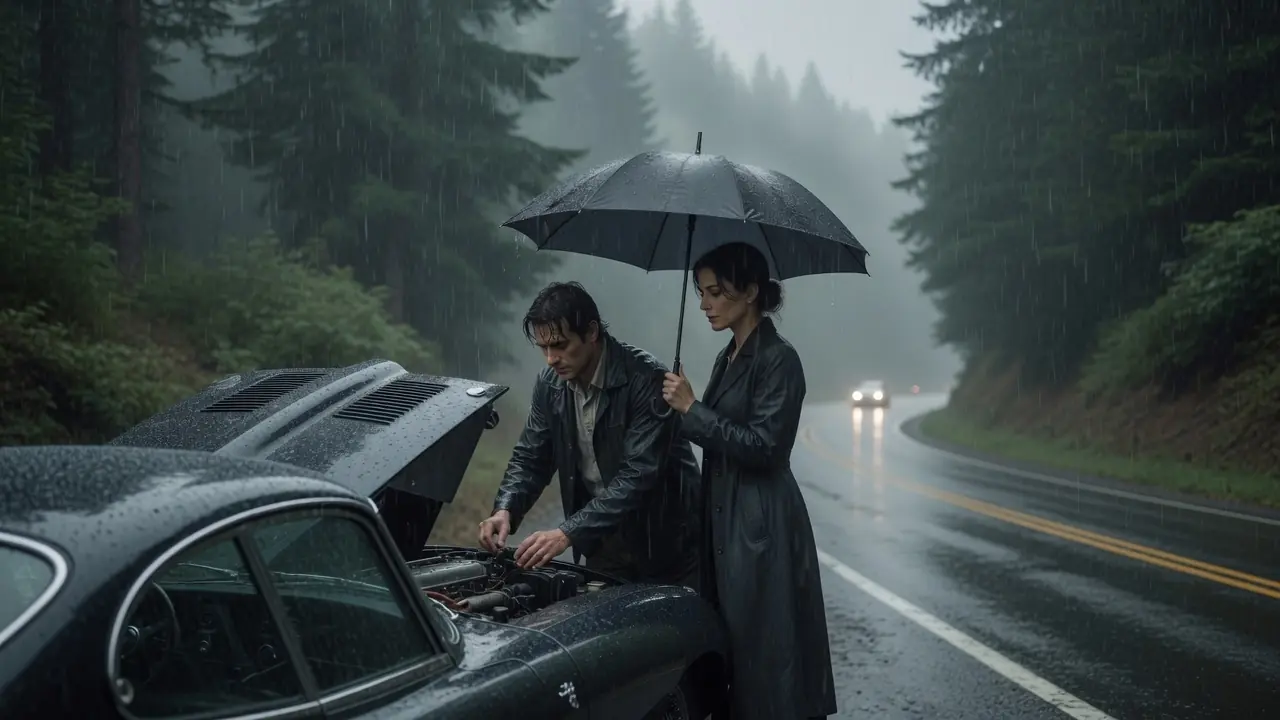
The door opened with a quiet click, and Victoria stepped out into the rain. David moved past her without comment, popping the hood with the easy familiarity of a man who had opened a thousand of them. The beam of a small flashlight swept across the engine bay, and the look on his face changed. Not the polite mask of a stranger trying to be helpful, but the narrow genuine concentration of someone reading a problem he already half understood.
How long has this car been sitting? he asked, not looking up. Months. I don’t drive it often. That’ll do it. He angled the light toward a cluster of components she could not have named on her best day.
The rain darkened his shoulders, ran in thin streams off the cuffs of his jacket, but he did not rush. He had the steady patience of a man who knew that hurrying broke things further. Fuel pump’s not getting a clean signal, he said after a minute. Could be the wiring, could be the relay. On a car this old, it’s almost always the relay. Mind if I open it up?
Please. He laid out a small set of tools on a rolled shop towel from the truck, wrenches the size of her finger, a multimeter, something that looked like a cross between a needle and a pen. She found herself watching his hands. They were broad and dark with old grease, and they moved across the engine with a kind of tenderness she had not associated with men in years.
The wind shifted. A sheet of rain caught him across the back, and he flinched without breaking concentration. She did not think about it. She just lifted her umbrella, stepped around the open hood, and held it over him. He looked up, surprised, and then something quieter underneath it.
You don’t have to do that, ma’am. You’re working on my car in a thunderstorm. It’s a thunderstorm I chose to walk into. And it’s an umbrella I am choosing to hold. A faint smile touched the corner of his mouth, and he went back to work.
For a long stretch, neither of them spoke. The only sounds were the rain on the umbrella, the far hum of a freeway nobody could see, and the occasional metallic click as he worked his way through the relay assembly. She studied the line of his jaw in the half-light. She had been holding umbrellas for politicians at funerals and donors at cornerstone ceremonies for half her adult life. She could not remember the last time she had held one for a person who actually needed it.
Where were you headed? He asked, eyes on the engine. The question was casual, the way a stranger asks the weather. A restaurant, a diner. Important one. That depends entirely on whether the other person shows up.
He gave a small dry laugh. I know that feeling. Oh, I’m late for the same kind of evening myself. Blind date. My sister set it up. I’ve been dreading it for 2 weeks.
A thought brushed against her, then light and unwelcome, and she pushed it away. The world was full of blind dates on a Friday night. Coincidences were what tabloid writers built careers on. She kept her face carefully still under the umbrella. Dreading it? Why?
Because I already know how it’s going to go. He twisted a fitting, tested it, twisted again. She’s some corporate woman, the kind that runs a building somewhere, the kind that fires people for sport, and judges your shoes the second you sit down. Probably going to spend the whole dinner looking at her phone and thinking about how much money she’s losing by being there.
The umbrella did not move in her hand. Her fingers tightened around the handle. That’s a very specific picture, she said evenly, for someone you’ve never met. I’ve met enough of them in passing. I work on their cars. They don’t usually look me in the eye when they hand over the keys.
He tested another connection. I’m not saying she’s a bad person. I’m saying I’m not the right night out for a woman like that, and she’s not the right one for me. My sister means well. She’s wrong. But she means well.
Inside her chest, something turned over, slow and uncomfortable. Anger, first a quick, clean spark of it, because she could have listed for him by name the dozen executives who actually fit the description he had just given. And then right behind the anger, a hot, thin thread of shame. There was a phone in her bag she did, in fact, intend to check during dinner. Her assistant had built the reservation around her quarterly call.
She had assumed, without a moment’s thought, that the man waiting for her tonight would be small and grateful and easy to dismiss. She watched the back of his neck and said nothing. What about you? he asked. The dinner. Excited? No.
Bad blood with the other person? I don’t know the other person. That is part of why I am not excited. He nodded as if that were the most reasonable answer in the world, and he kept working. Something ticked over inside the engine, a small definitive sound like a key turning in a lock. He straightened up. Try it now.
She handed him the umbrella, slid back into the driver’s seat, and turned the key. The Jaguar coughed once and caught the low growl of the engine settling into the rain like a long exhale. She let out a breath she had not known she was holding. When she stepped out again, he was already wiping his hands on the shop towel. You should have someone look at the wiring harness this week, he said.
This is a patch, not a fix. A car like this deserves a real one. What do I owe you? He shook his head before she had finished the question. Nothing.
You’ve been out here for almost half an hour in the rain, and you held my umbrella. A small smile gone almost before it arrived. Call it even. She studied him, the tired clothes, the hands he had not bothered to apologize for, the fact that he was at that moment walking her closed umbrella back to her like a bellman returning a coat he had no intention of being tipped for. What is your name? she asked.
It came out softer than she had intended. David. Just David? On a road in the rain, just David is enough. He handed her the umbrella. You should get going. Whoever’s waiting at that restaurant is probably worse off than you were 5 minutes ago.
A laugh almost escaped her. She could not remember the last time a laugh had almost escaped her. He tipped his head, walked back to the truck, pulled the faded suit jacket off the passenger seat, and shrugged it on as he climbed in and pulled away into the dark before she had decided what else she wanted to say.
Lesante sat at the end of a private drive lit from beneath by white gravel and the kind of landscape lighting that cost more than most people’s cars. Victoria left the Jaguar with the valet, walked through the front doors, and let the maître d’ lead her to a corner table reserved under Cassie’s name rather than her own. She had been late by 17 minutes. She did not expect him to still be there. He was.
David sat with his back half turned to the door, looking out the window at the rain on the patio. He had attempted to smooth his hair. There was still a thin streak of grease behind his left ear he had not noticed. The faded suit jacket was draped over the chair beside him. The sleeve still damp at the cuffs from the half hour he had spent leaning into another woman’s engine.
He turned when he heard footsteps. His face moved through three expressions in the space of two seconds, recognition, confusion, and then a slow dawning horror that arrived all at once. He stood up. Victoria stopped at the edge of the table. Her hand was still around the strap of her bag, and for a moment she could not remember how to set it down.
You. He said. Me. She lowered herself into the seat across from him, placed the bag on the floor with more care than the bag deserved, and folded her hands together on the white linen so that he would not see them shake. My full name is Victoria Harrington. She said quietly. I am the chief executive of Harrington Global Holdings.
The corporate woman you described on the side of the road tonight, that was a fairly accurate description of the woman now sitting across from you. The answer did not come right away. He looked at the centerpiece. He looked at the napkin. He looked very briefly at the ceiling as if hoping a beam might have the decency to fall on him.
Ma’am, he said finally. I would like to climb into the engine bay of your car and stay there until next Tuesday. A laugh escaped her before she could stop it. Short, surprised, unfamiliar. He looked up at the sound. And something in his expression shifted.
The horror still there, but no longer alone. I am so sorry, he said. Everything I said out there was honest, was rude, was honest. There is a difference and tonight I would rather have the first. He sat with that for a long moment.
The waiter approached, registered the temperature at the table, and intelligently retreated. For what it’s worth, David said, you are not the woman I described. You don’t know me yet. I held an umbrella with you for half an hour in a thunderstorm. I know enough.
She lowered her eyes to the tablecloth, and for the first time in longer than she could remember, her own pulse rose in her throat for a reason that had nothing to do with anger or strategy. She was about to speak when a voice cut across the room from the bar. Victoria, I had no idea you were slumming tonight. The voice belonged to Richard Carmichael.
He came from the bar with a glass of bourbon in one hand and a smile that had been engineered over several decades to look friendly to people who were not paying attention. Victoria had spent the entire afternoon in a conference room dismantling a hostile bid he had spent six months assembling. The wound was 3 hours old. He was here to remind her of it. He did not glance at David.
He pretended not to see him. I was told the kitchen here was excellent, Richard said. The company appears more eclectic than the menu suggested. Victoria felt the old machinery come online inside her. The cold, polite voice, the surgical small smile, the tongue that could end careers.
She drew a breath to use it. David spoke first. I’m sorry, he said, looking up at Richard with the same patient expression he had worn over the open hood. I didn’t catch your name. Carmichael. Carmichael.
David nodded slowly. You drive a German sedan, don’t you? Late model, black. Richard’s smile twitched just slightly. I drive several cars. The black one has a knock in the rear differential.
I could hear it from the valet stand on my way in. If you don’t get that looked at in the next month, you’ll be standing on the side of a road in worse weather than I was tonight. And the man who stops to help you is going to charge you four times what the job is worth because that’s what men in your position get charged when they haven’t been kind to anyone on the way up. Richard’s mouth opened. Nothing came out.
David picked up his menu as if the conversation had simply ended because it had. Victoria watched him scan the appetizers with hands that were not shaking. And she thought with a clarity that startled her. I do not know this man yet. But I am going to.
Three nights later, she had not called. David stood inside Sterling Restorations at half past nine in the evening, alone. The foreclosure letter unfolded on the counter in front of him. The bank’s number was printed at the bottom in small, careful type. $40,000. Two weeks.
He had read the figure so many times the digits had stopped meaning anything. He thought about the woman under the umbrella. He thought about the sound of her laugh across the white linen. He thought about how a story like that ended in real life and he folded the letter back into its envelope and slid it under the register where Emma would not see. Fairy tales did not happen to men who smelled like motor oil.
He had known that going in. The lights of a black car turned into the lot outside. The light swept across the front window of the shop, paused, and went still. David did not move. He recognized the particular stillness of an idling engine waiting for a person to make up their mind.
After a moment the engine cut, a door opened and closed. Footsteps crossed the wet asphalt, not the heavy stride of a man, not the hurried tap of a customer. Measured. Careful. Like the steps of someone who had rehearsed walking up to a door.
He knew who it was before the knock landed. Victoria stood on the other side of the glass in a long charcoal coat. Hair pulled back the streetlight behind her catching the rain on her shoulders. She was not dressed for Lesante tonight. She was dressed for whatever this was.
He unlocked the door and held it open without speaking. It is late. She said. I’m sorry. It is not that late. It is late for someone to come without calling first.
I am still sorry. He stepped back to let her in. The shop smelled of old grease and coffee that had been on the burner too long. He saw her register all of it. The hand-painted sign above the office door, the framed photograph of his father in coveralls, the calendar still turned to last month, and he saw her not pretend not even for a second, that any of it was charming.
That was the part that almost undid him. Your daughter is here. She asked, glancing toward the back stairs. Asleep on the cot upstairs. Long day. I will keep my voice down.
She did not sit. There was nowhere to sit that would not have ruined her coat. She stood near the counter with her gloves in one hand. And for a long moment, she looked at the unopened envelopes stacked beside the register as if she already knew, without being told, exactly what they were. Maybe she did.
I owe you an explanation. She said. For 3 days of nothing. You don’t owe me anything, ma’am. Please don’t call me ma’am, not in this room.
He let that sit, and he didn’t answer it. I almost called you a dozen times. She went on. Each time I stopped because I could not trust the reason I was calling. I have been the woman on the magazine cover for so long that I had forgotten how to want something for myself without checking first whether it was a calculation.
So, I gave myself 3 days. I told myself, If I still wanted to walk through that door at the end of the third day, then it was real. And I would walk through it without an excuse. And then you walked through it with an excuse. A small smile touched the corner of her mouth. I walked through it with an offer.
Those are not the same thing. She set a slim folder on the counter between them. He did not touch it. Harrington Global runs a fleet of 140 company vehicles in the Pacific Northwest. She said. Executive cars, security cars, courier vans, three vintage models my father insisted on keeping that nobody on payroll knows how to maintain anymore.
We currently pay a corporate dealer a great deal of money to do mediocre work on all of them. I would like to move that contract to Sterling Restorations. 3 years. I have brought a draft. David looked at the folder. He looked at her.
The thing inside his chest that had been carefully holding itself together for 3 days went very quiet. Ma’am. Not ma’am. Victoria. His voice was rough. I know what this is. Do you?
I’m 2 weeks from losing this place. Somehow you know that. And you came down here in the rain at 9:30 at night with a folder under your arm so I wouldn’t have to ask anybody for anything. I know what this is and I appreciate it and I can’t take it. She did not flinch.
She had clearly braced for the sentence before she had walked in. Why not? She said. It was not a question because the second I sign that thing I’m a man who got rescued. And every time I look across a table at you for the rest of whatever this is I’m going to be looking at the woman who rescued me. And one day maybe in a year maybe in five you’re going to look back at me and you’re going to see the same thing.
And neither of us is going to be able to fix that. The shop went quiet. The rain tapped at the high windows. Are you finished? She said softly. Yes. Good.
Because you are wrong and I am going to tell you why. She picked up the folder and opened it on the counter so that he had no choice but to see it. This is not a charity document. There is no provision in here that gives you a discount, a grant or a forgiven loan. The rates in this contract are the rates Sterling Restorations would have quoted any corporate client 3 years ago before the bank started circling.
I had my legal team build this against your old invoices. The numbers are yours. I did not invent them to save you. She turned the page. I did not come here because you need me.
I came here because my company has needed someone like you for 6 years and I’ve been too tired and too distracted to find him. I found him on the side of a road in a thunderstorm and I would have been a fool to walk away from that twice. Once because the engine started and a second time because I was afraid of looking like a woman who could not tell the difference between mercy and recognition. She closed the folder and slid it across to him. You are not being rescued, David. You are being hired.
There is a difference and tonight I would rather have the second. He looked down at the folder. He recognized the words before he had finished the thought. They were almost the words she had said to him across a tablecloth four nights ago, turned around and handed back, was honest, was rude, was honest. There is a difference. His throat closed.
I need to think, he said. Take all the time you need. I mean, I need to think and I am not a man who thinks well in front of people. I understand. She picked up her gloves.
She was halfway to the door when a small voice spoke from the foot of the stairs. Daddy. Emma stood there in her pajamas, hair on one side flattened from sleep, a Lego figure clenched in one fist. She was looking at Victoria with the unguarded curiosity of a child who had not yet learned that some questions were not polite. You have a visitor, she said to her father.
Then to Victoria. Are you the lady from the rain? David started to answer for her. Victoria touched his sleeve, just once, just enough. She knelt down so that she was at Emma’s height, the long coat pooling around her on the dirty shop floor.
She did not seem to notice the floor. She was looking at Emma, the way she looked at engineering schematics, carefully, and as though the answer mattered. I am the lady from the rain, she said. Your father fixed my car. I came to thank him properly. He didn’t tell me.
He probably did not want to brag. Emma considered this with the seriousness of a small judge. Then she held out the LEGO figure. This is the doctor. She fixes things, too. You can borrow her if you want.
Victoria took the small piece of plastic and closed her hand around it, as though Emma had handed her something rare. Thank you, she said. I have not been given a present in a long time. By anyone. By anyone who meant it.
Emma nodded gravely, as if that confirmed something she had suspected about adults all along, and trotted back up the stairs without another word. Victoria stood up slowly. The LEGO figure stayed in her closed hand. David could not speak for a moment. When he did, his voice was not entirely steady.
You can keep her, he said. Emma gives them away when she means it. I had assumed. He looked down at the folder on the counter. He looked at the unopened envelopes beside the register. He looked at the photograph of his father, who had taught him, among other things, the difference between accepting help and accepting recognition, a difference his father had never been able to explain in words, only by example.
If I sign this, he said slowly, I sign it as a contractor, not as a man who owes you anything outside the work. That is the only way I would let you sign it. And whatever this is between us, we keep it separate from the page. Completely separate. Then I’ll read it tonight, and I’ll call you in the morning. That is acceptable.
She did not move toward the door. He did not move toward the counter. The space between them had narrowed by some quiet increment neither of them had measured. Victoria. Yes. For what it’s worth, the second reason. The one that has nothing to do with the contract. Yes.
I have been thinking about it for 3 days, too. The smile that crossed her face then was nothing like the small polite smile she had worn at Lesante. It was younger and tireder, and it cost her something to wear. Goodnight, David. Goodnight, Victoria.
She walked out into the rain, the LEGO figure still closed inside her fist. The contract was signed on a Wednesday. The bank was paid on a Friday. By the following Tuesday, the first three Harrington fleet sedans were sitting in the bays of Sterling Restorations, and David was on his back under the second one with a clipboard balanced on his stomach dictating notes to Emma, who had appointed herself junior secretary for the afternoon.
Victoria came by occasionally, not as a chief executive, not as a benefactor, as a woman who happened to need an excuse to be in a particular zip code on a particular afternoon, and who happened to find one most weeks. She brought coffee that was not from the burner. She brought a small folding chair on her second visit because she had figured out that there was nowhere in the shop a person could comfortably sit. She brought once a single LEGO piece she had found in an airport gift shop in Denver, a tiny mechanic figure in a blue jumpsuit, which she presented to Emma with the solemnity of a head of state delivering a treaty. Emma kept it on her bedside table.
She also began over the following weeks to talk to Victoria the way children talk to people they have decided to keep. She asked Victoria about her father and what kind of cars he had loved and whether Victoria knew that the doctor Lego had a sister who had been lost in a vacuum cleaner 2 years ago. Victoria listened to every one of these things the way she had once listened to quarterly earnings calls with full attention and a small notepad in her head. It was on a Saturday afternoon 6 weeks after the night of the rain that David finally kissed her. The shop was warm with the late spring light coming through the open bay door.
He had just finished tightening the last bolt on the differential of one of her father’s old cars, a vintage coupe she had told him quietly that she had not been able to bring herself to drive since a bad winter accident in college. She was standing in the doorway with her sleeves pushed up a smudge of grease on the inside of her wrist where she had brushed against a fender and she was watching him work with an expression he had stopped trying to put a word to. Emma was 20 ft away on the office rug building something elaborate and architecturally improbable out of every Lego in her collection. She did not look up. He set the wrench down.
He walked across the shop floor without hurrying. He stopped a foot in front of her and he gave her the same chance he had given her on the side of the road, the chance to step back. The chance to lock the door, the chance to decide. She did not step back. When he kissed her, it was not the kiss of a man who had been rescued and it was not the kiss of a woman who had done the rescuing.
It was the kiss of two people who had been working separately and very hard on the same broken thing for a long time, and who had finally figured out that they were better at the work together. From the office rug without looking up from her Legos, Emma said, About time. Victoria laughed against his mouth. It was the laugh from the white linen tablecloth, only louder, and there was no one in the room she felt the need to hide it from. Outside, the late sun caught the hand-painted letters above the door, Sterling Restorations.
The paint was still chipped. The sign was still crooked. Neither of them had any intention of replacing it. The most beautiful things, David’s father used to say, were not the things that arrived perfect. They were the things you found in the dark on the side of a road in the rain, and chose patiently and on purpose to put back together, piece by piece.
He had been right about a great many things. He had been right about that one most of all.