The first bottle of water sold for one dollar and made Noah Carter feel like the richest ten-year-old in North Carolina.
He held the crumpled bill in both hands and stared at it as though it were a winning lottery ticket.
“Emily.”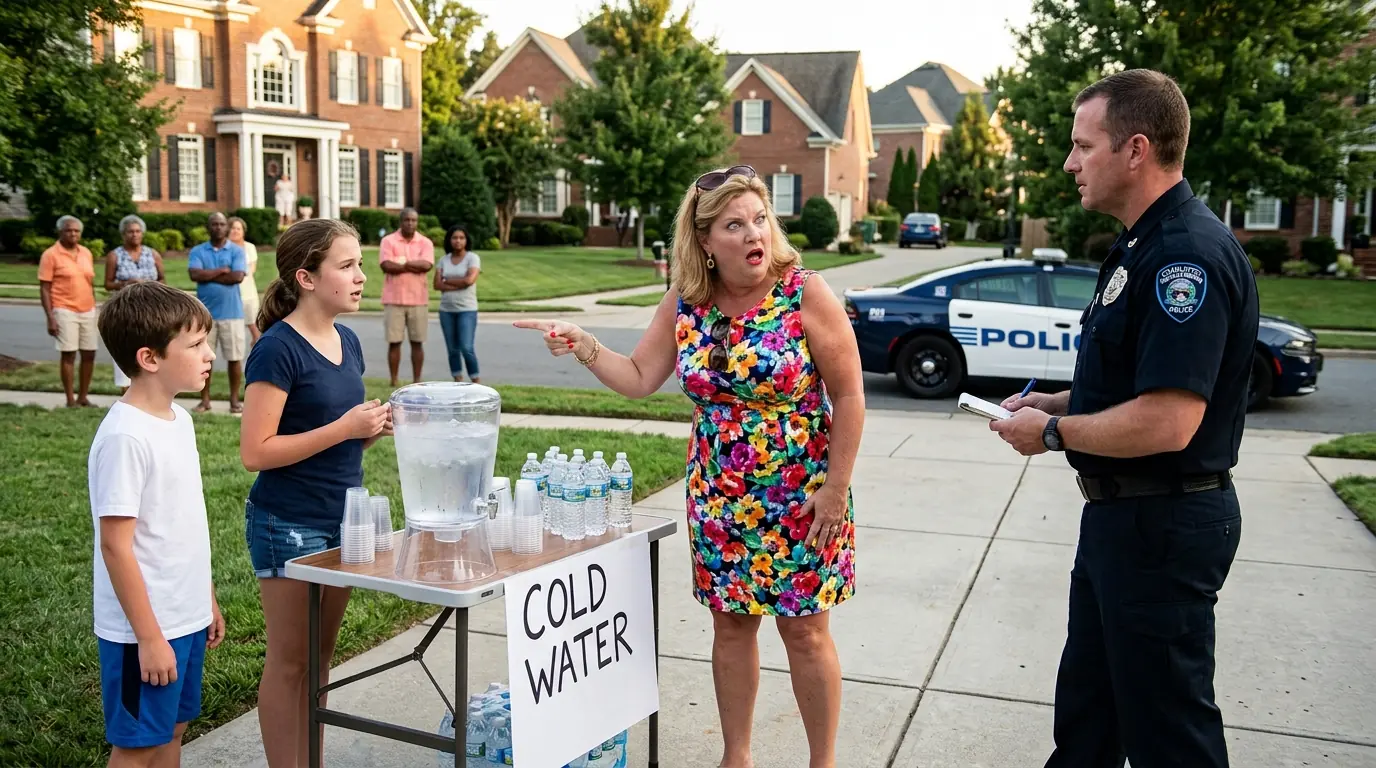
His sister looked up from the folding table.
“What?”
“We made money.”
Emily Carter laughed.
“That’s usually what happens when somebody buys something.”
“No, I mean actual money.”
She rolled her eyes.
“You’ve seen money before.”
“Not money I earned.”
That distinction mattered to Noah.
It mattered to Emily too, although at thirteen she had already learned that showing excitement in front of her younger brother guaranteed he would become unbearable.
So she folded the dollar bill and placed it inside an old metal cookie tin their mother had given them.
“Official business revenue.”
Noah nodded seriously.
“Should we make a spreadsheet?”
Emily stared at him.
“You don't know how to make a spreadsheet.”
“I can learn.”
“After we sell more than one bottle.”
Their little business stood at the edge of the Carter family's driveway on Maple Ridge Court, a quiet suburban street outside Charlotte lined with two-story houses, trimmed lawns, basketball hoops, flowering shrubs, and mailboxes that all looked suspiciously similar because their homeowners association had once spent three meetings debating mailbox colors.
The table itself was nothing special.
White folding legs.
Plastic top.
A large glass dispenser filled with ice water and lemon slices.
Two coolers underneath.
Clear plastic cups.
Several dozen sealed water bottles.
A handwritten sign Emily had made with black marker:
COLD WATER - $1
LEMON WATER - $2
SAVING FOR SCHOOL SCIENCE CAMP
Noah had insisted on adding a small drawing of a rocket.
It looked more like a bent carrot.
Emily left it.
The science camp was hers, not Noah's.
Her middle school had organized a three-day environmental science program in the Blue Ridge Mountains for October.
The fee was $280.
Her parents could have paid it.
Probably.
But Emily knew money had been tight since her father's heating-and-air-conditioning business lost two major commercial contracts.
Her mother, Sarah Carter, worked as an elementary school librarian.
Nobody had said Emily could not attend.
Her father had actually told her not to worry about it.
That was exactly why she worried.
Adults sometimes said “don't worry” when what they meant was “I am already worrying enough for both of us.”
So Emily decided to earn part of the fee herself.
Noah heard the plan and immediately appointed himself vice president.
“Vice president of what?” Emily had asked.
“The company.”
“We don't have a company.”
“We will.”
“What do you do as vice president?”
“I help.”
That part was true.
He had dragged the table from the garage.
Filled coolers.
Carried ice.
Designed the rocket.
And shouted “cold water” at passing joggers until Emily threatened to fire him.
Saturday morning began well.
A cyclist stopped and bought two bottles.
A woman walking a golden retriever bought lemon water.
Mr. Patel from three houses down gave them five dollars and refused change.
A landscaping crew working across the street bought six bottles in less than two minutes.
By eleven fifteen, the cookie tin contained twenty-eight dollars.
Noah counted it for the fifth time.
“Thirty by lunch.”
“You said that at twenty.”
“Because I understand growth.”
Emily smiled.
Then she looked up.
A woman was walking toward them from the sidewalk.
Emily recognized her immediately.
Vanessa Whitmore.
Nearly every child in Maple Ridge knew Vanessa even if they did not know exactly what the HOA was.
They knew she was the woman who complained when basketball hoops stayed too close to the street.
The woman who once photographed Mr. Jenkins's trash cans because he left them beside his garage until nine thirty in the morning.
The woman who told Emily's friend Madison that sidewalk chalk made the cul-de-sac look “unmanaged.”
Vanessa was forty-eight and had served on the Maple Ridge Homeowners Association board for almost three years.
She was not president.
She introduced herself like she was.
That morning she wore a sleeveless floral dress covered with red, black, beige, and white patterns, oversized sunglasses resting on top of her blonde hair, gold earrings, sandals, and a large leather handbag.
Her expression told Emily this was not a customer.
Vanessa stopped directly in front of the table.
She looked at the sign.
Then the water.
Then Emily.
“What is this?”
Noah answered proudly.
“Business.”
Emily closed her eyes briefly.
Vanessa looked at him.
“A business?”
Noah nodded.
“Water.”
“I can see that.”
Emily stepped in.
“We're selling cold water for science camp.”
Vanessa looked at the driveway.
“Do your parents know?”
“Yes.”
“Are they home?”
“My mom is.”
“Get her.”
Emily frowned.
“Why?”
Vanessa removed her sunglasses.
“Because you can't operate a commercial stand in the neighborhood.”
Noah looked at Emily.
Emily looked at Vanessa.
“We're selling water from our driveway.”
“Yes.”
“For one morning.”
“That doesn't matter.”
Emily had expected somebody eventually to ask whether they needed a permit.
Her mother had checked.
Charlotte's local rules for a temporary children's stand selling simple prepackaged drinks on private residential property were not the obstacle Vanessa appeared to believe they were.
More importantly, Emily's mother had specifically contacted the HOA management office two days earlier.
The answer was simple.
No specific rule prohibited a temporary children's table fully contained within their own driveway, provided it did not block sidewalks, create signage on common property, or generate ongoing commercial traffic.
Emily did not know all that language.
She knew the short version.
“Mom already checked.”
Vanessa smiled without kindness.
“With whom?”
“The HOA office.”
“Who?”
“I don't know.”
“Exactly.”
Emily's face tightened.
“No. My mom knows.”
“Then get your mother.”
Noah whispered:
“Do we have to?”
Vanessa heard him.
“Yes.”
Emily said:
“No.”
That surprised everybody.
Including Emily.
Vanessa stared.
“What did you say?”
“My mom said we could do this.”
“That isn't what I asked.”
“She doesn't need to come outside because you want her to.”
Vanessa's expression hardened.
Thirteen-year-olds possess a dangerous combination of incomplete fear and perfect moral certainty.
Emily had both.
Vanessa was used to adults becoming cautious when she invoked the HOA.
Emily simply found her annoying.
Vanessa pointed at the table.
“You need to shut this down.”
“No.”
“I am a board member.”
“I know.”
“Then perhaps you should listen.”
“My mom already asked.”
Vanessa took out her phone.
“Who gave permission?”
“I told you, I don't know their name.”
“So nobody.”
Emily stared.
“That doesn't make sense.”
Vanessa began photographing the stand.
Emily stepped sideways.
“Don't take pictures of us.”
“I am documenting a violation.”
Noah moved behind Emily.
His excitement was disappearing.
“You're not allowed to photograph kids.”
Vanessa glanced at him.
“I can photograph a violation visible from the street.”
Emily moved closer to her brother.
“What rule?”
Vanessa looked at her.
“Commercial activity.”
“Show me.”
“What?”
“The rule.”
“You want me to show you the HOA covenants?”
“Yes.”
Vanessa laughed.
“You wouldn't understand them.”
That made Emily angry.
“My dad keeps them in the office.”
“Then maybe your father should read them.”
Emily's jaw tightened.
“My mom already called.”
Vanessa's voice rose.
“Stop saying that.”
A few neighbors looked over.
Mr. Patel was washing his car.
He turned off the hose.
Across the street, Anna Brooks paused while bringing groceries inside.
Vanessa noticed the attention.
Instead of lowering her voice, she became more official.
“I'm giving you a direct instruction on behalf of the homeowners association. Pack this table up immediately.”
Noah whispered:
“Emily.”
She looked at him.
He was nervous now.
That changed her attitude.
Emily did not want a neighborhood war.
She wanted science camp.