The woman who stepped down from the westbound stage in Briar Ridge did not look lost.
She looked tired.
There was a difference, and Caleb Mercer noticed it from the driver’s bench of his wagon before he made himself stand. The woman stood on the plank walk with a carpet bag held in both hands, her chin steady, her coat buttoned high against the wind, and her eyes moving once over the town as if she were measuring what it might cost her.
The stage driver dragged her trunk from the boot and dropped it into the mud without apology.
She did not scold him.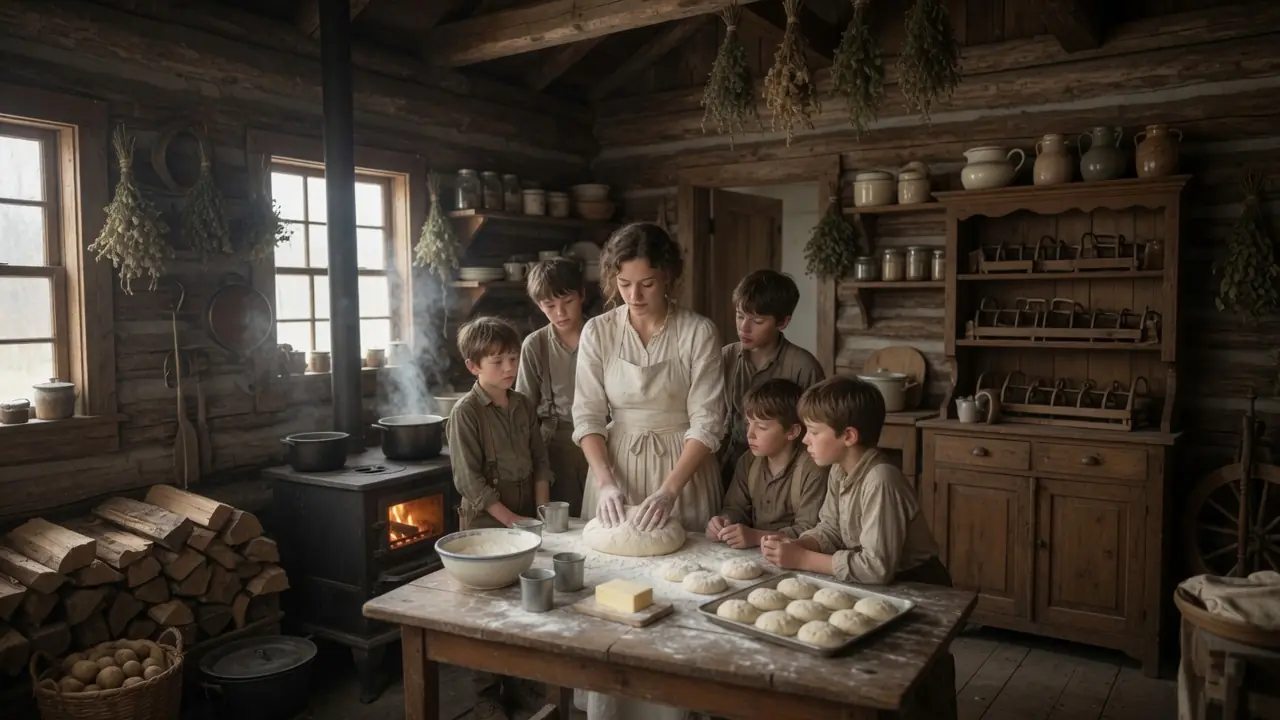
She did not thank him either.
She simply looked at the trunk, then at the mud, then at the driver with the kind of calm that made a careless man suddenly remember he had been raised better.
Her name was Ruth Bellamy.
She was thirty-two years old, though grief and work had given her face a stillness that made people guess older. Her brown coat had been mended at both elbows. Her gloves did not match. The left toe of one boot had been patched with black thread so carefully that only a person who had done without things would notice.
In her pocket was Caleb Mercer’s letter.
The letter said he had five sons.
It said his wife had died the previous spring.
It said he needed a woman to cook, clean, manage the kitchen, and help keep the house through the winter months. It said there was a small room off the back hall, meals included, and wages paid when he could manage them. It also said that if she wanted to leave when spring came, he would see her safely back to the stage.
Nothing in the letter sounded like romance.
Ruth was grateful for that.
She had answered the notice from a boarding house in Topeka where the rent had gone four weeks overdue and the landlady had begun speaking softly, which was worse than shouting. Ruth knew that tone. It was the tone people used when they had decided to feel sorry for you right before asking you to leave.
She had been a hotel cook before the hotel closed.
Before that, she had kept house for a doctor’s family in Salina.
Before that, she had belonged to a farm outside Lawrence, where her mother taught her bread and her father taught her beans, weather, debt, and the danger of trusting a promise without work behind it.
Both parents had died before Ruth turned twenty.
So she had learned early that life did not care whether you were ready.
You got up.
You worked.
You kept your hair pinned, your hands moving, and your feelings somewhere they would not spill into the stew.
The Mercer wagon waited at the far end of the street.
She knew it because it was the only wagon with no woman inside it and a man on the bench who looked like he had forgotten how to sit easy. Caleb Mercer climbed down when she approached. He removed his hat, held it awkwardly in both hands, and looked at the trunk rather than at her face.
“Miss Bellamy,” he said. “I appreciate you coming.”
His voice was rough from little use and too much weather.
He was perhaps forty-one, with a short dark beard, broad shoulders, and eyes gray enough to look almost colorless in the cold. He did not look cruel. That was the first thing Ruth understood about him, and it mattered more than handsomeness, money, or manners.
Cruel men looked directly at a woman they had hired.
Caleb looked at the work.
He loaded her trunk carefully into the wagon bed and helped her up without letting his hand linger. Then they rode out of Briar Ridge under a white November sky that smelled like coming snow.
For the first mile, neither spoke.
Ruth did not mind.
She had worked in enough houses to know there were many kinds of silence. Some were hostile. Some were empty. Some were simply tired. Caleb’s silence was the last kind.
He watched the road, the fence lines, the sky, the creek beds.
A man alone on his land reads things in it.
Ruth watched him watching, and she understood that the house she was going to had not only lost a woman. It had lost the person who made the day speak in a language the others could understand.
The Mercer place sat seven miles north of town in a shallow valley cut by a frozen creek. The house was wood-framed, built in stages, with two rooflines that did not quite agree and a back porch leaning slightly to one side. There were outbuildings, a barn, a smokehouse, two corrals, and wood stacked high under a tarp.
That woodpile was the first hopeful thing Ruth saw.
Someone here still planned to survive winter.
Before the wagon reached the gate, the front door opened.
Four boys appeared in the doorway.
They stood shoulder to shoulder, arranged by height, like a jury that had been warned not to speak too soon. The fifth, Ruth would later learn, was hiding in the barn because he had declared that another cook meant another person leaving and he had no interest in greeting her first.
The boys watched her climb down.
Ruth watched them back.
The oldest looked fourteen, tall and serious, with his father’s gray eyes and the shoulders of a boy trying too hard to become a man before supper. The second was maybe twelve, narrow-faced, restless, and already forming a question he had probably been told not to ask. The third had a bruise on his cheek and one boot untied. The fourth was small, sharp-eyed, and silent.
Caleb said, “Boys.”
They stepped back from the doorway.
Inside, the kitchen held the cold of a room that had been used but not tended. The stove was not out, but nearly. Dishes sat on the table from the noon meal. Flour dusted the floor near the bin. A pot on the stove had something burned hard along the bottom.
But the curtains were clean.
Ruth noticed that first.
Clean curtains, washed recently and hung straight, though the table was a mess and the stove neglected.
Somebody had cared enough to wash those curtains.
Somebody had been trying.
Ruth set her carpet bag beside the wall, removed her coat, found a peg for it, and opened the stove door.
Caleb cleared his throat.
“Your room is through there. I can show you—”
“Later,” Ruth said.
She studied the coals.
“There’s still life in this.”
He said nothing after that.
She heard him leave through the back door, his boots crossing the yard toward the barn, and then she was alone with five boys trying very hard not to look like they were watching her.
She rebuilt the fire.
She cleared the table.
She found the water barrel low and turned to the oldest.
“Water.”
He stared at her.
Then he took the bucket and went.
No argument.
That was promising.
She found cornmeal, dried beans, salt pork, onions soft but usable, and a sack of potatoes in the pantry. By the time the oldest returned with water, the kitchen was warmer, the pot was soaking, and supper had begun to smell like something decent.
The boys drifted around her in a loose circle.
Not close.
Not far.
Like stray dogs deciding whether a hand held food or a switch.
The twelve-year-old finally spoke.
“Our last cook left after ten days.”
Ruth cut potatoes without looking up.
“Did she?”
“She said we were wild.”
“Were you?”
He thought about it.
“Yes.”
“Good,” Ruth said.
That stopped him.
He had expected scolding.
Children often did.
She learned their names at supper.
The oldest was Matthew, fourteen, who sat beside his youngest brother and cut his meat for him without making a display of it. Samuel was twelve, the talker, the one who asked three questions before the first answer was done. Peter was ten and could not keep both feet under the table at the same time if salvation depended on it. James was eight and watched everything with dark, careful eyes.
The youngest was Will, seven.
He appeared from the barn halfway through the meal with straw in his hair and suspicion in his face. He sat down at the far end of the bench and ate two bowls of stew without once admitting he liked it.
Caleb sat at the head of the table.
He said almost nothing.
When he did speak, it was to pass bread, correct Peter’s elbow, or ask Matthew whether the north gate had been latched. After supper, he looked at Ruth and said, “This is good, Miss Bellamy.”
“The salt pork is nearly gone,” she replied.
He nodded once.
A practical answer to a practical fact.
That pleased her.
After supper, the boys went back out to finish chores. Caleb followed them. Ruth washed the dishes and had the kitchen alone for the first time.
Her room was small.
A cot.
A washstand.
A narrow window looking out at the woodpile.
One hook on the wall.
It was enough.
She had slept in finer rooms where she felt less safe.
She unpacked her second dress, two books, a sewing roll, a tin of hairpins, and a folded photograph of her parents she did not set out where anyone could see it. Then she went back to the kitchen and set bread for morning.
That night, she heard Caleb walk the hall.
He stopped at each room, one by one.
No voices.
Only the pause of a father checking that what remained of his world was still breathing.
At the kitchen doorway, his footsteps stopped.
Ruth kept her hands in the bread dough and did not turn.
After a moment, he moved on.
It took three weeks before she understood what was happening to her boots.
The first time they disappeared, she assumed she had misplaced them. She found them outside the back door with snow packed into the toes. She cleaned them, dried them by the stove, and said nothing.
The second time, she found them behind the water barrel, side by side, placed too neatly for accident.
The third time, one boot was under James’s bed and the other was in the barn on a shelf above the harness pegs, toe pointed outward as if it had been arranged for inspection.
Ruth stood in the barn with the boot in her hand and looked at the shelf for a long while.
Then she went back inside.
She put both boots on.
She made breakfast.
The boys came in with their hair wet from washing and their expressions innocent in five different ways.
Samuel would not meet her eye.
Peter watched the porridge like it might confess.
James watched her with that quiet attention of his, not afraid, exactly, but waiting.
Will looked at her boots, then at the ceiling, then at his spoon.
Ruth set porridge in front of him.
“My boots need to stay where I can find them,” she said, to no one in particular. “If I cannot get to the woodpile, there is no fire. If there is no fire, there is no breakfast.”
Will found the ceiling deeply interesting.
“I understand,” Ruth said.
Samuel’s spoon stopped.
She did not sound angry.
That made it harder for them.
“I understand why you did it.”
Nobody spoke.
“The woman before me left when the first snow came,” Ruth said.
Samuel looked up then.
“She said this house was too much.”
Ruth stirred her coffee.
“This house is too much.”
Five boys stared at her.
She took a drink.
“But too much does not mean impossible.”
Will’s lower lip moved.
“You’re leaving in spring.”
“That was the agreement.”
The kitchen tightened around them.
Ruth set her cup down.
“I have not decided what spring means yet.”
“That means yes,” Samuel muttered.
“No,” Ruth said. “It means I have not decided.”
Children know the difference between a lie and an adult trying not to promise what the world might break.
They heard the difference.
That morning, something shifted.
Not enough to call trust.
Enough to call a beginning.
Ruth learned the household the way she learned every household.
Through evidence.
The cookbook on the kitchen shelf had a cracked spine and grease-darkened pages. Certain recipes were marked in small, neat handwriting. More salt for Samuel. Mash carrots fine or Peter will pick them out. Matthew likes coffee but do not let him have it after noon. Will eats better if no one watches.
That handwriting belonged to Lydia Mercer.
Caleb’s wife.
Their mother.
Ruth never met Lydia, but she came to know her through those notes. Not as a ghost. As a woman who had understood that children are made of details, and that love often survives by writing those details down before they are lost.
Ruth used her own recipes.
But she followed Lydia’s notes.
She mashed the carrots.
She set sugar where Lydia had kept it.
She learned that Matthew drank coffee too young because somebody had needed him awake too early after April. She began leaving a cup for him before dawn when she heard him moving around the kitchen. She did not ask why he was up.
She just put the cup down and went back to the stove.
The first time he thanked her, he said it to the table.
The second time, he looked at her.
By December, the cold had settled into the valley like a living thing.
The kitchen stove drew well when the wind came from the north and sulked when it came from the west. Ruth learned to coax it with dry kindling and patience. The stove in the front room had to be banked at night or the house would wake bitter by three in the morning.
So Ruth woke at three.
She banked it.
Then she went back to bed.
After a week, Theo—no, Peter, because she had to remind herself every child was not merely a type but a person—began bringing kindling before she asked. He took pride in keeping the wood box full. He watched it like a soldier watching a border.
James set the table exactly.
Forks on the left.
Knives straight.
Cups spaced evenly.
Will followed Ruth from room to room, saying little, watching everything.
Samuel began kneading bread with her in the evenings.
At first, he treated the dough too gently, like it might bruise. Then too hard, like it had offended him. Finally, he found the middle. When the bread rose properly and came out golden, he ate three slices at supper and pretended not to be proud.
Ruth let him pretend.
Pride needs privacy sometimes.
Caleb was harder to understand.
He was not unkind.
He was not cold.
He simply moved through the house as if trying not to occupy too much of the space his wife had left behind. He checked on the boys at night. He mended coat sleeves badly but patiently. He carried wood to every door before sundown and split more before anyone noticed the pile was low.
He loved his sons with work.
Ruth recognized the language.
One evening, he stood in the kitchen doorway holding a torn bridle and said, “You don’t have to do all this.”
She looked up from sewing.
“All what?”
He glanced toward the stove, the table, the bread cooling under a cloth, the socks mended in a basket, the house warm enough that Will had fallen asleep on the rug.
“More than cooking.”
Ruth threaded her needle.
“You hired me to keep house.”
“Yes.”
“The house includes the people in it.”
He looked at her for a long moment.
Something moved in his face.
Not quite grief.
Not quite relief.
Then he nodded and sat at the table with the bridle. After that, he stopped finding reasons to be outside every evening. He brought small repairs into the kitchen. Harness. A broken latch. A coat button. Accounts that needed sorting.
The room began to feel less like a place people passed through to survive.
It began to feel like a place they came back to on purpose.
On the worst night of January, Will had a nightmare.
Ruth heard him before he knocked. Small feet in the hall. A pause. Then another step. She opened her door and found him sitting on the floor outside his room with his knees pulled to his chest and his face too still.
She sat beside him.
The floor was cold through her stockings.
He did not cry.
That worried her more than crying would have.
She did not ask what the dream was.
She did not say his mother was in heaven or watching over him or any of the other things adults say when they are afraid of silence. Ruth had stood at graves before. She knew how small those sentences could feel beside the size of loss.
Instead, she said, “Your mother taught Samuel to set the forks on the left.”
Will looked at her.
“She taught all of us.”
“I know.”
“She made coffee too sweet.”
“I know that too.”
“Because of the sugar shelf?”
“Yes.”
He studied her in the dark hallway.
“You notice things.”
“Most things tell you how they want to be cared for if you pay attention.”
Will leaned his head back against the wall.
“She smelled like soap and cinnamon.”
Ruth swallowed.
“That is a good thing to remember.”
He sat quietly for a while.
Then he said, “You’re not going to leave.”
It was not a question.
It was a request disguised as certainty.
Ruth looked down the hall, toward the kitchen, toward the stove she had banked, toward a house full of sleeping boys learning to breathe easier without quite knowing it.
“I don’t know everything yet,” she said.
Will’s face tightened.
“But I am here tonight,” she continued. “And the stove is warm. And there will be bread in the morning.”
He thought about that.
Then he nodded once.
“That’s enough.”
“Usually is.”
She walked him back to bed and tucked the blanket around his shoulders. Later, on her cot, she lay awake listening to the wind press against the window and feeling something inside her loosen in a way that frightened her more than the cold.
By late February, the light changed.
The land remained hard and brown, but the sun stayed longer in the yard. Snow shrank away from the south side of the barn. The creek ice thinned at the edges. The boys began walking like creatures who had remembered the world might open again.
One morning, Ruth stood behind the house looking at a patch of hard dirt near the kitchen window.
She had been thinking about a garden.
Not officially.
Not in any way she had admitted to herself.
But she knew where the morning light fell, where the wind broke against the shed, where she could plant onions, beans, sage, marjoram, and maybe marigolds because her mother had always planted them, useful or not.
Peter appeared beside her.
“What are you looking at?”
“A garden.”
He looked at the dirt.
“There isn’t one.”
“There will be.”
“When?”
“When the ground is ready.”
He accepted that with the seriousness of a child raised around weather and animals.
Then he asked, “Are you staying when the ground gets ready?”
Ruth looked at the bare patch.
“Yes,” she said. “I am staying for spring.”
Peter nodded as if this confirmed a theory he had been developing.
Then he ran inside to tell everyone before she could stop him.
In March, a man from the neighboring ranch came by.
His name was Amos Greer, and he had the easy confidence of someone who had mistaken other people’s patience for permission his whole life. He came to talk with Caleb about a fence line, but stayed too long over coffee, watching Ruth pour as if she were part of the service rather than a person standing in front of him.
“Fine cook you’ve got,” Amos said.
The kitchen went still.
Ruth set down the pot.
Caleb’s hand stopped near his cup.
Amos smiled.
“My place is bigger. Been needing a woman in the kitchen since mine ran off. Maybe when spring comes, she’ll be looking for better wages.”
Ruth dried her hands on a cloth.
Slowly.
Not because she was unsure.
Because some men needed time to hear the door closing.
“I am not available,” she said.
Amos laughed.
“I wasn’t speaking to you.”
Caleb’s chair scraped.
Ruth lifted one hand slightly, not toward Amos, but toward Caleb.
Not because she needed protection.
Because she did not want blood on her clean floor.
“I know,” she said to Amos. “That was your mistake.”
The boys were silent.
Even Samuel.
Caleb spoke then, very quietly.
“She is not available.”
Amos looked from Caleb to Ruth, then back again.
Something in the room told him he had misjudged the entire house.
He left soon after.
When the wagon was gone, Matthew stood in the doorway and said, “He talks like that to women.”
“I know.”
“You’re not leaving.”
“No,” Ruth said. “I’m not.”
This time, there was no hesitation in her answer.
Spring came hard and sudden.
Mud swallowed the yard. The creek rose, growled, and fell back again. The horses rolled in the pasture, and the boys spent every hour outside that they were not forced inside to eat or sleep. The house opened its windows for the first time in months and breathed out winter.
On the morning the spring stage was due through Briar Ridge, Ruth woke and could not find her boots.
She stood in the kitchen in her stockings, looking at the empty place by the back door.
Then she laughed.
Not loudly.
Just once.
She found them under the kitchen table, pushed all the way to the wall. Both boots. Side by side. Hidden poorly enough to be found, hidden carefully enough to make the point.
When she pulled them out, Will stood in the doorway.
Jaw set.
Arms at his sides.
Trying so hard to look brave that his face almost broke with the effort.
“Will.”
He said nothing.
“I know why.”
His eyes stayed on the floor.
“I am going into town today,” she said. “I have things to settle.”
His face crumpled a little before he could stop it.
“Then I am coming back.”
His eyes lifted.
“You promise?”
Ruth looked at him.
At the boy who had hidden her boots in the barn, behind the water barrel, under the table. The boy who kept his mother’s sugar shelf untouched. The boy who had sat beside her on a cold floor and decided warm stoves and morning bread were enough truth for one night.
“Yes,” she said. “I promise.”
Then she went to find Caleb.
He was in the barn mending harness, the door open to the thin yellow light of a Kansas spring morning. She stood near the gate and waited until he looked up.
“I want to talk about staying on,” she said.
He set the harness aside.
His face went still.
“The same work,” she continued. “Cooking. Housekeeping. Garden, if you want one. Nothing formal changed unless you want it changed.”
Caleb looked at his hands.
Then toward the house.
“The boys.”
“Yes,” Ruth said. “The boys.”
“And other things?”
She held his gaze.
“Yes. Other things.”
For a long moment, the barn was quiet except for a horse shifting in the stall.
“I am not asking you to be what Lydia was,” Ruth said.
His eyes closed briefly.
When he opened them, there was pain there, but not the kind that pushed her away.
“I couldn’t be.”
“I know.”
“And I can’t promise I know how to do any of this right.”
“I would distrust you if you did.”
That almost brought a smile to his face.
Almost.
“What are you asking, Ruth?”
She had not expected him to use her first name.
It settled between them softly.
“I am asking to stay.”
He looked at her the way a man looks at water after a long dry stretch.
“Then stay.”
No speech.
No grand declaration.
Just two people standing in a muddy barnyard with spring rising around them, telling the truth in the only way they knew how.
When Ruth turned back toward the house, all five boys were crowded in the kitchen doorway.
Matthew at the back, arms crossed, eyes bright.
Samuel for once without words.
Peter leaning around James to see better.
James watching with exact attention.
Will in front, failing completely at pretending he had not been waiting.
Ruth stopped before him.
“You can hide my boots if you need to,” she said. “But I will always find them.”
Will’s face broke.
Not into tears.
Into relief.
She walked past them into the kitchen and lit the stove.
Behind her, the house came alive.
Peter attacked the wood box. James set the table, forks on the left. Samuel talked loudly about nothing because the quiet had become too full. Matthew stood near the window with his coffee cooling where she had left it for him.
And Ruth understood something that had been true before she had dared to name it.
She was home.
Not the home she lost in eastern Kansas.
Not her mother’s kitchen with the south-facing window and the smell of Sunday bread.
That could not be replaced.
This was another kind of home.
The kind built by work.
By waking at three to bank a stove.
By leaving coffee for a fourteen-year-old who thought he had to become a man too soon.
By finding boots in strange places and putting them on anyway.
By knowing how much sugar belonged on one shelf and why no one had moved it.
In June, Caleb asked her to marry him.
He did it with a note because spoken words still caught in him sometimes when they mattered most.
She found it under her coffee cup.
The handwriting leaned hard to the right, just like the letter that had first brought her there.
Ruth,
I know this is not what you came here for. I know the boys have already asked you in their way. I am asking properly. If you will stay for good, I would count it the greatest mercy this house has known since April.
Caleb.
Ruth read it twice.
Then she stood at the stove for a long while, letting the kitchen settle around her.
The bread rising.
The coffee steaming.
The boys arguing outside.
The curtains straight in the window.
The sugar on the shelf.
All the places she had lived had asked her to be useful.
This house had somehow made room for her to be needed, and then, more dangerously, wanted.
She took his pencil and wrote one word at the bottom.
Yes.
At supper, she slipped the note under his cup.
Caleb read it.
He did not speak.
He only placed the paper carefully in his shirt pocket and looked down at his plate for a long moment while the tightness around his eyes eased.
That was enough.
They were married in August by a circuit preacher who came through Briar Ridge once a month and mispronounced Ruth’s middle name even after being corrected twice.
The boys stood in a row wearing their best shirts.
Samuel stayed quiet for almost the entire ceremony, which everyone later agreed was proof that something sacred had indeed occurred. Peter had dirt on one cuff. James held the ring with the gravity of a bank president. Matthew stood beside Caleb, tall and solemn. Will stood beside Ruth, because he had decided that was where he belonged.
Nobody argued.
Two weeks after the wedding, a neighbor named Martha Ellison came by with preserved plums and the kind of frankness women on the prairie develop because winter leaves little use for delicate lies.
“I’ll tell you something,” Martha said at Ruth’s kitchen table. “We all thought Caleb might send the older boys to relatives.”
Ruth poured coffee.
“He thought about it.”
“He did more than think. He came to my husband in January asking whether Topeka cousins might take Matthew and Samuel for a while. Said it might be better for them.”
Ruth looked toward the yard, where Peter and Will were arguing over a fence post as if the fate of the territory depended on it.
“What changed his mind?”
Martha smiled into her cup.
“You.”
Ruth frowned slightly.
“He told my John, ‘She knows how to bank a stove.’ John thought he was talking nonsense. I knew better.”
Ruth said nothing.
Martha leaned back.
“A man who has spent months afraid his house is freezing from the inside out notices the person who keeps the fire alive.”
After Martha left, Ruth stood in the kitchen for a long time.
She thought about what it meant that a man’s idea of safety had become a banked stove.
Then she thought maybe that was not small at all.
Maybe most of life was made of such things.
The three o’clock fire.
The cup of coffee left without question.
The boots found and worn.
The door knocked on before entering.
The bread warm in the morning.
Small proof, repeated until the heart believed it.
That fall, Ruth planted the garden she had imagined in February.
Garlic.
Onions.
Beans.
Sage.
Thyme.
Sweet marjoram.
And a border of marigolds because her mother had always planted them, partly for the beetles, mostly because some traditions survive because they deserve to.
All five boys helped.
Badly at first.
Then loudly.
Then well enough.
By the end of the day, they were covered in dirt, arguing over rows, and Ruth stood at the edge of the plot with mud on her knees and thought this was what loud was meant to sound like.
Not chaos.
Life.
The next spring, Matthew turned sixteen.
He came into the kitchen before dawn and poured coffee, the way he had all winter. Ruth stood at the stove, turning bread dough beneath a cloth, and let the silence stretch until he found the courage to fill it.
“I keep waiting for it to stop hurting,” he said.
She did not ask what.
They both knew.
“It does not stop exactly,” she said. “It moves farther back.”
He looked at her.
“How?”
“Other things come between you and it.”
“Like what?”
“Coffee,” she said. “Bread. Your brothers fighting over kindling. Your father building something in the barn and thinking no one knows.”
Matthew almost smiled.
“He is building you a workbench.”
“For garden tools?”
“Yes.”
“I know.”
Matthew looked at her then, really looked.
“You always know.”
“No,” Ruth said. “I pay attention.”
They drank coffee in the gray light while the house woke around them. Samuel complaining about a lost sock. Peter thumping down the hall. James’s measured footsteps. Will calling from somewhere that somebody had moved his knife, which almost certainly meant he had moved it himself.
The bread rose.
The stove held.
The morning began.
James was twelve when he stopped calling her Miss Bellamy.
He did not announce it.
He simply set a cup beside her one evening and said, “Ruth, your coffee.”
Then he sat down with his arithmetic as if nothing enormous had happened.
Ruth stood very still for a moment.
Then she put one hand briefly on the back of his chair and went back to the stove.
Henry—no, there was no Henry in this house, and that was how she knew these boys had become real to her beyond comparison. They were not types. They were not replacements. They were Matthew, Samuel, Peter, James, and Will.
Her boys.
Not by blood.
By mornings.
By winters.
By boots hidden in the barn.
By bread broken at the same table.
Years later, people in Briar Ridge would tell the story as if Ruth Bellamy came to the Mercer place and saved it.
Ruth never liked that version.
It made her too large and the others too small.
The truth was quieter.
She arrived for one winter because she needed wages and a room.
She stayed because five motherless boys tried to hold her in place the only way they knew how, by hiding the very boots she would need to leave.
She stayed because a tired man knew enough to take off his hat, speak plainly, and not pretend grief had made him someone else.
She stayed because a dead woman had left notes in a cookbook so her children would not be forgotten.
She stayed because the house asked much of her, but never asked her to become invisible.
On the last evening of that first full year, Ruth stood at the kitchen window after supper.
The prairie sky darkened from gold to purple. The first stars appeared over the barn roof. In the yard, Caleb worked by lamplight on the bench he still believed she had not guessed. Down the hall, five boys made the sounds of five boys who had run out of daylight but not energy.
The bread was warm on the rack.
The fire was right.
The curtains hung straight.
The sugar sat on the shelf where Lydia had kept it.
And Ruth’s boots stood by the back door, exactly where she had left them.
Will came into the kitchen, saw them, and considered.
Ruth looked at him.
“Thinking about moving those?”
He looked at the boots.
Then at her.
“No.”
“Why not?”
He shrugged, trying to be casual and failing.
“You know where home is now.”
Ruth turned back to the window before he could see her eyes fill.
“Yes,” she said softly.
“I do.”