She Came to Marry a Widower With Seven Sons — Then the Woman Who Tried to Starve Them Out Learned Who She Had Threatened

Chapter 1

Theme:
Font Size:
24px

Mercy Callaway had been standing on Thomas Bell’s porch for less than one minute when his oldest son announced exactly how long he expected her to last.

“One week.”

Caleb Bell was nineteen, tall like his father, with sun-browned skin and the narrow suspicious eyes of a young man who had spent the previous eighteen months watching strangers attempt to repair something none of them understood. Six younger brothers stood scattered behind him, ranging from seventeen-year-old Jonah to six-year-old Peter, all staring at Mercy as if Thomas had ordered an unfamiliar piece of machinery and nobody knew whether it belonged in the barn or the kitchen.

Mercy set her traveling case beside her boots.

“The last woman lasted five days,” twelve-year-old Eli added.

Mercy looked at him.

“Then six days would already represent improvement.”

Somebody snorted.

Thomas Bell’s mouth moved.

Not quite a smile.

Almost.

The Wyoming wind pushed loose strands of Mercy’s chestnut hair across her cheek. Behind the house, cattle moved slowly through the yellowing grass while the Bitter Creek mountains rose in blue-gray layers beneath the September sky. The ranch was beautiful in the way difficult places often were, offering scenery as compensation for everything required to remain alive inside them.

Thomas removed his hat.

“You still sure?”

Mercy looked at him.

He had asked the question at the railway station.

Again beside the wagon.

Again after they crossed the final creek.

Now on his porch.

Thomas Bell clearly believed a woman ought to receive repeated opportunities to reverse a foolish decision.

Mercy respected that.

“Yes.”

Thomas nodded.

“All right.”

That was their engagement.

No kiss.

No dramatic welcome.

No speech about destiny.

Mercy had not traveled sixteen hundred miles expecting poetry.

Thomas had been brutally honest in his letters.

Forty-four years old. Widower. Seven sons. Three hundred cattle. Mortgage manageable but tight. Housework neglected. Winter difficult. Marriage, if it happened, should be based on honesty, work, mutual respect, and perhaps companionship if both parties were fortunate.

Mercy understood practical arrangements.

She had spent eleven years working in her aunt Beatrice’s Missouri boarding house after her parents died. She knew what happened when fifteen people needed supper and only eight had paid rent. She knew how to mend sheets too worn to survive another laundering, how to stretch broth, negotiate with butchers, preserve bruised produce, identify dishonest suppliers, and tell the difference between a hungry man and a man pretending he was not hungry because pride felt more important than appetite.

She also knew something about loneliness.

By thirty-one, Mercy had watched younger women marry, return with babies, leave again, and occasionally return without husbands. She had received two proposals herself. One from a traveling salesman who smelled permanently of peppermint and debt. Another from a widower who explained during their third conversation that he needed “a woman willing to know her place.”

Mercy had told him she already knew her place.

It was somewhere else.

Thomas’s letters were different.

He never asked for a photograph.

Never asked her measurements.

Never told her a wife should be cheerful.

His third letter contained three paragraphs about repairing the west barn roof and one awkward sentence near the end:

I do not expect you to become Ruth to my boys. Ruth was Ruth. Anyone who comes here must be allowed to be herself.

That sentence brought Mercy to Wyoming.

Then she saw the kitchen.

The stove was cold.

Gray water stood inside the washbasin.

Potatoes sprouted in a wooden crate near the pantry.

A pot of beans smelled one day away from becoming livestock feed.

The flour barrel contained barely enough for two loaves.

Mercy stood in the doorway.

Seven boys watched.

Thomas looked embarrassed.

“We eat.”

Mercy turned.

“When did everyone last have a proper supper?”

Silence.

Peter looked toward his father.

Caleb folded his arms.

“We manage.”

Mercy considered the room.

“So do people in lifeboats.”

Eli coughed suspiciously.

Thomas looked away because he was smiling.

Mercy removed her coat.

Underneath she wore a dusty-plum work dress, practical and plain, with sleeves she immediately rolled to the elbow. She tied her oatmeal-colored apron around her waist, walked to the stove, and began opening cabinets.

Thomas followed.

“You don’t have to cook your first afternoon.”

“I’m hungry.”

“The boys can handle tonight.”

Mercy looked through the window.

Jonah and Samuel were wrestling beside an overturned bucket.

Eli chased a chicken with a broom.

Peter had somehow climbed onto a fence post.

Mercy looked back.

“I have evaluated the alternative.”

Thomas laughed.

It was brief.

Rusty.

As though the sound had been stored somewhere too long.

Mercy remembered it.

She rescued the beans.

Cut the spoiled portions from potatoes.

Found onions.

Trimmed a smoked ham hock.

Added herbs from the small packet she carried from Missouri.

The last shortening became bread dough.

Nobody spoke much while she worked.

The boys drifted through the kitchen pretending they had reasons to be there.

Peter entered three times for water.

Samuel inspected the stove.

Eli asked whether the bread required “testing.”

Mercy threatened his fingers with a wooden spoon.

He looked delighted.

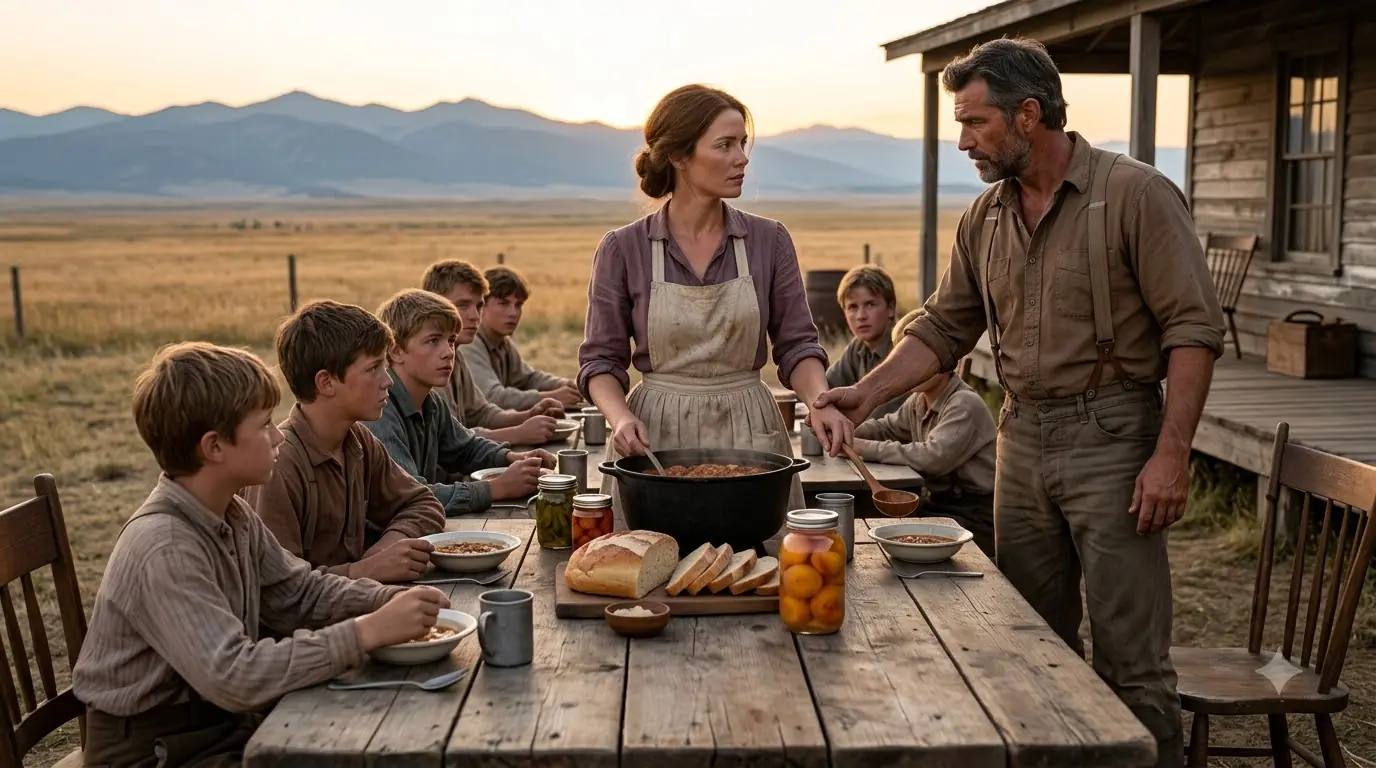
By sunset, a black iron pot sat steaming on the outdoor table.

Mercy lifted the lid.

The smell moved through the yard.

Seven boys appeared almost immediately.

Thomas came last.

Beans thickened with potato and onion.

Smoked ham.

Bread.

Ruth Bell’s final jar of preserved peaches.

Mercy had hesitated before opening those.

Thomas saw the jar.

His face changed.

“Those were hers.”

Mercy stopped.

“I can put them back.”

Thomas looked toward the boys.

Peter was staring at the jar.

“No.”

He swallowed.

“She preserved them to be eaten.”

Mercy opened it.

They sat.

Caleb tasted one spoonful.

His guarded expression changed before he could stop it.

He took another.

Then another.

Soon seven spoons scraped bowls.

Peter held out his empty dish.

“More?”

Mercy stared.

“You already finished?”

He nodded solemnly.

Mercy refilled it.

Then Samuel’s bowl appeared.

Then Jonah’s.

Then Eli’s.

Mercy looked toward Thomas.

He had barely touched his own food.

He was watching his sons.

“Ruth used to complain they ate faster than she could serve them.”

Silence settled.

Not uncomfortable.

Just grief.

Then Peter asked:

“Can I have more bread?”

Thomas laughed again.

Longer this time.

Mercy passed the bread.

Beyond the fence, a polished black automobile sat near the road.

A woman inside watched the table.

Then drove away.

Mercy did not know her yet.

She would.

Her name was Adeline Prescott.

And within thirty days, Adeline would try to starve Mercy out of Wyoming.

For the first week, Mercy’s greatest enemy was not Adeline.

It was laundry.

Seven boys produced clothing with the efficiency of industrial machinery. Shirts appeared from bedrooms, barn hooks, porch rails, beneath beds, inside feed sacks, and once inexplicably behind the stove.

Mercy established rules.

Every boy carried his own laundry.

Every boy washed one personal item.

Every boy completed one household duty in addition to ranch work.

Caleb objected.

“We work cattle all day.”

“And I cook for nine people.”

“Housework is different.”

Mercy handed him a bucket.

“Yes. It smells better.”

Jonah laughed.

Caleb glared.

“You’re not our mother.”

The kitchen became still.

Mercy stopped folding his shirt.

“No.”

Caleb had expected defense.

Maybe hurt.

Maybe anger.

Mercy continued.

“I’m Mercy.”

She placed the shirt on the table.

“I don’t need Ruth Bell’s place.”

Caleb looked down.

Mercy softened.

“And nobody can take hers.”

He said nothing.

But the following morning, his laundry arrived in the washroom before breakfast.

Folded.

Sorted.

Pockets emptied.

Mercy noticed.

She did not mention it.

Thomas noticed too.

Their relationship developed through small observations.

He learned Mercy hated wet firewood.

She learned he drank coffee strong enough to dissolve metal.

Thomas learned she hummed while kneading dough but stopped whenever she realized someone was listening.

Mercy learned he checked every bedroom door before going to sleep.

Seven doors.

Every night.

Even Caleb’s.

She saw him once from the hallway.

He touched Peter’s door.

Then Samuel’s.

Then Eli’s.

Quietly.

As if confirming his children remained where grief had left them.

Mercy returned to her room without speaking.

The next morning, Thomas found a repaired button on his work coat.

He knew Mercy had done it.

He said nothing.

That became their language.

By the third week, Mercy discovered the ranch had financial problems Thomas did not fully understand.

Not ruin.

Leakage.

Small losses everywhere.

Prescott Mercantile charged Bell Ranch six percent more for flour than neighboring customers.

Kerosene invoices included unexplained delivery fees.

Salt pork weighed less than billed.

Feed transport charges appeared twice on two separate months.

Mercy spread the accounts across the dining table.

Thomas came inside.

“What happened?”

“You’re being robbed.”

His hand moved instinctively toward the wall where a rifle normally hung.

Mercy looked up.

“By arithmetic.”

He stopped.

“Oh.”

“Sit.”

Thomas sat.

Mercy showed him.

Thomas stared.

“How long?”

“At least fourteen months.”

“I trusted Prescott.”

“That is not an accounting system.”

He frowned.

“I was busy.”

Mercy looked toward the empty chair where Ruth once sat.

“I know.”

Thomas looked at her.

Mercy returned to the ledger.

“No shame in surviving badly for a while.”

His eyes remained on her.

“You say things like you’ve done it.”

Mercy’s hand stopped.

Her aunt’s boarding house after influenza.

Three funerals in six weeks.

Rent unpaid.

Food rationed.

Mercy had learned to smile while counting pennies.

“Yes.”

Thomas waited.

She offered nothing more.

He respected the boundary.

That mattered.

Mercy wrote letters to three suppliers outside Lark Crossing.

One in Casper.

One near Riverton.

One operating from a railway depot east of the valley.

Thomas watched.

“Prescott won’t like that.”

“I’m not marrying Prescott.”

His mouth twitched.

“No.”

Mercy looked toward him.

“Unless something in your letters was incomplete.”

Thomas laughed.

By the end of September, the Bell kitchen no longer smelled abandoned.

Bread rose every morning.

Vegetables hung drying above the pantry.

Apples became sauce.

Tomatoes became preserves.

Fat rendered into jars.

Bones became broth.

Old flour sacks became kitchen towels.

Thomas repaired two shelves after Mercy explained she required additional storage or would begin using his desk.

The shelves appeared that afternoon.

The boys changed too.

Peter followed Mercy constantly.

Eli discovered he enjoyed baking biscuits because tasting dough could be disguised as quality control.

Samuel became responsible for eggs.

Jonah chopped wood.

Caleb maintained the household supply list, though he insisted it was “ranch inventory.”

Mercy allowed the fiction.

Then came the Harvest Social.

Lark Crossing held it every October inside Prescott Mercantile Hall.

Thomas asked if Mercy wanted to attend.

She did not.

Then realized refusal would look like fear.

So she wore her forest-green dress.

The only nice dress she had brought west.

Thomas stood in the doorway when she came downstairs.

He had shaved.

Mercy noticed first.

Then his clean white shirt.

Then the way he simply stared.

“What?”

Thomas blinked.

“Nothing.”

Mercy looked down at herself.

“Is something wrong?”

“No.”

He cleared his throat.

“You look…”

Seven boys appeared behind him.

Caleb grinned.

Thomas glared over his shoulder.

Mercy waited.

Thomas finally said:

“Nice.”

Eli groaned.

Mercy laughed.

“Thank you, Thomas. That was almost romantic.”

His ears turned red.

The boys nearly collapsed.

At the social, Adeline Prescott approached before Mercy had removed her coat.

She was thirty-six, elegant, wealthy, and beautiful in the deliberate way of a woman who understood exactly what rooms expected from her.

Burgundy silk.

Pearls.

Perfectly waved hair.

She looked Mercy over.

“So you’re the Missouri woman.”

Mercy smiled.

“And you’re Adeline.”

Adeline’s expression changed slightly.

Thomas had mentioned her.

Not much.

Enough.

Their families had known each other for years.

Before Ruth died, Adeline had been merely a neighboring acquaintance.

Afterward, she appeared more often.

Brought pies.

Offered to supervise the boys.

Suggested Thomas needed “a proper household.”

Thomas never encouraged her.

That refusal had become humiliation.

Now Mercy represented the answer Adeline had not received.

“You’ve done wonders with the kitchen, I hear.”

“Food tends to improve when somebody cooks it.”

Adeline smiled tightly.

“I suppose useful is useful.”

Several women nearby laughed politely.

Mercy understood the insult.

Not pretty.

Not refined.

Useful.

She glanced toward Thomas.

He had heard.

His expression darkened.

Mercy touched his sleeve lightly.

No.

She would handle it.

Adeline continued.

“A man with seven boys can’t afford to be particular.”

The room went quiet.

Mercy uncovered the pie she had brought.

Apple.

Perfect lattice.

She placed it on the table.

“I didn’t come to Wyoming to be particular.”

Then looked directly at Adeline.

“I came here to stay.”

Nobody laughed.

Thomas looked at Mercy.

Something moved behind his eyes.

Adeline walked away.

Three days later, the winter flour order was canceled.

Then the kerosene.

Salt pork.

Lamp oil.

Sugar.

Prescott Mercantile controlled the largest supplier network within sixty miles.

Thomas discovered each cancellation separately.

By breakfast, his face had gone pale.

Caleb entered carrying an envelope.

“No name.”

Thomas opened it.

One sentence.

SEND THE MISSOURI WOMAN HOME BEFORE WINTER, OR THE BELL RANCH CAN LEARN WHAT HUNGER REALLY MEANS.

Nobody spoke.

Thomas looked toward Mercy.

Not because he suspected her.

Because he expected fear.

Mercy stood.

Walked into the pantry.

Began counting.

Flour.

Twenty-six pounds.

Beans.

Forty-two.

Potatoes.

Enough for perhaps two months if managed carefully.

Dried corn.

Apples.

Tomatoes.

Salt.

Rendered fat.

Preserved meat.

Onions.

Turnips.

She wrote everything down.

Thomas followed.

“What are you doing?”

“Inventory.”

“Mercy.”

She kept counting.

“Seven jars peaches.”

“Mercy.”

She closed the ledger.

“We have enough flour for approximately twenty-four days at current use.”

Thomas stared.

“Then what?”

“We reduce bread.”

“The boys need calories.”

“I know.”

“Winter could close the road.”

“I know.”

He stepped closer.

“I can send you back to Missouri.”

The sentence hurt more than Mercy expected.

She looked at him.

“Do you want to?”

“No.”

Immediate.

Strong.

Thomas took a breath.

“No.”

Mercy’s expression softened.

“Then don’t offer.”

“I won’t let them starve because of me.”

“This isn’t because of you.”

“It’s my ranch.”

“She threatened me.”

Thomas looked toward the note.

Mercy continued.

“And she made a mistake.”

“What mistake?”

Mercy smiled slightly.

“She threatened a boarding-house cook with hungry boys.”

Thomas almost laughed.

“This is funny?”

“No.”

She opened the ledger again.

“But I know hunger better than Adeline Prescott knows intimidation.”

By noon, Mercy had a plan.

Use less flour.

Increase beans.

Trade beef directly.

Purchase grain through independent farmers.

Make soap from tallow.

Render lamp fuel where possible.

Preserve remaining produce.

Thomas would ride east and contact railway suppliers.

Caleb and Jonah would inspect every storage shed for overlooked grain.

Eli and Samuel would collect eggs suitable for trade.

Peter would stop stealing biscuits.

Peter objected.

“That isn’t a job.”

“It is now.”

The first obstacle was transportation.

Independent suppliers charged too much to deliver to one ranch.

Mercy needed volume.

So she visited neighbors.

The Johnson ranch.

Widow Clara Finch.

Old Mr. Hastings.

A dairy farm three miles south.

Every household complained about Prescott prices.

Mercy asked:

“What if we order together?”

Clara frowned.

“Adeline won’t like it.”

Mercy smiled.

“That seems to be happening frequently.”

They pooled orders.

One wagon became three.

Three became seven.

Within two weeks, a railway supplier agreed to send flour, sugar, kerosene, and salt to Lark Crossing if someone collected the shipment at the eastern depot.

Prescott owned the town freight contract.

Mercy bypassed it.

Thomas sent two ranch wagons.

Other families sent four.

Adeline responded by convincing the depot manager that independent shipments lacked proper commercial documentation.

Mercy requested the regulation in writing.

There was none.

The shipment moved.

People noticed.

Prescott Mercantile had never seemed vulnerable before.

Not because it was invincible.

Because nobody had tested the edges.

Mercy tested everything.

Which goods could be traded directly?

Which neighboring ranches produced surplus?

Who made soap?

Who had bees?

Who milled grain privately?

Who owned wagons?

Who had railway contacts?

Within a month, the Bell ranch porch became an informal exchange point.

Eggs for lamp oil.

Beef for flour.

Soap for sugar.

Repair work for coffee.

Nobody called it a cooperative.

Mercy did not know the fashionable terminology.

She called it:

“Not paying Prescott.”

Thomas liked that.

Adeline did not.

She visited the Bell ranch in November.

Her automobile stopped beside the fence.

Mercy was outside hanging sheets.

Thomas approached from the barn.

Adeline stepped out wearing a wool coat trimmed in fur.

“You’ve made your point.”

Mercy pinned another sheet.

“What point?”

“The little market.”

“It isn’t mine.”

“You organized it.”

“I asked neighbors whether they liked paying too much.”

Adeline looked toward Thomas.

“You’re allowing this?”

Thomas stared.

“Allowing?”

Adeline realized the word too late.

Mercy smiled faintly.

Adeline continued.

“The Prescotts have served this valley for thirty years.”

“And charged accordingly,” Mercy said.

Adeline’s eyes hardened.

“You think these people are loyal to you?”

“No.”

Mercy pinned the sheet.

“I think they’re loyal to feeding their families.”

“That’s worse.”

Adeline looked confused.

Mercy explained.

“If they were loyal to me, you could make them dislike me.”

She turned.

“But they’re loyal to lower prices.”

Thomas looked away to hide a smile.

Adeline saw.

That angered her more than Mercy’s words.

She walked toward Mercy.

“You don’t belong here.”

Mercy stopped.

The wind moved between them.

Adeline continued.

“You arrived with one suitcase and married desperation.”

Thomas stepped forward.

Mercy raised one hand.

He stopped.

Mercy looked at Adeline.

“You’re right about one thing.”

Adeline waited.

“I arrived with one suitcase.”

Mercy gestured toward the ranch.

“But I don’t think anybody standing here looks desperate anymore.”

Behind them, Peter and Eli came running from the barn laughing.

Thomas watched them.

Adeline did too.

That was the real loss.

She had wanted Thomas.

Mercy had given him laughter.

Adeline left without another word.

That night, Thomas sat beside Mercy after supper.

The boys had gone upstairs.

Fire cracked in the stove.

Mercy worked on the supply ledger.

Thomas watched.

She finally looked up.

“What?”

“You’re tired.”

“So are you.”

“You barely ate.”

“I ate.”

“You fed everybody else first.”

Mercy returned to the numbers.

Thomas stood.

Walked to the stove.

Filled a bowl with remaining stew.

Placed it beside her.

“I’m not hungry.”

“You are.”

Mercy looked at him.

“Since when do you know?”

“Since you arrived.”

That surprised her.

Thomas sat across from her.

“You feed everybody when you’re worried.”

Mercy’s hand stopped.

“You clean when angry.”

Pause.

“You hum when you’re happy.”

Another.

“And when you’re scared, you count things.”

Mercy stared.

He had noticed everything.

“When am I scared?”

“Every night since that note arrived.”

Her eyes dropped.

Thomas continued.

“You count flour after everybody sleeps.”

Mercy swallowed.

“I’m responsible for food.”

“No.”

He leaned forward.

“We are.”

Mercy’s eyes lifted.

Thomas reached across the table.

Not touching her.

Waiting.

She placed her hand in his.

His fingers closed.

Warm.

Rough.

Steady.

“I won’t send you away,” he said.

Mercy’s throat tightened.

“Even if the ranch suffers?”

“Especially then.”

“That’s foolish.”

“Probably.”

She almost smiled.

Thomas continued.

“I spent eighteen months believing keeping this place standing was the same thing as keeping a family.”

Mercy said nothing.

“It wasn’t.”

He looked toward the staircase.

“They were fed.”

“Usually.”

“Clothed.”

“Debatable.”

Thomas smiled.

“Alive.”

Mercy squeezed his hand.

“That matters.”

“Yes.”

He looked at her.

“But they weren’t living much.”

Silence.

“Neither was I.”

Mercy’s breathing changed.

Thomas stood.

Walked around the table.

He removed his coat.

Placed it over her shoulders.

Mercy looked up.

“You’ll be cold.”

“I’m going to bed.”

“Thomas.”

He rested one hand against the back of her chair.

Not touching her body.

Just near.

“You made this house feel occupied again.”

Mercy’s eyes filled.

“That’s because there are eight men in it.”

“Nine people.”

His correction landed softly.

Mercy looked down.

Thomas tilted her chin upward with two fingers.

Slowly.

Giving her time to move.

She did not.

Their faces were close.

Then Peter shouted from upstairs:

“ELI STOLE MY BLANKET!”

Thomas closed his eyes.

Mercy began laughing.

The moment broke.

Thomas looked toward the ceiling.

“Romance may be impossible here.”

Mercy laughed harder.

“Probably.”

He smiled.

Then kissed her forehead.

One brief kiss.

Nothing demanded.

Nothing promised.

Mercy sat alone afterward with Thomas’s coat around her shoulders and realized she had stopped counting.

Winter arrived hard.

Snow buried fences.

Cattle required constant feed.

Three roads closed.

The east depot became unreachable for nearly two weeks.

Mercy’s preparations held.

Beans.

Potatoes.

Beef.

Cornmeal.

Dried apples.

Less bread.

More stew.

Nobody went hungry.

Not comfortably full every meal.

But fed.

The boys adapted.

Even Caleb.

One evening he brought Mercy a small wooden box.

“What’s this?”

He shrugged.

“Open it.”

Inside was a carved sign.

MERCY’S PANTRY

Mercy stared.

Caleb shifted.

“You label everything.”

“Yes.”

“So.”

She looked at him.

“You made this?”

“No.”

Pause.

“Yes.”

Mercy smiled.

“Thank you.”

Caleb looked toward the door.

Then:

“You’re past one week.”

“Apparently.”

“By a little.”

“Should I pack?”

He almost smiled.

“No.”

Mercy touched the sign.

Caleb continued.

“I thought you were trying to replace her.”

“Ruth?”

He nodded.

Mercy looked toward the photograph in the dining room.

“I couldn’t.”

“I know.”

Another silence.

Then Caleb said:

“I think she would’ve liked you.”

Mercy’s eyes filled immediately.

Caleb panicked.

“Don’t cry.”

“I’m not.”

“You are.”

“Leave.”

He laughed.

Mercy threw a towel at him.

By February, Prescott Mercantile’s sales had fallen sharply.

Not catastrophically.

Enough.

Adeline’s father, Walter Prescott, requested a meeting with Thomas.

Mercy attended.

Walter disliked that.

“This concerns ranch accounts.”

Mercy opened the Bell ledger.

“So do I.”

Walter looked toward Thomas.

Thomas sat.

Said nothing.

Walter turned back.

“We’re prepared to restore your commercial terms.”

Mercy smiled.

“At the old prices?”

“Standard.”

“Which standard?”

Walter frowned.

Mercy opened three competing supplier sheets.

“You charged Bell Ranch eight percent above the Casper rate.”

“Freight.”

“Duplicated freight.”

Walter’s expression tightened.

Mercy continued.

“Four neighboring ranches have similar discrepancies.”

“This meeting concerns Bell Ranch.”

“Then refund ours.”

Thomas looked toward her.

Walter laughed.

“You think you can dictate terms?”

“No.”

Mercy closed the ledger.

“We already found other suppliers.”

“Then why are you here?”

“Because you requested the meeting.”

Silence.

Thomas coughed to hide a laugh.

Walter’s face reddened.

Then he offered credit.

Mercy declined.

Discounts.

Declined.

Priority winter delivery.

Declined.

Finally Walter asked:

“What do you want?”

Mercy looked at Thomas.

Thomas nodded.

Mercy answered.

“Fair published prices for everyone.”

Walter laughed.

“You expect me to let every farmer inspect my margins?”

“No.”

“Then?”

“Post prices.”

“Same base price.”

“Separate actual delivery fees.”

“No hidden weight adjustments.”

“No retaliation against customers buying elsewhere.”

Walter stared.

“This is extortion.”

Mercy raised an eyebrow.

“You threatened starvation because your daughter disliked me.”

Walter’s face changed.

Thomas spoke for the first time.

“She has the note.”

Mercy placed it on the table.

Walter read.

His expression became genuinely shocked.

He looked toward Adeline’s office door.

“You think she wrote this?”

Mercy said:

“I know somebody did.”

Walter read again.

Something complicated moved across his face.

Not innocence.

Not certainty.

Fear.

He requested the note remain.

Mercy refused.

“You can have a copy.”

That evening, Walter confronted Adeline.

Nobody at Bell Ranch knew what happened exactly.

Two days later, Adeline arrived.

Alone.

No automobile driver.

She stood on the Bell porch.

Mercy opened the door.

Adeline looked exhausted.

“I wrote it.”

Mercy said nothing.

Adeline continued.

“My father didn’t know.”

“I believe that.”

Adeline looked surprised.

“Why?”

“He looked frightened when he read it.”

Adeline laughed bitterly.

“He was.”

She looked toward the kitchen.

“I thought Thomas would send you away.”

Mercy leaned against the door.

“Why?”

“Because winter would scare him.”

“It did.”

Adeline looked at her.

“Then why are you still here?”

Mercy thought.

“Because fear and leaving are different things.”

Adeline’s eyes filled.

She hated that.

Mercy could see.

Adeline whispered:

“I loved him.”

Mercy’s expression softened slightly.

“Maybe.”

Adeline’s eyes sharpened.

“You don’t believe me?”

“I believe you wanted him.”

“That isn’t the same?”

“No.”

Mercy looked toward the barn where Thomas worked with Caleb.

“If you loved him, starving his children would have been impossible.”

Adeline flinched.

“That wasn’t what I meant.”

“It was what you threatened.”

Silence.

Adeline looked toward the ground.

“I thought he would choose before it reached that point.”

Mercy nodded.

“That is what people tell themselves when they use fear.”

Adeline cried then.

Not dramatically.

Quietly.

Mercy did not comfort her.

Compassion did not require pretending harm was harmless.

Adeline eventually said:

“My father is sending me to Denver.”

“For how long?”

“I don’t know.”

Mercy nodded.

“Maybe that’s good.”

Adeline looked offended.

Mercy almost smiled.

Then Adeline asked:

“Do you hate me?”

Mercy considered.

“No.”

“Why?”

“Too much work.”

Adeline laughed despite herself.

Then left.

Walter Prescott later published standardized prices.

Not because of morality alone.

Competition forced it.

The informal buying network continued anyway.

People liked it.

They began calling it the Lark Crossing Exchange.

Mercy hated the grandness.

“It’s seven wagons and Clara Finch’s chicken ledger.”

Thomas smiled.

“Sounds official.”

By spring, families were pooling seed orders.

Tool purchases.

Kerosene.

Medical supplies.

The Prescott mercantile remained profitable.

Just less powerful.

Nobody starved.

Nobody destroyed the town.

Competition made everyone slightly more honest.

Mercy considered that enough.

Then came the wedding.

Mercy and Thomas had signed their legal agreement months earlier, but Thomas insisted on a proper ceremony after winter.

“Why?”

“Because the first one felt like hiring.”

Mercy stared.

“You wrote the agreement.”

“I know.”

“You’re criticizing yourself?”

“Frequently.”

The boys planned everything.

Badly.

Eli stole flowers from somewhere.

Nobody admitted where.

Peter lost one shoe.

Caleb wore Ruth’s old silver watch on a chain inside his vest.

When Mercy saw it, she cried.

This time he did not tell her not to.

Thomas waited beside the porch.

Clean suit.

Hair combed.

Hands shaking.

Mercy stopped.

“You’re nervous.”

“No.”

“You are.”

“Quiet.”

She smiled.

The ceremony was small.

Neighbors.

Exchange families.

Walter Prescott attended alone.

Adeline remained in Denver.

Mercy wore a cream dress altered from fabric Clara Finch helped order.

Thomas could barely speak his vows.

Mercy enjoyed that immensely.

Afterward, supper covered three tables.

Food from half the valley.

Beef.

Bread.

Potatoes.

Pies.

Preserves.

Coffee.

Children everywhere.

Thomas found Mercy near sunset carrying another pot toward the table.

He took it from her.

“I can carry that.”

“I know.”

“Then why?”

“Because you’ve carried everything else.”

Mercy looked at him.

He set the pot down.

The mountains glowed beyond the cattle fields.

Seven boys crowded around the table.

Caleb arguing with Jonah.

Peter stealing bread.

Eli pretending not to notice.

Mercy smiled.

Thomas watched her.

“What?”

“Nothing.”

“You’re staring.”

“Yes.”

She looked away.

He touched her hand.

“Mercy.”

She turned.

“I told you in my letters I couldn’t promise romance.”

“I remember.”

“I was wrong.”

Her breathing changed.

Thomas looked almost embarrassed.

“I don’t know when.”

“When what?”

“When this became…”

He gestured helplessly.

Mercy waited.

Thomas Bell, who could repair a roof in freezing rain and face a charging steer without blinking, appeared completely defeated by one sentence.

Mercy smiled.

“Take your time.”

“I love you.”

No poetry.

No speech.

Just truth.

Mercy’s eyes filled.

Thomas panicked slightly.

“That was bad?”

“No.”

“Then why are you crying?”

“Because you took five months.”

Thomas laughed.

Mercy stepped closer.

“I love you too.”

His shoulders lowered.

Relief.

She placed one hand against his chest.

Thomas bent.

Kissed her.

Slowly.

Behind them, seven boys erupted.

Mercy broke away.

“Oh, for heaven’s sake.”

Peter shouted:

“DO IT AGAIN!”

Caleb covered his face.

Thomas laughed into Mercy’s hair


Years after Mercy finally stopped wondering whether she had earned the Bell ranch, the ranch itself faced a question none of them had ever expected.

Could something built through hardship survive success?

The first winter had taught the family scarcity. Later years taught them cooperation. But prosperity brought a different kind of danger, quieter than hunger and far more difficult to recognize because it arrived wearing clean boots, carrying contracts, and speaking politely about opportunity.

By 1948, the Bell ranch had expanded beyond the three hundred cattle Thomas once struggled to keep alive. Caleb managed most of the livestock with two of his own sons. Samuel visited monthly from Cheyenne to inspect animals and complain that nobody listened to veterinary advice. Eli’s bakery supplied bread to half of Lark Crossing, while Peter had become the school principal and somehow developed the same severe eyebrow Thomas used whenever one of the boys tried lying badly.

Mercy was fifty-three.

Her chestnut hair had begun turning silver near the temples, though Thomas insisted he could not see it.

“You need spectacles,” she told him.

“I have spectacles.”

“Then wear them.”

“I look old.”

Mercy stared at him.

Thomas was sixty-six, gray-haired, weathered, and increasingly dependent on a cane whenever his left knee objected to Wyoming winters. He still rose before dawn, still checked fences nobody expected him to repair himself, and still attempted to carry feed sacks whenever Mercy was not watching.

“You are old.”

Thomas looked offended.

“You married me.”

“When you were less old.”

“You were thirty-one.”

“And sensible.”

“You came to Wyoming to marry a man with seven sons.”

Mercy considered.

“That does damage my argument.”

Their marriage had grown into something neither had been able to imagine when Mercy first stepped onto the porch with one suitcase.

They still disagreed.

Frequently.

Mercy thought Thomas worked too hard. Thomas thought Mercy fed people until they became incapable of leaving. Mercy believed the ranch office needed modern bookkeeping. Thomas insisted pencil ledgers had survived perfectly well before electricity reached the valley.

Their arguments rarely lasted.

Mostly because Thomas had discovered that if he kissed Mercy in the middle of one, she forgot at least half of what she intended to say.

She considered that cheating.

He considered it strategy.

The Bell sons found both of them embarrassing.

That pleased Mercy enormously.

The Lark Crossing Exchange had become something bigger too.

What began with shared freight wagons during Adeline Prescott’s attempted boycott had grown into a regional cooperative serving ranchers across three counties. Farmers combined orders for seed, fuel, machinery parts, medicine, fencing wire, flour, coffee, and nearly everything else difficult to obtain cheaply in isolated country.

Mercy remained treasurer long after insisting she wanted nothing to do with the position.

Every election ended the same way.

Someone nominated her.

Mercy objected.

Everyone ignored her.

Thomas enjoyed watching.

“You could resign.”

“I have.”

“Apparently badly.”

“I hate this town.”

“No, you don’t.”

Mercy never managed to prove otherwise.

The cooperative’s success attracted attention.

Not from Adeline.

By then Adeline Prescott lived comfortably in Denver with her husband and teenage daughter. She and Mercy exchanged Christmas cards, occasional letters, and once every several years an unexpectedly pleasant lunch when Adeline returned to Wyoming.

The new threat came from a company called Western Continental Agricultural Supply.

Western Continental was everything Prescott Mercantile had never been.

Large.

Modern.

Efficient.

Backed by banks from Chicago and Denver.

Its salesmen arrived in polished automobiles carrying printed catalogs filled with machinery, fertilizer, cattle supplements, electrical equipment, and prices slightly lower than what the Lark Crossing Exchange could negotiate.

At first, Mercy was impressed.

Competition was useful.

She had spent twenty years teaching Lark Crossing that loyalty should never become an excuse for bad prices.

Then she read the contracts.

That was when admiration ended.

Western Continental offered exceptionally low introductory prices, but only if buyers signed three-year exclusive supply agreements.

No purchases from competing distributors.

No pooled buying outside company channels.

Equipment financing tied to company banks.

Default clauses allowing liens on livestock and future harvest revenue.

Thomas found Mercy at the kitchen table after midnight surrounded by papers.

He leaned against the doorway.

“You’re counting.”

Mercy did not look up.

“That means you’re frightened.”

“I am not frightened.”

Thomas crossed the room.

“You have four pencils.”

Mercy looked down.

Four.

She sighed.

“That does suggest concern.”

Thomas sat beside her.

“What is it?”

Mercy pushed a contract across the table.

He read the first page.

Then the second.

Then stopped.

“I don’t understand half of this.”

“That is intentional.”

Thomas frowned.

Mercy pointed.

“First year feed is fifteen percent below our current rate.”

“That sounds good.”

“It is.”

“Then?”

“Second year adjusts according to company market index.”

Thomas looked at her.

“What market index?”

“Exactly.”

He read farther.

Mercy continued.

“If a ranch finances machinery through their bank and later buys grain from another supplier, Western Continental can declare breach.”

Thomas’s expression changed.

“And the equipment?”

“Immediate balance due.”

“That could ruin somebody.”

“Yes.”

He looked toward the contract.

“Will people sign?”

Mercy leaned back.

“They already are.”

Three neighboring ranches had accepted.

The Hansen family needed a new tractor.

Western Continental financed it.

The Lewis ranch had lost cattle after a harsh winter and needed cheaper feed.

Another family simply saw lower prices.

None were foolish.

That worried Mercy more.

Bad systems rarely survived by attracting only foolish people.

They worked because the first offer genuinely solved a problem.

The cost appeared later.

Mercy took the contracts to the cooperative board.

Half the members shrugged.

“Maybe Western Continental is just better at business,” one rancher said.

Mercy nodded.

“Possible.”

Another asked:

“Then why are you worried?”

“Because good prices should not require surrendering the right to compare prices later.”

A younger farmer leaned back.

“Mercy, the Exchange was created because Prescott controlled everything. Now you’re angry because somebody else offers competition.”

Mercy’s face remained calm.

“I am not angry.”

Thomas whispered from beside her:

“Four-pencil concerned.”

Mercy kicked his boot beneath the table.

He smiled.

She continued.

“I want Western Continental competing with us.”

Then she held up the contract.

“I do not want us celebrating competition by signing agreements designed to eliminate competition afterward.”

That sentence changed the room.

Not everyone agreed.

They did not need to.

Mercy never expected obedience.

The cooperative voted to hire an attorney to review the agreements and publish a plain-language comparison.

Western Continental responded quickly.

Its regional director, Harold Whitmore, arrived in Lark Crossing two weeks later.

Harold was forty-eight, clean-shaven, charming, and professionally offended by nothing.

Mercy disliked him almost immediately.

Not because he was rude.

Because he was excellent.

He met ranchers by name.

Remembered children.

Asked about cattle breeds.

Bought lunch.

Complimented Mercy’s cooperative.

“You built something extraordinary.”

“I helped.”

“People say you created it.”

“People exaggerate.”

Harold smiled.

“Modesty becomes powerful women.”

Mercy’s expression cooled.

Thomas, standing beside her, quietly moved one step closer.

Mercy noticed.

She appreciated it.

Did not need it.

Harold continued.

“Western Continental does not want to destroy your cooperative.”

“Good.”

“We want to partner.”

News in the same category

She Came to Marry a Widower With Seven Sons — Then the Woman Who Tried to Starve Them Out Learned Who She Had Threatened

5 Part