"You think an ape who hasn't finished evolving can crack a problem I built?"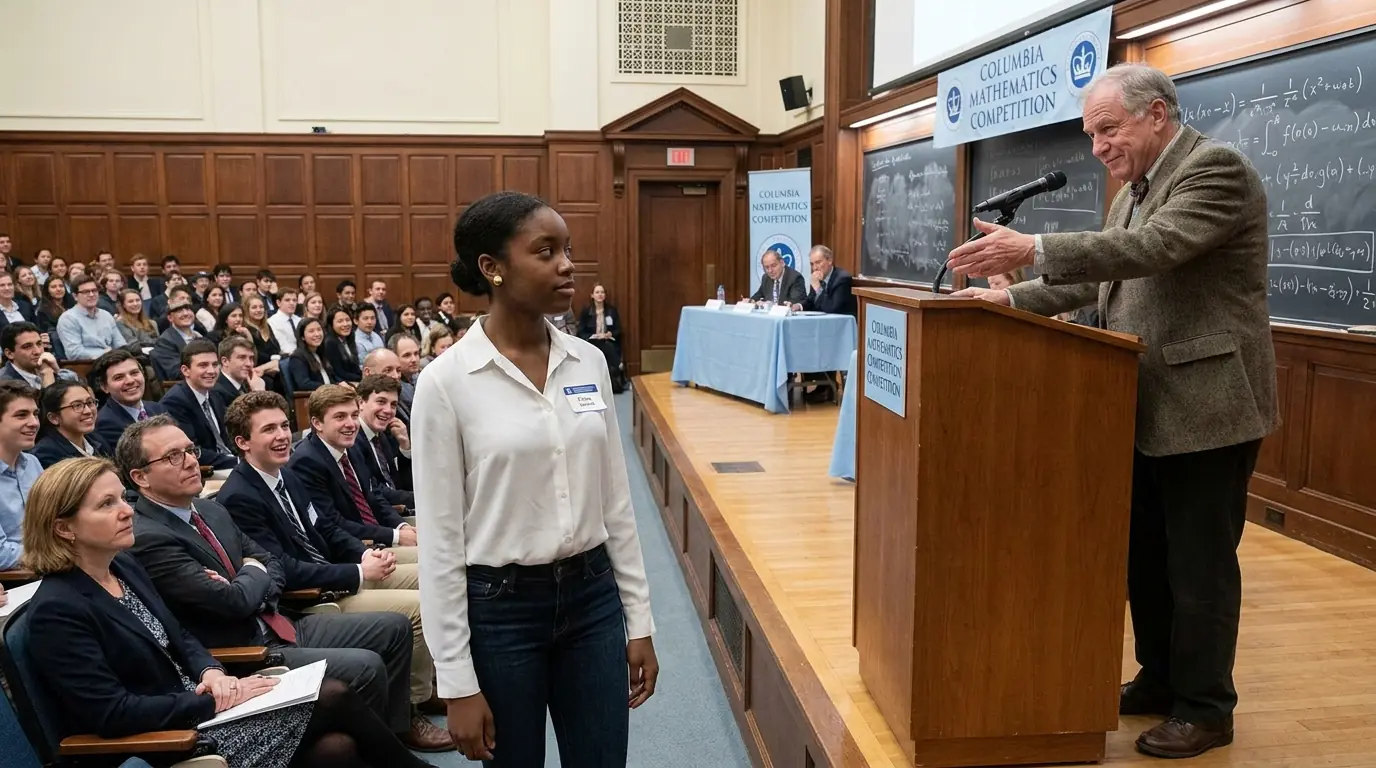
That got a big laugh. Whole room. Three hundred people cracking up like it was a comedy show, not a math competition at Columbia University.
Professor Gerald Whitfield stood at the podium. "I gave that same problem to my golden retriever once. Took him three minutes to walk away."
The room lost it.
Cora didn't flinch. She looked straight at him and said, "Are you done? Because I'd like to see the problem now."
Whitfield grinned. "Fine. Let's see how fast you quit."
She didn't quit. She made every single person who laughed that day choke on it, starting with him.
To understand what happened that day, you need to understand the room Cora Lawson walked into: The Whitfield-Sterling Open Mathematics Invitational, held every year at Columbia University in New York City. Nineteen years running. Founded, funded, and chaired by one man: Professor Gerald Whitfield.
This wasn't some local science fair. Past winners went on to MIT, Princeton, and Fields Medal shortlists. Winning this competition didn't just look good on a college application; it launched careers. It changed lives. And for nineteen straight years, Gerald Whitfield decided who got that chance.
The lecture hall seated three hundred. Mahogany walls, portraits of past winners lining the corridor outside—every single one white, every single one male, except for one woman added in 2018.
The judges sat elevated on a raised platform looking down at the contestants below. Five panelists, Whitfield in the center chair.
The audience was exactly what you'd expect: prep school kids in blazers, their parents in the third row already networking, private tutors standing in the back, arms crossed, scouting. A livestream running with a few hundred viewers. Press from two academic journals.
And then there was Cora.
Cora Lawson, sixteen years old, born and raised in Brownsville, Brooklyn—one of the toughest neighborhoods in New York City. She lived with her grandmother, Gloria Lawson, in a two-bedroom apartment on the fourth floor of a building where the elevator hadn't worked in three years.
Her school, Frederick Douglass High, had its math program cut two years ago. Budget problems. No advanced classes. No math team. No teacher qualified to read what Cora had been writing in her notebooks since she was thirteen.
Because here's the thing about Cora Lawson: she taught herself. Library books, free online lectures, YouTube videos at 2:00 in the morning on her grandmother's old tablet with a cracked screen. She studied number theory the way other kids studied video games: obsessively, joyfully, alone.
Her notebook—a $2 marble composition book from the bodega on the corner—was filled with original proofs. Not homework, not practice problems: original work. Theorems she built herself from scratch, in handwriting so small you'd need a magnifying glass to read it. No teacher had ever reviewed that notebook, because no teacher at her school could.
So how did she end up at Columbia?
Her brother, Derek, twenty-four years old, worked night shifts loading trucks at UPS so their grandmother wouldn't lose the apartment. Derek found the competition flyer crumpled up on a bulletin board at a community center in East New York. Entry was free, open to the public; any high school student could register.
He smoothed out that flyer, brought it home, and said, "You should do this."
Cora looked at him. "It's at Columbia."
"So?"
"So, I don't exactly fit the profile, Derek."
He didn't argue. He just said, "You fit the math."
That Saturday morning, Derek borrowed a car from his co-worker, drove Cora across the bridge into Manhattan, and dropped her off in front of a building that looked like it was designed to make people like them feel small.
Cora wore her best clothes: clean jeans, a pressed white blouse, her grandmother's good earrings—small gold studs that Gloria wore to church every Sunday for thirty years before she gave them to Cora and said, "You wear these when you need to remember who you are."
She arrived forty minutes early. She walked into the registration lobby alone. The volunteer at the check-in table looked at her school name, Frederick Douglass High, and asked twice if she was in the right building.
Cora said yes both times.
The volunteer shrugged and handed her a name badge.
When she entered the lecture hall and sat down, the seat next to her stayed empty. The whole row filled up on both sides, but that one seat, right next to Cora, stayed empty for the entire pre-competition briefing. Like there was an invisible wall around her.
Now, let me tell you about the man she was about to face.
Gerald Whitfield wasn't some fraud; that's what makes this story hurt. He was a real mathematician, published in the Annals of Mathematics, cited hundreds of times, tenured at Columbia for over twenty years. He had earned his authority the hard way, and he believed—truly believed—that talent came from a certain kind of background: certain schools, certain families, certain zip codes. He wasn't evil; he was worse than that. He was certain.
And his favorite student, the one everyone expected to win, was already seated in the front row: Harrison Moore, eighteen, Dalton Academy, two-time semifinalist. Whitfield had mentored him personally since he was fourteen. Harrison glanced at Cora once when she sat down. Then he looked away, the way you look past something that isn't worth noticing.
But Cora—she opened her notebook under the desk and looked at a proof she'd written back in February. Five months ago. Before she even knew this competition existed. She had been waiting for a room that could understand what was inside that notebook; she just didn't know the room would try this hard to keep her out.
The competition started at exactly 9:00 in the morning.
Whitfield stood at the podium, adjusted his microphone, and welcomed the room. Forty-two contestants, "the best young math minds in the tri-state area"—that's what he called them.
"This competition demands rigor," he said. "It demands discipline. It demands the kind of intellectual preparation that separates serious mathematicians from..." He paused, let his eyes drift across the room, and landed on Cora for exactly one second. "...hobbyists."
A few people in the audience smiled. They got the message.