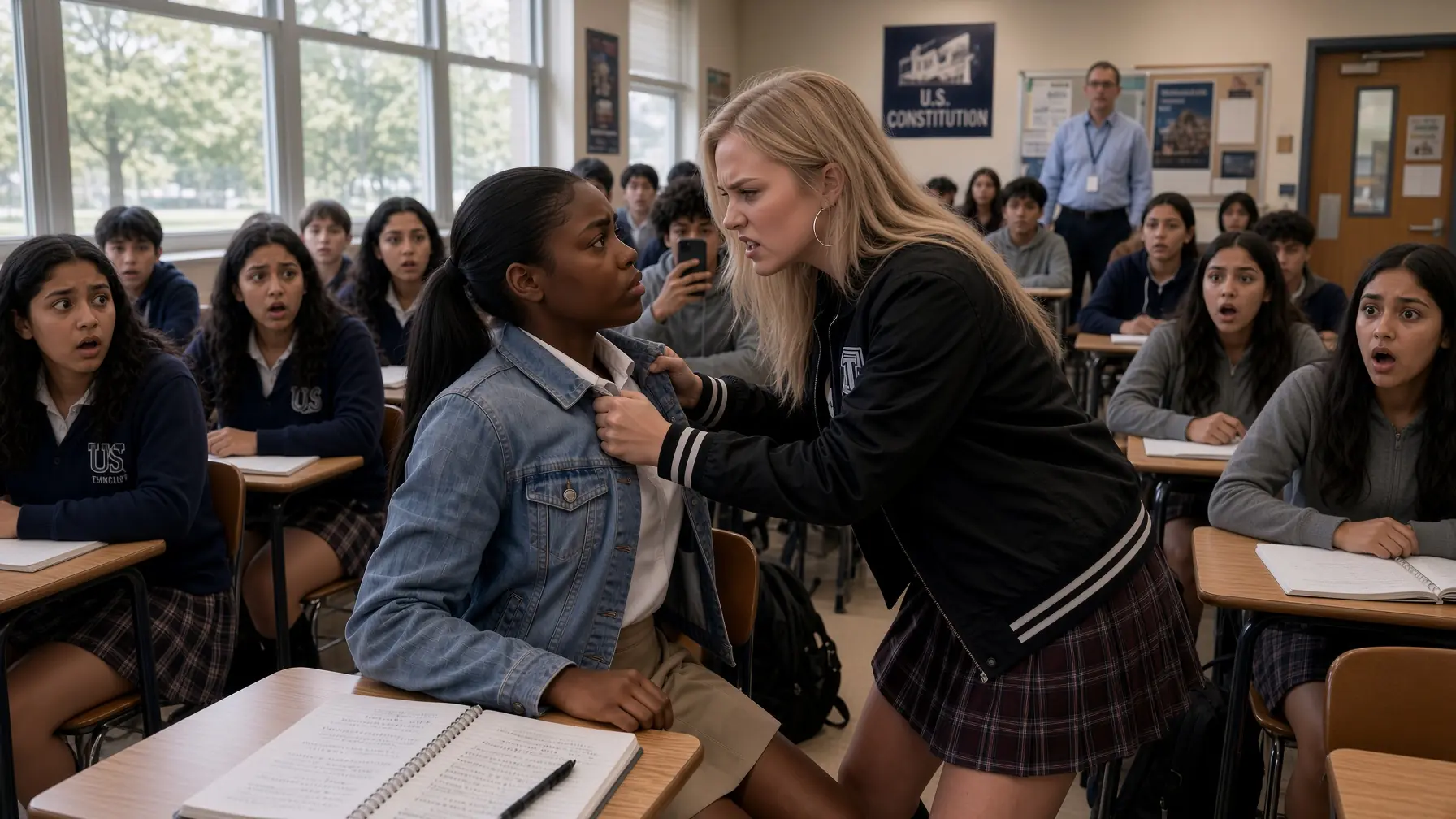
Avery Brooks knew Brooke Carlisle had stopped beside her desk before she ever lifted her eyes from the page. Twenty-seven students were supposed to be working silently on an assignment about civil rights and government accountability, yet the room had gone so quiet that Avery could hear the air conditioner clicking behind the ceiling panels. She kept writing anyway, one hand resting over the lower half of her notebook. By then, she had learned that silence usually arrived a few seconds before Brooke decided somebody needed to be reminded who mattered at Westbridge High.
“You really carry that thing everywhere?” Brooke asked.
Avery finished the sentence she was writing before looking up. Brooke stood over her in a white varsity jacket with forest-green lettering, spotless sneakers, and the relaxed confidence of a girl who had spent seventeen years watching adults move obstacles before she reached them. Her blonde hair was pulled into a smooth ponytail, and the expression on her face looked friendly until you noticed nobody else was smiling. Avery closed the notebook halfway.
“Apparently.”
Brooke placed her palm on it.
“I asked what you keep writing.”
Avery looked at Brooke’s hand.
“Move it.”
A boy near the back made a sound that might have been a laugh, then immediately coughed when Brooke turned toward him. Mr. Keller, their American Government teacher, glanced up from his laptop for less than a second before looking back down. Avery noticed that too. So did Brooke.
Brooke leaned closer.
“You came here two months ago and suddenly you think you can question everybody.”
“I ask questions in school.”
“Not those kinds.”
Avery finally looked directly at her.
“What kind?”
Brooke’s smile vanished.
“The kind that get my mother phone calls.”
Avery tilted her head slightly.
“Maybe your mother should worry less about who’s calling and more about why.”
The room changed.
Even Mr. Keller stopped typing.
Brooke stared at Avery for a long second, then slapped her palm harder against the notebook. “You think because you’re quiet, nobody knows what you’re doing.” Avery kept her voice level. “I think you’re touching something that doesn’t belong to you.”
Brooke bent lower.
“My family has done more for this school than yours ever will.”
Avery’s expression barely changed.
“That sounds expensive.”
A few students inhaled sharply.
Brooke grabbed the front of Avery’s faded black denim jacket and pulled.
The chair scraped against the tile.
Avery rose because the force left her little choice, but she kept both hands at her sides. She did not shove Brooke, grab her wrist, or give anyone an image that could later be edited into mutual blame. Instead, she looked at the fist twisted into the fabric near her collar.
“Let go.”
Brooke tightened her grip.
“Or what?”
Avery looked past her.
Four phones were already raised.
“Or tomorrow everybody gets to watch you explain why you were the first person who put hands on anybody.”
Brooke followed her eyes.
For the first time, uncertainty crossed her face.
She released the jacket.
But she did not step away.
“You should have left my brother alone,” she whispered.
The words were quiet.
Unfortunately for Brooke, the phone held three desks away was recording audio perfectly.
Avery studied her.
“What are you afraid I found about him?”
Brooke’s face changed.
Then Mr. Keller finally stood.
“Enough.”
He came between them with both palms raised.
“Both of you sit down.”
Avery looked at him.
“Both?”
Mr. Keller hesitated.
“Yes.”
Avery glanced around the classroom.
Everyone had watched Brooke walk over.
Everyone had watched her put a hand on Avery’s notebook.
Everyone had watched her drag Avery halfway out of her chair.
And everyone had watched their teacher wait until Avery was standing before deciding the situation required intervention.
Avery picked up her notebook.
“No.”
Mr. Keller blinked.
“What did you say?”
She slid the notebook into her backpack.
“You watched her grab me.”
“Avery, sit down.”
She pulled one strap over her shoulder.
“She already made me stand.”
Then Avery looked toward Brooke.
“I think I’ll stay that way.”
She walked out of Room 214 before anybody found a more respectable phrase for what had just happened.
By lunch, the video had traveled through nearly every student group chat at Westbridge High. By the end of the school day, parents were reposting it on Facebook and former students were identifying the Carlisle name in the comments. The fourteen-second clip showed a wealthy white senior pulling a quiet Black transfer student from her desk while a teacher hesitated several feet away. But the video was only the smallest visible part of a story that had begun nearly two years before Avery ever enrolled there.
That older story belonged to her brother.
His name was Marcus Brooks.
Before Westbridge High turned him into a warning, Marcus had been the kind of student administrators loved to photograph. He ran middle-distance track, tutored freshmen in algebra, volunteered at the county library on Saturdays, and spent two years in the school’s student technology fellowship helping staff maintain classroom computers. He had been accepted to Purdue’s engineering program before his eighteenth birthday.
Their mother, Renee Brooks, kept the acceptance letter taped to the refrigerator.
Marcus pretended it embarrassed him.
Everybody knew he checked it whenever he walked into the kitchen.
Six weeks before graduation, an administrator opened his locker and found a flash drive.
The school said it contained copied exams, teacher passwords, and screenshots from the district’s grade system. Marcus said he had never seen it before. Within forty-eight hours, the boy whose photograph had appeared in the district newsletter was being described as the student responsible for one of the most serious academic-security breaches in Westbridge history.
His Purdue admission was placed under review.
His scholarship disappeared.
He was removed from track.
Westbridge barred him from graduation while the district conducted what Principal Evelyn Ward repeatedly called “a comprehensive internal investigation.”
No police charges were filed.
At the time, Renee considered that mercy.
Marcus did too.
Years later, they would understand it differently.
If police had become involved, outside forensic investigators might have demanded access to the same computer systems Westbridge controlled.
Instead, everything remained inside the building.
The local newspaper ran Marcus’s school photograph under the headline STUDENT TECH AIDE LINKED TO GRADE SYSTEM BREACH. People who had once applauded him at track meets shared the article without reading beyond the first two paragraphs. Parents who had asked Marcus to repair their children’s laptops suddenly referred to him as “that hacker.”
Marcus finished high school through a district online program.
He never walked across a graduation stage.
Purdue moved on without him.
At twenty, he worked nights at a large medical-supply warehouse outside Dayton maintaining automated sorting equipment. He was good at the job, though nobody who knew him before Westbridge believed warehouse maintenance had ever been the future he imagined.
He rarely complained.
That worried Avery more than anger would have.
Marcus had learned to talk about the ruined year as if it had happened to somebody else.
Then, one Wednesday night in September, he came home with an envelope carrying the Westbridge School District seal.
Renee was halfway through a twelve-hour shift at Mercy Valley Medical Center, and Avery was at the kitchen table fighting with calculus homework. Marcus dropped his work bag beside the refrigerator and opened the door. Avery saw the envelope before he could push it farther inside the bag.
“What’s that?”
“Mail.”
“You’re holding it like it bites.”
Marcus sighed.
“Avery.”
She stood.
“Why is Westbridge sending you anything?”
He stared at her.
Then reluctantly placed the envelope on the table.
A technology company assisting the district with an archive migration had contacted him because an old student administrator profile under Marcus’s name still existed in historical system records. The vendor wanted confirmation that the account should be permanently disabled. Avery read the letter twice.
“You still had an administrator account?”
“Student tech account.”
“That’s not what Westbridge told everybody.”
Marcus took the letter back.
“That was almost two years ago.”
“That isn’t an answer.”
He opened the refrigerator and stared inside without taking anything.
Avery knew him well enough to understand avoidance.
“What did you see before they accused you?”
Marcus froze.
He closed the refrigerator slowly.
For several seconds, neither spoke.
Then he pulled out the chair opposite Avery and sat.
“When I worked tech support, we had limited administrative access,” he said. “Not enough to change major records, but enough to troubleshoot devices and help staff when the grade platform locked up.”
Avery nodded.
Marcus rubbed both palms together.
“About a month before everything happened, I noticed some audit records.”
“What records?”
“Manual overrides.”
Avery sat down.
“Grades?”
“Grades. Attendance. Discipline.”
He looked at the dark window.
“Some students had way more than everybody else.”
Avery already knew where the story was going.
“Who?”
Marcus did not answer.
She waited.
Then said the name herself.
“Grant Carlisle?”
Marcus nodded.
Grant was Brooke’s older brother.
Two years earlier, he had been Westbridge’s star quarterback, captain of the football team, all-state honorable mention, and the smiling face on nearly every promotional piece connected to the school’s athletic program. He had received recruiting interest from several major universities before committing to Notre Dame.
“I saw his chemistry grade change from sixty-eight to eighty-eight,” Marcus said.
Avery stared.
“One change?”
“Three classes.”
He leaned back.
“And twelve absences disappeared between October and December.”
“Who made the changes?”
“The account looked like it belonged to guidance.”
“Did you report it?”
Marcus laughed without humor.
“That was mistake number one.”
He brought the audit information to district technology director Paul Vance.
Vance told him student technology fellows were not authorized to examine administrative records.
Marcus explained he had discovered the overrides while troubleshooting legitimate access logs.
Vance ordered him to delete whatever copies he had made.
Marcus refused.
Two days later, Principal Ward summoned him to her office.
Paul Vance was there.
So was Elaine Carlisle.
At the time, Elaine Carlisle chaired the Westbridge Educational Foundation and oversaw millions of dollars in annual private donations. Her family’s name appeared above the football stadium entrance, the renovated science laboratory, two scholarship programs, and an athletic training facility completed the year Grant graduated. Marcus had never understood why another student’s mother was sitting in a meeting about his technology access.
Nobody explained.
“They asked if I copied confidential data,” Marcus told Avery.
“What did you say?”
“That I saved audit logs because the changes looked wrong.”
“What happened to the logs?”
Marcus looked at her.
“Gone the next morning.”
Avery felt a chill.
“From your account?”
“Everything.”
He leaned forward.
“Three days later, they searched my locker.”
Avery stared at him.
“You think they planted the flash drive.”
“I don’t think.”
Marcus’s voice became harder.
“I know.”
“Why didn’t you tell Mom all of this?”
“I did.”
Avery blinked.
“What?”
“Not every detail.”
He looked down.